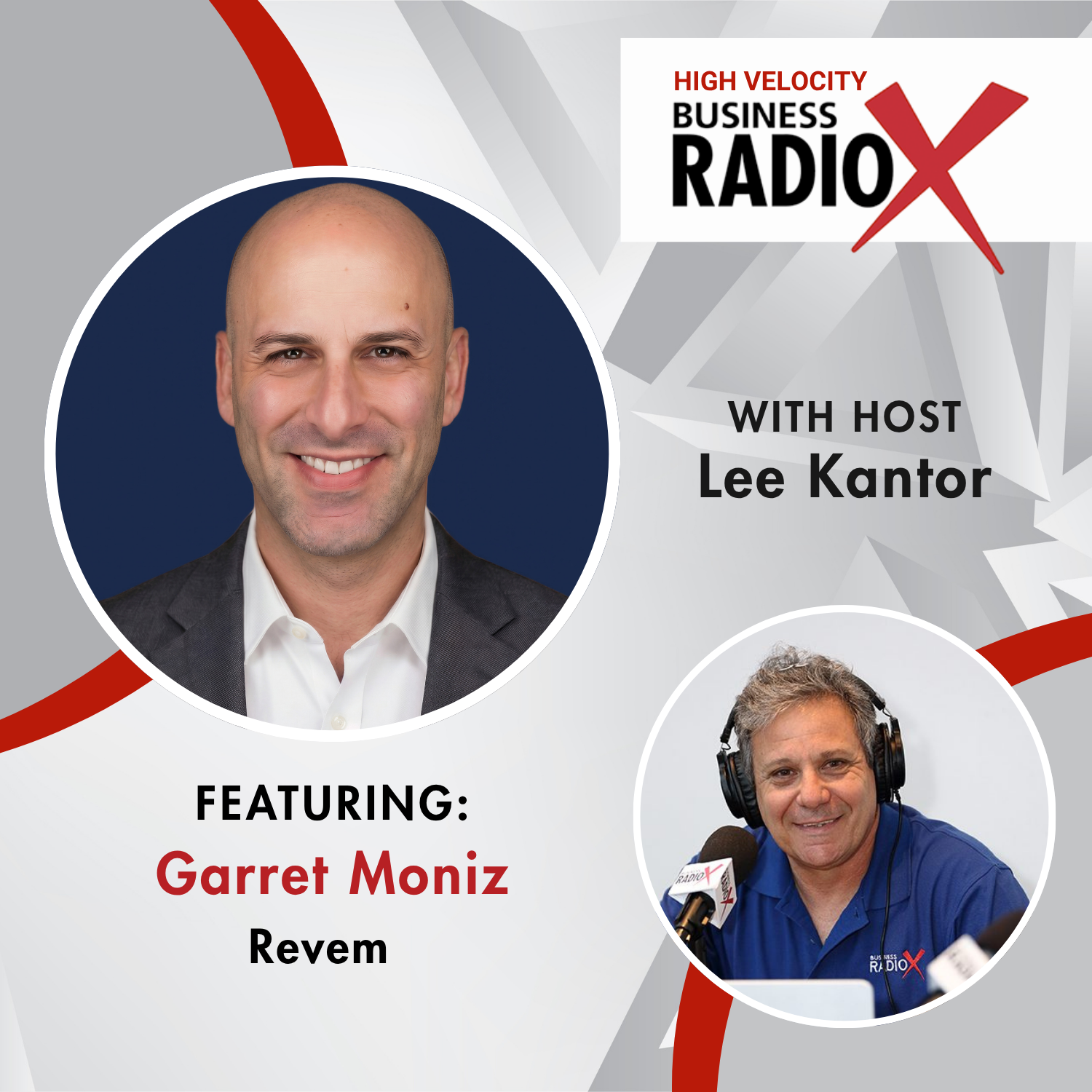

In this episode of High Velocity Radio, Lee Kantor interviews Garret Moniz, founder and leadership coach at Revem. Garret shares his personal journey from a stressed corporate leader who missed a key promotion to becoming a certified leadership coach. He explains how he helps leaders excel under pressure by developing authentic leadership styles rooted in core values. The conversation covers topics including emulating versus authentic leadership, navigating organizational culture fit, and knowing when to become a change agent.

 Garret Moniz spent almost two decades leading revenue teams, navigating the kind of pressure that comes with owning a number, managing people, and being accountable for outcomes at every level. Like many leaders, he believed the answer was to push harder. Until the cost of that approach became impossible to overlook.
That breaking point led Garret to discover a different way to lead. One built on clarity, awareness, and habits that allowed him to execute fully without burning out. The experience was so transformative that he built a business dedicated to bringing it to other leaders.
Today, Garret is the founder of Revem, an ICF certified executive coaching and leadership development practice committed to helping leaders build the skills, routines, and resilience to perform at their best without the cost that so many leaders quietly endure.
Connect with Garret on LinkedIn.
Episode Highlights
- Challenges faced by leaders in high-pressure and complex environments.
- The journey from corporate leadership to becoming a certified leadership coach.
- The importance of developing authentic leadership styles aligned with personal core values.
- Strategies for managing leadership pressure and stress.
- The significance of organizational culture fit and personal values in leadership.
- Coaching methods including one-on-one, team coaching, and cohort-based training.
- Common pain points and challenges faced by clients seeking coaching.
- The mix of clients from large enterprises to small businesses.
- The role of self-discovery and feedback in leadership development.
- Best practices for delivering effective coaching and leadership training.
 This transcript is machine transcribed by Sonix.
TRANSCRIPT
Intro: Broadcasting live from the Business RadioX Studios in Atlanta, Georgia. It’s time for High Velocity Radio.
Lee Kantor: Lee Kantor here. Another episode of High Velocity Radio and this is gonna be a good one. But before we get started, it’s important to recognize our sponsor, Business RadioX. If you’re a business coach who’s tired of being a best kept secret, set up a call with Stone Payton at bookstonephone dot com to unlock your perpetual prospect pipeline. Today on the show, we have the founder and a leadership coach with Garret Moniz. Welcome.
Garret Moniz: Thanks for having me. Excited to be here.
Lee Kantor: Well, I’m excited to learn about your practice. Tell us about Revem. How are you serving folks?
Garret Moniz: Yeah. So today leadership is harder than ever. There’s more pressure, more complexity, more uncertainty. And despite all of that, leaders are expected to show up to lead, to manage teams and to to meet different metrics and expectations. So I help leaders work through that. I help leaders and serve leaders that are looking to not just survive that environment, but to, but to be able to excel and to, to do well and to be able to continue to not only grow their, their leadership, but also help the folks that they work with. In addition to that, I work with HR leaders, led leaders, enablement leaders to also build programs for leaders within the organization as well.
Lee Kantor: So what’s your backstory? What makes you the right person to be doing this kind of work?
Garret Moniz: Yeah. So, you know, I’ve been a corporate leader my entire career in specifically in the revenue space. And, you know, a couple of years ago, we were coming off the tech that post Covid, sort of like perfect storm for, for the tech industry. There was a lot of macro struggles we were going through. There was this tension between remote work versus office work, you know, organizational uncertainty. There’s just a lot going on. And, you know, in addition to all the macro work, I missed out on a huge promotion that I had been working with, working towards for a really long time. You know, and the pressure for me as a leader back then wasn’t super dramatic, but it was something that just continued to ramp day in and day out for me. And, you know, it showed up as chest pressure. It showed up as just this need to work harder and harder. You know, that pressure would lessen on the on in nights and weekends, but, you know, never completely. It just it was just sort of continued to add up. And so, you know, part of what I bring to my practice and what I bring to my coaching is, you know, I’ve, I’ve lived that stress. I’ve lived the life of a stressful leader who didn’t quite know what to do, just felt like working harder to get ahead of the pressure and to get ahead of the expectations was, was the way to do it. And luckily for me, found a new way or found a better for me, at least a better way to lead. That didn’t come with all of that pressure and, and just difficulty and actually being able to show up well for my team.
Lee Kantor: So then, so you spun off onto your own practice.
Garret Moniz: Uh, so it wasn’t, yeah, it wasn’t quite maybe as dramatic as that for me. It was a, it was a longer process. So that all took place maybe about three years ago. I was fortunate that I got selected at the company I was at at the time. I was selected to sponsor this leadership development program. Uh, that was new to the organization. Um, it was run by this fantastic coach named Brian Newman. Uh, and so part of it was I got to participate in sponsor the leadership program. Uh, but part of that is I also got to work with Brian as, as one of his executive coaching clients. And so, uh, what transpired over the year that I worked with him was the opportunity to refine my leadership, uh, in some ways become a better leader for the folks that were, um, that were reporting to me at the time, uh, you know, working on things like vision setting, working on things like communication, uh, on executive presence on, you know, managing up and managing down, uh, managing across, you know, a whole bunch of skills that, that he and I worked on together. Uh, and then in addition to that part of that was also just how to, how to manage the pressure, how to show up every day and not let that pressure, uh, build.
Garret Moniz: And so what I started to develop really was my, my lifestyle as a leader. So what were the things, the practices, the habits, the routines, the, you know, in some ways, the mindset that I needed to, uh, needed to embody in order to be the kind of leader that I wanted to be. You know, I think one of the, probably the most important things he and I worked on in, in our coaching was, um, Because I had missed out on this big promotion, I felt like I needed to be like the leader that got that promotion, or I needed to be like the other leaders around me that, um, that just led in a different way than, than I did. And so, you know, part of the work was even just understanding how I showed up authentically and differently. And you know, what kind of leader I was, um, what sort of values I had, uh, that, that allowed me to lead the way that I did. So, you know, it was a long process of doing that. And along that, you know, along that process, I started to then really think about, you know, what it was that I wanted to do for my career long term. And one of the things that I had considered when I was going through this really stressful period was maybe I just needed time off.
Garret Moniz: Maybe I just needed to take a year off, take a sabbatical, really spend that time to reflect on, uh, you know, maybe, maybe this stressful environment just really wasn’t the right fit for me. Uh, and through my coaching with Brian, I was able to discover one. Not only could I manage the the stress and the pressure of that role, but also I started to then figure out like, what really was it that I wanted to do? What? What purpose did I want to serve? Uh, irregardless of, of what I was doing in that moment. And so it was in that coaching environment that I discovered, uh, that I wanted to be a coach myself. I wanted to bring this idea of being able to lead through pressure to other leaders. Uh, and so that was, that was actually about two years ago. So two years ago, I decided that and then spent the time going through getting my certification, deciding, uh, what types of clients I wanted to work with, deciding how I actually wanted to set up my practice. And so, uh, you know, this in some ways has been, has been a long time coming. And I’m really excited that it’s, that it’s finally here.
Lee Kantor: Now when you’re working with the leader, you brought something up that, um, kind of intrigued me a little bit. Uh, so you don’t get the, the role that you were going out, uh, trying out for. And then one of your first moves was to say, okay, how do I be, you know, like be, I don’t want to say behave, but maybe emulate how the person who got the role, maybe I should be doing more of whatever they’re doing. Is that a common kind of thought process that leaders, um, kind of go through instead of saying, okay, what makes me uniquely me? Let me lean into what my qualities are that make me who I am and, and how I engage with people rather than, okay, who’s ahead of me and let me be more like them because they’re ahead of me. They must have done something to get ahead of me, or what I perceive to be ahead of me. Like, is that kind of, um, it sounds like it feels to me like kind of that’s a, a push pull or a point of, inflection where you’re like, you don’t know how to get to the next level. So the best thing you do is emulate the person who you feel is at that next level. And sometimes when you’re doing that, you’re diluting what makes you, you.
Garret Moniz: I’ve noticed the same thing. And what’s interesting, uh, you know, whether it was me, whether it’s with my clients that I’m working with is there’s no, there’s no right answer to should you emulate a leader that you respect or maybe even don’t respect? And they’ve just gotten the things that you’ve wanted. Uh, or do you just stay true to yourself? And the answer I’ve always come back to it was true for me, and it’s true for my clients is it’s always a mix of both. There’s certainly things we can learn from other leaders. There’s certainly things that we can emulate. You know, there’s, there’s lots of leaders and mentors I’ve had in my life that, uh, you know, I continue to emulate or continue to go back to the lessons that I learned from them and apply them to my own leadership, while at the same time there is something that is unique about what I bring to the table. Or same thing with my clients. There’s always something unique about each of us that people are drawn to. If we allow it to flourish, if we allow it to, to in some ways unleash on the folks that we work with, the trick becomes, how do you tell? How do you tell the difference? How do you tell when it’s right to emulate another leader and learn from them? And how do you. And how can you tell when you’re just doing it? Because that’s what they did. And you think that that’s going to drive the results that you’re looking for. So I think it coaching becomes an interesting space in order to play with that of, uh, and, you know, some of it is like, you just got to practice.
Garret Moniz: You just got to try new things. You got to try what fits for you. While at the same time, you want to also build that foundation of what is unique about you. You know what? You know, what’s unique for me is, uh, you know, in some ways, my, my core values, my values are core values are joy, helpfulness, and creativity. So as I started to think about the my foundation of leadership, it’s those three things. And every decision I was making was determining whether that was in alignment with those values or out of alignment with those values. And in some ways gave me a compass to say, okay, am I still being true to my values? Now I can try it a different way as a, as a leader or, or yeah, maybe just take a look at that and say, you know what? That’s really not for me. That’s not how I lead. And so I’m going to lead in a way that’s more authentic to me. So I think it’s, I think it’s a really great point to for anybody that’s trying to decide how they want to improve as a leader is at the end of the day, you kind of have to pick a mix of both and decide what is it you’re going to take from others and put it in your own tool belt, and then what are you just going to continue to lean on that’s really authentic to your foundation as a leader?
Lee Kantor: And I think that some of the pressure they. The person would feel is if there may be at an organization or an environment that is kind of forcing them to maybe be incongruent that like, say, like you’re saying that joy and creativity are important to you. And if you’re working in an organization where that’s not important to them, that might be a signal that maybe I should be going somewhere else, that maybe I can’t force fit myself in this specific environment, that I have to find my people wherever they are, instead of forcing myself to mold into this situation.
Garret Moniz: Exactly. Yeah. It’s part of it is owning at the end of the day, you have to own what you’re best at, what your strengths are, what your blind spots are. And maybe the organization you’re in isn’t isn’t the right organization for that. And I think that’s a, that’s a great outcome of coaching, uh, for you to be able to recognize that this just isn’t the right place for me to flourish and how I want to flourish, while at the same time, it could also be a great opportunity to to decide like, maybe this organization needs more of these values, and I’m just going to be strong and prepared as a leader to know that the values I bring to the table aren’t congruent or don’t align necessarily with the organization. And maybe I’m just going to take my best chance to see can can actually bring more of those values into my day to day interactions. Um, and yeah, you can try both. And, and at the end of the day, uh, we all can decide whether we are up for that challenge of bringing it into a new organization or to your point, go, go find an organization where those values are going to be, uh, not only, uh, respected and appreciated, but in some ways probably, uh, you know, given the opportunity for those values to flourish.
Lee Kantor: Right? And if you are going to, you know, kind of, I don’t want to say be a contrarian, but kind of say, okay, I’m going to try to make the change that I think is important here, that at least go in eyes wide open so you don’t have some of that physical, um, the feelings and the, uh, physical change in your body and your stress levels and your health, maybe of just kind of fighting every day is a battle. Just go in eyes wide open that say, hey, I’m trying to be a force for change here. And, um, I’m not going to let the stress or the, um, you know, the way I’m being perceived impact me physically because this is what I believe. I believe this to be right. And I understand that I’m the one out of step with how the organization is going. Like at least go in eyes wide open.
Garret Moniz: And prepare so you can prepare yourself knowing, uh, and just set up, set up practices or set up ways to make sure that you continue to refresh those values or refresh yourself physically, mentally, emotionally, uh, so that you’re prepared for that pushback. Uh, and yeah, in some ways, you might be surprised that by, by sticking to your values or sticking to what makes you a really great leader, that in and of itself can relieve a lot of the pressure. That was at least my experience and experience of a lot of the, uh, a lot of the clients I work with is at the end of the day, the job didn’t change. We changed or, or we reframed what it was we were there for. And that allowed us to then excel and continue to, or maybe even overperform in a different way, because we were just more aware of what our strengths were and just and just owned it. And, uh, to your point, we just had our eyes wide open and were prepared for when there was that tension. And we had created practices and ways in order to, to handle that.
Lee Kantor: Right. And then you can be the change agent you’re trying to be.
Garret Moniz: Yeah, yeah, yeah. And then at the, again, the best story I can come back to is my own. By the time I was ready to leave that corporate environment, um, people really respected the values that I had. People, uh, were really drawn to the leadership and the things that I was doing. Uh, you know, I even left behind the opportunity for a really large promotion in order to, uh, go down this, go down this path. Coincidentally, the same promotion I had, I had lost out on a couple of years ago. And so, you know, part of it is, uh, you know, just believing in yourself and believing in what you bring to the table. And sometimes that actually creates the, creates the change within the organization that you’re hoping for. Uh, just by showing up as, as a real authentic leader.
Lee Kantor: So now let’s kind of dig into Revem a little bit is Revem is that I’m sure that name was chosen intentionally. Is the rev like the energy, uh, energizing or is rev revenue like what is kind of the meaning behind the name?
Garret Moniz: Yeah. So it’s meant in some ways to mean all of those things. Uh, yeah. I like the idea of, of, of, uh, you know, rev of like a rev up, uh, you know, energy and excitement. Um, but actually the, the origin behind the name is those are actually my kid’s initials. So I have two daughters. Uh, I’m not going to say their names, but their initials are REVE and then our last name Moniz. So it’s actually, it’s actually a family, uh, you know, a family name with at the same time, it just felt like it had a good, a good coaching, uh, a good coaching ring to it.
Lee Kantor: Now is the, what is kind of the pain that your clients right now are feeling right before they connect with you and do a discovery call and have those first conversations? Are they going through some sort of transition or burnout? Like what is going on in their lives where they’re like, you know what, I better get in touch with Garret.
Garret Moniz: Most of my clients are the ones that look back over the past few years. They’ve done really well. They’ve achieved. And one of two things is happening. One, there’s been some sort of interruption in that ability to achieve. So maybe it’s they lost out on a promotion. Uh, maybe it’s they some, some people, they’ve, they’ve lost their jobs due to layoffs or due to, due to some other circumstances. Um, you know, maybe it’s, they thought their career was going in one direction and they’ve just sort of hit this point where it just isn’t making sense as much anymore. And so they’re just looking for a partner to, to examine what they’re best at, what their values are, what, what it is that they bring to the table, and to help them understand what’s best for them in terms of next steps. So that’s, that’s one group of folks. Uh, the other group of folks I work with as well are the folks that look back over the last two years and they just noticed this trend of just an increase in pressure, an increase in pressure, an increase in complexity. Their job has just continued to get harder and harder. And they’ve reached this point where they don’t think they can just continue to work harder in order to keep up with that pressure and complexity.
Garret Moniz: And so I also work with leaders that are looking for a way to continue to excel, to continue to rise above the pressure and do well for their team or do well for their organization. But they’ve just reached this point where there’s only so many hours in the day, there’s only so much of them that they can give. What else is it that they could do in order to continue to, to lead at this elite level, but not do it at the same pace, or maybe even a harder pace than they’re at right now. And so those those are the two groups of clients that, yeah, if you’re listening to this right now and you’re thinking like, gosh, I just don’t think I could work any harder, but I want to continue to do well. That’s a perfect time to reach out. Meet with me, meet with other coaches, and see what sorts of changes you can make to your leadership that will help you continue to perform without it just being. I’m just going to put in more hours. I’m just going to put in more time.
Lee Kantor: Now, are these folks in kind of enterprise level organizations or are they entrepreneurs? Are they C-suite or are they, um, you know, high potentials, like kind of aspiring C-suite?
Garret Moniz: Yeah. So I work with leaders at, uh, all types of organizations, uh, some of the largest companies in the world where those leaders are not just navigating the pressures of the job, but also pretty big political, bureaucratic, uh, organizations. And as a leader, politics is just another skill you need to build. And so I’ve worked with leaders at all levels at organizations like that, and then also leaders at small and medium businesses as well. You know, those leaders in particular have a lot on their plates, are wearing a lot of hats. And in addition, often are working with potentially the founders of the company and some of the tension that can come up in those situations. And so, yeah, I’ve been fortunate that, you know, it’s really anybody that has a leadership position that’s under a ton of pressure and is looking to figure out how to how to continue to excel in that environment.
Lee Kantor: Now, is there a story you can share that maybe illustrates how you work with somebody, don’t name their name, but maybe share the challenge they came to you with and how you were able to help them get to a new level.
Garret Moniz: Yeah. So, you know, if I, if I think back, uh, on, on, um, you know, a particular client, this individual, uh, had been working there as a leader and were working, had been working for their leader for what felt like ten, 15 years. It was, it was a really long relationship, followed them through multiple companies. Uh, and so there was this interesting tension between, uh, a loyalty to this, this leader above them, and then also how they wanted to show up as a leader themselves. And so they had reached this point where, uh, there was an incongruence between the values of the leader they worked for and the type of leader that they wanted to be. And so we went through, uh, the reverend process together. Uh, we focused first on more of a self-discovery of what are this leader’s strengths? What are their core values? Uh, we did some assessments. We got some feedback from their team members. Uh, we got some feedback from the boss that there was some tension with, and it created this great picture of, uh, what, how this leader was experienced by others as well as what was it that made this leader unique, their strengths, their values, that sort of stuff. Uh, and then what we then did as as part of the process from there is using that as a foundation, uh, over months and weeks and months of the engagement. We then use that to then look at different issues and problems that were coming up. A lot of it was due to the tension with the, the leader that they worked for, but some of that was just tension that they were feeling with, with the individuals on their team.
Garret Moniz: And so on a bi weekly basis, we would get together, we would discuss what they learned over the course of the week. We would also co-create different practices or different, um, uh, you know, different methodologies or things that they could think about, uh, in order to help bring their values and bring their strengths more to the forefront. Uh, and then ultimately, uh, what we, what we worked on is also how to create some space between them and that leader so that this leader in particular could, could flourish. And so over the course of, of that time frame, uh, they really developed a really good, uh, really strong style in terms of what was important to them. Uh, they understood where that tension was between the leader and them. Um, and they, they continued to stay up until this point there. As far as I’m aware, they’re still at that organization. Uh, and again, it wasn’t really that the job changed. It wasn’t even that they were looking to change jobs. They were just looking to really have some confidence around how they showed up as leader versus how, uh, their, their leader that they reported to showed up, uh, and just by working through some awareness and then actually practicing that in, uh, coming up with different strategies in order to handle that tension. Uh, they’ve just shown up as a much better leader, uh, since then. Um, you know, and obviously my hope is, is that there’s, there’s great things ahead of them now that they can just be a little more confident in their ability as, as a leader.
Lee Kantor: Now, how do you typically deliver your coaching? Is it like one on one? Do you do group? Do you have cohorts? Uh, do you do, you know, do organizations bring you in to do kind of group things like, how does it work?
Garret Moniz: Yeah, it’s a little bit of everything. So, um, there’s one on one coaching where I would engage with a leader directly. Uh, also a majority of my career was, uh, second, second line leadership. And so I actually have a ton of personal experience coaching and managing teams, not just individuals. And so, uh, I can also offer or also offer, uh, team coaching and team workshops where, you know, maybe there’s a particular skill or maybe there’s some resilience, uh, that you want to build as a leader for your whole team. And so I can also assist leaders with that. Uh, and then also the coach, Brian Newman that I had worked with, uh, I’m also partnering with him, uh, around delivering this cohort style leadership training to other, uh, corporate clients, uh, across the industry. So, uh, it’s been a really nice mix of individual team and cohort based work. Um, that, uh, that yeah, it’s been, it’s been a really nice mix, uh, to be able to deliver and, and serve and help people in multiple different ways.
Lee Kantor: Now, is there any advice you can give that leader, um, who’s maybe considering putting together one of those cohorts or team coaching? Like what’s, uh, some do’s and don’ts when you’re implementing some of that kind of training?
Garret Moniz: Yeah, I would say, you know, from a dues perspective, a lot of it is around expectations, setting expectations with the team, uh, understanding expectations, you know, especially at a big corporation, there’s a lot of pressure to deliver on ROI to make sure you can understand the impact of spending this, spending this money. And then what sort of impact is that going to drive? And it’s always better to do that upfront and to make sure everybody who’s on board, stakeholders, uh, the people on the team, the leaders who are going to go through that, making sure everybody really understands what this is driving, what what business problem are we trying to solve or trying to, uh, you know, attach, attach this program to. And so a lot of that work up front is, is really important. Um, and then I’d say that the don’ts, uh, you know, a really big don’t is like, is, uh, don’t, uh, maybe this is a double negative, but like, don’t not keep people involved. Um, making sure that even though you launched this program, it can’t just be a one time thing, you know, changing is like breathing. Sometimes you expand and you have these big changes and then sometimes you need to contract in, in, uh, you know, let, let some time go. And so a great cohort is one that has plenty of space for both expansion and contraction. And you need to, you need to plan that ahead of time.
Lee Kantor: So if somebody wants to learn more, have more substantive conversation, what’s the website? What’s the best way to connect?
Garret Moniz: Best way to connect? If you head to my website, uh.com, I’ve got a link right there where you can book a free consultation. Uh, I’ll spend an hour with you, understanding what you’re looking to accomplish, whether it’s for you or for your organization. Uh, and we can work together to figure out what the best offering for that would be. Uh, I’m also pretty active on LinkedIn, so you can also find me on LinkedIn and reach out to me there. Uh, and, you know, looking forward to, for those of the folks listening today, uh, you know, happy to spend the time and really figure out where I can best help.
Lee Kantor: And that’s revenco.com. It’s a website.
Garret Moniz: That’s correct.
Lee Kantor: Well, Garret, thank you so much for sharing your story today. You’re doing such important work and we appreciate you.
Garret Moniz: Lee, thanks so much for having me today. This was great. Appreciate it.
Lee Kantor: All right. This Lee Kantor we’ll see you all next time on High Velocity Radio.















