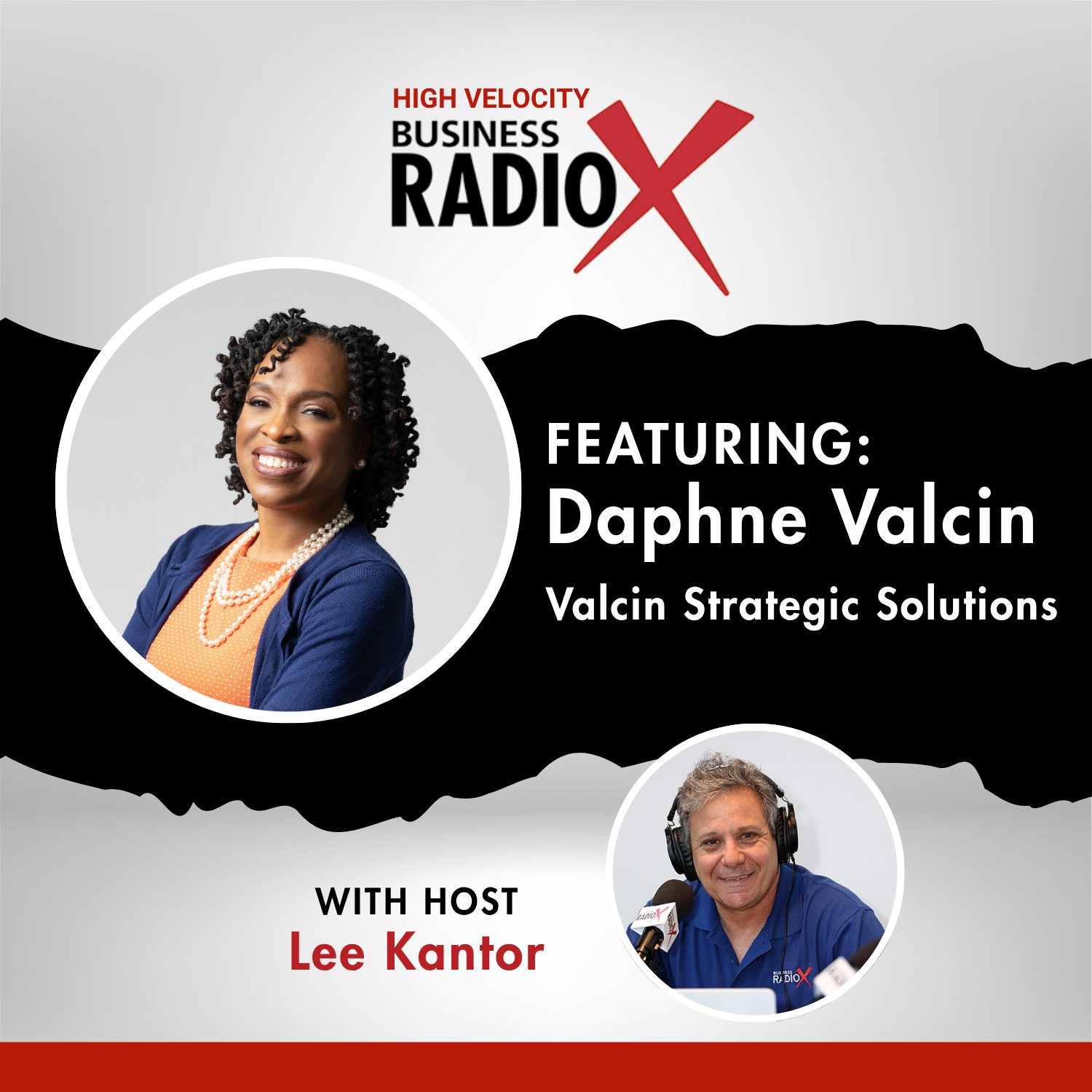

In this episode of High Velocity Radio, Lee Kantor is joined by Daphne Valcin, CEO of Valcin Strategic Solutions. Daphne shares her journey from public relations and education to entrepreneurship, and discusses her work coaching high-potential leaders to increase their influence. She offers insights on leadership development, career advancement, and building strong teams, emphasizing the importance of clarity, alignment, and self-promotion. The conversation also covers work-life balance, the value of volunteer leadership, and practical strategies for professional growth, making this episode a valuable resource for aspiring leaders and professionals.
 Daphne Valcin, is a certified coach, speaker, and trainer focusing on career advancement and business growth who has been featured in Forbes.com and Voyage Magazine. She has coached over 400 clients across 20 states and 4 countries since 2014.
Her clients have represented Fortune 50 and Fortune 500 companies including UnitedHealthcare, Lockheed Martin Corporation, UPS, and JPMorgan Chase & Co. and social change organizations including Higher Achievement, Boys & Girls Clubs of America, and KIPP Public Charter Schools.
Her clients have landed dream roles, enhanced strategic relationships, increased productivity, and have had salary increases as high as 20%, 40%, and 105%.
Connect with Daphne on LinkedIn, Facebook and Twitter.
What You’ll Learn in This Episode
- Productivity hacks for transformation and balance in her life, work, and business
- Top 3 strategies leaders can do to optimize their time
 This transcript is machine transcribed by Sonix.
TRANSCRIPT
Intro: Broadcasting live from the Business RadioX studios in Atlanta, Georgia. It’s time for High Velocity Radio.
Lee Kantor: Lee Kantor hear another episode of High Velocity Radio and this is going to be a good one. Today on the show, we have Daphne Valcin and she is the CEO of Valcin Strategic Solutions. Welcome.
Daphne Valcin: Hey. Glad to be here.
Lee Kantor: Well, I am excited to learn what you’re up to. Tell us about your firm. How you serving folks?
Daphne Valcin: Sure. So we are a boutique strategic consulting firm that helps leaders, especially high potential leaders, to increase their influence and their impact up, down and across their organizations, especially when it comes to communications, confidence, conflict, and connection.
Lee Kantor: So what’s your backstory? How did you get involved in this line of work?
Daphne Valcin: Great question. My undergraduate degree was in public relations. My master’s is in education. So what I realized throughout the years was the through line of the work that I did was tapping into the potential of people and their ideas. I’ve always been really creative. So I was a child doing paper mache for fun at home and writing stories and writing songs. And the way that that translated as I got older was I was the person who was the problem solver, who led a lot of different initiatives, whether in the community or even in undergrad. Um, and so in 2014, 2013, actually, I met my husband, I was about to get my MBA, and I wanted to work at a consulting firm. I already knew which one. And when I met my husband, my plans changed and I decided to do something different that I thought would grow really well with a family and that was coaching. So I launched my business in 2014, and since then have added training assessments in addition to the training in addition to the coaching, and that we do as well.
Lee Kantor: So do you like being an entrepreneur more than you like kind of working in a larger organization?
Daphne Valcin: I would say yes. And what I realized was a lot of the jobs that I had before, this allowed me to be very flexible and free in the way that I did things. For example, when I was the director of Community mobilization for an organization, we were work from home. My boss didn’t think that we needed offices, and that was in 2008. So way before that was a cool thing, he said. As long as we got the work done, we would go meet in the office once every two weeks. And so I feel like I’ve been entrepreneurial in organizations. I’ve been doing entrepreneurial things within organizations. I didn’t think I would be an entrepreneur, but now that I am, I really do enjoy the flexibility, the creativity that it takes to be an entrepreneur.
Lee Kantor: Now on the clients you work with now, do they have is there any kind of thread that ties them all together, or is it? Certain industries or certain types of businesses?
Daphne Valcin: So with the I have about 21 on one clients on average. I’ve had 400 since I started my business, over 400. And then I have around 2 or 3 speaking engagements or trainings per month. I’ve had over 200 of those since I started in 2014. When it comes to the sectors, they’re everywhere. Oil and gas, health care, education, marketing, advertising, all those things. But when it comes to the one on one client specifically, I do feel like people who are attracted to my organization have a heart for social impact, even if they work at a fortune 500 company has. That’s not really you wouldn’t put it. You wouldn’t label it as a nonprofit or social change organization. I noticed that the people who come to me individually have a heart for social change, and that could be because of my own background and also having a heart for social change.
Lee Kantor: So what is kind of the problem they’re having right before they call you. Are they kind of stuck or are they frustrated? Like what is happening in their world where they’re like, you know what, I need some fresh eyes on this. I need some help.
Daphne Valcin: Yes. So with the one on one coaching clients, I have a framework that I created to answer this question called the case framework. So usually people are looking for the C clarity when it comes to what’s next for how they’re approaching a role that they’re in, or what’s next for them within an organization or even externally that A is alignment. So maybe someone knows what they need to do. Maybe they’re like, man, I really need to increase my confidence, um, as a senior leader within my organization. But something’s just not clicking for me. It’s not happening and I’m not sure why. So that’s the alignment. The S is for strategy. So maybe they’re like, I know what I need to do, I want to do it, but I have no idea where to start. And I don’t know how to continue, uh, progress. And the thing that I’m trying to do, um, and then the E is for execution Or I’d like to also call it executive routines. So what are you doing on a regular basis in order to make sure that you’re continuously implementing those things that are most important for whatever it is that you’re trying to do. So that case framework applies. And then when it comes to organizations, sometimes they’re seeing that there are high potential leaders, but they don’t have the capacity to be able to hone their leadership development skills. Sometimes they’re seeing that the organization is not being as productive as they can and reaching their objectives, and are not really sure. Maybe they realize that their employees and leaders could benefit from understanding each other’s personality, styles, and working styles in order to work more effectively. So those are some of the things that I tend to see as reasons why people come and utilize my services.
Lee Kantor: When you’re working with individuals. Is it ever a case where maybe they didn’t get a promotion, or they’re at a level they think they should either move on or they’re having difficulty kind of moving up? And you help them with strategies to kind of get to those new levels.
Daphne Valcin: Yes. So my clients, um, and internally within their organizations and externally have had salary increases as high as 20%, 65%, 85%, 100%, and even as high as 105%. And that was someone who, internally within their organization, um, was able to move up multiple bands. So when I say bands, I mean that person could have just moved up one leadership level, right? Or two. But in that case, they moved up five different levels up in leadership and and specifically just the listeners get, you know, get some some juicy things from here, from from our conversation today, they were able to do that through strategically networking internally within the organization with individuals who are at higher levels. And us thinking about what do you say in order to really form a connection with someone, where they understand who you are and what you can bring to the table? So when opportunities come that they look at you as a prospective candidate.
Lee Kantor: And I think this is an area in coaching that a lot of people don’t either understand they’re not aware of, or they don’t appreciate how to navigate an organization is a skill. And you you can’t just hope for it to happen. You have to be proactive and really kind of design the path for yourself and execute some things along the way. And I would think that somebody like you or a coach with kind of fresh eyes on it, can really help a person, uh, you know, change the trajectory of their career.
Daphne Valcin: I agree, and I wish we would have learned that in college. So so one of my clients, um, when I worked with I worked with MIT and their college of business, and, um, one of the, the, the people who was in that presentation shared that there’s now a class at MIT in the School of Business about how to navigate power dynamics in the workplace. I had no idea how to do that, so I graduated. I was most likely to succeed, um, when I was in high school and then in college, I spoke at my college graduation. I had a 5.15 GPA graduating from high school, and I realized when I graduated from college, I had no idea how to navigate workplace politics. Zero idea. I thought everyone was just going to be nice, um, and promote me when I did good work and pay me what was, you know, it would be great for me to be paid. Um, but I had no idea that you had to really be strategic around your relationships or even just understanding the culture of your workplace and how you fit in that culture.
Lee Kantor: So is there any advice or tips you can share for listeners, like if they want? Is there some easy, low hanging fruit things they can be doing? Because a lot of times, sometimes it just comes down to just do the thing. Whatever the thing is, just do the thing relentlessly, and then you’re going to be kind of seen, heard, appreciated and get to those new levels. But a lot of people don’t want to do the thing.
Daphne Valcin: Yeah. That’s true. Um, I think there are so many different things, but I’ll share this, um, nugget that I’ve been sharing on some of the interviews I’ve been doing lately. And it is know what your essential three are. I call it your essential three. So your three words, what are three specific words that describe who you want to exude at all times in your networking, and you’re connecting to different individuals. Think about who you are at your best. For example, for me it’s inspiring. Energized. Um, and a guide. So like a mentor being resourceful, I know that I’m at my best when I’m coming off that way. Right. And so for what you said, we’re doing the thing. One of my core values is excellence. So in every position that I had a number of them, I got promoted. And then I would say all of them, I had some high level of respect by at least some of my peers or managers, because excellence is important to me. Right. So I want you to think, if think, if you’re listening to this, what are those three words that embody who you are that you want to exude at all times, and then making sure you’re aligned with that? The second part of your essential three are knowing your three wins. So what are some of your three biggest achievements maybe currently this week? What’s happening that are three of your biggest achievements overall in your work? What are those three biggest achievements? And the way this shows up is if you’re having a conversation with a mentor, with a colleague who maybe is a decision maker and they say, well, how are things going? Instead of you saying, oh, busy as usual.
Daphne Valcin: If it is a mentor or someone who can provide you with an opportunity, you can say, hey, well, Lisa, we just finished closing out our Q3 objectives review and I’m so excited that I really I surpassed metrics. Um, and by 20% when it comes to the sales that we closed in this quarter. So things are busy, but they’re good busy. And I’m so excited that they are so, so basically, knowing those wins allows you to integrate them more into conversations and be intentional before you walk into somebody’s office about what are some things that they should know about your work, right? So they can say your names, your name and the rooms, uh, that you want them to say your name in. And then the last thing is knowing your three goals. So what are the goals that you have? And this could be in general in your work, in your professional life. Um, what are your three goals you have right now? Because maybe you need to be sharing those goals with the right people who you can trust, who can help you to attain those goals. Or maybe that means that it allows you to prioritize better. So it’s your essential three. Three words. Three wins and three goals.
Lee Kantor: Yeah. And you can’t assume that people know what you’ve done or are doing. You have to kind of be your own promoter and remind people of what you’ve been doing.
Daphne Valcin: It is so important. It can really open up doors to to really great opportunities.
Lee Kantor: Yeah, I think a lot of people just either they think it’s too kind of self-promotion or something, where it’s in their best interest to remind people of what you’ve done, because don’t assume they know what you’ve done.
Daphne Valcin: Yes. And if you’re someone who’s like, well, I don’t want anything from anybody, I just want to give. I just want to be the best I can be. That’s great. And if you can share your wins even with your mentees. So with colleagues, um, who you don’t even know that they might be looking up to you, that might also inspire them to be able to do great work or inspire them to be better, um, or help them to be able to tell you where they can help you as well. So it’s not just about you trying to get something from someone. It’s also about the way that you give and you serve by telling your story.
Lee Kantor: Yeah, I think a lot of people don’t do that enough. I mean, is there any other kind of mistakes you see kind of leaders making when it comes to kind of their career growth or what it could be based instead of what it is.
Daphne Valcin: Yeah, I think fear comes in a lot, and that it doesn’t matter if someone is a first time manager or a C-suite executive. I’ve worked with individuals throughout that whole, um, journey. Uh, and I see that people can be very afraid of taking the next step towards whatever it is that they desire. More of the next step could mean, I want to speak up more at my meetings. Right. And so people could be afraid of that. Or the next step could be, I really want this higher level position within my organization. Or even you’re a senior VP and you want a C-suite role, um, being able to take the next steps to be able to make that happen, even as there’s uncertainty and different things going on in organizations, doing it with the right timing, but not being afraid of going for it. I think of something that I see show up at all levels with individuals that I’m serving.
Lee Kantor: Now as your kind of entrepreneurial venture grew over the years. How did you kind of assemble the team that you have now? Like, how do you find these kind of a players in order to build, uh, kind of the organization out the way you’ve done?
Daphne Valcin: Yes, I love a players. And part of why I love a players is because they’re just so much easier to work with. Um, so here’s what I, here’s what I, what I’ve done and what I’ve also advised others to do. I observe people before I even invite them to be a part of my team. I am in associations with them. I am in meetings with them. I maybe have interacted with them, uh, in different other activities that I’ve done, different initiatives. And I observe what is their response? Responsiveness? What are what are they saying that people say about their work? Uh, maybe I’ve had the opportunity to work with them. Are they producing an excellence on an ongoing fashion? If there’s someone who’s new, That’s in my space. I’ve been able to do trial runs to say, hey, let’s have a conversation about you possibly supporting me. Let’s work on one project together and see how things go. And then let’s come back together after that project to discuss if it’s a good fit for both of us. Um, but a lot of the the the reason why I have a team I have today is from its years of observing how people are acting within. It could be a Facebook group, mutual training program, just different places. Because for me, it’s important that anybody on my team, um, is exuding excellence and serving clients well and that I don’t have to be, you know, let’s say, recording all of their calls and listening to all those calls in order to make sure that people are serving individuals. Well, when it comes to coaching, or I don’t have to be in the room if they’re facilitating the training, um, to know that that training is going well. So, um, so observing and then also giving people a trial run, I think those are kind of my top two methods of making sure I have a great team.
Lee Kantor: Yeah, and I think that’s great advice for young people listening is that join those associations, take leadership roles, demonstrate what you can do because you don’t know who’s watching.
Daphne Valcin: Yeah, exactly. And I think of even radio. So when I was in undergrad, I met this gentleman. I was on a campaign, so I was working a campaign for a county court judge. Even I was an undergrad, and I was just being myself and trying to do things in excellence. And I got an internship at a record company, um, that would allow me to contribute to, um, just checking out new artists. Um, and I think they had a radio station, too, and they were managing new artists. It was really cool, but it was being in the room doing something I wasn’t even getting paid for. Right. Working on this campaign to contribute my skills and public relations, doing a good job and then getting in front of an opportunity that I had no idea that I would have at that time.
Lee Kantor: Right? But there are so many young people, especially, that are like, I’m not going to join that or volunteer. You know, I got enough. You know, they don’t see the opportunity because there’s not a lot of places a young person has to demonstrate leadership. And those kind of groups are those places.
Daphne Valcin: I’m with you on that, I agree now.
Lee Kantor: Um, do you do you find that the leadership today, they have a difficult time kind of, uh, creating that harmony between their personal life, their professional life. Like, it seems like the the lines are blurred with everything, especially with all the remote work where it’s hard to kind of say, okay, this is my time, where I’m going to recharge here, I’m going to go to, I’m going to work out, I’m going to go to the gym. And, you know, everything kind of bleeds together. Do you have any does that happen in the clients that you’re working with?
Daphne Valcin: That definitely happens. I think of the generation before my parents generation when cell phones weren’t as accessible. They couldn’t even take their work home if they wanted to. Um, we didn’t have laptops. I was telling my husband about how I used to buy desktops off of, um, off of eBay. So computers off of eBay that you can only plug into the wall. We didn’t have laptops. So with the invention of wonderful technology, um, it’s opened up, uh, just a blurred, uh, blurred line between work and a personal life. And I, as I was getting my first jobs, work life balance, started to be a buzzword, which is really great. I think people realized that they needed it. But then with the pandemic, the lines became very blurred again. Um, as people were working from home and also managing multiple responsibilities within their homes. So what I’m seeing now is I feel like a movement back to work life balance, a movement to finding what fills you up, wept. What gives you purpose? And then as I get older. This this sounds kind of sad, but what I’m seeing is as people are passing away. Um, I just turned 41, right? A few months ago. Um, but as people around me are starting to pass away, or even my age, I’m or older when I’m seeing from my colleagues in my age range, um, is even an understanding that life is short. So we need to exercise, drink our water, keep our stress down, um, and have a little bit more balance. So I’m seeing a trend in that, especially in generations of clients that I have who understand that life is short because I’ve served clients as young as maybe, maybe 25 when it comes to professional development, all the way up to 67. Um, and so I, I noticed that with different generations, it also looks different to.
Lee Kantor: Yeah. And I think it’s important to really kind of make time for yourself because people’s health, it’s for real. I mean, and there are certain things you have to do and that means eat, right? That means exercise. That means sleep enough. Like there’s certain kind of blocking and tackling you have to do in order to be the best you you can be.
Daphne Valcin: Yes, yes. Yeah. It’s essential. And the thing is, it’ll stop you in your tracks, even if you’re the most ambitious, excellent person. And when it comes to your work. Yeah, I know, I know this sounds cliche for a number of people listening, but you have to be able to be healthy to do the work that you’re doing, right? Even if you love, you absolutely love that work. You’re a guru. As an entrepreneur, you have to be able to be present to do the work that you’re doing. Unless everything is on autopilot, um, or you’re an owner, but not an operator, that’s different. But if you’re doing work as a professional, career professional, or an entrepreneur, your health is essential for your wealth.
Lee Kantor: Yeah, I think that, you know, there was a time. I don’t think it is as much as as it used to be. This kind of. They would take pride in not sleeping or they’d take pride in, you know, I didn’t eat it all the day or, uh, you know, I didn’t sleep or I, I fell asleep at the office. Like, those were kind of badges of, you know, look at me. Look at I, you know, look at how hard I’m working. Whereas that’s unsustainable.
Daphne Valcin: It is not sustainable. That was me in my early 20s. I was like, if my boss needed me to meet at 10 p.m., I’m like, I’m there. You got an idea? At 7 p.m., you want me to go do something at a different time on the weekend? I’m good. Um, and then that’s when when I first got my first jobs in the 90s, I believe that was, um. It was also important to be a good multitasker. You were supposed to say that in interviews and on your applications for jobs that I’m really great at multitasking. And now it’s looked at as, no, don’t do that. Just focus on one thing. So. Multitasking team no sleep. When I became an entrepreneur, that was a phrase that was popular. I’m team no sleep hustle all day, all night. Um, but now no, we don’t we don’t do that anymore because I think the health and wellness, um, trends also have grown over the years, and they are in complete opposition of team no sleep.
Lee Kantor: Yeah. I don’t think this younger generation is team no sleep.
Daphne Valcin: They’re not their team. Please give me my boundaries.
Lee Kantor: Exactly. I turned my phone off for you at 6:00.
Daphne Valcin: Exactly. The email is not going to be answering.
Lee Kantor: So, um, for your ideal client, um, is it industry agnostic? Is it so it’s anybody who is kind of, um, on the same page as you. Is that that the best fit for you and your team?
Daphne Valcin: I feel like it’s industry agnostic, although a lot of the clients I have, based on my own background tend to come from, um, more recently I would say. So it’s PR or marketing or advertising or healthcare education. Um, some government folks as well. Or, and I think this is what you were saying, kind of when you talk about like me, they work like they could work in finance, they could work in operations, but they are mission driven, right?
Lee Kantor: Mission driven. Is that the.
Daphne Valcin: Mission driven that is I think that is the through line with if I think of all my clients right now, mission driven, no matter what sector, what role they are, the person who says, I really need to hear my team out more. So I’m going to design a training or develop a professional development for them during our next check in. Do you have any recommendations? They don’t have to do that, but they’re trying to look out for their direct reports and trying to build a rapport and trying to listen to their feedback. So people who are mission driven, um, leaders. Um, those are the individuals that tend to to love working with me most.
Lee Kantor: And is there kind of a like a first project that you normally get with them? Is that like a speaking opportunity? Do you do a workshop? Is there kind of a first kind of thing that people hire you for?
Daphne Valcin: So when it comes to the workshops that I tend to get hired to do most first, it’s a I’m certified in a number of assessments, including the risk assessment, the five behaviors of a cohesive team assessment, um, EC 2.0, a whole bunch of others. But Disc workshops, I tend to be called in to do that, to help teams, to be able to communicate even more effectively with one another and learn each other’s personality styles. I’ve been called in to do the five behaviors of a cohesive team. Workshops to help teams also to be more cohesive, to build trust, to make sure that there’s buying and commitment on teams and then difficult conversations. Trainings are very popular, um, to do for teams along with I would say. Lastly, um, I have this talk called Making Waves. So it’s about how to re-energize, um, your commitment to your work. So how to be even more engaged. And so for some organizations they utilize that talk towards their quarterly objectives. So like we’re trying to hit quarterly objectives. We want to bring you in so that you can help the team work on what do you need to have to do to be, um, how do you need to approach your work in order to be able to meet these objectives? So when it comes to teams, those are usually the first projects with individuals. They’re all different. But that case framework, the clarity alignment strategy or execution tends to be what we work on first.
Lee Kantor: So if somebody wants to learn more, have a more substantive conversation with you or somebody on the team. Is there a website? Is there a best way to connect?
Daphne Valcin: Sure. You can go to my website. Um, the easiest way to get me is just go to Daphne Boston.com and it’ll take you to the awesome strategic solutions. Com. Um, so either way, or you can connect with me on LinkedIn. Um, with my name. Daphne. Allison. Um, and send me a message there. Uh, I think those are probably the best ways to be able to reach me.
Lee Kantor: And Val is spelled Val syn.
Daphne Valcin: Yes. Yep.
Lee Kantor: Well, Daphne, thank you so much for sharing your story today. You’re doing such important work, and we appreciate you.
Daphne Valcin: Thank you so much. It’s been my pleasure. This has been a great interview.
Lee Kantor: All right. This is Lee Kantor. We’ll see you all next time on High Velocity Radio.














