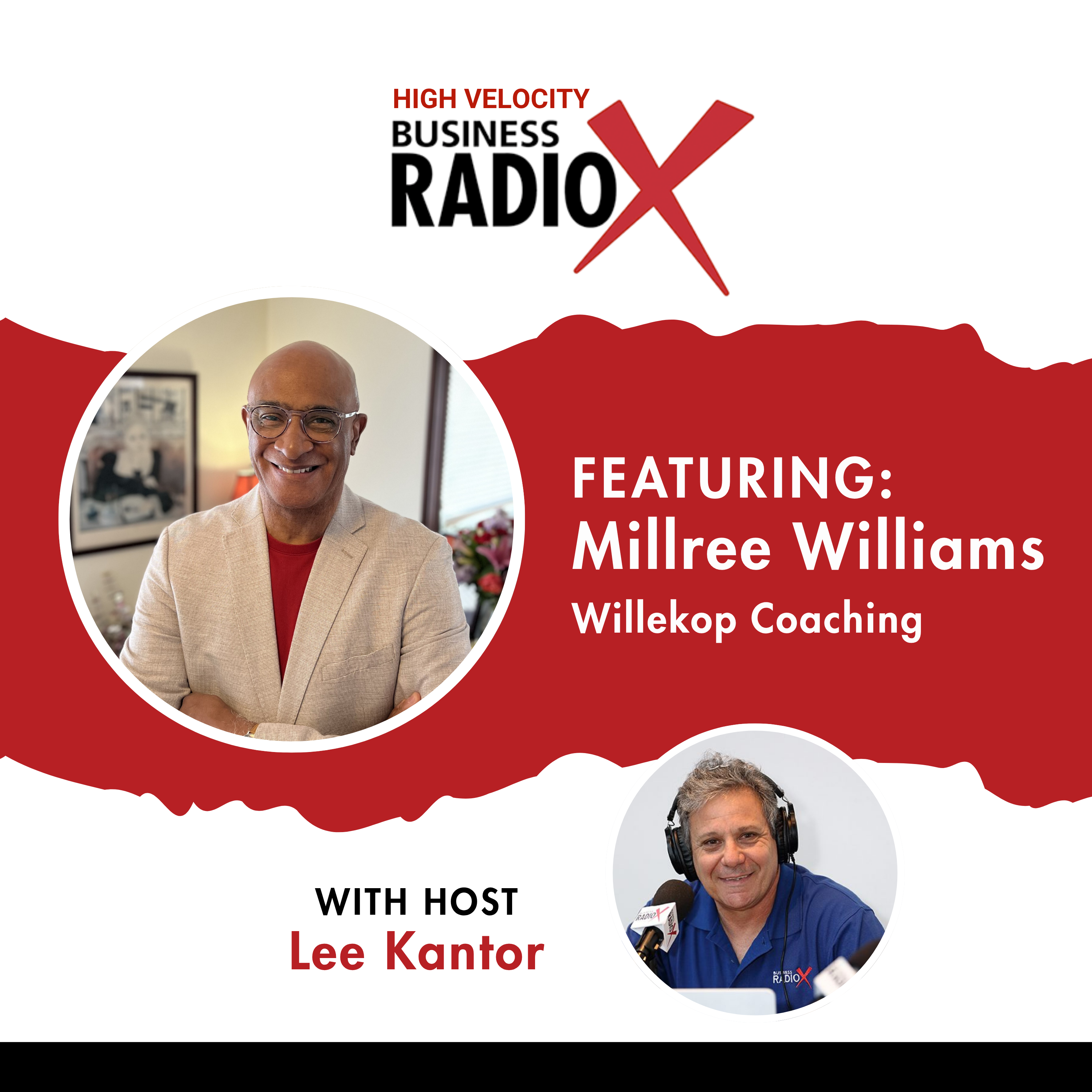

In this episode of High Velocity Radio, host Lee Kantor interviews Millree Williams, owner of Willekop Coaching. Millree shares his journey from communications leader to coach, specializing in career transitions and retirement life coaching. He helps mid-to-late career professionals navigate identity shifts, reframe retirement as an exciting new chapter, and create fulfilling second acts on their own terms. Millree discusses working with organizations on employee retirement transitions, shares a client success story, and highlights his Retirement Roadmap framework.
 Millree Williams has had several careers throughout his life—including roles as a tech editor, PR executive, communications leader, communications consultant, and professional coach. He has learned that everyone has the capacity to overcome challenges, struggle, and ultimately thrive in their careers.
Beyond coaching, he brings curiosity, an eagerness to learn, and the confidence that people can get through anything—qualities he shares with each client.
Connect with Millree on LinkedIn.
What You’ll Learn In This Episode
- Career transitions for mid to late career professionals
- Retirement life coaching and its significance
- Mindset shifts regarding retirement and identity management
- Creating fulfilling second acts after leaving a career
- The role of organizations in supporting retirement transitions
- Coaching approaches and client experiences in navigating retirement
- Importance of planning retirement on one’s own terms
- Addressing age bias and the value of experience in the job market
- The shift from traditional retirement activities to meaningful engagements
- The impact of coaching on personal fulfillment and life structure post-retirement
 This transcript is machine transcribed by Sonix.
TRANSCRIPT
Intro: Broadcasting live from the Business RadioX Studios in Atlanta, Georgia. It’s time for High Velocity Radio.
Lee Kantor: Lee Kantor here. Another episode of High Velocity Radio and this is going to be a good one. Today on the show we have the owner of Willekop Coaching, Millree Williams. Welcome.
Millree Williams: Hi, how are you? Thanks for having me.
Lee Kantor: Well, I am so excited to learn what you’re up to. Tell us about your practice, how you serving folks?
Millree Williams: Yeah, I really do two different kinds of things. One is I really work a lot with career transition professionals, especially those who are in mid to late career, particularly late career. And I focus a lot of attention on helping people who are thinking about preparing for or in retirement, not the financial side, but the side that talks about, you know, what are you actually going to do now that you’ve put this money away?
Lee Kantor: So what’s your backstory? Have you always been involved in coaching?
Millree Williams: No, I actually came to coaching about 8 or 9 years ago. I had been a communications leader in universities and in non-profits. And at one, at one point in my life, I got a coach who was helping me sort of navigate, you know, my way forward. And, you know, we did some really good work together. I was really happy about it. And then she came back a few years later and said, hey, you know, you really should be a coach. And of course, I was. I thought that was the worst possible thing I could be because I was a communications person. And she literally convinced me over about 3 or 4 months of calling me from New Zealand almost every week to convince me to do it. And ultimately, the point that she made that was kind of the pivotal place for me was, look, Mary, whether you become a coach or not, and I think that you will become a coach, but whatever you do, you’re going to learn some new skills that you’ll be able to use in your communications practice. You know, all these other kinds of areas. And so that convinced me to go out and, um, train to be a coach. And, um, you know, I just haven’t looked back.
Lee Kantor: Now, when you made the transition to becoming a coach, did you think initially. Well, I’ll be a coach in and around what I’ve been doing communications. Was that kind of your first move? And then you obviously pivoted.
Millree Williams: Yeah, that’s really interesting. Yes. That’s exactly what I thought was going to happen because I was a communications and marketing person and I thought, hey, I’m just going to coach, you know, marketing and communications people who are making transitions and, you know, the pandemic started shutting down opportunities that I ordinarily would find, you know, like going to conferences and things like that. And I had this conversation with my mentor coach, the one who convinced me to become a coach, and she said, look, your tribe, your niche will find you. You just continue doing good work. And that’s what I did. And I started working with people who were mid to late career. And ultimately it got me into this whole other demographic where I didn’t even think there was such a thing as a retirement life coach. But I started seeing more and more in my practice in the late, you know, career transitions area that people were really approaching retirement and thinking about, you know, who am I going to be in this next chapter of my life? And so many of them were thinking and, you know, concerned and cautious because they were thinking, you know, I just don’t know who I’m going to be. I’ve been putting money aside, but honest to goodness. I feel like this is kind of an end stage rather than a beginning. And of course, I’ve gone through many, you know, professional transitions in my life and I thought, this is an area where I can actually help people, uh, and just show them that there is a different way to think about it as well as, you know, just knowing that all the things that are really important to them, they already have inside of them. So yeah.
Lee Kantor: Now when you’re working with a client, are you kind of having that same conversation your coach had with you in terms of maybe you don’t have to figure it out? Exactly, but let’s just get directionally correct here and then just play in that world to see what kind of resonates.
Millree Williams: Uh, yeah, uh, that’s part of it. Uh, the larger part though is just helping them think, hey, and just know within themselves that I’m actually going to create this next exciting, sort of fulfilling chapter of my life, whether that’s a career transition or whether it’s planning for and entering into retirement. So, um, that’s really a baseline in most of the conversations that I have on both sides of the equation, career transition and, um, and retirement life coaching.
Lee Kantor: So the person has to kind of get the why, right?
Millree Williams: Yeah. And it’s just kind of a mindset shift, you know, rather than thinking, you know, I’m really feeling some trepidation about this next chapter, um, and whether or not, you know, how am I going to be approaching it and just create a level of excitement about you can now be whomever you want to be at this stage of your life. And, uh, is just really a very exciting time that you can actually create on your own terms. It’s not that you’re, you know, shifting Jobs, or you’re trying to fit into someone else’s thinking about who you might be or what they might need, and just thinking, what are the terms that I want to create and starting to live that out and just actually planning for it.
Lee Kantor: So instead of kind of taking a woe is me now, look, I didn’t want to do this, but now it’s thrust upon me. You try to reframe it to give them more agency and control over the possibilities.
Millree Williams: Absolutely.
Lee Kantor: Now, do you find folks that are in the mid to late career, um, having a difficult time finding those opportunities maybe that were in a similar, maybe, um, amount of money they were making or even a similar amount of responsibility. Is it, is it difficult for, uh, mid to late career folks to kind of jump to a new opportunity or do they have to rethink everything?
Millree Williams: Well, you know those folks who are those professionals who are, um, in their late career, uh, transition. So many of them are thinking, oh my goodness, I’ve got to compete with a younger person or, uh, they’re thinking, oh, how do I get around this issue around age? And rather than thinking, uh, instead, what do I actually bring to the table? I’m a consistent, uh, employee. Maybe they’re going to be some areas that I’m going to have to that I’m going to have to upskill in. But an employer who gets me is going to get someone who is committed because they actually know who I am. They know you know what I stand for. I have a track record of of experience and excellence, and I’m going to bring a certain level of maturity to this role rather than thinking, how do I sort of game plan around the age issue? There are so many things that a person who is in late career transition, for example. Brings to the table and you know, they, you know, we’re taught in this society that youth is king. And it’s not always king or queen. It’s, uh, what is the value and what is your, what is the value you bring to an organization? And what is your value proposition in life in general, and what you actually bring to this new enterprise? And just leaning into that.
Lee Kantor: Now, do they have to kind of manage their expectations in terms of, well, maybe I won’t be able to get a full time job with all the benefits and perks that I had, but maybe I should transition into more of a consulting project based kind of second or third act.
Millree Williams: Well, you know, it just kind of depends on the terms they want to create for themselves. Um, if consulting is an area they want to go into and I made that transition myself. Um. Um, you know, earlier in my career, but if they want to, um, be embedded in an organization where they are, they get the benefits, they have a steady income rather than the cycles that go into consulting, uh, and contract work. They can just sort of create that on their own terms. Now, there may be some things that they’ll have to do. They may have to, you know, bone up on their tech skills. They may have to learn how to use the communications, uh, platforms that are in an organization. And, you know, there are some realities, you know, as we get older, you know, we learn a little bit more slowly, but the value that we ultimately bring to the enterprise is the bigger thing.
Lee Kantor: Now let’s switch gears into the retirement folks, because I find that to be an interesting, um, like you, I didn’t realize there was a market for folks that help somebody transition from working to retirement. When you discovered that, um, what were some of those conversations you were having where you were able to say, you know what, I can be a bridge and help people make a successful transition. What were some of the, the fears or trepidations that the, um, retiree or, or almost retiree was having? Right? Yeah. Like how, what were those early conversations where you were like, okay, now I can see, I see where the challenge is and where I can be a bridge.
Millree Williams: Yeah. One of like, one of the first things I was hearing pretty consistently is the whole idea around identity. You know, who am I now? Who am I as I’m going into this next phase of life? And when they hadn’t answered that question. That’s where the trepidation and the caution and the anxiety started. Because, you know, quite frankly, most people were building their own financial base. And the the opportunity then became, you know, where who am I going to be? You know, what am I going to be able to do with the lack of structure when, you know, and you get an opportunity to create those things on your own? Our people. Are my family members going to be considering me a retiree, which I’d love to get rid of that word, but are they going to be considering me as a retiree? And my, my, um, time blocks are totally open to anybody that I want, you know, who wants to pop into my life? So creating structure, identifying, you know, who they want to be, leveraging whatever their assets have been in the past, you know, whether areas of expertise, passion projects, Volunteerism. Consulting. Contracting. You know, whatever those things are. Creating it on their own terms. That’s really where, um, I started seeing and started helping people create on their own terms who they wanted to be. And I think once I started really working with, um, people who were approaching retirement and they started doing that mental pivot, they really got more, much more excited. I mean, if they wanted to go back to work and do something part time or be a consultant, you know, and building on an area of expertise, that’s great. But if they wanted to just kick back and travel for a while, that’s the terms. Those are the terms that they’re creating on their own. And I think, um, when people, when my clients started seeing, hey, I now have the latitude to do the things that I want to do, that’s when it really started kicking in for them. And, uh, that’s the thing that World Cup coaching helps people navigate.
Lee Kantor: And so they get kind of that aha moment where it’s like, oh, I control every aspect of this. These are every choice I make are my choices. I don’t have to really do anything. I get to do lots of things.
Millree Williams: Exactly. And I get to do them on my own terms. It’s a process. I mean, it’s a it’s not that. It’s not one conversation that you might have with someone or that I might have with a client. It’s helping them think about what is the difference, uh, what, what’s going to be the impact of your family on your retirement? You know, have you checked in with them? Have you checked in with your partner? Uh, what are the things that really are important to you? Uh, maybe it’s, um, creating a legacy or maybe it’s mentoring. Maybe you’ve got additional skills that you want to bring to another organization as a consultant, you know, where you help an organization problem solve. Uh, maybe you just want to work just enough to do the kind of travel at the level that you really are. The level where you want to be. You know, whatever those things are, helping my clients identify what those important, uh, levels are with those important, uh, steps are. And then helping them create a plan to do that really is very empowering to them.
Lee Kantor: Do, do people believe nowadays? I think, um, when we were younger, maybe you pictured, oh, when I retire, I’ll be fishing all day or playing golf or doing some leisure activity, you know, forever. And it’s like eating cake, like eating cakes. Nice. Once in a while, but I don’t know if I want to eat cake at every meal. Uh.
Millree Williams: Right.
Lee Kantor: But so is that kind of a mindset shift that people still have nowadays, or are they, or are we kind of beyond that, where people realize that, hey, life is long and I got to fill 24 hours every day, so I better have stuff to do or else I’m going to go crazy.
Millree Williams: Well, it’s not so much. I better have stuff to do. It’s more I’m going to be alive. I expect to be alive in around for at least 20, 25 more years. You know, minimally and I think society has demonstrated that that’s generally the case. And um, how am I going to spend these this. You know, what chapter am I going to create and how is that going to look on my terms? And, um, you know, look, people go back to work. You know, people consult, uh, people do a lot of different things professionally. Uh, but they also find things that they really want to do in their community. They want to spend more time with their, you know, children or grandchildren, whatever those things are. Li it’s, it’s, you’re setting an intention that this is the way I want to walk going forward as opposed to I’m being pulled into something. You know, I was I my, my company, you know, forced me into retirement. I wasn’t really ready for it psychologically and emotionally. And so now I’m kind of stuck. No, it’s like you have an opportunity now to just create the lifestyle that you want and it happens. Yeah, you would be.
Millree Williams: Well, you might not be shocked to know that it happens, you know, amongst high net worth, uh, people who are working with financial planners. It happens in succession planning in organizations, professional athletes who are, you know, have been cut from their teams. Now, you know, who are in their 30s, they’re young, they, uh, have money and resources and they, but now they just don’t have the identity that they’ve been used to having for 20 years, you know? Um, so we’re not 20 years, but maybe for, for professional athlete, maybe 10 or 15 years. So, you know, what is the, what are those areas that you’re actually lacking that you really want to now, you know, um, pivot and do some other things, you know, like, for example, a professional athlete who’s cut from a team has had a tax sheltered foundation that he or she has been working in. And they’ve been doing that for a while now. They get a chance maybe to lean into it a little bit more fully. Maybe they do some things with the NBA or the NFL where they can do, you know, partner. So the setting, the intention is really the thing.
Lee Kantor: Now, how do you help them just for that initial kind of shock of when that happens? Because at that point, I would imagine there’s a lot of fear bubbling up and a lot of, um, you know, going from some, like you said, structured, organized life to now an unstructured, um, chaotic, seemingly chaotic life going from very clear, um, path of what every day and week looks like to now a blank calendar. How do you help them through that period of being untethered? I would imagine for some people that’s very, maybe the scariest part, like waking up one the next day and not having anything to do. Like, do you try to get to them before that happens? Like, are you part of organizations kind of, um, you know, offboarding process? Um, or is this something that just like here they are, it’s the next day and it’s like, figure it out guy.
Millree Williams: Well, I, I work with clients all along the spectrum. Um, if they’re in an organization and the organization has brought me in to do a webinar or a workshop on succession planning or in a wellness program. I get employees to start thinking about that in advance. Uh, if, uh, a wealth management, uh, organization has brought me in to, um, work with some of their retiring, you know, wealth managers, for example, um, I get a chance to have those conversations in advance. Um, but, you know, I just want to step back just a second and just kind of say that, um, you know, people think that the fear is that they’re going to have this huge chunk of time and that they’re not going to be able to do anything with it, or they’re afraid that the lack of structure, um, for them is intimidating and has them sort of, to use your phrase, untethered. But the reality is that once people really start talking about what’s really important to them. And this is where I come in in many ways. In the very beginning, to just have them thinking about, you know, like what’s really important to you at this moment. And you would really be shocked at least to, to see the light go off. Uh, the light go on, uh, amongst, uh, clients and my clients in particular where they start thinking, okay, all right, so this is not something that I should be afraid of. Now, if I want to spend a certain number of hours a week with my grandkids or my, my children, that’s great. If I want to travel, let me start planning that. Uh, if I want to work part time, you know, or volunteer, let me start thinking about that. Where might these opportunities be? If I want to go back and consult or be a contractor, short term, you know, project focused contractor, where can I do that and where does that fit in my life? But the intention is I want to be in control of that, where maybe prior to that, you know, they had been pulled along organizationally.
Lee Kantor: Now our organization’s especially, I mean, every day you’re reading about layoffs nowadays. Um, are they on one hand, they’re comfortable laying off lots and lots of people. Are they at least mindful enough and have enough humanity to insert somebody like you into the process to make that kind of transition at least more humanized?
Millree Williams: I would love to have that happen. It’s starting to happen more and more. Uh, and I’m working with, you know, particularly corporate HR offices where they are really sort of focused on, um, you know, the fact that they have a retirement plan for their the employees, but, you know, employees who are entering the last couple years of their work, their work experience in the organization are starting to look outside rather than thinking about, you know, what is the great succession plan that I, as an HR leader, can create? How can I have this person thinking more about mentoring folks and, you know, while doing his or her work? How can I have them think about mentoring and creating a plan that, you know, sort of maintains the intellectual property of an organization rather than having it walk out of the door because a person, you know, has now retired and you’ve thought about it more as a financial issue rather than a succession issue.
Lee Kantor: And, and then they leave all that history behind and all that, um, that knowledge.
Millree Williams: And, and yeah, and HR offices really as they’re beginning to think more and more about this. They’re bringing people like me on to really be thinking about that and planning it because, you know, like retirement really isn’t a date. It’s actually a human transition. And how can an HR office in an organization help to manage that? And guess what? Uh, when organizations think about this in a different way, the brand of the organization is embellished in a way that they really never really were thinking about. Because if you have employees who you’re interviewing, uh, on the front end of their relationship with the organization, guess what? When they start thinking that, hey, I’m thinking about Mary as a human being, what sort of not just skills that I can help Mil recreate, but how can I help him to create the kind of program that’s going to make sense for him as a human being that really embellishes your brand as well.
Lee Kantor: And I would help. I would hope that would help in recruiting your next generation of talent, because they would see how you treat your people.
Millree Williams: Exactly, exactly.
Lee Kantor: So, um, is there a story you can share about maybe one of your clients that came to you with, uh, maybe they’re going through a transition, or maybe they were going into a second act of their career that you find rewarding. Were you able to help them get to a new level?
Millree Williams: Yes. Sure.
Lee Kantor: You don’t have to name their name, but maybe just share the challenge they were going through.
Millree Williams: Yeah, yeah. I, um, was recruited by a wealth management firm to help a retiring senior executive. So a wealth manager who was a senior executive for this organization. And they wanted to, they, they wanted to bring somebody like me in. And they, they interviewed several different people and they found me. They brought me in to help this person. Um, they wanted to give him an off ramp, and that was very kind of this organization of this wealth management team. So they wanted to give him an off ramp. So, you know, they gave him golf clubs and a whole bunch of different things, but they also offered him, uh, eight months of retirement life transition, retirement, life planning. And so they brought me on to do that. And honest to goodness, when I first started working with this guy, he was really sort of, uh, anxious about what’s next for him. And this kind of gets into the whole sort of, um, you know, identity issue, which we see, which I see so commonly amongst, uh, many of my clients, I started working, I started working with him and he would be on the golf course and someone would say, so what do you do? And honest to goodness, he was he hesitated because he had built a whole legacy of success bringing clients on, helping them manage their money and all of these different kinds of things.
Millree Williams: And he just hesitated on the golf course. He hesitated because he didn’t really have an identity for himself. He also didn’t have any structure. And one of the things that he and I tackled quite a bit was so often when he was working, he was building in the time of day where he was really in a very structured environment, and in the evenings he could do all the things with his wife and with his, you know, his son. Um, but then once he retired, he found himself doing so many of these different things during the day that he couldn’t figure out exactly what to do with that 6 to 8 p.m. time that ordinarily would be filled with his family, because now he was spending more time with them. So we spent a lot of time trying to figure out, you know, who am I now? So he can really seamlessly and with passion answer the question that he was seeing so often on the golf courses, as well as figuring out the kinds of things he could do in his own family. And of course, travel was one of those big, big deals that was really important for him and his wife spending more time, you know, helping his son, um, learn more about stocks and investing and those kinds of things, helping his son create a small business. All of those things became, um, they emerged as priorities for him that he really didn’t know when we started talking and when we started working together, uh, he found that he had this really passionate interest in Eagles, and he really started doing a bunch of research.
Millree Williams: He started actually working with his golf associates, with his golf club, with his, the, the, the golf course where he played the golf course. Thanks. Uh, the golf course to because he, they, he discovered that there were several eagles that were in that area. And so he would do lectures. So all of these things were things that he never was thinking about. Um, when he was, you know, exiting his organization and they just became very, very important to him. He was carving out time. He was creating, you know, plans to travel with his wife. He was helping his son, um, create a business. All these different things. And he started out believing that he was not going to have enough time. And then all of a sudden he, I mean, he, was trying to figure out what am I going to do with this time. And then he started, you know, as he walked through this whole process and started getting engaged in these other areas, he started realizing, hey, I just don’t have enough time in the day. So it was really a very interesting sort of transition for it.
Lee Kantor: Now, how do you deliver your coaching? Is it primarily a one on one or do you do group coaching or is there online courses?
Millree Williams: Oh yeah, I, yeah, I don’t do online courses. I do workshops for organizations. Um, I work individually with a portfolio of individual clients. I get referrals. Um, and I create this thing that I call the, um, retirement roadmap. And it’s a sort of a framework to help people think through what’s really important to them.
Lee Kantor: So if somebody wants to learn more, have a more substantive Conversation with you. What’s the website? What’s the best way to connect?
Millree Williams: Yeah, they can reach me at Mary at corp.com or they can go to my website, which is william.com.
Lee Kantor: And that’s W I l l e k o p.com.com.
Millree Williams: Absolutely.
Lee Kantor: Well thank you.
Millree Williams: The easiest way is to just reach out to me directly.
Lee Kantor: And then you’re also on LinkedIn, right?
Millree Williams: Absolutely.
Lee Kantor: All right. Well, thank you so much for sharing your story today. You’re doing such important work and we appreciate you.
Millree Williams: I really feel like I’m this is an area where I can provide great value to people and I’m really passionate about it. So thank you.
Lee Kantor: All right. This is Lee Kantor. We’ll see you all next time on High Velocity Radio.















