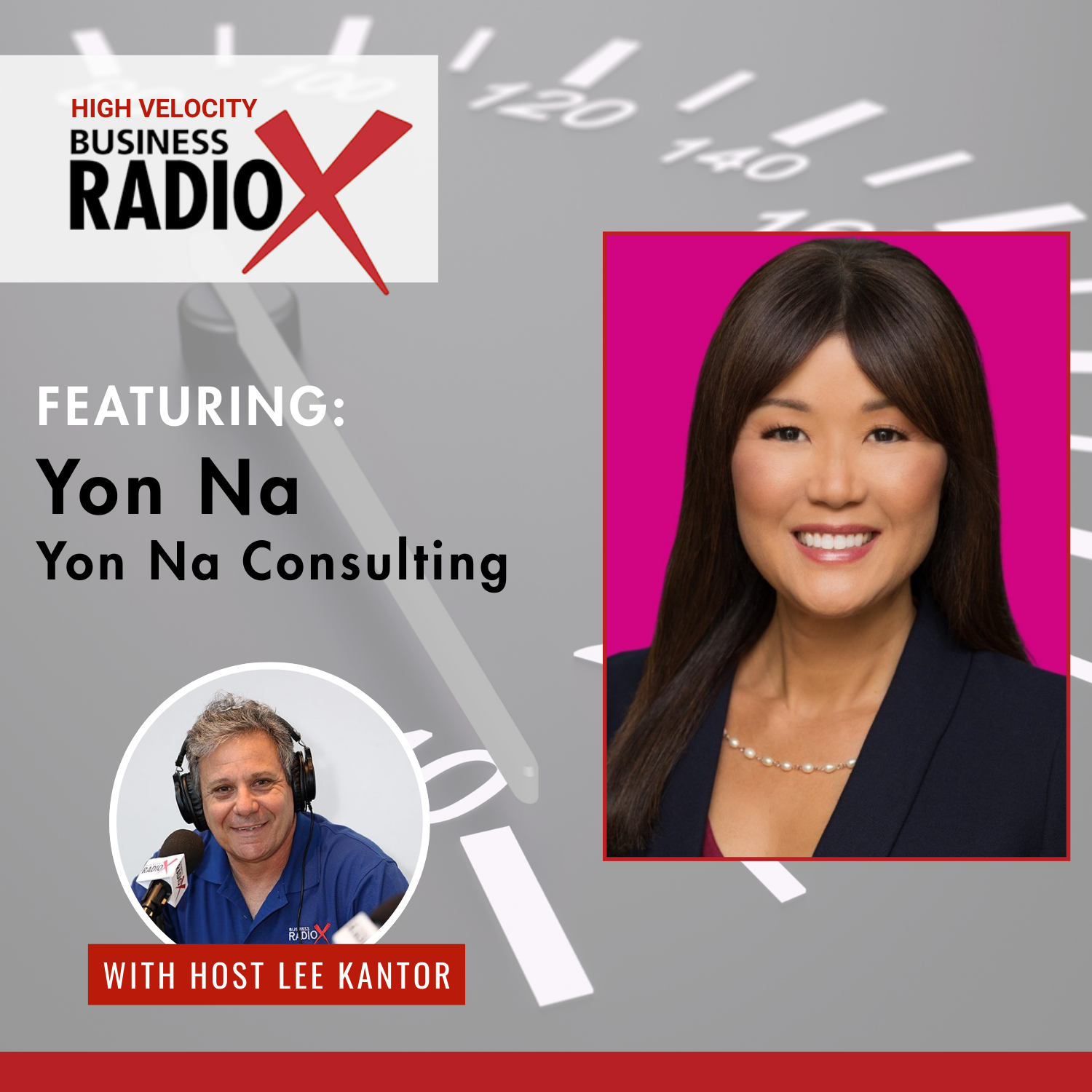

Host Lee Kantor talks with Yon Na from Yon Na Consulting about organizational culture and effectiveness. Yon shares her journey from advertising sales to organizational psychology, inspired by witnessing workplace dysfunction during a company acquisition. The discussion explores leadership challenges, employee engagement, and the importance of inclusive cultures. Yon explains her data-driven approach to uncovering root causes of dysfunction and emphasizes ongoing reinforcement for lasting change. She offers actionable advice for leaders to foster open dialogue and trust, highlighting that real organizational improvement starts with listening to employees and addressing their unique needs.

 Yon Na, PhD, Organizational Psychologist & Principal Consultant of Yon Na Consulting.
She is an organizational psychologist and consultant who helps leaders & teams create inclusive cultures and accelerate performance by applying organizational psychology principles.
Throughout her career, she has led Organizational Effectiveness and Leadership Development efforts in Fortune 100 and high-growth companies, including Warner Bros., The New York Times, Microsoft, Johnson & Johnson, and Nordstrom. She partners with her clients by leveraging research and assessments to design customized solutions.
She lives in Northern California and, for fun, she and her husband and two dogs travel around the country in an Airstream Trailer. She does the towing, he does the navigating. The dogs snore in the backseat.
Connect with Yon on LinkedIn.
What You’ll Learn In This Episode
- How to improve your business outcomes: Creating inclusive Cultures Key Questions
 This transcript is machine transcribed by Sonix.
TRANSCRIPT
Intro: Broadcasting live from the Business RadioX studios in Atlanta, Georgia. It’s time for High Velocity Radio.
Lee Kantor: Lee Kantor hear another episode of High Velocity Radio and this is going to be a good one. Today on the show, we have Yon Na, who is with Yon Na Consulting. Welcome.
Yon Na: Thank you Lee. Nice to be here.
Lee Kantor: Well, I’m excited to learn what you’re up to. Tell us about your firm. How are you serving folks?
Yon Na: Sure. I am happy to say that I’m able to help organizations to be less dysfunctional and meaning they are working. They, meaning leadership, are working effectively together. Employees feel motivated and inspired to do their work. And ultimately, with those two in place, you’re getting better business outcomes. And I do that by helping to create inclusive cultures where all voices and ideas are heard and also implemented, if it makes sense.
Lee Kantor: So what’s your backstory? How’d you get involved in this line of work?
Yon Na: It’s funny because I was living in New York a long time ago, in the 90s, before I moved out of New York right before nine over 11 or around that time. And what happened was that the company that I was working for was in the process of becoming acquired, and it was during the.com boom, and I happened to work for a.com company. And this is the most stressful time during an acquisition for all parties involved. You know, everyone from the senior leaders to the administrative assistant, they’re all wondering, you know, who’s going to stay? Who’s going to go? What’s going to happen post acquisition? And I was one of those people who were questioning what was going to happen to me. And I was not in HR. I was not in leadership development. I wasn’t doing any of the work that I’m currently doing now. I was in a role where I was very detached from that piece, and this had a profound impact on how I was viewing my work, how my colleagues were interacting with one another. And there was, as you can imagine, there was a lot of this kind of grabbing territory, you know, that kind of thing where people were feeling like, I have to protect my territory, I have to protect information, I have to protect my work.
Yon Na: And that’s what I’m talking about when I’m talking about dysfunction in organizations. If there was some communication from leadership about where the company was going and not all the details, because during acquisitions, you know, you can’t divulge all the information that employees want to hear. But what you can do as a leader is tell them, you know, we don’t know exactly how everything is going to fit, but we will figure it out and you will be the first to know. You know, those kinds of things help when you’re going through a massive change. So seeing that and experiencing it as an employee and then seeing the HR team try to navigate that. That’s really how it all got started. And so this was a number of decades ago. I realized that every single company I worked in, there was some level of dysfunction and organizational ineffectiveness. And so I did a whole career switch. I was in advertising sales, and then I went back to school for a degree in organizational psychology.
Lee Kantor: Now, it’s funny that you bring that up. My work for corporate for decades and in her career, it felt like every 18 months or so there’d be a reorg and there’d be kind of what you’re describing is that, you know, I gotta protect my turf. Or if I survive, I have kind of survivor’s guilt, like, why did I make it? And this other person didn’t make it, or now I got, you know, the work still there? Um, you know, people might have be gone, but the work is still there. So anytime there’s, um, Kind of that kind of change. I just boggled the mind as being an outsider and being kind of an entrepreneur, and not kind of having that corporate lens that she has that the organization would just it’s almost like they want the employees to have that men in black little thing where they click the thing and then they don’t remember what just happened, and then they just go boldly forward as if we’re just have a clean slate today.
Yon Na: Yes.
Lee Kantor: Um, so I don’t understand how we’ve gotten to this point. I mean, maybe you have more insight because this is what you’ve been studying, but to me, it just is. I, I don’t get it. And like, they, they wonder why there is, you know, no loyalty anymore. And quiet quitting and all this stuff happening. And then they create cultures where that’s what they’re encouraging.
Yon Na: That li that visual of the men in Black, that, um, whatever that thing is that the device that you that is perfect because I That’s. So we’re talking about blind spots. So leaders have blind spots when it comes to things like organizational culture and how that leads to business outcomes. They have a blind spot because they believe, inaccurately wrongfully, that whatever worked in the past is going to work now and in the future. Um, because this is how we’ve done things. You know that whole idea, right? So, um, it’s helping. So the work that I do is around helping to uncover what the, uh, potential issue might be that they’re facing. As leaders, as organizations, and without. So it’s sort of like, if you don’t understand exactly what the root cause of the problem is that you’re trying to solve for, first of all, do you even know what the problem is that you’re trying to solve for? Is it employees leaving? Is it people not feeling engaged or productive? What is that problem number one. And then how do we get to the root cause of that. And you can’t do that by, you know, taking a so-called best practice from another organization and applying it to your company. So I learned about this interesting idea that there’s a social contagion out there, meaning business leaders are looking to see. So Google is looking at Facebook. Facebook’s looking at Microsoft, whatever the case may be, to see what’s working, maybe for those particular companies and then trying to apply that to their own company without really digging into like, what is it that they’re trying to actually solve for? That’s I think that’s where we’ve gone sort of, um, into this chaotic environment that we’re in right now.
Lee Kantor: Now, if they’re not working actively in creating kind of this enclosed, inclusive organizational culture that you speak about, a culture is going to form no matter what they do, what they do or don’t do. And if they’re not mindful about it and not proactive, they’re Obviously they’re not going to get the result that they want. Like it’s impossible.
Yon Na: Yes. It just, um. There’s that old saying and, you know, it’s attributed to different management consultants, but the that culture eats strategy for lunch. And I firmly believe that because, um, exactly what you said, Lee, if you don’t actively manage it, but before you manage it, understand what it is, then how are you going to how are you going to work with it so that you can get the best out of people? So, you know, sometimes we talk about culture and leaders get really nervous. Like what is like, how do we even address it? Is it going to take 20 years for us to build that ideal culture? Yes and no. Um, there are incremental steps you can take as a leader to make sure that the, the immediate environment that you’re creating for your direct reports is the type of culture that you want to create. So are they contributing to contributing their ideas so that they can solve business problems together. They meaning the team. Are they looking for ways to do things differently, or is it that they’re going to continue to do things the same way? Because that’s what gets rewarded. So these kinds of intangible things, that’s what culture is about, right? It’s the beliefs. It’s the behaviors, it’s the mindsets. And you can’t really hold on to that. Uh, from a kind of a tangible like, it’s not a block you can pick up, but it is something that is swirling in the environment, and that’s what you need to get you. Meaning the leaders need to get a handle on.
Lee Kantor: But do you feel that the way to do this properly is kind of slowly demonstrate with behavior some sort of cultural shift or change, rather than make some grand announcement and tack a new list of you know who we are. Mission statement on the wall and say we’re done.
Yon Na: Yes. Right. Right. And. And that. Yes. You put that poster up, and then you just leave it and nobody looks at it again. Um, yes, that is true.
Lee Kantor: So because culture is it’s an action. Like it might be invisible, but things are happening like they’re not. Um, you might not. Like you said, it’s not maybe three dimensional, but it’s affecting everything, whether they wanted to or not. So, I mean, this stuff is I mean, it’s so interesting to me and it’s so complex because whenever you have an organization, especially a fast growing or a large organization, it’s very chaotic and it’s hard to manage that level of chaos. And, you know, the more you try to control it, the more chaotic it becomes. So let’s talk about your work specifically. What is the trigger that brings them to you or you to them?
Yon Na: It usually is something around like something’s not working from a team standpoint or employees feeling disengaged, meaning, um, they are. So when in our in the field that I’m in, the way we think about employee engagement is what is that extra effort that an employee is going to put in to their work, meaning they can just do the basics or they can put in that extra effort. And that’s what true employee engagement means. So if there’s some, uh, dip in that, um, kind of scale in terms of how much effort someone is putting into their work and people feel like they’re disconnected from the work or teams are not working well together, that’s another big area. Or there’s a big thing that may have happened with the company, like, um, and this happened in early 2020 when every single it seemed like so many large corporations were put on notice, so to speak, about, what are you doing about our culture? What are you doing about diversity, equity, inclusion? That was a big there was a big call to action, so to speak, from employees to their leadership. So these are all the kind of, um, things that might prompt a leader to reach out to me.
Lee Kantor: But is there something happening like that they can see on a dashboard? Is there? Is it is it something like, why can’t we fill this position? You know, it’s been empty for, you know, six months now or or why is turnover so high or, you know, like like is there are there things that are like, you know, kind of blaring lights that they can’t ignore? Because some of the stuff I would imagine, especially in the higher levels of leadership, they’re not even they don’t see with their eyes, you know, they might see on a spreadsheet, but they might see what their eyes.
Yon Na: Yes. Right. Exactly. Yeah. High turnover, you know, higher than what the industry is. The industry that they’re in, high turnover is one area. The other is employee engagement surveys. That’s the so many of the companies that I’ve worked with have employee engagement surveys. And those survey results are going down year over year. And they’re trying to understand why, even though they’re trying to do all of these things from an employee engagement standpoint. But programs and events only go so far. So you can do a, hey, let’s all get together and have a, um, like a celebration of something, but what is that really going to address long term? So that’s where you know that there’s a disconnect between what employees want and what leadership thinks they want. And what I’m trying to do is bridge that gap.
Lee Kantor: So how do you go about bridging the gap? Like are you kind of advocating for the employee and you’re kind of pulling them in an anonymous manner where you’re kind of getting the lay of the land so you can go to senior management and say, look, you, you, you’re thinking that happy hour after work is a perk for them. And you’re, you’re giving them something they want. But these people want to go home to their family. So you’re punishing. They’re seeing it as punishment. That’s not a reward, right?
Yon Na: Yeah. I advocate for the data. Meaning what is being said by employees, by middle managers, even the leadership team who are also trying to figure out what that gap is. So that’s the data that I try to advocate for. And by that, I mean that’s how you get deeper into what the root cause of the problem is. Just like you said, it’s like, yeah, I mean, happy hours. Sure. That might be great. From a, um, get a couple of drinks in me and then I go home. But that’s not going to solve the broader problem that you might be experiencing as an organization. So yes, it’s the data that I try to, uh, dig into by way of looking at the qualitative information on employee, uh, employee surveys, qualitative results say so much more sometimes than what quantitative result might say. I do focus groups to understand or listening circles and focus groups to try to understand from a group standpoint what’s working, what’s not, what can we do more of, and what should we definitely stop doing? And then having one on one interviews with key leaders in the organization, because they may be feeling it too. They may be feeling that disconnect, but they don’t know how or who to articulate that to.
Lee Kantor: So then they’re they’re going to you to look for kind of the truth, like your job is to kind of kind of suss out what’s real and what’s not. You know, because a lot of times, especially in these complex environments or bureaucracies, even, there’s a lot of assumptions made by both sides. And and what happens over time, I believe, is that people stop giving the other side the benefit of the doubt. And they’re looking kind of at the worst. They’re looking at what the worst thing is rather than what other possibilities might be. So you’re trying to kind of determine what is factual and true and what people are believing, not what you think they might be believing.
Yon Na: Yes. When I worked in HR, um, unfortunately, once in a while I would get called into a deposition because I would be the the party on behalf of the company and providing my perspective via the deposition. And there was a time when a lawyer said this to me, which I thought was so fascinating. And I think this is why the data piece is important. The lawyer said to me, you know, there’s there truth. There’s, you know, the there’s the one person’s truth, the other person’s truth. And then there’s the actual truth. And that’s what we’re talking about. The the data that is collected from an organization in the method that I described. That’s the truth that we’re creating together. It’s not a one sided truth.
Lee Kantor: Right? As long as it’s a truth we both believe to be true, then everything will be okay.
Yon Na: Yeah. I mean, and that’s the thing. It’s like. And this is hard for. And I have to say, you know, someone who has been on the HR side for an HR practitioner to go in there and try to dig that up, that’s really hard because first of all, the perception is sometimes unfortunately, you can’t tell air certain things. Uh, and that’s really unfortunate, but that’s, that’s the perception from employees. And then from an HR perspective, you are looking out for the company. So you do have an unconscious bias that could go, that could filter how you’re looking at what’s emerging in terms of the potential problem that we’re all trying to solve together.
Lee Kantor: Now, is there a story you can share that maybe illustrates how this can work? Like share, like how they came to you with a challenge or problem and you help them get either a solution or get to a new level. You obviously don’t name the name of the organization.
Yon Na: Yeah, yeah. And and this is why the what is the problem that you’re trying to solve. That question is really important. So there was a situation or there was an a scenario where it seemed like based on what the kind of the call to action was from the employees that the employees were asking for, um, a racially sensitive organization. So dismantling racism that is currently in this organization. That’s big. That’s a big thing. And that’s what I was called in to try to figure out. How do you address that? But I mean, how do you address that? You go back to what everyone is saying in terms of, okay, so what does that look like? What does diversity look like? What does inclusion look like? What does it look like to have an equitable work environment where your mitigating for racism, you know, racism will exist in certain situations and certain organizations. But how do you mitigate the the negative impacts of it? So, so what was really fascinating was that the problem was not actually about racism, but it was about there was some things around nepotism that, you know, existed in the organization. Um, there were some things about regional differences, meaning geographical differences. This is a multinational organization. So there were um, obviously like different cultural like as in culture as in country differences. Um, there are also differences around how employees were perceiving promotions. Um, and if that was, you know, so all of these things were not pointing to racism. It was more around transparency, clarity, Charity and giving people an opportunity to have a voice in, in solving problems. So it was all around. It was all about that. It was about how we worked together rather than the racism issue that was glaring. It seemed like that was the thing that we were trying to solve for.
Lee Kantor: So how did you kind of, um, explain to both sides that this is going to be the solution? And then for the people who felt racism was the issue initially, that you’re not addressing that directly because you’re kind of handling this at a more macro level. How did you kind of create a Kumbaya experience after after after? They each obviously initially saw something that they really, after a while realized that that wasn’t really the issue.
Yon Na: Yeah. And the, the coming up with so coming up with what the actual solution is to, um, all of these things that I described that was not directly about racism. Um, they were they meaning there were multiple focus groups across the organization, uh, randomly select selected individuals who contributed to creating kind of what does it mean to have a more inclusive culture? What does diversity mean to you? What does inclusion mean to you? So defining it. So that’s where the clarity comes in. Like okay we’re going to create a culture where we’re looking at inclusivity as a way to help people feel like they belong. What does that look like to you? So there was a um, going back out to the organization in terms of helping them to build what it is that they wanted to reach in the future. So that was very helpful. And then for the, um, the part of the organization that wanted to figure out how to best, um, work together. And and it was really about unconscious biases that people had around. They might be perceiving others differently. You know, if you’re in the mainstream, so to speak, in that organization, how are you working with others who are not in the mainstream and vice versa? So we did specialized things to help with that. So there were special, um, like trainings and content that helped them to feel more comfortable about interacting with others and using the right language so that we were not alienating folks. So there was the macro piece, and then there was the like the very customized specific, um, kind of solution by way of training, understanding and follow up trainings to help people to really have a conversation. And that’s what it is like when there’s a disconnect. People need to learn how to have a conversation about these challenging topics, so help them to build those skills to listen and then have the conversation by using the right language.
Lee Kantor: And have an environment of trust where it’s okay to have a conversation like this and and not, you know, hurt someone’s feelings or get defensive or some of these other issues that kind of can bubble up when you’re, you know, trying to have these kind of conversations.
Yon Na: Exactly, exactly.
Lee Kantor: So how do you kind of make sure that the change isn’t just temporary? Like is there follow up? Is that kind of built into the the way that you work so that there are kind of, um, reminders and, and, uh, so we keep talking about it so it doesn’t like, you know, you’re never done. So like.
Yon Na: No. Right. Right. Um, and it depends on the organization. Some organization will organizations will have reinforcement like sort of conversation, ongoing dialog or conversations or trainings or off sites with key leaders to continue to reinforce what they’re trying to change within that culture. And for other organizations, it’s, you know, they try to do something from within. So there might be a group of people. And this was at another organization I worked with, a group of people came together, a volunteer group, and they developed, uh, their roadmap for creating a more empathetic culture. Um, and that was a piece that they wanted to work on, is creating more empathy in their culture so that they could serve their patients in an empathetic manner. So they created their own, uh, governing body to address the work. Or, you know, I can help with some of the implementation implementations of the recommendations that I come up with. So it could be that training, it could be follow up trainings, it could be, um, benchmarking to see, you know, based on how you’re doing and based on benchmarks of companies that are in your similar industry and also similar size. You know, what can we potentially, um, look at or leverage moving forward? So it’s always this kind of ongoing thing because it doesn’t end right. Culture work doesn’t end after 90 days. It doesn’t end. That’s just the beginning.
Lee Kantor: Right. And you want to make sure it sticks. I mean, you know, people have been through so many trainings where they get all fired up and then, you know, a week later they forgot about it.
Yon Na: Yes. There’s a there was an interesting statistic. I read that when someone attends a training. So within 30 days, the way our memories work is that within 30 days they lose 90% of their whatever they learned. Unless there’s some sort of reinforcement activity, whether it’s coaching or whether it’s continued discussions or dialog or making that particular behavior or skill part of the performance evaluation process, there has to be some reinforcement, Otherwise it just goes away.
Lee Kantor: So consulting and training are part of your work. Is coaching also part of your work?
Yon Na: It’s a if I look at the big pie. It’s probably about 20% of my work ie consulting, doing research and coaching. That’s how I kind of categorize my work.
Lee Kantor: So what do you need more of? How can we help you?
Yon Na: Oh, you know, part of it is just helping leaders to understand that you need to think about. And even if they don’t call me to do it, you need to get a handle on your culture and do a cultural assessment or an audit, is what we call it, and try to figure out what’s working, what’s not, especially in this business environment where things are so chaotic and there’s so much going on outside of the workplace where, I mean, I just saw a recent Gallup poll where, uh, employees, when asked in the United States, 1 in 2 employees is open to leaving the organization. I mean, that’s a that’s an alarming statistic. And one of the key reasons is due to culture and then well-being and work life balance is another reason. So you’ve got employees who might be on the fence or who are just doing the bare minimum to get by because they don’t feel as motivated. They don’t feel like there’s clarity. There’s not trust because leadership is not focusing on creating that level of trust with their employees. All of these like seemingly simple things that can be done, um, from a behavior standpoint on a day to day basis. That’s what I want leaders to think about. You can do a lot, even in a conversation with someone that lasts 20 minutes.
Lee Kantor: So you mentioned assessments and surveys as maybe a place to begin. Is there any kind of thing a leader that’s listening right now could implement just, you know, in their own organization immediately. Like, or is it just kind of a change your thought pattern a little bit like what would be something that’s actionable for a leader right now?
Yon Na: I would say the next time you have a staff meeting and give your team a heads up, that this is what you’re going to be asking for. Just spend 20 minutes during that one hour call and ask your team, you know, how are we working together? Meaning, how is this whatever it is that we’re trying to do together, how is that working for you? What needs to change from a everyday kind of interaction standpoint, and what can we do more of? Just asking that and letting them, you know, think about it and then maybe participate in the meeting. Or they can email the leader in advance of the meeting and then you can have a discussion about it. It really depends on what kind of climate or culture you’ve created for your team, but that would be the one thing that I highly advocate that leaders do is just see how are things going, what’s working, what’s not from a work standpoint, right?
Lee Kantor: Just act like a human being and pretend you care. Like humans used to do back in the day. Let’s treat each other like humans.
Yon Na: Yes, absolutely.
Lee Kantor: Yeah. I mean, I think that if we all got in the habit of just asking, you know, how are you doing? What what kind of help do you need? You know, what can we be doing for you and caring about that and really following up and making sure that they get heard. And I mean, it’s that would solve so many problems. But people just are like so task oriented. They’re just they don’t look at the humanity of the organization. They just look at the, the production.
Yon Na: And I think they’re afraid. I think that’s the other thing, too. They don’t know what to say. They don’t know how to say it. They feel like they might get canceled or, you know, like, there’s just people are afraid.
Lee Kantor: Well, that’s why they have to bring experts like you in to kind of smooth some of these rough edges off.
Yon Na: I hope so.
Lee Kantor: So if somebody wants to learn more about your practice, um, get a hold of you or somebody on the team. Is there a website? Is there a place to connect?
Yon Na: Yes, I am on LinkedIn. Yana or it’s Yana Consulting. Um, if you do a search or you can just go to Yana consulting.com.
Lee Kantor: All right. Well, John, thank you so much for sharing your story today, doing such important work. And we appreciate you.
Yon Na: Thank you Lee.
Lee Kantor: All right. This is Lee Kantor. We’ll see you all next time on High Velocity Radio.














