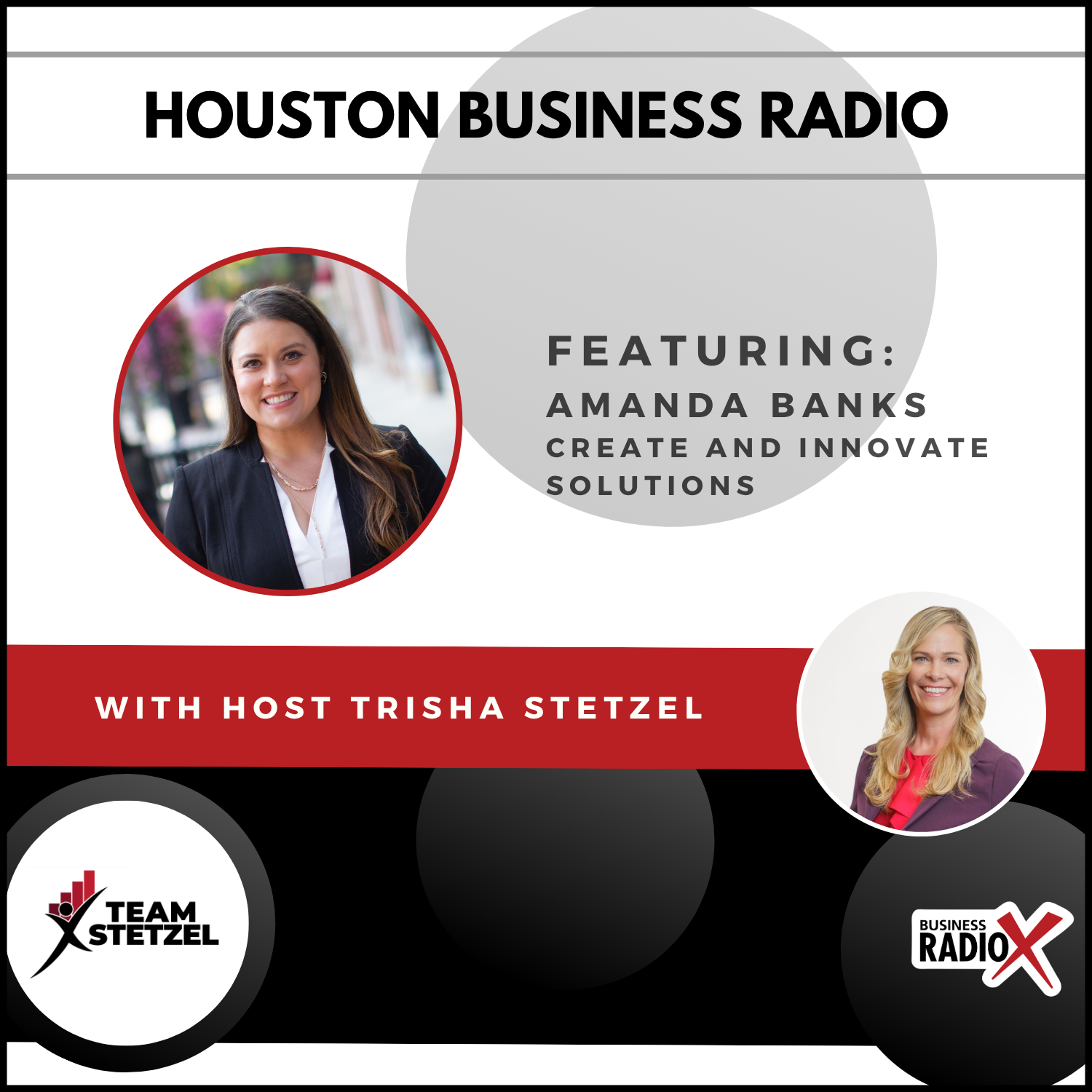

 Amanda Banks is a former Corporate Sales Executive turned Entrepreneur, TEDx Speaker + Host + 3x Organizer, Former High-Level Competitive Athlete, Media Show Host, Nashville Business Journal 2020, 2022, 2024 40 Under 40 Nominee, 2023 Nashville Emerging Leaders Award Finalist- Education Category, Coach, and Leader.
She has a strong track record in sales with a specialty in navigating complex sales cycles, marketing, brand development, media, technology, and thought leadership development.
Her company Create and Innovate Solutions, LLC. partners with individuals who are ready to step into thought leadership, helping them shape their ideas, clarify their message, and build influence in a way that feels human, aligned, and sustainable. 
She helps thoughtful, high-integrity people translate what they know into influence, connection, and forward movement without compromising who they are.
In 2026, she’s launching Our Humanity Network℠ bringing thought leadership-oriented media to the world to serve others.
LinkedIn: https://www.linkedin.com/in/amanda-banks-9945502b/
Website: http://www.amanda-banks.com
 This transcript is machine transcribed by Sonix
TRANSCRIPT
Intro: Broadcasting live from the Business RadioX Studios in Houston, Texas. It’s time for Houston Business Radio. Now, here’s your host.
Trisha Stetzel: Hello, Houston Trisha Stetzel here bringing you another episode of Houston Business Radio. It is my pleasure to introduce you to Amanda Banks, founder of Create and Innovate Solutions. Amanda is a thought leadership strategist who helps integrity driven leaders clarify, develop, and distribute their message in a way that feels human, aligned and sustainable. She’s a TEDx speaker, host, and three time TEDx organizer of TEDx Old Hickory. A former corporate sales executive and competitive athlete, Amanda now focuses on helping leaders turn lived experience into meaningful influence. In 2026, she’s expanding her grassroots media platform, Our Humanity Network, to bring thoughtful, service oriented leadership to a wider audience. Amanda, welcome to the show.
Amanda Banks: Trisha, thank you so much for having me. I’m so excited to dive into conversations with you.
Trisha Stetzel: Really excited to have you on. And, uh, shout out to Dr. Kevin Dyson for introducing us. I’m sure he’ll listen to the show. All right, Amanda, tell us a little bit more about you.
Amanda Banks: Yeah. So as you mentioned, you mentioned a lot of different things. Uh, started out as a former high level competitive athlete and carried those lessons into my professional career, have a corporate background, uh, transitioned into entrepreneurship in 2020. And really since then have just been helping purpose driven entrepreneurs and leaders, um, identify and expand their ideas. I’m a mom. I’m a wife. I’m a dog mom. Um, so live a really busy life right now, and I’m just so grateful and I’m excited about the journey.
Trisha Stetzel: Yeah, I love that. And you do so many things even beyond your bio, just the things that you voiced. We do a lot of things, but before, you know, I really want to dive into how you went from corporate to entrepreneurship because I think that’s really important. But before we get there, Amanda, do people ask you often, how do you get it all done?
Amanda Banks: I’m maybe ask myself that, right? Um, I do get asked that, right? But I ask myself that as well. I think that, you know, there’s a lot of moving parts and pieces and I’ve got a very busy teenage daughter, um, that keeps us busy, right? We’re doing sports and choir and all the things, and I try to live in harmony. I don’t always win that, uh, that battle. But, you know, busyness is part of, you know, part of the journey right now. And I just try to find harmony within all the things.
Trisha Stetzel: Yeah. I love that people ask me that all the time. And I, I don’t know, I don’t compartmentalize, I don’t have a magic wand that says, hey, I’m going to get all these things done. I just do what I can. And I love that you say live in harmony. Uh, and maybe we’ll circle back around to that a little bit later in our conversation. So let’s start with this. You moved out of corporate and into entrepreneurship, specifically in this thought leadership space where you’re serving others in this space that you work in. What what led you to move away from this corporate position into doing your own thing?
Amanda Banks: Yeah. So in March of 2020, my daughter’s school got destroyed by a tornado. So right before Covid was a thing, um, we had, you know, our daughter, who was, I believe, in fourth grade at the time, if I’m remembering correctly, um, at home. And so, you know, throughout the following weeks and months, you know, we started having the conversations around those harmony discussions around how can we create harmony within the family unit? And quite frankly, it was it was not there. So that’s really what kind of forced me into entrepreneurship. So I didn’t intentionally say I’m going to have a corporate background and then at some point go into entrepreneurship. So it was more of a forced experience. Um, but it’s been one of the best, I guess, learning lessons that I’ve experienced in my entire life.
Trisha Stetzel: Yeah. So what’s really shifted for you, moving from working for someone else to owning your own day or owning that harmony?
Amanda Banks: You have to be really mindful of who you are as a human being. And I think that that is something that we don’t spend a whole lot of time exploring. And all of the things, all the tendencies are really exemplified in entrepreneurship because it’s you like everything stops with you. Um, you may have strategic partnerships or teams, but you know, a lot of the mindset challenges or a lot of the tendencies that you carry that may not be exemplified in a corporate role really get highlighted when you become the the one stop shop of trying to run your own business.
Trisha Stetzel: Yeah, absolutely. So, Amanda, how do you decide who, who you spend your time with professionally? Because you are a busy professional and you do want to create this harmony in your personal and your professional life. How do you choose who you’re spending time with?
Amanda Banks: I think it evolves. It evolves over time. And I’m a process driven person. I’m my mind thinks through strategy. So for example, you know, I know a lot of people want coffee meetings. Like that’s a new, a new thing in business is let’s set up a 30 minute coffee meeting. And those add up really, really, really quickly. So one of the things that I did this year was say, you know what, let’s, um, rather than me doing one on one with all these different coffee meetings, let’s create a monthly group where if you want to have a coffee meeting, we just get together as a group. And so to your point, I think it’s a strategy on time management. It’s also a boundary setting thing of like, what am I going to apply my time and my resources to? And being very mindful of that, knowing when I’m living within harmony of that or living in not in harmony in that. Um, and so I think it’s a strategy thing is being very mindful of this is the time that I just have, it is what it is. We can’t add additional time to our day. Um, and being able to ensure that you’re still spending time with as many people that you want to be spending time with, but being very strategic about that.
Trisha Stetzel: Yeah, absolutely. And one of the things I love to talk about is who’s in your room and the importance of the relationships that we’re building. So as you’re, you’re meeting new people, you still have relationships with people that you’ve met a long time ago. How important is it for you to be in the right room with the right people?
Amanda Banks: Oh, it’s everything like neighborhood Community network. All of those things are. Those are so incredibly important and everything that we do. You know, we just had a massive ice storm in Nashville. And I didn’t really think about the importance of neighborhood recently. And when that ice storm hit, you know, who are the people that are asking, what do you need? It’s your neighborhood. So, you know, I think that it’s everything.
Trisha Stetzel: Yeah, I, I agree with you. I get goosebumps when you talked about the whole neighborly thing and the people that are going to be there for you when something happens. And it’s not just about one room, it’s about the rooms that you’re in. I recently discovered that I may have been hanging around in some of the wrong rooms, where I kind of felt like I was the person that everyone was coming to. And then I discovered Amanda, a room where I wasn’t the biggest, strongest, fastest, most intelligent person in the room, and it was very fulfilling for me. Have you discovered that your rooms have different intentions when it comes to what you’re learning or giving?
Amanda Banks: So my intentions are always to just simply be and learn or to teach one of those two things, depending upon the rooms that I’m in. And to your point, I think, you know, the diversification of the spaces in which you’re showing up is incredibly important. You know, I know oftentimes it’s very easy as leaders or whatever to get stuck in our silos and to only show up in spaces, spaces in which we seemingly belong. But I think that there’s something really beautiful about showing up in different industry spaces or different, you know, just places that you seemingly shouldn’t belong in. So I love to just randomly show up to maybe a real estate mixer or just something that can keep me sharp and help me get a better perspective on what other industries or other people just in general are facing.
Trisha Stetzel: Yeah, absolutely. Thank you for that. And I think a lot of us find ourselves. We’re not sure we have the right room. Are we hanging around with the right people? I feel like if if we eventually decide we’re the smartest person in the room, that we might be in the wrong room right now. And then we can circle back to that because there’s also this giving space. And so I want to go there next. Amanda, when you and I connected a few weeks back, um, this whole value of serving others really came up and, and I, I feel compelled to have a conversation around that today because most of the people that I hang around with are, um, givers. They’re serving others and you do it in such a special way, helping people be visible without looking for the fame, if you will. So can you talk more about the work that you’re doing now with helping people create space to be visible in their businesses?
Amanda Banks: Yeah. So one of the lessons that I learned pretty quickly in my entrepreneurship journey is it’s much easier to speak and be visible and attract people to the business, rather than me having to individually try to go after all of these different people. Um, from a sales and business development perspective. And so as a natural introvert and somebody that I did not like public speaking, um, I had, I was terrified of cameras and media and public speaking, but I recognized the value pretty early on in my entrepreneurship journey of how important that actually can be. And so I leaned into those skill sets. As you mentioned, I got asked to do a TEDx talk, which was an incredible experience. Then I emceed one and then I hosted three, and I had the opportunity to work with people from all walks of life, all industries, all different visibility. Uh, you know, some people are highly visible. Other people, you know, have no social media presence at all. Um, and work with those individuals and visibility is really important in that perspective because once again, if people don’t know that you exist, then how can you show up and serve them? And so there’s this weird balance, especially for somebody that’s naturally introverted and doesn’t really care much about self-promotion, but also being a business owner and trying to find and attract the right people that you can show up and serve at your highest capacity.
Trisha Stetzel: So how do you, how do you mind set shift? So one, maybe your own personal experience going from, I’m terrified, I don’t want to do this. This is way out of my comfort zone to actually doing it for your, for, for you personally, but also for those that are listening today that may be going through that same thing. They know people keep saying, do a video, show up, do the thing, and they’re like, no, I don’t feel like it. So tell us your personal experience and then give us some maybe tips on how do we shift that mindset from where we’re at today to getting in front of the audience that you need to be in front of?
Amanda Banks: Yeah, I think that the biggest thing is comparison, right? Like we as individuals will oftentimes look at other people’s content or look at other people when they speak on stage and compare ourselves at where we’re at in our journey versus where they are at in their journey. And so everybody has to just start like you just everybody begins from somewhere. And that’s the mindset shift is like, you know, starting and using it as an opportunity to learn. Maybe it’s to learn to become a better communicator. Maybe it’s to learn how to be more comfortable on camera. Maybe it’s some other skill than it is just to post social media content or just to go and get on a stage. You know, one of my favorite things is to take people that have never done that work before and get them in in five months ready for a TEDx talk. And so that was, you know, part of what we looked for at TEDx Old Hickory was speakers that did have current visibility, but also people that maybe had never even stepped foot on a stage before. And so having that side of the experience. I firmly believe that regardless of how introverted you are or regardless of how you know self conscious, everybody has the ability to become a more effective communicator and show up in a way that is their best selves. Not comparing themselves against somebody that is different or shows up differently from them.
Trisha Stetzel: I love that being authentic and actually feeling authentic when you’re showing up. Yeah, I.
Amanda Banks: Think most people that, um, that we look at that are professional speakers, like these people have years and years. It is a craft, it is an art. It is something that takes a long time to develop. And so there’s a big curve between just getting started and then, you know, being a globally renowned speaker. But the beautiful thing is there’s always something else to learn within that journey. There’s always something to, you know, maybe it’s a technology that you learn, maybe it’s you want to, you know, learn how to have better conversations one on one with people. These are all things that in that ecosystem can be part of the equation to keep you, keep you behaviorally motivated to keep moving forward.
Trisha Stetzel: Yeah, absolutely. Even in this space, in the podcasting space, it increases my ability to be a great coach by asking questions and listening. And it’s, it’s not something you think about, right? As someone who’s doing that, but it really has increased my capabilities as a coach. And it was simple, although I didn’t know I was doing it. Amanda. It just happened.
Amanda Banks: It’s the learning lessons. I mean, I believe that we’re here to learn. That’s part of our journey. And there’s so many different components and parts and pieces that you can take from these experiences. It’s also about building value for other people and building relationships with other people. There’s something very intimate on these types of conversations, especially when you have people that don’t feel super comfortable in these spaces all the time. Um, and there’s something really beautiful about that.
Trisha Stetzel: Yeah, I agree absolutely. All right. So I know people, listeners are already wanting to connect with you. So where’s the best place for them to find you or connect with you? Amanda.
Amanda Banks: Yeah. So my website is www.com and that’s the easiest way to reach out. I’ve got a contact form if you’re interested in maybe speaking yourself or learning more about the work that I do. Please feel free to reach out.
Trisha Stetzel: I love that, thank you Amanda. Okay, I’m going to circle back to Ted. I set it in your bio. You’ve talked about it. I’ve talked about it. I know people are curious. Oftentimes you hear Ted and ears perk up. Like what? What does it actually mean? Because you taught me a lot of things when we talked just a few weeks back. So tell us about Ted and the real work behind that.
Amanda Banks: Yeah. So I am no representative of Ted or Ted as a whole. I can only speak to my journey with Ted Old Hickory, so I’ll speak to that. Um, we’ve had three events and had amazing experiences every single year. Um, and so part of what the TEDx ecosystem and TEDx Old Hickory is, is a fully volunteer led, community oriented team that says, you know what, we want to bring ideas to our local community. Let’s collaborate. And so we collaborate. We do everything from coaching the speakers to getting them ready to, to step foot on stage to building the community around it. Um, and then we host the event and it’s an amazing experience.
Trisha Stetzel: Love that. Thank you. And, and then five months of coaching, it’s all volunteer work.
Amanda Banks: It is. And not every, not every, um, TEDx event is similar. That’s the beauty of the ecosystem. Tedx old Hickory. We were able to, to within the, the, um, within the ecosystem and obviously the rules, we were able to create our own approaches. And part of that is I really wanted to better understand how to capture this individual thought leadership and really refine it to an idea and get it out to the world in a meaningful way, and do it with people that come from all walks of life, all experiences, all backgrounds. And so that was the beauty of being able to serve in that capacity and coach these individuals for five months, um, and work with them and watch them show up on the stage and deliver incredible results regardless of what experience they had.
Trisha Stetzel: I think we’re, I think we’re on to something here. Amanda. Um, I’m really excited about having this conversation around being in a place where, uh, we didn’t want to be on stage yet. We knew we needed to get out there to get in front of the audience that we wanted to serve to. What does it look like on the other side? So can you talk to me about what it what the difference is between professional presence and being an influencer when it comes to being in the public?
Amanda Banks: Yeah. So to me, there’s a difference between influence and influencer. Like oftentimes when we think about influencer, we think about a lot of noise and a lot of just doing whatever to do to bring eyes and ears, likes, follows, whatever you want to call it, to build influence. We as individuals, I believe we all have influence. I mean, my daughter has massive influence on me. So we as individual human beings, we all have our own wisdom and our own unique knowledge and experiences, and we all carry something within us that has the ability to serve other people through the influence that we have, regardless of how big or small we may perceive that influence to be. Oftentimes, I think when we think about influencers or influence, we’re looking at a very macro scale with when to me, I look at how do we build individual influence as leaders to serve the people sitting right in front of us, or to serve our families or to serve the people in our in our sphere of influence. And by doing so, how can we either become a student or become a teacher to serve other people with the knowledge and the experience and the wisdom that we have?
Trisha Stetzel: How do you find that? Amanda. So for the, for the listeners today, they want to serve. They want to be a part of something bigger. What’s one thing, just one thing that we can do to take a step forward to using the influence that we have with the right groups that we want to be a part of.
Amanda Banks: I think that’s the intentionality around it. It’s having an intentional focus of some of the things like, who are we? What are we passionate about? What services or industries do we have experience in, and what are other things that we are deeply knowledgeable in that may not even relate to our career? Um, which is oftentimes like for me, I was a gymnast, so I can talk gymnastics all day long, but I don’t do anything from a career perspective in that industry right now. So when you take a look at all four of those categories and you kind of get to the core of where the intersection is between those four things, you get to a better understanding of what are some things that are unique to me that maybe by just sharing through conversation or teaching that I can serve other people with.
Trisha Stetzel: Mhm. Oh goodness. Yes, I love that. So many nuggets today. Um, very excited about everything that you’ve offered. Amanda. What about, um, and I’m going to focus on the women for just a second. I hope that’s okay because I, I often will have conversations with women who, um, don’t feel like they have enough content or don’t want to be on camera or don’t want to fill in the blank. Um, I don’t, I’m not labeling it this, this is the word that words that I hear is imposter syndrome. So if someone, a woman today is who’s listening, struggles with that imposter syndrome, but knows they have something worth sharing. What’s the first 15 minute step that they can take this week to just start showing up?
Amanda Banks: Yeah. So this was me. Okay. I didn’t label it imposter syndrome, but when I started in this journey, I recognized very clearly if a camera is in my face, it’s going to be very easy for me to say no. Over time, I’ve become more comfortable with that. But when I first started down this journey, I had to think about how can I build a platform or an ecosystem that is going to allow me to show up at my best today and serve other people? And I knew that by conducting interviews with other people that I would not let other people down because I you know, if I say I’m going to do something, I try my best to get it done. I also like to help amplify other people’s people’s voices. So I love to give platforms where, you know, other people have the ability to share their, their amazing ideas and their amazing experience. So I think to somebody that’s tuning in that may struggle with even just like that first step to get started, I think it’s an intentionality in understanding, like one that this is something that you want to dive a little bit further into. But two, creating an ecosystem in which you can serve other people and you can take the focus off of yourself as you’re getting things started. And so once again, I had a live show that I did for a year and a half straight every single week. And I knew that if I just created that discipline and that ecosystem and that that muscle to keep things moving forward, that if I interviewed other people, rather than doing one on one, I would keep it moving. And so that’s a great strategy for when people are a little bit more introverted or not comfortable or feel like they’re weird, Like find something that you can do that helps amplify other people. And that tends to take a lot of the pressure off yourself.
Trisha Stetzel: Mhm. I love that it makes it reminds me of something I like to talk about, which is the gift that you have. It needs to get out there. You have a gift to give. So what is it? And it doesn’t have to be about you. It’s about the other person receiving it. Yeah. And if you keep it to yourself, then you’ll receive your gift.
Amanda Banks: And that’s, that’s one of the things that I’m kind of leaning into this year. And one of the things that I saw very clearly in my TEDx Old Hickory work is there are a lot of incredible people, amazing people that have absolutely no digital presence, but that their stories have so much wisdom and experience and just deep rooted knowledge. And part of that is like, if you know, and you recognize as a leader that you’re not going to follow through with, you know, maybe hosting a podcast or getting on stage or doing these things. Find other people and their ecosystems and work with them to help get your information and knowledge out there. There are those spaces available.
Trisha Stetzel: Absolutely. And the word of the day today, Amanda, is an is intentional. I’ve heard you say that multiple times and we all need to be very intentional. All right. Last topic, if it’s okay with you, I would love to talk more about our humanity network. Tell us more.
Amanda Banks: Yeah. So it is a grassroots initiative. I know that there’s a lot of complexity in media today. And really what the area of focus for our humanity network is. How can we find those people with amazing ideas and amazing stories? And how can we, you know, capture those with as much integrity and beauty as possible and bring them to the world in a meaningful way? So it’s totally grassroots. There’s not a lot of information out there about it yet, but throughout this year, we’ll start releasing some content and bringing on a contributor network and really doing some amazing work in this humanity space where it’s all geared around individual thought leadership. And how do we bring that to the world to serve other people with it?
Trisha Stetzel: And yet, one more great reason to follow Amanda.
Amanda Banks: Yeah, I’d love to connect with people. So, you know, our humanity network is really geared around people and humans, and how can we learn from one another and build from one another. So please just reach out to connect. I’m, I’m on LinkedIn. I’m very active. I provide content on LinkedIn pretty regularly. So I’m always looking to connect with new people.
Trisha Stetzel: Love that. All right, Amanda, one more time where people can find you.
Amanda Banks: Yeah. So w w amanda.com or LinkedIn. I’m very active and I produce a lot of content on LinkedIn. So if you’re looking for more content, that’s humanity esque oriented, leadership oriented, definitely connect with me on LinkedIn. And I’d love to keep the conversations going with whoever’s listening.
Trisha Stetzel: Yes. Amanda, thank you so much for your time today. I really appreciate it. And I also appreciate your, um, allowing me to be part of the balance that you’re having this week.
Speaker 4: Oh, thank you so much.
Amanda Banks: I, I’m so grateful for this conversation and so thankful for you for having me on.
Trisha Stetzel: Thank you very much. All right, you guys, that’s all the time we have for today. If you found value in this conversation that Amanda and I had today, please share it with a fellow entrepreneur, veteran or a Houston business leader ready to grow. And be sure to follow, rate, and review the show. It helps us reach more bold business minds just like yours and your business. Your leadership and your legacy are built one step at a time. So stay inspired, stay focused, and keep building the business and the life you deserve.














