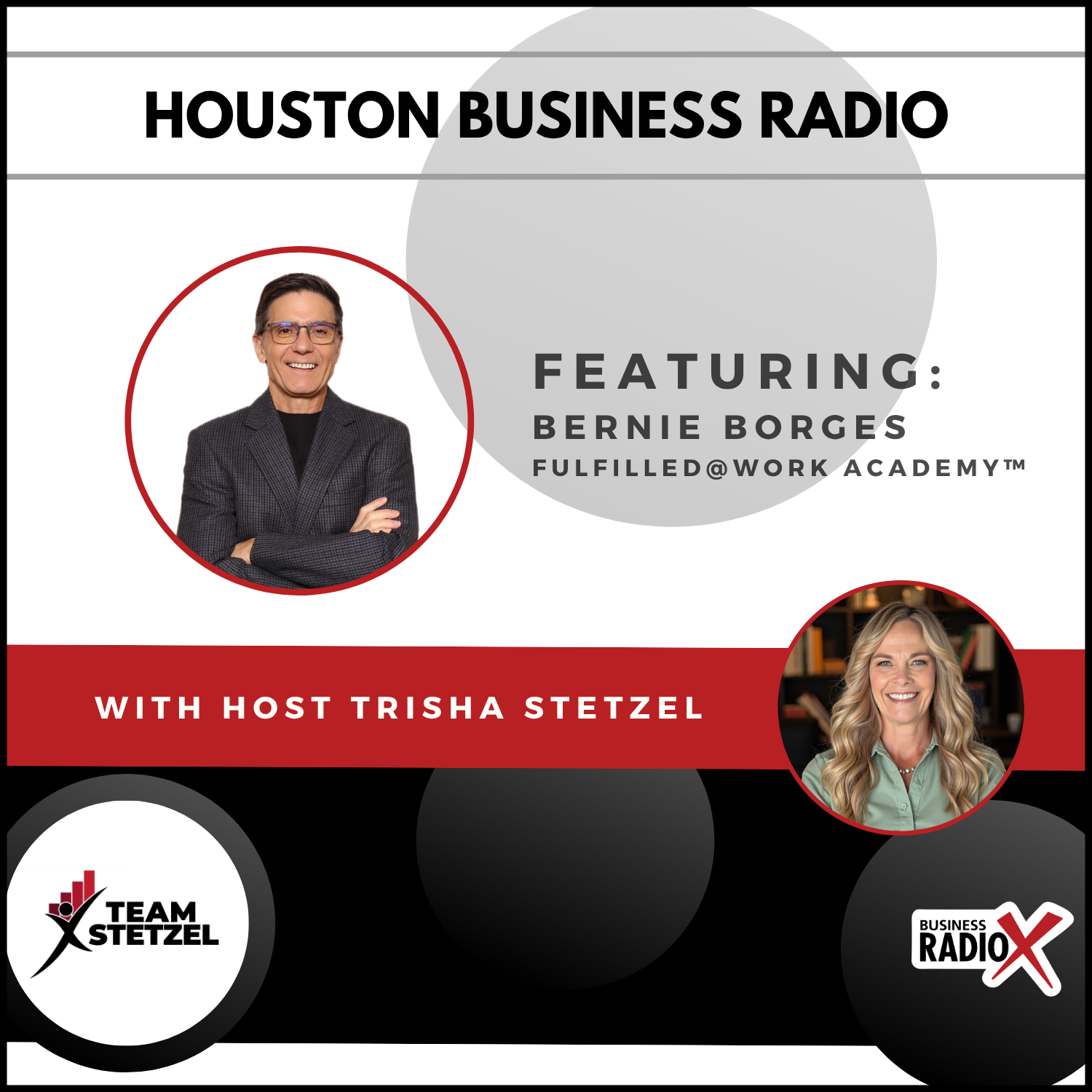

 Bernie Borges is the Founder and CEO of Fulfilled@Work Academy™ and creator of Fulfillment-Centric Leadership™ (FCL), a leadership methodology designed to help organizations strengthen employee engagement by developing more self-aware and fulfilled leaders.
A keynote speaker, workshop facilitator, and author of The Human Dividend, Bernie combines leadership research, neuroscience, and practical frameworks to help executives navigate engagement, organizational change, and AI transformation while keeping trust, purpose, and human contribution at the center.
LinkedIn: https://www.linkedin.com/in/bernieborges/ 
Website: https://fulfilledatworkacademy.com/
 This transcript is machine transcribed by Sonix.
TRANSCRIPT
Intro: Broadcasting live from the Business RadioX Studios in Houston, Texas. It’s time for Houston Business Radio. Now, here’s your host.
Trisha Stetzel: Hello, Houston. Trisha Stetzel here bringing you another episode of Houston Business Radio. It is my pleasure to introduce you to my guest today, Bernie Borges, founder and CEO of Fulfilled at Work Academy and creator of Fulfillment Centric Leadership, a leadership methodology built on the belief that fulfilled leaders create engaged teams and high performing organizations. Bernie works with senior executives and HR leaders to address one of the biggest, biggest, biggest challenges employee disengagement by helping leaders first develop greater self-awareness across the areas of life that shape how they lead. We’re going to talk more about that. He is also the author of The Human Dividend A Leader’s Guide to Human led AI transformation, where he explores why successful AI transformation begins with people, not technology. Bernie, welcome to the show.
Bernie Borges: Thank you Trisha. I’m excited to be here. And hello, Houston.
Trisha Stetzel: Hello, Houston. All right, Bernie, tell us anything else we need to know about you?
Bernie Borges: Well let’s see. So I grew up in New York City. I’m a city boy. Went to California in my 20s, met my wife out there. I got married and lived there ten years. Dragged my wife kicking and screaming to Florida 34 years ago. We have two kids, two adult kids, five grandchildren altogether, and my career was mostly in B2B marketing until I burned out. And then I reinvented myself Just a few years ago, and now I’m doing this thing that I call Fulfill the Work Academy that you said in the introduction. And I think that’s the quickest introduction, life history introduction I’ve ever done. Trisha.
Speaker 4: Just like that.
Trisha Stetzel: Like 20s. Bernie. I love it. Well, I’m glad that you drag your wife kicking and screaming to Florida. I’m guessing she’s still not mad at you. 34 years later.
Bernie Borges: Yeah, I know. She she she’s adjusted.
Trisha Stetzel: Although it’s hot right now, and that’s okay. Um, all right, let’s get serious. I want to dive into. I’ve heard you use the phrase fulfillment is a performance strategy. That’s a very different way of thinking about leadership. So what led you to build your work around that idea?
Bernie Borges: Well, let’s see, we have four hours, right? Because that’s about what I.
Speaker 4: Need to explain the backstory.
Bernie Borges: I’m kidding, I’m kidding. So, uh, you know, when I burned out, I really did burn out in my, my marketing career. I just started doing a lot of self-reflection. What do I want to do at this stage of my life? And I looked at it as life, not just career. And I ended up asking myself, am I fulfilled? And what I realized was that I was asking the wrong question because it’s the old boiling the ocean kind of a question. You know, am I fulfilled? I realized that I need to ask that question five times across five dimensions in my life. I call them the five life pillars health, fitness, career, relationships, and legacy. So I went through that self-reflection exercise. I asked myself how fulfilled I am across those five pillars. So if I may, let me walk through the meaning behind each of those five pillars, why I settled on them. That’s why I was jokingly saying, you know, do we have four hours? Because I can go deep on this, but I understand what we’re doing here. So health is both physical and mental. And for a lot of people, especially parents with young children, it’s the responsibility of overseeing someone else’s health. So health is multifaceted and it’s humongous. And if we struggle with health in any way, it impacts everything. Fitness is very deceiving. Trisha. Yes, there’s a physical fitness aspect of it that I think too many people don’t prioritize in adult years. But there’s another meaning to fitness. Think about what an athlete does when they stay fit. Why do they stay fit to be prepared for competition? So fitness is about being prepared for life every day. Career is multifaceted. And bottom line, there is.
Bernie Borges: Most of us reach a point where we want purpose in our career. We want to be fulfilled in our career, not just have a paycheck. Relationships is also multifaceted and pretty obvious, right? Home, outside of home, work, etc. but it’s also religion. I don’t like the word religion faith. I’m a person of faith. That’s a relationship. And then legacy tricks a lot of people because it’s not just how do you want to be remembered after you’re gone, but it’s also what impact do you want to have today? So legacy is impact today. So those five life pillars really make up what we all want. We all want to be fulfilled across those five life pillars, whether we consciously know that or not. Trisha, you asked me about fulfillment as a performance strategy. So let me answer that question. We need to perform whatever that looks like. It’s unique to each one of us, right? So if we experience fulfillment, which is the emotion of experiencing something that makes us feel good when we achieve something or do something with purpose, that’s what fulfillment is. You’re with me on that film. It is when we are either achieving something or doing something with purpose. So when we are living life that way and we are intentionally seeking fulfillment, Then we have the ability to perform better, whatever that means to you, because that could be multifaceted as well. So in the workplace, when employees experience more fulfillment, just simply stated, they feel better, they feel more valued, they feel respected, they they feel like they belong. They feel like they’re willing to do their best work. And what does that translate to better performance? So I’ll leave it there.
Trisha Stetzel: Are you going to leave it there?
Speaker 4: Come on.
Bernie Borges: Well, because I want to invite I want to invite your conversation as well as pushback. I mean, go ahead and push back. If if you see something else, I, you know, I love engaging in conversation around it.
Trisha Stetzel: No, I love this methodology that you have. I love that you chose these five pillars. So what I would, what I would like, and I think what the, what the listeners may be longing for is how do those five pillars along with all all of the all of your teachings and the way that you bring people together and making sure that our employees are fulfilled so that we can have better businesses. How do all five of those come together and influence the way someone leads in an organization?
Bernie Borges: Okay, so let’s first unpack the meaning of leading leadership, okay? Because, Trisha, a lot of people I’ve learned through the work that I do with people that a lot of people have a narrow view of leadership. Leadership is influence. So it’s not limited to leading people that report to you on an org chart. Leadership is influence. And and I say that leadership comes in three ways. We all have at least one of them and maybe two and maybe three, but at least one. And that that one that we all have is self leadership. When you get out of bed in the morning and you bathe and brush your teeth, as simple as that may sound, that is a part of self leadership. It goes way beyond that and I think you get my point. Like we have to lead ourselves before we can expect to effectively lead others. So that’s, that’s leading others is the other one. And that’s a big one. We can’t effectively lead others if we are not, if we don’t understand where we are fulfilled and where we are not fulfilled, because then what we’re trying to do is we’re trying to impose upon people that we’re allegedly supposed to be leading something that isn’t authentic because we don’t understand it for ourselves. Because here’s a newsflash, Trisha. We’re human. We’re not robots.
Speaker 4: What?
Bernie Borges: So, so how can I, as a leader, as a human, expect to lead other people who report to me on an org chart and do it effectively. If I’m completely unaware of where I am and I’m not fulfilled in my own life, what if I try to do that? I’m faking it. And some people might fake it better than others. But the bottom line is it’s not an effective way to lead. So that’s how I answer your question. Like, how does that how does that fit together in terms of leading people? First and foremost, we have to lead ourselves. And then if we’re leading others in a formal way, and by the way, leading others can also be at home, right? If parents still have young children at home, you’re leading your children. Just as a simple example, it’s not limited to the workplace, but you still have to be aware of where you are and are not fulfilled. Because one of many reasons, because again, we’re not in a all day or half day workshop setting in this conversation, we’re in a 30 minute podcast recording. One of the the, the many reasons that this is so important is that leaders have to realize that everybody that they are leading is on the same journey as me. So anybody I’m leading, they’re on the same journey I am. But the things that are going on in their life are unique to them. The things that are going on in my life are unique to me. But it’s the same journey, the the same five life pillars.
Speaker 4: Okay.
Trisha Stetzel: All right, Bernie, some people who are listening are thinking, I’m sure, but when I bring leaders up, we teach them communication and delegation and how to just be a good leader where with your programs, your methodologies, you always start with self-awareness. So for those who feel like that might be a little woo woo, can we dig just just a little bit deeper into why you and you’re very adamant about starting with self. But why is that so much more important than communication skills, delegation skills, and the other tangible leadership skills that many go to a workshop or hire a coach for?
Speaker 4: Sure.
Bernie Borges: I love this question, Trisha. And by the way, I don’t think woo woo is actually in the dictionary, but I understand. I understand your question. It’s not the first time I’ve heard it. Um, okay. Kidding aside. So here’s the thing. There’s a study that was published by Harvard not that long ago that says that only 15% of everybody, like all people, are sufficiently self-aware. 15%. Whenever I say that in a client scenario and I’m in front of people, either keynote presentation or in a workshop environment, usually people start to say, oh, well, that explains why so and so behaves the way they behave. And that’s exactly the truth. Because 85% of us lack self-awareness now. Those communication skills and other skills that you mentioned, they’re all important. And by no means would I ever say that leaders shouldn’t get those skills in training. Of course they should. But what I am saying is that foundationally, whether it’s not necessarily before they get those skills, but foundationally they need to understand that it’s not woo woo. It is absolutely inherent to how we interact with people. There’s that word again. Uh, it’s inherent in how we interact with people. They have to become self-aware. And there’s an exercise that I have for that. It’s really the exercise that I went through myself, but I went through it in a period or a season of crisis. I mean, I was burning out, as I shared earlier. And so I simply sat down with pen and paper. No joke. Pen and paper. Even though I’m a digital guy and I can type 70 words a minute, I sat down with pen and paper and I asked myself, where am I fulfilled across these five life pillars? And then the second part of the exercise was, okay, now that I’ve documented that this was not a one sitting, by the way, this was spread out, spread out over weeks of of self-reflection.
Bernie Borges: Then I said, okay, what are my values at this point in my life? I don’t mean the values taught by mom and dad when I was five years old. I mean, what are the things that are important to me at this point in my life? So I wrote those things down and then I did the gap analysis. I didn’t call it that, but I basically said, okay, here’s my values, here’s where I’m fulfilled and unfulfilled. Where am I aligned and where am I not aligned? Where am I in sync? And where am I out of sync between the things that are important to me and how I’m living my life? Simple example. I’ve heard this example a million times. A value might be I want to be home for dinner every night with my family. That’s a value. Living your life. I have to work till 8:00, three nights a week, or have to travel 70% of the time for my job. Disconnect there right now. I’m not saying that’s an easy one to resolve, because if the job demands the hours and or the travel, that’s a tough one. But at least, Trisha, there’s self-awareness when you when you have that conversation literally with yourself. And of course, you can have it with a loved one or whoever you want to have it with to just become aware of that.
Bernie Borges: Because when you become aware of that, you are better capable, you are more capable of leading others more effectively, because then you begin to see the things that they might be dealing with in their life. What if you have an employee who has to leave at 430 and your inclination is, well, they’re leaving early, but in a simple conversation, you realize, well, their spouse dropped the kid off at daycare. So, you know, they’re just doing their part of the daycare pickup, and all you do is sit down with that employee and just say, since you are leaving 30 minutes early every day, five days a week, let’s just make sure that we’re structuring your work in a way that you can still accomplish everything you need to accomplish. Notice I didn’t say anything about hours. I just said, get things done that need to get done. But if you’re self aware of that and you have that conversation with the employee, and you don’t have to pry and get into more detail than is necessary, but just understand that they’re on the same journey you are with their unique circumstances. And when you have a higher level of your own awareness of where you are in your own journey across those five life pillars, then you are better able to lead others that way. And so again, those communication skills and other skills are important. But foundationally self-awareness is truly, truly foundational.
Trisha Stetzel: Just as a side note, I completely agree with you.
Speaker 4: Just saying. All right.
Trisha Stetzel: Bernie, we’re about halfway through our conversation. I know that folks are already ready and want to connect with you or learn more. Where is the best place for them to find you?
Bernie Borges: Sure. Well, my website fulfilled at work, academy.com all spelled out. I’m also most active in social media on LinkedIn. So Bernie Borges, BORGES, easy to find.
Trisha Stetzel: Perfect. Thank you Bernie. All right. We’ve been talking about humans. I want to talk about AI, and I want to talk about this piece of work that you did. The Human Dividend A Leader’s Guide to Human led AI transformation. So first tell me about the piece of work. And then I would love to start talking about, I’m going to call it the human in the loop because I think it’s so important to keep it human.
Speaker 4: Sure, sure.
Bernie Borges: Well, I was going through my fulfillment centric leadership training method with a client, and after reviewing it, the client said, you know, Bernie, we’re really struggling is we’re struggling with getting our employees to adopt AI. We really are, you know, leaning heavily into AI, and we’re struggling with that. So how can you help us with that? And in that conversation, Trisha, I didn’t really have a great answer. So I, I got to work and, and I developed a method that, that compliments my fulfillment centric leadership and I call it the human dividend. And basically what it does is it teaches leaders to do what I call the four moves of, of human led AI adoption or AI transformation. And the four moves are first, reduce fear because the fear is real. So you have to acknowledge the fear and be willing to have a conversation about it, even if you don’t have all the answers. The second is to create clarity. Why are we using AI? What are we going to use it for? How does it impact the business, the company, our department, your job, all those things. And even if the leader doesn’t have all the answers, that’s okay. And frankly, in most cases, the employees don’t expect you to have all the answers because this is still relatively new for most companies.
Bernie Borges: The third one is to preserve meaning. And what I mean by that is preserving the meaning of the human, because there are three, what I call irreplaceable human capacities that AI cannot do, and they are discernment. Discerning when AI gives you meaningful output or not. Relational intelligence does this output that I just got from AI. Trisha, if you’re my boss and I get this output from AI, I need to know if that’s output that’s going to really fly with you, or how to position that or how to package it for you, right? That’s relational intelligence. And the third one is purpose driven judgment. I need to have the human capacity or, or leverage. The human capacity of purpose driven judgment is what I’m getting from AI. Does it align with our values, our strategy, and who we are and where we are in the marketplace? Those are all under the umbrella of preserving meaning. And then the fourth one is building adaptability. And that is this AI thing that we’re rolling out in the company. It’s not going to change us overnight. It’s going to evolve over time.
Bernie Borges: So what’s the plan that allows us to adapt and evolve over time. And it needs to include permission to experiment and permission to fail with certain guardrails in place. So those are the four moves. Let me repeat them under my what I call the human dividend reducing fear, creating clarity, preserving the human meaning, and building adaptability. And the reason I call it the human dividend, Trisha, is because you know what a dividend is, right? A dividend is something that usually associated with like a stock with giving you sharing profits is really what it is sharing profits. Well, when AI is led this way, there’s a dividend to the business because people are actually now willing to use it and using it productively. So there’s a dividend to the business. There’s also a dividend to the the person, the employee, because they feel valued, they have clarity and they’re willing to use it and generate good work, which comes back to the dividend, to the business. So the dividend has two meanings. So that’s, I think, the shortest explanation that I’ve ever given on the human dividend. And to your point, I’ve got that in a white paper, which is of course also on the website.
Trisha Stetzel: Yeah, fantastic. And I know folks are going to go out and take a look at that. I really, I love this whole idea around self-awareness and treating our employees as human beings because they’re going through the same thing that we’re going through and leading through change, and also thinking about how we use AI with the human in the loop. I think that’s so important. So many of us solo entrepreneurs like to buy a tool and say, okay, set it and forget it. And that’s just not the way it works. If you do that, it’s probably not going to give you the output you’re looking for. As you mentioned.
Speaker 4: Exactly.
Trisha Stetzel: Oh my goodness. All right. Bernie, can we talk about something fun? I heard that you might have a podcast where you’re putting on or giving a lot of this information and also inviting guests in to have conversations with you about the work that you’re doing.
Bernie Borges: As a matter of fact, I’m so glad you asked. So my podcast is called the Life Fulfilled podcast. And I interview smart people like you, Trisha. And we talk about a lot of different things that always get connected to fulfillment across any aspect of those five pillars. And I specifically tie it to leadership because again, leadership is leading self leading others. The third one that I didn’t mention is leading through change as well, whatever change might be in the workplace today. Most of that is around AI. But so yeah, leadership or the Life of Phil podcast and Trisha, I’m super excited. I think it’s next week, if I’m not mistaken. Yeah, you’re on the calendar. We’re going to feature you.
Speaker 5: To be a guest.
Speaker 4: I’m excited. I’m excited.
Bernie Borges: About that. Now, by the time this episode is published, maybe we’ve recorded yours and maybe even published it, depending on when this this is publishing. But yeah, I’m super excited to, to feature you and get your story on the life of podcast. And by then I will have broken through the number 300. I’m just coming up on episode 300. So you’re going to be up in that first, first ten north of the 300th episode.
Trisha Stetzel: I love that. Thank you Bernie, and I’d really like for you because you’ve shared this with me to share your why behind the podcast. It’s not, you haven’t done 300 episodes because you’re just out to do a podcast. There’s actually a mission behind it. Tell me about it.
Bernie Borges: So it’s really multifaceted. Um, one is that I actually enjoy what I’ll call the investigative reporting aspect of it. As you know, Trisha, I have a process whereby I have a detailed prep call. And in that prep call, we, we just discussed different aspects of your life. And, and what I do is I try to kind of pull out the story. So I really, I feel like that’s a part of me that, uh, has only ever really blossomed through my podcast. And there’s a part of me that even wonders that maybe I should have, you know, been a journalist, uh, you know, way back at the beginning of my career because that’s what I feel like I’m doing. I feel like I’m doing journalism. But the other is that I am passionate about this thing called fulfillment. I do believe that fulfillment is the second most powerful emotion in our humanity, second only to love. Because fulfillment is really that emotion that we experience when we either achieve something or do something with purpose. So the podcast is an outlet for me to really sort of, you know, create a platform and advocate for fulfillment and advocate for it across those five life pillars. And then the third dimension is that I do lean towards leadership again, whether it’s leading yourself, leading others, or leading through change. Uh, it really lets me bring all those three together into, uh, into one thing under one umbrella. And that’s the podcast, the life fulfilled podcast.
Trisha Stetzel: I’m so excited. You guys go out and take a listen. There’s some amazing episodes out there. So Bernie, I’d like to break things down into small chunks, especially for my listeners, because they’re just, they’re looking for that one thing, maybe that they can start or stop or shift or change. So what do you think? If, if this really spoke to someone today that’s listening, what’s one practice they can begin this week that will positively impact both their own life and their team.
Bernie Borges: The one thing that I would leave the listener with, on what they can think about, that can impact themselves and or their team, is to ask themselves the following question does my influence impact others in a way that makes them feel better valued, respected, liked? Pick whatever descriptor you want, but just feel better as a result of my influence. Or does my influence make those people feel heavier in whatever way that means? And so asking yourself that question on a daily basis, even asking yourself that question after you have a conversation with someone, you walk away from that conversation, step away and say and ask yourself, did I just did my influence in that conversation make that person feel better? Or heavier. That’s what I would ask people because that helps you become more self aware of your influence when you encounter people and whatever, whatever, whatever that looks like. And Trisha, real quick, even if it’s a boss who has to have a tough conversation with an employee, maybe reprimanding them on something.
Speaker 4: Mhm.
Bernie Borges: Which is reality, right? I mean, that can happen daily for some people depending on their situation, but still, how you have that conversation, how you treat that person with respect, even if you’re reprimanding them, you can still ask the same question and do some self-reflection and self-awareness on how your influence is being perceived by others.
Speaker 4: Wow.
Trisha Stetzel: That’s magic. Bernie. Mic drop. I don’t even have to ask my last question because it’s normally, what would you like people to walk away with? And I think that we just found the magic. That was beautiful. Thank you for that. It has been so much fun to host you today. Bernie. I can’t wait to let you return the favor. Is that is it okay if I say that?
Bernie Borges: Absolutely, I can’t wait. I’m looking forward to it. Trisha. It’s going to be a blast.
Trisha Stetzel: Bernie, thanks for spending your time with me today. I really appreciate.
Speaker 4: It.
Bernie Borges: Thanks for having me. See you Houston.
Trisha Stetzel: All right guys, that’s all the time we have for today. If you found value in this conversation that Bernie and I had, please share it with a fellow entrepreneur, veteran or Houston leader ready to grow. And be sure to follow, rate and review the show. Of course, it helps us reach more bold business minds just like yours and your business, your leadership and your legacy are built one intentional step at a time. So stay inspired, stay focused, and keep building the business and the life you deserve.















