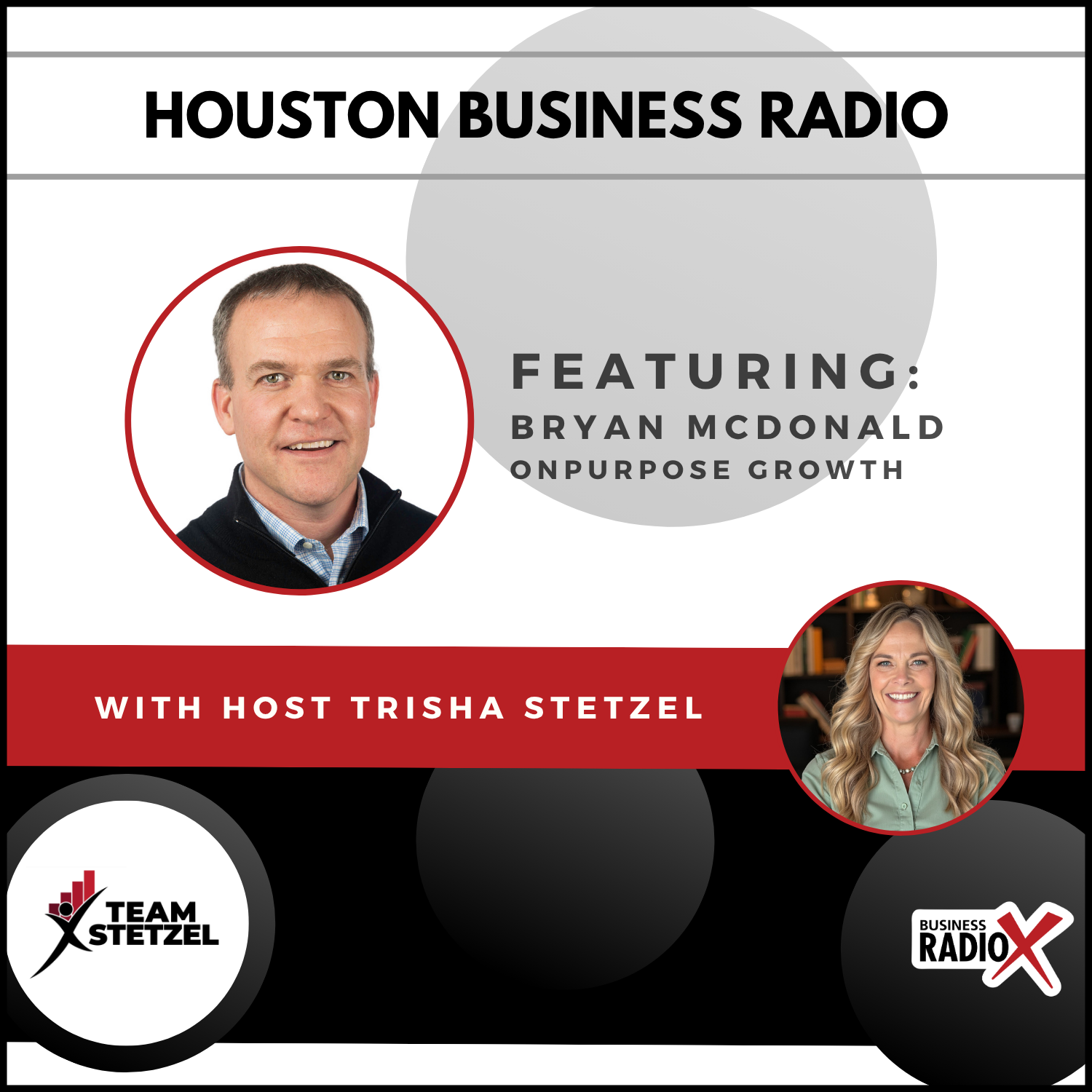


 Bryan McDonald has spent his whole 24+year career in new revenue growth, focused on a client centric sales strategy that created a track record of success by serving vs selling people.
He is a partner at onPurpose Growth, a coaching and consulting firm that serves entrepreneurs who have ambitious yearly or multiyear revenue goals, fulfil that ambition.
He helps entrepreneurs build sales systems & practices that predictably grow revenue. Clients say that when they apply what they learn from Bryan they are assessed as rare by their prospects and clients so, their offers are more readily accepted vs people with common skills and practices.
Bryan has served entrepreneurs by helping them go from as little as $75k in revenue all the way to $1M+ in 6-18 months using the strategies, tactics, mindsets and frameworks he and his partner Jeff have put together.
LinkedIn: https://www.linkedin.com/in/mcdonaldbryan/
Website:https://www.onpurposegrowth.com/
 This transcript is machine transcribed by Sonix.
TRANSCRIPT
Intro: Broadcasting live from the Business RadioX Studios in Houston, Texas. It’s time for Houston Business Radio. Now, here’s your host.
Trisha Stetzel: Hello, Houston. Trisha Stetzel here bringing you another amazing episode of Houston Business Radio. I’m stoked. We had such a great pre pre conversation. I can’t wait to get into the meat and potatoes here. I’m joined by Bryan McDonald partner at On Purpose Growth, a coaching and consulting firm that helps entrepreneurs predictably grow revenue through better sales systems and practices. Bryan has spent more than 24 years in new revenue growth, with a client centric approach built around serving rather than selling. He works with entrepreneurs, consultants, founders, and experts who are great at what they do, but may not naturally see themselves as sales people. Sounds familiar. Helping them strengthen their communication mindset and sales practices so they can differentiate them, differentiate themselves in meaningful ways, and grow their business. Bryan is also the coauthor of Peak Performance Sales, and his philosophy around sales is refreshingly human. How you show up, how you communicate, and how well you understand the person across from you matters more than simply learning another sales technique. Bryan, welcome to the show.
Bryan McDonald: Oh, thanks for having me, Trisha. This is going to be fun.
Trisha Stetzel: Oh my gosh, it totally is. And we should have been recording all of our call. It was so good. So good. It’s okay, you guys, if you’re listening or watching, we’re going to get there, I promise. But before we do, um, Bryan, I’ve, I’ve let the audience know all about your professional bio. They’ve got a sense for who you are, but what else do we need to know about you?
Bryan McDonald: Um. I didn’t sign up to be in sales. Uh, I, I, uh, I’m a I’m me. Uh, excuse me. Uh, I’m helping people who are me. 26 years ago. Right. Uh, I was as much as I seem like an extrovert. I was a people pleaser. I cared what people thought about me. I hated rejection. Blah, blah, blah, blah, blah. And and actually, my first job out of college, I applied for a marketing job. I have a management marketing degree. And when I showed up the first day, I realized it was a sales job I didn’t know. Yikes. So, uh, it’s proof that even though you’re not a natural salesperson, this can work well when you approach it in a way that’s human centered, authentic, uh, and based in communication, not, uh, manipulation tactics.
Trisha Stetzel: Mhm. Yeah, absolutely. So I want to talk about that human centric piece of it. But before we go there, just to level set, I feel like we’re all in sales. It doesn’t matter whether you’re standing in front of somebody else’s brand, you don’t have a brand, you have your own brand, you’re an entrepreneur, a leader. We’re all in sales in some fashion. So can you just take us down that path for a minute and tell me what you think about that statement?
Bryan McDonald: I think it’s true. If you’re ever trying to, um, I’m going to say enroll someone in what you want or your way of thinking. You’re in sales. So, uh, my wife wanting me to do something around the house is sales. My youngest daughter trying to get me to take her to the pool is sales. Uh, I mean, you name it, right? Like so many people say, I don’t understand sales. I’m not in sales. But the the truth is the opposite. Everybody is. You cannot avoid it in the world that we live in.
Trisha Stetzel: That is so true. And so, um, why doesn’t being great at your craft, like you’re really good at something, you’re very passionate about it. Why doesn’t that automate automatically make you a great sales person selling that product or service that you have so much passion for?
Bryan McDonald: Uh, a lot of times, uh, the expertise causes us to actually try and sell, to convince people, um, of our skill set and our expertise. And in the world we live in, buyers are coming to the table, understanding that you are an expert at what you do and it’s table stakes, right? This is more about, uh, communication than it is, uh, convincing someone like you. We were talking about this, uh, pre-recording. I don’t believe you can convince anybody of anything. And when you try to push or sell your expertise on, on, on someone, so they work with you is convincing them. And, and I just, I firmly believe, look, I can’t make you do anything at all, right? I can give you some data points that allow you to choose, but it’s called free will for a reason.
Trisha Stetzel: I get to decide.
Bryan McDonald: Exactly.
Trisha Stetzel: Uh. Huh. Yeah. So I’ve heard that people buy based on emotion. What do you think about that, Bryan?
Bryan McDonald: Uh, we’re irrational human beings. Mhm. Um, so we lead with, uh, we lead with deciding on emotion, and then we fill that in with ration. So an example, simple one. I have never bought a car with ration. I have only bought it with emotion. Like there’s times where I’ve, uh. I’ve just showed up to the car dealership to get my car fixed. And I bought a car when I was done. So now I stay away because I take my car to the Ford dealership. I stay away from the sales floor because I know what’s going to happen. Right. Uh, because we’re emotional beings, we can’t, uh, get around that. And one of our feelings is we want to be heard and understood.
Trisha Stetzel: Mhm.
Bryan McDonald: Right. It’s, uh, there’s a bunch of emotions mixed up in that. Uh, but the ration of our emotions drive us to start making decisions, and we complete this decision with, with some type of ration. And sometimes you probably I agree with me is the, the ration is, is, uh, irrational, right?
Speaker 4: It can be for sure.
Trisha Stetzel: Yeah. Let me rationalize this emotional decision that I just made.
Bryan McDonald: Correct. Because it’s tied. Things are tied to what we want. Right. What we sell is a means to an end of something. I emotionally want to provide for my family. I emotionally want to be successful. I emotionally want to succeed. So when I buy things or do things, I’m leading with that emotion and then deciding how I’m going to do that with ration.
Speaker 4: Mhm.
Trisha Stetzel: So we we also don’t want to go down this path of manipulating someone’s emotions. So I want to come back to this client centric or human focused, um, piece that I brought up a few minutes ago. I want to come back to it. So let’s talk about your approach that client centric and focused on serving versus selling. What does that mean?
Bryan McDonald: I use the word enroll for a very specific reason. A couple minutes ago. Um, and, and what I mean by that in, in this client centric approach is I make things all about other people. I lead with their best interests in mind. And I ask them questions that allow them to enroll themselves or not into my way of thinking. Right. Uh, because then they have that free will and they can, uh. They can, they can make their own choices. And, um, the number one thing people like to think about is themselves the number one thing people like to, to think about when they’re not talking about themselves is themselves, right? Uh, so that where they’re talking about ourselves, they’re thinking about ourselves. Um, so if we understand that, we understand how we have to orient to sales, Uh, and, and I, I, I, I, a client centered approach to me, one of the tenants is lots of questions, right? Uh, and I’m trying to figure out, uh, if I can help this person or not. So when I go into sales conversations, there’s always two answers. Uh, uh, yeah, I’ll leave it at that. Two answers. Yes. They want to work with me. And no, they do not. Many people enter into sales conversations with a yes only. Uh, and that creates a lot of problems for people, right? Um, uh, here, here’s here, here, here’s the impact of this can make and I, I, I take sales and, uh, business development, looking for referrals as the basically the same approach.
Speaker 4: Yeah.
Bryan McDonald: So when I’m asking, when I’m searching for referrals, I’m making it all about other people. There was once, years ago where I was introduced to a lady, uh, by another lady. We sat down and we talked. All I did was ask her questions, and I made the meeting all about her. About her referrals. Uh, she talked for 55 minutes and I talked for five because at the end of 55, she said, oh my God, Bryan, I’ve been capitalizing on all this time. Who can you help and how can I introduce you? And I just kind of framed it in her world. She gave me two introductions. But here’s the amazing thing. She went back to the lady that introduced us and said, Bryan is the most interesting person I’ve ever met. I, I didn’t really talk. Right. Uh, the impact, that’s the impact you can make on your referral network. You can make that impact on, on your clients. Like, uh, here’s another one. I’ve had many people say, Bryan, uh, I’m talking to other people about what about getting help and you are way more expensive. But you actually understand me, so I’m going with you.
Speaker 4: Mhm. Mhm.
Trisha Stetzel: Because you took the time to ask all of those questions and really understand what it is that they need. Oh my goodness. Yes.
Bryan McDonald: I don’t do the. A buddy of mine, uh, Ty says the value vomit when people meet, meet me. I don’t vomit on them. My value. Uh, I start pulling out of them. What they want, what they’re looking for, what are they running into? Um, I barely talk about myself because they don’t care.
Trisha Stetzel: Yeah, no they don’t because they care about themselves and what they’re going to get out of the conversation they have with you. That’s just the bottom line. All right. Um, so Bryan, take me back to, oh my gosh, this is a sales job in 24 years ago. So how did you figure it out? How did you figure out what worked for you? And then leading into how you help others.
Bryan McDonald: Um, a couple things. Uh, I’m mistaken on purpose. You know, I just, uh, throughout my life, my parents been divorced since I was one. My mom had a, a nasty second marriage to an alcoholic. And then, you know, I live with my dad. Uh, in high school, and he worked two jobs, and I was always on my own. So my general strategy in life is I’m just going to lean in and figure out what happens. So when I got that job, I just leaned in. I go, okay, I’m just going to throw myself out there. Right. I had a client base and I would just show up and be me. Uh, I didn’t really try necessarily to sell anything that wasn’t on purpose. That was just like ignorance at that point. Uh, and about six months into the job, my sales manager came out with me saying, hey, I want to go. I want to go, uh, on, visits with you to to clients and a majority to about half of my client base. He had had uh, prior and I experienced the following. I remember I was sitting in, uh, Melrose Park, Illinois, in front of a president of a company that’s about $80 million.
Bryan McDonald: I forget what he manufactured. And I was sitting there with my sales manager. And either before, during or after the meeting, the sales manager got up and went to the bathroom. And this gentleman was in his 60s, maybe early 70s, and he leaned across the table. When my sales manager left, he goes, Bryan, if you ever come back here with him ever again, I’m not letting you in that front door. I like you and not that guy. I was like, oh, that’s kind of weird. But then during this process, I also got phone calls from other clients after we showed up. Hey, next time if you’re going to come with him, can you give me a heads up? Because I’m going to decide if I I’m telling you I’m somewhere else. Or if I got the time to put up with his crap. So he was a great mentor of what not to do. I figured out like, just do the opposite of that. Mhm. Um, and then after that job, I was, I, I didn’t, I, I made it about a year. Uh, I’m not, I have an authority issue. I have a problem. Uh, so I.
Speaker 4: Could, you can.
Trisha Stetzel: Admit it. Bryan.
Bryan McDonald: Yeah, I do, I have authority problem. Uh, so I just used to get jobs that, um, were basically full commission. I was an entrepreneur inside the business and it was like, hey, here’s a desk and a phone. Here’s what we do. Little slap on the back and let me know when you need help. So I had to figure it all out. So I went to, to mentors. Um, I, I sought out people that approached sales in a way that I thought was good. Uh, or I liked and I could, um, I could adapt, I learned how to build a referral network. And then after I learned how to build a referral network. I learned how to sell without selling.
Speaker 4: Mhm.
Bryan McDonald: Uh, because it was something I wanted to understand, but I just didn’t know how to fully execute, make it repeatable. And I met a guy, Bryan, who’s a friend today where I paid him a ton of money for sales coaching in his very first lesson was like this. He sat me down. He goes, okay, here’s what we’re gonna do. Here’s how you’re going to sell a lot. I go, what? Tell me, I’ve got notes and everything. He goes, you’re going to stop selling. I’m like, what? He goes, yeah, you’re going to stop. Stop all that crap. And I’m like, okay. And I dove in. Uh, I learned how to listen. I learned how to communicate. And then I met another mentor where I spent two years with him specifically learning how to, uh, advance listening and advanced communication and really how to drive home a client centric approach. Um, so I learned from people who were approaching it the way that I wanted to. I never stopped learning. Right. Uh, and I realized along the way, it’s not about me. Right. And I think too many people that I like to see who are really good at what they do that can make an impact. And they’re not because they can’t convert prospects or making sales all about them. They cannot listen, they cannot communicate, and it shows up in their results. Uh, so I would say like as a basic, those three, four things are how I became successful. There is no easy button or, or, uh, shortcut, right? There’s no trick. Uh, I tell clients this is just how I show up in the world. The, the sales, Bryan and the Bryan with his friends is not, is not different, right? Uh, I don’t put on a different persona. Right. This is just how I show up in the world.
Trisha Stetzel: And that’s the way. Yeah, that’s the way we should all be when it comes to sales, right? And if you have to, oh my gosh, you’re listening right now. And you’re like, no, I don’t want to get out there and sell myself. Okay, then go build relationships because that’s exactly what Bryan is talking about. Go build relationships, not stop talking about selling. And one of the things that I heard you say, probably in the, I don’t know, three conversations ago was the best way to sell your expertise is to stop talking about it. Right? Stop talking.
Speaker 4: 100%.
Trisha Stetzel: And make it about the other person.
Bryan McDonald: My buddy Bryan, um, taught me the principle is you become more a couple things. One, you’re interesting if you’re interested in other people.
Speaker 4: Mhm.
Bryan McDonald: The other thing is, uh, everybody listening or watching can probably relate to this. You meet someone that they’re for the very first time, or you just know them and all they do is talk about how awesome they are, how things are great. And it’s, it’s annoying as hell, right?
Speaker 4: You saw my deep breath like.
Trisha Stetzel: Oh, I know people like that, right?
Speaker 4: But then.
Bryan McDonald: But then there’s people that don’t do that. And then you also you, you question their success, right? Like, hey, if you can’t stop talking about it, you’re overcompensating. But then you meet people who are highly successful and don’t really talk about it. So when they share those tiny things about how they successful are you, their authority goes through the roof. Like my buddy Bryan. It took him. I don’t even think he told me. I found out from other somebody else after knowing him for about five years, um, I, I found out that, uh, he was part of the executive team or the main driver that grew a business from start up, and they sold it for $800 million.
Speaker 4: Wow.
Bryan McDonald: In the, in the, in the late 90s.
Speaker 4: So think about wow.
Bryan McDonald: Yeah. And, um, uh, it’s, it’s when you don’t talk about yourself and your expertise is important, but two, you can actually, uh, not exude illustrate your expertise by the questions you ask, not by the statements you make.
Speaker 4: Yeah, absolutely. Okay.
Trisha Stetzel: Bryan. Um, for those that are listening, who, who do you work with? Like who’s your ideal client? And then tell us how they can connect with you.
Bryan McDonald: So we kind of alluded to, uh, alluded to it, it’s people who, uh, one want to learn how to sell without selling or two, uh, are they’re experts. They have some type of expertise that they’re selling in a product or service, and they don’t feel like they’re a natural salesperson and they don’t, and they feel like, uh, people don’t understand their value or they’re getting beat by competition that is, um, isn’t as good as them. Uh, and there’s a couple ways to get a hold of me, uh, all my social media, LinkedIn, Facebook, Instagram. Twitter is my last name. First name McDonald. Bryan. Uh, I’ve even got a personal website with that. But then also I’ve got a, a, a free sales community. Uh, if anybody goes to paid what you are worth.com. That’s paid what you are worth.com. Uh, you can find me there. I, I just came out of doing something in there before we hopped on to this. So, um, those are the best ways to find me.
Speaker 4: I love.
Trisha Stetzel: It. That’s fantastic. And if you’re looking for him on social, it’s BRYAN, just in case. Just in case BRYAN. Okay. Um, I can we talk about differentiation? So we’ve you talked about building relationships. Just be you, uh, be curious. Listen, instead of trying to tell them everything that you bring to the table. How do you differentiate yourself from all of the other people out there who are maybe selling something similar to your product or service?
Bryan McDonald: Yeah, I was just thinking about this. Listen to a podcast today. So there’s a way to differentiate your offer and service. But I also want to say those things that you just listed, those things differentiate you too. People want to, uh, uh, hear you hear that you’re different and they want to experience that you’re different. I think that’s important. Right? Um, uh, but here’s, here’s, uh, differentiation. You have to figure out what lane do you want to own and own it? Uh, I forget the guy’s name, but I was listening to Lewis Howes, uh, the School of Greatness podcast this morning. He had somebody on about manifestation and he was basically talking about like, hey, people think that I’m like a Joe Dispenza world, but Joe’s like the rabbit hole. I’m at the front end of that when you’re dipping your toe. And I was thinking to myself, that is great differentiation because on the surface level, you would, you would think they’re doing the same thing. But he not only, uh, clarified how he was different. He actually put himself in a timeline of where people would be on that, on getting that type of information and said, hey, if you’re here, this is where this is where you use me. Um, so what you have to do is you have to think about what you’re really good at and, uh, and where in the timeline of, uh, the category that you’re in the category, meaning like, uh, consulting, coaching, uh, accounting, whatever the, uh, where you’re at in the timeline of your prospects journey.
Bryan McDonald: Um, because you could be at the beginning, you could be at the middle, you could be at the end. Um, uh, so think about them in that, uh, in that differentiation, um, and be able to be in a room with your competition and you can explain how you’re different and somebody can actually pick it out as well, right? If that’s happening, you’re doing well. Um, but, but you really have to claim, um, your stance, uh, put your stake in the ground, your stance on how the problem is solved and how you have uniquely solved it. Um, to, to start differentiating. And last thing on this, if you’re saying I do good customer service, I take care of my clients, we put them first. Everybody, everybody says that, um, you have to be able to, uh, you can’t look at your website and ten of your competitors and they all say the same thing. You’re not different. If that’s the case. Am I making sense?
Trisha Stetzel: Yes, absolutely. And it’s so true. Um, all right. I want to talk a little bit about mindset. Uh, as we’re kind of getting to the back end of our conversation because I think it’s really good to roll this into what we’ve already talked about. So it’s, it doesn’t have to be sales if that feels heavy. Oh my gosh, we’re all in sales, by the way, so get over it. But if you can’t get over it, then just call it relationship building and that will help you get over the hump. That’s what helped me. I was scared to death right, of this word sales. So I just started thinking about it in the way of, um, relationship building. So when it comes to mindset, uh, I, you’ve said in one of our conversations that mindset trumps technique 100% of the time, right? Um, I before we go to that particular statement, I want to talk about the no. And oh, as you mentioned it a couple of times at the front end of our conversation that it’s a yes or a no. And the no feels so awful. It’s so icky and nobody wants to hear it. So from a mindset perspective, talk to me about the no.
Bryan McDonald: Here’s what I would say. Um, it’s, it’s attached to that, but, but different.
Speaker 4: Okay.
Bryan McDonald: Um, I tell clients detach from the outcome. Mhm. Before you enter the conversation. And the only, uh, because lots of these things are connected. So the only way I believe I can make it all about somebody else and client centric and their best interest is if I enter that conversation, almost neutral. It’s not saying that I’m not going to prepare. I’m just going to detach from the outcome. Um, because that communicates nonverbally, right? To someone that it’s safe to tell me the truth that, um, you, you don’t have to say yes to me. No is an option. And for ideal prospects, that actually helps people say yes faster and more. Right? So it’s like if I let go and, and just let’s see what let’s be open to possibility and what happens. Many times what the no turns into is I wasn’t a good fit. Uh, they’re not ready. Uh, or something else that, uh, that ultimately doesn’t mean, uh. How do I say this? The no isn’t about me. It it. You understand what I’m saying?
Trisha Stetzel: I love that I tell people all the time. It’s it’s it’s not you. It’s them. It’s not, you.
Speaker 4: Know, I mean, it’s that’s.
Bryan McDonald: How I think about here’s how I think about price too, because this is kind of attached to this is if, if I may, if I have a client centric approach, um, and, uh, both the, the person I’m talking to and myself believe that I can fix their problem, um, that they see I have a history of it and they have confidence in it and I offer and, and I’ve established ROI if I offer up a price and they decline and I want to present it this way, this is not a judgment. This is totally neutral to me. It’s they’re just not committed to themselves.
Bryan McDonald: The price and the investment is a commitment to themselves, not a rejection of me. And that’s okay.
Speaker 4: It is. Right.
Trisha Stetzel: And that’s all between your ears.
Trisha Stetzel: It really is all between your ears. All right. Um, we ran out of time. Oh, my goodness gracious. This is such a good conversation. I have so many more questions. We’re going to have to do this again. I think I’m going to come on your show. Maybe we’ll have some conversation there. Yeah.
Trisha Stetzel: Um. All right. Give me a quick summary of peak performance sales, which is a book that you coauthored.
Bryan McDonald: Uh, so peak performance is all about a client centric approach is, uh, uh, how do I put prospects first? How do I ask questions to establish authority and get the information I’m looking for for both me and the prospect to decide if we’re a match and or if we could continue the conversation. Um, and what it does is it takes this mindset and approach takes the pressure off of you. So you get out of your own way and you start serving people instead of selling them.
Trisha Stetzel: Yeah. All right. Mic drop. Start. You should be.
Trisha Stetzel: Serving, not selling. Um, Bryan, where can they find the book if they’re interested in getting that?
Bryan McDonald: Uh, Amazon. Amazon is the, uh, the only place, uh, it’s a great book. It’s more than just me in that book. So you’re going to learn a lot of mindsets, uh, in that book. It’s, it’s basically based on, uh, different mindsets and sales. Uh, so if you want to work on your mindset, go get it.
Trisha Stetzel: I love that peak performance sales. You guys, uh, go out there and take a look. All right, last question for you as we close up today. And if someone who’s listening today, um, were to take just one thing away today about becoming better at sales without becoming someone that they’re not. What would you leave them with?
Bryan McDonald: I’m going to go back to detach from the outcome. Uh, I think if you focus on that and learn how to do that, a bunch of other dominoes that you want to fall, fall in place. Um, and you’ll get closer to getting what you want.
Trisha Stetzel: Oh my goodness. All right. You guys all have to know that I met Bryan through another person who knows Bryan, that knew someone that I knew, that knew someone else that I knew. And Bryan and I eventually found each other. And I’m so excited that we’re going to continue collaborating on a few things. And I can’t wait for people to reach out to you and have a conversation. So, Bryan, one more time, how can people connect with you or find more information?
Bryan McDonald: Yep. Uh. Paid what you are worth.com is a free sales community. It has a bunch of stuff we’re talking about and on social media anywhere. It’s my last name. First name McDonald. Bryan. And like you said, Bryan with a Y.
Trisha Stetzel: I love that.
Trisha Stetzel: Bryan with a Y. Bryan, thanks so much for spending your time with me today. Really appreciate it. All right, you guys, that’s all the time we have for today. If you found value in this conversation that Bryan with a Y and I had today, please share it with a fellow entrepreneur, veteran or Houston leader ready to grow. Be sure to follow, rate and review the show. It helps us reach more bold business minds like yours and your business. Your leadership and your legacy are built one intentional step at a time. So stay inspired, stay focused, and keep building the business and the life you deserve.