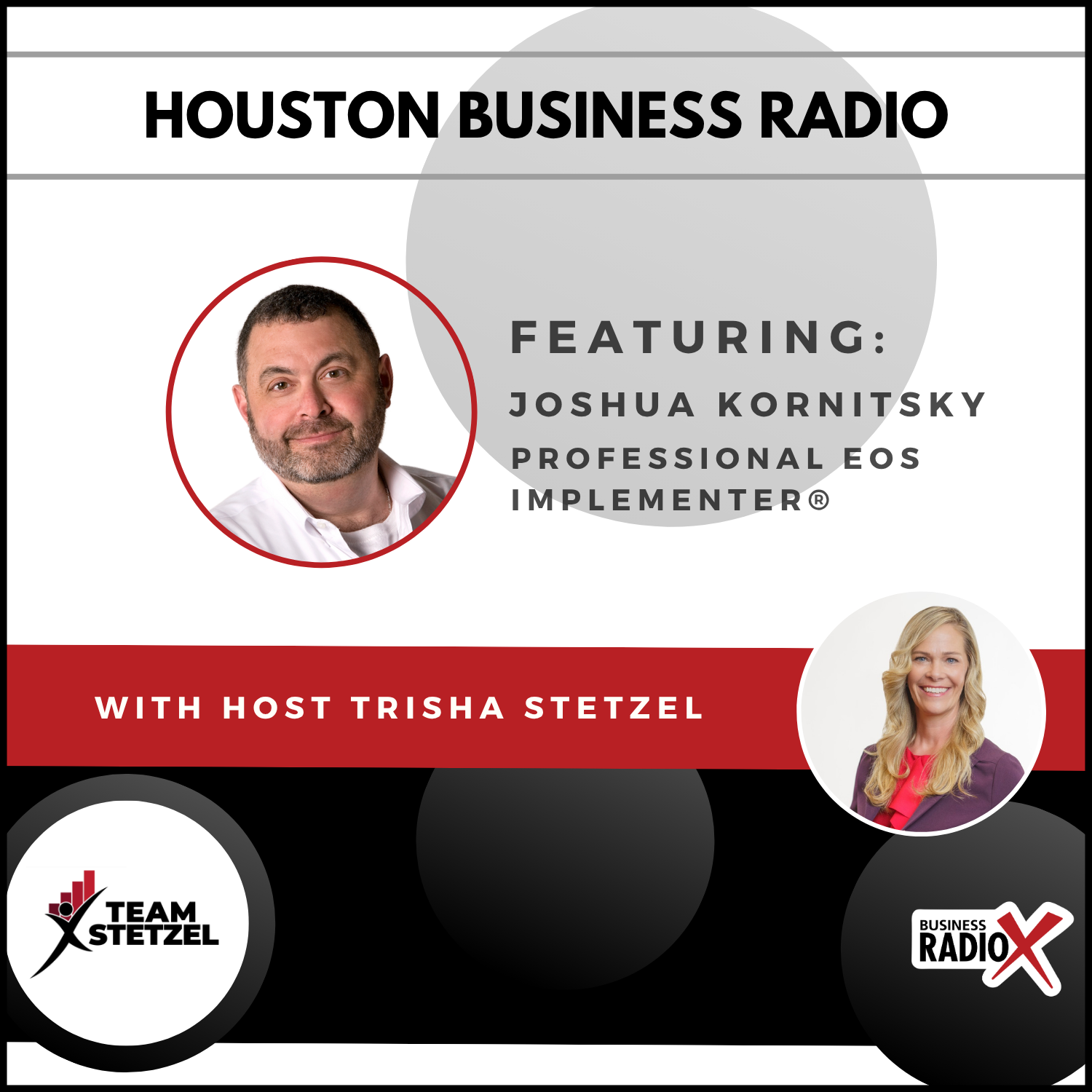


 Joshua Kornitsky is a fourth-generation entrepreneur and Professional EOS Implementer® with more than 20 years of experience across technology, strategy, and business leadership.
His career began in the automotive industry alongside his father, giving him early exposure to the complexities of running a family business. From there, he expanded into IT, software development, training, and executive leadership, cultivating a deep understanding of organizational growth and operational efficiency.
In 2015, Joshua helped lead a company through the implementation of the Entrepreneurial Operating System® (EOS®), which became a turning point in his career. I
nspired by the transformation he witnessed firsthand, he later co-founded a simulation-based training software company, which he also ran on EOS. These lived experiences—as a leader, founder, and now implementer—give him an authentic, practical lens through which he helps teams break through ceilings and achieve clarity, alignment, and accountability.
Today, Joshua coaches leadership teams nationwide, guiding them to execute their visions with purpose and discipline through the EOS framework. He also hosts a show on Business RadioX, where he highlights inspiring business stories and community impact.
Based in Georgia with his wife, two daughters, and mother, Joshua brings both heart and strategy to every client relationship, offering coaching in person and virtually across the U.S.
LinkedIn: https://www.linkedin.com/in/joshuakornitsky/
Website: http://atlantaeos.com
 This transcript is machine transcribed by Sonix
TRANSCRIPT
Intro: Broadcasting live from the Business RadioX studios in Houston, Texas. It’s time for Houston Business Radio. Now, here’s your host.
Trisha Stetzel: Hello, Houston. Trisha Stetzel here bringing you another episode of Houston Business Radio. Today’s guest is Joshua Kornitsky, a fourth generation entrepreneur and professional eo’s implementer with more than 20 years of experience in technology, business strategy, and organizational growth. Joshua first experienced the power of EOS as a leader in 2015, when this system brought clarity and growth to his own company. Since then, he’s lived EOS as an owner, a leader, and now as a coach, helping leadership teams across the country align their vision, strengthen accountability, and execute with confidence. He also hosts a Business RadioX show. You guys Have to Listen to It, where he highlights business leaders making an impact in their communities. Joshua brings a unique perspective on how iOS transforms both companies and cultures. Joshua, welcome to the show.
Joshua Kornitsky: Thank you for having me, Trisha. It’s really great to be here.
Trisha Stetzel: I’m so excited. I can tell when I’m doing people’s bios, they get a little uncomfortable. They’re like, really? She’s going to say all those great things about me. Yes, I am, because we don’t do it for ourselves very often.
Joshua Kornitsky: It’s true, it’s true.
Trisha Stetzel: Very excited to have you on today. So, Joshua, tell us a little bit more about who you are.
Joshua Kornitsky: Wow. Well, thank you for the opportunity to talk about myself. I appreciate that. Um, as you said, a fourth generation entrepreneur, uh, I was born in the northeast. My parents, my grandparents both owned new car dealerships, and just through the evolution of what that business was like, I ended up in the car business. But we as a family are no longer involved. Uh, and to go back to the to the great great grandparents, that first generation of entrepreneurs, uh, they were immigrants coming here and did what they needed to do in order to get started. And in those days, pretty much everybody had to be an entrepreneur in one way or another. Um, I’m I’m somewhat amused and pleased to tell you that my great great grandmother, uh, was a bootlegger, um, making, I presume, bathtub gin, that I’m not a gin guy. But if I could figure out how to make bourbon well, at home, I might do that. Um, but I. I was born into the automotive industry, and I’m forever grateful for that because, um, it allowed me to see every aspect of of the good, the bad and the ugly of working with businesses, working with people And learning how to engage and interact. Because as the auto industry has in many regards, uh, created a negative impression of itself, not everybody is that way. And having grown up, uh, and being taught by my dad, who also had been in it since he was a teenager, I learned that there were two ways you could approach things. One was to to hit a customer over the head hard and make a bunch of money, but never see them again, or take good care of a customer. Make a fair profit, treat them well and you will see them over and over. And that was kind of my foundation in business was understanding that. And uh, when my dad passed, he was selling cars to the grandchildren of people that had bought cars from him initially. So it’s a proven process, right? It’s a strategy that works. Treat people well and they’ll come back to you. Yeah, absolutely.
Trisha Stetzel: Absolutely. That is an amazing story. Thank you for sharing that and being a fourth generation entrepreneur is, um, I find few and far between. We don’t see as many people coming from that background, if you will, and I love the lessons that you’ve learned from that. So you’ve also worked across IT industries, software design, executive leadership. How does that play into where you’ve landed today? And being in a an owner or a coach in the EOS space?
Joshua Kornitsky: So thank you. That’s a great question. Um, the first thing that I’ll tell you is that that anything with technology, whatever I used to know has a limited applicability today, but the skills remain the same. And in the skills that I developed, because I, I was early in on technology when there weren’t very many people in able or capable or knowledgeable or more directly curious, uh, that that we’re able to step up and learn and help. So the biggest thing that I think technology brought into my life that carried forward to now is that curiosity, because I’ve learned over time that the best way that I can offer any type of guidance or structure through iOS or through any other engagement is to understand first what it is that the the individuals I’m dealing with are contending with. And, and it’s all too easy to be prescriptive and to walk in the door and say, well, here’s this system. Everybody needs to do what I say when I say, and it’ll all work out. Number one, you’re not going to succeed. Number two, they’re not going to succeed. And number three, if you try to use the same recipe, you can’t bake 17 different cakes. You’re only going to end up with one. And it’s probably not going to be a good one. My apologies. That’s my mom ringing through on bypass.
Trisha Stetzel: You know what? It’s all good. And listen, we’re all human here. And even before we started recording, we talked about, uh, how we both are caring for aging parents. And it happens. Right? It’s just part of what we do.
Joshua Kornitsky: It does? And, uh. Yep. It does. And I and I love her dearly. And I’ll check on her as soon as we’re done.
Trisha Stetzel: Yeah. This is what makes us human, Joshua. Fair enough. All right, so, Joshua, clearly you have a great IT background, leadership background. I’m very curious. I’d like to roll you back all the way to 2015 with your first experience with, um, iOS and the implementation of that. What was the biggest shift you noticed in 2015 that really grabbed your attention about this implementation?
Joshua Kornitsky: Well, so let me set the context a little. We I had been recruited to become chief technology officer for a B2B lead gen company. Me, and they were a successful company. They’d been in business at that point, probably eight, eight, nine years. Um, and they were growing, but they’d hit a ceiling and, and that’s what caused them to go out and look for help. And, and quite often that’s what brings entrepreneurs looking for a solution is, is what brings them to the book traction, which is what EOS is based on by Gino Wickman. And for us, um, they brought an implementer in or the CEO brought an implementer in. And we began the process and it’s quite normal. Um, I remember to this day it’s quite normal to think, oh, it’s the flavor of the month. You know, this month everyone’s going to wear blue shirts because it’ll change the way we are. Uh, but it turned out that the system really isn’t promising magic, and that’s what got my attention first. The second thing that got my attention was it doesn’t pretend to bring magic, the discipline and the accountability that I learned. And the biggest thing that changed for me was understanding that you you could have a highly accountable culture and still be at a place that people enjoyed working because the, the, the assumption is quite often that, that, oh, well, you know, you’re just bringing in more scrutiny, more depth of drilling down to understand every aspect of where every second of every day goes. And that’s not at all what it’s about. What it’s about is understanding that in an open culture where people aren’t afraid and they understand their job and they align to the core values that they’re actually able to to exceed their own expectations and provide an unbelievably, um, inspired level of, of work and service because they want to be there.
Joshua Kornitsky: And that to me, that spoke to me, that’s who I am. I’ve always been someone that’s been drawn to making sure that the work that I do matters to me. I’m a fan of Daniel Pink’s book drive. And in in drive, he talks about how intrinsic motivation is by far the most powerful form of motivation out there, and that’s what speaks to me. So what I found in iOS as chief technology officer was the ability to help the folks who worked with me do, uh, their jobs more effectively, to have clarity when they came into work to understand what the expectations of them were at both a micro and a macro level. And together we were able to set goals that made sense. That helped drive us forward. And I know it sounds like I’m reading off a cue card, but that’s really what what excited me about it. So much so that that I co-founded a software company with one of the principles of, of, uh, the company I was working for. And we started with us right out the gate. And it was only because we were both experienced in it that it made sense. Typically, it doesn’t really align with the startup. But, uh, while I did step away from that company, I believe they’re still running on us today. Wow.
Trisha Stetzel: That’s amazing. All right, so I want to take a deeper dive into iOS. There are likely people listening who have no idea what iOS is, and there may be some misconceptions about it. You tackled a few of those things as you were talking about your experience in the beginning. So let’s talk about iOS. Take a deeper dive and any misconceptions that you think people may have about it.
Speaker1: Sure.
Joshua Kornitsky: That’d be easy. The the very briefly, what iOS does more than anything else is three things. It gets everybody aligned around the vision of the founders of the organization. It instills discipline and accountability, Traction, as we call it, and it works to help the leadership team, which in an entrepreneurial business, which is who we typically work with. Often that that leadership team came together because different people with different skill sets organically either grew into the role or there was an identified need, and they brought somebody into the role, and they typically can have very disparate backgrounds and very disparate experiences. So while they’re capable of working together, they may not have healthy relationships as a leadership team. So that’s what we do is we we do that vision traction, then help them become healthy. And as the leadership team embraces it, so does the rest of the organization. And that’s really in a nutshell, what what EOS can do for a business and as it progresses and matures. And I had a quarterly planning session with one of my, um, I’m already graduated clients, meaning a client that went through the whole system, which takes about two years and they still bring me in to facilitate their quarterly and their annual planning. And we pushed hard as a group to see what we could do to continue to improve what’s already working. Because I’m not a believer in saying, you know, nobody on a scale of 1 to 10, nobody’s a ten that doesn’t speak to who I am. You can get to attend, but I’d like to believe that there’s an 11. I’d like to believe that we can continue to grow and excel, but it all starts with the work they do. So the only thing I really do is facilitate the brilliance in the room. I don’t bring the brilliance. I just bring a structure that that makes it.
Trisha Stetzel: And that’s what makes you a great coach. I love that, Joshua. It’s all about standing in the greatness of our clients, right? I think you and I share that same ideal. Um, if people are already interested in having a conversation with you. They want to learn more about iOS or the implementation, or just ask you some questions. What’s the best way for folks to connect with you?
Joshua Kornitsky: So I’ve got a long first name and a long last name, and I my my email address is at EOS worldwide. So what I did is I took my cell phone number (678) 414-7696, which you can call. But I put a I registered it as a URL. So dial that.com and it’ll bring you to the the website where you can get in touch with me. Uh because otherwise it’s Jay at EOS worldwide. Com and I joke that I have to get extra long business cards in order to fit that. So 6784147696.com we’ll get you to me.
Trisha Stetzel: Wow. It says the guy who infamously comes from technology. What a great idea.
Joshua Kornitsky: I just want to make it simple. You know, the easier we make it for people to find us.
Trisha Stetzel: Yes, absolutely. Okay. For those of you who are going to go look up Joshua or find him on LinkedIn. His name is spelled j o s h u a last name k o r n I t s k y. It’s so much easier to go to his phone number. Com so.
Joshua Kornitsky: You can go.
Trisha Stetzel: Everything that you’re looking for. You guys know I’ll put that in the show notes so you can point and click. If you’re sitting at your computer please do not do that. If you are driving in your car, wait until you get home and then you can point and click and connect directly with Joshua. Okay. So back to this conversation. Listen, you’ve lived iOS as a leader and owner and implementer. You bring such a unique perspective to your clients because of that and because of your background. So I’d really love to hear tactically, um, how you really create this alignment. Right? You talk a lot about culture in the business and the leaders embracing what’s happening, and then everyone follows. So give me some like tactical ways that that’s happening as you’re implementing this tool with your clients.
Joshua Kornitsky: So the way that that we work with our clients and I say we because there are 850 US implementers around the world, uh, we all can determine where we help one another. I’m willing to travel. Others aren’t. Uh, I have clients that are fully virtual, and I mention that because the journey is the same, regardless of whether it’s virtual or in person. We start with a day called a focus day. Actually, back it up. We start with what’s what’s a 90 minute meeting, which is where the leadership team, uh, gets into a room with me or gets onto a zoom call with me and I give them a 10,000 foot overview. Because if you expect someone to be able to jump right into something transformational with no knowledge. You’re going to be disappointed. So we give that 10,000 foot overview where I take them through at a very high level. How EOS is is designed, what it helps with, where it enables them to, to find areas to improve. And what is, as I mentioned earlier, what’s really, really important is it as a system. And this is something we say internally. It’s intended to be handrails not handcuffs. So we we want to to take them through the leadership team, through the education process. If what they hear in the 90 minute meeting speaks to them. And I’m going to give you a 45 second overview, we explain to them the history of the US.
Joshua Kornitsky: I talked to them to understand who they are and what their goals are. And then at a very high level, I take them through the six key components of iOS, which, when Gino Wickman wrote the book traction, what he ultimately determined was that all business problems fall into six categories vision, having people aligned with where you’re going, people having the right people in the right seats, data using real hard data rather than aspirational accounting, as I call it. Um, and when you’ve got that first half down where you’ve got the right people in the right seats, you know where you’re going and you’re using real data issues pop up. Pretty common, pretty clear. So we teach our clients how to identify and resolve those issues and make them go away forever. Then the fifth key component is process. And that’s just simply having determining what the right and best way things need to happen and getting that documented and, uh, followed by everybody there. That’s really the magical key to if there’s any magic here. That’s where scalability lives in. In. Trisha. I know that you are a veteran. And thank you for for your service. But in the military, a little bit process driven. I presume that process is there because it works.
Speaker4: Uh huh.
Joshua Kornitsky: You know, and and while it may be occasionally, uh, redundant, the best way to make sure that airplane takes off every time, the best way to make sure that that boat doesn’t have an issue is to have a checklist and to make sure. So we work with them, but they control the pace. And then the the last piece we do is we teach them about traction. We teach them about setting what we call rocks, which is a metaphor for a goal. And we teach them about having an established meeting pulse. And that’s really the 90 minute meeting, and we take them through it once they find that, that, that it is the right path for them. Uh, we’ll set up a focus day and we spend eight hours together with the leadership team. During that eight hours, we teach them about hitting the ceiling and how to break through hitting the ceiling. And then we start with this remarkable document that that is free to anybody that wants it at EOS worldwide. Com or they can reach me and I’ll share it with them. It’s called the Vision Traction Organizer. It’s eight simple questions. What are your core values? What’s your core focus? What are you best at? What’s your ten year or long term target? What’s your marketing strategy? Meaning what do you say to people? Who are the people you want to talk to? And what is it you say to them? Then we set out a three year picture, a one year plan.
Joshua Kornitsky: We establish goals for the next 90 days, and then we keep a list of all of the other issues that are important, but that we’re not going to deal with now because there is a magic to getting those on paper. Because if you and I talk about something and we both agree that someone’s got to walk the dog, but neither one of us write that down, the dog’s going to be scratching at the door or we’re going to be cleaning up. Um, and and really, that’s iOS at the highest level in a nutshell. There’s, there’s other tools that we teach over those two years. But once we’ve gone through those first initial three days, which are spread apart because you got to have time to absorb it, you’ve got to have time to to understand it and try it on. Then I meet with my clients once a quarter and and do a two day annual planning every year. And it just leaves them all of the time in the world to understand that the business has to keep going, to operate their business, to succeed in their business, but with a different structure and a, in most cases, a completely different type of accountability. Um, that’s that’s it in the nutshell.
Trisha Stetzel: Okay. Yeah. That’s amazing. Now, I heard you say I know people are already interested. They’re like, oh, I need to talk to Joshua because this sounds right up my alley. But I heard you say earlier that this isn’t necessarily meant for Are startups. So what type of client or you know, at what stage of business does iOS make the most sense for? And who do you find are your I’ll call them your best clients or your ideal clients for iOS.
Joshua Kornitsky: In a perfect world, iOS is is designed and built for organizations between 10 and 250 employees. I personally have clients with less than ten I don’t currently, but in the past have had clients above 250. But that’s the sweet spot. And in the idea behind it is a startup has uh. And I’ve been part of two startups. A startup has one thing in common. They all have is is too many hats and not enough heads. And in that instance, I will tell you that iOS could stop that brilliance from shining by imposing a rule set on a on a business that’s simply not mature yet. Um. With regards to anything that’s already struggling. While yes, iOS would help, we don’t typically want to talk to folks who are struggling because adding additional work into what is already a stressful situation is really unlikely to benefit them, because they’re in they’re in the staying alive mode. Um, so who we typically work with are clients that their business is doing well and they just can’t seem to break through to get to that next level. And they find the book traction because they’ve tried everything. And if you think about the entrepreneurial mindset, these are folks who solve their own problems. So they’re not accustomed to reaching for help. And when they finally have that moment where they go, you know, I’m going to have to reach for somebody, that’s when we can help them. Because if they’re not ready, and I’ll use the analogy that I use when I talk to people. If my lovely wife tells me, hey, you should lose a little weight, I’ll nod and acknowledge her. If my doctor says you really should use lose a little bit of weight, I’m going to pay attention, but I’m probably going to just nod my head.
Joshua Kornitsky: But when I go to put on my jeans and they’re a little tight, oh, crap, looks like I need to lose a little weight. That’s where we do the most effective work, because if someone or a leadership team or a leader doesn’t feel like change is the only thing that’s going to make the difference, there’s not any amount of anything I can say that’s going to change their universe until they’re ready to embrace it. And that’s the hardest part, because in that entrepreneurial mindset, I know it, I have it. Part of you feels like you’ve done something wrong if you need help. Yeah. And and I have very, very healthy clients that I, that I met that were already very healthy. And you still have to help them understand that, that if they are theoretically at $10 million and their goal is to get to $30 million in five years, the skills you need at 10 million are very different than the skills you need at 30 million. The personnel you need, the things that the business will require, all of those things you don’t necessarily have that ability to scale today. You can certainly plan for it. Yeah. And that’s just part of the natural growth that comes with every business. You can’t rush that. Uh, there’s a famous old technology book called, uh, The Mythical Man Month. And in that book from the 1960s talking about data processing on cards, they say that you you must work to overcome the common management belief that you can accelerate the baby by hiring nine pregnant women and be pregnant for one month only. It doesn’t work that way. There isn’t a shortcut. But. But there are best practices, and that’s what we can help them with.
Trisha Stetzel: I love that, okay, so I shouldn’t tell anyone that their pants are too tight. They have to experience it themselves. That’s what I’m getting.
Joshua Kornitsky: That’s the analogy. But but speaking as someone who occasionally has that challenge, you do know when it when it’s the case and you know it’s it’s time. Yeah. Either that or you got to buy new pants and that’s not going to help your business grow.
Speaker4: No, that’s definitely not going to help your business grow.
Trisha Stetzel: Okay. So I our time has flown by. And Joshua, I’ve got one last question for you before we wrap up. So for those business owners that are listening who do feel stuck, or maybe they know that their pants are too tight, uh, and they feel out of alignment with their teams. What’s one simple step that they can take today or tomorrow to start moving closer to the clarity and accountability Ability that iOS will provide.
Joshua Kornitsky: So it’s funny that you use the word clarity, and there was no discussion on this, um, built in to iOS at the leadership team level and ultimately through the business is this concept of a clarity break. Take a piece of paper and a pen or a pad and a pen. Put your phone down, put your laptop on, do not disturb and and said, start with an hour once a week and just set that time aside and don’t focus on anything other than what does your business need. And and just think about what does your business need. And from there, I suspect very strongly that you’ll fill up that pad. The good news is you’re everything that’s great in your business. You’re responsible for. You made that everything that’s a little off kilter. Well, sorry you made that, too. But by starting to just create that list of the things that your business needs. The next thing that you can do is prioritize that list. And once you’ve prioritized that list, you can begin to take incremental steps, just little things. You know, it’s everyone wants to to move the mountain in a day, so to say. Um, all you’ve got to do is, is 1% better than the last time you did it. And you can make that impact over time. So stop. I have a I have two daughters. My youngest daughter and I talk often about the concept of you. The only way to solve a big problem is, is you eat the elephant and bites. The only way to solve your big business problems. You’re not likely to have a massive revelation or a lottery win that’s going to change everything tomorrow. Perfectionism is the enemy of progress. Just take an incremental step and and reach for help. There are people that really and truly have a help first mentality and and want to help.
Trisha Stetzel: Yeah, just like you Joshua. That’s why we connected, right? You you have said so many things that would come straight out of my mouth. And I love the idea of 1% better or eat that elephant one bite at a time because we can’t swallow it whole. That’s just the bottom line. Okay. Thank you so much for being with us today. I have learned so much about you. You guys, if you want to connect with Joshua on email, I know his name is very long, but it’s J dot at EOS worldwide comm or Joshua. Give us that website where we can 6784147696.com.
Joshua Kornitsky: And I’m old school so I’m happy to actually talk on the phone too. But that’s the number you can call. Or you, you, you can go to the website and it’ll direct you to how to find me.
Trisha Stetzel: I love that yeah. You guys, Joshua and I, we are very much alike. So get on the phone with Joshua, have a conversation, learn more about what he’s doing, and if you feel like it’s the right fit, then just say yes. Joshua, thank you so much for being with me today.
Joshua Kornitsky: Trisha. Thank you so much for having me. It was an absolute joy.
Speaker4: Awesome.
Trisha Stetzel: That’s all the time we have for today, guys. If you found value in this conversation that I had with Joshua today, please share it with a fellow entrepreneur, veteran or Houston business leader ready to grow. And as always, please follow, rate and review the show. It helps us reach more bold business minds just like yours and your business. Your leadership and your legacy are built one intentional step at a time. So stay inspired, stay focused, and keep building the business and the life you deserve.














