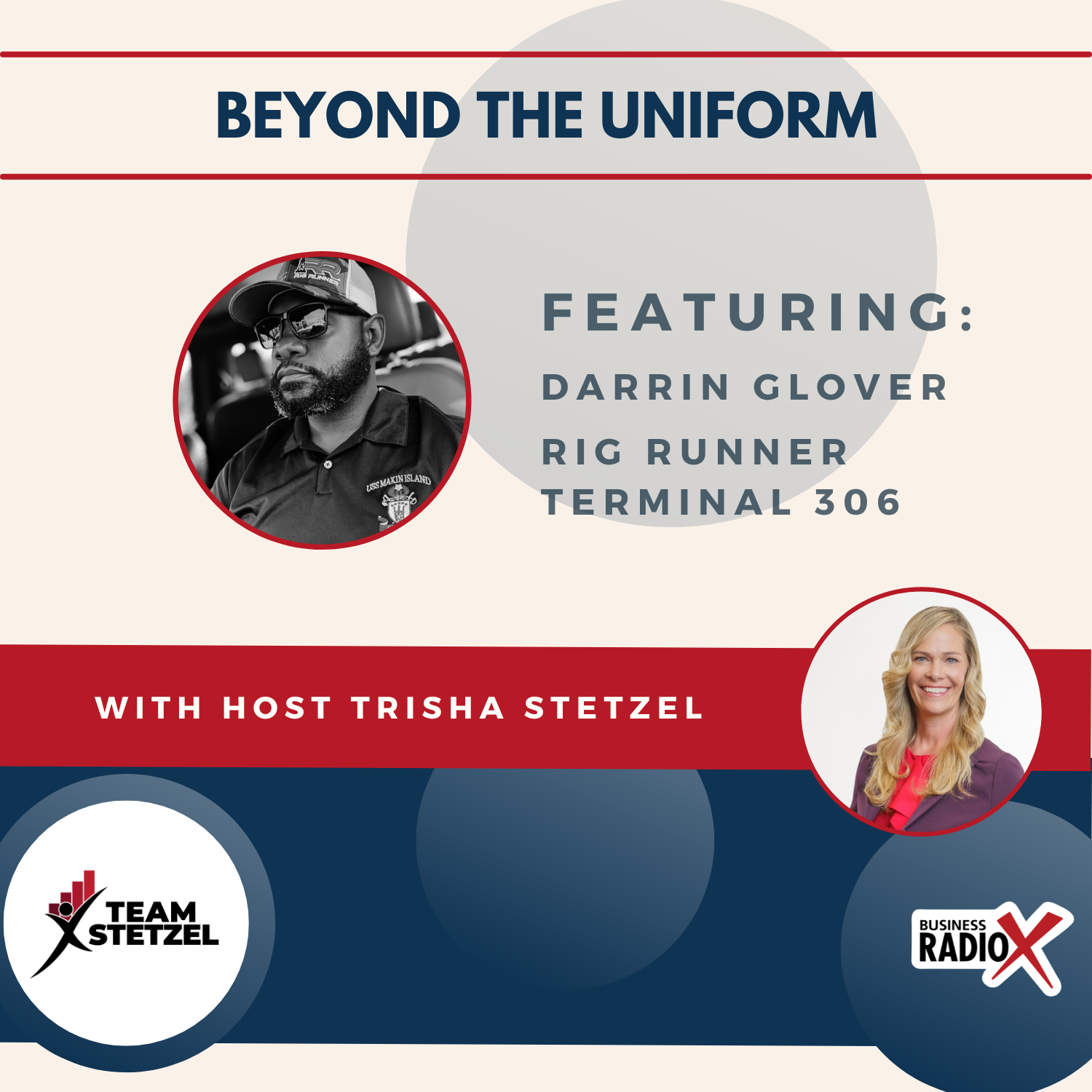

 Darrin Glover is a seasoned human resources executive and U.S. Navy veteran with over 20 years of experience leading personnel, building systems, and driving organizational success.
Throughout his decorated military career, Darrin specialized as a Yeoman, serving on four ships, completing seven combat deployments, and excelling in leadership roles, including military recruiting and joint assignments overseas.
His deep-rooted expertise in policy development, mentorship, and training positioned him as a respected leader committed to accountability, team development, and service excellence.
Following his military retirement in 2023, Darrin transitioned into the oil and gas logistics industry, bringing his strategic leadership and operational insight to Rig Runner Terminal 306 as a Business Development leader.
Despite being new to the industry, Darrin quickly applied his military-honed skills in organizational development and cross-functional collaboration to grow opportunities in transportation and logistics. His passion for learning and mentorship continues to drive his success in this dynamic and evolving sector. 
Beyond his professional roles, Darrin remains deeply committed to mentorship and community service. As an active member of Omega Psi Phi Fraternity, Inc., he leads youth mentorship programs like Omega Lamplighters and Dr. JAM, supporting young men from grades 5 through 12.
Darrin is also a strong advocate for veterans’ transition support and continues to be a mentor to both active-duty personnel and fellow veterans navigating life beyond the uniform. His leadership, resilience, and service-oriented mindset make him a standout figure in every space he enters.
LinkedIn: https://www.linkedin.com/in/darrin-glover-ba-m-s-s-l-1a1bb265/
 This transcript is machine transcribed by Sonix
TRANSCRIPT
Intro: Broadcasting live from the Business RadioX studios in Houston, Texas. It’s time for Houston Business Radio. Now, here’s your host.
Trisha Stetzel: Hello, Houston. Trisha Stetzel here bringing you another episode of Houston Business Radio. Beyond the Uniform series, I’m stoked about this guest that I have on with me today, Darrin Glover. He is a seasoned human resource executive and program manager with more than 20 years of experience leading people, building systems, and driving organizational success. With a strong background in personnel management, policy development and leadership training. Darrin has created HR procedures, orientation programs, and mentorship systems that increase accountability, efficiency, and employee engagement. Darrin, welcome to the show.
Darrin Glover: Trisha, I tell you, it’s truly my honor and my pleasure to be here. Thank you so much for having me today.
Trisha Stetzel: So yes, absolutely. Before we started recording, you were telling me so many things I didn’t already know about you. I’m like, we have to get started because I want to know more about Darrin. So number one, thank you for your service. Fellow Navy veteran, uh, would love to learn a little bit more about you, Darrin. So share a few things about yourself.
Darrin Glover: Thank you so much. Uh, again, uh, it’s an honor and a pleasure to be here. Uh, want to give all praises due to God for allowing us to wake up and be here today. Uh, but a little bit about me, uh, just right there. I’m God’s child. Uh, AJ and Faith Glover, oldest son, uh, small town, Porterville, Louisiana. I graduated class of oh two. I joined the Navy a couple months after that as an undesignated seaman, uh, and went off to the the war on terrorism turned 19 on the way to the war, uh, spent 21 years, uh, as an HR. Ended up becoming an HR professional as a yeoman. For those that are in the Navy, you know, uh, yeoman made chief and 2013 retired in 2023. Uh, four ships, uh, special forces recruiting joint overseas, uh engineering assessment Pacific. And just a host of things are bouncing all over with seven combat deployments. Uh, wonderful career. And I couldn’t have done it without my family behind me.
Trisha Stetzel: Absolutely. And now you’re the business development guru for for Rig Runner terminal 3306. Right? Yeah.
Darrin Glover: Yes, ma’am. Uh, you know, you talked all the HR things and a lot of I get a lot of pings for HR jobs, but I’m excited about this new venture. Uh, people that know me know I go across a lot of things. I have several things that I. I dibble and dabble in. Uh, but right now, I’m mostly excited about this business development here at Rig Runner. Uh, man, I it’s hard to really talk about it. Uh, only because of the excitement and the opportunity. Uh, most people don’t know about oil and gas. People don’t know about how oil and gas and transportation go together. Most people don’t even know what business development is. Uh, however, I’ll be honest with you, until April 9th, I didn’t know what business development was. I didn’t know what Rig Warner was. I didn’t know none of this world existed of Ong or LNG, and I am thankful for it being in business development, I’ll tell you. Um, although the industry is new, the the tactics, the drive, the understanding is very, very similar. And that’s a lot of what I can tell you, that the Navy prepared me for this position.
Trisha Stetzel: Um, yes it did. And by the way, if you guys are not watching the video on YouTube and you’re only listening, I’m going to encourage you to go jump on the YouTube channel and take a look at the background behind Darrin, because it is absolutely amazing, all of the things that you’ve prepared to be behind you on the show today. Thank you for that.
Darrin Glover: I had to, uh, it’s my office, and, uh, I wanted to make sure that not only did I have something to represent me, but represent your show. Uh, we’re representing for veterans. We’re representing for the families we represent, for the industries past and present. And, um, as you say, beyond the uniform. And a lot of people get hung up on titles, uh, rank, uh, but a lot of times it’s the things behind again, behind the uniform that makes that uniform so bright.
Trisha Stetzel: Yeah, absolutely. And many of us continue to serve after we’ve served, and that is very important. So I want to circle back in a few minutes around the business development and rig runner. But I want to also, um, dive into this mentorship since we’re talking about the, uh, what we learned in the military and how we’re giving back or continue to serve others. You have been very involved in mentorship programs for decades, so let’s talk about that. What mentorship looked like for you in the military and what it looks like for you now beyond the military.
Darrin Glover: I’ll tell you from day one, mentorship has been vital. I’ll start when I say day one, I mean even my Navy recruiter, uh, Frank Evans. He, uh. It’s funny, we actually see each other often. He is a he’s retired. P.s. one he works at the my old middle school as a teacher. Uh, we still talk pretty often, and we still talk to this day. After all these years of after meeting at his mentorship really gotten me through my recruiting process. He stayed active throughout my naval career, um, and running into other people like Trisha Henderson, uh, on my first ship and Teddy Miles, uh, a host of other, you know, great, uh, servicemen like Scotty Scruggs, Derek Cox, you know, that’s just on my first ship to really introduce a 18 year old kid that’s from a small country town to the big city, to the world, preparing to go defend the country. And that was important to me. And I will really tell you that that helped my career. Uh, my first command was amazing. Uh, getting, you know, several accommodation, medals, 2004 Junior Sailor of the year and a lot of that and majority of that contested to two people, one my wife and two people like Taylor Miles and Trisha Henderson. And because of that, and it set the trajectory for a very successful career.
Darrin Glover: So I maintained in it, and it was poised to me that these are the things that we have to do, because you never know where someone where someone may be. On top of that, I followed up and then became a Navy recruiter 37 months, uh Navy Recruiting District, Nashville, Tennessee. I started out in Pine Bluff, Arkansas in 2009. If anyone knows about Pine Bluff, Arkansas at the time, it’s one of the poorest areas. Crime was high. Delta was the delta of Mississippi from Pine Bluff all the way down to the Louisiana state line. One of the poorest areas in the nation, but one of the richest and resources. And we found ways to be successful. Not only did I win. Fy ten Medium Station recruiter of the year across five states. Our zone in Arkansas was the number one zone across five states, and it allowed us to dive into those resources and look past the screen of poverty and not resources, and find the best and brightest, uh, in our area to serve our country. So those things, really, and some of those gentlemen, men and women that I even recruited, I had one guy text me last night. I’m calling you tomorrow. I need to talk to you about something. And he’s a senior chief in Hawaii right now.
Trisha Stetzel: Wow. Wow. So, bringing you up in the military, you named off so many mentors that you had, and then you eventually became a recruiter, which automatically puts you in this mentor state to other young people who want to be a part of serving our country. In your new role as, um, the business development, I’m going to call you the business development officer, because that sounds really important to me. Uh, for Rig Runner, how do you.
Darrin Glover: Find that to my email?
Trisha Stetzel: Uh, right. Yeah, I think it sounds pretty official. Um, how does the mentorship play out in this new role that you’re in now with Rig Runner?
Darrin Glover: In two parts, uh, personal And professional, uh, professional as coming with a wealth of knowledge of not only how to mentor, but organizational development, HR resources and training and development period. Getting into with a industry and group of professionals that have already been doing and adding to the success, uh, being able to expand, uh, organizational norms, uh, shrink down distractions and add value to where we’re at and also learn. Remember, I’m new. I just started this job in April of 2025, and what I thought I was going to be doing, what I said I was going to be doing, and what I’m doing today is absolutely and completely different. And also what I get to do. The second part of this on personal is, uh, for those that know me, uh, and those that don’t know me, I am very active in my fraternity, uh, from college. Uh, Omega Psi Phi Fraternity, incorporated, where we host a mentorship program of Omega Lamplighters, uh, in San Diego, my home chapter. We host, uh, the Doctor Jam program, where we host, uh, a series of informational mentoring for young men from the, you know, age from fifth grade, all the way up to 12th grade. Uh, because sometimes, in most cases, we need that mentorship in a world that everything is here, there. And being in the military, I was gone. So having that mentor when I was away, uh, understanding that having a place for, you know, not troubled kids, it’s always seemed that mentorship is for troubled kids. And it’s not that it you know, the 4.0 student, uh, the 4.0 athlete, student athlete, he or she needs a mentor as well, too. So having those spaces where people can not only have Receive and continue mentorship from professionals and people with high regards that they can look up to or help guide them to where they need to be.
Trisha Stetzel: Yeah, it’s so important. So, Darrin, anybody who’s interested in learning more about that program or even just connecting with you, what is the best way for them to reach out?
Darrin Glover: Best way to reach out LinkedIn. On my LinkedIn bio you can email me directly. Uh, Darrin Glover at gmail.com. Uh, I have a host of things that, you know, on my LinkedIn that will allow us to get to those opportunities and to really show. And when people connect with me directly on any of the other social media outlets, you will see a different host of opportunities, things that we’re hosting, things that we’re doing, uh, not only for us, but for the community and our mentor mentees. We find it important that, uh, if we can go out in the community, uh, as adults, how do we show the younger generation? So that’s why we partner, uh, with the breast cancer walks, blood drives and all the communities to really show to exercise that muscle of not only community service, mentorship and just understanding. Because I can honestly, honestly say I had no clue. Uh, ONJ existed in my hometown, in my area. I’ve learned more in the last five months about ONJ, LNG, uh, economics for Northwest Louisiana than I did the whole entire time, even from living here and being in the Navy. So I’m very thankful for the mentorship that I’m getting right now. Uh, and being a mentee, because it’s rewarding.
Trisha Stetzel: Yeah. Fantastic. And you guys, if you’re looking for Darrin on LinkedIn, it’s d a r r I n g o v e r. Of course I will put the links in the show notes so you guys can just point and click. If you’re sitting in front of your computer, please do not do that. If you are driving. Wait till you get home and then you can point and click and connect with Darrin. I want to circle back around to something that you said when you were talking about mentoring, and that mentoring isn’t just for those who are troubled or need help. We also need to be mentoring our high success or high achievers. Can you talk more about the importance of being there for our high achievers as well?
Darrin Glover: Vital. And the reason why it’s vital? Because when you are flying high, as we know, oxygen gets low and when oxygen gets low, things don’t click all the time. And we need that. And I’ll tell you it was the the simplest this question. Who does the doctor go to? Who does the dentist go to? Right. In the military. Who does the chief go to? Who does the XO go to? Who does the commanding officer go to? Who does the admiral go to? And having mentors at all those levels, uh, at the, you know, enlisted level, officer level, senior enlisted and senior officer levels. And all of them can attest to one thing mentorship and and their success was driven by that because it allows them to do that. And when you take on that, when you say that, okay, I need mentorship and I need that breath of fresh air, I need that boot, I need that redirection, I need that senior leadership or and even sometimes junior leadership Because my 19 year old son, who’s a college student pre-med major at LSU, we talked and there’s been some things here lately that he’s learning in his journey as a young adult that he’s saying, hey, dad, have you thought about this? And I was like, I don’t like this, but okay. Right. But at the end of the day, it’s warm welcome and it’s needed. And we need to make sure that we take a, you know, for those that are privileged enough to have mentors in our life that pour into us, um, make sure that we’re thankful for that mentorship and, and show that gratitude as well.
Trisha Stetzel: Yeah, absolutely. I love the saying, uh, that the five people you spend the most time with, you become the average of. So who do you want to become the average of? And I always say the people who are bigger, better, faster, stronger than me. And those are the people I’m looking for. People like you, Darrin. People like you. I want to hang out with you. Hey, congratulations on having an amazing, successful son and can’t wait to hear the rest of that story. All right, I want to circle back around. We talked a little bit about your military service earlier, and I want to circle back to that conversation. You recently transitioned just within the last couple of years out of the military and into this new space that you’re in. How was that? Was it challenging? Was it easy? Tell me more.
Darrin Glover: Well, I have I’m a glass over full type guy, and I would tell every veteran it is a ride. It doesn’t matter how much you prepare, there is a shift. Shift, understanding shift a space ship, a belonging shift of need, shift of Sister, won’t I tell you? For me, it was a very unique ride. Um, being the fact that, you know, a lot of moving pieces happen, uh, at the end, moving from California to Louisiana, uh, to going from not only two different states, two different mindsets, two different cultures. Um, that was easy. A lot of people like, man, I know you miss San Diego. I do miss San Diego. That’s why I go often. However, I will tell you that being back here has allowed me to see just different things. Being in the Navy and across my diverse landscape of, uh, commands. I can live anywhere. It doesn’t bother me. Uh, so that was easy. Uh, really understanding where you want to be, how you want to be. That was more challenging than moving. Um, I’m an HR guy. I was looking for HR jobs and landed a tech job for for a major tech company, and did that for a year and eight months and woke up on the first day of vacation and said that, hey, we lost the contract and you are no longer needed. Okay. Cool. What’s next? Uh, that’s where mentorship comes into play. How do you deal with that? How do you pull that? And I add to that my wife lost her job the same day, too, because we worked together.
Trisha Stetzel: Wow.
Darrin Glover: You know what we did? We went on vacation. I said, pack a bag. Let’s go. We went to see our son in Baton Rouge for a weekend. Right. And? And I don’t say that to be cocky or anything. I just said we have to redirect the focus. And a mentor told me, hey, man, you need to get away. Just take a deep breath like your glove. You’re going to be okay. And I thank him for that. And you move forward. Then I landed this job here at Ridge Runner. Um, and I’m just so thankful for that and the mentorship that I’m getting here, uh, from people that I don’t even know. So I really appreciate the mentorship, and it allows us to really be diverse. And I’ll tell you that that’s another characteristic from the military to help me. How do I go from being in the military to a tech job to working in logistics and oil and gas? This is no different than transferring from the USS Nashville to going to Expeditionary Strike Group, to the USS Gunston Hall, to Camp Lemonnier, Djibouti, Africa. You know, uh, and we use those skills to, to, uh, make things where they need to be.
Trisha Stetzel: Mhm. So I love that your glass is always overflowing. Somebody told me this and I’m going to let you steal it from me. It’s refillable. Isn’t that amazing? The glass is refillable. It’s never empty. It’s never too full. We just refill it. And I love that you have such a great attitude. And, um, veterans and even those in active duty are very resilient. And we are, most of us, very used to shift and change and going with the flow because we’re changing duty stations all the time. I know there are a lot of veterans listening today. Um, Darrin, particularly to your story, because you are so fresh coming out of the military and transitioning into this new position. What advice would you give to those who are close to their retirement or close to leaving the military and thinking about, what am I going to do next? I don’t even know what to wear when I wake up the day after I get out of the military, right? What advice would you give them to those people who are listening that are close to getting out of the military?
Darrin Glover: Well, lean in a little bit and I’m gonna say this directly. First and foremost, make sure that you have a great relationship with God. Number one. Have a great relationship with your family, uh, and have a great relationship with yourself. Uh, don’t stop working out whether it’s running calisthenics, even, you know, even if it’s just jumping jacks. Right? Uh, get some sun. I also tell you to relax a little bit because it’s scary. But I also the main thing, the main point that I tell any veteran right now is this. Go back. To maps. No, go back to the hotel.
Trisha Stetzel: Um.
Darrin Glover: Go back to the hotel. Go pick up Darrin. See what Darrin wanted.
Trisha Stetzel: Mhm.
Darrin Glover: See. Do you still love that with Darrin. Wanted to do at 18, 19, 20 or whatever year you joined the Navy. And see that those dreams still have fuel. And if they got fuel put a flame to it and try it out. If you’re not in a position to try it out, if you’re in a position where I know so many service members, get out in survival mode. Focus on getting out of survival mode. You do that and you will get out of survival mode quick. But number one, take a deep breath. Allow yourself to breathe, and don’t be scared to put the backpack down. As a guy that led at a high level for many years, uh, starting from, you know, being junior in the Navy and making rank fast all the way until the day that I retired and and still now to this day, we have to make sure that we’re good and we look at what we like to do. Take a deep breath. It has been a fun ride. People say, oh, thank you for your service. I tell them, hey, it was 21 years of being a rock star. It was my pleasure. And that’s not nothing from chick fil A. It’s truly an honor, you know, to do the things that we’ve done and experience the thing. And and some veterans don’t even realize you have written history. We study history. Well, guess what? Someone’s going to study what we’ve done. We’ve done some amazing things in the last two decades, what, 3 to 4 decades that will forever be etched into the history books and be proud of that work. Some of it is not the best, but be proud of what you’ve done. Because we do live in a country that’s different, that’s better, that allow us to do things to not only go from being in the military to oil and gas.
Trisha Stetzel: So profound there. I have so many things, Darrin. You’re going to have to come back on the show because we’re almost out of time, and I have so many more questions for you. Um, okay. I thank you for saying that. There are a lot of veterans out there that don’t talk about being veterans, that it’s not because they’re not proud. They just don’t run in the same circles. They don’t have people in their life that they have this type of conversation with. So, um, what would you say about that? Like, how do I, as newly out of the military, I’m not telling anyone that I’m a veteran. I’m kind of hiding in the background doing my own thing because I’m resilient. I know how to go GSD get stuff done. Yeah. How do I open up and find a mentor Get the right people in the room and really embrace my brothers and sisters that were also in the military because they understand the story. So where where do I go from here? Darrin.
Darrin Glover: When you pick your mentor, most of us picked a mentor in the early in our career and we stayed with him or her. Right? Yeah, and that’s Leo Gordon. You pick up the phone, you call Leo Gordon, you say Leo. Hey, I’m not having a good day today. How can I, you know, and he might pick up the phone and say, hey, man, you do XYZ or hey, go, go, go call the admiral. Go call Dino. Okay, cool. Or depending on what we got going. Hey, you go call this friend because we all have that mentor or friend that retired before us. 12 2436 months before us. And we we get that mentorship. It was good for the goose. It gotta be good for the retirement, you know?
Trisha Stetzel: Yeah.
Darrin Glover: So that’s the biggest thing. Get that veteran retiree, uh, and let him or her show you, uh, where to go, how to go, how to feel. Um, and I know that wholeheartedly because I’m Navy and I move right next to the largest B-52 air force base, uh, Barksdale Air Force Base. So it’s air force country and army country here. So when I see a sailor, oh, it’s shipmate. All day we hugging and everything.
Trisha Stetzel: Even virtually hugging. Darrin.
Darrin Glover: Yes.
Trisha Stetzel: Yes. Oh my gosh. Yes. This has been such a fantastic conversation. I really appreciate your time today. This has been a long time coming and we’re going to do this again okay.
Darrin Glover: We will.
Trisha Stetzel: All right.
Darrin Glover: Thank you so much. Again. The honor and pleasure is all mine. And I cannot wait, uh, to do this again. Again. If you need to reach me, Darrin Glover at gmail or see me on LinkedIn, or you see me around, give you a high five and let’s go.
Trisha Stetzel: I love it. Darrin, thank you so much for being with me today. And that’s all the that’s all the time we have for this show. If you found value in this conversation I had with Darrin today, please share it with a fellow entrepreneur, a veteran or a Houston leader ready to grow. And be sure to follow, rate and review the show. It helps us reach more bold business minds just like yours and your business. Your leadership and your legacy are built one intentional step at a time. So stay inspired, stay focused, and keep building the business and the life you deserve.














