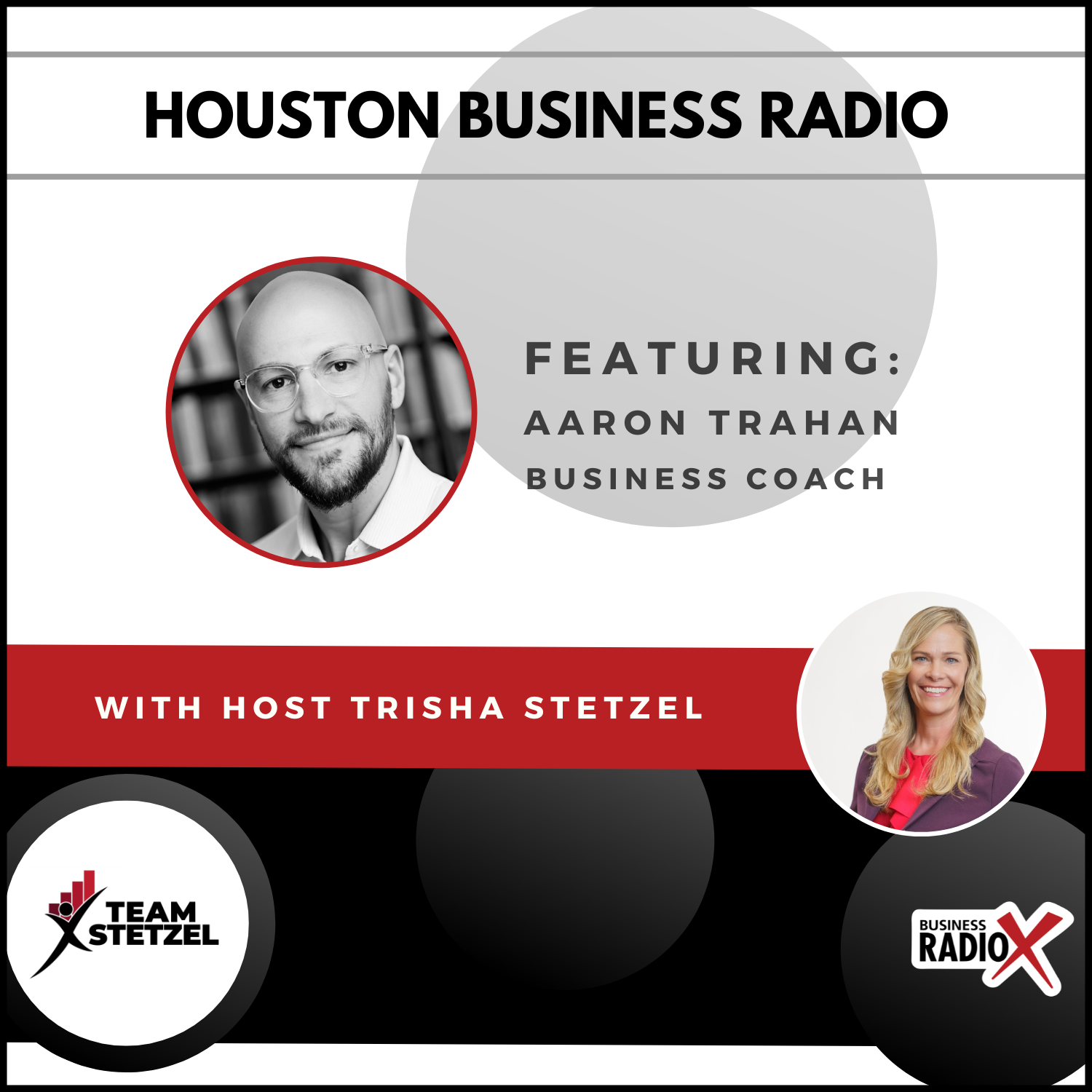

 Aaron Trahan is a business coach, advisor, and former corporate executive with over 20 years of experience leading high-growth consumer businesses.
By age 30, he was leading a billion-dollar retail brand, building a reputation for scaling teams, operations, and profitability.
Today, Aaron helps B2C companies implement customized operating systems that drive clarity, execution, and sustainable growth—blending leadership expertise with proven coaching strategies. 
LinkedIn: https://www.linkedin.com/in/aarontrahancoaching/
Website: https://performancemindsetcoaching.co/
 This transcript is machine transcribed by Sonix
TRANSCRIPT
Intro: Broadcasting live from the Business RadioX studios in Houston, Texas. It’s time for Houston Business Radio. Now, here’s your host.
Trisha Stetzel: Hello, Houston. Trisha Stetzel here bringing you another episode of Houston Business Radio. Today’s guest is Aaron Trahan, founder of Performance Mindset and a seasoned executive with more than 20 years of leadership experience in both corporate and startup environments. By the age of 30, Aaron was leading $1 billion publicly traded company, a role that gave him deep insight into what drives growth and what derails it. Today, he works with leaders and organizations to to achieve sustainable, profitable growth by breaking the chaos cycle and creating systems of clarity, focus and accountability. Aaron’s mission is to help leaders get better at getting better and build businesses that scale the right way. Aaron, welcome to the show.
Aaron Trahan: Hi Trisha, thank you so much for having me excited for this conversation.
Trisha Stetzel: Yeah. Me too. And for those of you who are not watching on video, you need to jump over to the YouTube channel because Aaron has this most beautiful Winnie in the background. And I’m not going to tell you what it is. So you guys just have to jump on and see.
Aaron Trahan: It’s it’s always good to have a cute, uh, cute, fluffy business partner, you know?
Trisha Stetzel: Yeah, absolutely. All right, Aaron, tell us a little bit more about who you are.
Aaron Trahan: Yeah. You know, I am someone who really, from an early age, just gravitated towards this big, bold concept of continuous improvement. Um, I was kind of just a nerd of business books from a very early age. I started watching CNBC to just learn about what all this stuff means. Someone asked me is like, do you even know what showing up on that thing running across the bottom? And I just remember saying, not entirely, but I’m I’m learning, right? And so it just this concept of growth and continuous improvement. And before I even really knew what the concept of scaling really was about, that’s it was just kind of a gravitational pull for me, and not only on an individual level of just trying to understand how can I be a better leader, how can I lead teams more effectively, but also then how that translated to an organizational level and really just finding myself, um, you know, positively obsessed with what is it that allows Those leaders and organizations to find the next level to keep growing over a long time. But more importantly, what is it that prevents them from doing that? Why do leaders burn out once great high growth organizations, you know, either become a non growth organization or fail outright? And so, um, that was kind of the invisible journey that I was on that eventually led me to, um, you know, being a seasoned executive operator to now finding myself on the other side of the table, serving those leaders, operators and businesses of trying to avoid the same mistakes that I made, being able to access all the lessons and key insights without having to acquire the same scars that I had to acquire.
Trisha Stetzel: Um, I love that. Not that you have all the scars, but that you’re able to bring all of your expertise, your knowledge and experience to others that you serve. Now that’s amazing. All right. Names always have a meaning. And I want to dive into performance mindset which is your business. So talk to me one about the name of your business. And then let’s take a little deeper dive into the services that you provide.
Aaron Trahan: Sure. Yeah. It’s, uh, it’s probably one of the most frequently asked questions that I get is performance mindset kind of what? Tell me more about that. And, you know, kind of going back to the past 20 years that I’ve had in and around all sorts of businesses, of all sorts of shapes and sizes. You know, I think the great work that Carol Dweck did at Stanford University of really bringing the concept of a fixed mindset and a growth mindset to the mainstream, I think was was pretty valuable for all of us. But I think as I started to understand the nuances there, I started to realize that, you know, when we think about that in terms of the application to business, I just found a different story kind of playing out. In reality, nobody is going to admit to having a fixed mindset first and for all. And so every room that I was speaking to, every team I was a part of, whenever I would ask the question and really explain what a growth mindset is all about, every hand in the room is going to go up and say, yep, that’s me. I’ve got to fix our growth mindset. That’s what I’m all about. And so then I started back to that curiosity of what makes people grow, leaders evolve, and what prevents leadership growth. I started scratching my head of saying, well, if everyone has a growth mindset, why are we having these wild variabilities in performance and outcomes and results? And what I realized was there’s kind of a next level to it with a growth mindset, that thinking and believing that nothing’s fixed, you can develop and grow and build intelligence and capabilities.
Aaron Trahan: That’s great. But what I was starting to understand was thinking and believing can only take you so far. It’s missing a key ingredient and it’s the willing to take action. So when I kind of think about what shows up a lot in the business world, it’s much more nuanced than just fixed versus growth mindset. I think it’s really kind of a status quo mindset of people getting comfortable with where kind of they are, and things are good enough, so to speak. But then this other group has the performance mindset, which is just the bias to action to continuously improve. They’re not looking in the rear view mirror, kind of hanging their hat on what has already been achieved, or look at what we’ve done. It’s always asking the question how do we further improve? How do we continuously get better? Where can there be areas to take it up a notch? Where am I not operating either at an individual or an organizational level at anywhere close to our full potential? So for me, it really became this status quo mindset. Are we comfortable with where things are and we’re just kind of playing the status quo game. Then it becomes the the performance mindset. Are we willing to take the action and do what’s required to truly see better performance and better results? And so for me, that’s what that was kind of the narrative that I was seeing play out in the arena of business. It’s not as simple as fixed versus growth. It’s much more about status quo versus that bias for action to do what’s required to get better performance.
Trisha Stetzel: Okay, so how do we get from status quo or just this growth mindset where we’re just sitting still to performance.
Aaron Trahan: Yeah, I think it it is all around first generating awareness, right. For for everything that I do, it all really starts there. And I love kind of the saying that says a weakness or a development area that you’re not aware of will never be strengthened. Right. And so much around that status quo thinking is really that belief that, you know, good enough is always going to, at some point lead to complacency. And when you’re complacent, you’re not going to be intentionally driving awareness around where the gaps are. And look for high performers. Gaps may not be underperformance. The gap we are really focused on is where you’re performing versus where, you know you can potentially be performing. So it’s kind of it’s a you versus you. It’s am I better tomorrow than I was yesterday? And do we understand and put the awareness on where the gaps are that if we took action to evolve, develop, build the capabilities will get us closer to that full potential that makes us 1% better every day. That drives the continuous improvement. And that’s not always a comfortable place to be in. Always looking for how to develop. What more can I do? What more am I capable of? It requires it just requires a different intention to build the awareness, to learn where to act, to generate a better outcome. And if you’re in the comfort zone of the status quo, that’s just going to be an area that is, you know, never going to be found in that zone.
Trisha Stetzel: Yeah, absolutely. So what are your thoughts around doing it alone versus surrounding yourself with the right people.
Aaron Trahan: Oh, I, um, I’m just a big believer that you can only go so far alone. Um, you know, I’ve I’ve been the beneficiary of having a lot of great mentors, a lot of great coaching. Um, whenever I realized that I personally needed to leave that one zone of comfort and status quo thinking into a performance mindset, I needed a third party. I needed a coach to help me see what I wasn’t seeing. I needed someone to not only help me identify that there are corners coming up, but then to be able to have, you know, develop some insights, um, to proactively maybe understand and see what’s around those corners. And yeah, I think if the only, only voice of accountability that you’re kind of listening to, uh, is that voice inside your own head, I, uh, I think it’s going to be tough to really tap into the full potential that I think is there for, uh, all leaders and organizations. So I’m a big believer, um, that with others is a accelerated path to ultimately getting you to your destination.
Trisha Stetzel: Yeah, absolutely. And by the way, you need to check who’s in your room, too, right? Because we want to surround ourselves, like Aaron and I, uh, have the same kind of very uplifting, above the line energy, and we wouldn’t want to hang around. I hope I don’t want to speak for you, but I don’t want to hang around with people who have negative energy. I want them to have more energy than me and more passion. Uh, yeah. So that I can strive to be there, I love that. So let’s take this from growth mindset to sustainable growth. So can we unpack why the how of growth matters more than the how fast?
Aaron Trahan: Yes, absolutely. And it’s such a great time period of the year to have this conversation, because I believe Inc. magazine just recently released their updated list of what’s referred to as the Inc. 5000, which is the 5000 fastest growing private companies in America. And as you can imagine, every small and medium sized business would love to be on this list. What better marketing for you to put on your website or in a promotional blast of saying we are an Inc. 5000 company? Now, what’s interesting about this to kind of start this part of the conversation is fast. Growth is good, but it should not be the only thing you’re optimizing for, because follow up studies from this great list of the fastest growing companies has found a troublesome kind of where are they now? Um, you know, story that’s unfolded. And what the data shows is that 68% of companies that make the Inc. 5000 list remember the fastest growing companies in America over the next 5 to 8 years, 68%. More than two thirds of these companies either fail outright or are no longer a growth company, and they’re a significantly smaller size. And I think that just really puts an exclamation point on sustainable growth, growth that you can continue to maintain and work to compound over a long period of time is always going to be a better option than just rapid expansion.
Aaron Trahan: Back to having great mentors and someone sharing wisdom with you. I had to learn this the hard way, so I’ve got very intimate, first hand experience of all the chaos that emerges when you grow too fast. So luckily, I had a mentor on my board who pulled me aside after a not so pleasant board meeting to remind me never grow faster than you and your team’s ability to manage it. And that was always a stark reminder for me. It’s that if growth starts to outpace your ability to execute your team’s ability to manage it, chaos starts to ensue. Um, look, the graveyard is full of companies that grew too quickly, were not able to implement the systems and the structure to be able to support it and maintain it. And unfortunately, far too many businesses die by a result of collapsing under the weight of their growing pains, not from competition. Um, and so I think it’s just an important reminder that growing the right way, your ability to make sure you can manage it, the ability to generate operating leverage, um, allowing the growth to compound over longer periods of time is always going to be far more important than trying to just increase the top line by all costs as fast as possible.
Trisha Stetzel: Mhm. Yeah. That’s such a great point Aaron. And I know people are already wanting to connect with you to learn more or even just to pick your brain. If you let people do that maybe you do every once in a while. What is the best way for the listeners to connect with you? Aaron.
Aaron Trahan: Yeah, the two places I show up, most, uh, one’s going to be on LinkedIn. I would highly encourage anyone to connect, reach out. I’m always trying to share, um, the things that I’ve learned along the way and continue to learn. I’m pretty transparent with my community there of. Look, learn from my lesson. Avoid my scars. Uh, and then for a more in-depth review, my website would be the best place to go to really understand how I help executives and organizations. And that’s simply performance mindset coaching. Dot CEO uh, so those will be the two places that you’re going to be able to get access to me as quickly as possible.
Trisha Stetzel: Fantastic. And if you’re trying to connect with Aaron on LinkedIn, you can find him at r r o t r a h a n. And it’s actually Aaron Trahan. Coaching is the handle for LinkedIn if you guys are looking for him there. Okay I heard you say chaos cycle. I think we probably have an idea of what it is you described, what it is. But if we find ourselves in that chaos cycle, how do we break free from it?
Aaron Trahan: Yeah, yeah. So I think it it really comes down to one important thing. And if I could back up for a second, I think for a lot of business owners, founders, leaders, you know, it almost kind of feels like chaos is just kind of part of the game, right? It’s just if you’re in a growing business, there’s going to be some chaos that comes along with that. And I think while that’s true, I think there’s there’s different flavors of chaos to look for sure. When an organization stretching and growing and we’re reaching new heights, there’s going to be that healthy chaos that comes with stretch. But what to look out for is when the chaos really starts to hold the organization back. When you start to feel like there’s bottlenecks everywhere, you’re playing whack a mole. Your days feel much more like a, um, a day long firefight than actually doing things that are productive, that can drive the business forward. So to more directly answer your question, it all comes down to prioritization. And here’s what I’ve seen in businesses that have been a part of businesses that I help and just businesses that I’m observing is there tends to be a chaos cycle that ensues when some of the negative flavor of chaos shows up. And by the way, I’m a firm believer that when you’re experiencing that chaos in the business, that’s nothing more than the business’s way of screaming out to you that it needs better structure and needs better systems.
Aaron Trahan: That’s that’s just think about that as the language at which your, your business is communicating to you. But where the cycle starts is really going to be around your ability to properly manage prioritizations or the inability that shows up as priority mismanagement. And here’s what I see so much Uch when priorities start to be mismanaged. That could be in the form of your team feeling like priorities or switching every single week, or everything’s a priority. You know, when a business has 20 different priorities. Whether your employees say it to you or not, what they are talking about is we don’t know what the hell to focus on, right? And so priority mismanagement will always drive the next stage of the cycle, which is fragmented. Organizational focus. Focus for any business in any industry is a superpower. Period. Full stop. So when you think about the priorities at which the top level of an organization’s driving down to the team, when that’s not clear, when there’s too many, when they’re constantly changing the focus, that superpower of your organization is never going to be in the right dosage, in the right spot. So it’s going to be fragmented. It’s everywhere. So what happens when priority mismanagement leads to a lack of organizational focus? Results suffer. You see it in weak execution. You’re missing expectations. You thought sales would be here. They come in way short. We’re scrambling to figure out why. And so what do leadership teams do after this third stage? Priorities.
Aaron Trahan: Priorities were mismanaged. There’s not enough focus in the right area. Results start to show up. Weaker than expected. We need new priorities. We need a new initiative. We we need a new growth strategy to kind of get things back on track. Which then takes us back to the very top of the cycle. And you’ve now created the vicious loop. Too many or constantly changing priorities, fragmenting focus even more on, on and on through the cycle. And so to stop the cycle, to get out of the chaos cycle really comes down to a business’s ability to prioritize. And I like to think about it in terms of a question. If I was to randomly show up to your team leadership or management manager meeting, and if I was to go into the room unannounced and secretly ask everyone the same question, what are the top 2 or 3 priorities for the business, and why are these the priorities for the business right now? What would happen? Would everybody say the same thing? Would everybody say something different? So to break the chaos cycle, you have to have that team saying something similar to each other, because when they’re saying things different about the downstream chaos that that creates in an organization, everybody thinks the priority is different, which means their focus is behind something and nothing may come back and align to what is truly most important for the organization.
Trisha Stetzel: Yes, yes and yes and yes. All of these things resonate with me so deeply. Erin, thank you for taking us down that path. So does this play into that business GPS system that you talk about? Yeah. So can we dive into that a little bit 100%.
Aaron Trahan: And that’s why as I kind of in my the seat that I sit in today, kind of helping leadership teams and organizations avoid the same mistakes that I unfortunately made. You know, the past decade for me has kind of been a reverse engineering of what were the what were the tools that I was lacking, what were the frameworks and the systems that if I would have used, I could have avoided the mistakes, missteps and failures that that showed up on on my path that I had to course correct on. And yeah, because prioritization that I found is so critically important. I kind of like to think of it in terms of a business GPS. So if we were to pull out our phones and pull out whatever your maps app of choice is Apple Maps, Google Maps, whatever it is, remember, these companies that built these apps have spent billions of dollars to make it useful for us consumers. But it requires us to enter a critical data point for it to work. We need a clear destination. And if we don’t have a clear destination, that billions of dollars poured into this app will never work for us. So I’m sitting here talking to you today from Austin, Texas, right. And look, if we were to just type in central Texas into Google Maps, it’ll give us a million different options to choose from. Even if you, you know, you went into Southwest Austin. Okay, we maybe have thousands now, right? But until you get a specific location or address, that’s the only way you’re going to get an optimized route to take you from where you currently are to where you want to end up.
Aaron Trahan: I take businesses through that. Same thing is, where do we want to be over not too far out in the future because then it starts to lose its teeth. Not too short in time because we need some ability to kind of think out and plan. So I found two years to kind of be the sweet spot. So where I love to start working with businesses is really getting their teams firm on what’s our two year destination, kind of call it the vision. Within the vision, where do we want to end up? And I, I serve as kind of the challenger in the room to say, bring it down to abstract to conceptual, being the best or world class like that we can operationalize around that. How do we quantify what that looks like? How do we plug in my address in Austin and not just Central Texas or the greater Austin area. And then from there, we just didn’t execute a very streamlined, working backwards experiment. If we get the team very, very focused and aligned on what our two year vision looks like, where we want to end up, then knowing where we need to be at 12 months, knowing where we need to be at six months, knowing what’s most important over the next three months starts to get very clear and very simple. And now the prioritization of what we’re going to prioritize and what we’re not has the necessary guardrails for us to easily determine priorities from priorities. But most importantly, it helps an organization say no way more often than they are today. And as.
Trisha Stetzel: Oh my gosh.
Aaron Trahan: So.
Trisha Stetzel: I know.
Aaron Trahan: You said.
Speaker4: Yeah, Go ahead.
Aaron Trahan: Yeah. Is Warren Buffett’s always said the difference between highly, highly successful people and average people is the highly successful people say no to virtually almost everything. And it’s because the priority scope is so defined. We know what we’re going to say yes to. That fits within that scope. Everything outside of it is a no or not yet.
Trisha Stetzel: Mhm. I love this. So you just took us on this beautiful journey. Aaron thank you so much for this amazing conversation. I’ve got one last ask. Tell me your favorite client story.
Aaron Trahan: Hmm. My favorite client story is the one that’s top of mind. Was the call that I was actually just on. Um, okay. This is this was a client that was in the physical therapy space and also did some longevity, uh, strength training of really helping people coming in for physical therapy and a part of the country where people are very active, um, and have a huge interest in staying active for longer. But as you can imagine, someone running a big physical therapy operation and another business, the challenge was I can’t get out of the business. I kind of feel like so much depends on me. I’m the bottleneck. I’m reactive and firefighting all day long. And, you know, I’m not sure I want to keep doing this. Right. It’s like I’m working harder. Only for poor results on the bottom line. And so taking this client in his business through these different types of tools, we were able to get very clear on where we wanted to be. We were able to get very clear on what matters most. And we were able to then start prioritizing what needs to come off his plate, what needs to go on to different plates, how do we streamline the organization? Where where are the areas that’s really holding the business back? Um, and as you can imagine, the work that we’ve been doing over the past couple years where literally the call that I was just on before this call, a lot of the conversation was talked about how great the team is doing, how he’s got a team of individuals now operating like owners.
Aaron Trahan: He’s able to be 95% strategic, 5% tactical. Two years ago, it was the exact opposite. He was 95% reactive, 5% strategic margins have expanded in the business top lines expanding in the business. And he’s putting in fewer hours than he ever thought was possible in a growing, optimized business. And so it was just one of those feel good calls of seeing seeing someone be able to create the business that they dreamed of, for it to perform the way that he envisioned it performing without him having to be the bottleneck in every single step of the way.
Trisha Stetzel: Mm, I love that. So something simple, if you’re in your business and you can’t take vacation because you’re so embedded in it, you need to talk to Aaron. I’m just saying.
Aaron Trahan: It’s it’s kind of, uh. It’s nothing more than helping build the bridge, right? I think every business kind of has three islands, right? Vision, strategy and execution. And so few times I’ve seen are those islands connected with a clear bridge? That’s all we did in this case is we took the vision of what he wanted. We created a strategy that would make that vision tangible and put in the mechanisms to drive day in, day out, week in, week out execution to generate week over week progress. And so his three islands now have very tight, very solid, very well built bridges connecting those three islands.
Speaker5: Wow. That’s beautiful.
Trisha Stetzel: Thank you so much for this conversation today, I felt like I went on a journey and maybe even thought about vacation for a minute. We’re growth mindset. Oh no performance mindset. This was fantastic. Aaron, thank you so much for your time today.
Aaron Trahan: Yeah. Thank you for having me.
Trisha Stetzel: That’s all the time we have for today, guys. So if you found this conversation with Aaron valuable, please share it with a fellow entrepreneur, a veteran or a Houston business leader. Ready to grow. Be sure to follow, rate, and review the show and helps us reach more bold business minds just like yours and your business, your leadership and your legacy are built one intentional step at a time. So stay inspired, stay focused, and keep building the business and the life you deserve.














