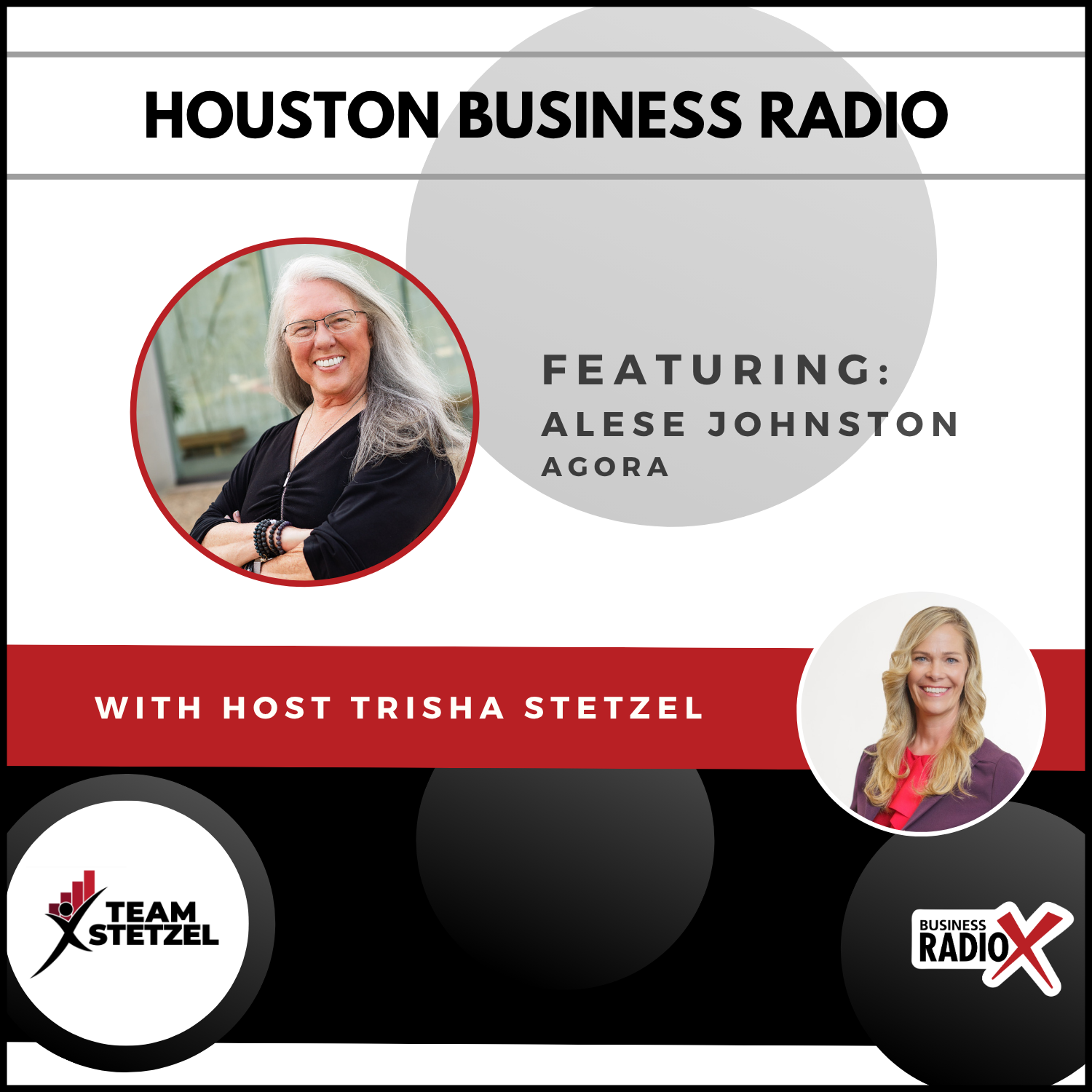


 Alese Johnston is an entrepreneur, author, and speaker focused on social connection, aging, and community design. With a background in business, investing, and tech, she now explores how human connection impacts health and longevity.
She founded Agora, including the Elysium Club—small, in-person peer groups designed to foster meaningful, consistent relationships. She also created The Fabulous 70 Challenge, a project centered on curiosity and lifelong growth.
Alese is the author of Beyond the Locks and regularly speaks on entrepreneurship, reinvention, and the importance of connection in aging well.
LinkedIn:https://www.linkedin.com/in/alese/
Website: https://agoraworldproject.com/
 This transcript is machine transcribed by Sonix
TRANSCRIPT
Intro: Broadcasting live from the Business RadioX Studios in Houston, Texas. It’s time for Houston Business Radio. Now, here’s your host.
Trisha Stetzel: Hello, Houston. Trisha Stetzel here. Bringing you another episode of Houston Business Radio is my pleasure to have this guest back for the second time. And no, we won’t be talking about the same thing. We’re going to be talking about something even more interesting today. Today’s guest is Alese Johnston, CEO of the Agora World Project. More to come on that and a returning guest. As I said, Alese is an entrepreneur, author, and speaker whose work focuses on the powerful connection between community aging and well-being. After a career in business development, investing, and technology platform, she began studying the growing body of research linking social connection to physical health, cognitive resilience and longevity. She’s the founder of Agora, an initiative exploring how intentional human connection can support well-being as people age. Agora first program, The Elysium Club, is designed as a small, in-person peer group model that fosters meaningful relationships, reflection, and shared perspective. She is also the creator of the fabulous 70 challenge, which we talked about last time, and the author of Beyond the Locks. You can find more in our last episode. And she continues to explore how curiosity, connection, and community shape healthy aging. Alese. Welcome back.
Alese Johnston: Thank you. It’s good to be back.
Trisha Stetzel: So excited to have you today. All right. So for those who have not listened to episode number one that we did a few months ago, tell us a little bit more about you. And then I want to jump into our big topic today.
Alese Johnston: So I’m a compulsive author. I love to start new ventures where I see problems worth working on. And I’m about to turn 72 in 6 weeks. Might be five weeks now. Um, yeah, I am very, uh, personally invested in trying to make aging look good.
Trisha Stetzel: And you do so well. By the way, if you guys are only listening, you need to jump over to the YouTube channel so you can see how amazing and vibrant Alese is at 72. Yes, I love it. Look, I made you read. I made you a little read. I love it. Okay, so tell me. I know that you just released a new book. Can we talk a little bit about that first? Okay, let’s do it.
Alese Johnston: My ego loves to talk about my new book. Um, I love, like love, love, love underscore, uh, when people jump in on my fabulous 70s challenge and tell me about new adventures that they have had, things that they’ve done that they had never done before. And I didn’t realize when I started that challenge for myself how much I was going to enjoy hearing other people’s stories or watching them engage with it. Um, I had one, uh, new friend reach out and share with me her website where she had, uh, kind of done the same thing in response to mine, although she was only turning 60, so she set herself 60 challenges. So, you know, uh, duplication is the most sincere form of flattery. And I decided that it would be fun to write a book encouraging people at large to do that. So the book talks about, uh, the mission, uh, everything from how it affects the neuroplasticity of your brain to just how much fun it is to give yourself permission. So the book is 105 page permission sheet to go out and enjoy life and do some new things. And it includes workbook area to write down what you did. And at the end of the book, there’s even a link to a spreadsheet and we’re going to provide some more content, but it’s basically a workbook for how to do your own 70 New Adventures Challenge. So go have some fun.
Trisha Stetzel: I love this so much.
Trisha Stetzel: Okay. The book is called The Fabulous 70 challenge at least. Where can people grab that book from.
Alese Johnston: On Amazon currently.
Trisha Stetzel: Amazon.
Trisha Stetzel: And you can also look up the author since she’s written more than one book on Amazon. It’s a LESE Johnston with a TJOHNSTON. Look her up as an author and you’ll find all of her books. I’m really excited about this newest one. Thank you. I just saw the announcement this week and I can’t wait to go out and grab it. So my friend, um, one of the things that we touched on lightly the last time you were on the show, because we were really talking business last time, and I wanted you to come back and talk about this whole idea around loneliness. We don’t talk about it and it really is a thing and it does affect you. So tell me more about what you’ve learned over the years and what loneliness is really doing to us as human beings.
Alese Johnston: So let me paint a little picture for you. If you have two friends and one of them is a chain smoker and smokes like 1520 cigarettes a day, and one of them is just always alone, never goes out, never talks to anybody. Which one would you put your money on is going to die first.
Trisha Stetzel: So you’re going to ask me that question. And I think all of us think, I think I’m just going to speak for everyone who’s listening today, that the person who’s not taking care of their body, the person who’s smoking, would be the first one to go.
Alese Johnston: Mhm. That’s what everybody thinks. And yet there’s a recent publication from the Surgeon General Clearly showing that the person who is isolated is more likely to have the soonest exit, and they’re going to be less healthy because they get heart issues and inflammation and a lot of other issues. Your brain lining starts to deteriorate when you’re alone too much. Humans are social animals. Our bodies are designed to be around other people in person, not just on Zoom.
Trisha Stetzel: Oh, you mean this doesn’t work very good. At least this didn’t work.
Alese Johnston: Sorry.
Trisha Stetzel: I mean, good conversation.
Alese Johnston: It’s fun and it does good things for us. But it it it does not give you the maximum benefit.
Trisha Stetzel: Yeah, absolutely. And I think we touched on, I had read a book a million years ago. I feel like it was called the Blue Zones. And I was so I couldn’t believe that community or that relationship, the, you know, getting rid of loneliness was. It’s part of why people are living to be more than 100 in some of these blue zones, which is very interesting to me. So talk to me more about why we don’t talk about loneliness. It’s something I feel like we all just push under the rug and we don’t talk about it.
Alese Johnston: I would be horribly embarrassed to tell you that I was lonely. It sounds like a personal failing, and I’ve found that a lot of people my age respond to it that way. They it, they feel like it’s a judgment that they’re not as good as other people or, I don’t know, lots of reasons. I mean, you can go talk to ten people and get ten different answers for why they don’t want to talk about that. But it seems forbidden and whiny. I mean, you and I will sit here and whine about the weather before whining about being lonely, right?
Trisha Stetzel: That’s true. Absolutely.
Alese Johnston: It’s just a little embarrassing. Um, but we need to talk about it. Um, because it’s not it’s not a personal failing by any stretch of the imagination. Our very society is optimized for efficiency and that kind of connection that you get off of your cell phone or your computer. It’s like we’re fed all this content, but none of it is in person. I mean, when when was the last time you went to a live theater, for example? Um, and you, you watch movies, you watch TV, but, you know, going to a lot of theater is pretty rare these days. Um, it’s just it being with another human just has this instant boost to your endorphins, all your hormones, your heart rate. Um, and then we could get really radical and talk about the biological effect of touch, uh, which has become so forbidden in this society. And yet it has incredible. I mean, given another human a hug. Oh, but that your biology is incredible. But, um, mostly I just want people to spend more time with each other having, like, real human conversation. I mean, just your voice, hearing another person’s voice in person does amazing things. I, I will put some research on our Agora website and share the science behind a bunch of that. We’re building quite the repository of of information that really smart researchers are putting together that supports this stuff. So if you like to read, um, that kind of thing, we’ll have material on the website. But, but just, you know, take it at a high level that being in proximity with other real people is good for your health. So invite somebody out to dinner.
Trisha Stetzel: Invite somebody out to dinner. I love that you might be very happy to know, Alese, that I just went to a live concert on Saturday. We have the Houston Rodeo here in the spring, and they do live concerts every single night for 20 days. And we went and saw Dwight Yoakam. I know he was good. He covered some Elvis songs, which was tons of fun, and we got to sit next to some friends. We invited friends and friends.
Alese Johnston: What a concept.
Trisha Stetzel: I’m taking all of your advice, Alese. Okay. I think this is a good lead into into the Agora project. So first, before we go there, because we’re going to dive right in, tell people where they can find more information about the project that we’re about to tackle.
Alese Johnston: Absolutely. We have the early stages of a website with resources on it called Agora World project.com. There are lots of just agora this, agora that out there. So you need to be pretty specific and do Agora world project. Uh, and I realize that’s an ambitious name and I’ll just own it because I have global Aspirations for this project. That might take me the better part of that ten year goal, but we’ll get there.
Trisha Stetzel: It’s going to be fun, and I can’t wait to go on this journey with you. All right, you guys, you can find that at a GORAWORLDPROJECT, make sure you spell it all the way out, and you’re going to find the information that you’re looking for. So, Alese, here’s what I would like to know. Why in the world did you start this project in the first place? And what in the world is it for?
Alese Johnston: I love to go to longevity conferences. Imagine that. And they’re always talking about this list of 6 or 7 things that are critical to helping your body live a long time. I talk about sleep and exercise, and everybody’s got a supplement they want you to take And, uh, they want you to go to your doctor on the regular, you know, all those things, but everybody includes in their list social connections. But at these conferences, I don’t see anybody doing anything useful about helping people develop social connections other than maybe come to the conference and hang out with people that have similar interests, which is, you know, a good thing, but nothing that reaches a broader audience. And so I thought, well, let’s sit down and take a look at this and see what we can find. So I spent eight months or a year doing research to see who was doing what in this space. And there are a lot of small local efforts, local communities, local people that have classes or programs or, you know, little retirement Communities, but nothing that um, both combined scale and would try to go really large with AI and with a whole collection of resources that would try to fit like the broad audience of people. And I thought, well, let’s sit down and pull some people together and see if we can’t tackle this. Um, and fully full disclosure, this may be a crazy person’s mission, but you know how I love to, to go after big projects. So, um, I’m not sure what form it will ultimately take. Right now, what we are envisioning is the whole pyramid of services that we’re designing using a lot of AI and human research to try and figure out how we can connect with the audience at large and make a real, measurable difference. One of our goals is to collect a lot of data that we can then use to help and study the problem and understand it better over time.
Trisha Stetzel: So how can we help right now? For anybody who’s listening today, how can they help you move this project forward? Mm.
Alese Johnston: Well, it depends on how you want to connect. If you are interested in, uh, using our services, once they’re developed, you can go to our website now and join our waiting list. Please do. We’d love to have your email address. We’ll stay in touch. Um, so that would be greatly appreciated. If you happen to be a human who likes to invest in early stage projects, we would love to talk to you. So email me personally at Alese at a girl a Girl world project.org. The. The.org is important because I don’t have a.com email address. Um, but yeah, just reach out to me and we’ll have a conversation with, you know, that have all the usual investor deck information that we’re happy to share.
Trisha Stetzel: Yeah, I love that. And something that you sent over to me earlier, and I know you’ve said it, but I want to read it straight from this document because it’s very impactful to me. Loneliness and social isolation are emerging as one of the largest public health risks of our time, of our time. Alese. Yes. And I think, you know, you talked about the human connection and touching each other and, um, the endorphins that we get. People are so addicted to other ways of releasing those endorphins. As I hold up my phone, if you’re not watching the YouTube video, it because that’s what we’re looking for, but we’re getting it from other places and not from humans. So tell me more about the long term idea behind this project. Is it me being able to connect with somebody on the other side of the globe if I’m going to be there? Tell me more about your vision for what this looks like.
Alese Johnston: So our vision can get a little crazy. We, um, I’ve been working with the guys at Luminar who are developing some trust based, uh, AI algorithms that can match humans based on their interests. Like the algorithm is designed around a series of questions that let us understand who you are at your core, and then can match you with other humans who share those interests. And so maybe you’re interested in learning a skill. There’s nobody in your neighborhood who does that. This algorithm would be able to connect you up with somebody who had that skill and was willing to talk to you about it. Or, uh, you know, maybe you like boating and like to talk about that. I, you know, I don’t know. This could go many ways. And, um, so kind of a combination of eharmony and match and, but not focused on dating, just focused on human connections and a lot of trust verification because we’re very trust forward. I think that’s super important as AI matures. Um, and I know a lot of people, you read constantly about people developing supportive relationships with their AI chatbot And not that there’s anything wrong with that because I enjoy talking to ChatGPT a lot, but that doesn’t mean to be your primary relationship. In my humble view of the world, that doesn’t solve your, uh, biological loneliness by any stretch of the imagination.
Trisha Stetzel: Yeah.
Alese Johnston: So, and we, we want to use tech to help connect people more effectively, whether it’s for mentoring or just conversation or let’s, you know, sync up and watch a movie together on the same YouTube channel this Friday or, you know, whatever floats your boat. Um, although. It’s hard to connect in person with somebody on the other side of the world. And we really want to drive people to be like in person with each other. Uh, so some of these solutions that were coming up with and testing, um, don’t necessarily 100% get to my real goal, which is getting people in the same room for conversations with their phone down.
Trisha Stetzel: Mhm.
Alese Johnston: But they’re small steps in building community. And I, as you’ve probably seen on a lot of my material, I believe community is medicine.
Trisha Stetzel: Mhm.
Alese Johnston: And if you can’t build it 100% in person, you can still build it. And that has some value.
Trisha Stetzel: Yeah, absolutely. Well, and, you know, replacing human conversation with chat. Gpt is not healthy. I, I can’t imagine anyone listening to this show right now would think that ChatGPT is more healthy than me having a conversation with Alese because it’s so much fun. It’s so much fun. I would much rather I would choose you all day long over my chat in person. And we talked about that right when one of us is in the other one’s backyard, then we’re going to reach out and actually go sit down and have a human to human conversation with each other. And it really does start, I think, at least with just bringing people together. And even if it is online, that’s okay. We’re at least having a conversation with another human being and not having a conversation with an AI. There’s nothing wrong with that. It’s not a relationship, right? And again, I want to, um, bring this from what Alese shared with me earlier today because I think it’s really important. The long term goal she has here is to create the world’s most comprehensive platform for understanding, strengthening, and scaling human connection. And I love that. I love what your mission is. I think this is fantastic. So those people that you asked to get on your wait list, maybe we could survey them and see what kinds of things they need from Agora. Like what would they want that platform to look like? So get on the wait list, you guys, um.
Alese Johnston: Drop me a note, tell me what you want, tell me what would be meaningful to you or how how you would like to solve your own loneliness problem and need support in accomplishing I that could tell us a lot about what we need to design to be actually helpful.
Trisha Stetzel: And even just having a conversation about it. For gosh sakes, Alese, before we started recording today, we were talking about nobody talks about it. It’s just not part of our vocabulary because in some cases it may feel embarrassing. Well, I may, I created this myself. Well, no you didn’t. And you can do something about it, right? You can definitely do something about it.
Alese Johnston: So many people my age Have such a small list of friends that they could reach out to. Through no fault of their own, people have moved away because we’re in such a mobile society. People die. I mean, I’m at that stage of my life where I attend more funerals than weddings and, you know, when did that happen? It just sneaks up on you. And you look up one day and your Rolodex of people that used to have an endless supply of names that you could go out to dinner with on Friday night is now down to 4 or 5.
Speaker 6: Mhm.
Alese Johnston: Um, because they all died or moved away. It’s not because you did anything to diminish your own community. It’s not your fault. Um, other than living long enough to see that happen. Um, so good luck. I mean, uh, good work sticking around. I think that’s an awesome accomplishment personally, but it just means we have to constantly be developing new community for ourselves.
Trisha Stetzel: Yeah, absolutely. Well, and even starting with the challenge, I think is a great way to start building local community. And I love that. All right. I know our time goes by so fast. I don’t know, Alese. Um, when you look out five or even ten years, what would success look like not just for Agora, but for the people and the communities that it touches?
Alese Johnston: Real success, because I’m a data geek at heart, would would be that Agora has provable numbers that show that we have made a positive impact in the communities that we’ve touched, like the loneliness scores are down and people’s health is better. They’re enjoying their life more, which that’s really what we’re here for, right, is to enjoy our lives.
Speaker 6: Mhm. Um.
Alese Johnston: So I would like to see that data, but, you know, sometimes success comes in tiny bites. Like, I got a text message this morning from a woman who had read my challenge book, and she bought it just because she knew me and was wanting to be supportive. I don’t know that she had any real expectation that it was going to be impactful, but she said she was having a real crap morning. And so she picked it up and started reading it. And there were a few sentences of encouragement there that said, I’m not going to quote it exactly, but it was something about you don’t have to do everything. You don’t have to do everything right now. You don’t have to do everything in any particular order. You are enough. And I she told me how impactful that was to her morning. And now she’s excited to read the whole rest of the book. And so that Tricia, that is success. One little note at a time. One person’s life that you get to touch. One lonely person who made a new friend this week because they were brave enough to reach out.
Speaker 6: Mhm.
Alese Johnston: I mean, as much as I like to be, you know, I like charts and graphs, shows that, you know, we’ve made dramatic progress. One human having a better life makes it all worthwhile. That’s my soapbox.
Trisha Stetzel: Well. And this all comes back around to the cover. And we were talking about this before we recorded, and I wished I would have had that because we just made full circle around how do you you didn’t use this language, but how do you eat an elephant? One bite at a time. It’s not everything at once. We’re not going to solve the problem with the first iteration, or even the first piece that you put in place here, but you’ve got the ball rolling. And right now what you need are people who want to invest in something that is going to create longevity or help with longevity, and people who want to get on the waitlist to use this tool that you’re creating to connect people. And I think that’s amazing. All right, you guys, if you’re interested, I want you to reach out directly to Alese and you can get her on her email at a LESE at agora world Dot org. Make sure you get the org at the end of that, and you can just send a lease, a direct message. Alese, as we close today, any other words of wisdom that you would like to share as we part ways?
Alese Johnston: So I have been thinking this morning about the fact that aging is not the enemy. Stagnation is. So those are my parting words.
Speaker 6: Oh.
Trisha Stetzel: I know some people who are going to hear that and love it. And I’m listening too. I had a birthday last week.
Speaker 6: I’m not I’m not.
Trisha Stetzel: In the 70s club, but I’m in the 50 something club.
Speaker 6: Yeah.
Trisha Stetzel: Alese, thank you so much for coming back on to talk about this project. I’m so excited. Congratulations on your book. You guys go to Amazon. Look up Alese Johnston as the author. You guys can see the books that she has out there. They’re all fabulous just like she is. Thanks for being on with me.
Speaker 5: It’s a delight to see you.
Speaker 6: All right, you guys.
Trisha Stetzel: That’s all the time we have for today. If you found value in this conversation that Alese and I had, please share it with a fellow entrepreneur, veteran, or Houston leader ready to grow or somebody that, you know, that might want to participate in a 70s challenge with Alese or even be a part of the Agora World Project, be sure to follow, rate and review the show. It helps us reach more bold minds just like yours and your business. Your leadership and your legacy are built one intentional step at a time. So stay inspired, stay focused, and keep building the business and the life you deserve.















