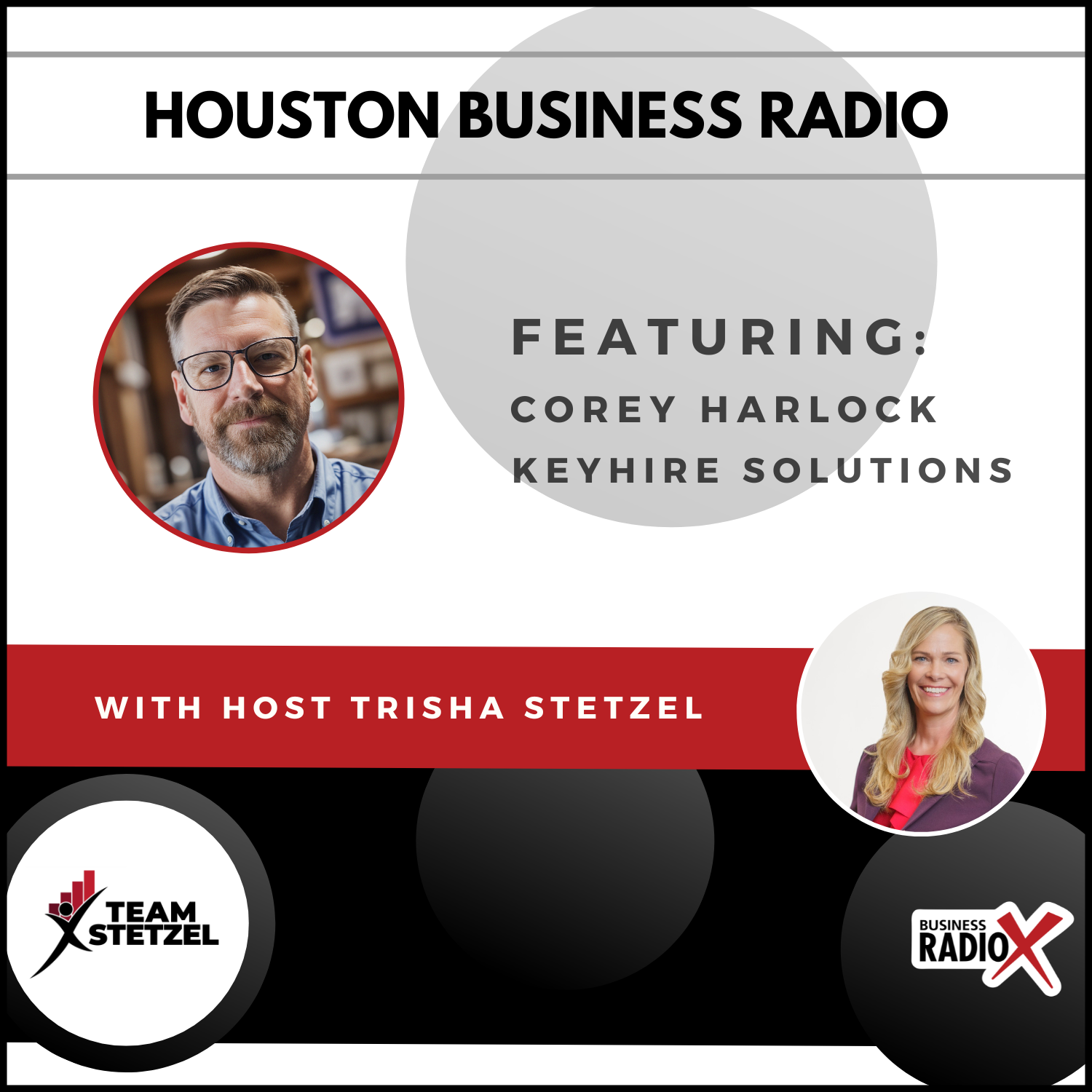


 Corey Harlock is the founder of KeyHire Solutions©, a talent strategy and acquisition consulting firm that helps small businesses—typically in the $5–25 million revenue range—scale successfully by hiring the right people at the right time.
With his Strategic Talent Scaling System© and KeyOwner Stages© framework, Corey empowers business owners to move from reactive hiring to intentional, strategic growth by redefining how they approach leadership and team building.
In his conversation with Trisha, Corey shared his unique journey from the hospitality industry to becoming a trusted advisor in the world of small business talent consulting. He explained how most business owners fall into the trap of hiring the wrong leaders or expecting too much too soon from new hires—and how KeyHire helps prevent those costly mistakes.
By deeply understanding each client’s business, constraints, and culture, Corey ensures a 90% first-hire success rate while saving time and frustration. His passion for listening, strategic hiring, and shifting leadership mindsets is what truly sets his work apart.
Connect with Corey on LinkedIn.
 This transcript is machine transcribed by Sonix
TRANSCRIPT
Intro: Broadcasting live from the Business RadioX studios in Houston, Texas. It’s time for Houston Business Radio. Now, here’s your host.
Trisha Stetzel: Hello. Houston Trisha Stetzel here bringing you another episode of Houston Business Radio. It is my pleasure to introduce you to my guest today, Corey Harlock, who is the founder and principal of KeyHire Solutions, a specialized talent strategy and acquisition consulting firm dedicated to small businesses. Through his proprietary Strategic Talent Scaling system, Corey helps elevate owners businesses from where they are to where they want to be. And I know you don’t want me to go on Corey, but I’m going to do it just a little bit longer and then I’m going to turn it over to you. So what sets Corey’s approach apart is how quickly and intimately he he learns each client’s needs, talent gaps, and constraints. This comprehensive understanding allows roles to be precisely defined, leading to the recruitment of highly qualified professionals who hit the ground running. Corey, welcome to the show.
Corey Harlock: Thank you. Pleasure to be here. Man, you can make yourself sound really good on paper, hey?
Trisha Stetzel: I know,right?
Trisha Stetzel: Yeah. Every once in a while, it’s nice when somebody uses your bio to introduce you. And that’s only a portion of it. Right. So, Corey, I know people listening and even I would like to learn more about you. So tell us about Corey and then let’s jump into Kiara Solutions.
Corey Harlock: Do you want personal professional. Bit of both.
Trisha Stetzel: Yeah, a little bit of both.
Corey Harlock: Sure. I’m, uh, been married and I’ve been with my wife now, my wife, since 1999. We got married in 2016. We have two kids, a 16 year old and 11 year olds. We’re right in the middle of it. Um, and, you know, we moved down to Houston from Canada. I will be speaking Canadian throughout this entire interview. We moved down here in 2014, so not long enough to get my drawl yet. But my wife’s a French speaker, so hers is really taken a long time. Um, but, uh, so we came down here and, you know, I’m I was an agency. My first life was in hospitality. Then I transitioned into agency recruiting back up in Canada. And when I came down here, I slipped into another agency job. But the whole time, um, I knew I’m an entrepreneur. And so, uh, I wanted to start a business, but I wanted to do something totally unique and different. And because I’m an entrepreneur, I wanted to help entrepreneurs. And it’s easy to look around the landscape and see everyone is happy to help the big guys because they got lots of money. And so I kind of put a challenge to myself to find a solution for small business that was fair and equitable for both sides, right? Your experience has value and I wanted to add value, but I also wanted to be able to earn a living.
Corey Harlock: And I was involved with Vista. I still am, but at that time I was in a different group and so I pitched this idea. I thought I had, and my members of the vistas group who had, you know, so many different disciplines, um, very graciously started kind of pulling me aside and saying, well, you know, our, our the CFO in the group pulled me aside and said, well, how are you going to make money? I said, I don’t know. It’s a great question. So he helped me come up with my my model. Um, we had Neo’s a really great EOS implementer here in the area named Randy Busby. She was like, well, how are you going to deliver it? I said, I don’t know. And she said, well, you know, the EOS model is pretty good. So she helped me work through the delivery of it, and then I leveraged that to go to my chair and say, hey, in your CEO group, if there are any companies that want to demo this for free So I can prove my model. I’d be happy to do it.
Corey Harlock: So I did it. I think I had three people that tried it. They all kind of came back and said, yeah, what you’re delivering is not what we want. And so I changed the model again. And now we have key here as it is today. Right. So it was a bit of a journey, but um, and it’s developing all the time. But where it is right now is, uh, you know, we focus on small business owners 5 to $25 million. And our goal is to we come in right where when you start a business, you hire your neighbor, you hire your neighbor’s cousin, you hire your friend, and everyone pitches in and does everything they think they need to do. And if they do a great job, eventually that business will. The needs and requirements of that business will outgrow the experience and the capacity of the group of people that started it. And that’s where we come in. That’s where we go to the owner and say, okay, let’s look and see. Where are you? Do you have talent gaps? Where do we need to build capacity into your business so we can keep you on this trajectory? So that’s kind of what key hire was built for.
Trisha Stetzel: So I heard you talk about the collaboration and the effort to get you where you are today. And also underpinning that listening to your clients. Hey, talk to me more about how how you got where you are today. Were you always open to collaboration or was that something you had to practice because you were really good at doing it yourself? Tell me more about how that journey from there to here was part of your business journey, or your entrepreneurship.
Corey Harlock: Tricia, that is an amazing question. Thank you. So, um, when I was in hospitality, I went very far, very fast. Uh, just through sheer will and determination. Um, I didn’t know what I didn’t know, and I had a very, very healthy ego, and I thought I knew everything. And as I transitioned through, you know, different phases of life, learning to listen and accept the help is something I have worked very hard on when it came to building Key Hire. I had a group of people that I knew, like and trusted, and even they at times had to say, hey, hey, hey, just settle down here. Just listen to what I’m saying. Um, because it’s you build. You build something, you know, there’s there’s there’s a blog by Seth Godin. Godin, whatever you want to call it. And it’s, it’s entitled who Will say go? And I recommend every entrepreneur go read it. It’s two paragraphs, but it essentially says anyone on the planet can be a proofreader. Anyone on the planet can take your idea and poke holes in it. But it takes real courage to take an idea and put it into the world. Um, and so that’s that’s what I’ve had to learn is, um, to not talk. To listen. Right. Even when you’re asking the question, I thought I knew what the question was halfway through, and I was ready to answer, but I had to go. No, no, no, just beep. And I’m glad I did because it was different than I thought, you know? So, um, it’s it’s a journey. I’m a work in progress. Uh, I can still be a little hard headed. I can still be a little stubborn, but, um, I have people around me who care enough and are brave enough and are honest enough to say, yeah, get over yourself. You need to listen to reason here, so I’m happy for that.
Trisha Stetzel: Yeah, you have to collaborate and you have to listen to your clients sometimes, right, to see what they actually want or need. Read alongside of what we think we’re bringing to the market, right? In order to support them.
Corey Harlock: And the other side of that is in business. If I try to solve a client’s problem before they feel like I’ve heard the problem, they’re not going to listen to me and they’re going to say, you don’t get it right, and I’m going to lose business. So listening to this is not a revelation, right? Listening is a really important skill, and there are very few negatives to it, and tons of benefits to just listening to people and acknowledging them and, and, and, and, and, um, letting them know that they’ve been heard. I don’t think there’s a downside to that that I can think of. Maybe you can, but.
Trisha Stetzel: No, no, I think I, I would absolutely agree with you. And there isn’t there really isn’t a downside, a downside to listening. And now as human beings, we get to choose what we take with us and choose what we leave behind. Right. The good listeners actually take it all into consideration instead of just neglecting the part that doesn’t sound like very much fun or is hard.
Corey Harlock: The selective hearing. Yeah. And I don’t know about you, but I like to let things marinate. Right? I like to, um. People will tell me something and I’ll say, uh, maybe I don’t know. I don’t like it. And then you circle back. Two days, two weeks, two months later. And I’ve said it to my marketing guy. I’ve said it to my ear. I know you told me this, like, four weeks ago, and I didn’t like it. But it’s the right thing to do. Let’s let’s go with that, you know. So it takes me a minute to, to get there.
Trisha Stetzel: Mhm. I love that. Okay. So I’m going to circle back to key hire Solutions and what you’re doing in your business. And what I heard you say was you’re helping. Listen I know right now I’m repeating you back to you. Can you just tell I’ve had some lessons. Um, what I heard you say is that you’re helping businesses that have gotten to a point where they’ve hired their neighbor, they’ve hired the cousin, they’ve hired this, this pile of people that they know and love and trust, and they just can’t get to the next step, right? So my question there is, because a lot of people listening are right there. What’s their first mistake?
Corey Harlock: Okay. So the first mistake is um, not taking the time because often they don’t have it because at that point they’re underwater. They’re working 60 hours a week. They’re taking it home with them. They’re stressed out. Right. In the key hire vernacular, you know, we have these key owner stages, and we call that the overwhelm business over a business owner. And a real simple way to think about it is if you imagine a car and all four tires are off the car. Right. And so they’re looking at this business with all four tires falling off, and they’re thinking, I got a problem. I know it’s a big problem, and I don’t even know where to start to try and fix it. Right. So the first mistake is probably twofold. Number one, someone says to them, hey, my neighbor just got laid off. And they’re, you know, they were a high level manager with this big company. They’d be great for you. So they splash out a bunch of cash in terms of salary to go hire a big ticket leader without putting the right process in place. And nine times out of ten, that is great for about three months. And then everyone realizes we’re paying this person a whole bunch of money and we don’t know what they’re doing.
Corey Harlock: They don’t understand our business. They don’t have the right skill set. They don’t. They’re not able to build in the policy procedure capacity of the business. We hope they would. And it’s no fault of either side. It’s just that the right questions weren’t asked or to save the money. They start hiring people on potential, meaning people without the experience who have that go get them attitude, but they expect the results of a seasoned experience person, and then they and if they do well in the beginning, maybe, you know, their first month or two, they’re really taking things on and getting things done and having an impact. They heap tons and tons more responsibility on them, overwhelm them, and then say, well, I don’t know what happened to them. They were doing such a great job. And what’s changed and what’s changed is we just, um, didn’t manage their expectations or we didn’t align their duties. You know, something I call breaking their neck, right? I’m really good at, uh, cold calling people. And, man, you’re really good at cold calling. You should run our marketing program. Well, that’s not the same doing so. Social media and cold calling are very different skill sets. Right. So breaking their neck means their face this way.
Corey Harlock: Then you make them turn around 180 and go the other way, and they’re flip flopping between the two based on who’s knocking on their door at that moment. And then you start wondering, wow, they used to be really get a cold calling, but it’s really dropped off and they’re not doing a great job with their sales or marketing either. What? Why aren’t they engaged? What’s happened? Maybe I need to replace them. And it’s they’re still doing the best they can. Right. That the caveat here is when I talk about these things, I’m always assuming and I feel like I need to put a disclaimer out there. We’re always assuming everyone is doing the best they can and the best they can for the business, right? I never want to paint a business owner in a bad light and say, you know, they’re they’re making bad decisions. They’re doing exactly what they think they need to do. And their intention, they’re well intentioned. It’s just sometimes you don’t know, and you make a mistake and you do what feels right or you think is right at the time. But down the road it could really kind of turn around and make things a little more difficult.
Trisha Stetzel: Yeah, absolutely. And I’m just thinking as you’re talking through that, getting the right people in the right place, doing the right thing at the right time. And sometimes we skew that as a busy business owner and just keep piling things on. Okay.
Corey Harlock: And to add to that, you know, I just I’m onboarding a client right now and they need a production manager. They they did the exact thing. They hired a referral of a friend. They paid them a ton of money. And they and they just didn’t work out. And so they’ve they’ve released that person. And, you know, they said to me, we really need this position. I said, I get it. And and the owner made this thing like, I’m I’m swimming here. And I said, I get it. You have to tread water a little longer. This isn’t a two week fix, because I don’t want you to hire someone just to hire someone. I would rather you struggle now and let’s get the right person in place to take that off your plate so you can kind of exhale, build trust with them and push those responsibilities aside so you can focus on pushing your business forward versus hiring someone who’s kinda there. And then repeat this cycle again and never get you gained any traction and never have you really be able to exhale. Right. So and she’s like, I know, I know, I get it. I’m like, just you gotta hang in there, right? Like, let’s do this correctly because we want to maximize the probability getting this done right. So you can just kind of okay, I trust this person to do the job I need them to do. Yeah.
Trisha Stetzel: All right. So before we I want to dive further into that like your your process of helping people get through this, this space where they’re just swimming and they need to tread water longer and get the right hire on. But before then, uh, would you let people know how to contact you if they want to have more conversation with you about this particular topic?
Corey Harlock: Linkedin is a great way to do it. Just Corey Harlock. I might be the only Corey Harlock on LinkedIn, I don’t know. Or if you go to our website, um, uh, there’s a button on there that’ll say be our next success story. Um, but that is just kind of click that button. It’ll take you to a page where you can get access to my calendar and book. Book a meeting there. Uh, we always say no sales, no weirdness, just help. Uh, we’re a first company, so don’t think you’re going to get on there. And we’re going to try to sell you a bunch of stuff. I’m happy to spend a half hour with any business owner if we can build a relationship. And you like what I say and what we can do for you, then we can talk about working together. But that’s not the purpose of the call.
Trisha Stetzel: Yeah, I love that all of that information will also be in the show notes as usual. So if you’re sitting in front of the computer listening in or watching, just point and click for those of you listening in the car, don’t point and click. Come back to it later. And Corey Harlock is spelled c o r e y h a r l o c k. And yes, you can definitely find him on LinkedIn. Okay, Corey, let’s circle back to how you help clients hire the right people for the right thing at the right time, doing the right things.
Corey Harlock: So the three biggest mistakes a business owner makes when they when they hire is number one, they don’t clearly define the role. They kind of usually have an immediate need. So they build a job description around that. So once the person comes in and solves that problem, you kind of don’t know what they’re doing anymore. Number two is they don’t have a clearly defined process hiring process, which is very important. Right. Candidate experience is the number one thing that will move the needle in someone taking your job or not. And then number three is they hire for current needs not future needs. One of our expressions at Key Hire is we’re not hiring someone to run your $10 million a year company. We’re hiring someone to run your $30 million a year company currently doing ten right. And when you as if if I can give a business owner one piece of advice. Start saying that when you hire right. Take your current revenue. Take your five year goal and say we’re hiring for this goal. Currently doing this because the person who can get you there can build the process and procedure to help you scale. So back to, you know, Kiara, what we do is we do a ton of diligence with the client. So we’re not an agency recruiting firm. We’re consultants that that do talent acquisition. So our goal is to understand your business almost as well as you.
Corey Harlock: Um, you know, I’m flying up to a company in Oklahoma next Wednesday. Just spend the day with them just to walk that company and understand it. So when I when I go to market and start talking to people, you know, we’re not key hire representing a client. We’re representing them. We’re telling their story in the marketplace. Place, right? But when we do that, we’ll also, uh, the role they have. I think we’re going to need to discuss it. And the, um, the job descriptions or requirements are probably going to change a bit once we do our diligence and sit down and talk with them. So we’ll do that. We call that our action plan. And then the action plan. You know we create a scorecard and we’ll create a company overview and we’ll do comp analysis and we’ll create the hiring process that we’re going to use. And then so that is like clearly defining the role. Right. Exactly what we need. Then we’re going to clearly define the process. Our process is proven to work. We have a 90% success rate with our clients in terms of the people they hire. So we’ll we’ll define the process. And part of our scorecard is capacity. There’s three elements to our scorecard. It’s culture experience capacity. And we we measure everyone all on all of those things. Then we walk our clients through the process.
Corey Harlock: We do the heavy lifting in the background on behalf of them, Our clients spend anywhere from 6 to 12 total man hours per hire because we we try to go out and represent them the best we can. And when we bring them someone, we want them to think, um, yeah, this is great. I have a client who always says, if you ever need a referral, just have them call me because he always says the best thing. I like. What I like about working with you, Corey, is you bring me one person and I know I’m going to hire that person. I know I don’t have to interview a whole bunch of people because you know our company so well. Uh, it doesn’t always work out like that. But our interview to offer ratio is about 1.6 to 1.8. So our clients, on average interview 1.6 to 1.8 candidates per offer given. So really our goal is to give them back as much time as they can. Um, the battle cry of every small business owner don’t have the time, don’t have the money. So we try to solve the money issue by being, you know, a fair and equitable resource for them. And we try to solve their time issue by buy. Trust us, we’re going to do all the hard work in the background. You just have to show up when we need you to.
Trisha Stetzel: All right. I’m going to circle back around to the time thing, because it’s really sitting with me. And I talk to a lot of business owners who they’re swimming, right? Barely. They might have floaties. They need floaties because time is a big deal for all of them. So what would you tell these business owners who are listening and saying, gosh, I really I would really like to take that first step, but I’m scared to death to do it because something in my business is going to break. If I stop paying attention to it, what would you tell them?
Corey Harlock: Yeah, that’s so hiring the right. The mindset is in that situation when we’re talking about an overwhelmed business owner and our key owner stages, it goes from overwhelmed to unsure to curious to growing. So when we’re in the overwhelmed stage, the mindset becomes, if I can just hire that one right person, my life will be better. Things will be better. And it’s not. It’s not a home run. It’s for singles, right? So we need to hire the first right person to just let a little arrow to the tire. Right. Just give you a little more back. Just give you a little something back. So then we can focus on the next one. And then that next one comes in. And now we’re really letting the air out. Because now we have two main concerns of the business locked down with professional people that probably know that part of your business better than you do. Right? And that’s the goal. And so then each one is a continuum, right? So you go from that overwhelmed to unsure, which is you know, that the unsure we call those the wobbly wheels. So you know how the, um, the overwhelmed or the tires are off the car? Well, now imagine a car with all wobbly wheels. You’re going down the road, but it is not a smooth ride. Right? And you’re thinking you’re still unsure. Like, how do I fix this problem? But at least I’m getting some motion out of this.
Corey Harlock: It’s not. It’s not fun. Then the curious business owner, we call that the squeaky wheel. So you can point to the tire. You’re still going down the road. Things are okay, but I can point to the tire and go, I know I have a problem there, but I don’t know what my options are. How can I fix that? Right? Um, so we want to take them through that. And each stage, sometimes they go pretty quickly. But you see the the change in the mindset. Now, um, I like to say we, we help, uh, business owners redefine what good leaders look like. So once you put a good professional leader in a business and it works, that’s where they get curious and they start saying, oh, I had no idea they could do all of these things. Now we use I usually do, and we just kind of don’t talk about it because I don’t want them to feel like, well, no, I just need them to do this right. But then once they see it, they start thinking, well, what if I went out and got some other great leaders like this one? How would that impact my business? And then that’s where it starts getting fun, right? That’s where you start really getting some traction and moving through those stages and into that growing stages where ideally we would love to get them.
Trisha Stetzel: Yeah, absolutely. Okay, so one thing that I noticed is that you are almost a true Texan because you when you said you were going to Oklahoma, you said you were flying up there.
Corey Harlock: Oh, okay.
Trisha Stetzel: I’m just saying we’re getting closer. We’re getting closer to being a Texan. Uh, do you work outside? You said you’re flying Oklahoma. So do you work across the United States? What’s your preferred territory?
Corey Harlock: We like to keep it, you know, within Texas, if we can. But occasionally, you know, I’ve worked. We’ve worked in Alabama. Uh, we’ve worked in, uh, Tennessee. Going to work in Oklahoma now. Um, so, yeah, if we can get there and still be a part of that company and have them feel like, you know, we’re in, we’re in sauce for them and we’re part of their team. Yeah. Um, the process just works better when we can spend time with the owners and be with them and build that relationship.
Trisha Stetzel: Okay, awesome. One more time. Tell people how they can find you. And then I have one more question for you. So tell us how we can find you or connect with you.
Corey Harlock: Yeah. Linkedin Corey Harlock c o r e h a r l o k. And then the website is key. Hire dot solutions. So k e h I e dot solutions. Um and then you’ll find a button there like be our next success story or or schedule a meeting or whatever it is. And uh, like I said, no sales, no weirdness. Just help.
Trisha Stetzel: Just help. Just. Corey. I’ve really enjoyed our conversation today. So my last question or my last, I guess. I guess it’s a question. Um, tell me your favorite client story.
Corey Harlock: My favorite client story. Um. Well, I’ll tell you my. I have a and I’m really fortunate because I usually really just really, like, work my business owners. I mean, that’s why I wanted to work with business owners, because they’re really cool people. Right. They have a passion. They have the courage to start something. So, um, one of my favorite, uh, um, happenings was I have a client. He’s in warehouse distribution. He’s got a really cool business. And when I first started with him, you know, two and a half years ago, the first person I put in there was a director of operations for him. And it’s this guy out in New York. And I always say his love language is arguing. He just loves a good argument. But he does everything with a big smile on his face. And he’s just really good. And he’s just this great personality. And he’s built this, uh, relationship with the owner where they are, you know, no holds barred. They don’t hold anything against each other, but they’re not afraid to to just fight for what they think is right. And so we are now in the process of of bringing in a director of finance for him. And he said to me, Corey, this director of finance has to be good as the director of operations, you got me because he’s the best hire I ever made. And I was like, yeah, I love that. That’s amazing.
Trisha Stetzel: That’s awesome. I got goosebumps. That makes me feel sad. That makes me feel good for the work that you’re doing out there. Corey.
Corey Harlock: It’s it made me feel good for him because he hired a really good leader and he was humble enough to, uh, allow him to do his thing, even though he didn’t always understand it. But, you know, it’s just like eventually got to the point. And he’s like, I trust you. I know you will make the right decisions, so I don’t get it, but just go do what you got to do to make my business better. And, uh. It’s great. Right? Just watching, like, when I go on site with those two and just to hear them bicker, it brings me joy.
Trisha Stetzel: Love, languages, arguing. I know a few people like that, Corey. I’m just saying. Yeah. Thank you so much for being with me today. It’s been a great conversation.
Corey Harlock: I’ve enjoyed it. Thank you so much.
Trisha Stetzel: You’re very welcome. All right everybody. That was Corey Harlock with Ki Hire Solutions. And that’s all the time that we have for today. If you found value in this conversation share it with a fellow entrepreneur, veteran or Houston leader who’s ready to grow. And of course, as always, be sure you follow, rate and review the show. It helps us reach more bold business minds just like yours. Your business, your leadership, and your legacy are built one intentional step at a time. So stay inspired, stay focused, and keep building the business and the life you deserve.














