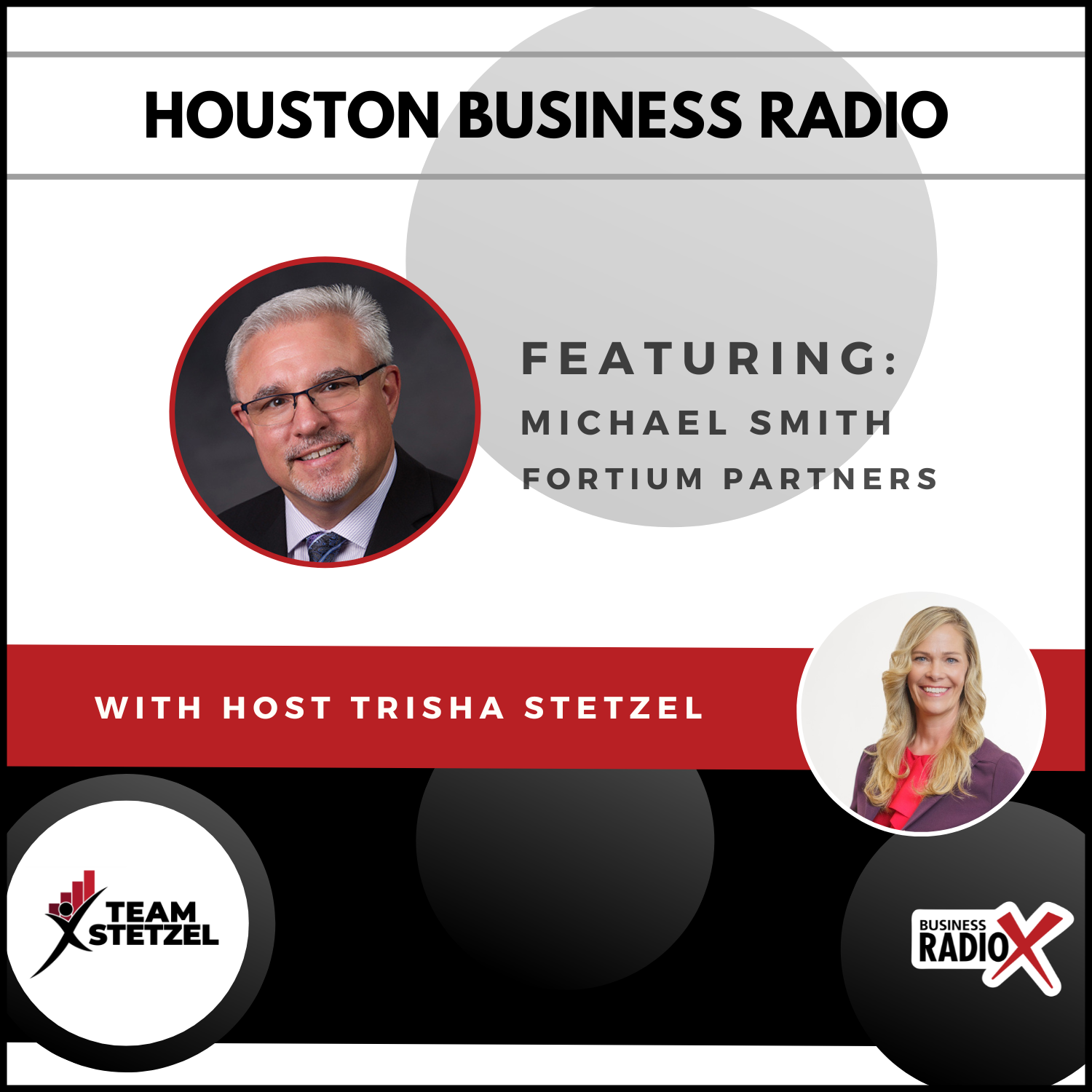


Michael Smith is a transformative, award-winning global business IT executive with a proven track record of driving organizational growth and long-term profitability across a range of industries.
With deep expertise in aligning technology strategy to business objectives, he is known for delivering innovative solutions that enhance productivity, streamline operations, and maintain a competitive edge.
Michael’s leadership blends technical acumen with strategic insight, empowering organizations to adapt, scale, and succeed rapidly.
LinkedIn: http://linkedin.com/in/michael-smith-7719011
Website: http://www.fortiumpartners.com
 This transcript is machine transcribed by Sonix
TRANSCRIPT
Intro: Broadcasting live from the Business RadioX studios in Houston, Texas. It’s time for Houston Business Radio. Now, here’s your host.
Trisha Stetzel: Hello, Houston. Trisha Stetzel here bringing you another episode of Houston Business Radio is my pleasure to introduce you to my guest today, Michael Smith, partner at Fortium Partners, a transformative, award winning global business and IT executive known for helping organizations use technology as a catalyst for growth. With a proven track record across multiple industries, Michael has led companies through digital transformation, implemented strategic systems that drive profitability and efficiency, and build the kind of leadership teams that keep organizations innovative and competitive. Michael, welcome to the show.
Michael Smith: Thank you. Thank you for having me on.
Trisha Stetzel: Yeah, absolutely. So I’d love for you to tell us a little bit more about Michael.
Michael Smith: Yeah, I live in Kansas City, so I don’t know if you can see my picture behind me. So that is the Chiefs Kingdom flag. So, uh, looks like an American flag, but it’s the chiefs kingdom. Um, my oldest son, when he was in high school, his friend was, uh, did a lot with woodworking. And so, uh, one of the Father’s Day, probably 5 or 6 years ago, um, his, uh, he coordinated for his friend to build that for me. And so, uh, so. Yeah. So I always enjoyed it. You can see my office. There’s a lot of Chiefs memorabilia around there as well.
Trisha Stetzel: We’re not going to talk about their season, are we? I’m just teasing.
Michael Smith: Well, they’re doing much better now. And so, yeah. So they didn’t start off well but they did a lot. They’re definitely coming on strong. So hopefully we get another chance at the Super Bowl. We’ll see.
Trisha Stetzel: Yeah absolutely. Well there’s there’s uh some good notable players on that team just say yes. All right. So Michael likes football.
Trisha Stetzel: Yeah. And and a few goodies hanging on your wall.
Michael Smith: Yes. Yes. And I’ve been in the IT industry almost 30 years. Um didn’t start my career in it. So my undergraduate degree was in criminology with an emphasis in, in criminal profiling from my major. And my minor was in communications. And so I was actually on my way to the FBI in behavioral science, uh, being a behavioral scientist. And at that time the the famous movie was silence of the lambs with Jodie Foster, and she was a behavioral scientist, uh, with the FBI. And that’s what I wanted to do. And, uh, being young and not very wise of the world, I didn’t realize that you couldn’t apply directly to the FBI from college. You either had to have prior military experience or three years of civilian work experience. Uh, and the reason why is if the FBI is going to hire you, they’re going to do a background check. And to the US government. You do not exist as an individual in the country until you have filed tax returns yourself. And so as a dependent, um, of my parents, the government doesn’t really recognize that you exist, uh, unless, you know, you’ve been arrested or something. And of course, that’s going to eliminate you from being in the FBI to begin with. And so so, yeah, I was on my way there and realized, okay, well, I interviewed with them. They definitely were excited about bringing me on board, but they said, you need to go and find someplace else to work. Uh, and I graduated in 93 from college. And so, uh, they said, hey, in the next 3 or 4 years, we’re going to have a mass exodus of, um, agents that are going to retire and be a perfect time. So come back to us. So now I had to find another job, right? And so I ended up finding myself at a bank and working in more of their automated clearinghouse to kind of look at fraud detection.
Michael Smith: So if large financial transactions were coming in and then money was being disbursed to a lot of accounts. That would sometimes be a red flag for money laundering or embezzlement of some kind. And one of the banks that I worked at, they had a As 400 mainframe system with an OS two operating system, and you may not know what that is unless you’re in the IT industry. Uh, and that administrator would drive in 2.5 hours to work on an issue that would take them about 30 or 45 minutes and then have to go back to the corporate office. And this was before remote diagnostics tools were available. So, uh, one time when they were there visiting, I said, look, I don’t have a clue what you’re doing, but maybe give me a call. And, uh, you can walk me through it, even if it takes an hour or an hour and a half. It saves you five hours on the road. And, uh, they like the idea. And so we did it. And after a few times, it was like. This was not what I was expecting it to be like. And I think the whole reason I was drawn to criminology around the whole idea of analytical and investigative and troubleshooting, you know, if a crime has been committed, you know, finding out who committed that crime. Uh, it was the same thing that drew me into it. So I ended up going back to school and, um, ended up being in the IT industry. And I look back and I couldn’t imagine being in any other industry in it. Absolutely love it.
Trisha Stetzel: Wow. Talk about remote it service. Yes. Beginning.
Michael Smith: Yes, yes.
Trisha Stetzel: Wow, what a great story. Thank you for sharing that, Michael. I love to just take a little bit of a swing to the left and talk more about 40 and partners, so tell me more about that.
Michael Smith: Yeah. So 40 has been in business for almost 12 years. Um, they are now the largest technology leadership as a service firm in the United States. And they support thousands of clients across the US and Canada. And what they provide is executive technology leaders. So if your company suddenly, um, have your CIO, which Chief Information Officer, CTO, Chief Technology Officer, or CISO, Chief Information Security officer, uh, has either decided to leave the organization and go someplace else, or they’ve been asked to leave. Um, then 40 will be brought in to kind of fill the gap and, uh, and play that role, uh, while the organization is trying to find their permanent replacement. And we partner with a lot of, uh, recruiting firms across the country, large and small, uh, to, to find who that permanent person is. But we are running the it function for the company. Everything from IT strategy to implementation to overseeing projects to driving the creation of technology roadmaps. Everything that a CIO, CTO, or CISO would do in an organization. But for our smaller and mid-sized companies, um, they may have not reached the point where they’re large enough to have a full time technology leader. So they also utilize us in the fractional space so that we can provide fractional services. Um, again, CIO, CTO and CSO and then our fastest growing segment of our organization is private equity firms. So PE firms will bring us in to not only help with the due diligence of an acquisition around the technology footprint, but also the post acquisition, integration of that, of that environment that they purchased to integrate into their environment or their portfolio of companies.
Trisha Stetzel: Wow. Very interesting. I have so many questions. Uh, first one, I’m trying to gather all my thoughts here. Um, tell me about your transition from. So you were a very, uh, what I can see as a technical person, you wanted to go into the FBI and problem solve, and then you were in it and problem solve. How did you transition from that technical role to actually leadership or technology leadership?
Michael Smith: Yeah, it actually goes all the way back to my first job in it. So after I went back to school and I was hired and this company doesn’t exist anymore, um, even the subsidiary doesn’t exist anymore. But there used to be a company called sprint PCs, and this was a subsidiary of sprint, which now is owned by T-Mobile. But sprint PCs was really the first, um, company that developed the CDMA technology, which is what cell phones use and communicate with. And so they started this company. And of course, sprint being headquartered in Kansas City. Pcs was headquartered there. And I started at the entry level of it in help desk and desk side support. And, uh, and I wasn’t an employee of sprint PCs. I wasn’t even a contractor. I was a subcontractor. So editors, which was the company owned by Ross Perot? Uh, many people remember him. Uh, he owned editors and editors, was the prime contractor for sprint PCs to build their nationwide infrastructure network from an IT perspective. And one of these subcontracting firms I interviewed with and got selected and was hired on to be a subcontractor. Well, about three months into that particular engagement, um, because I was supporting a lot of individuals in sprint PCs, I also had an opportunity that I was working in the corporate headquarters of PCs. So the CEO was there, the CFO was there, and the CIO was there as well. And, uh, one day, on a dare to myself, I reached out to the CIO of sprint PCs and asked if I could take some time to meet with them, and that I was new to the IT industry, but I ultimately wanted to do a role similar to what their role was, uh, in my career.
Michael Smith: And I wasn’t expecting to get a response back because not only was I not an employee, but I wasn’t a contractor, I was a subcontractor. So I was kind of like really Very low on the totem pole. Right? And there wasn’t a lot of reason for that particular person to meet with me. Well, not only did they reach out to me and schedule 30 minutes on their calendar, but when I went to meet with them, our meeting ended up lasting two hours long. And he had all this wealth of information he encouraged for me to go back to school and get my MBA. I did that and went in 2006, got that in 2008, and had all this advice for me of how I could position myself in my career to ultimately become a technology leader. And, uh, and now I’ve served as a CIO and three different companies, um, even before I joined 40, um, partners. And, uh, so, you know, when I think about that type of leader that I met with early in my career, um, I walked out of their office thinking, that’s the type of leader that I want to be. I want to be able to mentor the next generation and to help the next generation. Because they didn’t have to spend that time with me, and especially two hours worth of time. That really just changed, um, my entire career and probably even my entire life. And so, uh, so no, it was, uh, it was it was really it was a great experience. And so I’ve always tried to be that type of leader as well, with many people that work for me and work with me.
Trisha Stetzel: Yeah. Thanks to all the leaders out there. Shout out to those of you who are mentoring others behind you. That’s how we make workplaces and even the world a better place to live, right? Uh, is by doing that mentoring. So before we go any further, I know people are already ready to connect with you, Michael. So what is the best way to connect with you? If they have questions or even just want to follow the information you’re putting out there?
Michael Smith: Yeah. The easiest way is to email me and my email address is Michael. So m I c h a e l Smith. Uh, very common name Michael Smith. Right. So Michael Smith at 40 Am Partners.com. And that would be the easiest way to get Ahold of me. But you can also go out to 40 and Partners.com and learn more about the organization. Uh, the interesting thing with 40, um, with them being the largest of their type of, uh, company in the industry, is that if you’re going to work as I do with 40, you have to have been in the IT industry at least 20 years. You had to have served as a CIO, CTO or CSO in at least two, if not three or more companies. Uh, and what clients are actually receiving is very experienced executives that can hit the ground running. Um, because a lot of times, if, again, a technology leader has left, uh, specifically if they’ve left on their own, uh, and taken on other opportunities, it’s jarring to the company. And so now they’re having to figure out how do we backfill this particular position. And on average, for those types of executive positions. It could take 6 to 9 months to find someone, bring them in and then be able to get them up to speed. And just having that insurance policy of being able to reach out to 40 and having an experienced executive that is being brought in specifically for that purpose, and then helping the company also find who that right candidate is. And again, we’re not a recruiting firm, but we do work with a lot of recruiting firms. Um, but it just provides a lot of stability for the organization in those significant times of transition and change.
Trisha Stetzel: Yeah, absolutely. Okay. So you guys, the best way to connect with Michael is through email. And 40 is spelled f o r t I u. And it’s 40 m partners. Okay. Over here Michael you mentioned the fractional work that you all do as well. So for my midsize business owners and leaders that are out there listening, can we talk a little bit more about this fractional role? First, explain it so that people understand what it is, and then how these midsize, small to midsize businesses can actually benefit and grow from having a fractional person in their leadership.
Michael Smith: So, so the concept of fractional leaders has been around for probably 35, 40 years. It’s been more traditionally on the CFO or the chief marketing officer, the chief revenue officer or chief sales officer. Um, those types of executives have existed for a long time in the IT world. That’s probably only started to come into the industry in the last 10 to 15 years. So it’s still relatively new. Um, but the whole concept of fractional is that at least working with 40, um, you’re bringing in an executive level, very highly experienced technology leader into a company for as little as four hours a week to as much as 24 to 32 hours a week, right? I mean, you get above that 32 hours a week, you’re most likely getting a full time, uh, in terms CIO, CTO, or CISO, but it’s just that flexibility that the organization may have not grown enough, or they’ve been rapidly growing, and now suddenly they need to have that technology in place. But they’re not, um, at a point where they can afford a full time person then bringing in that fractional person that, again, can work a small amount, uh, with that organization on a weekly basis. Um, it just creates that flexibility. It’s very, uh, cost, um, you know, beneficial to an organization because, again, they are getting, uh, an executive that has come and has done this type of job many times at some of the largest companies in the world. And so it’s a very valuable asset for those companies.
Trisha Stetzel: Yeah, very exciting that these small to mid-sized businesses can take advantage of having someone like that in their business, even if it’s just for a temporary amount of time. Right. Um, as a fractional. So how do we you mentioned cost, and it makes me think about how most of us in business think of our IT department as being a support function. Right. Or a cost center where what you’re really presenting today is the idea of having a strategic partner in this space. So tell me more about your ideas on that.
Michael Smith: Yeah. Um, I would say in majority of companies and the only industry that might vary slightly would be in manufacturing. But in a lot of industries, the second highest cost for any company is going to be it technology costs, right. Second only to personnel and the people side that’s running the company and operating the company in manufacturing. Um, your inventory might end up being your second largest cost, followed by, um, it. Right. So no matter what, in every industry, at least the second or third highest cost is going to be the technology investment. And unfortunately for many companies, right. It’s one of those things that’s looked at as a cost center. Right. Well, we it’s a necessary evil. We need this technology to operate the organization. Um, but many companies may be surprised that the great equalizer in any industry is the strategic use of technology, uh, of being able to really make sure that the technology you’re investing in is exactly the right technology you’re needing for your organization, but also developing that roadmap, because every company that’s a successful company has built a 3 to 5 year strategy. Where do we want to go as an organization? Uh, and then being able to take the technology strategy and overlay it across that corporate strategy to really make sure that you’re getting the biggest bang for your buck. That if you’re investing in technology, make sure it’s the right tools and the right technology for what you’re ultimately trying to accomplish. And many companies, again, look at technology as it’s just an operational thing, but in reality, it needs to be treated as a strategic asset that it is really going to drive productivity efficiencies, profitability, um, growth for a company. Technology is going to be that centerpiece. And, and there’s a lot of companies that just don’t take advantage of that strategic asset.
Trisha Stetzel: Yeah. And not treating it strategically, we find ourselves with all of these shiny objects and all of these things that we need to go buy and implement, and we often find ourselves in trouble because we haven’t thought about it in a strategic manner. So I’d like to shift a little bit to just talk about AI. It’s a big topic, right? Um, AI and ML machine learning. And what advice would you give listeners, um, or even leaders about evaluating and adopting these technologies without falling into that shiny object trap?
Michael Smith: Yeah. Um, well, first of all, AI and machine learning has been around since the 1950s, right? All the way back to the mainframe technologies. It’s been there. What’s different this time around is more the front end side of AI, and it’s what we call generative AI or genetic AI. Um, and that’s where you’re you’re putting the power of AI into the consumer side of, of those that utilize it. So that could be ChatGPT that could be Claude, that could be grok, um, those particular tools. Um, and it has transformed for a lot of companies of being able to drive opportunities to really streamline and create efficient business processes within the organization. The challenge is, is AI and machine learning is no different than any other technology innovation. If you don’t have a strong business case and a business reason to adopt it, you’re going to invest a significant amount of money and time, and you’re not going to get a true ROI off of that investment. Um, in my industry. And I will will apologize to companies out there in my industry. And a lot of service providers are selling the hype and selling this concept of FOMO, fear of missing out.
Michael Smith: And you’ve got to jump on the AI bandwagon or you’re going to be left behind. Um, but don’t fall for that type of, uh, trap. You still need to understand what is the business reason of why you need to implement it. And I’m I’m telling you, AI and machine learning are very powerful tools and can really change the trajectory of an organization. But you’ve got to start with the same reasons why you brought other technology historically into your organization. What is the business reason and what’s the business case? And then if you do that, you will you will reap the benefits of the investment that you’ve you’ve built into that. Um, but but that would be my advice is make sure that you’re, you’re working with trusted partners. And again, Fordham is one of those partners that we do a lot around the strategy of how AI can really transform your organization. Um, but just don’t don’t fall, you know, both feet into the hype and invest significant amounts of money without really understanding and studying what your organization needs as it relates to AI and machine learning.
Trisha Stetzel: Yeah, absolutely. What great advice. So shifting that into the people space, like I think with the speed at which we’re seeing all of this technology, it becomes a leadership challenge. And, uh, cultivating new leaders who come behind you. You mentioned mentoring earlier in our conversation. Why is mentoring or mentorship such a critical part of bringing the next generation of technology leaders and executives up?
Michael Smith: Well, I think, uh, first and mainly is the fact that if you as a leader look into your career, chances are there was someone that took a chance on you at some point to give you that opportunity to lead. And if those individuals weren’t there in your career, you may have not had the opportunity to propel your career into leadership opportunities. And sometimes we get we get stuck in our day to day activities, right? And we forget that there’s another generation of individuals coming up. And a generation after that generation that’s coming up that those are the future leaders that when we as current leaders hang up our cleats and we’re done with our career and we retire. Those next generation of leaders are going to take that mantle and move on forward and hopefully, you know, do even greater things than what we were able to accomplish. Um, but that only really comes into play when we have individuals and leaders willing to mentor in the next generation and to pay it forward and to really, um, have an opportunity to take our wealth and our knowledge of what we’ve learned in our career and to be able to share that and invest that in the next generation, because someone did that for us when, uh, when we were early in our career as well.
Trisha Stetzel: I heard another footballer when we hang up our cleats. I’m just.
Michael Smith: Yeah. There you go.
Trisha Stetzel: Uh, okay. So, Michael, talking about mentorship, what is you’ve told us about you being mentored. Give me your favorite story about someone that you have mentored at some point in your career.
Michael Smith: Yeah, well, there’s a great organization out there. And again, this is more in the IT circles. But they’re called tech. And they are leadership development company for um mid and senior level um director level leaders in it that their goal is to be able to advance to become a CIO, CTO or CISO. And I’ve worked with them for a number of years, and I’m a mentor with one of them. And so when individuals come in and enroll in the program, then they’re assigned a particular leader that’s going to work with them during that six month period that they’re in that leadership development program. And it’s, um, again, technology leaders across the country and around the world that that participate in this. And I’ve done this now for 4 or 5 years and, and two years out of that 4 or 5 years, I’ve, um, received the Excellence in Mentoring Award. And what that means is that those that had that I had had the opportunity to The mentor had nominated me to receive that type of award because it made a significant impact in their career. And just being able to enhance the, the, the results of what they wanted to get out of that leadership development program. And so, so, I mean, I take a lot of pride in that. Um, but I always go back to early in my career with that CIO that did not need to spend any time with me, and they did that. I walked out of that office. Like I said, I want to be that type of leader when I become a leader, a CIO like this individual. And, uh, and so, yeah, I think every time that I mentor someone, I get more out of it than, than probably what that individual has received from me. And so it’s, it’s just a it’s a great opportunity to really invest in that next generation.
Trisha Stetzel: Absolutely. We all learn from each other. It’s not ever just a one way. I don’t think, uh, I love mentoring others in my space as well As we get to the end of our conversation today, I’ve got one more question for you. Um, as we’ve seen, you’ve spent your career helping organizations grow smarter through technology. This is the space that you love to play in. If you could leave our listeners today with one piece of advice about leading through change, because we know technology brings lots of that and using innovation to create real impact, what would it be?
Michael Smith: Um, I did a, uh, it was probably a podcast, probably 7 or 8 years ago that I happened to just come across when I was going through my LinkedIn profile. And you know, how in LinkedIn you can kind of, um, store some of your past things where you can kind of reference. And I just happened to come across this one in the podcast was called Lead With Boldness. And in that and the title of that podcast came from something that I had said during the podcast message and they thought, hey, this is a great title for this particular podcast, but I would encourage the, the, the business leaders that, that are listening to to this podcast. Lead with boldness and lead with courage. Right. Because when you think about change, change an organization is the the most anxious, um, concept that happens within companies, right? And there’s never a time that change doesn’t impact people, right? And people sometimes fear change because the fact that they’re used to how things work. And now technology is brought into the organization and it’s changing things. And I think there was, uh, one concept where people say, you know, my cheese has been moved, right? And so it really upsets my cheese.
Speaker5: Yeah, exactly.
Michael Smith: It really upsets people. Um, but what leaders need to really do is to lead with courage and with boldness, because it’s going to create a sense of calm, uh, in the sense of chaos, right? That happens with change. Having that bold and courageous leader is what’s going to really calm the storm and let people know that everything’s going to be okay. Right. And this is going to be a good thing. And and we’re going to get through this together. And it all comes down to that leader and their ability to to manage change and again lead with boldness and with courage.
Trisha Stetzel: Yeah, absolutely. And have a strategy. I learned that from you today too, which is very important. Michael, thank you so much for joining me today. This has been an awesome conversation.
Michael Smith: Well thank you. I appreciate you having me on.
Trisha Stetzel: Yeah. You bet. All right. One more time for the listeners. What’s the best way to connect with you.
Michael Smith: Yeah. So again email Michael Smith at partners.com. Or you can go out to Fordham Partners.com to learn more about the services that we provide to companies large and small across the country.
Trisha Stetzel: Yeah, fantastic. And you guys, as always, I’ll have this in the show notes. So if you’re not driving, click on over and you can connect. If you are driving, please wait until you get home and then you can grab those in the show notes. All right. My favorite friends. That’s all the time we have for today. If you found value in this conversation that I had with Michael today, please share it with a fellow entrepreneur, a veteran or a Houston leader ready to grow. Be sure to follow, rate, and review the show. It helps us reach more bold business minds just like yours and your business. Your leadership and your legacy are built one intentional step at a time. So stay inspired, stay focused, and keep building the business and the life you deserve.














