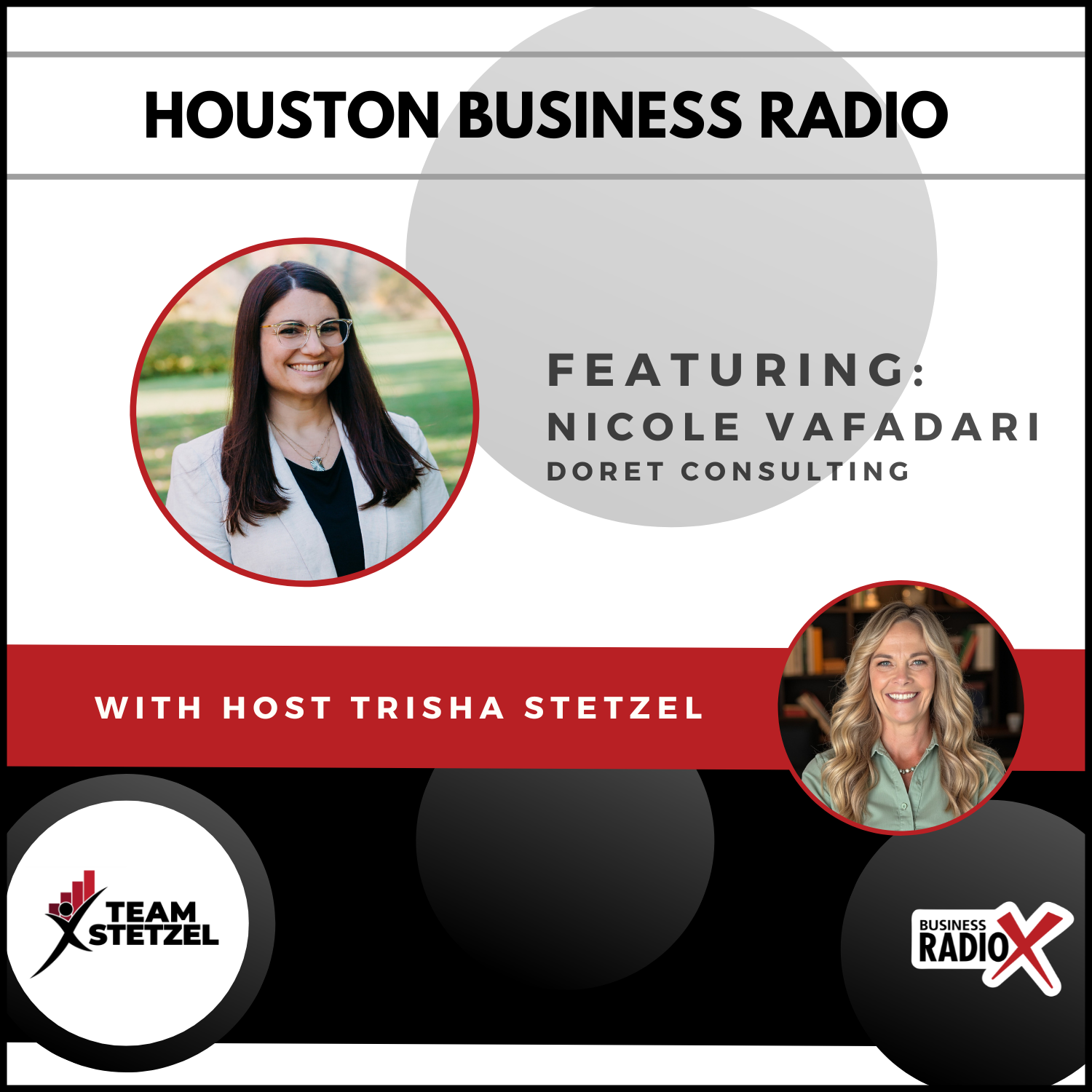

 Nicole Vafadari is the Founder & CEO of a healthcare technology start-up, where her entrepreneurial vision meets a deep expertise in both business strategy and IT.
She’s the kind of leader who can talk digital strategy with marketers one minute and dive into IT infrastructure the next. With a foot in both worlds, she’s built a career around bridging gaps, streamlining systems, and helping teams actually hit their goals on time and with intention. 
From leading ecommerce rollouts to fine-tuning CRM setups, Nicole knows how to make tech work for the business, not the other way around.
She’s data-driven but people-focused, always looking for ways to connect departments and align on what really matters: smart growth, clear communication, and results that speak for themselves.
LinkedIn: https://www.linkedin.com/in/nicolevafadari/
Website: http://www.doretconsulting.com
 This transcript is machine transcribed by Sonix.
TRANSCRIPT
Intro: Broadcasting live from the Business RadioX Studios in Houston, Texas. It’s time for Houston Business Radio. Now, here’s your host.
Trisha Stetzel: Hello, Houston. Trisha Stetzel here bringing you another episode of Houston Business Radio. It is my distinct honor and pleasure to introduce you to my new friend and guest, Nicole Vafadari, founder and CEO of Doret consulting, a healthcare focused consulting company dedicated to improving systems, communication and outcomes across the healthcare industry. Originally from Texas, yay! Now based in Wisconsin, Nicole brings a unique blend of business strategy, healthcare technology expertise, and values driven leadership. After stepping away from corporate America, she chose to build a company aligned with her personal principles, focusing on meaningful impact, authentic leadership, and sustainable growth rather than simply chasing scale. Nicole is also passionate about helping leaders avoid burnout while balancing business, family, and personal growth. From her annual Me Treat, reflection retreats to her people first leadership philosophy, she’s creating a thoughtful approach to entrepreneurship that prioritizes both results and well-being. Nicole, welcome to the show.
Nicole Vafadari: Thank you so much for having me, Trisha. I appreciate, I’m so excited to be here. And, uh, I feel back at home being on a Houston business, uh, radio channel.
Trisha Stetzel: Yay! I’m so glad. I don’t know why you moved so far away. We might have to talk about that. Not today, but we’ll talk about that soon. Yes, absolutely. Well, I’m so glad to have you on today, Nicole. Tell us a little bit about a little bit more about who you are.
Nicole Vafadari: Yeah. Um, so as you mentioned, um, born and raised Texan, um, and, uh, really focused on trying to, um, show up as a whole person and bring what I think will make industries better. Um, I am lucky enough to be a mom to two awesome kids who keep me on my toes all the time. Um, and I have a great supportive partner. Um, I’m also a big believer in being incredibly involved in my community. Um, I was a former school board member, city council member, and now, uh, my most important role, um, is mom and then very close second, um, is, uh, leader and, uh, coconspirator and peer to my amazing team at Doric consulting. Um, so yeah, very excited to have the opportunity to talk with another successful woman such as yourself, about the different kind of modalities and progress of career and how that fits into life.
Trisha Stetzel: Yeah, we do so much right? Nicole. We just do. There’s so many parts to it. So let’s why don’t we start here? Um, you made the decision to leave corporate America and build something on your own. So what pushed you to make the leap, and how did you know it was really the right time to do it?
Nicole Vafadari: Yeah. Um, so I did not know it was the right time to do it. It was, it was surrounding myself with a lot of people who kind of saw the, um, possibilities before I did actually. Um, so, uh, I was definitely, uh, at that time working with a career coach, um, which I actually, um, not as, not as fantastic as your podcast, but I did have my own podcast, um, called this could have been an email and, um, on that, I actually interviewed, um, this career coach who I had met to talk about like, what is career coaching? Um, and, uh, it was incredible, an incredible moment of kind of transformation. Um, and also at that time, I just didn’t feel really great about, um, the company that I was at in terms of where investments were being made. Right? There were decisions above my pay grade that led to me not feeling great about the ways that I had to show up, um, and work with clients in the healthcare space. Um, and so I really wanted the ability to like, um, kind of bring my best forward there. And then honestly, my, um, my husband was a great partner in saying like, it doesn’t seem like you’re super happy there. Um, and, and kind of taking the pause to say like, well, why don’t you just leave? And I said, well, what am I going to do? You know, I was used to being the primary breadwinner in our family. We had two small children. And so he was like, you know, you’ll figure it out. And so having somebody else who had the belief in me, um, gave me that permission and the incredible privilege, um, to quit my job with no plans ahead. Um, and then I took six weeks off, hung out with my kids, enjoyed the summer of Wisconsin, which is the part you want to enjoy. Um, and then did a lot of reflection and it was through that, that I decided, why don’t I just try this and see what happens? Because corporate America is always going to be there.
Trisha Stetzel: Yeah, absolutely. And as you started to think about that new journey that you were going on, um, values really became a part of the decision making and building your company around your personal values and principles. So what is that value based leadership actually look like in your day to day business decisions now that you’re running your business.
Nicole Vafadari: Yeah. Um it is, it’s interesting how, um, the privilege of being the founder and getting to state these, it becomes pretty easy. Um, and, and not to like kind of overstate it or understate it. Um, but one of the key things that I wanted to, um, bring forward was offering a space, um, kind of focused on both what, what do my values mean to the clients that we serve, to the work we provide them and to the people that we bring on. Um, so with clients that we serve, um, my big piece there was, I didn’t really like working for like a software company. I didn’t like always having to toe the party line of like, oh, you have this problem. Cool. Our technology could solve it whether or not it could. Um, so I really wanted a focus of I want to have my key focus, be the advocate for the client and that’s it. And I don’t care if I have to say technology A is best, but actually technology B is cheaper and could meet your use cases. Um, in the vein of the work, I really wanted to bring an authentic place where I could say, yeah, this is where I’m actually super brilliant and my team is great at this. And this other problem you have that is not what makes my heart go pitter patter.
Nicole Vafadari: And that is not where I will bring the excellence that you client deserve. But a key partner over here does bring that. And so I wanted to create a space where we could bring in partners and be honest about like, yeah, that isn’t where we’re great, but we can bring someone to the table who is, um, and then in the focus of people, um, it also means bringing on people in the right roles who are not forced to make themselves small. Um, that was a key item that I was really struggling with when I left corporate, um, of like having to make myself smaller to kind of fit in, um, and not in the place of like blustering about, um, I think as women, we, we often default sometimes to being more humble to taking things on. Um, but, uh, you know, I had one employer, um, a couple jobs back who, you know, told me like, you’re not my ideal, my ideas girl, you’re my get it done girl. And like, I was very much put in a box and it was super frustrating. And so the people that I have on my team, I felt very strongly that I wanted them to be in a space where they could bring their skill set. And I didn’t set up a system that boxed them into anything.
Trisha Stetzel: Love that. Okay. We’re going to circle back to that part of the conversation. But first I want to know more about Doric Consulting. What do you do in your business?
Nicole Vafadari: Yeah. Um, so at Doric Consulting, we work with um, healthcare clients, um, to help them improve the digital experience of patients. And we work mostly within the CRM space, um, with either, um, marketers and outreach to also improving access and helping with call centers, um, and things like that. Um, and so, uh, the work that we do is both in the strategy and consulting space, that technology implementation space, and then the actual execution and getting it done and running day to day. Um, and we really like to tailor our services, um, whether it’s, um, helping stand up a Salesforce environment for the marketing, CRM capabilities, or setting up your new call center instance of epic. Cheers. Um, so we like to tailor our services based on what the client needs. So awesome. You have a great IT team that’s fully staffed and you have a group of marketers. You don’t want us to touch a keyboard, but you want us to help you think through what tool is right for the job and how do you plan out your approach. That’s awesome. We don’t need to make a space for ourselves that you already have staffed. So that’s kind of what we what we hope to do and, um, bring the full scope, um, of the healthcare experience. That’s, uh, our name comes from a Persian phrase, which means let me encircle around you. Um, so it’s this idea of like a very holistic approach of, um, yes, you could market and bring patients into your system, but if you don’t have an immediately available appointment for them to grab. That’s super frustrating. So why why would you solve this without solving this problem as well?
Trisha Stetzel: I love that and thank you for the the lesson on the name, because I was going to ask you and you probably knew that was coming, I love that. Um, all right. If there are listeners who already want to connect with you and learn more about what you’re doing, what is the best way for them to find you?
Nicole Vafadari: Yeah, we, we love to nerd out with people in our space and chat. So you can either visit the website at consulting.com, um, or you can even email me directly, um, at nicole@consulting.com.
Trisha Stetzel: Okay. Very easy. That makes it so easy. And of course, you guys, I’ll put this in the show notes. So if you’re sitting in front of your computer not driving, then you can just point and click to get the information that you’re looking for and connect directly with Nicole. All right. I want to go a little deeper here because you and I had a really great conversation. Um, pre-call. And it has a lot to do with being a woman moving from corporate into business, having kids, having partners, having, giving, giving, giving all the time. So talk about the experience as someone, as a woman in corporate America and how that really played into your decision to move into entrepreneurship.
Nicole Vafadari: Yeah. Um, it was a, it was a, a kind of leap of faith. And I was, uh, talking with a group of, uh, female entrepreneurs, um, at the University of Wisconsin a couple weeks ago. Um, and we were talking about the, um, the, the fact that permission is a lie and the idea that if you wait until you’re completely ready, you’re never going to start anything. And if you’re waiting for the perfect time, you’re never going to start. And so that was kind of the, the process. Um, and when talking with my career coach, um, one of the things I brought up was, hey, you know, my kids are, I think at the time, three and six, like, I want to be a present parent. I, I don’t want to put my business first. I want to do all these things. And, um, I called her coach Nicole. Um, she, she brought up this idea that she said, yeah, I get what you’re saying, but also what is your energy being spent? Um, and do you really think as an entrepreneur, you’re going to spend that much more time and energy? And she brought up this concept of like time versus energy. And so yes, as an entrepreneur, there are some times where, you know, I’m like, okay, well, this project needs to get back on track. I’m going to be spending half of my Saturday doing this. And, uh, huge shout out to my mother and stepdad who are in town. Um, and really all of our family that helps chip in. Um, but there is a difference between hours spent and getting recharged from that work that you actually believe in and being able to say, hey, I’m able to bring on this person and, um, help coach them.
Nicole Vafadari: And that is like almost selfishly filling my cup back up or the work that I do with clients at Durrett. We don’t work with any, for example, pure payers in the health care market. So any pure insurance companies we don’t work with because we want more tied to actual care. So health care systems that have their own health plan, we love working with them because they are what we believe is going to bring America closer to value based care, right? Treating the whole person within health care. And so those type of ability to kind of pick your clients or pick the projects you work on, um, even though some, some weeks it is more hours. It’s crazy how I feel easily able to detach from work and I don’t spend as much time spinning on like, well, why can’t this person approve this investment in this product? It would help our clients so much. Um, it’s a little nice to say like, yes, I approve that investment in that product. Um, it’s, it’s so crazy to be able to be the one to do that. And it’s, it fills my cup up, um, to use an overused expression a lot more than it takes away time from my family so I can come back. And when I’m with my kids, when I’m with my partner, when I’m with my community, I come fully energized and fully ready to engage because I just feel so fulfilled in my day to day work.
Trisha Stetzel: Mhm. When you get to do what you love, it makes a big difference. Absolutely. Uh, burnout is still real. Yes. Even in entrepreneurship. Right. So the, the reality of balancing being a business owner, being a leader to your team, being a mother, being a good partner, and just in general, being a giver in life. What, what do you think women leaders especially need to hear right now about burnout and trying to do it all?
Nicole Vafadari: Yeah. Yeah. Um, I think that, you know, one of the things that I’ve started doing, um, on a, on a yearly cadence that you and I kind of chatted about was, um, I take an annual me treat. Um, so I take a retreat with just myself. Um, and I spend time, um, I bring a similar outline that I think through, I choose my, um, my word of the year. Um, I have a couple exercises that are kind of reflective on the past year and then prioritize the next year. And um, this past year, um, I almost canceled it because I was like, oh, we’re growing so fast. Um, year over year door has grown 400%.
Trisha Stetzel: Congratulations.
Nicole Vafadari: Thank you, thank you. And it’s one of those things that you kind of are like, you feel like you can’t complain about it because you don’t want to look a gift horse in the mouth sort of thing. Um, you’re like, whoa, people really love what we’re doing and they want to work with us. Um, but it is, It is hard, but so necessary to prioritize. What led to that? What led to Dora? What led to these pieces was me taking six weeks off to challenge, to think, to be introspective and reflective. And so if you keep pushing and you don’t take I can’t take six weeks off every year, but I can sure rent a cabin in the middle of the beautiful Wisconsin woods during the fall, which is my favorite time in Wisconsin. Um, and I take a yoga mat. I take, uh, all the snacks I don’t want to share with my children. I love my kids. Sometimes I just want to pack a gushers to myself. Trisha.
Trisha Stetzel: Oh, you know what, Nicole? We all hide treats, and we always do.
Nicole Vafadari: Oh, and then they give us that face, like, how dare you take those snacks from me? And you’re like, I was just for me. Okay. Um, yeah. So I think we as women sometimes Think of time for ourselves as taking away time that we could be giving to everybody else. And really, it couldn’t be further from the truth. Um, and so I think, you know, if women listening to this and even if men listening to this, right, I, I am lucky to have a husband who, um, at one point I was talking about needing to make lunch for my son, uh, for my daughter in front of my son. And I said, oh, gosh, I have to get Cora’s lunch ready. And he said, oh, that’s a daddy job. And it was crazy that my five year old son thinks that preparing lunches for my kids is a daddy job, because it’s just a role reversal in our house. And so, um, I have now encouraged my husband to take a me treat every year as well. And you just come back so refreshed and so ready to bring a fully composed person, um, to the table. And yeah, I would love everyone to start taking annual me treats.
Trisha Stetzel: I love that and it is scary. It’s scary as the president, CEO, trash can liner changer, the person who owns everything in the business to step away. But we all need to do that in order to come back refreshed. You’ve talked a lot about community and a good partner, and surrounding yourself with the right people and having the right people on the team. Tell me more about how you choose that community and why it’s so important to have it.
Nicole Vafadari: Yeah. Um, it is, it is so important because to your point being, the president in the trash can liner changer, I’m going to steal that. Trisha. That was awesome.
Trisha Stetzel: You can have it.
Nicole Vafadari: That was awesome. Um, in entrepreneurship, it can feel so lonely. Like even in, you know, when I first started, uh, I, the first deal I signed like it. I was celebrating with my golden retriever like it was just me and my dog and one other friend who was working with me part time. And I was like, this is a weird celebration. Um, and so I think, um, some key ways that you can kind of keep the energy up is finding those people that you can connect with and kind of protecting it viciously. It feels vicious. It feels like very, um, I don’t know, sometimes it can feel a little choosy and picky, but it’s kind of what you need to kind of preserve your energy and to be incredibly authentic and return that energy to the people who are in your community. Um, so one of, one of the key areas, wherever you are. Um, I’m sure Houston being the fourth largest city in the United States, there is quite a bit of this community as well. Um, I, I found a group in Madison called Merlin Mentors where it’s a bunch of like retired, some currently active entrepreneurs from a bunch of different industries that form a mentorship team. And I like had five mentors from different walks of life, different ages. And I fell in love with all of them. And I will still text them and be like, hey, um, we’re looking at a PEO to manage our HR as we grow. Like, do you have any thoughts on that? Um, just having a sounding board is so incredibly important.
Trisha Stetzel: Mhm. Yeah, absolutely. And you have to be choosy who you allow in your room. It’s so important, uh, to have the right people in the room with the right support in order for you to take care of yourself. Uh, and I hear that through, uh, through the journey and the story that you’re telling. So you said something earlier that struck me, and I’d like to circle back around to it, which is people putting you in a box or expecting a certain have a certain expectation of what you do or the performance that you have in a particular position. So whether people, the folks who are listening, whether they’re in a leadership position in a bigger brand or they carry their own brand, what would you say to them if they feel like they’re boxed in doing this one thing, when they really feel like they should be either doing something else or have a bigger role?
Nicole Vafadari: I think the key thing to kind of think through in that situation is, am I being boxed in because I’m allowing it, or because I’m actually in a space that is enforcing it? And so are there opportunities where you could say yes more, or you could say no, but I’d love to try this. Um, I think that challenging perspective of who is drawing the lines of that box and have you challenged it if it’s not serving you? Um, because that was a question I had to seriously ask myself as well. Um.
Trisha Stetzel: So thinking about, and I know you and I talked about this offline when we were first getting to know each other, um, thinking about being strategic in the way we show up or the visibility of the work that we’re doing, I think is so important. Many of us, Nicole just work harder crossing our fingers, hoping someone’s going to notice that we’re working harder. So what are your thoughts around the opposite of that. How do we strategically show the work that we’re doing to the right people?
Nicole Vafadari: Yeah, I think that you’re you’re so spot on. Trisha. And I do feel like we, we both bonded when we were talking about that. Um, I think being a strong self advocate and drawing to, um, this is a little tactical, but drawing to the outcomes of your organization is so very important. Um, and it’s actually a lot of the work that we do with our clients. Um, we often work with healthcare marketers, um, who a lot of organizations think, well, if I just open another clinic, they will come and, uh, they often then these marketers have to fight for every single dollar that they’re being given in their budget. And we actually work with clients to build Dashboards to say, hey, of the control group of people I didn’t talk to. Here is the amount of encounters, amount of appointments, amount of revenue recognized, and the amount of in in the journeys that we can. Hey, we ran a mammo screening journey and we early detected cancer in X amount of women. Those are my favorite stories to tell. Um, but we, we are able to compare and contrast when my work wasn’t applied. Here are the outcomes when my work was. Here are the outcomes and look how much more impact I could have. I think making sure you’re aligning to your organization, even if it’s something as simple as, hey, I am a janitor at X, Y, and Z hospital and, uh, I run the best janitorial shift there is.
Nicole Vafadari: Okay. What KPI or what metric could you draw to? Is there a way to state that, hey, I’m looking for a promotion to janitorial staff manager. When the staff was on my watch, the amount of MRSA, the amount of airborne spread diseases, the amount of X, Y, or Z. Right. And I think the interesting thing is that could seem really intimidating to somebody. But you will be shocked if you just take the time to like, get to know somebody and nerd out with them. People want to help people and people want to help you. Like, who is that person in it? Or who’s that person in your data informatics team that you can go talk to and say like, hey, if I wanted to look at X, Y, and Z data so that I can make sure my team is doing the best job we can, how could I find that data? That’s the cool thing about healthcare. Like everyone’s really in it to help people. Um, but I think in a lot of industries, that’s the case. I worked at American Girl, we were in it because we wanted to bring joy to girls and make them really cool dolls. Right. So I think double clicking on how can you tie your work, no matter how removed from a key organizational goal, and then talk about it quite proudly, um, to the people in the positions of, of leadership, um, that you’re looking to progress to.
Trisha Stetzel: Yeah. And we have to, and it’s not self-promotion, it’s not bragging. It really is about being strategic and delivering the data that people need to see that you’re actually making a difference in the organization, no matter what role or position you play in that organization. All right. Our time went by way too fast and we could just talk for another hour. However, we don’t have another hour. So one last question for you. If someone listening today feels disconnected from themselves or overwhelmed trying to balance work, family, leadership, a business. What’s one small step they can take this week to reconnect with what actually matters to them?
Nicole Vafadari: I love that that’s a great that’s a great question. So my favorite activity on my retreat that is very executable in, in a week’s time frame, uh, I do a reflection of how, what are some of the things that not that I did last year, but what are some of the ways that I felt and what were some of the words that described me? And you kind of circle the ones that really speak to you and you underline or highlight the ones that you don’t like, that you’re like, I hated that. I felt anxious and stressed all of the time. And then reflecting on, okay, what then led to that? Um, those items that I didn’t like that I could potentially reduce. And what led to the items that I love that I could increase. And I think that can lead to a whole bunch of thought processes around like, wow, actually, I can do a decent amount within my control to reduce the things I don’t like and increase the things I do. Or wow, it’s kind of outside of my control and the things I wish I felt are totally in a different industry or are in a different role, or look like me getting involved in my community in this way. Um, it’s like one of my favorite exercises to do and it makes it so plain and obvious for me at least.
Trisha Stetzel: I love that I’ve never heard anyone say that before. So instead of focusing on what you did or what you accomplished, how did you feel about it? That’s fantastic. What great advice. Nicole, this has been so much fun. I really enjoyed our conversation. Thank you for taking the time.
Nicole Vafadari: Thanks, Trisha.
Trisha Stetzel: All right, you guys, that’s all the time we have for today. If you found value in the conversation that Nicole and I had today, please share it with a fellow entrepreneur, veteran, or Houston leader ready to grow that needs to hear what we talked about today. Be sure to follow, rate and review the show. It helps us reach more bold business minds just like yours and your business. Your leadership and your legacy are built one intentional step at a time. So stay inspired, stay focused, and keep building the business and the life you deserve.















