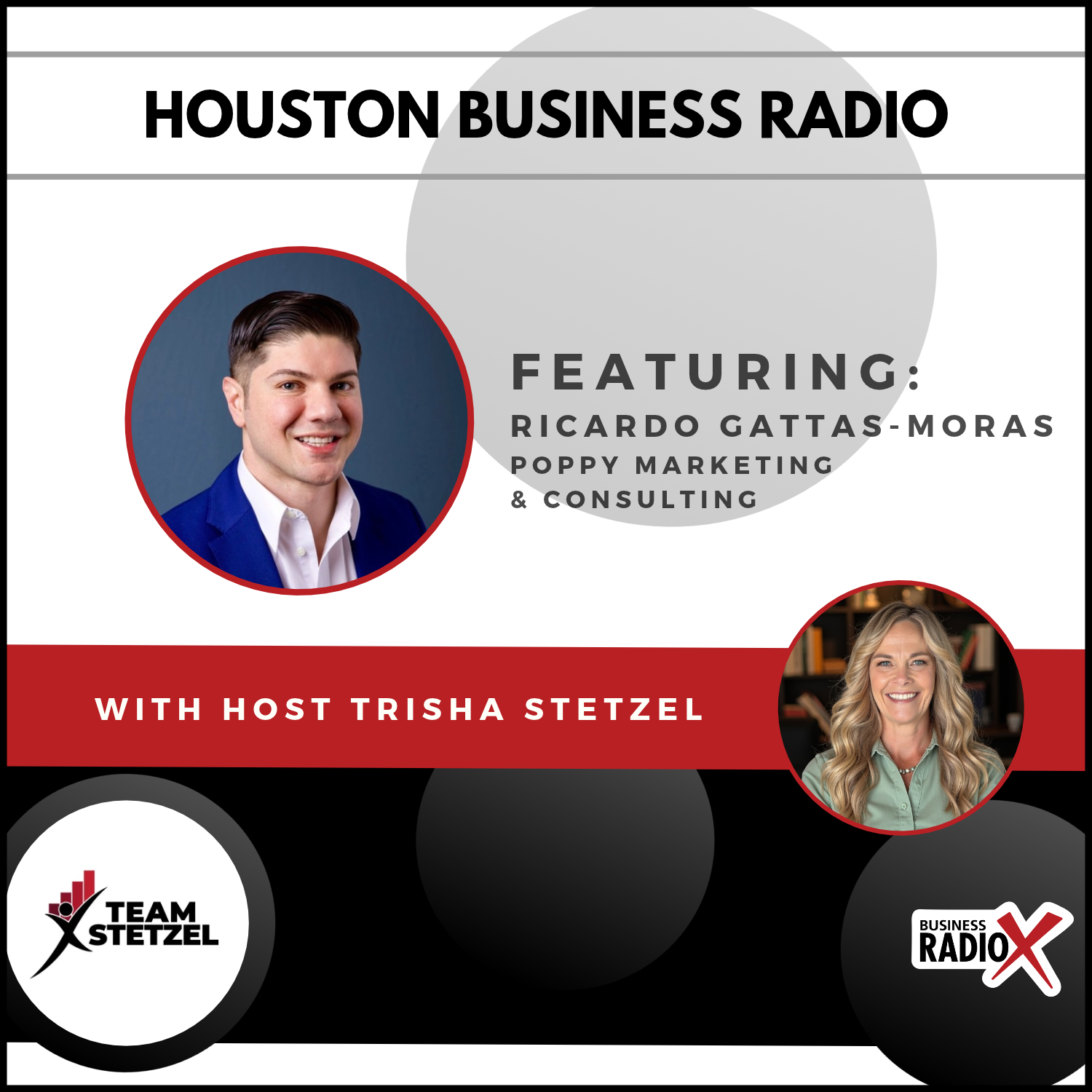

 Ricardo Gattas-Moras is the founder of Poppy Marketing & Consulting in Katy, Texas. Poppy helps local service businesses get more customers through websites, Google visibility and Google Ads, and practical AI, and builds AI workflow systems for larger teams where it makes sense.
Before Poppy, Ricardo spent 17+ years in Fortune 500 marketing and transformation, including leading internal marketing at Verizon as an Associate Director. His work now is translation: taking the enterprise practices that actually matter and making them usable for small businesses. He works in English and Spanish.
LinkedIn: https://www.linkedin.com/in/ricardo-gattas-moras/
Website: https://www.poppymarketingandconsulting.com/
 This transcript is machine transcribed by Sonix.
TRANSCRIPT
Intro: Broadcasting live from the Business RadioX Studios in Houston, Texas. It’s time for Houston Business Radio. Now, here’s your host.
Trisha Stetzel: Hello, Houston. Trisha Stetzel here bringing you another episode of Houston Business Radio. It is my pleasure to introduce you to my guest today, Ricardo Morris, founder of Poppy Marketing and Consulting in Katy, Texas. Ricardo helps small and local service businesses apply better marketing strategy and practical AI to grow their businesses. Before launching Poppy, Ricardo spent more than 17 years in fortune 500 marketing and transformation businesses, including his time with Verizon. Today, much of his work is about translation, taking the strategies and disciplines that actually matter at the enterprise level and making them realistic and useful for small businesses. And he is particularly interested. He has a particularly interesting way of thinking about AI. The human should be the judge. And I’ll tell you the rest later, because we’re going to talk about that, about the other thing being the clerk. We’re going to unpack exactly what that means. Ricardo, welcome to the show.
Ricardo Gattas-Moras: Thank you so much. Thank you, Trisha, for having me. And I’m excited to be here.
Trisha Stetzel: I’m excited to have you here as well. We had such a great conversation prior to coming together today. And even as we came into our recording today. So besides everything that I’ve told the audience about you, Ricardo, what else do they need to know?
Ricardo Gattas-Moras: Um, well, I mean, I think you covered quite a bit of it, but I’ll tell you this. I’ll tell you a fun fact about poppy marketing and consulting, and it’s how I came up with the name. And when I was thinking about what to name the company, I wanted it to be representative of the characteristics of how I wanted to show up, and how I wanted people to feel about poppy. And, um, and I think, you know, first, you know, I started thinking about the flower, the poppy flower and the fact that it represents resilience. And, you know, in that it, it’s able to, you know, grow in challenging environments. And I, and I wanted that to be a quality of how we show up, where we help people, even in challenging environments to be able to show up the right way and to still be able to grow. But then also my kids, I have a son and a daughter. They call me Poppy. So I felt like that was pretty close to the poppy flower. And they both seemed to match. And so I ended up going for the name Poppy and in marketing and consulting to help describe the work that we do to. So there’s a little fun fact for you that I don’t always share, but there it is.
Trisha Stetzel: Wow. And here it is right here on the show. I love that, and I will never look at a puppy the same way without.
Speaker 4: Thinking about your.
Trisha Stetzel: Story. I appreciate you sharing that. It’s always fun to know the, um, the idea behind the name that people put on their businesses. All right. So I know and so does the audience. They know that you spent 17 years in a fortune 500 environments before you decided to build Poppy. So what made you decide to take the experience from this big companies or these big companies and apply it to your business specifically or small businesses?
Ricardo Gattas-Moras: Yeah. Great question. You know, I, I think that, well, we were actually at a point in my, in my last job where we had to make a decision around reorganization or me taking a leap and, you know, on myself and taking that challenge of starting my own thing. And I needless to say, I took the leap and I decided to start my own business specifically around the gap that I was seeing in the market. I, you know, one, I wanted to be able to take the marketing strategies that I had learned from working in a big enterprise and how to apply that to help small businesses, because I could see how small business owners would often struggle with where to start or really understanding the importance of like narrowing down your message. So I wanted to be able to help people show up digitally the right way. But more importantly, I was seeing this gap around AI and the introduction of that and the importance that that played in small businesses. And I just have a big passion for it and really understanding how that applies to practical ways of using it. You know, whether it is in your personal life or your business, but I wanted to be able to create something that helped bridge that gap for small business owners that help complement their marketing needs, along with how to introduce this technology that is becoming a part of everybody’s day to day now. And specifically for businesses, uh, nowadays. So, uh, when I saw that, I felt like I was equipped to be able to take that role. And so I made the jump and decided to start popping.
Trisha Stetzel: Okay. So what’s that? What surprised you the most about what transferred from a large organization or a fortune 500 company down to small businesses?
Ricardo Gattas-Moras: Yeah. I think that the, the idea that having a bigger team, uh, also brings in better ideas. And that’s not always the case. I think that the ideas come from really understanding your audience and really understanding what it is that you want to accomplish and how you want to show up. And that doesn’t necessarily require $1 million budget, and it doesn’t require for you to have a whole team and organization behind your marketing. It only requires you to truly understand what that is and be able to then apply that into the work. Um, you know, so I think that was one of the biggest things that I took from there. Uh, and then also, you know, I think what I really enjoy about working with small businesses is that in working for enterprise, you find yourself with like layers of approvals often. And when it comes to making decisions while with business owners, often you make decisions on the spot and you’re able to move faster as well. So, um, that was something that I think it’s, it’s rewarding of working with small business owner because you’re able to make moves faster and make decisions quicker because you’re dealing with the person that makes the decisions often.
Trisha Stetzel: Yeah. And which is why AI is so important in this conversation, right? Because we are making such quick decisions as solopreneurs or entrepreneurs with smaller teams, if you will, in some of these smaller businesses. So, um, give us the, I’d love to hear just a little bit about your journey as a business owner and starting to adapt these AI tools that you’re now helping others adapt in their small businesses.
Ricardo Gattas-Moras: Yes. So, you know, I started to learn about AI probably, you know, in the same fashion that most people started. You started hearing about tools like ChatGPT and Claude and Gemini. And, you know, when I started to see the potential of what it could do, I, I was still in corporate when, when that started. And I started to really understand how can these help us make better decisions? Um, but what I quickly realized is that the tools were not necessarily tools that should be used to help make the decisions themselves, But that really helped you actually develop the ideas that come from you. Um, so that’s part of how my journey started when I started to see that gap in small business owners starting to use these tools in their day to day, or how do you use these tools to help make better decisions? I started to use that to help build my business around that and say, hey, here’s what I want to accomplish. If I were to, you know, want to do blank. What are the steps that I would need to take to be able to get there? What are the resources that I should be considering to use? And then taking that information and making my decisions, uh, where I felt that it was, you know, the best place to go. And, you know, I started like, I think most business owners start where you can say, you know what, I’m going to go ahead and just take everybody, help everyone because I’m equipped to be able to do everything. But then you like quickly realize that serving everybody. It’s like serving nobody because your message gets lost in the mix. So I had to take a step back and, and, and reassess my messaging and say, who is the ideal target that I want to serve? How is it that I want to show up for them? And then also, how do I do that in a way that is comfortable for the size of business that I have? Um, so I started to implement the strategy around a very specific local small business owner.
Ricardo Gattas-Moras: Um, you know, that, that needed that, that was at the point of, okay, I’m already getting enough business. I’m about to get to that point where I need to know how to scale, but I don’t know where to start to do that. So that is, I think, the ideal client where I work with, where I help them take the idea that’s already built around, you know, what they could serve on their own and then help scale that idea to be something bigger for them and help them grow. Uh, so I’ve used AI to help me be able to develop some of those strategies. But I think what is key is to always remember that the decisions need to still be your own decisions, because at the end of the day, AI is responsible for showing you the most common answer around whatever it is that you ask. And when you are asking or when you are expecting for AI to give you a unique point of view or a very, like, unique way of showing up, that’s not something that is going to be able to accomplish because its goal is to give you the most general, you know, answer that it can provide. So it’s, it’s really helping to understand how that can help businesses. And that’s how I used it to help my own business as well.
Trisha Stetzel: I love that. Thank you for sharing that. And I think it’s an important note here that 18 to 24 months ago, I was having conversations with people around. If you’re not adopting or adopting AI, you’re behind. And Now it’s how do we stop buying so many tools? Because they, I, I talk to somebody and they’re like, oh, well, I’m using this tool or I’m using that tool. Well, I must try that. So as you’re working with your clients, how do you keep them on track to not buy a whole basket of AI tools that they may not even need?
Ricardo Gattas-Moras: Yeah. Well, listen, first I have to understand how do I do that for myself? Because I want to try them all. But here’s the thing. I think it’s it’s important to know what you want to accomplish. Uh, and then also to understand that each one of the tools, they all fundamentally work out of the same technology, uh, but they’re better at some things than others. And I think that once you start understanding that, then you’re able to make better decisions around what you choose to adopt. Like, I’ll give you an example. And this is my point of view. Uh, I think that ChatGPT is better at doing research and it’s a little bit more conversational. So if you’re asking it to help you with some of your writing and maybe with some of the, you know, doing some research, uh, type of work, then it could be the tool that I may default to, well, if I want to build something or if I’m looking to, uh, create an app or let’s say, or a landing page, then I may go with a tool like cloud, which is a better builder. The way that I position this to clients is I consider a, um, a ChatGPT to be like a very smart friend. And then cloud is a very smart coworker. So it’s a more professional tool, right? So it depends on, so I ask my clients, like what it is that what is it that you want wanting to work with and what it’s, you know, the best way that you or what is the output that you want to generate? Because that will help us choose which tool to start.
Ricardo Gattas-Moras: Now, as you start getting more familiar with them, you may want to combine them. You may want to get the ideas in the research from one, but then have the other one build it for you. But I think that the adoption has to be progressive. Like it has to start with you getting comfortable with one so that you understand how it works, and then you jump to the next as you get more comfortable. Then you talk about something like Gemini and Gemini. It’s Google based, so the comfort level there is that it can connect with your workspace, with your Google workspace. So if you work a lot with Google Docs, Google Sheets, then maybe Gemini is the safer place to start. So it really does come down to the individual and how it is that you work right now. What tools do you use and then what needs do you have or what goals do you want to accomplish before we pick a tool? Right.
Speaker 4: Okay.
Trisha Stetzel: It’s so smart. And I, it’s hard to stay away from just buying the next tool. So we need somebody like you, Ricardo, to help us wade through all of the things that are available to us. And it’s not just the chat tools, it’s the calendar tools and all of the other things. You know, you talked about in these fortune 500 companies having hundreds or thousands of people around you that help you get through the day. And as a business owner, a small business owner in particular, we need, I believe, some AI to help us. Um, when we don’t have those employees or those team members around us. And I think that’s so important. So tell me a little bit more about the people that you’re working with those engagements. So if people are listening and they want to have a conversation with you, Ricardo, how do they know that they’re a good fit for you?
Ricardo Gattas-Moras: Yes. Look, I think that if you are in a place where you want to make sure that you’re showing up in the digital world correctly, uh, then that is, I think, a starting point for my conversation. If you say, you know what my. I have a website, but I’m not getting any calls. Um, I, um, you know, I have a Google business profile, but it doesn’t seem to be getting me any, you know, appointments or, you know, any reviews per se. Um, maybe I, uh, maybe I don’t have a website and I want to start one. Um, I’m missing a lot of calls and I need some sort of, you know, I’m not at the point where I can hire somebody to take those and I need some sort of answering service. Um, you know, I had a client who was getting a lot of calls and they were predominantly spam calls. So then we added an AI receptionist that could filter some of that for them and give them qualified calls instead. So I think anyone that is in a position to either want to show up better digitally, or if you have a challenge that you think that can be automated, um, whether it is answering the calls, capturing leads, sending emails, uh, things of that sort. I think that’s where our company can come in and help you understand what it is. What’s the best way to tackle it? And then if you know, if it’s, if it’s more of a recommendation or if it’s an implementation opportunity.
Speaker 4: Wow.
Trisha Stetzel: Okay. And so many of us are leaving money on the table by not answering the phones or being able to filter those out instead of just stop answering our phones because so many spam calls are coming in. That really speaks to me right now. Fantastic. I know that there are folks listening today, Ricardo, that want to connect with you. What is the best way for them to get more information or connect with you directly?
Ricardo Gattas-Moras: Yes. So either our website, which is w w w dot poppy marketing and consulting.com. Um, also our email info at poppy marketing and consulting.com, or you can find me on Instagram at Ricardo dot gaddis, That’s GATTAS. Uh, and, you know, we can happily connect and then talk about what it is that you want to do.
Trisha Stetzel: I love that, and I love that you’re bringing big business experience to those of us who have small businesses. That’s so important because we don’t always have access to that. And I love that your kids call you Poppy.
Ricardo Gattas-Moras: Yes.
Speaker 4: Yes.
Trisha Stetzel: All right. Um, something a little fun. I know I almost let the cat out of the bag when I introduced you, but you said something during our first conversation a few weeks back that really stuck with me. And I want to unpack that a little bit. And as we were talking about the human in the middle or the human being a part of all of these AI solutions and how important that is, you said that the human should be the judge and the AI should be the clerk. I want to unpack that. Tell me more.
Ricardo Gattas-Moras: Yes. Uh, this is just a big, uh, I guess, rule that I have for myself, but that I also like to help my clients understand is that the reason why we see so much of like AI slot or like, or where we’re starting to see a lot of the same type of responses or answers is because like I said earlier, AI often pulls from the most general, uh, potential answer, right? Not the most unique. So when you’re asking AI to give you the most unique point of view, it’s just not built to be to do that. It is trained with a lot of information, and its goal is to give you the most reliable answer, which often is the most common answer to um. So in order for you to have better processes or better outputs from AI, then the goal is to stop using it as the, as the way to originate your answers and to instead use it as a clerk. And when I say that, I mean have it organized things, have it draft things for you. Have it, um, help you brainstorm some ideas for possibilities. But the idea should always be yours. The judgment should be yours.
Ricardo Gattas-Moras: Any workflow that you build, I highly, highly, highly recommend that there’s always a human checkpoint before it completes the work so that you can look at it one more time and be the judge of that work before it goes out, because that’s how you go from something feeling like a I wrote it to something that sounds and feels like a human wrote it, but with the assistance of AI. And that’s where it becomes your coworker. A very smart coworker, right? Very smart co-founder and not the owner of the idea or the originator of the idea. Um, and you know, so that’s what I always tell people. I think it’s a, it’s an easy way to understand it. It’s use it as a clerk, have it go and do the work for you, but don’t let it make the decisions for you. You make the decision at the end because that’s when it feels it is your human context that makes the idea feel good, feel connected to others because it’s still we’re still humans, right? And we still want something that feels like it solves a real problem, not something that, you know, was written by AI.
Speaker 4: Yeah, absolutely.
Trisha Stetzel: And that’s how you build your personal brand. I know you want to talk about this as a marketer, right? So I was just thinking one way, one simple way to think about it is what belongs on the clerk’s desk and what belongs or has to stay with the judge. And it’s the human part, the ideas and your personal brand. So let’s talk about that. If everybody’s using AI to put their marketing messages out there, then no one is standing out. So how do we how do we fix that? How do we get away from everybody using the same message because we’re all using AI to craft our posts?
Ricardo Gattas-Moras: Yes. Um, well, one, I think. Start by asking, you know, AI to help you poke holes into your messaging and ask questions like, hey, if somebody were to go into my website, what would be something that they would be confused about? Or what is a something that does not fully clear? Um, ask me some questions that can help me make the message more clear to my clients or to make sure that I am targeting the right audience. Um, and again, have it used as a way to be able to bounce ideas off of, and then you then make the decision that feels right for you, for your business. And I think that the more that you can think of it that way, and the less that you can use it as a way to say, hey, make this better. Right. Or make it is instead is give me three things that we make this better. And explain to me why, so that I can make a decision of what direction I want to go in. Uh, and the more that you can do that, then the more that you will start generating ideas that are really coming from you, but that are built around, you know, either facts or research or, you know, or having a different point of view right next to you. Um, but I think that’s for me, the best way to be able to implement that into like your personal brand, not have it created, but instead have it challenged. Um, you know, if you know, I’ve, I’ll tell you, um, one example or something. Um, sometimes I’ll go into somebody’s website and the message says something like, I don’t know, the best, uh, roof fixers or let’s say, or the best plumber in town.
Ricardo Gattas-Moras: And it’s like, okay, well, the best plumber in town. Like, why are you the best plumber in town? What town are you talking about? Um, you know what? It’s the best plumber in town, something that somebody is going to be looking for specifically because typically when somebody is looking for a plumber, they’re looking for, uh, you know, where can, how can I fix this quickly? Or, um, or I need the closest plumber near me. Right? So if they’re looking for near me, then maybe the city should be listed on the headline too. Um, and so it’s understanding that, like, how is that welcoming message that you have on your website? The very first thing that people see, how can you make that more specific for the audience that you want to target? Now the second layer of that is how do you know what audience you want to target? And I’ll give you the easiest way to do this. Think of the best customer you have. Or if you don’t have a customer already and you’re starting your business, the best customer you want to have, and then build a story around them. Where would they shop? What kind of brands do they like? Um, do they have kids? Do they not have kids? Do they like to go out? Do they shop online? Do they look for Google or do they look for stuff on LinkedIn? Like you start building that narrative around the client that already exists or the client that you ideally want.
Ricardo Gattas-Moras: And then every decision that you make from there is based out of that one person. And then all of a sudden your message feels like it’s talking to an individual. And it’s not just talking broadly to everybody. Because again, when you talk to everybody, you’re talking to nobody. Right. So the more specific you get and the more that you’re able to identify who that person is, then the easier it will be for people to find you. Because once you find the one Jane or the one John that exists out there, there’s thousands of them out there too. So now you have a whole audience that’s building. And I’ll tell you one more thing, and it’s getting a little long, but it’s important. I often also hear, but wait, I don’t want to cut anybody off. I don’t want to exclude anyone from my, you know, audience. And the reality is that when you specialize on a specific audience, people don’t see it as you excluding them. As a matter of fact, they see you as this as a specialized business, so you earn more respect. But they also know that a accountant that can service a dentist can also potentially service a plumber, but it doesn’t necessarily take away from your credentials. Right. But now you’re still speaking to the one audience that you can get. And then slowly, as you gain that audience, you expand to be able to cater to others as well. So that is a big misconception. Narrowing down to a niche does not exclude everybody. It just makes you a special specialized service provider for that audience.
Trisha Stetzel: Yeah. You guys heard it right here. Go find your niche and go focus on it, because they will find you more often than if you’re trying to market to anyone. Everyone, someone, no one will show up for you. That’s the bottom line. It does feel uncomfortable though. Ricardo thinking, gosh, if I only market to female veterans in my space, then who all am I disqualifying? Well, I’m not actually disqualifying them. I’m just attracting the people that I want to speak to. I still get to work with these people over here when they find me. Right. Uh, and I think that that’s such an important message. Um, I want to talk about the human piece just for one more minute, because I think that that’s really important. You’re in the digital marketing space, you’re using AI tools, you’re teaching others how to use AI tools. How important is it for us to have human connection as small business owners?
Ricardo Gattas-Moras: Oh my goodness. I mean, it’s still a very important part of the business. Um, as a matter of fact, I’d like to pull up a statistic that I, that I have um, from earlier. I looked this up and In according to. Let me see it was. The US chamber reported that the utilization of small businesses using AI has almost doubled since 2023. So we went from like 23% to 58% of small business owners using AI. And I think this is in 2025. So this is not even the 2026 statistic that I’d assume that that’s significantly higher. Um, but here’s the other fun statistic too, is that it also showed that the, um, in Brightlocal found that 84% of consumers that had searched online for local business within the previous three months, they used AI for it. But they also said that it was that it was very important for any business that’s using AI to always have an option to be able to speak to a human. So the human component of it doesn’t necessarily need to replace the way that you do business. And I’m sorry, the AI component of it doesn’t have to replace the way that you do business, because humans still want to be able to have options to speak to a human. It only has to be able to make you easier to reach. You know, like we said earlier, you know, having to answer your calls whenever you’re not available, but still have the option to reach a human or a human can call back, right? Um, or have maybe AI be able to respond to emails, letting them know that the email was received, but then a human still follows back up because people still want the option or the ability to be able to deal with the human. But also the reality is humans are not always available, right? And there’s only so much of you that you can give. So automating some things is okay. Replacing yourself completely with AI is when I think it becomes a problem, or when people feel a little bit more disconnected from the way that you do business.
Trisha Stetzel: Yeah, absolutely. And we have to surround ourselves with humans. It’s human nature. We want to be around other humans, even though some people may not think so all the time. But it’s so true. So what I learned today. Ricardo, thank you so much for this amazing conversation, as we really need to think about what goes on the clerk’s desk and what stays on the judge’s desk. And we’ve got to keep that human in the loop and really use the tools as a way to create ideas, not to just craft messages that are going to go out to everyone, because that doesn’t make us different, right? Especially from a marketing perspective. All right. Last question for you as we wrap up is what’s next for Ricardo and Poppy marketing and consulting?
Ricardo Gattas-Moras: Yes, I think, well, you know what I what we’re working on now is a, a new way of also helping business owners not just be found because, you know, often it’s been SEO, which is like the search engine optimization, how people find you on Google per se, or through like a search engine. Uh, then now it’s evolving to how do people find you with AI, right? Because now we’re starting to see the trend where people are making decisions based on searches from a language model, a ChatGPT, a Gemini, a cloud. The future now is, and we’re starting to now see this actually come from the big tech companies is introducing Agentic AI, which it goes from a language model which can provide you information to an agent that can actually take action for you. So think of it as like little hands, right? So if you now have an agent that is helping make decisions for consumers or do search and, and be able to do transactions, then your websites, your apps, anything that you have also needs to be built around the ability to take action too. So it goes from just structure data to actual action funnels that the agent can take is.
Ricardo Gattas-Moras: And it’s answering the question of whether an agent can read what’s on your website versus can an agent take action on your website and book a service, make a reservation, purchase a product. Uh, because we’re starting to see it now. I think I actually, I know I read a report today that the number one downloaded app in the app store is muse, which is this agent that was launched through meta and it muse can reserve things for you, call some businesses for you do, uh, purchases for you. I mean, you know, I haven’t felt comfortable enough to give them my credit card information, but technically you can, uh, you know, I would say, you know, always be cautious about how much access you give, you know, any AI model, but so our future is about helping businesses be prepared for that next layer of AI. It’s not only can AI find me, but can AI take action in my website? Can they take action in my for my business? However, that you’re showing up and that is the future of what we’re working on now.
Trisha Stetzel: Wow. That’s amazing. All right, you guys, if that sounds really overwhelming and you’re not sure, then you need to talk to Ricardo because he can help you with what’s coming, what decisions you’ve already made, and what decisions you need to make based on the goals that you have in your business. This has been such a great conversation. Thank you for spending your time with me today.
Ricardo Gattas-Moras: Thank you. Thank you so much for having me. I, you know, I am honored to be a part of this with you and your audience.
Trisha Stetzel: Awesome. Tell us one more time, Ricardo, how people can connect with you or find out more information.
Ricardo Gattas-Moras: Yes. It is, uh, poppy marketing and consulting.com. And that’s poppy, like the flower POPPY. You can also find me on Instagram at Ricardo dot GATTAS. Or you can email us at info at poppy marketing and consulting.com.
Trisha Stetzel: Oh, fantastic. Thank you again. I appreciate you today. All right, you guys, that’s all the time we have for today. If you found value in this conversation that Ricardo and I had, please share it with a fellow entrepreneur, veteran or Houston leader ready to grow. And be sure to follow, rate and review the show. Of course, it helps us reach more bold business minds just like yours and your business. Your leadership and your legacy are built one intentional step at a time. So stay inspired, stay focused, and keep building the business and the life you deserve.
Ricardo Gattas-Moras: Yes.