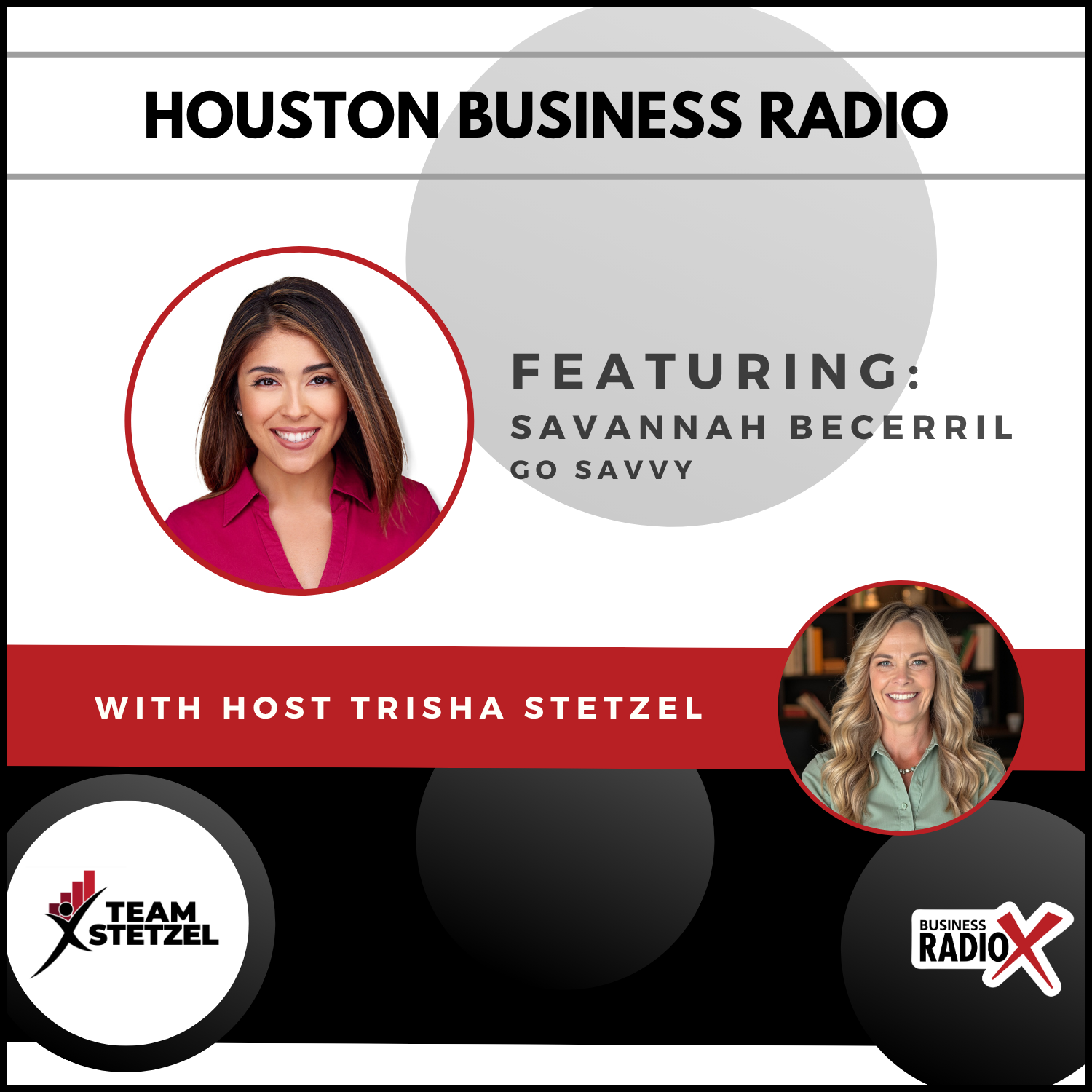


 Founder of Go Savvy, Savannah Becerril leads with a rare mix of creative instinct and operational precision.
A native Houstonian, she studied Entrepreneurship and Marketing at the University of Houston and holds a certification in Audio Engineering, a background that gave her an early, hands-on feel for how live production works. Music, athletics, and community outreach shaped her formative years, building the discipline and people-first instincts she now brings to every client relationship.
Savannah’s professional path spans live production, business strategy, and brand storytelling, which is exactly what allows Go Savvy to deliver clarity, coordination, and impact on every event activation to effectively move both people and missions forward.
Go Savvy was built on faith-based principles of integrity, service, and stewardship. Those values run through the company’s culture and how it treats every client, vendor, and partner. When not working, Savannah loves to spend her time with family, friends, at church, or out training for her next marathon.
LinkedIn: https://www.linkedin.com/company/go-savvy/
Website: https://www.gosavvy.biz/
 This transcript is machine transcribed by Sonix.
TRANSCRIPT
Intro: Broadcasting live from the Business RadioX Studios in Houston, Texas. It’s time for Houston Business Radio. Now, here’s your host.
Trisha Stetzel: Hello, Houston. Trisha Stetzel here bringing you another episode of Houston Business Radio. It is my pleasure to introduce you to a friend of mine and amazing business owner, Savannah Becerril, founder of Go Savvy, an experiential marketing company that helps brands and organizations create intentional experiences designed to move people and missions forward. Savannah brings together live production, business strategy, brand storytelling, and operational execution with a background that also includes entrepreneurship, marketing, and audio engineering. A native Houstonian and University of Houston graduate. She’s built ghost savvy around the principles of integrity, service, and stewardship. Today, we’re going to clear up a term that’s being used everywhere, everywhere right now, experiential marketing. What it actually means, how it’s different from simply planning an event, and why thoughtful experiences may matter even more in an increasingly digital and AI driven world. Savannah, welcome to the show.
Savannah Becerril: Thank you so much for having me, Trisha.
Trisha Stetzel: I’m excited to have this conversation today and shout out to Lauren for reconnecting us to have this conversation. If you guys haven’t heard Lauren Jefferson’s episode, please look back and find that when it was another great one. Savannah. What else do we need to know about you?
Savannah Becerril: Yeah. So yes, entrepreneur. I’ve built my career in the events and music industry. Love it very much. Although I am not my career. Also a dog mom, a outdoor enthusiast and marathon runner. And I just love bringing people together, whether that’s through an events or even, you know, community initiative or even just with my friends, I’m very social when it comes to my inner circle. So yeah.
Trisha Stetzel: Yeah, absolutely. And you and I have known each other. I was trying to count up the years. I think we met just before 2020, if I’m not mistaken. So we’ve known each other 6 or 7 years, and I’ve watched you really build something beautiful and turn it into something that’s not just about events. So why don’t we just dive right in? Tell us about Go Savvy and what you’re doing with your clients right now.
Savannah Becerril: Yes. So echo savvy, as you mentioned, we are an experiential marketing agency. And basically what that means is yes, we plan events. Yes, we promote events, but it’s kind of like that’s basically jacked up on steroids, to be frank. Uh, we take the extra step or really the extra mile in working with a brand or a nonprofit where we take a look at their event vision and we ask the pivotal question, what are your goals behind this event? What do you hope to achieve? From there, we apply the marketing approach. We develop a full marketing strategy strategy, starting with the development of KPIs or key performance indicators that we can measure throughout the entire event experience, from planning to promotion to on site facilitation, even post-event follow through to effectively help our clients scale or get an ROI from their event experience.
Trisha Stetzel: All right, Savannah, you are saying a whole bunch of things that really speak to my heart, and it sounds like you’re running this experiential marketing or this event for your client as a business. What, like that makes me feel really good. You actually measure what you’re doing and you’re helping create something much bigger for your clients. So tell me more about who your clients are. I heard you say nonprofit. I know that you also works for some for profit businesses. So tell me more about the people that you serve.
Savannah Becerril: Yes. So we serve both for profit and nonprofit entities, frankly, and it comes down to what your goals are behind your event. Uh, but that said, we tend to work mostly with mid-market and up entities and those who have already hosted events before. Typically our clients come to us because they understand the importance of having an event and how it can drive business or even just brand loyalty for their event or mission. But they somehow got lost in the middle of planning and executing their event. And basically they come to us and say, our event is terrible, we need help. We need it to make it better, you know, and make it better. It can mean so many different things to our clientele. That can be something as simple as we want more people versus we want, um, you know, intentional donors versus we want to sell, you know, X, Y, z number of units, the list goes on. So we step in when they’ve actually already been frustrated with their event experience, or they want to learn how to properly scale through multiple events throughout the year.
Trisha Stetzel: Okay. All right, I love that. So one of the things that I’m picking up on it, and this was even from our prior discussion, is when people are planning events, it’s less about the event and more about the attendee experience. Can you talk about how important that is?
Savannah Becerril: It is, number one, the number one thing when it comes to hosting an event in today’s society, frankly, thanks in part due to Covid, in part due to AI, in part due to, you know, recent economic situations people want to meet. And when they meet in person, they want to have authentic experiences with each other, whether that’s, um, at a lunch or brunch gathering to, at a gala or nonprofit event or a brand activation. People want to connect with people. And because of that, brands and nonprofits, frankly, marketers have come to realize the importance of creating authentic engagements when hosting these in-person experiences.
Trisha Stetzel: Yeah, absolutely. So are you doing any not in-person events or is everything in person right now?
Savannah Becerril: We do virtual events as well. We also do hybrid events. Uh, our main goal with hosting those types of events is again, make it as personal as possible, make it as engaging as possible. We always try to help our clients ensure that everyone who is involved in a virtual event like their screen is active, they’re actively participating. Um, and we will roll out specific At CTAs or specific activities throughout those virtual experiences to ensure that they’re optimizing their engagement.
Trisha Stetzel: Oh, that’s so exciting. Okay. So, um, what should people. I heard you say that your, some of your best clients are those who are already challenged and that you get to step in and help them. Tell me your favorite client story, like from inception, the meeting to where you were actually able to help them and take them to.
Savannah Becerril: Sure. I will tell you, one of our more recent clients we were hired by, um, we actually hired by the UK Department of Business and Trade for a South by Southwest experience. For those who don’t know, South by Southwest is, uh, technically one of the largest festivals down in the South. It’s in Texas, in Austin, Texas, but it’s known to be the largest festival in the general south region of the US. Um, and many countries will host their own experience in, you know, during this festival. So we were hired by the UK actually very last minute, about less than two months out from the event experience. So they already had many logistics pieces already underway. We came in as sort of their saving grace. They wanted support with crowd management, but more importantly, data tracking and intentional touch points with their audience throughout the entire week long sequencing of events, as well as some minor immersive experience elements such as like the environment and how the flow would go for their attendees. So we came in in the final hour, we implemented those touch points to help create a more cohesive experience, and we were successful in capturing the data that they needed in order to better prepare for next year’s event.
Trisha Stetzel: And hopefully they’re going to invite you back. That would be wonderful. Yeah, I love that. Okay, so that is a very large client. It sounds like you work with some smaller ones as well. So give me kind of an idea or the folks who are listening today, an idea, if they’re interested in working with you, what that size looks like.
Savannah Becerril: Sure. So on a more smaller scale, one of our really fun success stories is we worked with a, they’re technically a national nonprofit, but they primarily operate in the state of Texas. It’s a faith based nonprofit. And they had been hosting their annual gala for about 15 years when they brought us in. And they were the exact client that came and said, hey, our galas are boring. We’re losing our donors. We need to make more money. We need to raise more money. Um, but they’re dropping like flies. What do we do? And so we came in and we worked with them for two years. The first year we changed only two components, which was the program flow. And, uh, the, we, we activated one engaging activity. And our whole goal with the first year was just to create a memorable experience for their current donor um attendees, while also increasing around 10% new donor attendees. So we were successful in that everyone who left that first year experience, um, was they could not stop talking about that one extra new activity. They’re like, we’re going to come back, we’re going to bring our friends next year. And then in year two, we increased their new donor attendance by over 20%, and we changed venue and brought in an even higher profile, um, entertainment artists, uh, which once again meant all of our goals in increasing their donor revenue streams, but then also new donor engagement so that they could roll that into their CRM and nurture process and maintain those relationships throughout the course of the year. So, um, that was a perfect example of, uh, frankly, a local nonprofit mission that said, hey, we need help before we just stop all together.
Trisha Stetzel: Yeah. Okay. So exciting. I know that there are some people listening today that need your services because we’re rolling into holiday season, into the spring. People really should be planning for these things ahead. I heard you say that sometimes they call you when they’re in trouble. Uh, but for those who are interested in having a conversation with you, Savannah, or even learning more about Ghost Savvy, where’s the best place for them to go?
Savannah Becerril: Sure. So the best place for them to go is our website at go.biz, spelled out w w w dot GOSAV as in victory, V as in victory, y.biz, B as in boy, I, Z as in zebra. We have a contact form on there and they’re happy to reach out to us. That actually comes directly to my email and usually within 24 hours we will follow up with them.
Trisha Stetzel: Okay, fantastic. All right, you guys reach out and make sure you tell Savannah that you heard her right here on Houston Business radio. So she can treat you like a king or queen. She would do that anyway. Absolutely. All right, Savannah, I want to dive into this idea of experiential marketing. You brought it up to me. It’s not something that I had heard of. I understand it. So let’s go back to what does it actually mean and then take a deeper dive into what it means to people on the outside, right? Not just people like you who are on the inside.
Savannah Becerril: Sure. So the basic definition of experiential marketing is when a brand or mission posts an engaging experience or event with their target audience to build brand loyalty, to build authentic engagement at its core. That’s all it is. It’s intentional events.
Trisha Stetzel: Okay. Intentional events. So what? I know that you’re seeing in the market a lot of people using that language. So what’s the difference between it really being experiential marketing and those who are just calling it that.
Savannah Becerril: Sure. So at least in our perspective and what we do, um, the really core difference is that it’s not just, let’s just host this event and engage, but you know, what are your goals after that? How can we keep the conversation going even after this engaging experience between the brand or mission and their audience? Uh, lately, experiential marketing has become a bit of a buzzword here in the States. It’s kind of the it’s the fun trend to say for many event companies or marketing companies, um, or even, uh, AI driven, you know, immersive elements experience companies. I realize I use a lot of words there. Uh, but frankly, if you don’t apply a marketing strategy to your event experience and have an end goal in mind that you’re trying to target along with a follow through plan, then frankly, it’s not really much of an experiential marketing. It’s more of just an experience.
Trisha Stetzel: Mhm. Yeah, absolutely. All right. So I think all of these words that are coming together for me and what I’m hearing, Savannah, is this whole human connection piece, although there’s a lot of digital space out there and things that you’re using. But this human connection is so important. So talk to me about networking, the human in the middle, like, yes, we use digital AI and all of the tools, but why is that human connection so important?
Savannah Becerril: Oh gosh. So the human connection is so important. And I should preface in saying that it’s not about just let’s create this optimal look or story to sell. In fact, it’s, it’s completely the opposite. It’s more so as a brand, let’s authentically engage with our audience on a human level. And the reason why that’s important these days, frankly, is because of recently what our, um, what the world has been going through from Covid and being in dealing with shutdowns, not being allowed to talk to each other, to AI. And, you know, people nowadays don’t know what they’re looking at on social media or the news and what’s real versus what is AI developed. Um, people are now creating those personal touch points with each other. And at the end of the day, it is statistically known that humans desire the connection, like biologically desired connection with other humans over a screen, over an interface, over a robot, etc.. So, um, that is actually deemed the most successful way for, um, initial contact. And then of course, for brands and missions to then share your story, share the reason why, you know, your entity exists in the first place, how it’s meant to help humans and then again, connect that human connect, make that human connection.
Trisha Stetzel: Yeah, absolutely. So I’d like to talk a little bit more about go savvy, because you were right in the middle of the world shutting down, trying to build a business. And so the I love to hear like your mindset shift shifting and how you were running your business then versus what it looks like now.
Savannah Becerril: Yeah, that’s a great question. So fun fact, I went full time with the company in January 2020. Uh, so three months before, you know, the world’s nearly, you know, blew up. And so I had to quickly pivot and pivot every expectation I had at the time. Um, my most valued skill set according to world standards was my engineering skill set. So I, uh, stuck more with the virtual events, podcasts and supported that, um, while also still trying to build the company. We did a lot of virtual events. And then what we found is that people still wanted to share their special moments. Brands still wanted to share special moments. And so a lot of brands and or people wanted to do like custom backdrops so they could publicly share whatever that celebration is, whether that’s a five year anniversary or ten year, etc.. Um, so then we started producing those. And then gradually as the world began to open up, we then, you know, took our course. And in the process of doing that, we further prioritized the need for human to human connection, but also understanding that brands coming out of Covid and missions coming out of Covid, they generally understood the need to not just host an event, but to be intentional about their events, um, in connecting with their audience in a, in an authentic way. And so that’s where experiential marketing, that’s what I decided to actually mold and shift my company from being just an event planning and event promotions company to being experiential marketing. Um, that’s also when we decided to develop specific proprietary tools that will literally help our clients focus on not just what money is going out, but what potential revenue streams are coming in, and how they can use that to then build their brand through events.
Trisha Stetzel: Yeah, absolutely. Okay. Thanks for sharing that. I know sometimes taking that step back and thinking, gosh, look where I am today. It’s such a, it’s just an amazing thing to celebrate. And so congratulations to you on being able to shift and really grow something so beautiful as ghost savvy. When I spend a little bit more time talking about that, um, scaling the brand is you mentioned it earlier, but we didn’t take really a dive into that. So having an event, how, how does that really actually scale a brand?
Savannah Becerril: So statistically speaking, events are actually the most considered, the most successful form of marketing for brands and missions today. However, that is only when it is done correctly and by correctly that means not just the promotion side and the on site facilitation side, but also the follow through side, the post-event interaction and discussions you have after the events already done. How do you keep that conversation going when you’ve got the full sequence of these pieces for your event experience, you are 70% more likely to increase your brand loyalty and your audience engagement for any brand and or mission. Um, and again, that’s now that’s all statistic, right? We take those statistics and we match those with our proprietary tools to literally show our clients how they can scale and show that throughout the entire process. Hey, this is working. This is what’s going on. This is how you’re going to scale your brand. Did I answer that question?
Trisha Stetzel: Yeah, absolutely. And so let’s take the follow through a little bit further. Why is that so important that we actually continue to have conversations or interactions with our guests after post event.
Savannah Becerril: So the follow through plays into two factors. One, it solidifies that intentionality behind hosting the event with your audience, but then it also solidifies your sales pipeline. To be frank, that’s that nurture sequence that keeps the conversation going and shows your audience that you, as a brand or a mission are intentional about maintaining a relationship with them. Um, you know, and I’m not necessarily saying, you know, brands are people, but it’s the people behind the brands and the stories behind those brands that would help connect with your audience.
Trisha Stetzel: Yeah, absolutely. All right. I know you’re a networker and you’ve always had a really tight knit group of people. How important is it from a company perspective? Those who may be thinking about events, or even people who listen to your story and are like, gosh, I’ve been through the same thing. How important is it to surround yourself with the right people?
Savannah Becerril: Incredibly important. I can’t tell you enough times where having the right kinds of people within my sphere to not only support me from an encouragement level, but even to pass on referrals or even to, uh, be a support in hiring, you know, in contracting, um, has, you know, taken us leaps and bounds. We’ve had opportunities and doors open up to go savvy. That would not have happened without having these, uh, you know, partners in place. So it’s incredibly important to, especially for an aspiring entrepreneur or startup to do your due diligence, get out there and network within reason, be mindful of where you’re networking and you know the value of your time. Uh, but while you’re out there, make quality connections that again, can help you and your brand, but also that you can help and support as well and build a community as you grow together.
Trisha Stetzel: Mhm. Yeah, absolutely. So, uh, of your inner circle, because I know that you have some. Have you guys really figured out. I want to talk about this referral marketing that is happening and is really important to your inner circle. So tell me more about that. How long you guys have had your inner circle and how that trust has really built over time?
Savannah Becerril: Yeah. So I definitely, over time, I have developed little cohort communities. Um, that’s what we’ll call them. And what’s fantastic about that is every person that I have built a relationship with is a specialist within their field and they’re good at it. And I trust them and they trust me. And because of that relationship that we have built, we are able to, frankly, support in selling each other, um, and do collaborations with our clientele. And that has been a very resourceful, uh, Experience that I’ve been blessed to develop with my sphere. I hope that answers the question.
Trisha Stetzel: Yeah. No. It’s fantastic. And I want to talk about the visibility, too. As you were getting into this business almost six years ago, you were in just in the way that you and I connected, not outwardly visible and getting yourself out there. You were helping everyone else become visible. And I’ve seen a shift in that, Savannah, in the way that you are representing your own self and your company. So talk to me about how that visibility has shifted from being the person in the background to what you’re doing today for your own marketing.
Savannah Becerril: Oh, that’s a great question. Um, I think there’s no other way to say it other than, you know, go savvy in the brand that has been developed. Um, you know, by the grace of God, we’re just now known as. Oh, have you talked to Savannah yet? She does events, you know, and I can’t tell you how many times I get a referral and they’re like, yeah, so and so. Tell me about you. They said you’re the person to go to for events. You’re the person to do if you really want to scale. Um, can you help me? And we get that often. And, um, I feel blessed to be known as, you know, this person. So to your point, yes, I spent a lot of time nurturing those relationships, trying to support where I could. And I still do. Um, but now I do see that reciprocation coming back and I feel blessed to have that.
Trisha Stetzel: Yeah. And people know who you are. They know who you are. Right. And sometimes it’s uncomfortable putting yourself out there. Right? There’s a little bit of that. Um, but I, I love that you are doing so much business by referral and you’ve built that intentionally. So again, congratulations on so much success in your business. Um, tell me how people can find out more about go savvy or even connect with you. Savannah.
Savannah Becerril: Sure. So if not at our website, you’re welcome. We’re on all the major socials, especially LinkedIn and Instagram. That’s probably where we’re the most active. You can find us on LinkedIn at Go Savvy. You can find us on Instagram at Go Savvy USA. If you want to connect with me, you can also reach out to us to our email at info@go.biz. Uh, those are all great ways to reach out to us and or me. I, I take a look at everything. We are a boutique agency currently, so I kind of have my hands a little bit in everything right now. Um, but we are hoping to scale even more so in the new year.
Trisha Stetzel: Yeah, I love that. So. Savannah, timing wise, when should people be thinking about reaching out to you for their upcoming event?
Savannah Becerril: Oh, that’s a great question. I would say at bare minimum, three months or more prior to their event experience. If you’re looking to do a holiday event at the end of 2026, now is the time to reach out, even if it’s just a consult. Uh, we have thorough consults with our clientele and or prospective leads, and frankly, we share the realities of budget, uh, time frame allocation expectations, etc. we kind of put it all out there on the table because at the end of the day, this is a significant events are a significant investment and you don’t want to take those decisions lightly. So I would say at least three months out, we are already mostly booked for the the end of 2026 fall season, and we are now currently booking for spring 2027. So we’re really excited about that.
Trisha Stetzel: Yeah. That’s fantastic. All right. Uh, as we wrap up our time together today, by the way, this has been fantastic. I had no doubt this was going to be a great conversation. Uh, as we wrap up, tell us what’s next for Savannah and go savvy.
Savannah Becerril: Sure. So we are knee deep into plans for fall events right now. Uh, we are in the process of booking for South by Southwest next year. We are looking to scale, especially out in the Austin community, so we’re very excited about that. And I will be speaking at an event on the 25th, I think it is in Houston. It will be, um, at Sesh, uh, co-working space in Midtown Houston. So I will be there, I believe it’s a ticketed event, but that will be a fun experience. And, um, yeah, we can connect with us on social media as well.
Trisha Stetzel: I love that. And you do so much out on social. So if you guys want to get to know Savannah better, please go, uh, take up her offer to allow you to get to know her before you even reach out if you want to do that. If you’re not ready and you you have an event next year. Savannah, this has been fantastic. You guys go savvy. Gosavvy.biz is where you want to go and find all of that information that Savannah talked about today. And Savannah has been my pleasure to host you.
Savannah Becerril: Thank you so much for your time. Trisha. I really appreciate it.
Trisha Stetzel: Absolutely. And happy Monday, Tuesday, Wednesday, Thursday and Fridays. Coming fast. All right, you guys. That’s all the time we have for today. If you found value in this conversation that Savannah and I had, please share it with a fellow entrepreneur, a veteran, a veteran, someone who needs Savannah for their event or a leader ready to grow. And be sure to follow, rate and review the show. It helps us reach more bold business minds just like yours and your business. Your leadership and your legacy are built one intentional step at a time. So stay inspired, stay focused, and keep building the business and the life you deserve.