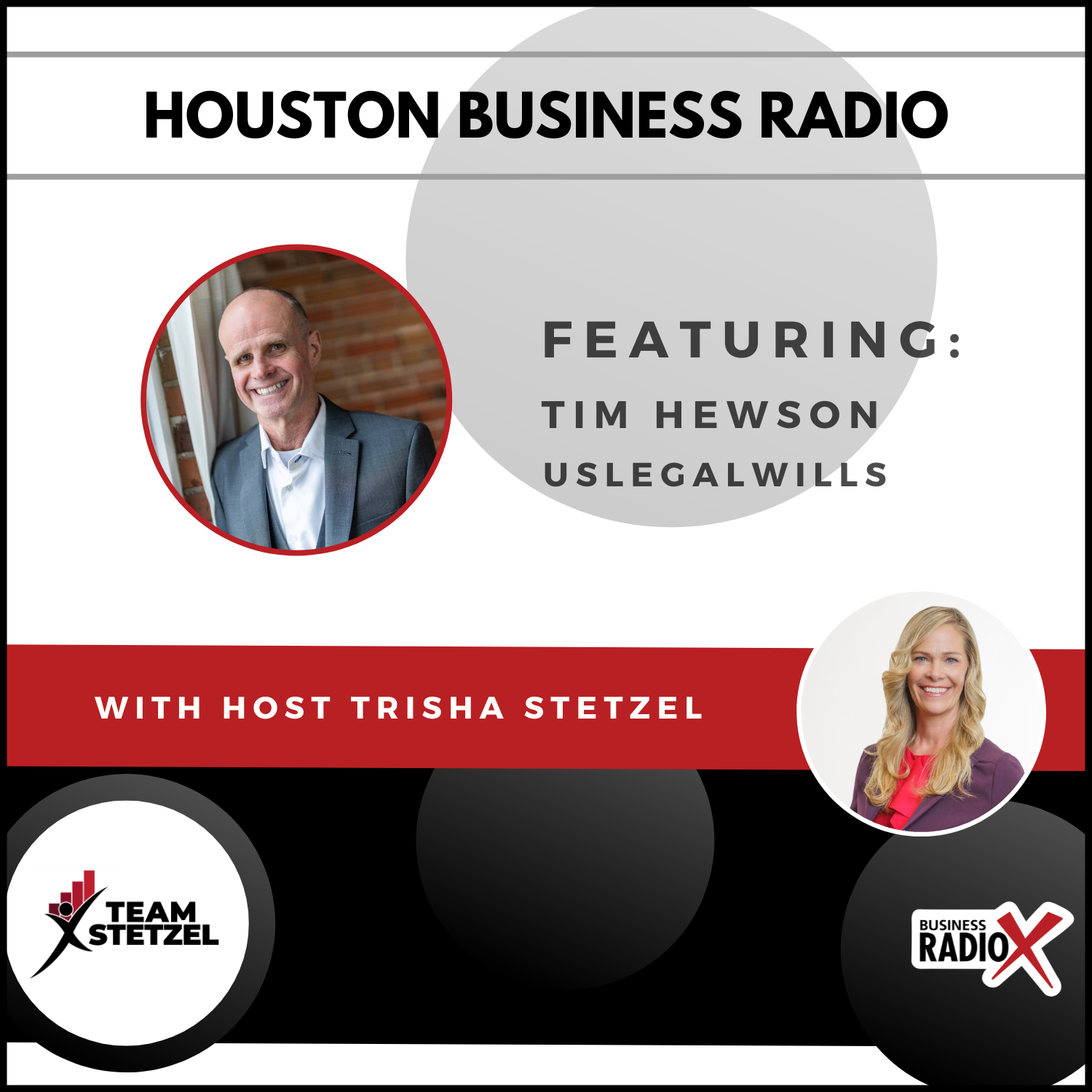

 Tim Hewson is the co-founder of USLegalWills.com, an innovative online platform that has helped over 500,000 people create Wills and estate planning documents with ease.
Originally from the UK and now based in Canada, Tim launched the service in 2001 to break down barriers in end-of-life planning.
Under his leadership, the platform has expanded its reach to the U.S., Canada, the U.K., and South Africa, making legal peace of mind accessible across the globe.
LinkedIn: https://www.linkedin.com/in/timhewson/ 
Website: http://www.uslegalwills.com
 This transcript is machine transcribed by Sonix
TRANSCRIPT
Intro: Broadcasting live from the Business RadioX studios in Houston, Texas. It’s time for Houston Business Radio. Now, here’s your host.
Trisha Stetzel: Hello, Houston. Trisha Stetzel here bringing you another episode of Houston Business Radio. Today’s guest is Tim Hewson, co-founder and CEO of USLegalWills. He has an online service that removes the barriers to writing a will and other estate planning documents, which is amazing. I’m so excited to have you on. He’s originally from the UK and now residing in Canada. Tim built the Legal Wills Company from an idea way back in 2001, and has built that into a service that now operates in Canada, the US and South Africa. To date, over half a million people have written their will using the service at legal wills. Tim, welcome to the show.
Tim Hewson : Thank you very much, Trisha. I’m delighted to be here.
Trisha Stetzel: I’m so excited to have you on today. So let’s start with this. Tell us a little more about Tim, and then I’d like to know what happened way back in 2001 and how you started this business.
Tim Hewson : Okay, a short history of me, because that’s probably not the most interesting part of the conversation. Um, but yes, you’re right. I’m from the UK, emigrated to Canada to work in high tech. Uh, I worked with a big high tech company called Nortel. Um, it was a darling of the tech industry, um, back around 2000 and then had a dramatic fall from grace. Um, so any of your younger viewers and listeners who may never have heard of it, but it’s worth reading up about what happened to Nortel, the Nortel story. Um, but, um, when I was working at Nortel, um, we, we kind of knew that the Nortel wasn’t going in a good direction at that time, but we used to go out for drinks, uh, after work regularly. A crowd of us would go out every Friday. And, uh, one time we did our regular weekly, um, after work debrief, and somebody brought up the topic of, you know what? I don’t have a will. Um, and, um, this person had children, they had a job, they had a house, and we went around the table. There were 15 of us around the table, and not one single person around the table had a will. And we all knew it was important. And we all kind of scolded ourselves for not doing it. Um, and we realized that, you know, it wasn’t necessarily for our benefit, it was for our families. And we’d not taken the time, made it a priority to do it. So as I say, we all had jobs and families and and we all knew it was important.
Tim Hewson : So immediately, myself and my co-founder, who was sitting next to me in that bar back in 2000, um, who we’re still working together now to this day. Here we are 25 years later. We’re still the CEO and the CTO of the company. But we immediately looked at each other and thought, there’s got to be a better way. Why? Why is nobody doing this? Um, what are the barriers? And, um, it wasn’t really cost. Um, but it was more a convenience factor, like when we were going to be able to make the time to coordinate with our families, coordinate with our spouse, to go to a lawyer’s office and sit there and talk to them, not really knowing what we’re going into the office to talk about. We weren’t really didn’t really know what it will entailed. Uh, and knowing that we would have to then go back the following week to review it, and then the week after that to sign it. It just. And then ultimately we thought it could probably wait. We we could probably do it next month or next year. We could do it in six months. It was never going to be a critical item that was going to be the top of the to do list. So everybody around the table procrastinated and nobody around the table had got it done. So we at that point we look for a better way.
Trisha Stetzel: I love that. So was this a bar napkin idea, Tim? I’m just asking.
Tim Hewson : It was. Yeah, absolutely. Because we it really was back in that time. I mean, people were putting a lot of things online, like traditional practices. It was a bit of a, a time, a.com boom, um, for coming up with an idea. And I mean, back then, it’s a bit of a nostalgia trip, but back then it was like all of the Super Bowl commercials were dot coms, right? They they’d all had, like, crazy funding. And it was like, I remember there was Pets.com, like there was a lot of these businesses who were worth, you know, half $1 billion and didn’t really have a business plan. Um, but ours was very much like, we we could do this. People could go online, answer questions, and we could create their will for them. That doesn’t seem that crazy an idea. And we did it. And I think it’s fair to say at that time, we were probably before people were ready, um, before people were ready to type in personal information, uh, into an online service and share those details. So it was a slow start, and that I think timing your idea with the market is, is really important. And I think we were ahead of where we needed to be our sales and our first year was slow. And as it turned out, it was fortunate because we could still. Ride the decline of Nortel. While we were building up the legal world’s business, we were able to kind of like do both in tandem. Up until such a time as Nortel officially died, and then we’d had enough runway at that point to be able to move directly into legal wells and do that as a full time job.
Trisha Stetzel: Yeah, I love that. Okay, so before we dive into the importance of wills, because we we know and you and I have had this conversation that that’s very important. I’d really like to talk about the business building. Part of this bar napkin idea sounds amazing. The first year sounds a little tough. That probably resonates with people who are listening or watching today. So let’s talk about that whole business building and funding and pouring yourself into trying to build this business and work a full time job for a little while. So what did that look like for you and your partner Tim?
Tim Hewson : So We. Yeah. So? So we didn’t get any external investment. Um, so myself and my co-founder, Henry, we decided, okay, what are we going to need here? Well, we should incorporate. There’s a cost there. We need hosting of the service, and then we’ve got a then between the two of us, we’re going to spec out what this service is going to look like. And we’re going to build it. Not me. Like Henry is the technology guy. He did the development. I was more like bouncing ideas and thinking of how we could do it. Um, so it’s fair to say that if it was our full time jobs in that first year, things would have been tight and we would have had to have really felt, um, real confidence in, in the story, like what we were doing. And it really didn’t matter how confident we were, but we needed everybody else to be confident in this as a service. Um, but we I think the lessons are that I don’t necessarily I like the way that we didn’t leap. And just because it would have been too stressful for us.
Tim Hewson : Um, but we also it was really important to us to take our first payment online how quickly we could get to somebody, actually, that we didn’t know. A complete stranger finding our website and having faith in our service and paying us money. And, um, that’s always. And I have a pet peeve about getting investment and then looking for an exit. I don’t like that. Like we never, ever went into this business thinking, how are we going to exit? Um, and like to me, like if I was starting a butcher’s shop around the corner, nobody would ask me of my exit strategy. Right? They it’s it’s a business. And we’re running a business. Um, and so we always, uh, put revenues back into the business. And, um, since the very early days, we’ve been revenue positive, cash flow positive. We’ve never taken a loan, uh, and we’ve never sought outside investment. So here we are, 25 years later. I own half of it. Henry owns half of it. And, uh, we still pull the money out of it when we need it.
Trisha Stetzel: Okay. Would you do it the exact same way all over again, Tim?
Tim Hewson : I think we could have built faster. Uh, so there’s always. There’s two paths you can get. We could have hired, you know, six software developers, five marketers, um, and been faster. And would we? We probably would have accelerated our revenues faster. And we’ve certainly seen other seen other businesses coming in with investment who have managed to do what took us eight years. They can do it in ten months or a year. Um, so would I have done it? I think given my personality, Henry’s personality, where we are risk averse, we’re not ones for taking a flier. And we’re not one. We like our autonomy that we’re not answering to any outside investors. We can make our own decisions. So there’s a lot to be said for it. Um, but there’s there’s pros and cons, so would I, I think I, I think I would have done it the same way, but I sometimes wonder.
Trisha Stetzel: Yeah. Okay, so here we are 24 years later. What’s the secret sauce to business? Longevity?
Tim Hewson : Uh, the number one is, um, getting a good business partner who you really like and get along with and and respect each other’s, Others, uh, what each other bring to it, bring to the table. And we’ve got some kind of unwritten rules around, um, if if one of us feels strongly about something, we’ll go with it. If the other one doesn’t really mind, either way, we can live with it, because there’s going to be a time where I’m going to feel strongly and Henry can live with it. And we’ve just always we’ve never had, um, um, irresolvable difference of opinion and all of that time. So having someone that you respect, because the other thing is that, like your workloads aren’t always going to be the same, um, there’s going to be times where one of you is going to be putting in 100 hours, and the other one’s going to be sitting there thinking in the bathtub like, what’s a good idea? Right? Like, so you’ve got to be able to understand that you’re you’re doing different things and, um, not and being kind to each other.
Tim Hewson : Um, and not only that, there, during this time, we’ve each of us have had young children. We’ve had different demands on ourselves, what we can give to the business and what we can’t. So it is a journey, but definitely, um, the secret sauce is a good business partner, um, who you respect and you want to work with for a long time, and you don’t want to get rid of, um, and beyond that, it’s, um, not it’s being able to, um, have revenues, like, have. So you’re not stressed out about the fact that you’ve been working on this for 18 months and nobody’s paid you anything yet. Um, and a lot of businesses that, you know, the freemium models where people are like, we’re we’re going to look, we’ve got 100,000 users, but none of us have paid, but we’ve got like 25 paying users and things like that. We we never really taken that approach. Um, so having a sustainable revenue is, is another important component because we were never at any point we’d never really been worried about, um, having enough money.
Trisha Stetzel: That’s amazing. Well, how wonderful to have such a great partner and that relationship. So I know people are already wanting to know more about what it is that you’re doing. We’re going to dive into that in a few minutes. But even just to connect with you, Tim, what’s the best way for people to reach out or find you?
Tim Hewson : Uh, well, the website is US Legal Wills comm, and I’m, unsurprisingly, Tim at US legal comm. Um, so you can find that’s the easiest way to get in touch. Um, I’m not super active on on social media. I, um, but. Yeah, just email me. Tim. Comm is the best contact.
Trisha Stetzel: Yeah. Fantastic. You guys can see it on the screen. If you’re watching the video, you can also catch that in the show notes and just point and click and send him an email and let him know that you heard him here on Houston Business Radio. So, Tim, one more question. Just about business building before we dive into wills and the importance of that and how that’s evolved. How has technology or has technology shifted or changed the way you do business here after 24 years?
Tim Hewson : So actually, I was thinking of a journey like you asked about the journey and how slow it was at the start and and what what moved that for us. And there were inflection points along that journey. And one of them was like tax software. It came after us, but became a de facto way to file your taxes that actually, um, familiarize everybody with that process of going online, stepping through a service, putting your personal information in and getting a result at the end. We pre-dated that. So us saying to everybody like, go online and put in all your information, trust us with it and we’ll write a document for you. It was a struggle until those things came online. And also one of the other inflection points was other services coming online that competed with us. And that’s another lesson because anytime there’s been a strong competitor, it’s raised everybody. Um, it hasn’t taken nibbles out of our business because us telling the world that you can do it online on our own and people saying, nah, you can’t. But when you have like 4 or 5 legitimate companies all telling everybody that this is a credible option, then it, it, um, helps the acceptability, um, for all of us across the board.
Tim Hewson : So there were so that’s not quite answering your question, but they were two major inflection points for us technology. How has it helped us? Well, I think that. So, yes, more people going online definitely helps, right? And, um, I don’t know whether I’ve seen as big a technology shift as we’re now seeing with AI. Um, and, you know, there have been incremental things, um, that all sound very kind of nostalgic now that have happened over the years. But I think where we’re going with AI and what it can do, we we’ve incorporated it in our support channels, um, our, even our call centers. Um, and so we’re going to see changes there and not just for us, but for the legal community in general. I think that law has we stumbled. Fortunately, we stumbled across an industry that really didn’t adopt technology very quickly. Lawyers don’t. They’re still sending faxes to each other like it. So it really helped us that they were not super active in adopting new technologies. But I think that AI is going to see, um, a real challenge to brick and mortar law firms. Like they’ve never seen before.
Trisha Stetzel: Sure, absolutely. Well, and I love that you’re adopting technology over time. And I also love that other technology actually boosted your business, even though it was outside of what you were actually doing. Uh, you.
Tim Hewson : Know, actually. And sorry to interrupt. Just sprung to mind. Um, but electronic signing of documents was was a huge one that we started in 2001. We thought everyone’s going to be electronically signing documents. And what happened was it was it was allowed for a long time. Docusign and all of that was allowed for a long time. But Wills was always explicitly not included. You couldn’t electronically sign a will. Covid happened. That created a whole bunch of problems. Um, for getting together with your witnesses, going to see a law firm. You couldn’t do any of that at the same time that people were thinking, what the heck is this global plague that I’m going to die from? I got to get my my affairs in order. Right? So there was, if you remember, like the early days of Covid, where we were getting pictures from China of people keeling over in the street and were saying, what on earth is this thing? Um, so Covid was another inflection point for us with allowing people to do more things online in terms of signing, remote witnessing and things like that. Um, and also people understanding that they might be mortal and this pandemic might pandemic might take them down. So it happened at the same time.
Trisha Stetzel: Yeah. Wow. You know, it’s very interesting. I was listening to something the other day about the pandemic and how there are some good things that came out of it. Although, you know, looking back, it was an awful thing. Uh, but in the end, there are things that are actually going to move us forward in. Especially around technology and the way that we interact with each other. Right. Yeah.
Tim Hewson : And electronic signing of documents. And so I don’t want to belabor this point, but the the law was written for ink signing on paper in 1830. And it didn’t change. It didn’t change for like nearly 200 years. Uh, like you had to prove who you were by scratching your ink signature on a piece of paper that in 2025, that was not the best way to prove who you were. Um, and it’s only now that people are looking at digital signing and, um, you know, security traces, IP addresses and things like that as a better way to prove that you were who you are and you were where you were when you said you were there. Um, so it was crazy that that didn’t change until Covid prompted the change.
Trisha Stetzel: Wow. Okay. So staying with the path of business building and ownership and what you’re doing. Who who are your clients? Who do you find are using the service?
Tim Hewson : Ultimately, we’re individuals are writing their wills. Um, so we’re not a we do some like B2B, um, partnerships who are then trying to provide the service for their employee benefits program or something like that. So they’re saying everyone should have a will. Here’s a great option for doing it. So some of our business partners are trying to do it for employees or clients as well. But ultimately it’s individuals, um, over the age of 18 or 19. Um, what we find is that, um, it needs some triggers for when you’re going to write your will. And those triggers could be I just dealt with an estate where the person died without a will. That was a nightmare. I’m not going to let my family go through what I’ve just been through. Um, that that certainly one that happens. Um, and then it’s people who. I’m going into surgery like 9:00 tomorrow morning. I got to get my will written. Uh, I need it right now. Um, and, um, so hopefully it’s not those situations, and it’s more people who are understanding that they, they are getting adult responsibilities, they’re getting married, they’re having children, they’re buying a house, they’re getting a job. And they realize that writing a will is a part of, um, adult financial planning. And we always try and communicate that this is not something that’s written on your deathbed, um, just a moment before you die. It’s the document that you write when you become an adult, and you update it throughout your life as your circumstances change.
Trisha Stetzel: Yeah, absolutely. And depending on where you live, your the country, the state, the Date. The Providence Province, wherever you are, there are different laws. I know here in the state of Texas, if you don’t have a will, it’s a big deal when it goes into probate, right? And then the state gets to make the decisions for you if you don’t have your wishes written.
Tim Hewson : Yeah, yeah. So I would challenge anybody to know what the distribution plan is for their state. Um, if you die without a will. But it’s different across different states, and I don’t know of anybody who’s actually written out their wishes that match what the state would have done for their estate. It doesn’t make any sense. Um, so, yeah. And not to mention things like common law relationships and blended families and things like that. Uh, which again, check your state laws because they’re very, very different in each individual state. So don’t assume that. And one of the reasons why people don’t write a will is it’s obvious what’s going to happen to my stuff anyway. It’s just all going to go to my spouse. Um, even if that was the case, the process for doing it without a will compared to doing it with a will is is vastly different.
Trisha Stetzel: Yeah, absolutely. All of this is so important. So let’s just reiterate the importance of having a will. We talked about the state maybe making decisions for you. And and the idea of the best time to write a will is, uh, now if you’re over the age of 18. But anytime your season changes, if you get married, if you, if someone moves in with you, you know, common law in Texas is six months, so you should, uh, be paying attention to things like that. If you have children, if you buy a house, if you sell a house, whatever that is. Right. We need to be paying attention to those seasons. So outside of that, um, knowing that the state could potentially make the decisions for us, what what are the other important ideas behind having a will?
Tim Hewson : Uh, how about naming a guardian for your children? Um, so if something were to happen, if you’re a single parent. Absolutely. If Absolutely something were to happen to you. Who’s going to be raising your children? And if you’re a married couple. If something were to happen to the two of you. Um, making that decision. So if you write a will you in your will, you can name who that person is. And what’s really interesting is when people step through our service, we can see the points where people stop and and save their work and, you know, walk away. Guardianship is is probably one of the most important. And people’s like, I know my sister’s expecting it to be her, but I don’t want it to be my sister. Um, what? How am I going to do this? And so people actually would rather not continue through the will writing process than confront that reality of, um, do I need to talk to her? Like. And actually, I mean, you don’t like you will is a is a private document, and it’s going to come to the surface after you’ve passed away. But having that named guardian and this isn’t it goes beyond like who’s your nearest relative? It’s like who shares your values and like who, who do your kids get along with? Like where do they live? And there’s a lot of nuanced, you know, do they have the same spiritual values as you like? There’s a lot that can go into that decision, and it’s got to be better that you make that decision than it land in a family court where a judge is going to say, well, how much do you make? How much do you make? Okay, well, you know, I’m going to grant the guardianship to you like it’s got to be better that you make that decision.
Trisha Stetzel: Yeah, absolutely. Well, and then you get to make that decision if you write it in your will. Right. That’s what’s so important. So.
Tim Hewson : Yeah. So so the actual way it works is that a judge is going to be granting guardianship. But like all things being equal, they’re going to look at the will and follow your guidance. Right. Unless you know the person you’ve chosen is now serving a prison sentence or something like that, something’s happened. Um, but all things being equal, it’s going to be the person that you named in your will is going to be. This is the person they want. That’s going to be the person whose name is Guardian. Um, so yeah, you make you should make the decision. And if it’s nothing else, if it’s not, um, the distribution of your bank accounts and assets, then the guardianships are really important one.
Trisha Stetzel: Yeah, absolutely. Okay, last question. Why don’t people write their wills? What’s holding them back?
Tim Hewson : Uh, so there are a number of factors. And this has been like maybe a lifelong quest for me to really kind of remove these, uh, these misconceptions. Um, so the idea is I don’t need it yet. Right. This. That’s the. That’s the one. Like we have people coming. I actually took a phone call recently from somebody who said my mom needs a will. Fortunately, I don’t need one yet, but my mom, she needs a will. And the obvious question is when? When do you think you’re going to need one? Um, because it can’t be when the bus is coming around the corner about to hit you. Um, and oftentimes, you know, the number of times that people say, like, my mother, you know, she’s in a care home, she’s 98, she needs a will. It’s like you’ve left it too late. She doesn’t know, like what she’s doing at that point. So, um, the idea that I don’t need it yet doesn’t make any sense, because you’re going to write it once. And this is what online services change. Because I think before, when people wrote it with a traditional lawyer and it was costing them $1,200, and it’s like, I don’t want to have to do this once, so I’m going to wait until my life is settled down. Um. And nothing’s going to change, so. Your life never settles down. So it never reaches a point of stasis where you can say, now I can get my will in. Um. So online services do allow you to log back into your account and make those changes very conveniently and easily. It takes five minutes, and then you print off a new document, an updated document, so you don’t have to wait until the time.
Tim Hewson : Um, but it’s also the misconception of it. It’s obvious what’s going to happen to my things. We’ve discussed that that’s not going to be one this sense that like, I don’t care, I’m going to be dead. That happens. People say that and it’s like, you know what? If you care about anybody in your lifetime, you should care about them after you’ve gone because you’re leaving them with a real pile of doo. If you haven’t done taken 20 minutes, its 20 minutes is what it takes to get the will written, and using a service like. I don’t mean to make this an advertorial, but 50 bucks and you’re going to save them six months of anguish. Um, so yeah, this this idea that it doesn’t affect me. It’s just so unbelievably selfish because you’re leaving people with a real mess. So those are some of the main reasons. There’s also the other one I would quickly bring up is this, like, um, like the concept of death, like, you know, talking about death or is this going to mean I’m going to die if I write my will, as am I putting a hex on me? Um, there’s there’s things like that. And I think we need to, like, um, try and talk about it more in the context of financial affairs rather than death care. And when people say, oh, you’re in death tech. No, we’re not, we’re in fintech. Uh, that’s our business. Um, so that’s another one.
Trisha Stetzel: Yeah. You know, it’s it there’s a parallel here in the business that I’m in where people don’t want to set goals because they’re afraid they can’t achieve them. Like, come on, this is how we get where we want to go, right? Uh, just as with avoiding writing your will because you’re afraid of death, it’s a real thing, and I get it. But it’s so important for your family. If you don’t do it for yourself, you should do it for your family or the people that you’ll be leaving behind.
Tim Hewson : Yeah, yeah. And the other thing is, like, you can always see the will as an opportunity as well. Um, yeah. So it’s dull, you know. But you know what? People have reviewed our service and said, I really enjoyed the idea of like, I could give, like, money to my nephew. There’s a charity downtown that I work with. Um, I could my favorite guitar. My my son like you. You can be creative with it. And there’s nothing sadder than seeing you get celebrity stories like Aretha Franklin died without a will. $80 million estate. She could have set up the Aretha Franklin Scholarship, a foundation for aspiring young musicians. A her memorabilia could have gone somewhere. It was just such a wasted opportunity, um, to do something. And as it is, it’s just all being eaten up with legal fees and everything sold off late. So, you know, I do see, even if you don’t have an $80 million estate, there’s things that you can do that can really make your heart or fill your bucket, um, and make you feel that you’re doing some good in the world. And it’s an opportunity.
Trisha Stetzel: Amazing. Tim, this has been such a great conversation. I appreciate you coming on the show with me today.
Tim Hewson : I’ve enjoyed it. I appreciate your questions. And, uh, giving me a platform to talk about my nostalgic story as well, I appreciate that.
Trisha Stetzel: Love that. Absolutely. All right, you guys, the best way to find Tim is to email him at Tim at dot com. You can probably go to the website as well if you want to learn information. Us legal wills. Com that’ll be in the show notes as well. Again, thank you so much for being with me today Tim.
Tim Hewson : And thank you Trisha.
Trisha Stetzel: Absolutely. And that’s all the time we have for today. If you found value in this conversation, please share it with a fellow entrepreneur, a veteran or a Houston leader ready to grow. Be sure to follow, rate, and review the show because it helps us reach more bold business minds just like yours and your business. Your leadership and your legacy are built one intentional step at a time. So stay inspired, stay focused, and keep building the business and the life you deserve.














