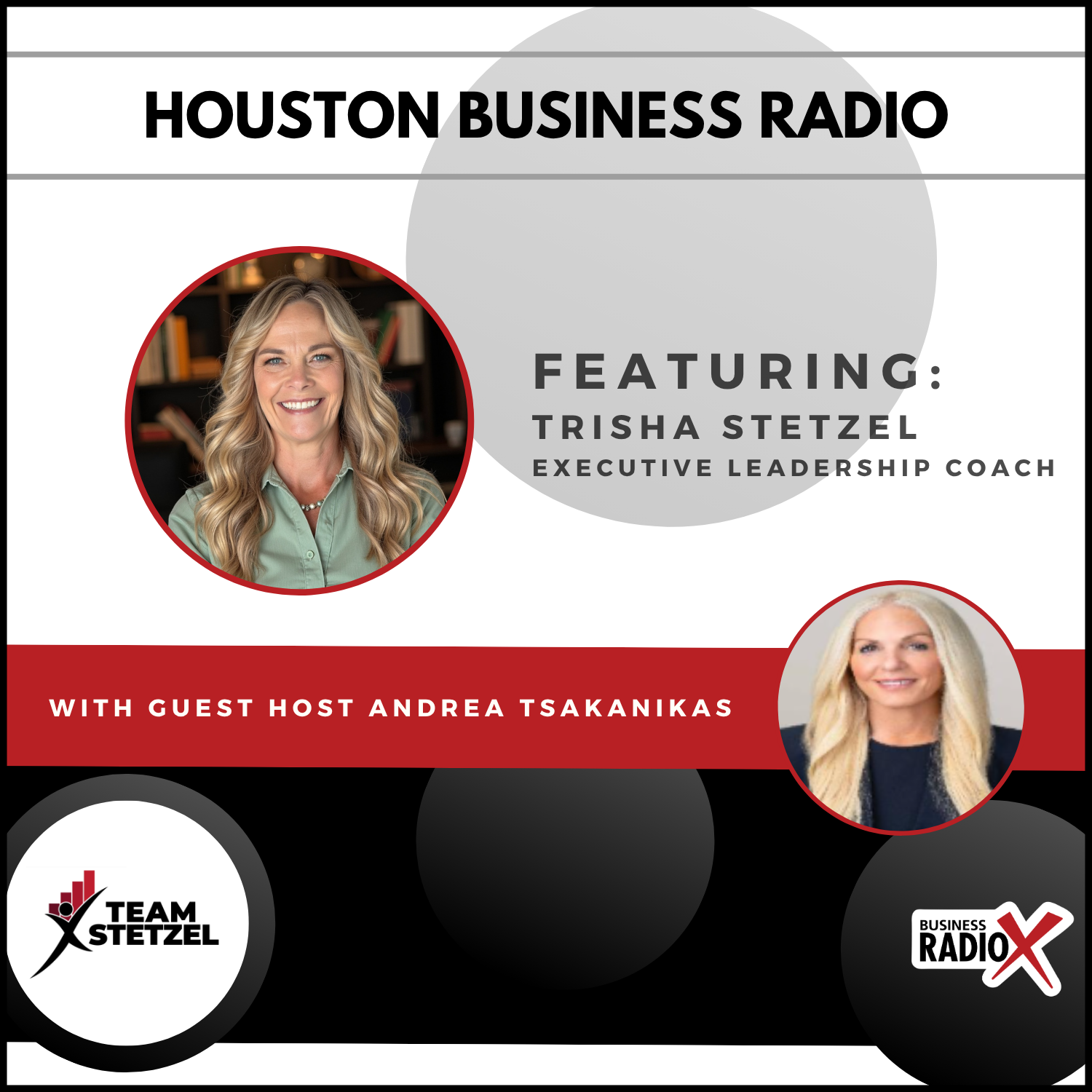


 Andrea Sakonikas, founder and CEO of Crew Logistics, sits down with Trisha Stetzel, executive leadership coach, U.S. Navy veteran, bestselling author, and Houston Business Radio host, for a reverse interview.
Trisha shares how joining the Navy at 19 helped shape her resilience, adaptability, and leadership philosophy.
She explains that leaders are developed through experience, mentorship, and intentional growth—not simply born that way.
The conversation also explores failure, perfectionism, and the importance of taking imperfect action. Trisha encourages professionals to become more visible by focusing on the impact of their work rather than self-promotion.
 She also discusses her books, including Battlefield to the Boardroom, Six Figure Chicks: Houston Volume One, and her upcoming solo book, Visibility Does Not Equal Vanity.
The episode closes with a powerful reminder that networking is really about building meaningful relationships, creating genuine connections, and showing others what is possible through the work you do.
LinkedIn: https://www.linkedin.com/in/trisha-stetzel/
Website: https://trishastetzel.com/
 This transcript is machine transcribed by Sonix.
TRANSCRIPT
Intro: Broadcasting live from the Business RadioX Studios in Houston, Texas. It’s time for Houston Business Radio. Now, here’s your host.
Andrea Sakonikas: What an exciting day it is for me. I am Andrea Sakonikas. I am the founder and CEO of Crew Logistics. We are based in Austin, Texas. And this is my first inaugural podcast. And wow. I mean, could I get any luckier? I’m actually doing a reverse interview with Ms. Trisha Stetzel of Houston Business Radio. She’s an executive leadership coach. She’s a US Navy veteran, best selling author, relationship builder who believes meaningful conversations create meaningful opportunities. And she’s just I’ve looked up to her. I’ve been interviewed by her and I was so we had such a great time during my interview that I said, let’s do something fun. And would you even consider me doing a reverse podcast and interviewing you? So here we are. Here we are today. So welcome. Welcome, Trisha, and thank you. I feel welcome to being on your own.
Trisha Stetzel: Andrea, thank you so much. This is going to be a blast. And when you asked me to create this opportunity, I was like, well, heck yeah, why wouldn’t we?
Andrea Sakonikas: So much fun together. It’s a lot of fun. A lot of fun. Well, well, little quick, quick blurb and why I’m even here and doing my podcast is called Crew Call and basically crew logistics. What we do is we are sourced by both commercial agencies and government agencies to help with their operational infrastructure. So when they have crews traveling on the ground, project to project, we help support all of their needs of moving from place to place because the real big, big thing that we all forget is, you know, life on the road, away from home, away from family, is not easy. And most of these, whether they’re a commercial company doing oil and gas, they’re doing road work construction, or it’s the Coast Guard or Air National Guard, their what their work is, is really important. And we want to make sure that they get the support they need. So part of what I’m so excited about today is I want to hear about you, Trisha, and, and hear about, you know, your story. And going back to the beginning of when Trisha was a little girl, what got you on the path to go and into the Navy? I just wanted to really start there.
Trisha Stetzel: Oh my goodness. So this has been a long time coming. I remember when we had our call moons ago, you said, I want to know more about you. And so here we are recording on my show so I can tell you my story. I love that. So all right, so I was a little girl. I was 19 years old, and, um, I found myself in a predicament of not being able to find the time and afford to go to school. My family didn’t pay for me to go to college. After high school, I had a small leadership scholarship to a junior college, and I was paying for everything else and working three jobs. Uh, don’t let that scare you. I was only 18 years old, so three jobs is nothing, right? As an 18 year old. So, uh, after three semesters of college, I decided that I needed something different. I was in a very small town. There were not a lot of opportunities for me, and I knew that I needed to get out of that town to find what would help me flourish. And I actually laid on the floor with a yellow pages, real yellow, y’all. Real yellow pages, and flipped through the yellow pages and found the Air Force recruiter called No one answered, nor did they ever call me back, by the way. And the next one was the Navy, and the recruiter picked up. And that’s where the relationship started right away. That was in the spring. And by the fall I was in boot camp. So that is how the decision was made. I will tell you, my mother was not very happy. I’m an only child, and I didn’t tell her because I was 19 and I was grown and I didn’t have to. Uh, and that looking back on that, it was probably not the right way. Uh, but I knew that it was the way for me to flourish and grow and get out of the, get out of the town that I was in and become a leader.
Andrea Sakonikas: Wow. Wow. How? I mean, it just shows who you really are. Of going from the three jobs and saying, hey, I need to find the next step to go, you know, to that next point of my life and. Wow. So what was it like as far as being, you know, a young female starting out? You probably had no idea what to expect. What was it like? How did you adjust to that life? And just give us a little background of some of the things that you did that you can share when you were in the Navy?
Trisha Stetzel: Yeah. Uh, so interesting as a 19 year old, right? Moving away from home for the first time because I was living at home while I was going to school. And, uh, it was a shock. You know, you think as an 18 or 19 year old, I can do whatever I want because I’m old enough, and then you move away from home and you have to start adulting. Uh, boot camp was a big shock. I had no idea what to expect, if I’m completely honest with you. The other interesting thing is yet another leadership opportunity. I was picked from 86 women that were in my company to lead my company as the Rcpo and Boot camp, which is very interesting. I you don’t raise your hand in the military. You don’t step forward. You don’t say me, me, me. Uh, I was picked out of 86 women to lead that company and actually led them through graduation as the Rcpo. And that company was just very awesome and still didn’t know why as a young person, why I was picked as the leader, more to come on that. And, um, after boot camp, spent some time in Florida at tech school, moved to Okinawa, Japan, as my first duty station. Talk about shock, culture shock. I had never been out of the country before, and as a 19 year old, that is something to remember. You show up and, uh, as a woman in a foreign country where women are not to look men in the eye from a culture perspective, there are a lot of things to learn because, you know, growing up and, uh, in my generation, women were strong and they were, uh, we all have equal rights and we want to be recognized and show up into a country.
Trisha Stetzel: And it’s very different. Um, learning that along with learning your job and getting along with people that you may not like or choose. So being away from home, living in quarters that you would never expect to live in, eating food that you would never, you would never cook yourself. Um, and learning a new culture. It was definitely a shock. So that was my first duty station. And then, uh, after Okinawa, I moved to Hawaii. I know, feel sorry for me. I spent three years in Hawaii after Okinawa, which was a little a little better, but still very much, uh, the culture there. Um, very much something to get used to, especially as, uh, active duty military and even a female. Uh, and if it’s okay to say a white female, um, because I wasn’t an islander. We were definitely outsiders. So that’s a kind of high level experience for me. I think the culture shock was more than the military shock, uh, military. I knew what to get. I knew I had to get up, go to work. I knew what to wear. I knew what my job was that day. I knew what the mission was. It’s a great thing about the military. You know exactly what you’re doing every single day. It was more about living and the culture and, um, being displaced and away from home.
Andrea Sakonikas: Wow, wow. What do you say to those? Because a lot of times people really need, when they look to somebody to be because I know you’re a leadership coach and we want to talk a lot about that too. How do we help others to say, well, they may look at somebody like you or somebody like me and say, well, you, you had that in your blood to be able to go do it. So when you say you were chosen out of 87 women at, you know, how young to lead, a lot of people would say to you or me, I come from a long line of entrepreneurial women that all launched careers and ran businesses. They say, well, it’s in your blood or it’s in your. But how do we help coach and support as we mentor other potential leaders? Because I believe for me, I believe it’s more about having the support to take that step. It doesn’t have to be solely, oh, it was in your blood to take that step. It’s giving somebody the courage and the support and maybe just being there for them to take this step. I don’t I want to hear from you on that because I know leadership. You can.
Trisha Stetzel: I love this topic, Andrea. Somebody just somebody asked me just yesterday, um, our leaders born or are they developed? And I believe that there’s a development process no matter what. You don’t show up as an infant with leadership skills. That’s just not how this works. It absolutely can start very early in development. As a young person who you’re surrounded by, what community you are supported by your family, are they raising you to be a strong person? Do they see you as a leader? Are they your biggest fans? I think a lot of that comes into play. So my opinion is that leadership skills are developed over time. Does the individual always know they’re being developed? No, I didn’t for years I had no idea because I was always picked right. You’re going to get a leadership scholarship out of high school to go to a community college. I didn’t apply for that. Somebody saw something in me, a teacher, and submitted an application for me. I had no idea I was awarded the scholarship. I was picked out of 86 women to lead a company. I was fill in the blank. I’ve had so many opportunities and I never saw it coming like I had these blinders on. So my mission now, Andrea, is to make sure that people know leadership skills can be developed. You do not have to be raised or some people call it born with it.
Trisha Stetzel: I don’t believe anybody is born. It comes with development. You can always develop those leadership skills throughout your life. When you’re ready to embrace the fact that you lead other people. And I don’t mean as a manager, I don’t mean inside of a company, but people are watching. They are always, always, always watching you and you need to be visible to them. And I think that is the most important thing. And it’s not about being braggadocious. It’s not about standing at the front of the room and jumping up and down and saying, look at me, look at me. No, it is about being strategic and showing everyone who’s behind you, beside you, and even in front of you what’s possible. And those people around you, like you and I and all of the other. I’m just going to say women who are supporting and mentoring other women need to be there for them, to show them the way and show them that it’s possible. By the way, what you’re doing and what I’m doing, it is not easy. I know some people show up and they’re like, oh, look at you. It’s so easy for you. Look at this amazing business that you built. No, you worked your backside off getting where you are today. It wasn’t handed to you.
Andrea Sakonikas: I think, because those things are not so much out in front. Those I talk about it all the time, the constant challenges and the walls that get put up in front of us and the, you know, the moments where you just, you know, you’re like, how do I get around these walls? And how do I accomplish this, this stress or this challenge and the failures? I think that’s the biggest piece that we don’t talk about is you have to expect to fail. And it’s those that get up, get back up. That’s the biggest challenge. They don’t see those failures out front. And that to me is success. The more you fail, the better, the better. You just get up and go stronger and stronger because you find a better way around that wall.
Speaker 4: So all those, all those.
Trisha Stetzel: Lessons that you learn when you fail right there, that’s, that’s why we have to get out there and just do the thing. So many people and I might be taking kind of a left turn here, but I meet so many people who are perfectionists or even calling themselves recovering perfectionists. If we try to achieve perfection, we will never take action. It is the nemesis of action. So we have to start taking imperfect action, learn the lesson, get out there and be willing to fail. Get uncomfortable. It’s okay because as you said, that’s the way we improve. That’s the way we get better.
Andrea Sakonikas: I love it. I mean, basically you just coached, you’re coaching me today. Even by this podcast, you had said, hey, get out there. Let’s, you know, show who you really are. There’s no perfect podcast host. Just be casual and formal. So that’s an example of what a leadership coach really is to give us that confidence that it’s okay. And there is no, like you said, perfection. There is no manual of you have to do it exactly this way and to follow. And I think that’s probably the biggest wall that most people have of why they won’t try because they have this picture of perfection and they don’t know how to really kind of walk that path. And that’s, that’s not realistic. So they don’t try at all.
Trisha Stetzel: Yeah, absolutely. And the, the other thing that I’ll say about leadership and having a coach and, you know, because you’ve had a coach for years, is that they stand by your side when you said, I have this project. Mhm. Would it be okay? Yeah. I’ll stand alongside of you. Let’s just go do it. And that is what you get when you engage with a coach. You get someone who’s going to stand there by your side and walk you through and challenge you and ask you the hard questions.
Andrea Sakonikas: That part, that’s.
Trisha Stetzel: Where you want to go. And I know if it’s okay, I’m just going to give a shout out to Darlene because I think she’s amazing. Um, and I just that’s what we do, right?
Andrea Sakonikas: It is what we need. That’s what we need. So, so tell me a little bit about I want to hear about the books I know you’ve done. You’ve written two and now you’re on your third. Tell us about. I want to hear all about them.
Trisha Stetzel: Okay. Awesome. Well, and I appreciate the opportunity to do that. The first book that I got to tell my story about transitioning from the military into civilian life was battlefield to the boardroom. And that came by way of Frank Zaccari, who’s a great friend of mine, also an Air Force veteran who allowed me and, and actually my husband, my husband’s a veteran as well. The two of us were, um, had the opportunity to write our stories inside of that book. So it is a collaboration of stories. I believe there are 19 veterans who wrote stories for that book, and it became a number one bestseller, which is very exciting. Yes. And then the second book is Six Figure Chicks Houston, Volume one. And I got to tell my story about and this is post-military, How? When I got out of the military, I was able to hit that six figure mark three times and it was so it’s such an interesting reflection on me. For me, as I wrote that story, I’m like, wow, I did this three times in three different scenarios. And I’ve never really reflected on that success. It was, oh, I got there. Now I’m going to do it again with this other thing, and now I’m going to do it again with this other thing. And the great thing about that particular book is that it’s meant for women who are beside us and behind us, right? So that they can see what the possibilities are. Again, a book, a collaboration of stories of business women in Houston. I think there are 12 or 13 of us that got to share our stories in that particular book. And it hit number one, best seller and number one international best seller, which is really exciting.
Andrea Sakonikas: That’s really exciting.
Trisha Stetzel: Now the project. Trisha’s project. This is my first solo endeavor and has been very exciting. Uh, I mentioned or I used the word visibility earlier. Um, it’s really important to me to help others change the way they think about being visible. And I don’t want them to think about visibility as vanity. So the title of the book is visibility Does Not Equal Vanity. And it’s, it does not equal sign. Uh, it’s really simple. And the mindset shift is it’s not about me, me, me. It’s about the results that I’m producing and the people that are engaged in that space with you as you move through your journey, your project, your fill in the blank, whatever that is and the community that you affect with those results. So we’ve got to stop thinking about it’s all about me. Because most of us, Andrea, women don’t like to jump up and down and kick and scream and say, look at me, look at me, look at me, because you’ll get the side eye from all of the other women in the room. Everyone knows what I’m talking about. I’m not trying to be secretive. Right. They’re going to look at you and go, hmm, look at her. Look what she’s doing. So we don’t like to do that. And oh, by the way, being a military veteran or even just having military experience again, you don’t step forward and say, me, me, me. You are taught to be a part of the greater whole and you just work harder. And so the idea is don’t just work harder and hope, hope, Hope that someone’s going to recognize the work that you’re doing. You have to be strategic about getting that work in front of the people who are beside you, behind and in front of you, so that they know the impact that your work is creating.
Andrea Sakonikas: So give me an example, because I know that’s what we struggle with every single day. Give me one example of something that really could help one of your listeners to see, like, what should I, what should I be thinking about? What should I do different? Because a lot of people like you said that they feel so they kind of stay quiet.
Trisha Stetzel: Mhm. Um. All right. Something simple. Most people, most business owners are putting something out on social social media, whether it’s LinkedIn, Facebook or Instagram instead of. And I and some people are reluctant. So instead of thinking about that post that you’ve been sitting on, waiting for it to be perfect going into LinkedIn, instead of that post saying, look at this amazing work that I do, and I want you to see this 90 day coaching program, and I want you to buy it from me because it’s amazing. And I did all of these amazing things. Instead of posting that, why wouldn’t you post a case study of someone that you’ve already worked with? No name, no name. It doesn’t need to include a name showing the impact of the work that you did with this person, and how it changed the way they do business or the way that they think. So tell that story about the impact to the person and their community versus look at me, buy my product. I want you to know everything about me.
Andrea Sakonikas: Perfect. I mean, that’s perfect because you’re not talking about you. When you tell the story of the impact that this service or the solution had for somebody else. You’re telling someone else’s story and how they they received it was it was helpful. And it was, you know, a solution for something that they really needed assistance with. And that is truly what we do in business. That’s what we’re here to do. So you just basically took a fear that somebody had and said, I don’t really want to boast about, you know, here’s my list of all my services or here’s, you know, all the problems that our company solves to transitioning it to here’s an example of someone that may be a similar business to yours, that here’s how this impacted them. And that is brilliant because we don’t think like that. So you just basically coach somebody through this book that you’re going to be putting out. I love this, I love this excited.
Trisha Stetzel: It’s coming in October.
Andrea Sakonikas: I love this congrats, congrats. I’m excited. So now I’m gonna have three books I need to read and I better read the first two now before I have time before the other one’s actually released. So that’s exciting. So tell me something like what keeps you grounded? Because you’ve really had an amazing career and your story is fantastic and you stay very busy. What keeps you grounded?
Trisha Stetzel: Mhm. The first thing that comes to mind. I don’t get asked this question very often or like ever. And the very first thing that came to mind, the first word that came to mind is Dennis, that’s my husband. My husband and I have been together for almost 36 years.
Speaker 5: Oh, wow.
Trisha Stetzel: And that, my friend, is what really, really grounds me. Look, we started out as friends. Buddies? We met in the military. We were doing the same job we got out of the military. Oh, we got married while we were in Hawaii. And, uh, when we got out, we went to work for the same company. We quickly moved from that company into IBM. We both did the same job, worked for that company. I eventually left IBM after ten years and opened my first business and my husband went on his own corporate journey after that and then circle back around 20 in 2015, opened the coaching business together, and we’ve been working together ever since. And so it’s not just the working that grounds me and him always being there as my partner in business, but also my partner in life. Hey, by the way, relationships are hard. I’m not saying this is a whole nother, it’s a whole nother conversation. It takes work. But he is what grounds me.
Andrea Sakonikas: I love it.
Trisha Stetzel: And that relationship is so meaningful to me that I make sure we make sure that our work schedule always includes, and I’m not going to call it date night because that’s not that’s not it at all. But Friday afternoons are our we have it blocked for our board meeting and that often turns into a board meeting into I’ll just call it date night for simplicity, right? That’s what grounds me. It may sound corny, but that’s the first thing that came to mind.
Andrea Sakonikas: Not at all. The world is all about that beautiful long term relationship. All relationships. I mean, everything going from your spousal relationship to even relationships just out and about. And that was my other question for you. I think a lot of people are asking the question, you know, they’re out and about. And what is the difference between a relationship business wise and in networking and getting out there and networking? Because it’s all about relationships, whether it’s your spouse, whether it’s in business, whether it’s your friends, personal, etc.. How do you look at that? How do you what do you.
Trisha Stetzel: Yeah, I’m going to, I’m going to give a mindset shift one more time.
Andrea Sakonikas: Mhm.
Trisha Stetzel: You I have stopped thinking about networking is networking. It’s a word means you got to get out. You got to go talk to people. You got to go to a thing, right? An event, have a call, start a show, whatever that looks like. Shift that to building relationships. Networking sounds hard and exhausting. Building relationships sounds amazing. And by the way, you just said, what’s the difference? There’s not a difference unless you make it be different. Okay, networking is all about building relationships. And look, you meet somebody, you may not want to continue building that relationship. Great. You don’t have to. You get to choose who you build those long term relationships with. If you meet somebody like I met you, I, you, you and I hit it off from the word go. And we continue to connect with each other because it’s a meaningful relationship. Again, relationship. It’s all about building relationships and whether you’re building it to collaborate, to produce referrals for each other, to find ways to just have conversations because you have so many things in common, or you’re looking to build a relationship to bring a client on board. All of that starts with if you want to use the word networking, great, I don’t. I like to call it building relationships.
Andrea Sakonikas: I love it and you can do it virtually too, because you and I are examples of this that you can build a virtual relationship. I mean, now we’re talking about we both are fishermen. We both love fishing. We both love being out on the water. And all these things find things in common. So I think that’s another piece like you can meet across the miles and you can get to, I mean, we learned it from Covid of really being able to get out and network and have and create relationships all over the country, in the world. It’s just putting the time in to do it and really get to know. Absolutely. It’s absolutely fantastic. This was absolutely fantastic. I know that your audience knows exactly where to reach you, but I definitely want to make sure that they can find you and, and to hear more about your leadership coaching. And because I think that their understanding from hearing us today about how important it is for us to grow and to have that support. So we definitely want to let them know how to find you.
Trisha Stetzel: Yeah. Thanks, Andrea. You guys, probably the best place to look for me is on LinkedIn at TRISHASTETZEL, like pretzel. I know, don’t make jokes. So Trisha Stetzel on LinkedIn, you can also, uh, just Google me. You’ll find what you’re looking for. And if you have any questions, certainly reach out and would love to have a conversation. And if you’re interested in being on the Houston Business Radio show, would love to have a discovery call to see if it’s a good fit.
Andrea Sakonikas: I love it, I love it, and for me, I want to make sure everybody knows for crew logistics.com, we’re based in Austin, Texas. Please look us up. We’re on LinkedIn and my name is very challenging to find me, but it’s Andrea Sacconi, STSAKANIKAS, and I am on LinkedIn as well. And this was the first inaugural crew call. And I’m I’m so excited. Trisha, thank you so much for, for coaching me, mentoring me, and allowing me to join your wonderful show to do this reverse podcast. I really enjoyed hearing your story. It’s fantastic.
Trisha Stetzel: Thank you, Andrea, and I am so glad that this podcast is going to serve two purposes. We’re going to have it on Houston Business Radio and your OGGN network.
Andrea Sakonikas: Thanks to Mark LaCour. So we’re excited about that on crew Call.
Trisha Stetzel: Awesome. Thank you.
Andrea Sakonikas: Thank you.















