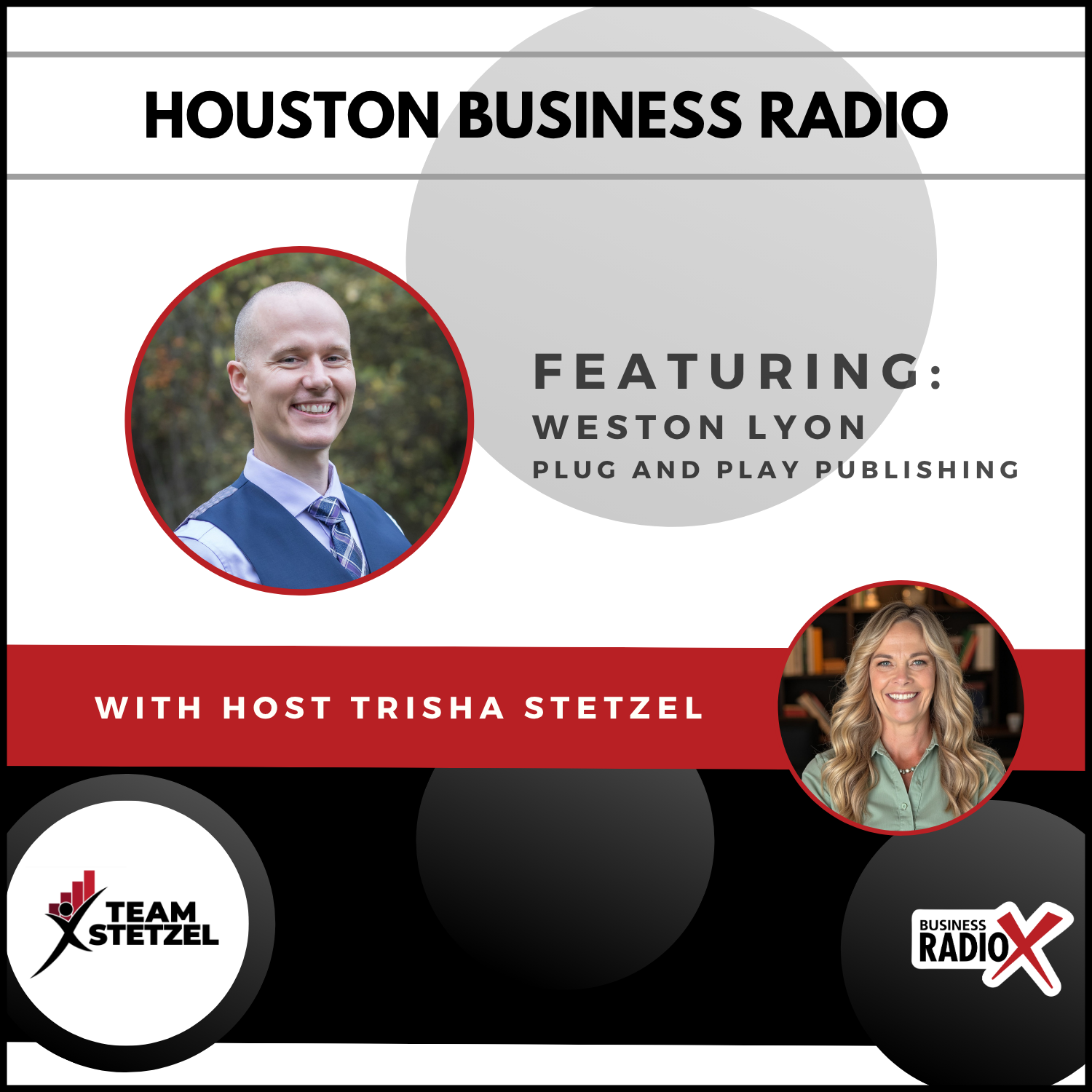

 Weston Lyon is the author of 23 books, including The Book Writing Blueprint, and the founder of Plug and Play Publishing.
Known as one of the only authors to write nine books in 11 months, he has delivered more than 600 presentations and interviews over the past 25 years.
Weston helps entrepreneurs and business owners write the right book and use it to build authority, attract clients, and grow their business. 
LinkedIn: https://www.linkedin.com/in/westonlyon/
Website: https://www.plugandplaypublishing.com
 This transcript is machine transcribed by Sonix.
TRANSCRIPT
Intro: Broadcasting live from the Business RadioX Studios in Houston, Texas. It’s time for Houston Business Radio. Now, here’s your host.
Trisha Stetzel: Hello, Houston. Trisha Stetzel here bringing you another episode of Houston Business Radio. It is my pleasure to introduce you to my long time friend. We’ve just rekindled our relationship and I’m so excited about it. And my guest, Weston Lyon, founder of Plug and Play Publishing and author of 23 books, including the book Writing Blueprint. Weston has spent more than 25 years speaking, teaching, and helping entrepreneurs turn what they know into books that actually support their businesses. And when it comes to getting books written. Weston practices what he preaches. At one point, he wrote nine books in just 11 months, and today he helps business owners figure out not only how to get their book done, but how to write the right book to build authority, attract clients, and grow their businesses. Weston, welcome to the show.
Weston Lyon: Thank you so much, Trisha. It’s an honor to be here. I’m so glad we rekindled our relationship. You’re always a blast to be around.
Trisha Stetzel: Yeah. Thanks so much. And thank you, Lauren Jefferson. Shout out. Okay, Weston, what else do we need to know about you before we get started?
Weston Lyon: That’s a great question. I would say a little bit more on a personal side since, I mean, I love I love introductions and you know, that’s always, you know, someone whenever someone’s introduced, it’s always your best stuff, right? It’s never like the, you know, the, uh, the stuff that didn’t work. Um, but, but on a, on a personal side, you know, uh, I like to consider myself a renaissance man. Um, not only am I an entrepreneur and a business owner, but I’m a painter, uh, as you can see behind you or behind me? Not behind you. Uh, I am a board game enthusiast, um, as well as a mountain biker, so I like to have all angles covered in life, whether it’s art or whether it’s, you know, sports or whether you know, um, or what have you.
Trisha Stetzel: Okay, so I learned some things about you today that I didn’t know and thank you for sharing the art. So if you guys are just listening, you have to go back and check out the YouTube videos. You can see the beautiful art that is behind Weston. Thank you. Yeah, absolutely. Okay. Before we dive into the business business side of it, I really want to talk about, uh, the 23 books that you’ve written and specifically about the nine that you wrote in 11 months. And before we get there, really, how have you used writing in your own business or part of your business journey? Before we start talking about how you help others?
Weston Lyon: Sure. Yeah. Um. Uh, writing has completely changed, uh, everything in my life. Um, and just to go back a little bit, I didn’t start out as a writer. I didn’t start out as especially a good writer. Um, I consider myself a good writer now, but I didn’t consider myself an actual writer until I wrote like 5 or 6 books. I got started back in 2005, writing my first book, which was I was a personal trainer back then. And the only, the only reason I wrote it was because I was broke and struggling. And a mentor handed me a book that, uh, whenever I read it, the author said, hey, there are three ways to position yourself as an expert in authority in your field. You write a book, you go speak on it, and you get into the media. So like TV, radio and nowadays podcasts and how to do that. But I knew I couldn’t cold call anymore because that gave me panic attacks. So even though as a C student in high school and college, when it came to writing, I decided to just pick up the pen and figure it out. And so what happened was during the writing process, it was it was intriguing because the writing process is really like a honing process. It’s you think you have a good idea until you start writing. And then you realize one of two things. You either have a good idea and it starts spilling out of you, or you don’t have an idea, the same idea that you actually thought you did. And it makes you, it makes you think harder about how is this a good idea? What direction should it go? What do I, how do I hone this message? So it’s actually clear and understandable to people. And so I’ve used that model throughout my entire business. And anytime I’m having any kind of struggle, I now go back to writing, even though I didn’t like it in the beginning, because writing helps me bring all those ideas out. Does that make sense?
Trisha Stetzel: Yeah, absolutely. So let’s talk about the nine books and 11 months. How in the world did you make that happen?
Weston Lyon: Yeah. Uh, well, it wasn’t easy, by the way. It wasn’t. It wasn’t intended either. I ended up writing my first book in 2005. Everything changed. I got on radio, TV. I did everything that the guy in the book, uh, said. And that completely changed my business. I rode that way for three years, and in 2008, I decided, you know what? I want to write a second book to see what happens. Now that I’ve ridden this wave, is it going to keep me at the same level? Is it going to bump me up another level? And you know, as a business owner or entrepreneur yourself and as a coach who you’re helping other business owners do the same thing. You’re always looking for that edge. You’re always looking for that, that next step up. And so I decided to write my second fitness book that year. But in the process of doing it, I just was really enjoying myself because I did a lot of writing in between those three years between 2005 and 2008, and I just had a rhythm and I wanted to start writing about other things. I’m like, you know what? I just I want to talk about marketing. I want to talk about business. I want to talk about, you know, time management. I want to start talking about all these things that I’ve learned in business in my first eight years of business, more failures than successes. But I wanted to write about all that. And so for me, it was more therapy. It was more cathartic than anything else. It wasn’t like I wrote this book with these books, with the intent to like get them out into the marketplace and become, you know, this author or guru or anything like that.
Weston Lyon: My second book, that was the purpose of it like that, that second book that’s it was the whole point was to grow the business. The other eight books that I wrote in those 11 months was just therapy for me, and they ended up ranging anywhere from like 100 pages to 200 pages. So they weren’t short, short books, but they weren’t super, super long books. They were kind of in the place in the middle, which I actually found was a sweet spot. We can come back to that later, but how did I do it? I just scheduled my time around it. It was a busy time in my life. My son was six years old. It was, um. So he’s young. He’s, you know, just starting off in school. Um, I for me, everyone’s different, by the way, some people write like an hour every morning. Some people block out 2 or 3 hour chunks. For me, my schedule during that time was I blocked out Mondays like literally the entire day. So Tuesday, Wednesday, Thursday, I would be coaching. Friday would be more of like an admin day. But Monday for me was work on myself day. And by the way, it actually still is. I still do a lot of writing and creating on Mondays because that’s when I’m freshest from the weekend. And so I would schedule the entire Monday. So sometimes 8 to 12 hours, sometimes even longer. And I was just having fun with it. And I didn’t have my son that day. So I just ended up working the entire day. And after 11 months, I had nine books. By the way, I would never do it again.
Trisha Stetzel: Okay. And you said something a couple of times right after I introduced you. And then also when you were talking about this journey that you went on, which is the challenges that you’ve faced, why is it so important that we share that with our audience? And we’re not just sharing the stories about how amazing everything is? Uh, why is it important to share those challenges as well? Because we learned from them, right?
Weston Lyon: Yeah, my son’s 24 now. And, uh, we talk about this on a regular basis. He, I always tell him like, listen, I was like the whole goal, this is my opinion, by the way, not everyone’s going to agree with this, but in, in, in my life, the whole goal is repetition. We just need to take action, take initiative, and one of two things are going to happen. You’re either going to win or you’re going to lose. And you gain confidence from your wins and you learn from your losses. And as long as you learn from the losses and you continue to take that action, you’ll become more successful. You’ll get more done. You’ll become more happy because you’ll. You’ll get better results because you’ve. You’ve increased your wisdom, not just your intelligence, not just your, your knowledge. You’ve increased your wisdom because you’re learning from the losses. So failure is actually a good thing. It’s as long, as long as you learn from it. If you don’t, if you don’t learn from it, then it’s not a good thing. But so anyway, that’s what I teach my son on a regular basis, um, when it comes to that. And so you know what, I completely forgot what your original question was.
Trisha Stetzel: It’s okay. You were headed down that path and it’s, it’s around sharing challenges with others, like the things that we tripped over.
Weston Lyon: Yeah. That’s important because we’re human. That’s, that’s life. We, we most, most people typically fail more than they succeed. Even people who have succeeded huge in life and successes, you know, it’s subjective. It depends on how you define your definition of success. But any kind of success in life, you know, it’s it’s those rare it’s those rare occurrences compared to the normal because most of us, you know, you stumble and then you learn to win, you stumble and then you learn to win. And so talking about the lessons that you learned during, uh, during the losses in your life, during the failures in your life, that’s what makes you human. That’s what makes you relatable. And that’s what makes people actually enjoy listening. It’s not just the wins because when someone just talks about their wins, they’re braggadocious. But when they talk about like, here’s what I did, here’s how I failed, but here’s how I bounced back. That’s what people want to hear. Because if someone is successful, they understand it. If someone is not as successful as they want to be, they want to get there and they understand that, oh, okay, this is just a process that I have to go through, and it’s encouraging and it’s inspiring for them.
Trisha Stetzel: Okay, so I hear a book coming from somewhere, somebody who’s listening today, they’re like, oh, I have so many stories. Um, before we go down that path, I want you to talk about, plug and play publishing. Tell me what it is that you do for your clients and who those clients are.
Weston Lyon: Sure. Yeah. So we only help business owners write and publish books to grow their business. So we don’t do memoirs. We don’t do fiction. We don’t do kids books. I refer all that business out because there are other people who want to handle that kind of work. We only help business owners, specifically coaches, consultants, speakers, and fractional executives. And so we help them grow a business with the books, and we walk them through three phases. And by the way, every author goes through these three phases. However, I like to kind of map it out so you can kind of see the 50,000 foot view. So you have the writing phase, the publishing phase, and the profiting phase. So all authors go through those. It’s just that we lead our clients through step by step and streamline the entire process. So in the writing phase, our flagship, uh, service is to write their book for them in six weeks. We then launch it as an Amazon bestseller in 90 days in the publishing phase. And then in the profiting phase, we work with them for an entire year to make sure that not only hit the ground running, but make sure they’re successful with their book. It’s not about book sales. It’s about how to leverage that book to grow your business. And there are dozens of ways that we show our clients how to do that.
Speaker 4: Okay. Wow. I love that. Okay.
Trisha Stetzel: I know that many of my listeners are already interested at Weston and connecting with you, or learning more about plug and play publishing. How can they find you and more information about the work that you do?
Weston Lyon: Well, first of all, I appreciate you asking. Secondly, for those who are interested in looking into writing a book to grow your business, two ways that actually, I’ll give you three ways you can reach out. Number one is the website that you’re seeing on the screen right now. Plug and play publishing.com. That’s our main website. You can go there and just see a wall of testimonials, see hundreds of clients that we’ve worked with over the years and see if it’s the right fit for you. Second thing, let me give you a resource. If your listeners and watchers viewers go to Free gift from western.com. That’s free gift from western.com. They can actually download our book, the Book Writing Blueprint. I’ve made this accessible to everyone. Doesn’t matter what your economic level is, whether you are successful or you’re just getting started and you’re in, you’re broke, like I was when I got started, it doesn’t matter. You can go and download the PDF, and I’ve also made the audiobook available for free at free gift.com. And then if you’re a business owner and you want to connect on LinkedIn, you can find me. It’s Western Lion and you can see the name on the screen. No s at the end. Uh, Trish and I were joking around about that.
Trisha Stetzel: No, s you just got to cut it off LYON that’s it. Yeah, I love that. Thank you, Weston, for the resource. If you guys are reaching out. Weston, know that you heard our conversation today so that he knows how you found him. All right, back to, um, helping your client. So you specifically talk talk about helping someone, right? With a w the right book without a W for their business. So what makes a book the right book? And where do you see business owners getting this wrong?
Weston Lyon: Yeah. So, uh, the right book is when you take you have two things. It’s what we start off with whenever we’re helping anyone or whenever anyone’s writing a book is who I suggest you have a target audience and you have a topic, right? And that’s, that’s a, you know, a can we can, we can talk about either one of those at length, but they have to intersect. And so as a business owner, whoever your niche market is, whoever your ideal target audience is, that’s who you have to write for. And most people get this wrong because they try to write to a generic audience. They try to write to too many markets out there. And whenever they do, it makes it. First of all, it makes it writing a lot harder because you don’t have you don’t have an avatar. You don’t have like a single person in mind whenever you’re writing and whenever you don’t have that single person in mind, you have all these people in mind. It’s really hard to write, especially if you’re not a professional writer. And by the way, I was not a professional writer when I first got started, so I had to hone in and focus in on, okay. Back then when I was writing the personal training book, it was women in their 40s and 50s who were trying to lose weight. That was that. That was the niche for that particular business. Nowadays, whenever like whenever I wrote the book Writing Blueprint, it was specifically for business owners, coaches, consultants, speakers, fractional executives. Like that’s who I had in mind whenever I wrote it. That’s not saying other people can’t read it and get value from it. It’s just that I had to pick a specific target audience. So when anyone writes a book, take your audience and take your topic and make sure they intersect, make sure that your your topic is going to help that specific target audience. Does that make sense?
Trisha Stetzel: Yeah, absolutely. It totally makes sense. I’m thinking about projects that I have in my head and I’m like, hey, I think I’m doing I think I’m doing it right. Weston.
Weston Lyon: I love it.
Trisha Stetzel: Okay. I think I’m okay. Um. All right. I hear a lot of, um, people, those that I work with and even those that I’m networking with. I’ve always wanted to write a book. Um, is that actually the right place to start or should a business owner be asking a different question first?
Weston Lyon: Oh, that’s an interesting question. Uh, well, first of all, uh, a book is, is going to take you to the next level once you actually write the book. And it’s the craziest thing, right? Like we know it intellectually, we know it consciously, but like on a subconscious, you can’t help anything on a subconscious level. So like, whenever I hold up a book, whenever you write a book and hold up a book, as soon as you do it, subconsciously people see you as the expert, they see you as the authority and like we’re talking about it. And like all your listeners and viewers are like, oh yeah, that makes sense. We do that, but it happens on a regular basis. So it takes you to that next level as soon as you hold it up. Just like whenever you’re a speaker, as soon as you step on stage, you elevate yourself. As soon as you appear on TV, you elevate yourself. So there are these little things that we can do that. By the way, I wrote a book several years ago called Stop Chasing Prospects. And in that book I talk about where you appear is actually just as important as what you say. And so, uh, appearing in a book, appearing on stage, appearing in the media, those three places, that’s where authorities and experts appear. And so that’s one of the reasons that people see you as an expert in authority whenever you appear in those places.
Weston Lyon: Um, so writing a book is wax. Absolutely. Do that. Should you do it is a different question. Should it like going back to your original question, should you start there? I mean, like you should always start with actually creating a business with like, who’s my target audience? What am I, what am I, what am I providing them? How am I, you know, how am I going to add value to the marketplace? And then actually creating cash flow out of your business. The. I get this question all the time on podcasts. I’ll just answer it right now for you, which I think will be very beneficial for your listeners. People always say, um, uh, what kind of people do you turn down when it comes to, uh, to writing a book? Well, I have one rule. I turn down anyone who doesn’t have the cash flow and, and the and I’ll tell you the reason in a second. I have helped people who are 18 years old just getting out of school, you know, write a book all the way up to people who are retired and moving into their second, uh, not second career, but they’re retired and they want to do something else in retirement. So like I’ve helped people from all different angles.
Weston Lyon: The people who I won’t help and a lot. I mean, you’re a business coach, so you understand that there are a lot of people who don’t don’t generate cash flow in their business. Cash flow is king. If you’re not generating cash flow and you’re in survival mode, it’s not the time to write the book. Okay. All right. It might be the time to start thinking about it, but I would actually focus your time, energy, and attention on generating cash flow. And so you got to generate leads. You got to convert sales. Um, those are the things you got to focus on right now. Once you’re at that stage where you have a business that’s generating cash flow and you’re ready to take your business to the next level, that’s when it’s the best time to write a book. That doesn’t mean you need to be the success that you want to be. Doesn’t mean you need to be making $1 million to do it. Whatever number it is for you that you’re surviving without thinking about surviving, that you’re actually like, you don’t have to worry about the money coming in. Uh, you have everything in place for that to happen. That’s the time to write the book because that’s where you level yourself up. That’s where you start positioning yourself and building your authority.
Trisha Stetzel: Okay. All right, I love that. So I want to take that just one step further. And, um, I think oftentimes when we’re at that stage, there become barriers or time constraints because we’re now serving clients, managing teams, uh, all of the other things that come along with being an entrepreneur, right? In that, um, founders role or even moving into the CEO role of your business. I heard you say earlier that you actually do some ghostwriting for clients who need that particular service. And you also talked about the number of pages in a book, and it doesn’t have to be 3 or 400 pages. It could be something smaller. So kind of pull all of that together for me. Time constrained, busy. It doesn’t necessarily have to be a 500 page book. Give me some information around. Let’s make the listeners feel a little more comfortable on getting started with the project.
Weston Lyon: Yeah, well, that was a loaded question, all right, because I think there were like three questions buried inside that. But I will do my best and bring me back on point, um, for any of that. Okay, so the first thing is, um, I don’t want to cover this. Uh, okay. The first thing is, is time blocking. So whenever someone sits down to write a book, they have to answer one. They have to answer a question first, am I writing a book or is somebody else writing the book? That’s the decision point that we get to first and foremost. And so whenever I’m talking to any prospect, that’s what the first question I ask is. Okay, great. You want to write a book before I even ask what it’s about. It’s, do you want to write it yourself, or do you want someone to write it for you? And it doesn’t matter what the answer is. We have solutions for both. It just depends on what they want to do. So if someone wants to write it themselves, we have a resource. So we have the book writing blueprint. I give them the book. We have a companion training that goes with it. They get it for free, they can go off and they can write the book on their own if that’s what they want to do.
Weston Lyon: Um, I’ll go down the how do you block out time for that now? So if you’re going to write it on your own, it’s just like anything in life, it’s called time blocking. We do it in our personal life. So like if you have a dentist appointment, a doctor’s appointment, if you have to pick up your kids from school, you block out that time, no matter how busy your day is, right? You’re not going to leave your kids sitting on the side of the road, right? And so at least we hope not. And so you, you block out that time. So anything important in your life you’ll block out time for. We all have the same 24 hours. So you could see it already. Like if you look at your calendar, anything that’s important will be on your calendar. So if you’re writing it yourself, then block out the time. Maybe you like an hour every day. Maybe you like an entire day of writing. It’s not for everyone, by the way, especially if if you’re as a business owner, you don’t have that kind of time to block out unless you schedule your time around that. That’s what I did back in 2008. And by the way, quick side note, that was one of the best things I ever did was take Monday completely for my for myself and my business and then work the other four days a week with clients.
Weston Lyon: Um, but some people might do it, but the bottom line is block out the time, figure out the hour, block the two hour block, whatever it is, it could be every day, it could be once a week, whatever it is for you, just find the time and start doing it. I will tell you this, if you block out and it doesn’t matter if it’s an eight hour a day, or if you just do it an hour every day. If you block out an hour every day, you can write your book in 2 to 3 months on your own. And it’s not that hard. Uh, as long as you have the process and I’ve given you the process. So you just go download the book writing blueprint, you’ll have the whole process, literally the five step process that I show personal clients, you’ll have it go write your book. You can do it in 2 or 3 months if you block out one hour a day. So that was one question you ask about, um, uh, time blocking. Uh, the next question you asked was, how do we support those who want someone to write the book for them? So we do offer ghostwriting and there’s different types of ghostwriting.
Weston Lyon: I mentioned our flagship product, our flagship service is what we call six weeks to success. And so that’s where we actually write the book for our clients in six weeks. It’s the easiest, simplest program that we’ve ever created, and it’s the one that most people choose. Now it’s also the most cost effective, cost effective one. There’s also. And so we get that done in six weeks. The other piece of ghostwriting you can go out and whether it’s with us or another another ghostwriter, you know, you can work with them for three, six, three months, six months, nine months, 12 months. You’ll get more, um, uh, you’ll, you’ll pay heftier fee for that, but it could also be worth it. So ghostwriting in general is between 15 and $150,000, depending on the kind of ghostwriter and kind of topic that you’re coming with. Or six weeks of success program is completely different. It’s actually for under $1,000, but the ghostwriting is 15 150,000. Um, and so those are the decision points. Do I write the book myself. Or do I have someone write it for me? And both answers are fine. There was one more question, Trisha.
Trisha Stetzel: Yeah, it was about the length of the book.
Weston Lyon: Oh thank you. So that comes back to the time that I just mentioned, like an hour a day. And some people are like, okay, how do I block out an hour? First of all, some people are like, how do I block out an hour a day that you got to figure out on your own? Once you block it out and you follow the process. The reason it only takes 2 or 3 months to write your book is because you don’t have to write as many pages as you actually think. What I found is a sweet spot for a book for a business owner. So a nonfiction book is between 130 and 200 pages. And your final paperback book. Okay. Now, the beauty of this, and most people don’t realize it because they’re not professional writers. They don’t do this on a regular basis. When you take your word document eight and a half by 11 and you shrink it down to like a six by nine, which is a traditional paperback book size, you actually. The number of pages you write in your word document double in your paperback. So instead of 130 to 200 pages, you actually have to write 65 to 100 pages. And, and so it’s not as many pages as you think.
Weston Lyon: And, uh, there’s actually something called front matter and back matter. So your book is made up of three sections front matter, middle matter and back matter. The middle matter is where everyone focuses. The middle matter is the content of the book, but there’s also front matter and there’s back matter. So it’s like the copyright page, the title page, the about the author page, uh, uh, a book review page. There’s actually 17 different types of front and back matter you can have. So those are 17 pages if you chose all 17, which you don’t have to, but if you did, that’s 17 pages of your book already done. Like we’ve already given you the templates inside the book writing blueprint. And so as you can see, it goes from 100, like let’s say 130 page book down to, oh, I only have to write 65. Oh, wait, if I choose, let’s just say 15 of those front and back matter pages. I’m down to 50 pages. Oh, I can write 50 pages. And like, if I just write an hour a day and I just write one page a day, it’s going to take me 50 days. So does that all make sense? Let’s see how we break that down into something more manageable.
Trisha Stetzel: Yeah, I love that. And don’t you love how I stacked questions as a coach for you? Weston, look, I knew we were time constrained, and I knew that I wanted to get all of that information out to the listeners because they think it’s important. Like, don’t don’t let time stop you from getting your thoughts written down. Right. Uh, okay. So as we wrap up our conversation today, what if someone who’s listening is just inspired today? Weston by oh my gosh, I’ve had this in me. I really need to get started. What is the best first step right now? Some small action that they could take after they listen to the show today.
Weston Lyon: That’s again, a loaded question. I’m going to answer that in a couple of ways for you first. First step is to decide, uh, do you, uh, is it time for you to write a book? Like, do you have cash flow coming in? You’re not in survival mode. If you’re in survival mode, please focus on growing your business. If you focus on growing your business, you’ll help more people and you’ll help yourself. If you are not in survival mode, then it’s a matter of do I want to become the expert authority and thought leader in my field? And if the answer is yes, then figure out do I want to write the book myself, or do I want someone to write it for me and our solutions for, for both of those, you can. You can. I already told you about both of those. Figure those out. And then once you do, it’s now a matter of following the process. So it’s blocking out the time. It’s figuring out who the target audience is. So you write to a specific target audience, okay, it’s figuring out what the topic is. Oh, by the way, all the topic is, is what problems does that target audience have and how do I help them solve it? Or how do I help them achieve the desired result that they’re trying to achieve? That’s all. It’s nothing more fancy than that. That’s where I would start. Does that help?
Trisha Stetzel: Absolutely. Weston, this has been a gold mine of information, and I really appreciate you spending time with me today.
Weston Lyon: I appreciate you having me on. Thanks so much.
Trisha Stetzel: All right. One more time. Where can folks find the resources that you have available and or connect with you?
Weston Lyon: Yeah. Thank you. So free gift from weston.com. Free gift from weston.com will take them to the book writing blueprint. Again, they can download the PDF, the audiobook. They get them both for free. Um, again, I just want to make it accessible to everyone. And if someone wants to find us on plug and play publishing.com to see our website, or if they want to find me on LinkedIn, they can look at Weston Lyon and, uh, looking forward to connecting with your audience.
Trisha Stetzel: That’s fantastic. And by the way, Weston is a super fantastic networker and love connecting with you, Weston, as always. And thank you for all of the connections that you’ve made for me, and I hope that I can do the same for you.
Weston Lyon: Yeah, you always do.
Trisha Stetzel: All right, you guys, that’s all the time we have for today. If you found value in this conversation that Weston and I had, please share it with a fellow entrepreneur, veteran, or Houston leader ready to grow. And be sure to follow, rate and review the show. It helps us reach more bold business minds just like yours and your business. Your leadership and your legacy are built one intentional step at a time. So stay inspired, stay focused, and keep building the business and the life you deserve.