
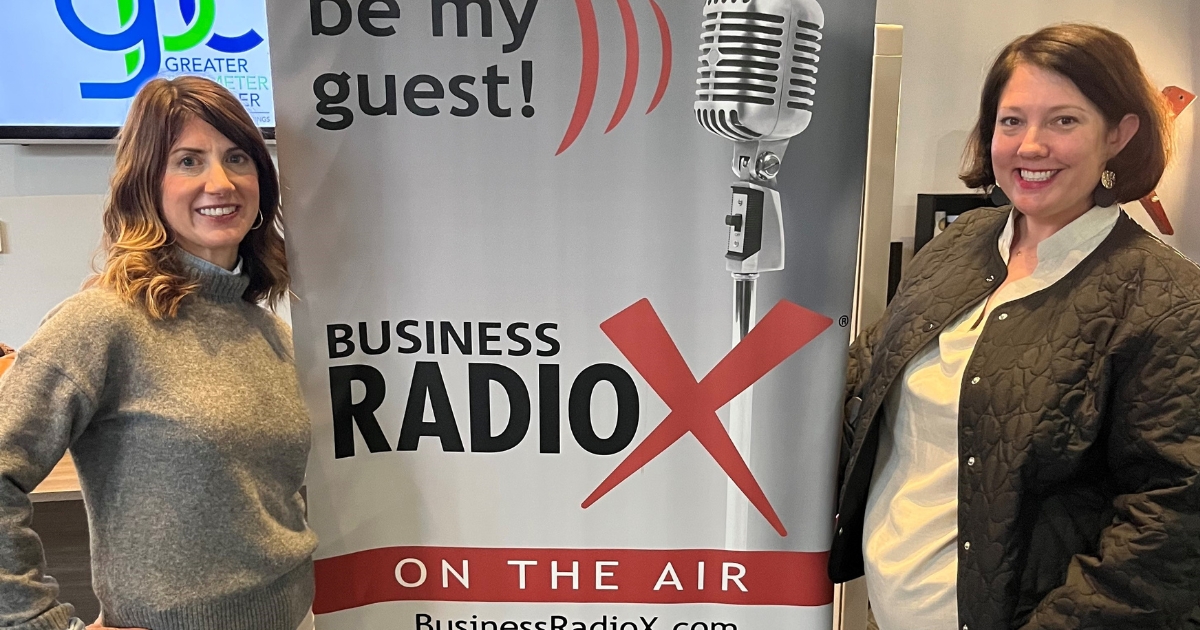
In this episode of Sandy Springs Business Radio, Lee Kantor talks with Maureen Sullivan and Katie Carr, co-founders of Everyday Art, a nonprofit organization dedicated to making art accessible and supporting emerging artists. They discuss the mission of Everyday Art, which includes an online gallery for under-recognized artists, art therapy workshops, and community engagement initiatives. Katie shares her personal story of finding solace in art after a severe accident, which inspired the nonprofit’s creation. They also highlight their efforts to host art classes and fundraising events, aiming to foster creativity and inclusivity within the community.

Everyday Art proudly showcases artists who have a talented portfolio and have a desire to give back to the community.
 Maureen Sullivan, co-founder of Everyday Art, grew up in Atlanta and went to Marist High School. After graduating from Wake Forest, she served as an AmeriCorps volunteer in an inner city school in Baltimore teaching art. Upon completion of the year, she enrolled in Catholic University Law School on a scholarship. It was there, in Criminal Law Term 1, that Maureen met her future husband, Brendan Sullivan.
Maureen practiced law in the Boston area for five years. She clerked for the Massachusetts Superior Court and then took a job in public finance. She worked for five years assisting cities and towns in the New England area to finance capital projects such as school buildings, public safety buildings, and water or sewer projects.
Maureen moved back to Atlanta in 2011 after the birth of her first baby. She wanted to be closer to family and be a stay at home mom. The public finance team asked if she would stay on as contract attorney part time. She agreed and has worked remotely for the team since, while being a stay at home mom with her three kids.
Maureen has served on the Finance Committee for her local school and church. She has been on the board as Treasurer at her local baseball and softball park. In her spare time, Maureen enjoys swimming on a masters swim team and volunteering with her daughter’s softball teams.
Born and raised in North Carolina, Katie Carr, co-founder of Everyday Art, is a graduate of The University of North Carolina Wilmington, with a degree in Communication and minor in Journalism. Katie received her Masters in Business from The University of Georgia and is an avid Dawgs fan!
Katie relocated to Atlanta with her husband Tim in 2013. Katie and Tim are proud parents to Anna (11) and Matthew (8). She and Tim have been married for almost 13 years and reside in Dunwoody, Georgia.
On January 8th, 2024, Katie’s life changed forever when an unexpected trauma took place during a routine surgery. She was in a coma for 11 days. After waking up, she was met with a change that would forever alter her plans for the future. Because of blood clots turning into sepsis, her left leg was amputated above the knee. Her husband, parents, brother, family, friends, Saint Jude the Apostle Catholic Church and School family, along with the entire Dunwoody community stood behind her from the very beginning.
Fast forward almost a year and 12 surgeries later, she is rehabilitating at The Shepherd Center learning to walk again with her bright pink prosthetic she calls “Leslie!” Katie strongly believes that without the amazing community, friends and family, and her faith surrounding her, she wouldn’t be here today.
Katie loves coaching volleyball and softball (especially with Maureen), sitting on the beach looking for sharks teeth and listening to beach music. She’s also an oil abstract artist and has participated in various art shows around the Atlanta area, notably Dunwoody Art Festival and Chastain Art Festival. She also loves showing her work at Moondog Brewery.
Follow Everyday Art on Instagram.
 This transcript is machine transcribed by Sonix
TRANSCRIPT
Intro: Broadcasting live from the Business RadioX studios in Sandy Springs, Georgia. It’s time for Sandy Springs Business Radio. Now, here’s your host.
Lee Kantor: Lee Kantor here, another episode of Sandy Springs Business Radio, and this is going to be a good one. We are broadcasting live from the Greater Perimeter Chamber, advancing Dunwoody and Sandy Springs. So excited to be talking to my guest today. We have Maureen Sullivan and Katie Carr and they are with everyday Art. Welcome.
Maureen Sullivan: Thank you. Thank you for having us.
Katie Carr: Thank you so much for having us.
Lee Kantor: Well, I am so excited to learn what you’re up to. Tell us about everyday art. How are you serving folks?
Maureen Sullivan: Everyday Art is a nonprofit. We just recently got our nonprofit status and we’re very excited about that. But we just created this charity. And the point is to try to bring art to the everyday person and encourage everyone to dabble in a little bit of art.
Lee Kantor: Now is art. When you say everyday person, does that mean the everyday person as artist or everyday person as consumer of art?
Maureen Sullivan: Uh, well, I can say probably a little bit of both. The one thing that we offer is an online gallery, and we search for artists that, you know, they’re not professional artists, but someone who is just a creative or who loves to dabble in watercolor or even, you know, mixed media. And we love to find these artists and display their work on our website. We have just found so many incredible people who you actually would never know how artistic they are. We have some kids who are great at photography drawing. We have moms who dabble into some art. Katie, help me out here. Anything else? It’s been awesome.
Katie Carr: So if it’s possible, we can backtrack just a little bit and tell you kind of how we got started, and that might.
Lee Kantor: Sure. Okay, so you want to. Let’s get the backstory where the genesis of the idea came about.
Katie Carr: Sure. Yeah. It just flows organically. So I had a really bad accident last January where I lost my leg. And Maureen and I are best buddies, and she immediately was like, you know what? I want you to have a place where you can always do art.
Lee Kantor: So you were like an artist.
Katie Carr: I am so in my spare time.
Lee Kantor: Or just.
Katie Carr: I did a couple shows like Dunwoody Art Festival and Sandy Springs. But.
Lee Kantor: But it was a passion.
Katie Carr: Passion project. Yep. All day long. And I’m an abstract oil painter. And it was just started as she was like, I have this idea, and it grew into this marvelous nonprofit that we just, you know, received our 500 and 1C3, checked that box, and there’s three different things that we’re trying to accomplish. And the first being what Maureen talked about is as recruiting this. The everyday artists kind of like how I was not in a gallery, not as public as what some may be doing, doing shows, but not necessarily having their own website. And we curate this art, and we’re trying right now to find artists that do a variety of pieces so we can build our online gallery to have a range of prices.
Maureen Sullivan: And this way, too, someone could purchase art and they can put it in their home or in their office, and it has a meaning and it’s something.
Lee Kantor: There’s a story behind it.
Maureen Sullivan: Exactly. It’s a little bit more than Hobby Lobby or Target, and one of my favorite pieces actually is from Amy, Amy Hamlin, and she is actually suffering from brain cancer, and she’s turned to painting as a way to cope with her diagnosis. And it’s just something, you know, you hang it on your wall and you think, wow, you know.
Lee Kantor: You’re making an impact.
Maureen Sullivan: Exactly. So it’s and we split the proceeds 5050 with the artists and the nonprofit. So that’s one thing that we’re doing.
Lee Kantor: Is that like, I don’t know how the gallery business works. How does a like if you were a gallery in a more traditional manner, what is kind of the financial way that they go about doing business?
Maureen Sullivan: Um, it’s similar. I think the split there is more. The gallery would take 60 to 70. Oh, really? So we do just a 5050 split. Mhm. Um, but so that has been really fun. And if you know anybody’s listening to this and is an artist, please come check out our website and contact us. We’d love to see your work.
Katie Carr: Absolutely.
Lee Kantor: Is there a physical gallery also or everything is just done online?
Katie Carr: Eventually we would like to someday.
Lee Kantor: So that’s on the roadmap is to have a physical gallery at some point.
Maureen Sullivan: Yes. Yes, absolutely.
Katie Carr: The second part of what we’re doing is, um, is something very unique in the fact that we are dabbling a little in the art therapy type workshop classes. Uh, we have a PhD in psychology that we’ve partnered with and kind of collabed on a couple of classes where it’s not it’s not preachy. It’s not deeply therapeutic. But, um, more mindfulness techniques. Right. And we host these classes where I’ll teach a class where we use, um, uh, texture for abstract. So using plaster to create something that you can put on a canvas and make it not something that you can pick up at Hobby Lobby, but not your fine art piece. Right. And just do different paint colors. And, um, that’s been a pretty big success.
Maureen Sullivan: Success. Yeah. I have to give a shout out to Morgan Weatherly. She is our therapist, and she’s been really fantastic in partnering with us and helping to set up classes. And our last class sold out. And, uh, right now we’re having classes kind of wherever we can because we don’t have a location.
Lee Kantor: And those are in person.
Maureen Sullivan: Yes, they are.
Lee Kantor: In the community, in and around the community.
Maureen Sullivan: So we go to different places.
Lee Kantor: So what’s an example of a place you’ve been to?
Maureen Sullivan: Uh, we were at a local preschool once. They had us come in, um, and then we have something on the horizon at a school cafeteria. We did something in a business park outside. So that’s been exciting, right? We were just talking to another company just this week, rise, which is a nonprofit. It’s a coffee shop where the baristas are adults with special needs. Right. And so we’re going to be going out there. We hope to do an art class.
Katie Carr: Yeah. Great partnership there.
Maureen Sullivan: Yeah. Um. Maybe anybody.
Katie Carr: Maybe classes for the parents with children with down syndrome. Or, um, grab a buddy and have a class with a special friend. Yeah. Where we teach the class, we provide all the supplies. They leave with a piece of art that they can hang in their home.
Maureen Sullivan: Right. And Morgan asked. Just such a nice piece, too. Just on the meditation and thoughtfulness, you know, of creating something and finishing something and how that feels.
Lee Kantor: Now, do you mind if we talk a little bit about kind of the nuts and bolts of starting a nonprofit? Because there’s a lot of folks out there that want to do something like this, but maybe They’re too overwhelmed by. It seems too hard or too difficult. Can you share a little bit about you come up with the idea, hey, we want to do something around art. You decide to go down the nonprofit path instead of a for profit path, which obviously I’m sure you discussed different ways of doing the thing you want to do. So you land on nonprofit. Can you talk a little bit about the nuts and bolts on how to get that out of your head, and then into an actual kind of an entity like you’ve done, right?
Maureen Sullivan: I mean, it was definitely a dream that we kind of couldn’t stop talking about for a couple of months. Um, and the 500 and 1C3 application, it’s it’s extensive.
Lee Kantor: Right. And you didn’t have an existing thing like you were. This was all from scratch, right? This is an idea in your head. Yes. It doesn’t exist except in your minds. And now it exists. Obviously. Yes. So how do you go from that thought into, you know, do you the paperwork, like how do you even begin the process?
Katie Carr: Before we did that, we would run this by people in our family, in our community, and we were never met with. No, that’s a bad idea. Right.
Lee Kantor: So that helped. Right. You got a.
Katie Carr: Little.
Lee Kantor: A little.
Maureen Sullivan: Momentum, a.
Lee Kantor: Little mental.
Maureen Sullivan: Momentum. No one said, don’t do it. That’s crazy. Yeah, we thought they would. Um, and then I have, um, a law background. I’m a public finance attorney. So actually, I’m pretty used to tax documents.
Lee Kantor: Okay. So that part didn’t scare you?
Maureen Sullivan: Didn’t? No. I read the 40 pages of instructions and completed it. Um, and.
Lee Kantor: Katie, would you have if you didn’t have her, would you? Pardon? It would have been done right. It would have been an idea. That’s a great idea. And then it would have gone away.
Katie Carr: We really need each other. I worked at State Farm, worked at State Farm for the past 18 years as a data engineer. So my background is not at all documents like that. So we were very, very fortunate.
Lee Kantor: Right. So, so from your end, if it would have been you with the idea by yourself, it probably would have kind of died on the vine there, right? It wouldn’t have gone beyond that.
Katie Carr: Yeah. And you know, the other special thing about it too, is that we feed off each other with passion. She’s really good at certain parts and I’m really good at the other parts, and we kind of figured that, okay, it’s really run pretty smoothly. But no, I don’t think that either one of us feel like we could have done it without the other.
Maureen Sullivan: Um, it definitely is a little better jumping into something like this with someone. Um, I don’t think even if I knew how to complete the paperwork, I could have sort of signed off and sent it without knowing. You know, I had someone I wanted to do this with and hold me accountable.
Lee Kantor: Right now, each of you works for other companies. Had any either of you done anything entrepreneurial like this where you’re starting kind of a business from scratch like this?
Maureen Sullivan: I had done a small math tutoring business with my dad about ten years ago. He bought a franchise and so I helped him run it. Um, and so that that was it.
Lee Kantor: Did that was that helpful in that? Okay, a franchise kind of has a kind of a business in a box kind of feel to it. So there’s steps and there’s procedures and you kind of knew that. And you can kind of maybe borrow some of that into what you’re doing now.
Maureen Sullivan: Yes, it definitely helped. You know, I knew we needed insurance. I knew we needed licensing. Right. You know, I and to be honest, you can also Google a lot. Exactly.
Lee Kantor: But again, having done it, it makes you more confident that, hey, I can pull this off this. Other people have done some stuff like this.
Maureen Sullivan: Yes, yes. And we’re not getting it too complicated. We don’t have a space. Right. Um, and it’s a nonprofit. It’s not running a payroll.
Katie Carr: Yeah, I was going to say the same thing. It takes the pressure off of us. Um, the entrepreneurial part is really a passion. And what we see as our dream to be able to do this and give back. Um, so not as much pressure about, you know, our salary and things like that at this point.
Lee Kantor: So now what is kind of your like, how do you mark milestones? Like what was the first thing. Okay. We got the entity. So that was check that box. We’re legit now.
Katie Carr: Our website.
Maureen Sullivan: Website.
Lee Kantor: That was the next big thing was okay now we need a need a website. Look, we’re doing this. We got to do this, right? Yeah. At some point, you know, you’re in for a dime. In for a dollar. Kind of thing. We’re going to. If we’re going to do it, let’s do it. So now you got to make a website. So had you done that or you had to now got to find a website partner.
Maureen Sullivan: We we.
Katie Carr: Did.
Maureen Sullivan: We had an old friend who helped us.
Lee Kantor: So within the network again the the community’s helping you.
Maureen Sullivan: Yes. Another mom. There’s been a lot of moms out there that have helped us. Morgan is a fellow, um, her daughter goes to school with our daughter’s fellow mom friend. And then this was my my friend from high school, but she does a small website business on the side.
Lee Kantor: So then you were like, hey, we’re doing this thing. Did you ask her, do you know somebody? Or did she raise her hand and say, hey, do you need help?
Maureen Sullivan: She reached out to us and said, if you need anything, let me know. So.
Katie Carr: But it worked out good. She’s she was able to set up the the shell for us and I maintain our website now. Um, I have a bit of like a digital background type communication. Right. Um, so I’ll, I’ll maintain it now, but it didn’t. I mean, we there’s no way on earth I would have ever been able to do what she did. Right. Really set us up for success. That was the first big milestone where we were like, oh, this actually looks really nice.
Maureen Sullivan: And we should say her name. Elise Black. If you have a website. Website that’s exactly very talented.
Lee Kantor: So then okay, so now you have the website and then how do you go about kind of finding the artist? Was that did you think that would be difficult or easy. Like what was kind of because at some point you have to reach out, right. And get some artists in here.
Katie Carr: I was in the hospital for a really long time, and Maureen was visiting different art festivals out there. Um, during this.
Lee Kantor: Time scouting.
Katie Carr: She was. Scouting has a great eye. So she had a whole slew of business cards when, you know, we were ready to really start talking about this and, and reaching out to artists. And we really the pace at what people. No one said no. So we are um.
Lee Kantor: Because from the artist standpoint, it’s kind of a no lose situation. It’s like, hey, I’m just digitally putting my stuff there and I get 50%. So it’s. Yeah, why not?
Maureen Sullivan: Right? Right. We do ask that, you know, we have exclusive right to it for a period of time. Period of time. Um, but yeah, there’s no downside. And when we try to showcase the artists, we’ll do a special social media push just all about them, or we’ll try to interview them and publish it on our Instagram. Um, just to, you know, show the world who this person.
Lee Kantor: Is and what their story is. Now, um, is a hard part kind of saying no to some artists because, like, you’re curating, right? That’s part of your job as a gallery owner. Or is it like, hey, it’s all comers come in and we’re going to.
Katie Carr: Fortunately, we have not crossed that bridge yet. I, I’m sure that at some point her and I are going to have to discuss. Is it appropriate for our site? Is this a long right?
Lee Kantor: Is this aligned with our brand?
Katie Carr: Right. Our brand that we’re creating? Um, but luckily so far we’ve been like, yeah, let’s do it. We have photographers, We have people that have made crosses, you know, out of oyster shells and just I think somebody was making a quilt. So it pottery, like the sky is the limit for what we’re looking at.
Lee Kantor: Right. So you’re casting a wide net.
Katie Carr: Wide net.
Lee Kantor: And then is the are there any kind of rules like do they have to be local. Like what is kind of the criteria that you’re looking at, the lens you’re looking at for artists?
Maureen Sullivan: It does not have to be local. No. Um, it’s a little bit more convenient for getting the art to a local from a local, um, artist to a local consumer.
Lee Kantor: Right?
Maureen Sullivan: That part is hard because to ship art is expensive. Um, so.
Lee Kantor: Which could be more than the art?
Maureen Sullivan: Exactly, exactly. So that’s kind of tough. Um, but we have some, you know, some of our artists have figured out ways to, you know, make it work, right? You know, instead of sending a canvas, they might roll up a sheet of parchment, um, and that, that has worked. So we’re just dealing with that as it comes.
Katie Carr: Yeah. Yep. And there may be, you know, artists. I’m from eastern North Carolina, so a lot of our, um, my community and my friendships are, are spread out through North Carolina. But within that community, there’s a lot of artists. So if they if we want to showcase some of their art, they can deliver locally in their state and their their spot where they’re in.
Lee Kantor: Right. You’re just figuring out ways to make it work for everybody.
Katie Carr: Make it work. That’s the beautiful thing about having an online art gallery. It’s not just local.
Lee Kantor: So now you mentioned the art. You have the, um, kind of therapeutic kind of classes. Is there any other?
Maureen Sullivan: Yes. This is our favorite part. Yes.
Katie Carr: Um, so we, uh, when I was in rehab for, you know, learning to walk again, I was able to kind of see what it looks like when you use creativity for rehabilitation techniques. So we’re very fortunate to take the proceeds that we are earning through the online art gallery, the art workshops, and build really awesome art kits. Um, it’s a it’s a box. It has a cute sticker on it from us. It’s wrapped in tissue paper on the inside with a canvas, some paint brushes and some paint. And we are able to partner with different, uh, hospitals in the area. We have contacts at Koa, at Piedmont, at Shepherd center, um, Emory, the list goes on. Anywhere you can deliver art kits to patients that could use creativity to help their spirit, help their occupational therapy.
Lee Kantor: Uh, so what are the elements in the kit?
Katie Carr: It’s it’s a canvas. So they get a small canvas, they get little containers of your primary colors of paint, and they get some paint brushes. And we have a card that we put in with instructions. So it’s and basically we’re working through the context of where we deliver maybe 50 kits to Piedmont, but we deliver them via an occupational therapist or a physical therapist and say, hey, you guys can run with this. It’s free of charge. This is our donation to you. Or you could call us in and we’ll be we’ll be happy to to run a class and kind of teach some basic art techniques, whichever they prefer. And we’re it just, it’s so awesome to be able to do.
Lee Kantor: Have you have you done that? Has that gone out?
Maureen Sullivan: Yes. We’ve delivered it to a few, um, occupational therapists and physical therapists. And then we have some contacts, actually, um, that we’re working on at Shepherd in Piedmont.
Katie Carr: Yeah. Wow. I’m very lucky to have my rehabilitation at the Shepherd center. Anybody who has heard that name knows only great things about it. Sure. And, um, you know, we I had a mom tell me one day where her son was diagnosed with cancer at a very young age. And she said, we would have loved to have one of these kids when he’s sitting in his room. Right. Just just to be able to. And that’s theirs. That’s their thing to do. Um, and everybody likes that feeling of creating something that someone else says that looks really nice, right? It’s that intrinsic feeling. We just want to bring happiness to these people.
Lee Kantor: And, um, do you do any kind of fundraisers or ways for the community to support your efforts?
Maureen Sullivan: Not yet. We’re working on it. No, we are working on it.
Lee Kantor: So what do you need more of? How can we help you?
Katie Carr: We’re in the process of being able to accept donations. And once we can do that with the state of Georgia, we’re able to partner with, um, different companies and different places that we’ve reached out to that have shown interest in maybe sponsoring a fundraiser night, and then we can showcase art from our artist. We can showcase pieces that maybe have been created by, um, someone going through rehab that wants to donate their piece back to us and kind of have a nice gallery type event. We we have a lot of really cool things on the horizon where we think that it’s going to just open up and create lots of opportunities.
Lee Kantor: Now, what about from the artist standpoint? Is that something you’re always looking at? Artist.
Maureen Sullivan: We will always be looking for artists 100%.
Katie Carr: So if Reach out on our website.
Maureen Sullivan: Reach out. Yes or Instagram.
Lee Kantor: So what if an artist has like just a few pieces? Is that okay? Or do they have to have like a certain number?
Maureen Sullivan: They can send us one.
Lee Kantor: One.
Maureen Sullivan: Whatever, whatever works. Um, but yes, we’re always looking for artists or, or if you’d like us to come to an art class.
Lee Kantor: Yes. And so then who’s the ideal partner for an art class?
Maureen Sullivan: Well, I mean,we have something set up, um, where we get our hair cut. Yeah. Um. Okay.
Lee Kantor: So. So the venue doesn’t have to be super large.
Katie Carr: No, no.
Maureen Sullivan: There’s.
Katie Carr: No. So the the haircut place they’ve shown interest in. Hey, we want to have kind of like our post holiday party at our home. You know, we don’t really want to have, like, a sip and paint or something like that because that’s, you know, painting something specific. Not everybody is, is.
Lee Kantor: Wants to.
Katie Carr: Do that. You know, would you guys be interested in coming to our house and doing, you know, showing us how to use plaster as texture and creating something abstract? And that’s been really cool. And we’ve been working with the chamber and some other some other nonprofits that have, you know, shared some insights into maybe having a space to have a classroom to be able to host these and, um, yeah.
Maureen Sullivan: It’s coming along.
Lee Kantor: So if somebody wants to learn more, I have a more substantive conversation with you or the team. What is the website? What’s the best way to connect everyday?
Maureen Sullivan: Art gallery. Com and the Instagram handle is everyday Art Gallery. And is that Facebook too?
Katie Carr: Yep Facebook as well. So in TikTok we’re on TikTok. Um, we are all about creating content right now, and this is why this is an incredible opportunity. So thank you for having us to share.
Maureen Sullivan: Yes.
Katie Carr: Thank you. Reach out. We would love to talk and connect and share more about what we’re trying to do.
Lee Kantor: Well, thank you both for sharing your story. You’re doing important work and we appreciate you.
Katie Carr: Thank you so much for having us.
Lee Kantor: All right, this Lee Kantor we’ll see you all next time on Sandy Springs Business Radio.














