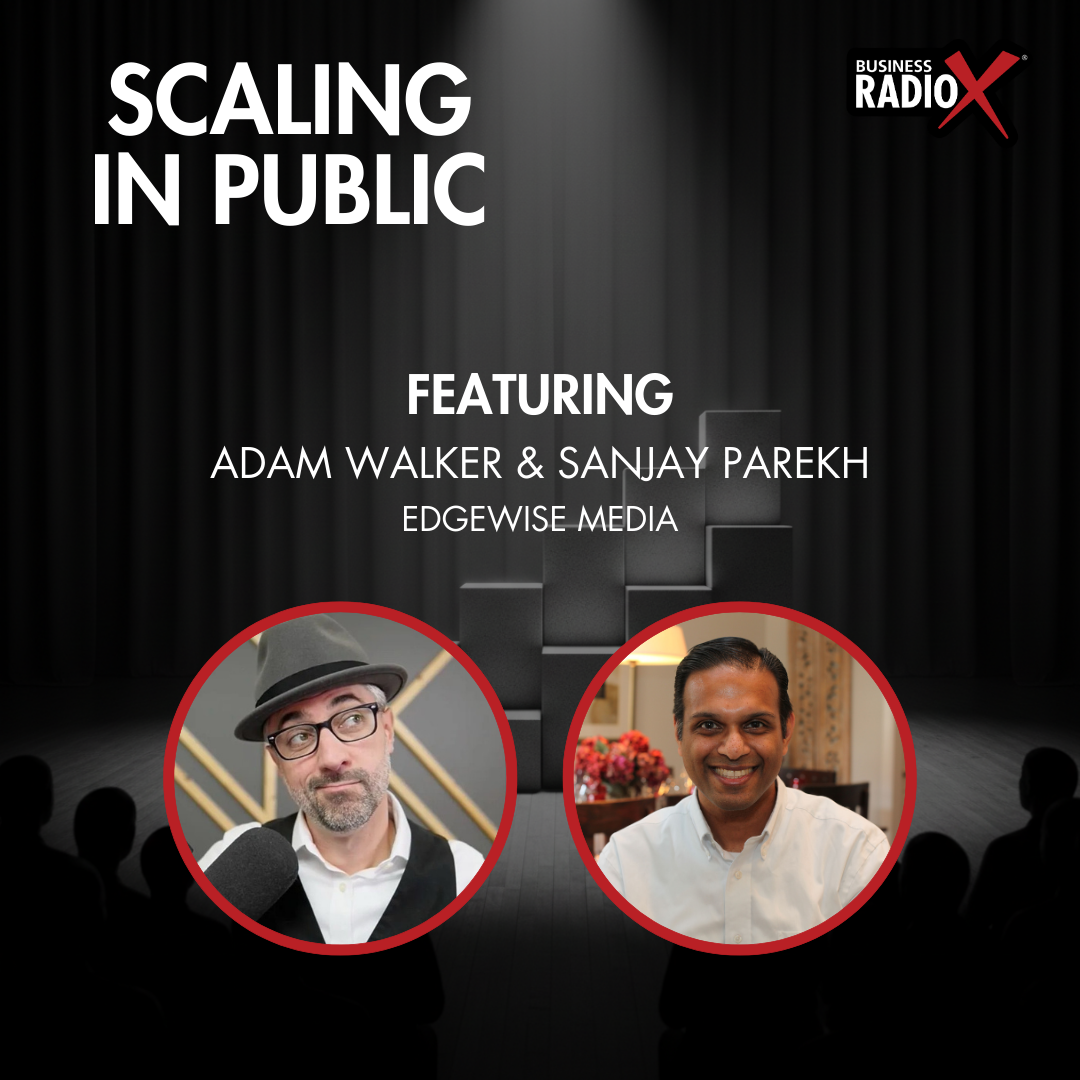

This episode of Scaling in Public dives into how video can help Business RadioX® reach its goal of 100 markets while still honoring its core of intimate, relationship-driven, local storytelling. Lee and Stone, along with Adam Walker and Sanjay Parekh, explore how to thoughtfully add video to the Business RadioX® model without losing the “magic” of in‑studio intimacy. They unpack the tension between in‑person audio, virtual video, and hybrid options, discuss video’s power for relationship-building and virality, and sketch out tiered offerings and on-ramps for future studio partners.
 Adam Walker is a husband, father of five, and wearer of fedoras. He is a marketing strategist, nonprofit leader, and entrepreneur passionate about using technology and storytelling to create meaningful impact.
He serves as the leader of 48in48, helping nonprofits by building 48 free nonprofit websites in 48 hours and is the co-founder of TogetherLetters, a platform designed to keep people connected without social media.
Adam also co-founded Edgewise Media, where he helps organizations turn ideas into powerful podcasts and short-form content. He’s committed to lifelong learning, daily reading, and helping organizations do good work, better.
Connect with Adam on LinkedIn.
 Sanjay Parekh is a serial technology entrepreneur. Currently he is the founder of Mirage Data, a startup focused on protecting data while maintaining usability. He is also the co-host of Tech Talk Y’all, a podcast covering technology with a southern flair, and also co-founded Edgewise Media.
Sanjay previously co-founded Prototype Prime, a hardware and software startup incubator based in the northern Atlanta metro. Previously Sanjay launched Startup Riot, a conference for startups which pioneered the three minute, four slide presentation format. He also ran Founder Fables, an off-the-record conference for founders.
Prior to founding Startup Riot and Founder Fables, Sanjay was the founding CEO of Digital Envoy and the inventor of the company’s patented NetAcuity IP intelligence technology. At Digital Envoy, Sanjay led the company to raise $12 million in angel and venture funding. Digital Envoy was acquired by Landmark Communications in June 2007.
Sanjay holds an electrical engineering degree from the Georgia Institute of Technology and an MBA from Emory University’s Goizueta Business School.
Connect with Sanjay on LinkedIn.
Episode Highlights
- Why Lee built Business RadioX® as an introvert’s alternative to traditional networking—and why video is now on the table to help reach 100 markets.
- The debate: does in‑person audio create deeper relationships than Zoom-style video, and how can intentional pre‑calls and “off‑record” chit chat make virtual interviews feel just as intimate?
- Adam and Sanjay outline simple, repeatable video setups (multi‑camera, lights, lav mics) and a single post‑production workflow that yields both audio and video assets.
- A tiered path for studio partners: starting with virtual-only video, graduating to in‑studio audio, and then layering on pro video as they grow.
- How short‑form clips and YouTube segments can 10x exposure for local businesses, turning one conversation into discoverable assets on TikTok, Reels, Shorts, and search.
 This transcript is machine transcribed by Sonix.
TRANSCRIPT
Intro: Broadcasting live from our flagship studio in Atlanta, Georgia. This is scaling in public. The next 100 Business RadioX markets, featuring founders Lee Kantor and Stone Payton, along with some of America’s top coaches, helping them grow the network with real strategy, real lessons, and real accountability all shared in public. To learn more about the proven system that turns podcast interviews into a perpetual prospecting pipeline through generosity, not gimmicks, go to brxhq.com And download the free Business RadioX playbook. Now here’s your host.
Adam Walker: That was a great intro, I love that. All right, so, uh, I think maybe we should start by talking about why why we’re talking about video. And so I know why Sanjay and I are very pro videos, so. So Lee and Stone, like, I’m wondering, like, if you could explore, like, why why are we even having this conversation? Is it because you think there might that might be an avenue to growth or what are your thoughts on that?
Stone Payton: So I absolutely think it might be an avenue for growth. One of the challenges, and I don’t think we’ve just created this as a perceived challenge for ourselves. I think it’s genuine. It’s one thing to be in a local market where you have people come into your studio and you get to meet them face to face. You see the body language, you create that relationship and that model is very well baked. It works. It always works. It never doesn’t work. If you run a local studio, you’re going to help people and make money. Now Lee and I have taken on the, the, the challenge of trying to get other people to do what we’re doing here in metro Atlanta and a few other communities across the country. You know, to get someone in a market where we’re not like a Memphis or Pittsburgh or San Diego, and I feel like. And I think Lee’s beginning to feel the same way. It’s almost we can use all of our tools and strategy to get to meet those people, begin to build a relationship. We can invite them on a show, but we’ve been audio only for so many years, and it’s it’s not the same experience. So as they begin their experience with Business RadioX, it’s not really the thing that I want them to do, right? It’s a zoom audio recording, and I’ve used this analogy before, but I’ll share it here again. I almost feel sometimes that I’m jumping in a rowboat, rolling out to the middle of the bay, and then trying to sell somebody an outboard motor. And so you know what I mean. So yeah, I do think there is very likely a place for video, maybe even at the local community studio level, but certainly in this scaling effort. Lee. Mm.
Lee Kantor: Yeah. That’s I mean that’s been our experience. We’ve had we’ve been doing audio. We’ve been doing in-studio work for so long. Um, and that’s worked for us since the pandemic and we transitioned to more video. Um, we just haven’t leaned into the video aspect of, of doing what we’re doing. And obviously you can execute this through technology in a variety of ways. Um, but in our work in a studio, having headphones in a place where we’re all there, intimately connected, it creates this bubble of intimacy. That is, we just haven’t been able to replicate using video.
Adam Walker: Mm.
Sanjay Parekh: You know, one of the things that kind of strikes me, um, in terms of the business that you’re in is I think you’ve said it a couple of times now is building relationships, right? It’s all about building relationships. And to me, and I think to Adam as well, uh, one of the things that video does is allow you to build those relationships, because one of the challenges when you’re listening to somebody’s audio only. And I have this challenge all the time. You know, you’re listening to, you know, NPR or whatever it is, and then you actually see the person and you’re like, the picture of the person doesn’t match up with what the image is in your head. And because of that, if you’re seeing them outside in the real world, you wouldn’t think that this person is the person that you’ve been listening to. But when you’re being able to see video of them all the time, like this happens to me, I think, Adam, it’s happened to you as well. People will come up to us because they know us from the things that we’ve done. They’ve seen us. Um, and then they compare the things that we’ve said and then what we look like, and then know when we’re out in public and be able to talk to us.
Sanjay Parekh: And really that helps build those relationships. And so the thing that you said there, Lee, about, you know, these, these communities and, and building those relationships, I think video is actually one of the, the strongest tools that you have in terms of helping that happen. And so I think one of the things that both of you have said before, uh, to us is that there’s like this hesitancy, uh, in terms of doing video like what’s like the core of that. Why the hesitancy? Well, it’s a bias. And it goes to what you said, the you’re focused on how the audience sees you and strangers come up to you because they’ve seen your video and they think they know you or whatever. In our world, the guest is the most important person. So the person that I’m interacting with in person, I am seeing face to face across the table as opposed to like we’re doing now, uh, across a video screen. So that relationship, I believe, um, becomes deeper, faster in person than it does, uh, via Zoom or Riverside or whatever platform you’re using.
Adam Walker: Yeah, I think that’s a good argument, but this kind of like it’s kind of the similar argument of like, we can only have good company culture if we’re all in the same building in an open workspace. And so I think, I think it’s a similar kind of argument. And so I think my response to that would just be that I think you can still build high quality relationships via video, and I think you can do it via video like interview like this. But it has to be there has to be like a lot of intentionality baked into it, because otherwise you miss out on the chit chat or you miss out on the follow up, or you miss out on the, you know, whatever. Um, so yeah, I think I think you can create a formula that would make that work. It just takes a lot of intentionality.
Lee Kantor: But I think I think you’re exactly right, Adam. I think that that’s a perfect analogy is that a lot of businesses want to go back to office because they want to create that serendipity and all those kind of watercooler moments that are difficult to replicate, you know, virtually. So what would be your recommendation if we were to go into video on how to create kind of those deeper relationships without it seeming like every other podcast video, podcast interview where the person jumps into a waiting room in one of these platforms and then, you know, you go five, four, three, two, one, and now you’re off, and then it ends and you go, thank you. Bye. So how would you recommend building that intentionality in those meaningful moments using video?
Adam Walker: Well, I mean, what I’ve done before and some of you may have a different opinion on this from from some of your experience in hosting. Um, so what I’ve done before is I’ve done like a pre-interview call, like just a, just to get to know you call and use that as an opportunity to better understand their story, better understand sort of what they’re about, and then create and craft questions around that for the interview.
Lee Kantor: When you say call are you saying call like a video call or.
Adam Walker: Yeah, like a zoom call. Yeah. Just yeah. Just to get to know you like, oh, tell me your story. Let’s talk about that sort of zoom call and then that can sort of pre inform the actual interview itself. But then suddenly, I mean, I know you do a lot of like pre chit chat on one of our podcasts. Like maybe you could talk about that too, because I think that that’s a slightly different approach but has the same effect. Yeah, I so.
Sanjay Parekh: I tend to do it uh during the, the recording. So before we actually hit record, um, I’ll start talking to them, you know, just to understand a little bit about their story, but really, uh, it’s kind of a multiple purpose one, uh, for some of the folks that don’t come on these shows often, it’s to get them comfortable, uh, and kind of loose and just, you know, chit chat and laugh about stuff or whatever. I just recently had somebody on, uh, who was originally from New Hampshire and I mentioned, you know, like, I remember the New Hampshire quarter, uh, and the old man in the, in the, uh, the Stone or something. I don’t know exactly what it was, but basically the New Hampshire quarter had that. So I started asking him questions about that. Um, and so he went into this long kind of conversation about this, and it kind of loosened him up. Um, but it also gave us this kind of common connection, um, that, hey, you know, like we’re friendly or whatever before we leaped into it. One of the things I did want to kind of mention and kind of talk about and dig into, is that the way we’re kind of framing this is that it’s an either or right, in-person or online video, and it doesn’t necessarily have to be right.
Sanjay Parekh: The in-person can still have video. You can still develop that that that content, that relationship and everything else in person. And then kind of the second order of this, I think the place that this adds a lot of value, not just for y’all, but also for the other people that are running Business RadioX, um, affiliates, is that the guests that are coming on will find value in this, because they’ll have the opportunity to kind of share this video and kind of spread it around. Like there’s there’s added value for them as well. And so I think for some of your folks that are affiliates to be able to, to attract these guests that they want on the show, um, this becomes another kind of quiver, uh, in the, uh, what is that thing called? Arrow in the quiver? Arrow in the quiver? The thing is the quiver. The arrows inside. Arrow in the quiver. Yeah. Thoughts on that?
Lee Kantor: Well, I, I agree that it’s an and not an Or, and we just have to figure out the best way to kind of leverage, um, video to achieve our objectives.
Adam Walker: Yeah. So what. So so so the objective is 100 Business RadioX by the end of the year. Right. So I wonder if you can take just a moment and explain, like why Business RadioX like why like like why would someone start a Business RadioX in their location?
Lee Kantor: Um, Stone you want to take that?
Stone Payton: I do, but I wonder if it wouldn’t even be more powerful for why you started the first one. And then I’m happy to share why I think someone in San Diego ought to get one tomorrow.
Lee Kantor: Yeah. So the reason Business Radio X exists is because I didn’t like doing networking. That was really at the heart of it. Um, Business RadioX exists because I did not want to go to another networking meeting and stand up and tell them why they should hire me to be a copywriter at the time. And so, um, I’m like, there has to be a better way to do this. I’m an introvert. I don’t like to go. I’m uncomfortable in that situation to begin with. And now I have to go every week, and I have to stand up there and say the same thing to the same folks. So what I did was I, um, I had been doing podcasting, um, for a show called Doctor Fitness and the fat Guy and, uh, I’m like, I wonder if I can use the same platform as a way to meet the people I want to meet. So instead of having a show called Doctor Fitness and the Fat Guy, I had a show called Atlanta Business Radio, and on that show I was interviewing business people, and it worked the same way as Doctor Fitness worked, because I could invite people and they would say yes, and they would come on the show and they’d come in the studio. And at the time we were this was at the beginning of podcasting. So there wasn’t. You had explained that you didn’t need an iPod to do, you know, to come on the show. And, you know, we’re having kind of different types of explanations that you’re having now, but they would come on the show and we’d have several guests at a time, and there was just this energy in the room that became a mini networking meeting.
Lee Kantor: Everybody got to learn about each other, and we did it in a manner that was very conversational and it was very intimate. And everybody had headphones were in a room all together. They couldn’t multitask, they couldn’t go on their phone, they had to listen. So everybody was forced to kind of learn about each other. And in that environment, a lot of people were like, oh, I didn’t know you did that, or I didn’t know this or that. And they were able to interact. And then a lot of folks kind of said, hey, I want to know more. And they’d go off and learn more about each other, or I would get clients like, how do how do I get a show so I can do the same thing for my, you know, my business? And it became evident, it was obvious because they saw it happen. It was visceral. Um, and that was something that, um, you know, led to one client to another and another. And, you know, all of a sudden I had a studio full of clients, of which Stone became one of them. And then it became, okay, can we take this same thing and move it to other places and do the same activity and help other people do what I’m doing, just in a different markets?
Adam Walker: I love that. All right. So Stone, why would somebody, you know, put one in, I don’t know, Miami or something like that. Give us more on that.
Stone Payton: Sure. Happy to. And I think I’ll start with why I did it. And I was invited as a guest. I was very impressed with the whole experience was very different than the traditional. You know, I’m a smart CPA. Saturday afternoon FM show that I was doing. I self-published a book back then and I had my, you know, I had all my little notes. I had that one joke that always landed. It was all but it was a much more superficial exchange. Those kinds of interviews on cable access and those FM afternoon shows. Man, I walked into this studio and, you know, the the clouds parted, the angels saying that the doves flew. It was it was just a very different experience. We had real, authentic conversation about me and the work and the why behind the work and where I was taking it and what I had learned from it. And I built genuine relationships in the space of, you know, 45 minutes, you know, an hour with I think it was like three other small business people and Lee and Amy, the two people that were hosting the show. So, I mean, I, I just had a marvelous experience and I couldn’t figure out how Lee was making money because he didn’t charge me to be on the show. He didn’t run any commercials? I stayed after he explained that to me. I probably not that day, but within a couple of days I wrote a check and and he helped me build my own show. And then, you know, it wasn’t 90 days before I wrote a bigger check and bought myself a different career and, uh, and became partners with Lee. But the the real motivation behind it all, if you look under the hood a little bit, is I’m anything but an introvert.
Stone Payton: If you’re not picking up on on that already. Uh, but I also, I like very much being the guy who knows the guy, and I absolutely detest and will never be that person that says, please, baby, please. You know, can we please have a cup of coffee? And I explain what I do and, you know, will you please take my call? I always wanted to be positioned, and I was fortunate in an earlier career, uh, that that we already were wasn’t because of what I was doing. Always positioned that people saw us and me out. And so and so here in Woodstock. I run one of the studios here in Woodstock as well. I mean, I’m the social mayor. Everybody knows me. I’m the cool guy in town. You know, I help support and celebrate everybody from the fire chief and and the police chief to the local business leaders and, you know, Stones, the cool guy in town that everybody that everybody likes. And as a business, I can help other people who want to build real relationships real fast with this platform and our methodology. I can help them do do that. I can help them do it, you know, with a great deal less energy and a lot more fun. And so if you’re in the professional services arena, you’re a coach or a consultant, you’re a fractional exec. It’s just a heck of a lot easier and a lot more fun to use this platform as a way to build real relationships than any other strategy or tactic that I’m aware of.
Adam Walker: Yeah, yeah, that makes sense. So so then it strikes me that there’s there’s kind of two, two components to this conversation for you. All right. One is can video build the type of relationships that you’re looking to build? So can you bring in the guests? Can you build that rapport? Can you create those networks. Can you do that through video? And then the second is can video help you in terms of Business RadioX expand your reach to get in front of more audiences in order to hit your goal to get 100 locations by the end of 2026. I mean, is that is that a reasonable way to sort of frame up the conversation?
Lee Kantor: Yeah, I think so. I think what we’re trying to do, we’re trying to get to 100 by any means necessary. And this is a tactic to do that. I mean, yeah, this is one of several tactics that we’re willing to explore. And we there’s a saying, Jimmy Johnson says that you are what your record says you are. So we we we don’t have ten yet. So we’ve been doing this for 20 years and we don’t have ten, so whatever we’re doing is not working. So everything is on the table to, um, to get to 100. So this is definitely one of the things on the table.
Sanjay Parekh: So there’s an interesting kind of point here. And I think in some of this. So we keep talking about locations, right? Locations. It’s a place where people come uh, this you know, going virtual like this opens up the opportunity where it’s not really a location anymore. Right? It’s a person interviewing, um, and they’re developing relationships. Now that I’m, like, thinking about what you’re talking about. I think this does open up a whole new avenue for y’all. Because right now, you’ve been focused on people that want to develop relationships that are local to them. Right? Because that person’s going to come into the studio and all that. Doing something like this, where everything is virtual, potentially now opens up the opportunities for people that want to develop relationships that are not necessarily local, right? They want to develop relationships across an industry, across a vertical, whatever it is. Uh, and I think then this actually breaks you out of this, uh, kind of constraint where you’re probably thinking, we haven’t talked about this yet. You’re probably thinking that these 100 are inside of the US, whereas if it’s all virtual, then it doesn’t necessarily need to be. And the buy in cost I think is a lot less. Right. Any kind of thoughts on that and feedback on that?
Stone Payton: Well, for me personally.
Lee Kantor: Go ahead, Stone.
Stone Payton: For me personally, I haven’t gone as far down that into the continuum as you’re describing, like having this entire virtual model. But I have, through our other coaching sessions, has lent itself to this big begun to broaden my definition of what a studio partner is. And maybe we ought to call them something else to to the extent that I’m even recommending do what I did. When I came to Cherokee, we moved from East Cobb. I went ahead and did a dozen interviews virtually. So by the time I got to to Woodstock and before I became social mayor, I had I had a, you know, I had some traction. And there are some distinct benefits that I’ve experienced in having those local people there and getting those local clients and all that. But I am definitely opening my mind to a broader definition of what a studio partner is, and that there’s very likely a place there for virtual programing. And for all I know, it ought to be the lead place, I don’t know. So yes, I’m leaning in that direction some. Sanjay.
Lee Kantor: I’m not leaning in that direction as far as Stone is or as you described. I think that what makes us unique and different is that there is a local element to this. And, um, and I’m not constrained by the United States as the only place these things can happen. I I think they can happen anywhere in the world, but I think the value of having a third place where people go physically and meet in person, face to face, I think there’s a place for that and those stories to be told in that manner locally that would benefit entrepreneurs that kind of lean into our methodology and our mission of being the place where these stories are told for the business community to support and celebrate local business. I think that that there is a business model that can support that and that we can help them achieve that. Um, you know, if if the target becomes anybody that has access to Riverside or, or any type of internet technology and they want to just build their, um, community, wherever that is, they can do that within that. Like that doesn’t discourage them from doing that. It’s an and not an or in our model, obviously the technology lets you interview anybody anywhere. So they can do that and still serve, you know, Memphis.
Adam Walker: Yeah. I mean I think there can be a local component and a non-local. I think to me, what it opens up is that if your model right now is all studio based, you’re limited to have people purchase locations that are only wanting to network locally. And I think there’s a pretty large number of professionals that want to network locally and beyond that. And so that would be.
Lee Kantor: The the target would be I would want the ideal the avatar for the ideal client would be somebody who wants to make an impact locally if they don’t want to make an impact locally, and they just, you know, the world is their oyster, that probably is not the right fit for our ideal prospect. Got it. Uh, even though obviously there’s more of those people on the planet, I think the person we’re looking for is the person that wants to say, you know what? I live here in town. I want to be the place where these stories are told. I think it’s important for these stories to be told, and I want to be the one who tells those stories.
Adam Walker: Got it.
Sanjay Parekh: Okay, so the I think there’s an interesting path here in terms of, um, business progression, right? So I think that’s an important thing that you highlighted there that it’s about the local. So it’s a good distinction to have to know that, okay, we’re about helping build up local businesses. Yes. There’s a maybe a remote option because hey every now and again we want to build bring in an expert that’s not local and this is how we do it. But Stone, you actually made the comment earlier that before you moved over, uh, you used these virtual opportunities to start building up the case for this. So is this maybe the right way for you to develop these affiliates to say, like, look, your first six months are are virtual so that you don’t have to go all in and buy, you know, all of this equipment and and spend all this with, with the hope and a dream that it’s all going to work out and that there’s a less expensive option. And in those six months, you figure out where that physical location is going to be based on what you see happen in those six months, and then you transition to a in-person and virtual opportunity. Is that something that makes sense in terms of the business?
Stone Payton: I think that’s an idea that has a lot of merit, and I could see doing that. And even the half step being you’re a pop up studio in the middle, you know, now with all these co-working spaces and all that, get the Business RadioX remote kit. That’s your second level of certification. You know, all that stuff. And then you show up, you know, every Friday at the local co-working thing and do your pop up. Uh, not that we’re doing that, but, I mean, it makes sense to me.
Adam Walker: That’s what we used to do with TikTok, y’all. We had a little pop up studio we’d arrange every every Friday. So.
Stone Payton: But I don’t want to While I want to be completely open minded to all of this, I want to make sure I underscore and I don’t want to dismiss the the sheer magic that happened. I’m at the house right now, but a mile down the road, I’m in a coworking space with a ten by 13 studio. That is a magical place, and you can make a very comfortable living a couple afternoons a week, running down there and giving people a chance to share their story and promote their work. So I don’t want to dismiss that at all. But yeah.
Sanjay Parekh: Yeah, but it’s more about the on ramp, right? Like how do you make it easy to people getting to that point? Because maybe they’re not convinced, but this might be an easier way. Lee did you have thoughts as well?
Lee Kantor: Yeah. Well I don’t want to dismiss like the person, the aspiring person that wants to be an authority in their community and they want to be kind of known as I know everybody or I’m this connector and I’m this really important cog in the ecosystem by partnering with us. This is almost a cheat code because like my studio in Atlanta is in the Chamber of Commerce for the Greater Perimeter chamber. So like they invited me to put a studio in their office, literally in their office. So when they have a mixer, I can broadcast from there mixer because I’m down the hall, you know, where I’m in the same room as them. So some of our partners have offices inside of businesses, like one person has an office in a bank, one of them has an office in a coworking space. Um, like multiple people have them in coworking spaces. But chambers of commerce are very interested in having the ability to have storytellers in their building. That’s a that’s a win win. So it’s not like, oh, it’s hard to get space or I’m going to have to pay a fortune for space. A lot of our people don’t pay anything for rent, and a lot of them get super discounted deals because they have partnerships with the businesses that they’re located in.
Sanjay Parekh: So that’s an interesting kind of concept that you’ve hit upon there. I don’t remember if it’s been discussed in previous episodes, but is that actually maybe your sales channel of talking to Chambers of Commerce and convincing them that they need a Business RadioX not hosted by them, but empower them to go out and find the person that would run it there and have them be basically your sales agent. You know, this is not going kind of far afield of what we were starting to talk about, which is doing video. But let’s talk about the business, because video is really just a matter of empowering the business, right? Spreading the word, um, giving a reason for people to come onto the show. But I think you just hit upon something super interesting that maybe should be the kind of point of this whole effort, right? The reason why you’ve only got in ten is maybe you’re not talking to the chambers of commerce, which is who you need to talk to.
Lee Kantor: The Chambers of Commerce historically have been willing partners. They haven’t been willing check writers, um, they’re not. Um, so far, we haven’t been able to convince any to my knowledge of saying, okay, here’s X number of dollars you can be here, but they are willing to, um, kind of co-brand shows they’re willing to distribute content. They’re willing to, um, have us appear, um, and to offer us, uh, like in my chamber that I’m in, in the Greater Perimeter Chamber of Commerce, that is a chamber that focuses on the top end of the perimeter from 75 to 85, along 285 in Atlanta. So they had multiple offices that they were leasing, and they wanted us to be in, in there. Uh, that was they saw that as a value to their members, to themselves, and they wanted access to our platform. So we were able to work something out there. And they’re a big fan of ours. They they like the fact that we’re there. It’s definitely an asset. And, um, those types of opportunities are available. Um, chamber leaders are open to having conversations with people who have a platform that can help tell their member stories. Let’s put it that way.
Adam Walker: Yeah, yeah.
Lee Kantor: That’s not a big ask. That’s not a big lift from a chamber standpoint to to say, oh, I can invite my members onto your show like that. Yeah, that’s no brainer. That’s an easy yes.
Stone Payton: But but, Lee, and what if we asked them to lift a little more and we framed it up? If what we brought to them was more than what you described? And we do have several examples of that, and we really did in our mind, uh, frame it up as sales agents. I like that terminology. I would love to have the president of the San Diego Chamber of Commerce actively be looking for someone to be our studio partner and be willing to collaborate with them. They would get all those benefits that our chambers have been getting, but they’d also get us our person, or at least help them.
Lee Kantor: Yeah, I mean, we haven’t been able to pull that off, but I mean, the chamber knows a lot of people and a lot of people want more, um, visibility within their membership. And our platform allows that.
Adam Walker: So. So I wonder if I can pivot there back to video for a second and kind of frame it up this way. So we talked about sort of in-person versus virtual. And it was kind of implied that in-person is not video and virtual is video, but that’s not necessarily the case. Right. You can do in-person and video as well. So I don’t want I don’t want to miss that. And I guess I guess what I’d love to pivot to is what video brings to the table in terms of opportunity. And I think, I think I would frame it up in a couple of ways, right? In terms of opportunity to build relationships, because I think video can do that both in-person and virtual. I think it also can help from a networking perspective in terms of if you create video assets that the person you’re interviewing then shares on their networks, you’re now expanding into their network in a meaningful way. And then I think the third thing is it also can create video assets that you can then share and expose yourself on these other networks, like TikTok shorts or reels, where it doesn’t really matter how many followers you have, it matters how good your video is, and you can have ten followers and have a video that hits a million views and that gets a lot of exposure to your brand in general. So. So I wonder if we can sort of, sort of pivot in that direction. Does that sound okay like a good topic?
Stone Payton: It does to me because I have some specific questions about doing video in a studio that may be more.
Adam Walker: Start there. What are your what are your questions about.
Stone Payton: If that’s not too, too tactical? So you guys clearly know what you’re doing with video even even virtually. But I suspect in a in a real environment if we.
Adam Walker: Were we’ve done real setups as well. Yeah.
Stone Payton: So we were if we were at your place or in my studio, I’m sure it would come out looking great. I’m also reasonably sure that if I tried to go to the studio this afternoon and video, uh, you know, the session, it’s not going to look too great. And so how how big and hairy is that to get it where, where it looks good. So that’s one tactical question. And then the other one is Lee and I both have been hesitant, probably for psychological reasons too, but but our, our, uh, our overt reason that we have articulated over the years is it’s so magical in there. I can’t emphasize that enough. The last thing I want to do is add any friction to that, that that set of intimate moments. So I don’t want the lady worried about her makeup or the guy worried about the mustard on his shirt, or the guy making sure he’s sitting up straight. Whereas in the way, I would do an interview this afternoon? Yeah, they’re a little nervous at first, but pretty soon, man, the microphone melts away, and and they can refer to their notes. And, um, so I’m, I would I would love to get to the place where I felt like, yeah, we can do video. Um, we can capture it properly, we can produce it properly, and it’s going to look good when we get done. And it’s not going to add too much friction to the, the, the dynamic that we’ve had so much fun and success with today.
Adam Walker: Yeah. Yeah. Uh, so, uh, were you going to start Sanjay or.
Sanjay Parekh: You know, you go ahead.
Adam Walker: Well, so I would answer in reverse order, right. I think I think the video camera melts away the same way that the microphone melts away. It may take a minute longer. Uh, but it’s been our experience that once you’re going, people get into it and there’s no problem there. Um, the other thing is just, I mean, it’s just gear. I mean, it’s just gear and proper setup. So there’s various levels of gear as, as, you know, there’s expensive and, you know, in cheap, um, we do a three camera setup when we, you know, go out and about. We do a three camera set up in two simple lights kind of coming down.
Sanjay Parekh: Well, that’s for when we have two people, right? Oh, yeah.
Adam Walker: Yeah. If we have two people.
Sanjay Parekh: Okay. Y’all have more usually. So yeah, it might be a little bit more than that.
Adam Walker: Yeah. Um, but I mean, but still, you can do it. You could probably still capture everybody pretty well with the three camera setup. So I mean, it’s just a question of, of a basic setup, kind of, you know, semi-circle cameras facing forward, lights coming in from the top. Everybody’s miked up. Um, we typically use lav mics for that just because it’s easier and cleaner. Um, but there’s a lot of options for that as well. So it’s not a bad.
Lee Kantor: Post-production that that’s like in for us. We record, send the audio off, it gets turned around pretty quickly and it’s pretty, um, economical. What is like a three camera setup, um, require from a post-production standpoint?
Adam Walker: I mean, same, uh, you know, we’ve got an editor that knows what’s coming and we’ve, you know, we’ve arranged a pretty decent rate with him, and, um, and he pulls it all in and, you know, takes a couple days to edit it and it comes back and it’s fantastic. So, I mean.
Lee Kantor: It’s it requires a human to edit it.
Adam Walker: We. Yeah, we I mean, when we do, I mean, for our podcast and for, uh, for, I mean, for in-person or virtual, we have a human. Yeah. An editor.
Sanjay Parekh: Yeah. We we don’t do the AI thing. Um, so, yeah, I mean, there’s AI augmentation and some of it we can use, uh, if we want to. But one of the things I was going to mention there, so the video and the audio editing is done all at the same time. Right. So all of that is pulled in. So it’s not like it’s a somebody doing audio and somebody else is doing video. Everything’s done all at the same time. They’ve got editors that allow you to see all of it. Uh, and so you’re, you’re piecing it all together all at the same time. Uh, so it’s not like you’re doing two different streams of, of production at that point.
Adam Walker: Yeah. Yeah. It’s not too bad I didn’t.
Stone Payton: One other question. We don’t have to address it right now. But what occurs to me is, um, you know, you were describing some of the barriers or perceived barriers for let’s take that person in San Diego like, oh, I got to go get the space. So I’m then I’m thinking, okay, now not only do you got to learn our methodology and our hosting mechanics and all that and our fairly simple method of getting, you know, getting the material to us to produce. But now you got to you got to learn the video thing, you know, is that is that or do we price everything appropriately so that they really don’t have to do much? And then we just take on the video production in-house?
Adam Walker: Probably the second one is what I would do. I mean, so so if it were me, I would create some kind of of simplified video kit for, for whatever price point you think your, your, your typical, uh, client. I’m a franchisee. I don’t know how.
Stone Payton: Studio partner is.
Adam Walker: Studio partner.
Stone Payton: That’s what we’re calling them today. When this publishes, I don’t know, we’ll probably come up with a cooler name. Yeah.
Adam Walker: I mean, so whatever’s tolerable for them and create a kit and send it out and have a have a video showing them how to set it up and, and then, you know, I mean, it’s it’s all, it’s all just following basic instructions and then file delivery. So I mean most most every professional should be able to handle that pretty well if it’s clear.
Sanjay Parekh: I mean I think you’re almost in a situation here where you’ve got three essential tiers that you could do with somebody that’s a studio partner, right? A basic where it’s video only over the internet. Right. That’s they’re getting started the, the regular, which is what you’re doing now where they actually have a space. Um, and maybe you build it so that, hey, the, the basic one where you’re only doing online, you’re only allowed to do that for a certain number of months. That’s, you know, getting your feet wet, figuring out where your space is going to be, whatever. Then that middle section is look audio only in a studio. And then the pro version is, hey, you get video, you do the all this stuff and you kind of pile that on, and that’s for the people that, look, we really want to do something serious. We really want to help out people. We want to give them video assets so that it’s not just people that are listening to the podcast, it’s people that are, uh, you know, just flicking through Instagram or whatever and stumble upon, hey, this really cool business that happens to be in town, right? So I think you might be in a situation where you could set up these multiple tiers and have people graduate from just getting their feet wet to be all in.
Lee Kantor: And then it’s the from a video production standpoint, is it possible that the video element is kind of doesn’t require much of them once it’s set up? Or is it something that, okay, there’s I you know, I have three people, so I gotta move cameras like is it can it all be done in kind of a, a simplified manner or is it something that okay, now I gotta get into the video production business. So I got to learn how to light people. I gotta learn how to capture audio. Like. Like how much of do do I as a, you know. Because remember, this person is an accountant. Yeah. And now yeah this person. So it’s not like they’re a videographers. They’re just they have a day job that they’re using this to help their day job.
Adam Walker: So yeah. Yeah.
Sanjay Parekh: Well I think the great benefit you’ve got here with, uh, the studio partners is that they do have a space, right? That’s their space. That’s this studio all the time. They’re not setting up equipment and tearing it down every single time. So because of that, um, I think you could probably set this up. You know, you’d probably do cameras that are a little bit wider, not fully cropped in with the person. Uh, and then you could set them up that way. So that way if the guest is, you know, shifted a little bit left or right, it’s okay because the video editor can then crop in, uh, and be the right way. So that way, all of that stuff really all then is, is, hey, you gotta turn on all the cameras, uh, and, uh, have them all.
Lee Kantor: There is a way to make it a simplified as possible.
Sanjay Parekh: Yeah. Yeah. I mean, they’re all sitting basically in the same spot. Come, come onto your show before and it’s the setup. You’re not doing.
Lee Kantor: Cartwheels down the right hall. Right. So it’s a different type of content capture. So yeah that is a dream that could come true. We could make a kind of a set where it’s like everybody, this is where you sit. This is how it works. If you want to do video.
Adam Walker: Yeah, I think so. Yeah I think everybody’s studio.
Sanjay Parekh: Yeah. Everybody’s studio might be a little bit different because the orientation might be a little bit different. But once they set it up I think they should be good. Yeah. Right.
Stone Payton: I like the tiered idea to back to that ramp. Right. I like I like that a lot. Right.
Adam Walker: Yeah.
Lee Kantor: Yeah. So this is great.
Adam Walker: Well and then and then so so focusing on the assets side. Right. So so can we do video. Absolutely. Can we make it you know relatively straightforward. Absolutely. But then on the asset side it gives you and it gives the person you interview access to so many more assets that they can then share across so many more different channels. And and to me, that’s probably the most powerful component because, I mean, if if you’re if I’m an accountant, right. And I, I, I don’t know, I bring a lawyer in to, to my new show, for example, and interview the lawyer on basic, I don’t know, copywriting law or something like that. Um, I can then hand that person a ton of assets that then they can about their own profession, their own expertise, and then they can go share on LinkedIn and look like a hero. And now they love me way more than they did before, because they look so good in the content I’ve just given them. Right?
Lee Kantor: Right.
Sanjay Parekh: This to me, is also kind of like what um, Ted has done, right? They’ve got Ted, the main Ted, and then they’ve got Ted. They’ve got all these affiliates everywhere. Right? Yeah, those affiliates really are obviously about, uh, kind of uplifting people that are doing interesting things locally. But the video assets that they get from all of those, right? Some of them end up really, really shining. And I think for for the two of you, what it creates an opportunity for is actually having Business RadioX kind of main social handles, then that uplift some of these video assets that end up really taking off locally. Right. Like you find, hey, you know, in in the middle of nowhere, there’s this really interesting business or they had a really interesting video. And to be able to share that on the main Business RadioX channels, for them to be seen even more and even further. Right. That’s a lot of value, I think, for somebody like that to to then have their kind of story be told much more broadly than just somewhere locally.
Adam Walker: Yeah, I love that.
Lee Kantor: Yeah. No, that sounds good. And you guys have done a great job. I think that your persuasion has has really worked on both Stone and I.
Sanjay Parekh: Have we hammered you into submission now at this point. So, so then based on that, then, um, and I know you’ve done this in other episodes, uh, what are you all committing to in terms of, of this and like, how are we going to move forward?
Lee Kantor: I mean, I think we’re definitely going to test, um, sharing videos. Um, and I think that we’re going to definitely explore how to create a tiered approach and what that would look like kind of financially, because part of what makes our platform attractive to partners is it’s it’s not super expensive. It’s super affordable. So what does this mean? If they add a video tier, you know, what’s how is that going to change the pricing. Um, and what are they going to get for it? And how are we going to be able to execute and deliver on that? Um, so we have to kind of research that a bit. Um, but that’s I mean, that’s all doable. And I don’t think there’s any harm in in creating that tier and seeing, you know, what the market will will do with that.
Stone Payton: So I’m going to throw my hat over the fence, as is my style. And this afternoon I’m going to talk about our tiered system. Not in any great detail, but my part of my safety net is if I feel like we get going down that road and it is just too far outside our lane, then I think we go back to one of our core best practices, and we figure out a way to partner with best in class in that lane to help us execute on the gaps that we cannot or don’t want to try to fill. And I don’t know if you guys know anybody with expertise in that arena, but they if you do, they might be a good, good collaborators in some fashion going forward.
Adam Walker: You can call he likes to wear plaid shirts. He’s, uh.
Sanjay Parekh: I know this guy that always wears hats. I’ve never seen the top of his head before. There’s always a hat on there. I don’t know, doesn’t exist.
Adam Walker: There is no top of the head.
Sanjay Parekh: So.
Stone Payton: Hey, uh, and then there may be more to talk about, but I don’t want to miss this. What is the best way for someone to set up a conversation with you guys? If they’d like to talk with what you guys do at Edgewise Media?
Adam Walker: Yeah, I mean, just Edgewise Media. Edgewise Dot media is the website. And there’s a there’s a form on there to fill out and just, you know, book book it. We’ll book a time and have a chat. We give lots of free advice and sometimes it turns into something else and other times it doesn’t, which is fine.
Stone Payton: So fantastic. Well, don’t let me cut you short, I just, but I wanted to make sure we did that, and I wanted you guys to know how valuable I have have found this time together. Yeah, yeah.
Adam Walker: Well, I guess I guess the last thing that, uh, that might be helpful is to just chat for just a second about, uh, not because we’ve talked about capturing video and we talked about building relationships through video. And we and I think we assumed the power of video in marketing. But I wonder if we should explicitly say, like what all you can do with video and why it’s important. I mean, is that is it worth chatting about that for a second?
Stone Payton: Absolutely.
Adam Walker: Okay. Uh, so I’ll jump in, I’ll dive in and then suddenly interrupt wherever you want. Um, so I think to me, the power of video is that we’ve shifted from a social media connected economy or space into an attention space. And what that means is what I said earlier, where you can jump on TikTok today, have two followers and publish a video. And if that video is good enough quality, it can get a million views. And that’s and I’m not exaggerating. Like that is completely doable today. And that’s true to some degree for reels. And that’s true to some degree for shorts. But TikTok in particular that’s very true for. And so, um, and the way it works is when you publish a new video, it kind of shops it around to like a small group of people. And if that small group of people engage with that video, then it goes, oh, this is pretty good. Let me give it to a bigger group of people, and if that big group of people engaged with it goes, oh, this is pretty good, let me give it to a big group of people. And so a great example of that is our podcast, Tech Talk y’all. You know, we have a limited number of listeners, probably a thousand 2000 listeners somewhere in there. And we’ve got videos on reels and on TikTok.
Adam Walker: I think we’ve got a reels video that’s had over a million views on TikTok videos. Yeah, that have hit, you know, several hundred thousand views. Right. And it just gets more exposure for us and gets more exposure for the podcast in general and expands our audience. And so I think that’s the power of video. The other power of video is YouTube, where you can create longer format videos, maybe not full length, but but longer segments. And then you found on the YouTube search engine, which is, as everybody knows, the second biggest search engine in the world. And so it just gives you, again, more exposure for people that are looking for whatever it is that you do. And I think for hyper local people, it actually becomes even more powerful because if you think about it, there’s not very many accounts. I live in Lilburn, there’s not very many accountants in Lilburn where if I’m on YouTube and I type in like Lilburn accountant, you know, for business. There’s not gonna be any videos on YouTube for that. But if somebody did what you did and put it on you, they’d be there. Um, I don’t know what the search capacity is for that or the the, you know, I’m trying to say, but it’s there. So anything to add to that? Sanjay I miss anything?
Sanjay Parekh: No, I think you covered a lot of it. I think the the opportunity to have something go viral like this is a lot stronger, uh, on some of these platforms, uh, you know, we just obviously we do audio as well. We do, you know, distribute the podcast or Spotify and Apple Podcasts and all that stuff. There’s just not that opportunity to go viral on on a place like that. And so the videos is really where that opportunity lies. Uh, and so a lot of value is created there. And that kind of exposure, the whole thing that we’re talking about, uh, in all of this conversation is exposure for small businesses, right? Exposure for these people so that they can be successful in the things that they’re doing. And so why not leverage one of the best mechanisms that we have right now, uh, to do that?
Adam Walker: Yeah. So that’s that’s the pitch. Yeah.
Lee Kantor: I think I mean, we’re definitely game on trying. So. Yeah. Yeah.
Sanjay Parekh: I got I think we hammered them into submission a while ago. Yeah. Now, now we just bludgeoned to death from this.
Adam Walker: We’ll create some assets for for you all. And you can use them however you however you prefer. But we’ll make sure you’ve got assets in your hands ready to go and, uh, and we’ll see how they perform and we’ll create some for ourselves as well.
Sanjay Parekh: Do we need to do, uh, make Stone and Lee do like a TikTok video right now or something so that you can do that?
Adam Walker: Yeah. I mean, you want to see him up for a couple of a couple of, like, quick TikTok? Yeah, let’s do that. That sounds great. What’s the hook? Hook?
Sanjay Parekh: I think Lee’s about to pretend like his camera’s gonna fail. That’s what I’m saying. Yeah.
Adam Walker: This camera’s flickering. It’s flickering out.
Stone Payton: So.
Sanjay Parekh: Uh. Okay, we should probably wrap this up. Uh, but, uh, Lee Stone, thanks so much for having Adam and myself on. Uh, this has been a lot of fun hanging out with y’all. Um, hopefully it was helpful for y’all. Uh, but as always, we’re always here to help for for anything you all need.
Stone Payton: Well, I know you are, and this has been a tremendous help already. And I know it will be as this effort continues to unfold. Gentlemen, thank you so much. And, uh, sounds like we’ll be talking again soon.
Outro: Thanks for listening to scaling in Public the next Business RadioX 100 markets. Are you ready to enjoy a steady stream of discovery calls? And finally, stop being a best kept secret? It’s time to step out of the shadows and watch your coaching business grow. Let’s fill your calendar ten discovery calls in a month, guaranteed. Go to Birr to download the free Business RadioX playbook.














