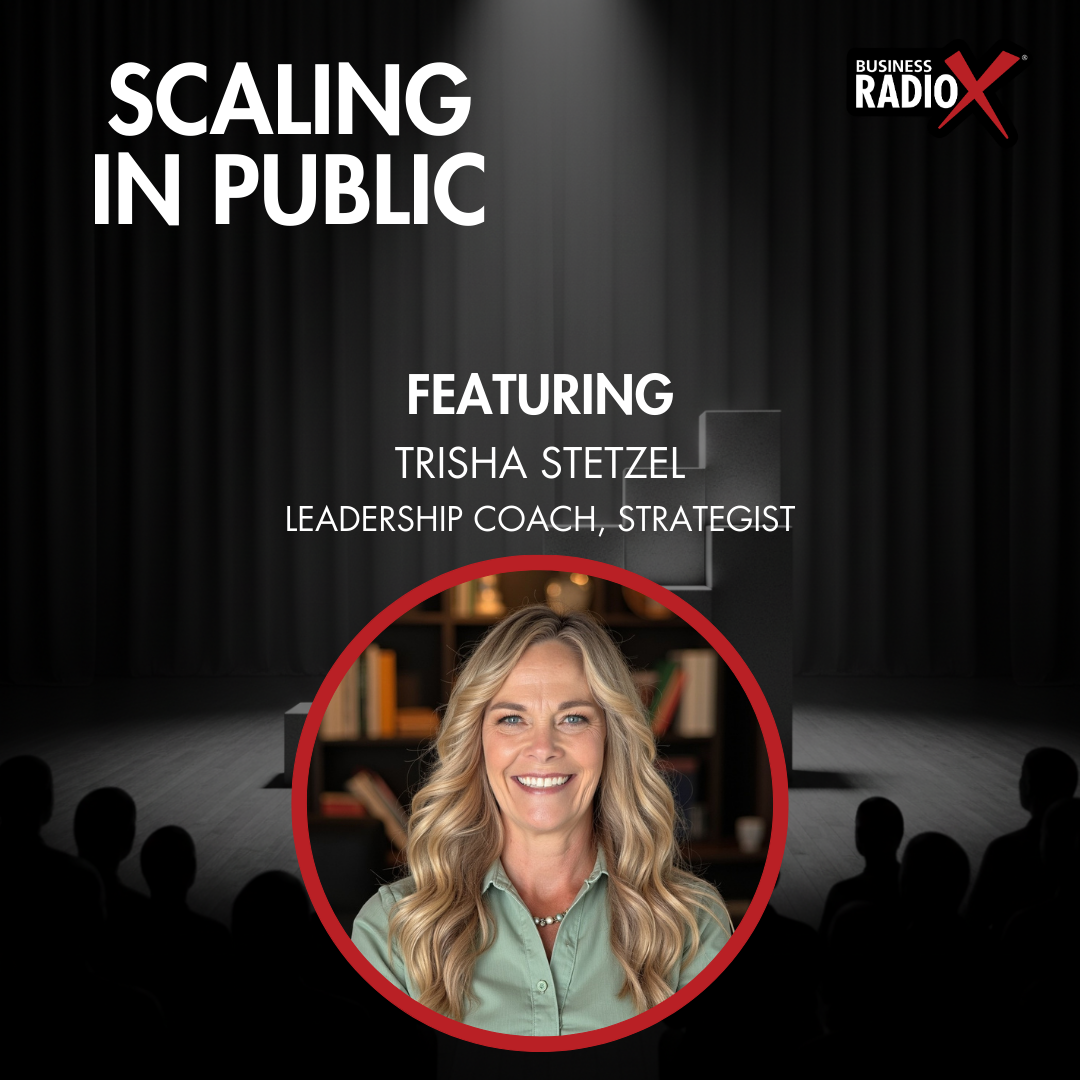

In this episode of Scaling in Public, hosts Lee Kantor and Stone Payton, joined by coach Trisha Stetzel, reflect on the first 30 days of their 90-day Business RadioX® plan. They discuss lessons learned, the impact of coaching, and the integration of AI tools to improve outreach and processes. The conversation highlights the importance of coachability, relationship-building, and actionable feedback. Together, they explore strategies for engaging partners, gathering insights, and adapting their approach, emphasizing collaboration, accountability, and continuous improvement as they work toward their business goals.

Trisha Stetzel is a leadership coach, strategist, and trusted conversation partner for founders and leadership teams navigating growth, transition, and complexity.
Her work sits at the intersection of leadership clarity and execution. Trisha helps leaders slow down long enough to ask the right questions, align around what truly matters, and move forward with focus and accountability. She is known for creating space for honest dialogue, challenging assumptions, and guiding leaders from vision to practical action.
With experience across executive coaching, organizational development, and business storytelling, Trisha brings both structure and humanity to her work. She believes sustainable growth comes from clarity, discipline, and a willingness to learn in real time, not from shortcuts or surface-level solutions.
Trisha’s coaching style is direct, thoughtful, and grounded. Leaders often describe her as calm, insightful, and deeply present, someone who helps them see what’s already there and act on it with intention.
Connect with Trisha on LinkedIn and Facebook.
Episode Highlights
- Reflection on the first 30 days of a 90-day business plan for Business RadioX®.
- Progress and lessons learned from coaching experiences.
- Importance of decision-making and prioritization in business activities.
- Value of being coachable and integrating coaching insights into daily operations.
- Use of AI tools to enhance processes and analyze data for continuous improvement.
- Strategies for effective communication and relationship-building with partners and coaches.
- Need for gathering feedback from existing partners to inform future actions.
- Emphasis on taking immediate, actionable steps to advance business goals.
- Balancing ambition with pragmatism in outreach and collaboration efforts.
- Importance of trust and support within the coaching relationship to foster growth.
 This transcript is machine transcribed by Sonix
TRANSCRIPT
Intro: Broadcasting live from our flagship studio in Atlanta, Georgia. This is scaling in public. The next 100 Business RadioX markets, featuring founders Lee Kantor and Stone Payton, along with some of America’s top coaches, helping them grow the network with real strategy, real lessons, and real accountability all shared in public. To learn more about the proven system that turns podcast interviews into a perpetual prospecting pipeline through generosity, not gimmicks, go to brx.com And download the free Business RadioX playbook. Now here’s your host.
Stone Payton: Welcome to another exciting and informative edition of Scaling in Public. Stone Payton, Lee Kantor here with you. Please join me in welcoming back to the Business RadioX microphone. Our lead, our mentor in this project, coach Trisha Stetzel. How are you?
Trisha Stetzel: Oh my gosh, Stone, I’m so excited. And you know, it’s been a few weeks. You had a couple other coaches come in and I can’t wait to hear how things are going. It’s fantastic to be back with you guys today.
Stone Payton: Yeah.
Trisha Stetzel: Okay. You guys ready? Absolutely. I know we only have a limited amount of time together, so before we jump in, uh, I’m gonna set some. Just a simple container for today and what that looks like. So we’re 30 days in, and this is a 90 day plan, right? This is our first season of this. Uh, I’ll call it experiment. Right. This fun thing that we’re doing in the background, scaling in public. Um, so this session isn’t about new strategy. It’s about reflection and course correction, or looking ahead to the actions that you want to take in the next 60 days, because we’re 30 days in. So the goal is really to gain some clarity on how you see the next 60 days going. I like to call this in my coaching practice the stop and reassess session. So we’re really just going to kind of stop, reflect and then look forward if that’s cool with you guys. Um, so why don’t we start with reflecting on the first 30 days when you think back to where you were 30 days ago, what feels different now?
Lee Kantor: Stone, you want to take that?
Stone Payton: Well, for me, what feels the most different? And there are a few things, but the most different is just a a renewed degree of focus on this objective. It’s real easy for me and maybe some others who are listening to get really excited about something. And then. And then a nice shiny object pops up over here and you forget about this. But I personally feel like I’ve had more direct focus, more consistent energy toward a specific set of objectives than I have in a long time. So it’s helped me achieve some clarity and focus. That’s the biggest shift I see for me personally.
Trisha Stetzel: Nice. Thank you Stone. Lee?
Lee Kantor: And for me, I think, um, it’s just honing in on activities that are that we’re trying and we’re actually executing and we’re tweaking. So we’re doing more activities and we’re getting more data, and then we’re adjusting based on what we’re learning from the data. So I’m excited about that moving forward of just more kind of focused activity. That’s it feels like it’s moving the needle.
Trisha Stetzel: I really? You guys are using coaching language? This is so much fun. I’m like, yes, this sounds amazing.
Lee Kantor: We hang out with a lot of coaches. Yeah.
Trisha Stetzel: So I love this. So you talked about, uh, Stone, the renewed focus and Lee for you, it’s the execution, right. And it’s not like giant things. It’s really looking at what you’re doing and making those small adjustments. So the execution is getting closer to where you want to be. What about this. So that’s thinking what about the actual decision making or the prioritizing. Do you feel like the conversations that you’ve had are creeping into how you’re making decisions or even prioritizing those activities you’re focused on?
Stone Payton: Well, I don’t know about prioritizing, but I feel like we we’ve taken more action on more things a lot faster and in some cases not even necessarily consulting each other to the nth degree on it before we do something. You know, I’m real comfortable with what Lee’s doing. Lee’s comfortable with what I’m doing. And, um, but the way that is, um, kind of, uh, come to express itself like we’ve gotten one of the themes has been lean on people who have already benefited from being a part of this thing and get them to help you evangelize. And, uh, and, I mean, we jumped on that with all fours, and we’re seeing those results. We have people who are revitalized from the conversation, and they are reaching out and evangelizing for us and creating, you know, more opportunities to have these conversations. And that’s I mean, that’s real time. That’s real.
Trisha Stetzel: Yeah. I love that. Lee at thoughts around the decision making.
Lee Kantor: Yeah. So for me, what um, from each session we’ve kind of gleaned what we feel was an aha moment maybe. And then when we’ve kind of thought about it. We tried to create action around it and, um, and, and I feel like we’ve really made major strides in honing in on some of the topics that we covered in terms of ideal client and how to make us, uh, you know, make the sale easier and how to, um, communicate the value in a way that, uh, people are grasping faster. And, and every time we got that kind of aha moment, we just really took it seriously and tried to create operations or execution around it. Um, so that’s the part that has really got me excited. And it’s now it’s become so integrated as part of our kind of work week and our and our time that I look forward to these sessions, you know, to get that next aha moment so that we can just get closer and closer to systematizing everything so that we are getting kind of those predictable results based on, you know, activities that are generating those results in, you know, kind of over and over again.
Trisha Stetzel: Okay. Yes, I love this. And so shout out to Maggie Ishak and Mike Brunnick for those coaching sessions that they’ve had with you guys. I would love to. And I think it’s worth doing here if people are curious, like what is your experience been having uh, or being coached? I’ll call it live. Right. Uh, these coaches are coming in and they’re actually coaching you on their expertise or the thing that they do best in their own practice. For you guys, what has that experience been like? Because I remember way back when we started this project, you both said you were going to be coachable. So how has that experience been?
Stone Payton: I feel like we’ve lived into that. I feel like we’ve lived up to that promise so far. You may get a different perspective from the coaches, but I feel like that we have been very coachable and there’s so many of these aha moments. And because our antenna are up, sometimes things just reveal themselves that I don’t think would have made it through all the clutter. And like this idea of of removing risk. I really, you know, we wanted to we got the idea to sort of like, what can we do to lower the risk of teaming up with us, or at least exploring this. And it turns out with just turning a few dials, we can eliminate the risk and have people completely comfortable before they make a financial investment. And much of a time investment in exploring this further. And, you know, prior to this, I would have never even put that much energy into trying to lower the risk. And now we’ve we’ve all but removed the risk. I mean, it’s, you know, so to me that’s that’s just gold. Absolutely gold.
Trisha Stetzel: I love that. So I’m going to spin it just a little bit different because you said in the beginning you like to be challenged. So as you reflect back on the coaching sessions, can you give us some examples on a couple of things that you’ve been challenged on that made you think differently?
Lee Kantor: Sure. Um, I think that, um, and I think this came up in Maggie’s when she said, can we make she said that it would have been great if Business RadioX was around when she started, because that would have helped her launch. And we were talking about how to create, um, the experience of Business RadioX kind of like a Sirius XM when you buy a new car, um, uh, where it’s just there. And then if you want to continue it, you just pay for it. Um, and that was something that we had never considered, um, even thought in that direction. And when she’s just brought it up, It was one of those things where I hadn’t thought about it. It hadn’t occurred to me at all. And then once I thought about it, it it kind of I was able to come up with. Okay, now I can see how that could work. And we just have to figure out how to make it work. And that was an area where it was out of the blue for me. Did not it didn’t occur to me. And um, and I was able to, I think, be coachable in the sense that I’m open to it and let’s see how to make it work. And then we landed on something that we felt pretty confident about moving forward, that we have now a way to make that work. So I don’t know. I mean, some people might think that’s kind of a like confrontationally challenge, but I think it’s just kind of thinking challenge where I’m something occurred that I wasn’t thinking about, and I was open to exploring it.
Trisha Stetzel: Oh, the beauty of coaching. You know, I heard some things about you guys from the other coaches. You guys are great when it comes to being coachable, so you’re definitely living up to the promise that you gave me all those weeks ago, which is very exciting.
Lee Kantor: So did they say, because this is one of my things that I’m a paranoid of my own personality is I don’t want to be a defensive. Are they? Did you hear any feedback from that standpoint? Because that’s something I’m trying to work on.
Trisha Stetzel: No, not at all. And Lee, I have been on the other side of that as the coach in one of our early sessions. And you’re not you don’t come off as being defensive at all, just asking thoughtful questions. And that doesn’t make you defensive. It it really helps us as coaches realize you need more clarity around what it is that we’re talking about, and we appreciate that. I think it’s fantastic for you to come back at us and say, well, I’m not sure what what exactly does that mean or what might that look like? And then we talk through it. Right. I think it’s great.
Lee Kantor: All right. I just yeah, just working on that.
Trisha Stetzel: Any bad things yet? Now I’m gonna come back around after your 60 days and we’ll see. We’ll see. Uh, how about if it’s okay with, um, shifting from the thinking, reflection and the things that were happening and, um, some things that were very interesting to you. Let’s talk about actions or even non-actions. What kinds of things? And you’ve we’ve started this conversation already, but let’s dig a little deeper. What kinds of things came up that you’re taking action on that are a priority for you right now?
Lee Kantor: Um, I’ll go first. One of the big things that we’re taking action and this has been a dramatic shift, is that we are we’ve implemented a weekly email, uh, to the four constituents that were focused on coaches, associations, franchises and then kind of our general database. And we’re writing emails to each of those each week. Um, and then what I’m doing, I, you know, I’m, I like systems and I like process. So, uh, the system is I write them on Saturday. Um, my VA, um, sends them out on Monday. She reports back on some key metrics on Friday. I take those key metrics and I take the emails and I dump them into AI, and then it makes recommendations, and that allows me to iterate and adjust the, you know, kind of fine tune the, uh, the communication for my writing on Saturday. And then it’s kind of rinse and repeat. So, um, it’s really I’m excited because I like process and I’m excited because I get to use AI, and and AI loves data, so I’m able to give them kind of content and data. It helps with analysis and makes recommendations. And then we’re able to, you know, kind of do it again. And we’ve done it probably since the beginning of this project.
Stone Payton: So this is one that I bristled with, but only internally. I did not voice my concern partially to be coachable, but also I just chose not to voice my concern. But I have never been one to communicate very frequently using email, you know, and I get emails a lot and they don’t make me mad or anything. But I have never been one to say, okay, let’s do a weekly email, let’s do more email marketing. And Lee has for some time, and I bristled with it internally. I didn’t voice a thing, but it’s working. It is working. People are responding and like and Lee crafted. While I was gone, I was off playing in Ireland for a couple of weeks. He crafted another note that, I mean, it really looked like more like one of these marketing emails to me. And I looked at that and said, man, okay, I’m glad. I’m glad I saw this. And you know, that’ll help me respond. And that email is that it’s working and people are scheduling time to have a conversation with me. And I’m like, well, I’m really glad we’re doing that. But I would have never done it on my own in a million years, ever.
Trisha Stetzel: Owen says. No more spam in my inbox. Well, I will tell you guys, I’m on your mailing list and I love what I’m seeing. And I didn’t realize, Lee, until you just mentioned it, that it is something new and one showed up in my inbox recently that said, we fixed the things that was stopping you from booking and I love that email. I was just searching for it. I’m like, I know I have this really great email in my inbox. So by the way, if anyone’s listening and you want a piece of that, you should reach out to Lee and Stone to get on their mailing list and have a conversation with these gentlemen about the work that they’re doing, which is.
Lee Kantor: And and for me, the AI component of this has been instrumental. The the ability for AI to take the like. First it recommended to keep track of certain metrics. Then and then then the my VA keeps track of those metrics every week. And then to take that analysis and then kind of be able to then move it into creating the content and then be able to test and say, okay, well, how did we do like that? That the thing you’re referring to was we were getting a ton of people saying, I’m going to book. And then they never booked. And then the AI is like, let me see your booking page. And then so I submitted the booking page to the AI and they’re like, this is the problem, change your booking page. So now we’ve changed the booking page and we’ll see if that really makes a difference. But and it seems to because anecdotally Stone and I saw a couple people book now. Um, and I think that for people who are on the fence about AI, I think they really should do some experiments around it because it is very powerful and it’s able to to analyze and synthesize data that you may be missing just because you can’t kind of keep in your head the quantity of data that it can.
Trisha Stetzel: Yeah, absolutely. And by the way, coaches who are listening to this show, did you hear that Lee’s using AI and not replacing the coaching with AI. We are not being replaced by AI. For those of you who thought we were. Uh, it’s still very beneficial to have these types of conversations with human beings for the accountability piece. Right? And thinking outside of the box. But AI is the most amazing tool. Lee, I’m on board with you. I know you and I have, uh, done some work exchanging prompts and the results from those prompts over the course of getting this project launched as well. Um, stone, anything else bubbling up for you from an action that you committed to in the last 30 days through coaching?
Stone Payton: Well, there’s a couple I think that weren’t mentioning. One is AI. So to date I have dived into AI and asked it a ton of hunting, fishing and archery questions, but I haven’t and I really do all this. And what I need to do, I think, is when I’m having these conversations, you know, I get the zoom AI summary. I could even record some if I wanted to. When I’m. Then what I need to do is pour that into AI and say and say, you know, help me get better. What? What else should I be asking? What should I leave off the the table? And so one of the things I’m definitely going to do going forward is start using it more for business and not just make it, you know, leads thing, which is easy to do, right. Oh that’s leads thing. So, so that’s uh, that’s one also in terms of building relationships with coaches. You know, we we eat our own cooking. So we reach out and invite them to come on a show, invite them to have a conversation about coming on the on the show. And there was a point at which I told Angie, I said, I’m getting buried. Stop doing the Pre-call just put them on the show. And and what I found was one not as many books, but also it took that much longer to forge the relationship where, just like we preached, just like we have our clients do. There’s so much relationship building that can happen in that initial pre-call. I mean, it’s almost a discovery call if you’re in the coaching, right? And so that we turn that switch back on and that made a difference almost immediately. So those are two things that are on my brain to, you know, to put into action.
Trisha Stetzel: Yeah, absolutely.
Lee Kantor: Well and something you asked though earlier was what haven’t we done. And this is something that came up in the conversation we had right before we started recording. And I think that it’s important that we kind of do a better job in in its poll our existing partners and kind of, um, go back to them and start asking them questions like, you know, what can we learn from your actual experience using our platform? And we’re not getting that data. And I think that’s an important thing that we should be doing. You know, sooner than later is going to the partners out there and then, you know, asking them, okay, what’s working, what’s not, where are you seeing success, where, you know, any good stories of success or any challenges? And, um, you know, we don’t have that many, so it’s not impossible. But I think it’s something that we should be doing. Uh, because I’ll be honest, several of the coaches have asked about that and we haven’t done it.
Trisha Stetzel: Okay, so it sounds like even though this was not an action taking coaching meeting today or session, uh, that there are some activities that are spawning up out of this conversation as well, which means we’re making great progress. So in that vein, that same vein, we some of the things that you’re not doing, what are some of the things that you may have talked about in some of the sessions that sound like a really great idea, but you’ve had to table them for now because it’s not a priority. It’s something that sounds good. You may want to look at it later, but what if you put to the side, at least for now, and thinking about something you want to circle back to later?
Lee Kantor: Well, the biggest thing is that. And the biggest aha. And the biggest lever we think for growth is to find a coaching organization to partner so we can pilot this idea that has come up on several of the coaches, and we haven’t done that yet. We haven’t reached out to any of the organizations yet to pilot anything. And that that to me has the greatest upside. And we haven’t done anything with it yet other than identify a bunch of coaching organizations, Identify, uh, some coaches within it that we have a relationship with, but we haven’t kind of, uh, you know, taken that last step. The the last mile and, you know, going up to them and saying, do you want to do this or not? And and that’s where I think the biggest opportunity in the next 60 days are we need to get more nos. You know, we need to get more people, um, saying no, you know, we have to ask for more business. And the more no’s we get, the more yeses we’ll get.
Trisha Stetzel: Uh, I love how. How did you know we were gonna flex into this? What are we doing for the next 60 days, Lee?
Lee Kantor: Well, I mean.
Trisha Stetzel: Read my mind.
Lee Kantor: Um, but, um. But that that’s to me, um, you know, and and the coaching has helped us kind of create this sense of urgency around doing that.
Trisha Stetzel: Okay. So it you have done something, you’ve taken action. You’ve made your list. You know that you want to go do this. So in thinking about moving that needle, if that is a priority for the two of you, or even just for you, Lee, what is the next first step you can take to get that ball moving down the hill?
Lee Kantor: Well, I mean, well, the two balls are the, you know, kind of pulling the existing coaches. So we have to do something where we’re having communication with them to ask them what we want to need and if they would be willing to share it. Uh, that has to happen. And then regarding the coaching organizations, the strategy that we kind of landed on is to identify champions within each of those coaching organizations. Uh, reach out to them, uh, create some sort of an opportunity for them to live into what we’re recommending and then have them go back to those coaching organizations are a part of in order to make that introduction to us. So to find a champion within it, that can be a bridge to us. And rather than us coming up kind of as a cold email or a cold relationship, to go in through somebody who’s already part of it. Um, and we have taken steps in that regard in 1 or 2 of the organizations.
Trisha Stetzel: Okay. Nice stone. What’s bubbling up for you?
Stone Payton: Well, you know, and maybe, maybe I’m a little too quick just to lean on what works at the local studio level. But to me, it makes perfect sense that somewhere in that equation, one of those steps could be that, you know, that coaches that coaches in that system has had a great experience getting to know us. We interviewed them all that stuff, and they tell the CEO or the CMO of XYZ credentialing organization or whatever that, and I have a call with them, and the first thing I’m doing with them is the first thing I do with everybody is just try to help them and and have the frame of helping them get ready to have a conversation about their organization, about the value of being credentialed about all of that, and be a little not be quite as cagey around and maybe communicate fairly early in that relationship when appropriate, that, hey, you know, we want to do this thing. We want to we want everything you’re experiencing and your coaches are telling you, we want to make it easy for you to provide that for your coaches. Here’s why it’d be good for you. Here’s why it’d be good for us.
Trisha Stetzel: Okay, so the two big things, the two big themes that I’m hearing here are the two balls, rightly, as we talk about pushing them down the hill, not up the hill, down the hill, because that’s way easier. Uh, one is surveying your current. We’ll call we’ll call them current clients. Right? Your your studio partners on what they need and what are they getting back? And then two having conversations. So of those two things I get, we could run them in parallel. But if we’re talking about bandwidth and what comes first which one has priority in thinking about time? How much time do you need to invest in either one of those things? And can you push that ball halfway down the hill in the next couple of weeks? One of them.
Lee Kantor: Um, for sure, we can do the partner one. Um, I think we can figure that out. Uh, and that will get done. The second one is we are making some inroads, but, um, we haven’t gotten kind of the the buy in necessary for them to feel comfortable, um, for a variety of reasons. But, um, that one’s going to be harder, I think, to execute.
Stone Payton: But it’s the most important. It’s the one that’s going to provide the biggest return.
Lee Kantor: Right? That has the biggest upside 100%.
Trisha Stetzel: So I’m going to take my coach hat off and put on my collaborator hat, because we’ve been doing a lot of collaboration together. And I was just thinking about something outside of the box, sitting on the other side as a champion. Could you put together a. I’m going to call it a package. It’s not really. It’s probably an email where you take my show, the one that we recorded together, not one that I’m doing right, but the one where Lee and I had a conversation about my business. You put that in the email or however you want to deliver it, with a nice email that someone can just send to the person like you do all the work for us. So you send over, um, a request to me and you say, hey coach, I would love if you would share your show and some of the information about Business RadioX partnering with your organization. Would you be willing to do that? If we provide you with what you need to send? And I would say, of course. And so you build this nice piece of work, which is the interview. Maybe it’s not the whole interview, because whoever’s receiving it doesn’t want to hear the whole thing, but a link to the whole interview and a clip that they can watch quickly in less than two minutes with an email that I can just copy and paste directly to the people that we want to get it in front of in the first place. So using me as a champion, but you doing all the work for me. I’m just throwing it out there as a collaborative, um, thought, what do you guys think?
Lee Kantor: Yeah, I mean, I’m for trying, so I want more no’s. So that’s I mean, I’m for trying pretty much anything that makes sense. So that makes sense. So, uh.
Trisha Stetzel: Well, I.
Lee Kantor: Don’t.
Trisha Stetzel: Yeah. And I don’t know that it’s time intensive. Stone, what do you think?
Stone Payton: Well, I think enough of the idea that I’m writing it down, which means I want I want to do it. And then I think, you know. And this time, I won’t leave it all to Lee. But maybe Lee could start with telling AI we’re going to do this. You know, what should we say and like. And I like your idea. Make make the full length interview accessible. Maybe get a really strong clip, maybe even a clip that includes them talking about why they’re so glad that they’re part of XYZ organization. Right? So, you know, and they’ll enjoy that part. And then thinking through, okay, what do we want to say in the email. You know, we probably don’t want to pounce on them with all fours and say, and you know, we want to pilot this with 15 of your best coaches or 15 of your marginal coaches. I don’t know, it might be good to do give me five of your best and five that are going to leave if we don’t fix them. But, uh, no, I think it’s a fantastic idea. And I think once I think the energy is, is crafting the note, tweaking it and then but, I mean, we have the systems to get it to the people and I mean, everybody we’ve interviewed, I mean, this is why the thing works so well. They will they will do it. I mean, I’d be really surprised if nine out of ten we asked to do it won’t turn around and do it. Yeah.
Trisha Stetzel: And so many of us want to help, but it takes a whole lot of work for me to craft that note and for the next person to craft that note and the next person. If you guys are willing to do that for us, it makes it so much easier. Right. Uh, to, to just put our own little spin on it and then send it off instead of trying to craft it from scratch.
Stone Payton: Yeah.
Trisha Stetzel: Okay. So I’m putting my coach hat back on. I’m glad that we got to collaborate on that. I, um, I’d love to hear from the two of you. What? What do the next 60 days look like? So I want you to reflect on the first 30. What kinds of. And I’m talking about the business, like closing business. So, Stone, I’m going to come to you first. What kinds of conversations have you had? How are you adjusting those and how are you going to get to more no’s so that we can get to the yeses?
Stone Payton: So I am adjusting with a little more attention toward, you know, let’s it all sounds great. I love the idea. I do think we would all win in this equation. And, you know, I don’t know about you. This is me just talking quotes. You know, I’m a little bit risk averse. So I think let’s do everything we can. Let’s just take the risk out of it for right now and just let’s validate some assumptions and some things that I’m sharing with you that work, and then actually have them engage in some of those key activities, like inviting people to be on Saint Louis Business radio or just say, you know, I’m working with Business Radio, get them on the High Velocity Radio show. And so that they can see firsthand and do it in such a way that if they don’t end up pulling the trigger, they’re still in a good light, they still tried to help somebody out. And then and because because I think we’ll find out first, you know, if they’re not, if they won’t go out and invite a dozen people, you know, then they’re not ready and they’re not that interested anyway. If they invite a dozen people, that’s just a nice thing somebody’s trying to do. So we can we can design the language. We have the language, you know? Hey, I’m teaming up with Business RadioX to, you know, you know, just a couple of sentences. Be delighted, you know, and just just set that up and see you just get the interest level when they see when the vast, the vast majority will have success if they do it. When they see that, I think that’ll really take the risk down for them and they’ll benefit regardless.
Trisha Stetzel: Yeah, absolutely. Lee, how about you? Have you, um, adjusted the way that you’re interfacing with people who could be potential studio partners?
Lee Kantor: Yeah, along the lines of kind of piggyback on what Stone was saying, something that we had talked about and that, um, was to, to make the, um, like when Stone’s talking to a person, like, let me pick your brain for a second here. Um, Stone’s having this kind of follow up conversation with somebody who’s gone through a show and, um, kind of explains in a general manner how this could work. Usually we say something along the lines in that conversation, You know, you don’t just test it like go send a note to ten people, like Stone said. 12 people about being a guest. See who responds. So instead of just kind of leaving it open ended like that, but to challenge them to say, okay, how about open your LinkedIn right now? I’ll drop in the chat the note, send it to five people right now, and then, you know, in a day or so, let us know if anybody kind of responds back and just make them do it right now. Like don’t wait for them to do it when the mood strikes them. But just say, here, I’ll drop it in the chat. Send this note. We know the note that works. See what happens. Five people just go through your LinkedIn about let’s share screens. Let’s drop five of these right now. And I think if people do that they’re going to see how this can work without thinking too much and just doing. And then even if if they don’t want to work with us, we’ll still interview them. They’re never, you know, there’s no risk. That’s what we’re talking about, of removing the risk. So if we do that relentlessly with coaches and just have them when we have a follow up, do that five times, they’re going to see that this could work. They’re going to get enough data in those five to say, oh, what if I did 20? What if I did 50? What if I did 100? Then they’re going to they’re going to be closer to giving us a yes or a no.
Trisha Stetzel: Yeah. And they’ll actually see it working real time.
Lee Kantor: Right. So I mean, you talk to people after your shows, you tell me if you had an activity like that, how many would say, all right, I’ll do that. I’ll drop five notes. What do I have to lose? Like there’s no risk. It takes a minute to send those five notes. I’m going to just drop it in the chat. Just cut and paste it into your thing and send it five times. Let’s go. Yeah. You know, people will do that, right?
Trisha Stetzel: Yeah. Most most of nine out of ten. Absolutely.
Lee Kantor: A lot of people would do it. And then, you know what’s going to happen when they do that? Because you’ve sent that note.
Trisha Stetzel: I people will respond, yeah, that sounds amazing. You want to hear all about me? Of course I do.
Lee Kantor: Right? So that’s the thing where we feel we’re closer to having the system in place to be able to kind of execute at scale. If we just get more people to have that conversation, more people to take that action, more people will see how it works and that it does work and that we’re not just another one of these people that are saying, you want more leads, you know?
Trisha Stetzel: Yeah, absolutely. Well, I’ll just drop a little testimonial in here, in my experience. And I shared something with you guys earlier today that’s happened, which is really amazing. And it’s, you know, the what do they call that seven seven relationships removed from Kevin Bacon I don’t know. Anyway, I had, um, an amazing coach and yes, by the way, I’m a coach. For those of you who don’t know me, I had an amazing coach, uh, leadership coach on my show, uh, the Houston Business radio show last spring, and she just dropped a note in my inbox introducing me to someone who is interviewing coaches for a giant project. I would first. I would have never met her had I not reached out. Like what Lee was talking about, saying, hey, would you like to be on my show? And two, I created so much trust with her during the process that she introduced me to someone that she trusts, and then I automatically have more credibility with that person that she introduced me to. And I’m in the process and it’s really cool. So, um, there is so much less friction when you can invite someone to have a conversation and it’s all about them and they, they don’t feel like they’re being sold to. That’s just the bottom line, right? We’re highlighting these amazing people and they for with and they have this content that they can use forever. All right. I’m off my soapbox. Thank you for the opportunity. All right, so as we close, we talked about a lot of things today. And I know I said at the beginning this was not actually about action, but we did talk about some of those actions or activities. So I would love to hear from both of you. Uh, between now and your next session. We’re doing these every week. So over the next week, what is one action or activity that you can either do or at least start before the next session next week? Who’d like to go first?
Stone Payton: Well, we just had another one of those where this idea of having them do it right then and there is, is a little more frontal than my typical approach with people. I’m usually a little slower, so it feels assertive and it feels like a little more salesy right, than I’m used to. And I’m going to do it, you know what I mean?
Trisha Stetzel: Okay.
Stone Payton: I’m not gonna not do it. I am going to do it. I’m gonna do it right there when they’re on the thing. And, you know, look, if I get a whole bunch of pushback, then we might reevaluate. But if it’s like what’s been happening recently, it’s going to work, and I’m going to be glad that I did it. But I’m just acknowledging to you right up front, it feels a little assertive, right? Like a just like the email did.
Lee Kantor: I mean, let’s get Tricia’s. Does it feel assertive to you. Like does that feel can you is there a way that you could, um, frame what I described in your conversations with people after the fact? Uh, after they’ve kind of, if they’re curious as a way to take that action without feeling salesy.
Trisha Stetzel: Yeah. It’s the language that you use. Look, I, I’m, I want to help you. And so if we do this little activity together, I really feel like you’ll understand how powerful this process is. So bear with me. I have a little activity. Can I get your buy in? And they’re going to go, well, maybe. What is it? Right. Most people. Well, what is it? Well, I’m just going to ask you to send five direct messages to people that you know, not people that you don’t know know. Or maybe you want them to message people that you they don’t know, whatever that is. Right? But give them some direction and say, here’s the message. You can make it your own. And I just want you to copy and paste it five times to five people. And then I’m going to check back in with you in a couple days and see what kind of response you got. That to me and the way that I’m bringing it to you, hopefully it doesn’t feel salesy at all.
Stone Payton: It didn’t feel salesy to me when you said it. So, see, so I have like this preconceived notion that it’s all sales. Yeah.
Lee Kantor: Right. But for me it has to be in they have to do it. Let’s do it together. Now. I want it to be. Let’s share screens and let me see your LinkedIn together. Let’s pick five. And here’s the note. And I want to see them send it five times like that. So we got to get to that. Be the activity in a way that’s elegant.
Trisha Stetzel: And, you know, you have to use the language that you’re comfortable with. And another thing that you could do, you know, there is such a thing as a three way DM. You could have them three way the message and you could be copied on it instead of screen sharing, because there’s some people who are uncomfortable with that. Right? It could just be send it three way I got your back. Let’s see what happens. Now. I’m writing along with you. Now I’ve taken even more risk off your plate because I’m willing to be there with you. It’s all in the way you present it, right? It’s all in the way that you present it. Okay, so Stone is getting comfortable with being uncomfortable. I like it, this is good. Okay. And, Lee, what about you?
Lee Kantor: Um, I’m gonna come up with a way to survey the coaches that we. I mean, the partners that we have so that we can get the information that we need in order, um, to kind of number one, to nurture who we have and doing what they’re doing, but also to learn from what’s working, what’s not, uh, to be able to take from some, some of those learnings away, um, from them. So that will happen this week.
Trisha Stetzel: Fantastic. Okay. How was this for you guys?
Stone Payton: Fantastic.
Lee Kantor: It’s always great. I always feel energized. And I’m so appreciative that you, um, are being so generous with us to kind of quarterback this, um, this series. And, uh, so I can’t thank you enough for all that you’re doing to help us.
Trisha Stetzel: Uh, I learn every time I get on the call with you guys, whether it’s through this project and coaching or the weekly check ins that we have together. It is, um, a very, not just a meaningful project that we’ve been working on but also relationship and I we all, I hope, have that kind of trust with each other where you know I got your back. How about that.
Lee Kantor: Yeah. And we have yours.
Trisha Stetzel: I know you do. All right, gentlemen, thank you again for your time today. I appreciate it and look forward to hearing your next coaching session.
Stone Payton: Thank you Trisha. We will keep you posted.
Speaker1: Thanks for listening to Scaling in Public the next Business RadioX 100 markets. Are you ready to enjoy a steady stream of discovery calls? And finally, stop being a best kept secret? It’s time to step out of the shadows and watch your coaching business grow. Let’s fill your calendar ten discovery calls in a month, guaranteed. Go to Birr to download the free Business RadioX playbook.














