
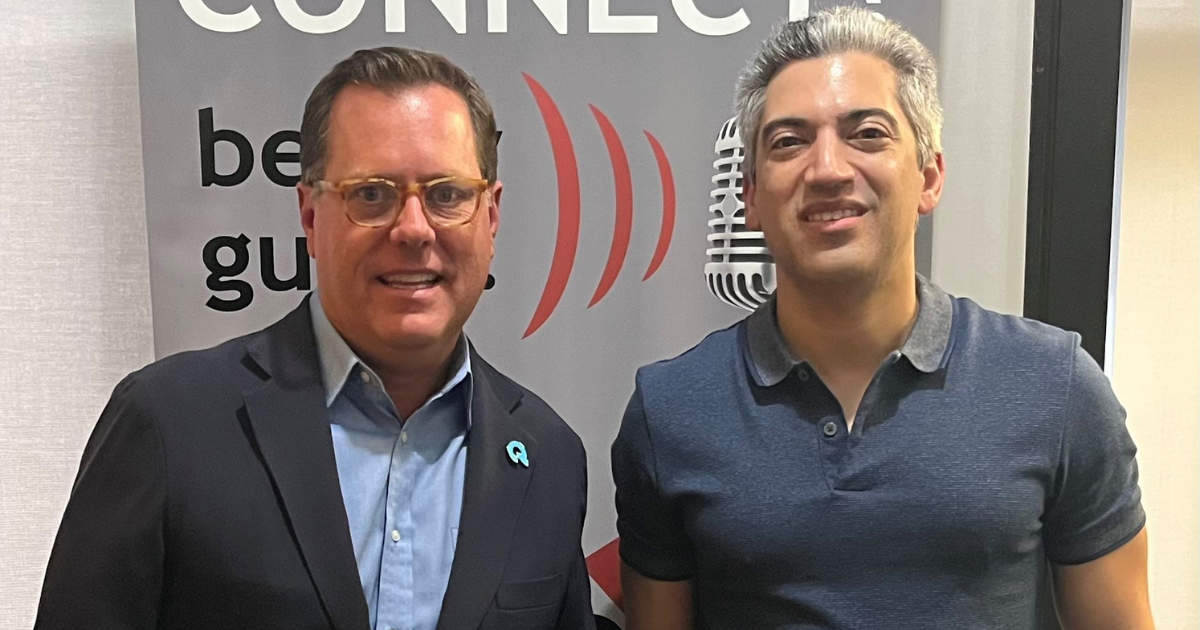
In this episode of Tech Talk, host Joey Kline interviews Steve Gertz, Chief Growth Officer of QumulusAI, an Atlanta-based AI infrastructure company. Steve shares his journey from investor to operator, explaining why QumulusAI went public early to access capital for their hardware-intensive business. The conversation covers their hyper-distributed “inference points” approach to AI infrastructure, their three customer segments, and the strategic advantages of being headquartered near Georgia Tech. Steve also discusses leadership philosophy, company culture, and why Atlanta is emerging as a major hub for AI innovation.
 Steve Gertz has served as QumulusAI’s Chief Growth Officer since December 2025 and previously served as the Chairman of our Board from February 2025 to February 2026.
He has served as the founder of Rhythmic Ventures, a growth acceleration firm with a portfolio of high performing companies, since February 2017. He was also a co-founder of 11|TEN Innovation Partners, a healthcare focused ecosystem and strategy consulting firm, from January 2017 to April 2024.
With over 25 years of experience, he has built high-impact partnerships across private equity, venture-backed companies, and large enterprises. From January 2007 to February 2017, he was Partner with Joe Gibbs at Joe Gibbs Driven Investors, Inc., the investment arm of the NFL Hall of Fame coach and NASCAR team owner, where he led a portfolio of high-growth investments.
Mr. Gertz invested early in QumulusAI, secured additional strategic capital, sourced key talent, and fostered a diverse customer ecosystem. As Chief Growth Officer, Mr. Gertz is focused on driving strategic vision by attracting key executive leadership, curating growth capital, and attracting a diverse mix of customers.
Connect with Steve on LinkedIn.
Episode Highlights
- Steve’s background and experience in investment and leadership
- QumulusAI’s unique approach to going public early to raise capital
- Focus on building high-performance compute cloud infrastructure for AI
- Importance of distributed inference infrastructure at the edge
- Challenges and opportunities in AI infrastructure development
- Role of the Atlanta ecosystem, particularly Georgia Tech, in fostering AI innovation
- Cultural values and leadership philosophy at QumulusAI
- Customer segments served by QumulusAI, including investment-grade customers and AI startups
- Demand-driven innovation approach and the significance of user feedback
- Environmental considerations and economic impact of AI infrastructure facilities
 This transcript is machine transcribed by Sonix
TRANSCRIPT
Intro: Coming to you live from Atlanta, Georgia. It’s time for another episode of Tech Talk with your host, Joey Klein.
Joey Kline: Happy Tuesday everyone. We have been off the air for a little bit, and we are back with a very, very special interview. Homegrown Atlanta company set to take over the AI world. Uh, privileged to be here with Steve Gertz, formerly executive chairman, now chief growth officer of QumulusAI. Steve, how are you?
Steve Gertz: I’m doing well. Thank you for having me.
Joey Kline: I really like that pin that you’ve got there. I’m always interested to see the type of swag that tech companies have going these days.
Steve Gertz: Yeah, we just actually rang the Bell Bell ceremony last week on the Nasdaq and we were handing these out. We had 131 people show up. Love it. All of our family and all of our little kids thought that they were Qumulus shares.
Joey Kline: It was exciting. That is, I like that. Get them into capitalism early and teach them. Yes, strive for that. But no, we don’t give handouts.
Steve Gertz: Never early enough.
Joey Kline: Yeah. That’s right. Okay, so I really do want to talk about y’all going public because it is a very unique thing for a company at your size and stage. But let’s set the table here. Who are you? How did you get to Qumulus and, and give us a little bit about what Qumulus does. And we’ll obviously dive deep, but what’s the headline?
Steve Gertz: For me personally, I’ve been an investor since 2007. I had a portfolio of companies here in Atlanta and throughout the United States, uh, had a couple exits in 2024 and said, I got to go all in on AI, but I didn’t just want to get in on AI at the orchestration layer or the use case level. I wanted to get in and build the AI highway infrastructure and what powers it. So I found a group that was doing blockchain and Bitcoin mining. So they understood power. And then they bought a high performance compute cloud company. And they said we got to make the pivot. And that’s right. When I invested and right after I invested, I was able to raise a lot of strategic capital right after my capital. And then they asked me to be on the board. Then they asked me to be chairman of the board. I spent two years, the last two years as chairman of the board. But while we were raising strategic capital, we were growing the team team of pioneers that had been in the industry to to go up stack and be a high performance compute cloud company. And as we were recruiting this team, we rebranded it as QumulusAI. It’s with a Q, not with a C. So QumulusAI is kind of quantum cloud. How do you scale? You scale through the cloud and where’s the puck going with AI? We think quantum, it’s not there yet at scale, but we’re QumulusAI. We’re a high performance compute cloud company where the infrastructure and what powers it.
Joey Kline: Okay. So for everyone listening at home, if you want to look them up QUMULUSAI, please do. Um, so I always find it interesting when we have operators who become investors and then kind of get pulled back in. And I’m curious about your personality and your leanings. Is this, is this like a Godfather three where it’s like, I tried to get out and they pulled me back in? Or is this like, I heard the music and I just had to dance? I couldn’t stay on the sidelines.
Steve Gertz: I love that question. Well, and in my experience, as I was raising capital, we were also de-risking our investment based on market making and ecosystem building. And what does that mean? That means market making, finding the right pioneer team to go execute with excellence. And that’s been a tremendous amount of fun. Also going after capital and the capital markets and bringing a capital markets team on board. We’re the first neo cloud that really has capital markets in-house. We have an in-house capital markets team and an office up in New York. And that’s been just fascinating to watch. And then also building strategic partnerships, ecosystem partnerships and access to distribution so we could scale. And so did I feel like I was being pulled in. I was more executive chairman, really taking a vested interest into the operations of the business and the growth of the business. So as we were mapping closer to public, some advisors sat me down and said, do you really want all of the board governance of a publicly traded company? Sounds all exciting. No, I don’t need that. That’s going to inhibit me of what I’m doing and focusing on from a growth perspective. So we created a role chief Growth Officer So I’m just elated and humbled and honored to, to, to play that role, but very excited about our growth trajectory.
Joey Kline: All right, let’s just jump into the public thing. So typically when you know, if you take technology companies of the past decade or so, right, the trend has been stay private as long as possible. Raise private dollars as long as possible. Really only go public when you absolutely have to, you know, and you absolutely, you know, are okay with dealing with all the scrutiny that comes with being a public company. All right. Um, this is a very, very different track, right? Typically for a company at your stage and you guys.
Steve Gertz: Have ten days. Yeah.
Joey Kline: 2019 okay. But still and relatively young in the pantheon of company tenure. To go public that early is an interesting strategy as opposed to just continuing to raise round after round. I’m sure you evaluated a number of different paths. What led you to this one?
Steve Gertz: These Nvidia chips are very expensive. Yes. So you have to be public. It’s the cheapest form of raising capital. And it’s accretive right. So when you raise capital in the public markets and you leverage a shelf where you sprinkle new shares into the market based on daily trading volume, you can raise very inexpensive capital. Then it becomes accretive growth. And that accretive growth from being publicly traded is very helpful. Um, we have to do that because it’s such a capital intensive business. We buy chips from Nvidia, deploy them in our hyper distributed environment. And then we operate the high performance compute cloud. So we manage the off take, but we have to have more capital to deploy more infrastructure for the demand. And the demand right now is vertical.
Joey Kline: Yeah. I mean it’s all that. I mean look it’s obviously a very small data point. I mean we had to we like everyone that is, you know, part of a large organization are trying to figure out what our AI strategy is. Um, and we recently had to kind of slow down a little bit on company wide adoption of some tools because we looked at the usage and the token usage and it was like, uh, I mean, how many people could we hire for this?
Steve Gertz: Well, and when you say we, you’re talking.
Joey Kline: I’m saying JLL. Yes.
Steve Gertz: Because I mean, everyone knows you as this, you know, radio personality and this podcast personality. I just wanted to bifurcate.
Joey Kline: I appreciate that you’re informing the audience for them. Yes. Obviously, you know, I moonlight as a commercial real estate broker during the during the daytime, we we talk tech on tech talk. Um, so yes, it is. And I’ve just, I’ve heard, you know, you hear anecdotes, right? But it, it is a trend that I think, um, enterprises are not ready for how much this costs. And obviously that means that the provider of these services and those suppliers to those providers, providers need to keep up.
Steve Gertz: You’re exactly right. I would have to say that, you know, when you think of the infrastructure that needs to be built, this is probably the largest it has to be. It’s the largest infrastructure build in human history. This is the AI revolution. And, uh, right now, today, they’re being built in these large hyperscaler campuses that are 300MW and up that take 48 and 52 months to bring online. Think about how many chip innovations that Jensen’s going to do in Nvidia between that time period.
Joey Kline: We have a whole side of our business that builds data centers. Exactly. Yeah.
Steve Gertz: And so the demand can’t wait.
Joey Kline: Okay. So so that is look it’s it is actually a very interesting marriage, right? Because, you know, real estate very typically still is certainly a physical product that you can touch, see and feel. That doesn’t mean that there’s not technology that can help enable the use of real estate or the construction of real estate. But at the end of the day, it is a physical, tangible product, and there’s only so much you can do to, um, decrease or expedite the build time. And we have this, um, you know, the technology, the future in Nvidia chips in AI. And we have this really interesting marriage between the two, I mean, and look, I say this with all due respect to my industry, I love it, but it is an analog industry. Um, we use technology, but it’s an analog industry. And this is and I really haven’t thought of it before this moment, but this is really, I guess I can’t think of any other time when an analog and a hyper digital industry have had to come together in such a critical way to power what we are all using. So you talked about the construction constraints of the typical real estate process, right? Help the audience understand how QumulusAI alleviates that problem.
Steve Gertz: Well, first of all, we have a go to market motion that is not hyper scale. It’s hyper speed. And what does that mean? We’re just bringing compute online at a hyper speed level. So it all comes down to the land, the power and the shell. Who owns the land, who controls the power. And then what shell are they going to have from a casing perspective? And how will it be constructed to meet our requirements to go ahead and place the chips, the network infrastructure, and all of the cooling that needs to go in it? And we have decided to be hyper distributed. And so there’s two different types of AI. There’s training the model, and we need those large campuses. Don’t get me wrong, because you have to train the model. But when the use case comes alive, it has to come alive on inference infrastructure. So we are distributed inference, you almost can call it like at the edge. It’s where the use case comes to life. And as you can imagine, ChatGPT came out and then you’ve got Claude and everyone is using it at a personal level and at enterprises are really starting to adopt it as they adopt it. You need more infrastructure at the edge. So when it’s making those calls, that latency is not there. And so that’s what we’re looking at. And we’re staying way under the radar. We don’t even like to use the word data center or like inference points. In essence, we look at the fiber network and all the connectivity, and we’re just bringing high performance compute infrastructure inference infrastructure to the edge on that fiber backbone.
Joey Kline: Yeah. Look, data center has become such a charged word, right? I mean, look, it’s also become an incredibly big and important business. I mean, if, if the typical food groups of real estate are office, industrial, retail and multifamily, I think there’s a very good case to be made that data centers have now become the fifth or inference points, as we will now call them for the rest of this conversation. Um, I would, uh, this, this is not meant to be, uh, you know, sort of you take this side and I take this side because I generally on the same side of, I mean, look, I guess I’m biased. I’m a real estate guy. Yeah. Um, but I would love to hear a little bit more from you on just debunking some of the misinformation that is out there about the build of this really important infrastructure. People read headlines, people read the first paragraph of article, and unfortunately, they mostly have no idea what they’re talking about. And so I would love to hear from you what you’re seeing on the ground, what you’re hearing from customers and why the why the negativity is not warranted.
Steve Gertz: Well, I think I’m going to stay away from getting political, but I will tell you that on both sides of the aisle, everyone’s embracing AI. Yep. And that AI, when you make those calls, has to be computed with infrastructure. You need high performance compute chips that process that AI. So if you look at it from that standpoint, if they’re concerned about environmental issues, are they concerned about water water usage? Well, these chips are being cooled by liquid cooling that are in closed loop systems. In many cases, especially in our small footprints, you’re actually trucking the water to the shell. So think of it that way. And the other aspect is, you know, when these are constructed in different municipalities, the tax base and what happens, you know, we pay a lot of taxes. It’s really good for those municipalities. And that just enhances all of their other infrastructure needs that they have in those local areas. So I think it just comes down to having an open conversation of what they’re really fighting for. And let’s take the political nature of it and let’s throw it out the window and say, what do we want to do? What kind of lifestyle do we want to have? And then do we agree that we’re both on AI and there’s going to be use cases that are going to change our lives totally. So we need to bring it to the edge.
Joey Kline: I love when I hear things like, well, you know, how many, how many jobs is this creating and what sort of tax revenue would this create? And I want that, you know, personal organization to answer. Um, how many jobs are tax revenue did the vacant piece of dirt create? Exactly. Um, okay. So we’ve talked about your place in AI infrastructure and what you’re looking to solve here. Talk to me about some of the types of organizations that you work with. I’m not asking you to, you know, reveal confidential customer names, but just take me through the breadth of companies that would would utilize and benefit from your services.
Steve Gertz: So there’s investment grade, um, customers that are really in need of our infrastructure because we can bring it online faster because they’re waiting on, you know, the very large hyperscalers to build these monolithic, you know, large campuses. So there’s a bucket of that. There’s also a bucket of AI natives. And these AI natives are well backed by private equity venture capital, and they’re coming on board. And sometimes we have to leverage our partnerships to, um, be a backstop with a larger balance sheet and do a rev share. There’s different things that we have to do very creatively. But you know, even anthropic is not investment grade yet, but they’re about to be. Um, and then there’s this whole boom of, I call AI developers that are developing AI and there’s a network of them globally, but, um, they can’t afford these long term contracts. So we call it the spot market, but the spot market is always there and it’s insatiable demand. It’s just not as bankable. So we like to mix that in. If you mix all of our off tickets investment grade and then it’s it’s the AI natives, and then it’s the spot market. And the spot market is actually the most profitable for us. It’s just they’re not on a long term contract and it’s always there. We just open up capacity and it’s at the door. It’s like Airbnb always filled. Yeah.
Joey Kline: Yeah. It’s so it sounds like maybe a little bit more, um, unpredictable or short term need, but again, accrue.
Steve Gertz: Or it’s a use case that’s being validated.
Joey Kline: Sure. Right. Okay. Um, and you know, I’d love to understand more about your history building companies and how that has gotten you to QumulusAI. And I think specifically about leadership and about culture. Um, you know, all organizations are different. And when you start an organization with three people, it becomes a very different place when there’s 50 people or 100 people. What what lessons have you taken from past companies that you’ve built and maybe exited, that you brought to this and you said, you know, I want to do it different this time, or this was spot on, and I got to figure out a way to duplicate this.
Steve Gertz: Well, I always say you win championships through people. Right. I used to work for a championship winning coach, Joe Gibbs. He won three Super Bowls and five championships in NASCAR. I used to run, um, he had a family office group called Joe Gibbs Driven Investors. We would invest his capital, de-risk that investment based on market making and ecosystem building. And we work with our 40 plus major sponsors in NASCAR and help them go fast off the track and bring them vetted out, validated value. Um, he always taught me, you win Championships with drivers and quarterbacks, and then you assemble the team around them. So I think building the team is key. Taking care of the team is imperative. They need to know from a leadership perspective that you’ve got their back right and they are locked in. And then from there, it’s all about the ecosystem and the ecosystem. For Qumulus, AI is the land, the power, the shelf from the molecule of gas, from the power source, all the way through the value chain to the orchestration layer, to the monetized AI data asset and everything in between. We have to be full stack and you have to be an ecosystem. What do ecosystems that are well oiled ecosystems do? They all feed. So everyone in the stack feeds. So we just have to break down all the barriers in the value chain so we can come in and innovate together. So that’s what I’ve always focused on in any business I’ve been a part of is build the ecosystem. Market make brings strategic capital, but you have to do it with a solid team.
Joey Kline: I like that you look no surprise to hear a seasoned leader emphasize the team. But I think that with so much, uh, you know, uh, so many perhaps afraid of what AI will do to the human element of our world. Um, I think it is very important for leaders like you who are building a company like this, um, to, to emphasize the human, um, you know, look, again, this is my personal opinion, right? I don’t think that we’ve had technological revolutions of all different shapes and forms and people change and people morph what they do, right? Nothing can ever replace a human face to face conversation, right? There are plenty of things that technology can help us do better and faster. But at the end of the day, you’re building a company. You need human beings to do that. It is still an important aspect of it. And so I it’s not that I’m surprised whatsoever, but I think it is. It’s an important thing to emphasize, again, with so much misinformation out there about what building an AI company actually is.
Steve Gertz: I appreciate that, and I would say that as you go up stack and you have software layers that are at that orchestration layer and you embrace with that, um, I would always say the biggest no, no is so many people develop technology for the end user. Um, I’ve always lived by demand driven innovation as a thesis. So demand driven innovation means you actually innovate and you develop with. So bringing the end user into the development process before it’s commercialized is an imperative for me. I don’t invest in a company that has not had a proven, validated use case by an end user. Who’s going to use this? How are they going to use this? Have you developed with their voice?
Joey Kline: Now, I saw that you used to be with 1110.
Steve Gertz: One of the founders.
Joey Kline: So were you involved with healthcare before you came to ComEd?
Steve Gertz: This is really cool. One of the Nasdaq executives looked at us and said, we have never had kids. This many kids show up and be a part of this experience on the bell ringing. And he’s like, why did you do that? And I said, I’m glad you asked. He said, you know, we are out sacrificing for our families, but they actually sacrifice more. We’re out there trying to, you know, make all this business happen, meet these milestones. And you know what? We’re going to celebrate. We need to celebrate with our families that have sacrificed even more than us.
Joey Kline: I love that.
Steve Gertz: And it was and it really showed the culture of the kind of organization we have. And, you know, if you go to our website, Qumulus.com with a Q and go look at articles at the top, you’ll see all the entire family there and all my kids. It’s just been so exciting to watch.
Joey Kline: That’s wonderful. I love taking my kids to the office. Right. Oh, look, they’re six and eight. They don’t truly understand.
Steve Gertz: You can’t start too young.
Joey Kline: Well, honestly, I’ve taken them on tours with select clients that I knew would be okay with the kids, but like, it’s, uh, you see kind of the light go on.
Steve Gertz: My 17 year old today, he’s about to be 18. I took him to Silicon Valley when he was eight. Yeah. And guess who? We met with Andy from JLL.
Joey Kline: Wow.
Steve Gertz: And Andy was giving him zingers. That’s awesome. And he even has he still has the notepad and it says he even he even spelled correctly.
Joey Kline: Wow. That’s that’s that’s pretty good. Although I’m gonna guess that was just a, uh, a wild chance that he took on that spelling. Yeah, yeah. Um, okay. Last question for you. So I think of in sort of the theme of this show, I think of as Atlanta, as kind of this like Greek chorus of a character in the background. Okay. And look, obviously we build global businesses. Okay. We do businesses across the state lines. We do business across country lines. Okay. But there is something to say about the hometown and the place that it comes from and the place where you really build it. I would love to hear a little bit about what Atlanta has meant to you, what role it plays in your building and growth of QumulusAI.
Steve Gertz: Man, I’m so glad you asked that. So we decided to build our corporate headquarters in Georgia Tech Square, and we did so because of five reasons. One, we’re going to hire hundreds of people in the next 24 months. Um, that’s a lot of economic impact, but we don’t want to just hire anybody. It needs to come from the brain trust of the Georgia Tech ecosystem. So that’s one. The other is major corporations are here like Home Depot, Delta, Coca-Cola, UPS, they all come to Georgia Tech and they say, what’s our AI strategy? Because I will tell you, out of all that off take you asked me about earlier, I said investment grade. Those are usually the Meta’s majors, you know, AWS. But then I said AI natives. So that’s even an AI native is like a anthropic. And then you have all this AI developer demand in the neo clouds and, and the spot market. But the enterprises are not even in the maybe they’re in the parking lot ready to come into the game individually. We’re all using AI, but enterprises are still just in the early stages of the game. Right. But that’s coming and that’s coming fast. But they’re all asking Georgia Tech, these large corporations, you know, what’s our AI strategy? And they’re glad, you know, to, to, to, you know, be there to connect the dots with all the great capabilities there.
Steve Gertz: And so we’re there as an infrastructure partner. So enterprise engagement. The other is create a TDC that’s a thousand startups. Those thousand startups are right there under our nose. There is a next anthropic out of those. And we we’re glad that they’re here because they can leverage our inference infrastructure and the use case can come to life. So that’s kind of the fourth reason. The fifth reason is around, um, chip innovation, deep tech engineers on this new Vera Rubin chip with Nvidia is being innovated on right under our nose. And because we’re at the highest certification with Nvidia, we can be there as the operator of that chip and that innovation and get first mover advantage as we deploy in our distributed infrastructure. So we have a main reason for being here. I think it’s the next Cerebral Valley is Georgia Tech. And this whole ecosystem here. And having groups like JLL to just to be able to point in the right direction, because that next company is going to need space. They’re going to need more infrastructure. They’re going to need more industrial supply chain is a massive opportunity in AI. And it’s right under our nose right here with Georgia Tech.
Joey Kline: I mean, look, Atlanta is a fantastic place to live build a business. Um, I think it can get it, it can, it can be a little bit underrated or maybe fly under the radar when compared with some of the gateway cities. But for every reason that you just said, um, you know, we’re a powerhouse and it makes sense why you’d want to be here.
Steve Gertz: And we’re the first infrastructure and power AI, um, high performance compute company to go public in the southeast. Yeah, so that’s pretty cool.
Joey Kline: It is very cool. Very, very cool. Um, I really appreciate the time here today. I really appreciate spreading the word and also appreciate just doubling down on this amazing city and building your business here. Um, if people want to learn more about you or about the company, how can they find out?
Steve Gertz: I would say QumulusAI.com or follow us on LinkedIn. I think that would be a great place. But I also, I love your show. Joey, this is awesome.
Joey Kline: Thanks, man. I really appreciate that everyone listening Qumulus with a QQUMULUSAI. Steve, thank you so much for coming and sharing your story.
Steve Gertz: Thanks for having me.















