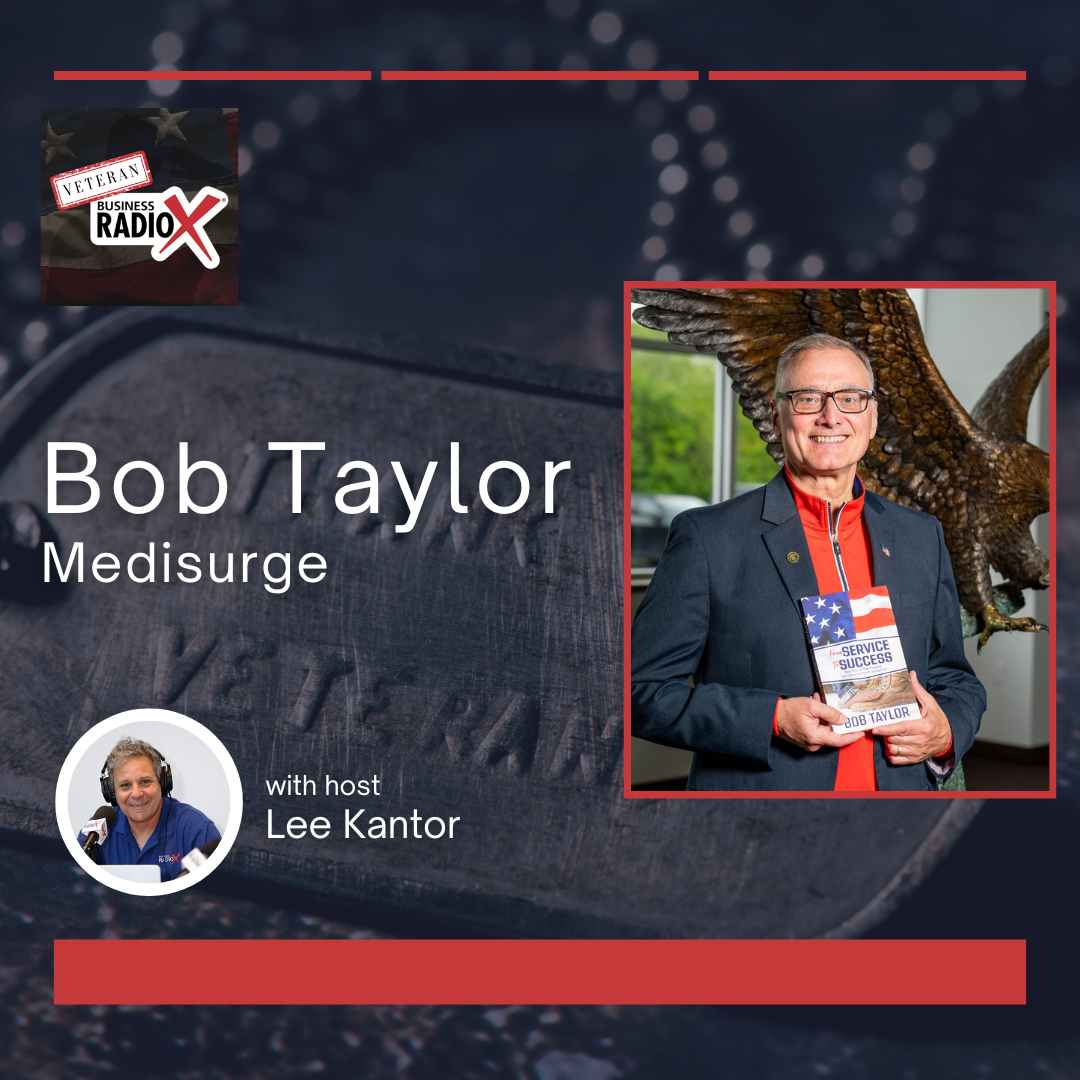

This episode of Veterans Business Radio features Bob Taylor, CEO and owner of Medisurge, Alliant Healthcare Products, and Alliant Biotech. Bob shares his journey from Air Force navigator to successful entrepreneur, offering insights into the transition from military service to business ownership. The conversation explores how veterans can leverage their unique skills to thrive in civilian careers, the importance of mission-driven leadership, and the challenges faced along the way. Bob also discusses personal growth, his commitment to helping veterans, and the impact of his book “From Service to Success” on the community.

 Bob Taylor attained a mechanical engineering degree from Michigan State University in 1986, then joined the Air Force in 1987. He married the love of his life, Sara, on the Fourth of July during navigator training. He finished that training program as a Distinguished Graduate.
Shortly after, Bob was stationed at Griffiss Air Force Base in New York. He then deployed to Diego Garcia, where he flew eleven combat missions during Operation Desert Storm and received the Air Force’s Air Medal. Shortly thereafter, Bob served as a KC-135 navigator and finally as an Air Force Academy Liaison Officer in the US Air Force Reserves.
Bob has dealt with the impact of his service for over 30 years, has worked within the VA health system for the last 10 years, and finally embarked on researching and writing his book, From Service to Success: New Mission, New Purpose, and a New Journey to a Great Life. Bob has firsthand experience with the gaps in veteran care.
Since his transition from military service, Bob has concentrated on the medical device industry, where he has started five new companies and sold two. Today, Bob is the CEO, founder, and sole owner of Alliant Healthcare Products, Alliant Biotech, and Medisurge – the Alliant Healthcare Group is located in Grand Rapids, MI.
Since 2002, his verified Service-Disabled Veteran-Owned Small Business has sold over $1 billion in healthcare products to the VA and military hospitals all over the world. Bob and Sara now reside in Kewadin on Torch Lake in northern Michigan.
Follow Medisurge on LinkedIn and X, and Alliant Biotech on X.
Episode Highlights
- Bob describes his transition from military service as a B-52 navigator to founding three successful healthcare companies.
- Strategies for navigating the complex world of federal government contracting and building relationships with large medical corporations.
- How skills and values gained in the military—perseverance, teamwork, adaptability—translate into civilian professional success.
- The importance of finding purpose and staying mission-focused after military service, including advice for veterans struggling with this challenge.
- Business lessons about overcoming obstacles and fostering a team culture where problem solving is prioritized over placing blame.
- Bob’s experience writing “From Service to Success,” the therapeutic process behind it, and his hope that it offers guidance and encouragement for veterans seeking a path forward.
 This transcript is machine transcribed by Sonix.
TRANSCRIPT
Intro: Broadcasting live from the Business RadioX studios in Atlanta, Georgia. It’s time for Veterans Business Radio, brought to you by ATL vets, providing the tools and support that help veteran owned businesses thrive. For more information, go to ATL vetsource. Now here’s your host.
Lee Kantor: Lee Kantor here another episode of Veterans Business Radio and this is going to be a good one. Today’s episode is brought to you by ATL vets. Inspiring veterans to build their foundation of success and empowering them to become the backbone of society after the uniform. For more information, go to ATL vets. Today on the show we have Bob Taylor, who is the CEO and owner of Medisurge, of Alliant Healthcare Products and Alliant Biotech. Welcome, Bob.
Bob Taylor: Thanks, Lee. Thanks for having me. It’s good to be with you.
Lee Kantor: Well, I’m excited to learn what you’re up to. Tell us a little bit about all your companies. How are you serving folks?
Bob Taylor: So I have three sister companies. The first one, Alliant Healthcare Products, we sell approximately $100 million a year into the federal healthcare market. We help about 30 to 35 other companies navigate selling their products into the federal market. Medisurge is a contract medical device manufacturer, so we make cardiovascular products for open heart surgery, hip and knee implants and some, uh, some other products that help during surgeries and things like that. And then we also have a Alliant Biotech, which, um, we focus on orthopedic surgery, wound care and biologics that help patients heal. So our tagline is we make lives better. And I think we do that throughout each of the three business units.
Lee Kantor: So what’s your backstory? How’d you get involved in this line of work?
Bob Taylor: So, yeah, you wouldn’t, uh, life? I always say life is not a straight line. And, uh, so I left active duty as a navigator and radar navigator in B-52s and was very fortunate, uh, to, to, uh, start as an R&D engineer. Uh, my background was as a mechanical engineer, and I became a R&D engineer in medical devices and a company in Kalamazoo and went through various aspects of manufacturing, marketing, mergers and acquisitions and ended up with my own business.
Lee Kantor: So you got to experience it through the lens of working for somebody else. And you decided, hey, I think I can do this on my own.
Bob Taylor: Yeah, you kind of grow through your different. I was very fortunate in, um, the company that I worked for in Kalamazoo, Richard Allen Medical, um, very entrepreneurial. Uh, I was able to be, uh, like, almost like a small business owner within the larger company. And I learned a tremendous amount, uh, started a new business around 1999 and, uh, kind of took on all of the operational aspects of it. But then, you know, you start to, to get a feeling like, maybe I can do this on my own. And I want to create a culture that was unique and, uh, and decide to step out on my own and start my own business.
Lee Kantor: Now was the first business in medical devices, or was it more in the, um, how to navigate kind of the the maze of getting government contracts.
Bob Taylor: So, uh, I started with, um, with manufacturing some products that were ultimately sold to the government. And then we started getting approached, probably about 5 or 6 years later from companies that were struggling, selling into the government. And so it was a little bit opportunistic on our side, where we decided to to kind of step in to help other companies distribute their products into the government. And that’s really when, uh, you know, kind of lit the match or lit the fuze. And the company started growing 1,800% per year for three years in a row.
Lee Kantor: So you were going in as kind of the prime or the sub, and they were coming in kind of as a partner. How did you structure those deals early on?
Bob Taylor: Yeah. So, uh, our breakthrough was working with a company called Stryker, and, uh, they were working with another company that was helping them, uh, sell their product into the government. And we kind of made the case that I thought that we could do it better. And we gave them some examples of, of that. And, uh, we took on one of their divisions and we demonstrated a, a pretty exceptional performance and a lot of growth. And, uh, that led us to picking up an additional four divisions of Stryker and, and, um, and it really came down to, uh, our entrepreneurial spirit and, uh, superior focus on customer service.
Lee Kantor: And people don’t, uh, typically kind of equate that with government contracting. How were you able to, uh, demonstrate that, the value of the customer experience when it comes to government contracting.
Bob Taylor: We I think we were very good early on at learning. Um, and so government contracting is is really difficult and arduous. And, um, there’s a lot of, um, really technical issues with it. And I was able to hire people that really could help me in the rest of the company, navigate that. And even in these really large businesses, they tend to have a very small number of people that understand government. And I refer to them as kind of the one one armed paper hanger where they they’re overstressed, they’re under-resourced, and they still have a lot of work to do. And we were able to come in with a really highly qualified team that, uh, could answer the questions and deal with, uh, government, um, Customers, contracting officers, clinical users and answer all their questions and really facilitate the transactions.
Lee Kantor: And that’s where I think some people don’t realize, ultimately, this is a human selling to a human.
Bob Taylor: It’s always relationships. And, um, and I think every company has a personality and, and, um, and a brand or a reputation that you develop and our, our brand and reputation was, was built on, um. Always meeting our promises and always getting to the answers that the customers needed. We might not have them right on the the phone call as they asked us, but we would find them and we would get them. So I think we had a a really good reputation early on as being very diligent and, uh, reliable.
Lee Kantor: Now, what was it like transitioning out of the military into that first opportunity, the first, you know, kind of job outside the military.
Bob Taylor: So I, I say that I was an engineer, um, by education. Um, you know, when I went into the Air Force. This was years and years ago. Um, engineering drawings were made on a drafting board, and we didn’t have, uh, computer software. And so when I got out of the military, uh, the expectation was that, okay, I had to I had to be an engineer that kept up with all my peers. And so I can remember putting in 60 or 70 hours a week, not only doing my engineering job, but learning the aspects of, uh, computer aided design and, and learning, you know, software and learning how to design, um, medical devices. I had to learn anatomy, uh, because we were going into surgeries. And so the, um, one thing that the military prepared me for is I didn’t when I got into the Air Force, I didn’t know anything about flying. I’d never flown before. And one of the first things I remember a navigator school was, was, uh, sitting in the cockpit of a twin engine two seater jet, the T-37, and, uh, having the ability to to learn how to fly it. And, um, so I think that’s what the the Air Force taught me was it really didn’t matter what it was. I knew I could learn it, and that’s what I had to do when I got out, as it’s just it’s nothing that I had direct experience with. But I was going to learn it.
Lee Kantor: And that’s one of the things that I think the military entrusts young people with a lot of responsibility and, uh, playing with toys that cost a lot of money.
Bob Taylor: Yeah. You, um, you have to be connected to and willing to do all the training that they present to you. So the military is really good at training. I can’t think of anything that I was asked to do where there wasn’t education and training. Um, the difference on the civilian side is maybe they don’t have that structured training. But what, uh, the exposure in the military taught me was, hey, it doesn’t matter what it is, you can learn it. And so it’s just a matter of the perseverance and the and the desire to learn.
Lee Kantor: Now, was it difficult to kind of find the big why behind the work? Uh, once you got out of the military? Because, again, the military services. So you know what you’re in there for, like you have a mission to accomplish. And in, in, in the commercial kind of world, it can only be about making more money?
Bob Taylor: No. And, you know, all people are kind of wired a little bit differently. And so, you know, statistically about half the veterans that leave struggle. So out of 22 million veterans, there’s about 11 million that are struggling in some way. And I think the majority of those who struggle are have a hard time finding the why or the purpose of what they’re doing. And so for me, um, having the ability to to help patients and help doctors figure out how to design their, their instrumentation, I felt that I was doing something really important. I felt that I was helping to save lives. Uh, and then I was, you know, really motivated to take care of my family and to make decisions that were going to help me, um, give them the type of life that, um, that we wanted, the happiness and, uh, you know, being able to to succeed together.
Lee Kantor: So do you think that was the combination of you being the entrepreneur and having kind of a mission and a purpose that is geared towards serving and helping others? Do you think that that combination is what puts you in that pile of people that aren’t struggling as much as others?
Bob Taylor: I do think that I, uh, one of the questions I interview, everyone that comes to work at the company, and one of the questions I asked them about is, what do they think entrepreneurship means? And do they consider themselves to be an entrepreneur? To me, an entrepreneur just overcomes whatever hurdles are presented to them. They find a way. They they don’t look at obstacles like some people do. They just they look at those obstacles as something that they need to work around or through. And that’s a really key part of success, is that entrepreneurship, the willingness to overcome whatever adversity that, that, um, that comes in our way. And then, um, having that mission focus, I call it intellectual curiosity. Uh, those are the things that serve us well. And, um, and then, you know, you talk about how to find a why you have to be willing to just try things. And sometimes, uh, things that are presented to us might not look like the right thing for us, but if we try it, um, you know, I’ve tried and experimented with a lot of different opportunities. And for example, I, I do glassblowing to see if that’s something that, you know, I can find a passion and purpose around. So I think there’s there has to be a willingness to try new and different things.
Lee Kantor: Yeah. You bring up one of my favorite quotes and it’s a book is called The Obstacle Is the Way by Ryan Holiday. And he talks about obstacles. Aren’t there to sabotage you. They’re just part of the journey that’s there. It’s part of it. Life is having obstacles. You have to figure out a way to get around it. They’re not the end. They’re just just something that you have to deal with as trying to get to where you’re trying to go. So you got to figure out a way to go around it, through it, over it, under it, whatever it takes to just keep moving forward. And I think a lot of people get they get hung up on these obstacles as these barriers that can’t be overcome. And, um, and humans are pretty resilient and pretty clever, and they can they figure, you know, they find a way.
Bob Taylor: So there’s a I have these kind of business theories or, or, um, kind of rules that I have. And one of them refers to what I call the damn rock. And here in Grand Rapids, there’s a river in the middle of town, and there’s a huge boulder in the middle of this river. And the water doesn’t even care about this rock. It just goes around it. And some people look at that rock like it’s a dam. And they look at it as it. They look at it as an obstacle that is going to hold things up. And, and they just get frozen by it. And that’s why I call it the damn rock, because they see it as a dam. And for the water that’s going down the river, it doesn’t even pay attention. It just goes around it. And so we have to be aware of that. There are obstacles, but they are just that. They’re just obstacles that are are meant to be worked around or or, um, overcome.
Lee Kantor: Yeah. I think it’s so important, um, from a leadership standpoint to, uh, really instill those kind of values in your team about, you know, reframing things like you’re saying it, it’s not a, um, it’s not a permanent obstacle. It’s an obstacle to go around or reframing, um, an experiment that doesn’t work and not as failure, but as a learning experience. I mean, a lot of what we, you know, how we assign the meaning to things really affects how we behave.
Bob Taylor: I think you’re right. I think we, uh, in our organization, we one of our focus is just to constantly bring up what the problems or obstacles are, And we address them. We identify them, we discuss them, and then we solve them. And the better you get at identifying, discussing, and solving problems, the faster you can move. And so it gets to a point where you don’t even look at them as obstacles. They’re just issues that come up. Issues that are dealt with. And you move on.
Lee Kantor: And when you instill that as part of the culture, you’re, um, you’re kind of training your folks to be problem solvers, not kind of place blame or be a victim. They’re there to solve problems, and customers have problems. And, and and solving problems opens up opportunities. I mean, I’m sure that’s how all of the businesses you are successfully running now were because somebody had a problem, that you figured out a way to help them solve it.
Bob Taylor: And, you know, the the thing is, is we we learn all this as members of the military, right. What mission goes as planned? I don’t care if you’re in a B-52. You’re, you know, in a combat operation on the ground. It doesn’t matter. I don’t think there has been a mission that has ever been accomplished exactly as planned. The air refueling doesn’t show up on time, or the target isn’t exactly what was predicted. It’s just all kinds of things. The enemy reacts differently than what we anticipated. The defenses are different, and and we learn in our training to adapt, to change, to accommodate the differences. And it is no different in our civilian world. As we’re presented with new information, we take it in, we analyze it, And we move forward in a new direction. We adapt and a lot of what we do, a lot of what I talk to young employees, uh, mature employees, everything is how do we overcome adversity? It’s always about overcoming adversity.
Lee Kantor: Right? You just can’t just call it a day and just say, oh, well, we tried, like, you got to figure out a way. You got to take action. You know, you have to experiment. You have to keep trying and don’t give up. And and a lot of folks just, um, you know, it just gets too hard or they don’t want to put in the effort. And, um, you know, humans are here because we can do hard things, and we we can’t shy away from hard things.
Bob Taylor: And I think, too, um, you know, I can’t think of anything that I did in the military that didn’t rely on working with other people, you know, in the B-52, it was a crew of six and KC 135 when I was a navigator was a crew of four. And so everything we did was as a team. If you know, if you’re in the Army, you’re in a platoon. If you, you know, you’re you’re part of a unit. And as, um, active duty reserves or whatever our role is, everything we do from a very early time is as one of a part of a team, were either relying on others or were helping others when we get out. It’s really amazing how veterans kind of shift to where they feel like they have to do everything on their own, right? And you know, when they struggle, they feel like they’re on their own. When they’re when they’re in a business, they feel like, you know, they’re on their own. And it is absolutely critical to keep in mind that you’re your it is not a solo position. You’re part of a team. So no matter if it’s hard or easy, um, it is always made better because you’re part of a team, and the sooner people can kind of grasp that. And when you identify problems, if they’re really hard, they’re easier because you can work with other people on them.
Lee Kantor: Right. And that is a mistake that a lot of folks make is they think they have to be this lone wolf to figure it all out, and everything’s on them. And there is a community available. Is there things that you’re doing in your organization or in your community that is kind of building community? Is that an important part of your life building community?
Bob Taylor: I’m always working with people within the community. I’m part of a CEO roundtable where we talk about what the challenges are within their organizations. You know, how do we treat Employees. Uh, how do we encourage employees? How do we motivate them? Um, yeah, a lot of what I do here, I spent my own personal time for about 5 or 6 weeks building, uh, what I call a lodge. It’s a kind of a knotty pine cafeteria to make it special for people to have a place to get together. Um, I’m involved with my church and doing things in that community, so I think we are tied. The best outcome is when we’re tied to the community and we try and reach out beyond ourselves.
Lee Kantor: And that, and that goes to the point earlier of creating that, uh, why and having that why in that purpose? Um, because you have to work towards something bigger than yourself, I think, in order to find that peace you’re looking for.
Bob Taylor: Yeah. So, you know, um, after 16, after I left active duty, about 16 years later, I started to struggle. I don’t know why, but I started having nightmares, and I thought that, well, maybe I’ll have a drink or two to try and help myself go to sleep. And that didn’t work. And so I tried a little bit more. And pretty quickly I got behind the eight ball, and I got to the point where I had to admit that I needed help. And so I started going to the VA and, um, you know, it it took some time, but I promised them that I would be the best patient they ever had. I did what they asked me to, and I did get better. And, uh, part of what I realized as I went through that is that I couldn’t be alone in my experience. And so I spent six years writing a book called From Service to Success. And, um, so I’ve spent a lot of time trying to reach out and and help veterans, um, find a path forward and, and, um, admit when they need help and helped them find a path, uh, between the VA and some of their personal, um, mindset issues that they can find, uh, success and happiness.
Lee Kantor: So was writing that book therapeutic for you? Was it good to get it out of your head and into into, uh, you know, uh, paper where that it was?
Bob Taylor: Yeah, it was, um, it was valuable to me because it it helped me really understand where I came from, where I was going. And it also was very beneficial because when you have something that is kind of higher than yourself, greater than yourself, It gives you a greater sense of purpose. And, um, in writing that book, I was focused on, you know, what could I say? Or what could I do to help other people? And it’s been extremely rewarding. Uh, you know, it hasn’t been read by millions, but it’s been read by thousands. And, uh, I’ve, I’ve received some very heartwarming, um, responses from some of the readers that, uh, that they’ve been helped. And that’s really if just one person said that to me, it would have been enough. So I’m I’m very blessed with that.
Lee Kantor: So what do you need more of? How can we help you? Do you need more, um, kind of workers for the different companies you’re working with? You want more people to get Ahold of the book? Um, you need more clients. What could we be doing to help you?
Bob Taylor: I’d be. I’d be very happy if people would, um, would reach out to find a copy of the book. It’s available on Amazon. I don’t make any money on it. Um, but if they could reach out and find a copy of, uh, from Service to Success and get it into the hands of a veteran that they think might need it. Uh, that would make me really happy. Um, you know, if someone wants to learn about our business and go on our websites for Alliant Healthcare products, for Medsurge, or for Alliant Biotech and learn about what we’re doing and express that interest. I’m always open. I always enjoy talking to people and and trying to help.
Lee Kantor: And are you available to speak about the book as well? Do you ever do any speaking engagements?
Bob Taylor: As a matter of fact, you know, I when I first launched the book, I, I did like 30 podcasts and, and learned all about that. But um, on um, I get into demand on uh, Veterans Day mostly, or some, you know, some, uh, uh, 4th of July or Memorial Day. Uh, but I’m speaking to a group of, uh, several hundred people here in, uh, on Veterans Day this year, and, and, uh, hopefully I’ll have some, some words that, uh, can help people.
Lee Kantor: Well, Bob, thank you so much for sharing your story today. You’re doing such important work, and we appreciate you.
Bob Taylor: It’s my pleasure. And thanks for reaching out. And, um, like I said, if if what I, um, wrote about or what I say can can help anyone, it is is absolutely my pleasure. And, uh, in my hope.
Lee Kantor: All right. This is Lee Kantor. We’ll see you all next time on Veterans Business Radio.














