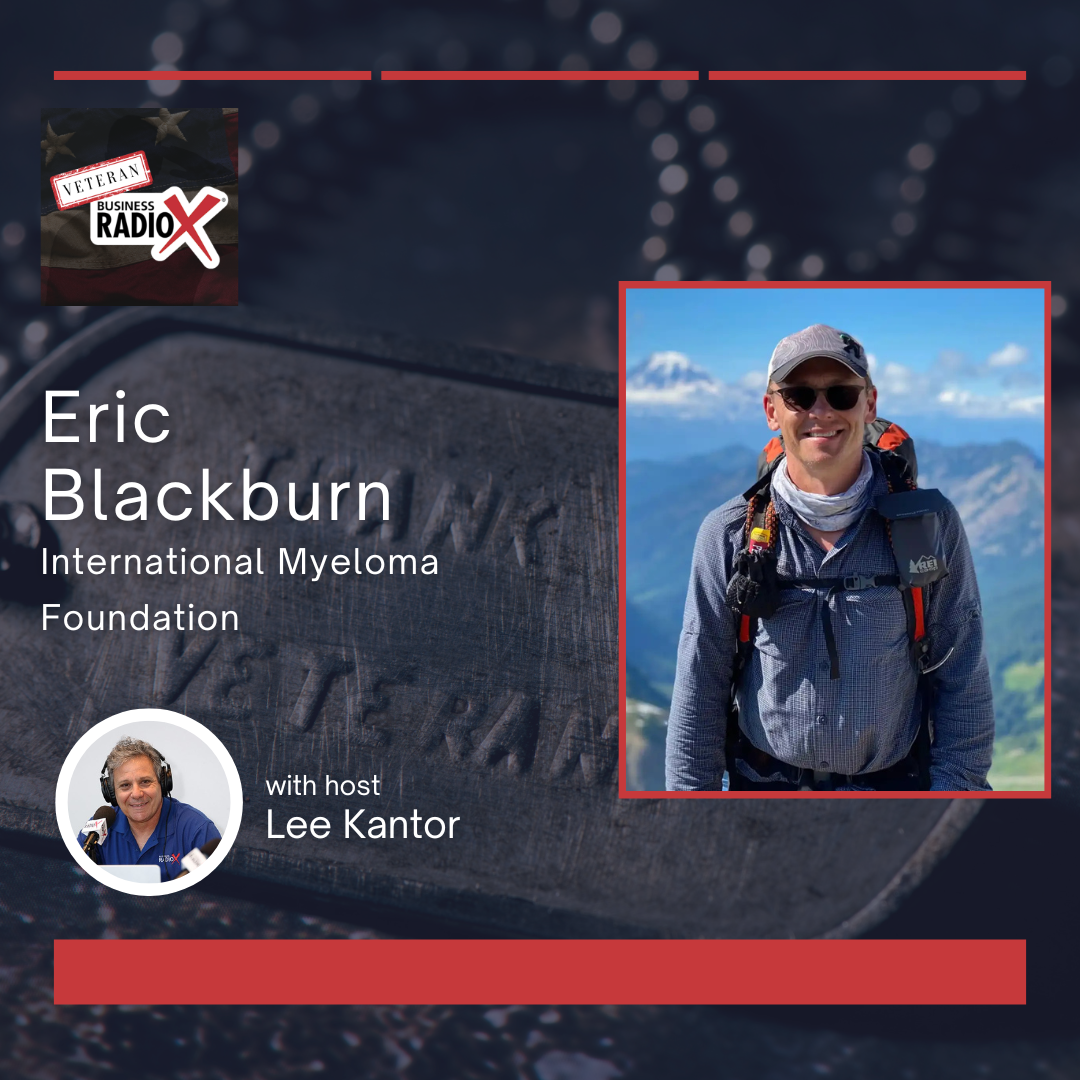

In this episode of Veterans Business Radio, Lee Kantor talks with Eric Blackburn, a Gulf War veteran, volunteer, and co-lead of the International Myeloma Foundation’s Veterans Support Group. Eric shares his personal journey after being diagnosed with smoldering multiple myeloma, the importance of early detection, and how his participation in the Iceland Cycling Expedition is helping raise awareness and funding for groundbreaking research. He also discusses the impact of toxic exposures on veterans, the role of lifestyle changes in managing health, and the value of support communities for those navigating cancer and VA care.
 Diagnosed with smoldering multiple myeloma in 2024, Eric Blackburn is a husband, father, and Gulf War veteran who transformed the shock of his diagnosis into a mission of advocacy and service.
An avid cyclist and outdoorsman, he channels his energy into raising awareness about the importance of early detection for high-risk veterans exposed to toxins. Through the International Myeloma Foundation (IMF), he co-leads the Veterans Support Group and serves as a patient advocate on national myeloma research initiatives.
Eric believes the IMF’s support of the iStopMM study in Iceland reflects his commitment to finding disease earlier and preventing progression before lives are upended.
For him, participating in the Iceland Cycling Expedition is a natural extension of that mission—combining a passion for the outdoors with advocacy, collaboration, and resilience in support of groundbreaking research.
Follow International Myeloma Foundation on LinkedIn, Facebook and X.
Episode Highlights
- Understanding smoldering multiple myeloma and the importance of early detection.
- Recognizing the connection between toxic exposures and long-term health risks for veterans.
- Supporting cancer prevention research through awareness and fundraising initiatives.
- Managing chronic illness through lifestyle changes, stress reduction, and holistic wellness practices.
- Navigating VA healthcare resources and veteran-focused support communities.
- Advancing medical research through large-scale data collection and targeted screening efforts.
- Using personal adversity as a platform to educate, inspire, and advocate for others facing similar health challenges.
 This transcript is machine transcribed by Sonix.
TRANSCRIPT
Intro: Broadcasting live from the Business RadioX Studios in Atlanta, Georgia. It’s time for Veterans Business Radio, brought to you by ATL vets, providing the tools and support that help veteran owned businesses thrive. For more information, go to atlvets.org. Now here’s your host.
Lee Kantor: Lee Kantor here another episode of Veterans Business Radio. And this is going to be a good one. But before we get started, it’s important to recognize our sponsor, ATL vets, inspiring veterans to build their foundation of success and empowering them to become the backbone of society after the uniform. For more information, go to atlvets.org. Today on the show, we have a participant in the Iceland Cycling Expedition, who’s a Volunteer and co-lead veterans support group with International Myeloma Foundation. Eric Blackburn, welcome.
Eric Blackburn: Hi, Lee. Thanks for having me.
Lee Kantor: Well, I am excited to learn more about your work. Tell us first about the International Myeloma Foundation.
Eric Blackburn: Yeah. So the International Myeloma Foundation is the oldest and largest organization, cancer organization focused strictly on multiple myeloma. And multiple myeloma is a a blood cancer that focuses in the bone marrow and specifically the plasma cells.
Lee Kantor: And then how did you get involved?
Eric Blackburn: Well, I got involved because in 2020, for some routine blood work at the VA determined that I had smoldering multiple myeloma, which is they call it a precursor. You can think of it as kind of an early stage of this blood cancer And from there I got introduced to some people, and I’m the type of person who likes to go down the rabbit hole. So I got introduced to, uh, an organization at the center of that type of research, the International Myeloma Foundation.
Lee Kantor: Now, is it something that if it’s at the smoldering stage, you can kind of snuff it out? Or is it something that, hey, this thing, this train’s already moving and you’re just now.
Eric Blackburn: Well, it can go either way. There are people with smoldering multiple. So let me set the stage here. There’s several precursor states that happen before. You have multiple myeloma. And multiple myeloma is usually you’re having symptoms like problems with your bones, bone breaks and kidney failure. Those are some of the primes. But there are two precursor stages, starting with what they call MGUs monoclonal gammopathy of undetermined significance. So we’ll call it MGUs and then smoldering. And a lot of people with these don’t advance. So a key in the myeloma communities you don’t want to treat too early. So I’m I’m before the myeloma before the the definition. But I have cancer cells in my body. And so I get blood tests every three months and bone scans every six months to see if I’m progressing and to keep trend.
Lee Kantor: And then so but you can’t make a move until that happens.
Eric Blackburn: Well, the the latest the people are starting to treat earlier and earlier. So even within smoldering now they have the ability to differentiate differentiate between high risk smoldering. So those people that were, were fairly sure are going to progress. And they have been running clinical trials to start treating those people earlier. So I’m not in that high risk category yet, but if I could be in that high risk category at some point and the treatments could eventually progress towards where I’m at, which is what I would hope for.
Lee Kantor: And the whole key. Do you even getting on this kind of journey is this, um, blood test. Like it was just kind of a chance.
Eric Blackburn: Well, so, so I, I was I’m a Persian Gulf veteran. I was a 54 Bravo chemical operations specialist. I, I had, I have documented toxic exposures from a variety of sources. And I’ve struggled with Gulf War illness for about 25 years. And that was kind of at the center of that Gulf War illness was chronic inflammation. And I. So I have chronic inflammation, chronic fatigue. I’ve been treated at the VA since early 2000. For those conditions, I’m fairly in tune with my body. And, uh, I had a really bad bout of fatigue in 2024, went into the VA, they ran some blood tests and they found the smoldering multiple myeloma.
Lee Kantor: And then so then did that answer questions? Now you were like, okay, this explains some things.
Eric Blackburn: Well, it started me down. It’s hard to say what the fatigue was, was the fatigue, my Gulf War illness or, or the cancer. But what it did start me down the path of is, is trying to get ahead of, you know, the smoldering multiple myeloma. Uh, it’s a reason for my involvement with the International Myeloma Foundation. It’s the reason I’m doing this bike ride is, you know, I’m, I’m a testament to early detection has allowed me to make some adjustments in my lifestyle, whether it be diet or exercise or supplements to try and get my inflammation in check so that, uh, maybe we can slow down these cancers.
Lee Kantor: So is that kind of the best thinking right now? That’s the path.
Eric Blackburn: That for right now, that’s the path because, uh, clinically, the doctors don’t really don’t have the tools to do with some to deal with someone at my category. Uh, so really, I, I and the VA had me on some anti-inflammatory inflammation drugs related to my chronic fatigue. But when I got this diagnosis of, of the cancer, I was, uh, it was suggested to me, strongly suggested to me that I go off those, those drugs that were suppressing my immune system. So, uh, I really needed to make these lifestyle adjustments to, to, to get ahead of the cancer, but also to, uh, uh, address the fact that I had to go off some of the drugs that were keeping my inflammation in check.
Lee Kantor: So then did you find other ways to keep the inflammation in check? That’s more natural.
Eric Blackburn: Yeah, a variety of supplements. I do some, uh, some other, you know, acupuncture, managing stress, meditation, mindfulness, uh, some of some of the, some of the tools that the VA is actually starting to roll out, uh, Outside of prescription drugs.
Lee Kantor: And then is the cycling something you’ve always done, or is this kind of just part of this?
Eric Blackburn: Um, well, I was, I was always, I was, I was a cyclist many years ago and kind of fell out of it during my, my corporate finance career, uh, wanted to get back into it. And so it was kind of a series of events. I was, I was introduced to the International Myeloma Foundation. And around that same time, I became aware that they wanted to restart a veterans support group. And also around that time, in early 2025, the VA made multiple myeloma and its precursors a presumptive condition for burn pit and Gulf War exposure. So it was kind of a perfect storm, kind of guiding me down a path to maybe putting, putting some of my energy into this important topic.
Lee Kantor: And then they threw a cycling event on top of this, then it was hard to say no, right?
Eric Blackburn: No. Absolutely. And what really is, uh, so I don’t know if your listeners are familiar with the, the million veteran survey, uh, you know, the VA has been collecting a lot of genomic data, data on veterans in the hope of starting to be able to predict when various ailments happen related to toxic exposure. Well, the the International Myeloma Foundation has partnered with the University of Iceland on what they’re calling the I-stop initiative, which is I stop, prevent or treat multiple myeloma. And it’s the largest study of its kind, focused on early detection of multiple myeloma, with a thought of one figuring out how to early detect and two, what are the benefits of early detection. So really, it was kind of a perfect storm that aligned around my specific needs. As a veteran with myeloma and focused on early detection.
Lee Kantor: So why was Iceland kind of championing this?
Eric Blackburn: Well, Iceland, it’s fairly unique. Uh, Iceland is a country where it’s a country of about 400 000 people. About 160 000 of them have, uh, medical records that they’ve shared or genomic information that they’ve shared. And, uh, so there are about 20%, I believe, of Iceland’s population, or about almost 50% of their people above 40 volunteered to be in the study. So it’s about 8000 people that volunteered to participate in this. When you link that up with the existing genomic and health record access that they have in Iceland, it’s like the perfect place to do a study like this.
Lee Kantor: Do they have a preponderance of people suffering from it there or.
Eric Blackburn: No, no, it’s it’s, uh, they’re just a very forward looking nation when it comes to this type of thing. And, uh, but, and they have so a variety of research has already come out of it. The big conclusions are still being worked on. But, you know, like, one of the things I believe they, they found out that is more, more people have these precursors than originally thought. Still don’t know about any differences in progression risk, but the like anything nowadays, it’s all about collecting the data and the more the bigger your sample, the better. So I’m really hopeful that this is going to have some very purposeful conclusions by the end of it. And so this, this cycling expedition is about raising awareness for the project and raising funds.
Lee Kantor: And then, um, to the end. So when they do the research on the precursor level, is it in the hopes of seeing like, okay, is something a trigger that moves a person from this precursor stage to a more dangerous stage? Is that.
Eric Blackburn: Yeah, exactly. So, uh, a couple of things. One is yes. Are there, are there certain people that are predisposed to get these precursors? And then are there certain people that are predisposed to actually advance? Because I think the goal of anything is, you know, blanket screening, screening is, is, is complicated because, you know, you’re giving people information. Some of the time screening comes up with conclusions that aren’t right. So how could, how could we structure targeted screening? Uh, in, in the most at risk population is a big part of the initiative. And this is where I’m hoping what we learn here potentially could be meaningful for the VA and where they where they have a similar data set and a preponderance of high risk, uh, veterans with toxic exposure.
Lee Kantor: Right. So then, um, that’s why it’s important to keep the funding into, you know, to learn as much of this as possible.
Eric Blackburn: Absolutely. And, you know, when the, when the VA says something is related to service like they did in early 2025, a lot of funding goes into paying disability and treatment. But the front end research of, of how people progress, I think is an area where we’re funding needs support. And, uh, you know, if you think back to Agent Orange, I think the VA and the government eventually came around and treated it as a disability and with benefits, but there could have there could have been more activity on the front end trying to connect the dots for why people, which people were predisposed and which people advanced.
Lee Kantor: Right. Yeah. I mean, it’s one of those things where early detection is always a good thing. And in order to identify folks as early as possible, and now it sounds like they’re able to identify them maybe earlier than they had previously. And now what do you do with this information? And then how do you make it to prevent it from either happening or to at least, um, make it less dangerous if you can?
Eric Blackburn: Absolutely. And our VA, you know, the, the people that receive treatment at the VA, uh, are population can have, you know, diabetes, a lot of comorbidities, uh, a lot of inflammation. So it really is a population where this work could be very, very meaningful.
Lee Kantor: So now, um, as the co lead, um, for the organization, what is your responsibility in that area? Are you, are you just kind of evangelizing and raising money, is that.
Eric Blackburn: Well. So one of the. So the IMS has very several platforms. One is research, which the Istop study is a key part of that. The other is support. And so I’m actually currently in Minnesota for a support group leaders summit. And we have over 100 support group leaders here from all over the country and some from overseas. And really, it’s where do people go when they want to find information about the disease they’ve just been diagnosed with? And so our veteran community right now, it’s largely people that have been in the system being treated, uh, for several years, or people that are looking for assistance, one on the disease or two to find best practices and how to navigate the VA system, which, uh, so our veterans who, who have these conditions really have the challenge of the condition itself. And then the challenge of how to coordinate care. And we help with that.
Lee Kantor: And then, um, do you have a big group that’s going to Iceland for the, um, cycling expedition?
Eric Blackburn: Yeah. So we’re going to have, uh, over 20 total people. It’s a, it’s a mix of people with the condition like myself or, you know, uh, caregivers, uh, some nurses, some doctors, and then representatives from the, the industry, uh, some of the leading drug companies that are involved in the space. So it’s really a team effort. And really it’s meant to represent, uh, kind of the, the, the journey of getting diagnosed with cancer, the challenges, the, the, uh, you know, it’s day by day, step by step, petal by pedal, that type of thing.
Lee Kantor: And then what is the actual, are you, are you riding for a period of time or a distance?
Eric Blackburn: Yeah. So we’re going to be there from August 17th through the 24th. And about three days of that would be dedicated to cycling. And we’re going to be doing about 150 miles total. Uh, a large portion of that’s going to be on the gravel roads, uh, starting in Reykjavik and headed into the Highlands. And this is the third year the organization has done this. It’s become one of their, their hallmark, uh, events. Uh, and we’ll be, we’ll be visiting our research partners at the University of Iceland. In addition, we’ll visit the, uh, the, the, the institution where they have all this, this genetic and medical information that’s coupled with the, the I-stop initiative.
Lee Kantor: So how can people support you? Or is it just at this point it’s, uh, sponsoring or raising money?
Eric Blackburn: Yeah. So we all of our, all of the people on our expedition have a page that’s all hosted on myeloma.org. And if you go there and type in Iceland, that page will pop up and you can see everybody that’s going on the expedition read their personal story. And, you know, we’ve got some amazing people, some amazing survivors that I’m sure anybody looking to donate could find somebody that really resonates with them.
Lee Kantor: And is this an annual event?
Eric Blackburn: Uh, it has, it has become an annual event. And I, I, with the success we’re having, uh, the, the outreach, uh, I think I see it continuing. I hope the myeloma organization is, uh, is, is where I’m at on that.
Lee Kantor: So if somebody wants to participate, maybe next year there’s an opportunity to sign up for that or you have to do something to qualify.
Eric Blackburn: There is a, there is a list, uh, next, next year, probably early in the year, there is a sign up, uh, for to volunteer. Uh, we, this year we had more volunteers than we had spaces. So, uh, they tried to put together a team representing a cross section of the disease and just the whole life cycle of the disease. And so that is a thing people can do is they can go to the myeloma.org and check out what we’ve done in the past. Uh, there is an award winning short documentary video on the website that really kind of tells the story of the expedition and why we’re doing it. Uh, so I’d encourage any, anybody who’s interested to take a look at that.
Lee Kantor: Yeah. And the website once again is myeloma.org. MYELOMA.org.
Eric Blackburn: Yeah. That’s right.
Lee Kantor: Well, Eric, thank you so much for sharing your story today, doing such important work. And we appreciate you.
Eric Blackburn: Thank you.
Lee Kantor: All right. This is Lee Kantor. We’ll see you all next time on Veterans Business Radio.















