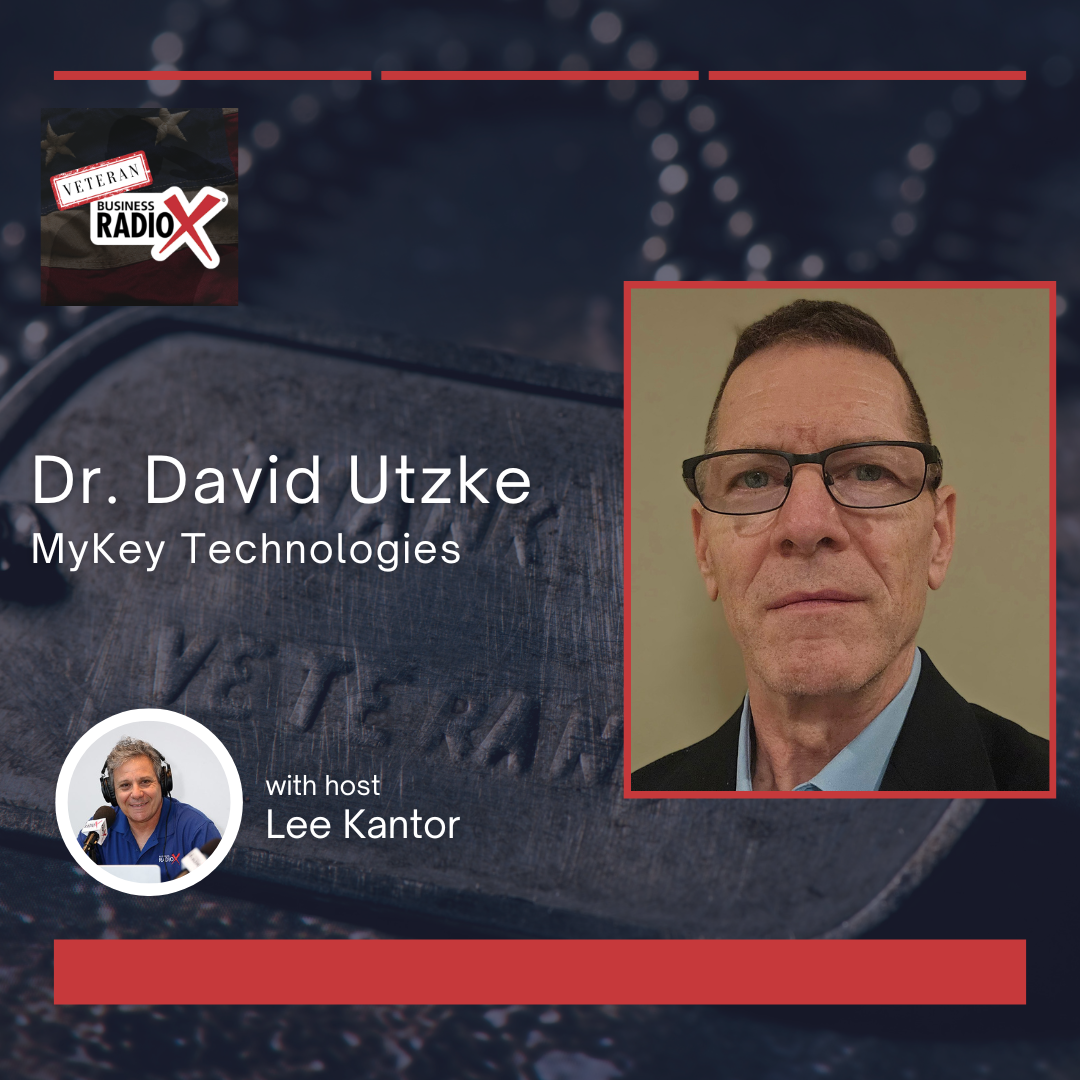

In this episode of Veteran Business Radio, Lee Kantor interviews Dr. David Utzke, CEO of MyKey Technologies. Dr. Utzke discusses his journey from federal Treasury agent to entrepreneur, and how his company addresses security vulnerabilities in digital assets and blockchain technologies. He highlights the urgent need for quantum-resistant cryptography, the challenges of technology adoption, and the importance of independent governance in digital finance. The conversation explores the future of digital assets, quantum currencies, and the role of veterans in driving innovation and cybersecurity.
 Dr. David Utzke is a military veteran and worked in a Special Operations (Spec Ops) Unit for over a decade.
Apart from being a highly decorated member of the U.S. military, Dr. Utzke is a Financial and Digital Asset Economist, Distributed Ledger Architectural Engineer, AI Engineer, educator, researcher, and author with experience in cybersecurity, cybercrimes investigation, data security, heuristic and forensic analytics, cryptography, economic game theory, Extended Reality design, and quantum computing.
He is currently the CEO and CTO at MyKey Technologies, a pioneering research and design firm focused on secure digital infrastructure technology and building secure, next-generation infrastructure for digital assets and sensitive data, with a foundation in privacy, compliance, and innovative architecture to help organizations protect, manage, and move digital information with confidence—whether it’s private keys, financial data, intellectual property, or identity credentials.
MyKey Technologies helps institutions, enterprises, and governments looking to operate securely and privately in the digital environment—offering new tools for storage, movement, and authentication that don’t rely on traditional cloud systems, third-party intermediaries, or classical cryptography. 
Dr. Utzke’s accomplishments include receiving numerous prestigious awards from the U.S. Department of Justice and IRS for the application of unique investigative and analytic methods supporting high-profile investigations and his pioneering work in developing tools and providing support in DLT, Digital Assets, AI, and XR in criminal and civil investigations.
Dr. Utzke holds a doctorate in Financial Economics and Data Security, MBA in Forensic Accounting and International Finance, MSc in Blockchain Engineering and Digital Currency Coding with postdoctoral work in Digital Asset Economics and Smart City Design with Technology Integration at MIT, and post-doctoral work in XR design at the University of Michigan’s XR Dept with a focus on technology ethical use, accessibility, social implications, privacy, and user security.
Dr. Utzke has received professional certifications as a Certified Fraud Examiner (CFE), Certified Forensic Interviewer (CFI), Certified Digital Forensic Examiner (CDFE), and completed training at the Army NCO Academy and Federal Law Enforcement Training Center (FLTEC) in Advanced Economic Crimes, as well as certifications in Blockchain Design, Blockchain Architecture, and L2 Contract Development.
Connect with Dr. Utzke on LinkedIn.
Episode Highlights
- Emergence of MyKey Technologies from a government contract.
- Focus on enhancing security for digital assets, particularly cryptocurrencies.
- Identification of vulnerabilities in current digital asset security measures.
- Impact of quantum computing on existing cryptographic algorithms.
- Transition from government to private sector focus for MyKey Technologies.
- Importance of educating financial institutions about security risks.
- Development of customized infrastructure solutions for secure key management.
- Challenges in technology adoption within government and military sectors.
- Need for governance frameworks for emerging technologies, including AI and digital assets.
- Discussion of the historical context and future trajectory of digital asset technologies.
 This transcript is machine transcribed by Sonix.
TRANSCRIPT
Intro: Broadcasting live from the Business RadioX studios in Atlanta, Georgia. It’s time for Veterans Business Radio, brought to you by ATL vets, providing the tools and support that help veteran owned businesses thrive. For more information, go to ATL vetsource. Now here’s your host.
Lee Kantor: Lee Kantor here another episode of Veterans Business Radio and this is going to be a good one. But before we get started, it’s important to recognize our sponsor, ATLVets, inspiring veterans to build their foundation of success and empowering them to become the backbone of society after the uniform. For more information, go to ATLvets.org Today on the show we have the CEO and CTO with MyKey technologies Dr. David Utzke. Welcome.
Dr. David Utzke: Thank you.
Lee Kantor: Well, I’m excited to learn what you’re up to. Before we get too far into things, let our listeners know about MyKey Technologies. How are you serving folks?
Dr. David Utzke: Sure. So MyKey technology is really rose up out of a government contract that I took on after leaving full time federal service as a federal agent with Treasury. And so the realization around the need for new technology was became very evident in what was happening in both the traditional banking space, uh, as well as in the adopted distributed ledger technology space. Many people don’t realize that that technology is decades old, well before Bitcoin started as an asset or as a network. So it really needs to be rethought and redeveloped around the technologies protecting these assets.
Lee Kantor: So what was kind of the the genesis of the idea? Did something occur where you’re like, okay, somebody needs to work on this and that? Somebody should be me.
Dr. David Utzke: Well, uh, working with cybercrimes, headquarters on the technology, digital assets side, things of that nature, it’s hard to implement change from within the government. And so it was really after retiring at the beginning of 2022, which retirement for me doesn’t mean I quit working. It’s just an opportunity to, uh, go out and start a new venture. And so it was really at that point, I was drawn into a federal contract with one of the US federal NGOs that ensures banks when they fail. And in working with them, uh, for a couple of years, uh, through 22, really having to realign a lot of their thinking on the technology because so much of of what’s conveyed about it in the web space is so inaccurate. And so they had false misconceptions of if a bank fails, how do we secure these assets? And of course, putting them in an environment where they’re co-mingled with other user assets like exchanges, things like that presented some problems, uh, for them, obviously, and I certainly saw it in working in seizures. Uh, within the government, I saw assets go missing. Um, not because there were, um, sticky fingers, uh, if you will, in the government. It was the result of the vulnerability of, of the entire wallet environment. So, uh, that was kind of the impetus behind getting it started. But one of the contractors that I had, um, experience with, um, and specifically, you know, working with Greg Favata, um, he encouraged me. He says, you’ve got to start a company around this. He says, this is just too good to just, you know, let it hang there. And so he was really the driver behind me, uh, taking that leap, um, of of jumping in and forming a C Corp. And so we now work together on, on introducing, uh, this technology to both, uh, government, uh, as well as, uh, private institutional space.
Lee Kantor: So what’s it like? Um, you know, now you’ve kind of have the unique seat of, of working deeply within the government and now working, uh, you know, kind of in concert with it. Can you talk about the trade offs of what you can and can’t do and what gets done and doesn’t get done? Uh, you know, one versus the other?
Dr. David Utzke: Yeah. Um, I mean, some of the benefits of, of being in the government, um, you have the ability to kind of dictate, uh, to everyone, uh, kind of like in the military, uh, a chain of command, uh, in the private sector, it’s more, uh, we can certainly see in the space everybody does their own thing, and it ends up being, uh, a little chaotic because no one’s really leading the charge.
Lee Kantor: So what? From knowing that and knowing that, I guess when you started the venture, did you have a strategy on how to kind of maximize the impact?
Dr. David Utzke: Yeah. Uh, there was an initial strategy, but of course, you know, like we say in the military, you always have a plan B, C, and D because A never works. Um, so, you know, there were alternative strategies, uh, developed, uh, and discussed to implement if plan A didn’t go well and plan A didn’t really go well because coming, uh, into the space, um, the, you know, there was a change in administration which good in some ways bad in others, um, you know, the cost cutting measures and things like that, which is what we’re all about in introducing new technologies far less expensive, uh, far less expensive to deploy than solutions that they’re currently using, uh, with existing, uh, technology contractors, consultants, uh, and the whole works. But, um, the, you know, the, the the other side was that pretty much significant cut in any and all contracts, uh, occurred as a result, uh, a significant cut in personnel, uh, kind of led to, uh, stifling where we were going. Uh, and that was specifically to work with the federal government to help them protect both seized and forfeited assets. And, um, it just, you know, that that whole transition process just didn’t, uh, didn’t align with, uh, our original, um, venture objective.
Lee Kantor: But the objectives were aligned. Just the strategies you were deploying weren’t aligned with the strategies the government wanted you to deploy.
Dr. David Utzke: Well, the, uh, again, the federal government and cost cutting and things like that, uh, removing personnel, um, it just kind of stifled any new adoption of technology. The the people that, uh, were previously there weren’t there anymore. Um, so, you know, a lot of the, the contacts that understand, uh, the technology, things like that, just a number of changes like that. So, you know, here again, that’s not unlike, um, change of command in the military. You get a new general, um, new rules, uh, new new operational, um, objectives and, uh, a different way of doing things. And that just hampered us being able to be the asset to the federal government that we wanted to be. So plan B ended up being. So we’re gonna, you know, we’re gonna reach out to the institutional space in the private sector and try to begin working with them and educating, uh, in this space in a very different way than what they’ve become accustomed to.
Lee Kantor: But you were still trying to solve that core problem that you were initially trying to solve for the government. You’re just doing it through the private sector now.
Dr. David Utzke: Yeah. And and here again is, um, and I think you can appreciate people kind of get stuck in a rut of doing things a certain way. So there’s a process of education, uh, around that. There is a different, a better way of, of doing it. Uh, you know, I think we all kind of get, uh, caught up in that, but I think, uh, at least my experience in the military, working in the environment that I was working in, you had to be adaptable. Um, you had to constantly be thinking strategically, um, you know, strategic alignment and then aligning the tactics behind the strategy. And you would make those adjustments to accomplish the mission. Um, tends to be a little different, uh, in the private sector, where there’s more focus on what’s the easiest and fastest to deploy to monetize.
Lee Kantor: So with that being the case, have you been able to make that pivot to adjust to this kind of new environment that you’re working in, and are you kind of getting the traction you imagined?
Dr. David Utzke: So the the traction, um, we’re getting there. We’re still a very new company, about 18 months old. And so, uh, still developing some, you know, credibility. Uh, of course, whenever Greg is out, uh, in DC, um, talking to, You, um, different folks that are no longer there. It’s like, hey, you know, Doctor Dave. Oh, yeah, I remember Doctor Dave. So I mean, we we do have some recognition, you know, personally, but as a company, we’re, we’re trying to build that reputation and what we can do and, and we’re still kind of in that phase of, um, the one thing, um, the, the one customer, the, the, the one opportunity that we’re going to get to to really shine and show what we can do.
Lee Kantor: But in your mind, the, the, the problem hasn’t gone away, right? Like we’re still your solution still solves that core problem that you were initially trying to solve through the government.
Dr. David Utzke: Yeah. The core problem is still there. Uh, the vulnerability of, uh, DLT based asset keys. Uh, people refer to these assets as crypto, uh, which is short for cryptography, which there is cryptography In, say, the data ledger. Uh, that archives all the transaction data. There’s cryptography in the transaction with digital signature algorithms that protect, uh, and hide the private keys of the sender and the receiver. But the assets themselves have no cryptography. Um, so that in and of itself, I think, is misunderstood by institutions and even individual users. And largely it’s not lost on the government. But again, this phrase of, of crypto as the asset is really misleading in the fact that there is no cryptography protecting these assets. We’ve got to wrap it in cryptography to be able to keep it safe. And that’s where we’ve really you know, a lot of the emphasis has been is really reaching out, educating. I mean, every time I have an opportunity to talk to a company that reaches out to us, it’s like, I didn’t know that. I didn’t realize that. Um, that’s very interesting. And, you know, using new technology really breaks the back of cyber criminals. Uh, I don’t know how many times I’d have, uh, senior executives at Treasury, you know, talk to me and say, how can we get ahead of the criminals? And it’s like, well, continuing to patch old processes, continuing to just, you know, add new layers isn’t going to work. You’ve got to change the technology. And and here again, digital signature algorithms, um, are from the 80s that are currently being used. And and so I mean NIST uh, has obviously, which, you know, the focuses on, uh, cyber intelligence and cyber methodologies has recently, uh, put a lot of focus on post-quantum or quantum resistant cryptography because we know that with the rapid evolution of quantum computing, well, faster than than what most have imagined.
Dr. David Utzke: And those of us that keep current, uh, in that technology have seen it, it just here again, it hasn’t been a realization to the financial sector and things like that that are now we’re 3 to 5 years away from breaking everything, uh, that is used from RSA in the financial sector and things of that nature. Um. The bigger threat to the distributed ledger site is in digital signature algorithms, not of stealing keys, but actually being able to spoof keys and transactions and, and take over, uh, assets in, in that space because of the old cryptography, uh, you end up with a completely new paradigm of potential criminal activity, uh, around this area. So here again, we’re trying to move people and, you know, by most analysts, banking sector and things like that, it literally is going to take anywhere from 2 to 5 years for financial institutions to do proper inventory of their digital assets, which that doesn’t just mean the kind of assets we talk about bitcoin, ether, things like that. We’re talking about all of their records, their transaction histories for customers, things like that. Those are all digital assets that banks hold. That transitioning them to post-quantum or quantum resistance cryptography is going to take 2 to 5 years. So we’re on a very tight timetable in doing a lot of these things. So bringing the sense of urgency is often, you know, it often resonates. But um, getting the action, uh, as you can well imagine sometimes is a little more difficult.
Lee Kantor: Now, is your solution, um, in the wild right now, or is this a hypothesis that you think would work if deployed?
Dr. David Utzke: So the design, uh, has a proof of concept, but because a lot of people try to frame it in terms of, uh, software as a service, SaaS, um, it’s not software, it’s actually integrating existing technology that, uh, for instance, um, the, the internet, it’s, it’s it’s built on uh, what’s called TCP, IP, uh, protocols. So the algorithms underline the, the internet are not, uh, per se software. It’s an infrastructure. And that’s what this really this design is around is creating private tunnels using post-quantum cryptography, uh, completely isolated off network vaults that have redundancies, uh, unlike servers, to the extent that the, you know, I’ve even designed the focus of, uh. The prevention around. Electromagnetic pulse type activities. We’ve we’ve had some threats of, you know, potential threats of that in the past. But, um, here again, we need to be looking at the protection of assets. It’s kind of like if you’ve ever seen, um, Bruce Willis in Live Free or Die Hard, the whole thing is around the apocalypse of the whole financial system, of the whole infrastructure of how things operate. Because one person knew too much about all of the systems. And that’s kind of where we’re at now. Uh, the vulnerability of our grid, things like that. We need to rethink how that is put into play and use new technology. While it’s in the case of Bitcoin, ether and the 3 million plus different DLT based assets that we have right now all operate around what people call wallets that originally were referred to as cores, uh, because they are loaded with software. And within that big folder of software, there’s another little folder with a file that has a dot data extension on it that holds the private key.
Dr. David Utzke: And that whole infrastructure is like old school stuff. And so we we bring about a new way of storing these keys. So again, back to your question. It’s not in the wild. It’s not a software. It’s implemented as a unique customized component for someone to use. And layered on that are different design components. For instance, uh, really emphasizing user access and zero trust architecture within organizations. That’s what happened to Coinbase, Coinbase at the beginning of the year. I just spent four hours on the phone with a gentleman the other day that called me. Reached out to me, he says. I was told by my CPA and many others that, hey, you’re the guy to talk to. I lost a half $1 million worth of assets. And as I started talking to him, it you know, Coinbase had a data breach, internal threat. It was it wasn’t an exploit by someone breaking into their system that the exploit was bad actors using internal, uh, personnel to extract a lot of data, personal data on account information that led to a phishing attack on customers. We can break that whole cycle. Um, people, unfortunately, are oftentimes the weak point in our vulnerabilities in cybersecurity. Kind of like going back to World War two with the Navy. My dad was in the Navy, but, um, the, uh, the idea of loose lips sink ships, right? Humans are still in this digital age. Uh, one of the biggest vulnerabilities in our cybersecurity framework.
Lee Kantor: So now, does your technology work, like, say, I’m ABC bank? Um, I can say, you know what I believe, doctor Dave? Everything you’re saying, I’m all in with your solution. Can I protect myself? Or does your solution have to be kind of holistically embedded into the system in order for it to solve my specific challenge?
Dr. David Utzke: Yeah. So, like in the case of, uh, key storage, uh, the way exchanges do it, uh, currently is again a real old school way of doing it is, you know, you basically send them your key, they convert your key to their key and they keep it in your, in their, you know, secure, uh, methodology that oftentimes we know from all the examples. And, uh, I just did an article for, uh, a cybersecurity magazine doing a postmortem on the Bybit and Coinbase, uh, issues that were there is that they they have control of that key with this particular infrastructure. We don’t want it integrated into their system. What we do is give them the ability to control their keys and an environment that we provide the framework for. And that’s the great part, is they don’t have to structurally integrate anything into their systems. So there’s never a compatibility issue. Uh, so they can operate, um, within a completely outside of network infrastructure for their digital assets. And we know banks, uh, especially with the passage of the, uh, clarity Bill now, act, is that banks are adopting these pegged USD tokens like Usdc. And a lot of new ones are coming along, um, simply because it introduces an avenue for people to monetize on pegged USD tokens. Uh, but Usdc, uh, circle here in the United States is is the largest and, um, you know, publicly traded company now.
Dr. David Utzke: So banks are jumping into that. Partnerships, uh, are being formed. Things of that nature. But we want to be able to manage those keys. Um, and when I say we, the institution actually manages their own keys through a very, uh, safe but simple process of user authentication and always having access to their system. So essentially what it does is even if they use the repository because the private, uh, tunneling, uh, outside the web environment is always there. I mean, the only way they would ever lose access is if the entire internet network goes down. Um, we see web facing infrastructure go down and people refer to it. Oh, the internet went down. Well, the internet didn’t go down. It was the web portals that rely on the internet that went down. So the internet rarely goes down. Um, and so building that framework within the, the, the larger internet tunnel network allows them for if MyKey went away tomorrow, they’ve still got that tunnel. That tunnel doesn’t belong to us per se. We just created a private tunnel access for them that they maintain, uh, exclusive use of outside of the publicly used tunnel that gets, uh, gets created for the web environment. Hopefully that kind of makes, uh, a little bit of sense.
Lee Kantor: Yeah. And, um, so what do you need more of? How can we help you? What do you what do you need? Uh, you know, to help your company Get out there and do the work that you were trying to do that you are trying to do.
Dr. David Utzke: Well, at this point, we’ve you know, we’ve managed to, um, be completely self-funded, uh, as a company. So that has been a huge benefit. And what we’re trying to really do is just build a network of, of advocates, um, and opportunities to share what this technology can do, uh, for financial institutions and things like that. Because sometimes getting to the decision makers, just like in government, military, getting to the decision makers is sometimes a little tough. Uh, there’s a lot of layers there to, to peel back before you really get through. So, you know, you can you can convince, uh, you know, gatekeepers that this is the, the best thing since sliced bread. And yet, they’re not the ones that, you know, uh, are the decision maker in, in adoption. So, uh, talking to folks like yourself and things like that is just, you know, looking for those, those network opportunities to get introduced, uh, to the technology leaders. Um, you know, I wished I had, um, you know, direct access to, um, you know, David Sachs at the white House and things like that. And, um, you know, those that are developing the bitcoin, uh, reserve fund, uh, to explain, hey, you don’t want to keep these on an exchange, and they’ve expressed as much, but we need the opportunity to be able to explain to them, hey, there is a better way of doing this. A just because it is not widely adopted as a technology doesn’t make it bad.
Dr. David Utzke: It’s kind of like, you know, when when AI was first introduced. You know, back in the 50s, 60s, I started studying artificial intelligence technologies, specifically in the natural language programing, NLP, which was one of the first, uh, use cases technologies behind AI. It’s like, oh, how are we ever going to use that stuff? Ah, and then all of a sudden in 2015, you know, you get this company, OpenAI, that develops the first chatbot in 2018. Still nobody paid any attention to it. 2019 they came out with a better version of it. It wasn’t until November of 22, um, you know, seven years later that everybody’s like, oh, wow, this is this is like great stuff, right? So, uh, it just takes time, uh, for that adoption in the, in the technology adoption cycle. Um, not new to it. Watched it with the internet. I mean, I was in undergrad in the early 80s, and, um, we were working on Arpanet back in the day, and it wasn’t until 1990 that the open source internet that we have today to build infrastructure on, like web pages, which came a couple years later from Timothy Berners-Lee. But, um, it was still a decade and a half later, and you had roughly 14% of the population taking advantage of, of the internet. Now everybody’s on it. But, you know, the internet, the internet protocols have gotten old. And what we’re looking at right now, um, and moving towards in even how we have framed the technology that we’ve worked with is an eye on the future, you know, having the benefit and hindsight of technology, of the past and how long it’s been around is we already have the beginnings of quantum entanglement or quantum internet.
Dr. David Utzke: 2010 was the first white paper, uh, and and research paper on the introduction of quantum currency, um, quantum dollars. Uh, there were newer papers that came out in 2019. Two of the newer ones were in 2022. But folks, we we’re looking at, you know, old technology with Bitcoin and Ethereum and Solana. Those are old technologies. When we look at where we’re going with quantum and already having, um, decades of research papers on, on concepts, kind of like David Chaum in the, in the late 70s, early 80s, wrote his doctoral dissertation on the ability to have an internet based currency, which didn’t become reality until a decade or decade and a half later, we’re at that stage right now where everybody’s like, oh, you know, Bitcoin’s a 100 year asset. And yet is it with quantum quantum currency a quantum internet? We’re looking at probably the next, you know, 5 to 8 years of seeing a new introduction of a quantum currency that will basically cause Bitcoin and things like that to be obsolete. And we’re already designing protocols around how do I secure a quantum currency asset.
Lee Kantor: Well, you know, things happen gradually then suddenly. So I’m sure.
Dr. David Utzke: Exactly.
Lee Kantor: You know, it takes a minute to, you know, how many decades to be an overnight success. I think that’s where, uh, you know, the change is going to come. And people don’t like change. So it just the speed of how technology moves, you know, currently is just uncomfortable for the people who are invested into the status quo.
Dr. David Utzke: Yeah, you’re exactly right. And that that is where a lot of the problem lies. They’re heavily invested in what they currently see. Um, and not enough attention given to the future. And, and so, you know, um, very long explanation to your question, but that’s, that’s really, you know, a big part of the hang up is just getting people to make that transition. Um, and explaining the importance and why it needs to be done. And hopefully I’ve kind of provided a, a background on why it needs to be done.
Lee Kantor: Ah, you definitely have, uh, started a conversation and I’m excited to see how it progresses. Um, so you’re looking for other kind of technologists to just keep networking with and to keep building up a tribe of people that can help move the needle in this manner, right into just open their eyes to, hey, this is going to happen whether you want it to or not. So you better get a board. Um, if you want to really get ahead of things and to protect yourself from things that are going to happen in the not so distant future.
Dr. David Utzke: Yeah. No, absolutely. And even, you know, going beyond the technology itself in terms of the governance of the technology, I mean, we saw just last week Bitcoin was like on an upward trajectory because of the the thought that the Clarity Act was going to be, um, heard by Congress. Very good chance of passage. Um, you know, well before the midterms, maybe in the next month. And all of a sudden last week, everything fell apart because of a few of the large stakeholders, uh, in the space. And, uh, we don’t we don’t we don’t like that. And they’re still trying to now, in retrospect, look back on the clarity Bill, which I had the opportunity to, uh, write a response to the Senate Banking Committee who was asking, hey, how is how we’re looking at this the right way? Had a phenomenal opportunity to kind of detail, hey, these are some things that you haven’t considered, uh, with clarity. Uh, and these are some things that you didn’t think about in the genius act. Um, what really needs to happen here? And, you know, one of the networking partners that I’m using right now is, is Dara under the, um, Blockchain Legal Institute out in Maryland, uh, is the development of an SRO or a self-regulatory organization that would be staffed? It would be a little bit like Finra for the securities arena, but this would be built more around, uh, independent.
Dr. David Utzke: Um, so we wouldn’t be looking to stakeholders of of populating a an SRO, a self-regulatory organization, simply because of the conflicts of interest. So staffing it with independent technologists and those that are very well, um, versed on the trading activities of, of digital assets. Again, not looking for stakeholders, but there are many out there that that have a very good background in, in asset trading and things like that, bringing together two branches of an SRO that would be able to, under the guise of wherever Congress would want to put it, to be able to guide the development so that we don’t have much of the mess that we have today with a lot of the Dijon, uh, casino model trading of meme token assets that are ripping people off of development of weak layer, two contracts that are exploited and people lose their assets. And what makes it worse then, is that the project shuts down because they can’t make, uh, users that lost assets whole. So the project goes kaput. Goodbye. It’s no longer there. Uh, forming an SRO around, uh, governance system around this, I think, is as critical as looking at the technology itself.
Dr. David Utzke: And I think the same model needs to be applied to artificial intelligence, uh, technologies, because there’s over a dozen different AI technologies. And so far the, the focus by Congress has been on this whole chat bot technology. Chat chatbots are what’s referred to as artificial narrow intelligence, which, uh, as an AI engineer in that that realm we refer to ani artificial narrow intelligence as as stupid AI or weak AI. Um, to be a little nicer about it. And so you’ve got a singular focus on a single AI technology. But what about the dozens of others? The Gans, the CNN’s, the RNNs, the the deep learning, uh, the deep neural networks, the shallow neural networks? You get the idea of where are we at at focusing on a governance framework for things like that. Um, so working very hard with some partnerships right now as well, uh, around just the governance framework, Congress is not equipped. And asking for stakeholder input isn’t terrible, but stakeholders are the wrong people to guide legislation simply because They are going to want Congress to move in the direction that is going to benefit them, maybe not the entire user community or the technology development community.
Lee Kantor: Yeah, there are, um, some, some issues when the people that make the rules don’t understand, you know, the current real situation and then can be influenced by people that maybe don’t have kind of the holistic, um, kind of their heart might not be in the right place. Uh, on solving some of these problems.
Dr. David Utzke: And to your earlier point of, you know, the, um, lack of change just because of the embedded, uh, investment in their current technology stakeholders are certainly in that camp because they’re trying to make Bitcoin a 100 year asset, uh, narrative. While I’m looking at the landscape changing very rapidly into quantum currencies completely different and outside of the distributed ledger technology. That again, is is 40 years old, right?
Lee Kantor: And we barely even gotten comfortable with cryptocurrency.
Dr. David Utzke: Barely gotten comfortable with that. Exactly.
Lee Kantor: And then you’re saying let’s we’re going to now fast forward to a new thing that you haven’t even heard of. Um, but trust me, this is the one technology.
Dr. David Utzke: I mean, we’re moving towards this era of singularity. Everybody talks about singularity. And yet, you know, where the technology becomes as intelligent as, as humans. And and when we see the, the path, the, the graphic representation of the polynomial growth towards that, it’s going fast. And yet we’re moving at 1940s pace of, of adapting.
Lee Kantor: Right. But we don’t think we are moving at 1940s pace. That’s the problem. We think.
Dr. David Utzke: That’s the problem.
Lee Kantor: That we’re not. We think we’re moving fast, but we’re just not moving as fast as the new definition of fast is.
Dr. David Utzke: And I think that’s where the military’s done a great job. I mean, when you take a look at the integration of, um, secure communications using distributed ledger technology, AI, swarm technology, using, um, you know, uh, deep learning, uh, uh, AI technologies, uh, I mean, I’ve, I’ve, I’ve had nothing but praise for the military working with some of the brightest corporations out there around the the integration of cutting edge technology that’s taking them into the next, uh, age of warfare. And it’s been beautiful to see. I just wish we could get more of that. That mindset in the, uh, civilian, uh, sector, uh, of the of the government, uh, moving in that direction as well.
Lee Kantor: Right. Because life and death is the tip of the spear. I mean, that’s when that matters. That’s where the attention is going to go first. I mean.
Dr. David Utzke: And and even in this digital asset space with, with the, with the push that the executive order towards um. Digital asset, you know, Bitcoin reserve funds and now all the states have started doing it. Now other countries are doing it. And things like, I mean the security uh, and thought of quantum post-quantum cryptography around protecting assets as opposed to the old 80s RSA, ECC technology that gets used in the financial sector, the distributed ledger technologies and things like that. Um. They, they really need to, you know, coalesce around adaptation towards the future as opposed to just this focus on trying to continue to build and develop on on what they have currently. Um, it’s kind of like, uh, trying to build an EV out of an Edsel.
Lee Kantor: Right. Well, that’s I mean, isn’t that a common way humans evolve? Like they just keep trying to fix the thing that came before it, rather than kind of starting with a blank sheet of paper. I mean, that’s just kind.
Dr. David Utzke: Of like the quote from Einstein, you know, and it’s very valid in so many respects that, you know, um, if you keep trying to do the same thing, expecting a different result and, um, at some point in time, you’ve got to sit back and say, gee, I’ve got to look at this a different way. I’ve got to approach this with a different technology. And so, yeah, and, well, you know, I think he’s famously quoted as saying to, uh, the same minds that created the problem aren’t the ones to create the solution. And that’s kind of where, um, you know, we’re at, um, we didn’t create the problem, as a matter of fact, for, for decades, I’ve been a researcher with distributed ledger, um, technology since, you know, since the 80s and, uh, in undergrad, I mean, we were learning about doctor, uh, Claude Shannon, who introduced block ciphers in 1949, in a Bell Labs paper that tells you how long, you know, blocks of data, encrypted data have been, have been around. And and it’s like we’re still kind of stuck in, in that framework. So, uh, a lot of these minds that, that are so focused on, on this, this idea of, uh, blocking technology for data security and things like that. We’ve got a national security issue around just just our data that we’ve collected.
Lee Kantor: Yeah. I mean, it’s we’re so invested in the past, we can’t see the future.
Dr. David Utzke: Yeah. And that’s, you know, um, um, the book that Wiley just recently published that they commissioned me to author, uh, called the Digital Asset Technology Guidebook. Um, I, you know, I provide a lot of the history behind these technologies and, you know, provide a path forward looking at the new technologies that are going to replace what, what they have, but they just can’t see it yet. And, you know, one of the quotes that I use when teaching grad classes in CPE sessions is that without a without a good view of the past, you don’t have an accurate, uh, picture of the future. Because if you don’t understand what’s happened in the past, you clearly can’t make a path forward for the future because you think the future is the here and now. And it’s like you’ve totally missed where all of this stuff came from in the past and how it’s evolved. Um, you can’t see the path forward as to how to evolve past what’s here today and moving to the technologies that are here today and will be the technologies of the future. But we need to be focusing on them in the here and now as we make that transition.
Lee Kantor: So, Doctor Dave, if somebody wants to connect with you and learn more about MyKey technologies, is there a website? Is there an easy way to connect with you?
Dr. David Utzke: Sure. One of the easiest ways to connect with me, um, being in the federal government is as an investigator and things like that. I have a completely open profile. So there’s, um, connecting with me on LinkedIn. It’s just, you know, Doctor David, I’m pretty easy to find. Um, you can connect and direct. Message me with any contact us questions or anything that that there might be. Um are our website is my dash dot io. Uh, we’ve got a little information out there on some of the, uh, technology designs that we have, uh, around, um, digital asset key vaults, uh, and things like that. We’ve got the white paper posted there, things like that. So pretty easy to find.
Lee Kantor: And utsc is spelled UTS k.
Dr. David Utzke: That is correct. Um.
Lee Kantor: Well, thank you so much for sharing your story today. You’re doing such important work and we appreciate you.
Dr. David Utzke: Thank you. Lee, uh, it’s been a pleasure speaking with you.
Lee Kantor: All right. This is Lee Kantor. We’ll see you all next time on Veterans Business Radio.














