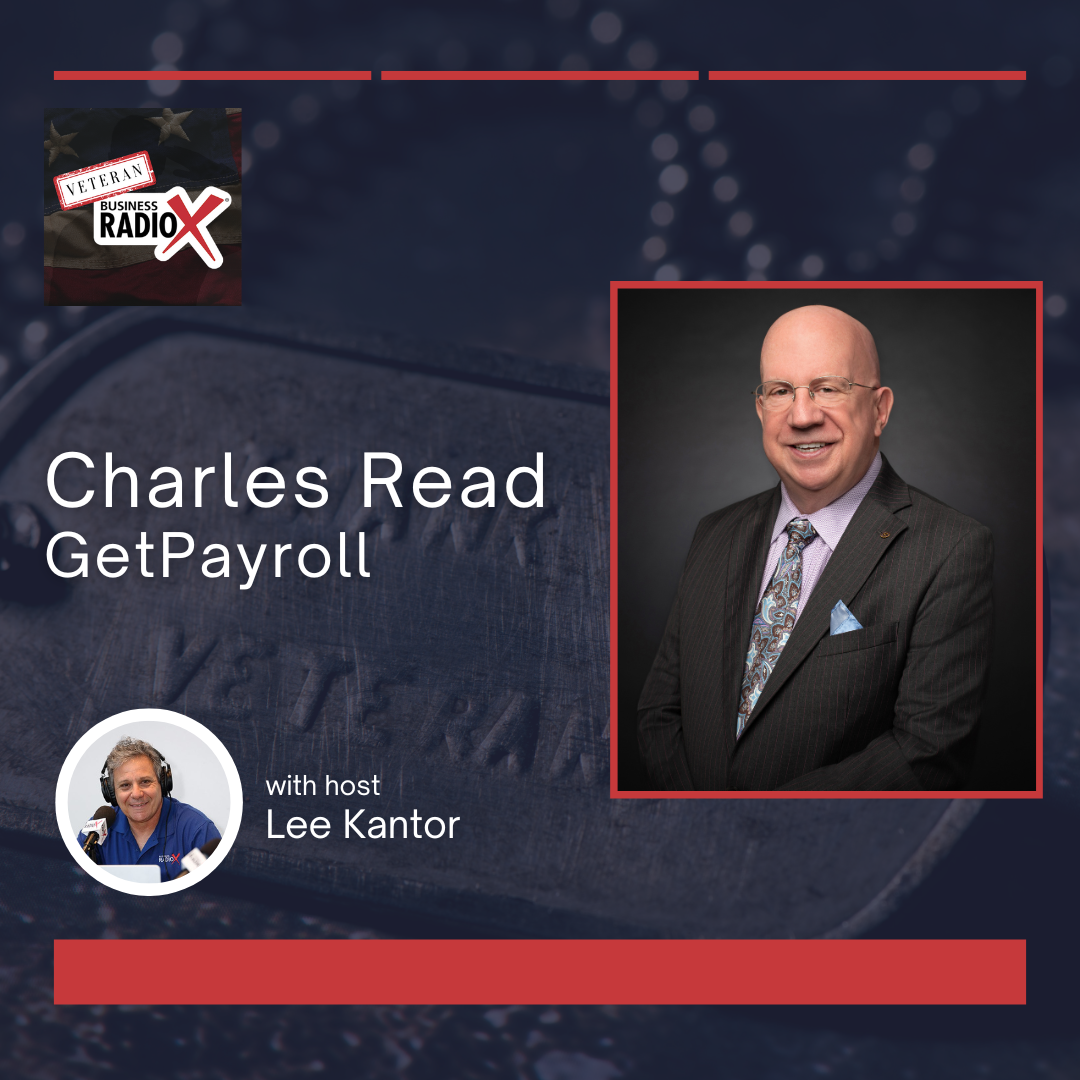

In this episode of Veteran Business Radio, Lee Kantor talks with Charles Read, CEO of GetPayroll. Charles shares his journey from Marine Corps service to payroll expert, highlighting the challenges small businesses face with payroll management. He explains the benefits of outsourcing payroll, staying compliant with IRS regulations, and how GetPayroll supports clients through onboarding and collaboration with CPAs. Charles also discusses common pitfalls, IRS notices, and the differences between payroll providers and PEOs, offering practical advice for business owners seeking efficient payroll solutions.

 Charles J Read is a Certified Public Accountant (CPA), U.S Tax Court Practitioner ( USTCP), a former member of the Internal Revenue Service Advisory Council (IRSAC), a Vietnam Veteran, and the Founder of GetPayroll.
Mr. Read’s companies have provided full-service payroll, payroll tax, and other payroll-related services since 1991.
Connect with Charles on LinkedIn.
Episode Highlights
- Overview of payroll services offered by GetPayroll for small and medium-sized businesses.
- Discussion on the complexities and challenges of payroll management.
- Importance of outsourcing payroll tasks to professional services.
- Charles Read’s personal journey from military service to CPA and payroll business owner.
- Common misconceptions among business owners regarding self-managing payroll.
- The significance of staying updated with IRS regulations and tax requirements.
- Guidance on how to respond to IRS notices and appeals.
- Insights on Professional Employer Organizations (PEOs) and their cost-effectiveness compared to direct payroll services.
- Onboarding process for new clients at GetPayroll.
- Collaboration between GetPayroll and clients’ CPAs to streamline accounting processes.
 This transcript is machine transcribed by Sonix
TRANSCRIPT
Intro: Broadcasting live from the Business RadioX studios in Atlanta, Georgia. It’s time for Veterans Business Radio, brought to you by ATL vets, providing the tools and support that help veteran owned businesses thrive. For more information, go to at vets. Now here’s your host.
Lee Kantor: Lee Kantor here another episode of Veterans Business Radio, and this episode is brought to you by ATL vets, inspiring veterans to build their foundation success and empowering them to become the backbone of society after the uniform. For more information, go to ATL vets.org. Today on the show we have Charles Read. He is the CEO of GetPayroll. Welcome.
Charles Read: Lee, it’s a pleasure to be with you. Thank you for having me.
Lee Kantor: Well I’m excited to learn what you’re up to. Tell us about GetPayroll. How are you serving folks?
Charles Read: Well, we provide payroll services to small and medium sized businesses around the United States. We handle everything. You tell us what your employees, the number of hours they worked. We already know how much they get paid. We do all the calculations. We create the paychecks, direct deposits, get them paid. Then we file all the taxes, all the reports, and do all the interfacing with the IRS and the states and so on to make sure you don’t have to.
Lee Kantor: So what’s your backstory? How’d you get involved in this line of work?
Charles Read: Well, I left the Marine Corps, uh, after four years. Work realized that business did not value military experience then. Just like now. So I went to college, got my degrees, went to work in business, worked in corporate world for about 15 years, got fed up with that and decided to open my own firm, hung up my own shingle as is a CPA and had payroll as a sideline, and payroll has grown and grown and grown and sold off the CPA business. And now we’re a payroll company.
Lee Kantor: So what are some maybe things that business owners don’t appreciate of partnering with a payroll company like yourself, instead of just trying to kind of power through it on their own?
Charles Read: Well, my analogy is when I grew up, Pelé was the world’s best soccer player. A wonderful athlete recently passed. But if you take Pele and you’d put him in a New York Yankees uniform at second base, he would be absolutely lost. He wouldn’t know the game. The rules. Pick up the ball with your hands. He’d still be a great athlete, but he’d be totally lost. So you take a businessman who’s successful at what they do, and now you say deal with the IRS. They’re an engineer. They’re an accountant. They’re a marketer. They’re. They’re a mechanic. They’re a cook. Whatever. They don’t know the IRS. They’re at second base. They’re totally lost. That’s where we come in. We’re experts at this. We’ll backstop you. We’ll take care of all that. We’ll make sure that the IRS stays out of your kitchen and out of your pocket as much as possible, so you just don’t have to worry about it. The time and trouble and cost. You would have to spend to be able to do what we do. You wouldn’t be able to be in business because what we do for a living. So that’s where we come in. We allow you to outsource that to a professional at a pittance and just solve all those problems.
Lee Kantor: Now the companies that are trying to do it on their own, is it something that they start small and then it’s like maybe manageable for 1 or 2 people, and then all of a sudden they got a few people and now it’s getting complicated. And they put somebody that’s, like you said, not an expert. That just is kind of Volun told to do this work, and then they get in over their head.
Charles Read: Well, you’d think that. But in reality, most small businesses screw it up. They get sideways with the IRS. They get sideways with the state, with either the state Revenue department or state unemployment department, because they don’t know what they’re supposed to do. They don’t understand how to classify employees. They don’t understand what taxes have to be collected and paid, when they have to be paid, what forms they have to file. All those things, all those complexities of a business entirely outside of the business they’ve chosen to be in. So yeah, you’d think they could start out small and get away with it, but in fact, they don’t. They get into problems even if they’re just trying to pay themselves as a single employee corporation. That’s what happens. And when they get a little bigger, then those errors multiply and come to the attention. And now it’s way too late. So our suggestion is the moment you have payroll, get a payroll provider. It’s not worth doing yourself. It just isn’t. When I was in corporate world, never tried to do payroll in-house. Just wouldn’t do it. It wasn’t worth it, I knew better. Uh, being a CPA. So, uh, no, they get into problems from day one because they they don’t know what they don’t know.
Lee Kantor: And then this is a situation where the rules are always changing. There’s so much nuance to this that this isn’t something that, like you said, if I’m a mechanic, I can’t be mechanics. And then, you know, learn about the latest IRS kind of new regulation.
Charles Read: I gave up trying to work on my car years ago. I had an milligram and the clutch was going out at 60,000 miles, which they always do. And I had my Chilton book and I opened it up to index and change the clutch. And I went to that chapter and it said to change your clutch. Step one. Remove the engine. See chapter seven. I closed the book and never opened it again. Okay, it’s worse with the IRS because the rules do change. You don’t know what they are, and if you’re not keeping up on them, you will not be current. It’s just like cars change the electronics and cars today. I have absolutely no idea what they do. None. I haven’t worked on a car in 50 years and it changes and it gets more complicated. And mechanics will tell you this, but they know it because they do it every day and they keep up on it. It’s their business. So their current when you take your car in to what’s going on, they get trained in it. I get trained on what’s going on with the Internal Revenue Service. I wish I was on the IRS Advisory Council for three years. Went up to Washington, you know, six times a year to work with them. So yeah, we get the trade journals. I get emails almost daily from from the States and from the IRS about changes. We get the trades. We all. We keep up with that. I don’t keep up with cars. I don’t keep up with a lot of things. I outsource a lot of things because that’s smart business. Uh, and people outsource payroll to us because that’s smart business, because we keep up with it.
Lee Kantor: So let’s let’s try to help our listeners and maybe, uh, share some of your expertise. So hypothetically, I get a notice from the IRS, which probably never is good news. I don’t think they send out birthday cards, but I get a notice. What? What do I do?
Charles Read: Well, first of all, is it wrong? And millions of them are. The IRS makes millions of mistakes every year. They won’t tell you that, but they do. 100,000 civil servants with technology, some of which goes back to the 1960s. So if they say you owe tax and you don’t. Now, if you do, just pay it. But if you don’t write a letter back to them explaining what what your position is, now, they’re going to ignore that letter. I guarantee you the first letter you write back, they will ignore. They will send you back and form a letter saying no, pay up. Your second letter. You may get a response that’s not automated. Canned response. Respond to that anyway. Your third letter then should go to the appeals coordinator, because each letter will tell you what you need to do. The appeals coordinator will actually look at what you’re saying. In all probability, they will deny your your your request to have that penalty abated. And so you continue to appeal it. There’s a whole series of appeals going up through and including Tax court that are available to you, both administrative and legal. And so whenever you’re dealing with a penalty appeal, appeal, appeal, appeal, appeal, you’re looking for that one person that says, yeah, okay. And then just shut up and take that and go away. Uh it will, in all probability happen at the worst. You get to Tax court and you’ll probably get an offer in settlement at some point, uh, for less than that. But the IRS cannot penalize you for simple mistakes, only for gross negligence in in for all practical purposes. So if you’re right. Appeal. Appeal appeal appeal. Sooner or later you’ll probably find somebody that says yes. Now if it’s $10, just pay it. It’s not worth fighting.
Lee Kantor: Now, is there? Uh, there’s a lot of talk about POWs. You have any thoughts on them?
Charles Read: Yeah, uh, I have POWs are an outsource of staff leasing. Uh, after all the legal problems that staff leasing had, they changed the name of the industry to get away from all the fraud convictions and so on. But it’s still the same business. It’s a way to shift tax burdens. Uh, Pose will promise you all kinds of things and charge you a fortune for basically nothing. Uh, we’ve never found a situation where we can’t take a company out of a P.O. and save them at least $1,000 per employee per year. Nobody buys a CPO. They’re sold a P.O.. Uh, the only thing they might do for you is offer you a Cadillac insurance policy for your employees that you couldn’t otherwise get. But you’re buying a Cadillac when you really want afford. So you’re going to pay through the nose for it. That’s about the only thing they can do that you can’t do on your own, or with the help of your payroll provider. We work with our clients, and we have contacts with all kinds of benefit providers that will produce a package that will handle all of this for you. Now, the one thing the POA peaoe does is they say, well, we’ll handle the air for you. But when Sally has a problem with a boyfriend, she’s not going to go cry on the po shoulder. She’s going to come to the boss and cry on his shoulder. So you’re really not getting much benefit.
Lee Kantor: So if I partner with Get Payroll, walk me through. Say, like you said, no business is too small and they should start. So I’m a I’m an entrepreneur, maybe a solopreneur. And I say, okay, I want to hand this off to Charles and his team. So walk me through what that looks like. You know what? What questions are you going to ask me, and what am I going to get for the service?
Charles Read: Well, if you’re a new business, we’re just going to ask you a few questions, get a few signatures because we take a 2848 an IRS power of attorney, limited power of attorney on every client. So we can advocate with the IRS for our clients and actually represent them up through and including tax court. Uh, because I’m not only am I a CPA, I’m also a US Tax Court practitioner, which allows me to represent clients in Tax court. So you’re going to sign a few pieces of paper, provide us some information, you know, names, addresses, rates of pay and so on. Then once per pay period, you’ll go into your computer and say, you know, people work 40, 80 hours, whatever. Or just pay all the salaries and we handle everything else. Send you copies of everything, copies of the payroll reports, copies of the reports. We file notices on what we’ve deposited for you and so on. What happens is you’ll send in the information to for the hours they worked. We’ll calculate that. Draft your bank account, pay out the employees, pay out the IRS, pay out the states, pay out the local taxing authorities, whatever, and file everything for you. So literally, you’re just going to have to keep track of. Sally worked 80 hours this pay period. You’re done.
Lee Kantor: And then. So And when I’m when I’m being onboarded. If I’m new to business, you, I have somebody on your team that’s going to kind of help me with any questions I have. Or is this something I have to.
Charles Read: Absolutely. We this this is this is what we do. We’re going to walk you through everything. Make sure everything is set up properly. Make sure that you get us set up with the states and or the local authorities and the IRS. Get all your numbers get because we can’t we can’t file the reports unless we have the identifying numbers. So we have a an organization that will do all that for you and file all that and make sure everything is, is copacetic. So you just don’t have those problems. So the only thing that’s going to happen. Is if there’s the IRS screws up, they’re going to send you a notice and we’ll fix it.
Lee Kantor: And so all all that’s happening is I have money in my bank account. And then you’re kind of allocating it to the proper places.
Charles Read: Absolutely. We’ll, we’ll we’ll draft your account and make all those payments for you. We do that. Uh, you know, I’m a CPA. I’m a licensed certified public accountant. Um, we do this for clients around the country. We have been in business for a third of a century. So, yeah, we’ll take care of it.
Lee Kantor: And then where does kind of the the, um, scope of work end? So you’re not my CPA. You’re just doing this one specific service around payroll.
Charles Read: Right. We handle the payroll and all the payroll reporting and all the aspects of payroll. Uh, and we handle ancillary payroll services. We can help you with benefits and and HR and employee handbooks and other associated things, uh, that involve payroll as far as your income taxes and your financial statements. That’s not something we do anymore.
Lee Kantor: And so. But you work with, like, my CPA. You’re. You’re.
Charles Read: Absolutely. We can electronically send your CPA the payroll reports in a, in a form that he can take in and put into his system. So it saves you and him time and money. He won’t have to charge you as much because he’s not going to be manually entering payroll reports. He’s going to be getting electronically.
Lee Kantor: So who is the ideal, uh, prospect for you in terms of get payroll? Is it, uh, or is it? I’m sure you mentioned that it’s all over the country, but is it industry agnostic or do you have some niches within certain industries?
Charles Read: We do. We do. You can’t you can’t imagine the kinds of businesses we do. I have restaurants, I have mechanics, I had a prophet who ran a profit professorial center, uh, in, in Lewisville. Uh, we have churches, we have gambling facilities. We have probably the only thing we don’t do is marijuana farmers because the banks don’t like them.
Lee Kantor: But if they’re a legitimate business in America, you have a solution for them.
Charles Read: Absolutely. If they, you know, everybody’s payroll is unique and we do understand that. But we do payroll and we do payroll for all kinds of businesses. So we haven’t. We do we do certified payroll for contractors that are doing federal contracts. If you’re a US payroll, we can take care of you.
Lee Kantor: And and like you said, if it’s a one person shop or, you know, 10,000 employees, you you can handle it.
Charles Read: Yeah. No, I’ll be honest. Normally companies, when they get to somewhere around 3 to 500 people take it in internally. Uh, and, and we understand that, but we have clients in the middle hundred of employees, and we have lots of social entrepreneurs that, uh, have incorporated and therefore they’re an employee and they need to pay W2 compensation and get it all reported. So yeah, we handle one season. We handle 300.
Lee Kantor: Good stuff. Well congratulations on all the success. If somebody wants to learn more what’s the website? What’s the best way to connect with you or somebody on the team.
Charles Read: Well we’re at on the net WW payroll.com. We’re all over the net. Um you can email me at J.R at get payroll.com. And frankly if you got a quick question (972) 353-0000.
Lee Kantor: Well Charles thank you so much for sharing your story. You’re doing such important work and we appreciate you leave.
Charles Read: My pleasure. Thank you.
Lee Kantor: All right. This is Lee Kantor. We’ll see you all next time on Veterans Business Radio.














