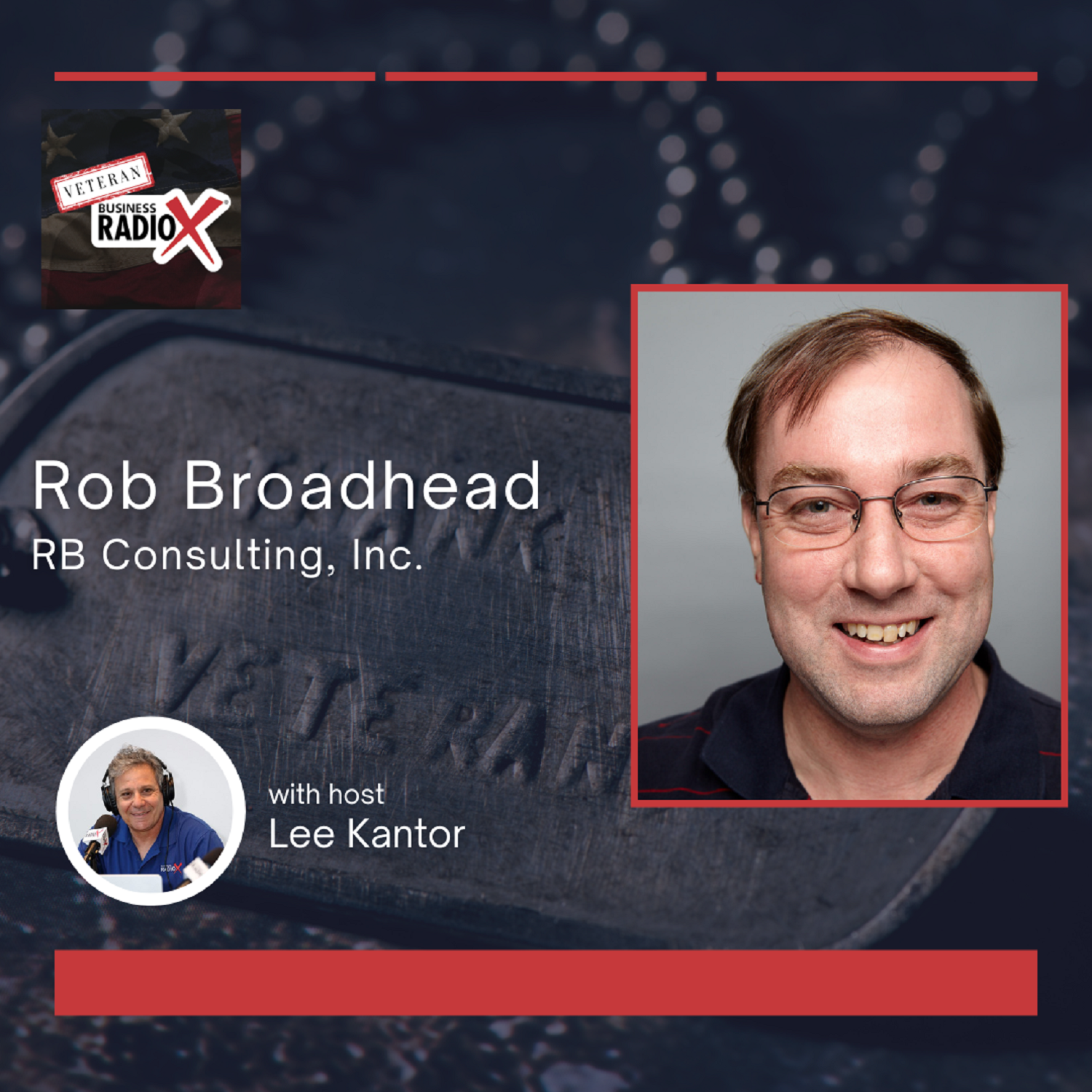

In this episode of Veteran Business Radio, Lee Kantor talks with Rob Broadhead, founder of RB Consulting. Rob discusses how his firm helps veteran-owned businesses leverage technology by first understanding their unique processes and goals. He emphasizes a business-driven, agile approach to technology solutions, the importance of clear requirements, and practical uses of AI. Rob also shares advice on hiring fractional tech leaders and recounts a successful client engagement.

 Rob Broadhead is a seasoned software developer, technology strategist, and entrepreneur with over 30 years of experience designing, building, and leading software projects across industries and platforms.
From enterprise systems to custom solutions for startups and small businesses, Rob has worn many hats — including architect, director of development, database administrator, and mentor — always focused on delivering practical, effective solutions.
In 2001, Rob founded RB Consulting to offer hands-on software development and implementation services. After seeing too many projects suffer from poor planning and technology misalignment, he shifted the company’s focus.
Today, RB Consulting helps clients avoid common IT pitfalls through well-crafted project planning, strategic consulting, and end-to-end development solutions. Under Rob’s leadership, RB Consulting has grown into a collaborative team of skilled developers who share his vision of improving the world through thoughtful, high-impact technology.
A passionate educator and mentor, Rob founded Develpreneur.com in 2016 to help developers grow in their careers. Through blog posts, courses, and The Develpreneur Podcast, he shares hard-earned insights and practical advice focused on growth, leadership, and lifelong learning.
He loves wine, travel (roamingwithrobalie.com), ice hockey, handball, and sharing stories with others through books, blogs, and podcasts. Feel free to check out his latest one page as well. https://rb-sns.com/guestinfo.php
Connect with Rob on LinkedIn.
Episode Highlights
- The role of RB Consulting in assisting veteran-owned businesses with technology integration.
- A business-driven approach to technology solutions, focusing on understanding client operations and challenges.
- Common scenarios prompting clients to seek consulting services, such as growth phases and market expansion.
- The importance of identifying business pain points and strengths before recommending technology.
- The types of businesses RB Consulting typically works with, including startups and growth-phase companies.
- The engagement model of RB Consulting, emphasizing client empowerment and ongoing support.
- The cautious approach to integrating artificial intelligence (AI) in business processes.
- The significance of clear communication and precise requirements when utilizing AI and technology tools.
- The agile project management methodology employed by RB Consulting for technology implementations.
- Advice for hiring fractional CIOs or CTOs, focusing on alignment of values and understanding of business challenges.
 This transcript is machine transcribed by Sonix.
TRANSCRIPT
Intro: Broadcasting live from the Business RadioX studios in Atlanta, Georgia. It’s time for Veterans Business Radio, brought to you by ATL vets, providing the tools and support that help veteran owned businesses thrive. For more information, go to ATL vetsource. Now here’s your host.
Lee Kantor: Lee Kantor here another episode of Veteran Business Radio and this is going to be a good one. But before we get started, it’s important to recognize our sponsor, ATL vets, inspiring veterans to build their foundation of success and empowering them to become the backbone of society after the uniform. For more information, go to ATL vets. Today on the show we have the founder of RB Consulting, Rob Broadhead. Welcome.
Rob Broadhead: Thanks a lot. Happy to be here.
Lee Kantor: Well, I’m excited to learn what you’re up to. Tell us about RB Consulting. How are you serving folks?
Rob Broadhead: Well, we help businesses find a way to leverage technology to do business better. And actually usually that starts with sitting down with them and talking about their business instead of it being a technology forward approach. It really is business driven. We find that processes are very important, and getting those out of the head of the the leaders and the owners of companies can sometimes be a little bit of a it’s an excellent practice, and that’s usually the most important first step, so that we can really help everybody understand and be on the same page with how things work, how the business is organized, what matters to it, and honestly, sometimes what doesn’t. Setting those proper priorities. And then from there, then we can talk about how to leverage all of the all of the blessings that technology can give you today without hopefully without, while avoiding all of the curses and the sprawl and all the other things that are the headaches that sometimes causes us.
Lee Kantor: Now, what is kind of the pain your clients are having right before they call you? Is are they coming to you because, like, they got a ransomware attack or something bad. Their computers have crashed. Like, are they coming for you to triage something? And then you start having these strategic conversations? Are they kind of having other kinds of problems within the business that, you know, a fractional CIO or CTO could help them?
Rob Broadhead: Uh, it is it is usually not a a fire erupting per se, like a security breach or something like that. Um, we actually and honestly, our ideal customers are those that it’s really more they are in a situation where they are, uh, for lack of better words, stuck where they’re, they’re at a point where they’re, you know, they’re making a change. Either the business is growing, uh, they may be launching a new line of products or going into a new market, or it may be a brand new business. So it is where, you know, owners are in a situation where they say, you know, the business leaders are in a situation where they say, you know what? We’ve we’ve got to prepare for this next phase, and we’re really not comfortable or not real sure on what we have. Uh, a lot of times, also acquisitions that’ll happen where there’s you’ve got a lot of technology. You may even have a big team, but you’re really not comfortable with what they do, what they provide, and how are they going to help you move forward. And that’s where we start having those conversations and say, okay, well let’s see. Let’s see what you got and let’s, you know, go to the war essentially go to war with the Army you’ve got with you.
Lee Kantor: And then what are some of the things you’re asking them in those initial conversations, like, do you have to know their kind of their tech stack. You have to understand kind of what you’re dealing with before you kind of can make recommendations.
Rob Broadhead: Yeah. But really usually the first question is going to be tends to be much more. It’s non-technical. We’re talking about things like what are your pain points? Where are your what are your strengths and weaknesses of your business as you see it right now, it’s things like, you know, are you really great at customer service? Are you, uh, are you delivering your products on time or are you having problems with that or are you having problems with your vendors? Are you having challenges communicating with your staff? There’s a lot of these. There’s a lot of things that just businesses can run into. And that’s where we start, because we want to figure out where the low hanging fruit is. What are the things that we can look at first to try to solve, to give you that, you know, benefit as soon as possible? And then as we get into that, that’s when we start talking more about, okay, now that we’ve got the, you know, the 50,000 foot view, let’s drill into some of those things and talk about how the organization is laid out. Uh, what are the, you know, the details, the nitty gritty details of things like your technology stack? Uh, some of it also a lot of it is where are you located? Are you a single headquarters or single location? Are you multiple? Are you a virtual company? Uh, because all of those things come into play when we’re trying to recommend, we’re going to recommend a solution because we’re not coming at you from a, you know, for example, like saying that we’re a Microsoft provider. So we’re going to recommend you the best way to use Microsoft Tools or the best way is to use Oracle. The best way to use whatever your you know, the technology does your is. Instead, we’re going to start from your business and figure out a right size solution for your business and where you’re at business wise, the vertical you’re in, and even geographically in the staff that you have to try to get the best fit for you.
Lee Kantor: So what is kind of the size and number of employees of a typical client? It are you working with kind of one person startups, or are you typically working with enterprise level organizations like who’s your best fit client?
Rob Broadhead: Our best fit tends to be, um, two. There’s really two fits. It is it’s startups. Because the nice thing there is, you have a, you know, completely clear whiteboard of what you can talk about, where you want to go. You can keep it really around their vision and their budget and then build a solution there. But also, um, probably even the people that need us the most, the most are those that have, uh, we refer to it as they’ve gotten out of the survival mode, and now they’re getting into the growth mode of their companies, so they’re usually a couple of years old. They could range from five to 50 or 100 employees. And they’re in the, you know, maybe in the low millions of their, their revenue. But they’re they’re sitting to a point where they said, hey, we’re we’ve been working our butts off. We’ve we’ve scrambled, we’ve scratched, we’ve clawed. And now we feel like we want to make this sustainable because, you know, working your butt off all the time is is not sustainable in the long run. And so they’re ready to get into that growth. And that’s where we’ll say, okay, well let’s look at what you’ve built and what you’ve got. And how do we turn that into systems and processes and automation and things like that that will help you grow and scale, uh, without, you know, running you into an early grave.
Lee Kantor: And when you work with them, are you coming in to kind of do that project and it ends there, or is this something like once you start working with them, you want it to be kind of an ongoing retainer type relationship where you’re monitoring and maybe you’re watching their back and staying ahead of things before they turn into problems.
Rob Broadhead: Ideally we like to we’re we’re we believe in the, you know, teach a man to fish over giving them a fish kind of approach. So we try to do what we can to put systems and people in place so that they can move forward. Somewhere along the way, they can move forward without us. We start with a recommendation, an assessment and recommendation, and sometimes the organization is set to go from there. Usually they’re going to, at least in the first couple of steps, are going to work with us to, you know, to help get things in place or to help. Just make sure that everybody’s on the same page. Uh, sometimes it sometimes it does take a while because there’s sort of a pilot project. And then once that gets in front of people, then the owners say, oh, wait, now that we’ve got this, we can do that, and then we can do this other thing. Uh, sometimes it takes a little while, but our goal throughout all of that is to not be, um, we don’t want to be, you know, we want you to give us a call because you’re just saying, hey, things are going great as opposed to just feeling like you’re constantly having to come back to us and ask us for more.
Lee Kantor: Now, how are you handling your conversations with your clients or prospective clients when it comes to AI? I mean, that seems to be, uh, all over the place and people. I mean, I would imagine they in their head, they think they know how it could help, but in reality, it’s not going to do what maybe they picture in their head. How do you have those conversations?
Rob Broadhead: Uh, it’s I’m chuckling as you ask that. We just, uh, I also have a podcast that I do, and we just had a conversation for an hour with, uh, somebody in the, in the exactly the same space where we, we talked about AI and the, the challenges, particularly from a business owner point of view. And with those, uh, we are you know, we’ve been researching it and it’s the level it is today. There’s not too many people that are going to be very far ahead of where you’re at as a business owner. But, um, technologists like us that have worked with it and smart systems and things like that for a few years, we’ve we’ve got at least we’ve got an eye on where you can go. Uh, a lot of times it’s we start with caution. And, um, for myself, I’m a big fan of caution and proof of concepts or, um, you know, minimal viable products or something like that to say, let’s, let’s talk instead of slapping AI at something, let’s go back to, like, what are you really trying to solve? And then once we look at understand the problem and the solution, then we can look at where AI can be applied to it. Um, there’s a lot of there’s a lot of things that people think AI will fix that it won’t or at least won’t right away. Uh, and even more of them that you have to yes, you can use it, but you have to be very intentional and understand what you’re you’re dealing with when you get into, uh, using AI and what your investments are and what you have to invest in your technology and even your people to make sure that you are getting the most out of that investment.
Lee Kantor: Now, are you, as a software developer, using it when it comes to coding?
Rob Broadhead: I use it extensively. I use it daily. I have used it to, uh. They call. They have this thing vibe coding. And, uh, I guess it’s don’t really use that as much. Uh, but it is a facet of that. Uh, since I’ve, I can write code and understand code and correct code based on what AI does. Uh, plus also we have our best practices and things like that. We’re able to, uh, generate some of the stuff, the stuff we’ve done in the past, uh, where at least it takes us at least at at least half the time, and sometimes quite a bit less to get it done. Uh, there’s, there’s cases where we’re seeing, you know, 70 and 80% productivity gains for the, the direct, uh, the coding part of it, uh, this design side and things like that, not as much, but we, uh, we definitely use it from the coding side, and we use it from a business side a lot. We use it a lot for, uh, for marketing materials and content and things like that to help give us a, a starting point so that we can then, you know, spend a little less time writing that, that nice article instead really focus on, uh, use it for the research and then, you know, gather it and write it up and turn it into something that, you know, that we’ve we are now presenting and not just, you know, a a collection of data points.
Lee Kantor: So if people are working with you, they would be using AI. It might just not be customer facing like it would be happening in the background.
Rob Broadhead: Yeah, most likely there’s there are very few things that we don’t. We there are very few things we don’t try to apply AI in some way, form or fashion at this point.
Lee Kantor: But it’s hard to have your clients kind of utilize it in the way that you’re utilizing it. There’s not a place for your clients to use it as a developer is using it.
Rob Broadhead: Uh, well, for developers, we’re using it to generate code, uh, for our businesses. There’s a for our clients. Uh, there’s there are definitely non coding solutions to AI that we talk about on a regular basis. Um, we actually I have talked extensively about how we think this is going to be Um, this is going to help people and force people to be, in a sense, better managers and more clear communicators. Uh, we’ve a lot of people I’ve seen a lot of people that talk about using having chats with, uh, with AI agents. And I think that is, uh, a really great approach for businesses. There’s a lot of things that you can get from a conversation, we’ll call it with, uh, with an AI, uh, application. You can use it for research. You can get a lot of, uh, out of the box ideas. I’ll give a very brief example is we’re about to my wife and I are about to embark on a lot of travel. Uh, going to a lot of some places we haven’t been before, and we have been able to use AI to, uh, actually, throughout the process, because we’re actually going to be digital nomads. We’ve, we’ve had, uh, AI send us, you know, provide us links and places to go to learn more about, uh, all of our, you know, travel visas and places to rent, um, you know, like Airbnbs and places to stay. Places to go see.
Rob Broadhead: And what are some of the sights and some of the concerns about that area as far as like timing and scheduling? Uh, down to like train schedules and planes? It actually has. We actually evolved our original plan quite a bit based on, uh, AI conversations and, uh, the sort of the rabbit holes. We went down there because there were we had our plan, uh, we had sort of our thoughts roughly of how it was supposed to be. And as we started going down some of the the steps to get there, AI would mention things or say things that led us in a different path. And, uh, we’ve been very happy with what we’ve seen out of it. And I can see that you can take that with almost any topic. So I think as a as a business user, I think that’s, uh, as a business owner, I think that is something that you should, you know, we’ll call it, play around with it and get comfortable with it. Uh, I think it’s here to stay and your competition is going to be using it. So you need to get comfortable as well. And those are some of the conversations we have is like, how do you if somebody doesn’t understand? They’re like, I don’t even know where to begin. Then we’ll talk to them about ways to begin and how to get started or something like that.
Lee Kantor: And you made a good point that they give you links that you should check, because we’re still at a trust but verify stage with this technology.
Rob Broadhead: It will I. My most frustrating conversation I had with this was with an application we were building as it was. One of the things that was doing is it was providing LinkedIn links for people that we were part of, the data that we were pulling back. And even though we specifically said, if you can’t verify the link, don’t give it to us, it would still generate a link and give it to us and say it was valid. And we’re like, no, it’s not. So we finally had to say, just don’t even don’t even try to add that into the information because it was it was effectively lying to us.
Lee Kantor: Yeah. When I recommend people play with it, um, I think it, it really opens their eyes on what it can do, but also what it can’t do. And to be wary of those kind of limitations. And it is frustrating where you’re like, just do you know you’re supposed to be working for me? And I’m telling you not to give me this, and you keep giving me this like I it like I’m talking to a toddler. Like that’s just ignoring me.
Rob Broadhead: Well, that is that is the best thing I now I’ve heard it from a couple people in conversations. To think of it as AI is like a super junior, like a, you know, an a person, a new hire that is fresh, you know, fresh out of business school or whatever. But they know everything. They have this amazing amount of knowledge, but the communication skills are lacking. And so I think sometimes that’s on both sides. I think it will help us as we look at our conversations to be more, uh, to learn how to be more specific and detailed when we ask questions of it, because AI is sort of unforgiving in that sense. So if you leave something out, uh, sometimes you will end up getting completely the completely wrong answer. And honestly, if you don’t understand what you’re asking, uh, then you can end up in a in a very bad place. Uh, we’ve I’ve seen more than a few, uh, basically rapes that have been built obviously through AI. And it is it actually ends up being nonsensical because I think it’s because the person that did it, you know, had a very, uh, general idea. They said, hey, go do this. And they didn’t understand where they needed to tie down some of the details. And sometimes they don’t even they didn’t understand what, uh, what they were asking for, for lack of a better term. For example, like if somebody says, hey, I need a CRM for my, my business. Well, you know, we all sort of know, okay, that’s a customer relationship management application. But there’s that is a big wide umbrella. And there’s a lot of things that can be involved in that, that you may or may not understand if you’re, you know, as far as building an application. And if you try to just have AI do that for you, you’re probably going to miss out on a on a lot of pieces or get some stuff that, like I said, sometimes it’s just conflicting data.
Lee Kantor: Yeah, you have to know how to write prompts. And um. It’s not you can’t be kind of general or broad that that’s opening up a can of worms.
Rob Broadhead: Yes.
Lee Kantor: Now, how, um, when you’re working with your clients, how, like, how do you kind of at the end of the project, how do you know it’s time to high five or hunker down and and do more? How do you measure success?
Rob Broadhead: We tend to do it in, uh, I love to do like phases or versions. Usually now it’s, it’s phases because even, uh, even though we’ll the approach we take uh, is based off of something called the agile approach. And one of the key things that we work with is regular, uh, usable, as they call it usable software. And so we try to do is we try to take whatever the project is and then break it down into, uh, steps or phases, where along the way we will put something in front of the customer. They’ll be able to see what’s there. They’ll be able to have some usefulness out of that application. And we’ll usually start with, uh, you know, x number of features and functions and sort of where we want it to go. And as we are building out those releases, then we will there’s an evolution of that that either is, uh, an expansion where it’s like, well, hey, we really need these additional features, or sometimes it’s reduction where it’s like, oh, hey, since we’ve got this, we don’t need these other things that we thought we needed. And there is a it ends up being it’s there’s definitely an art to it is finding, uh, good logical stopping points. And it very much varies from project to project because it has to do with what they have in place as far as, uh, their team and their systems, uh, because sometimes they don’t have if they don’t have it, if they don’t want to hire any IT people, they don’t want to outsource stuff, then if they want to do any additional features, then, you know, we’re going to have to come back and do it.
Rob Broadhead: But even then we try to do it in a sort of like essentially a project based a finite definition of what that product is. And we even start at the beginning of a project and talk about like what is what is done mean? Like, what are the things that we even if we’re not sure all the features, what are the key things, the why for this project that we’ll be able to look at all the time and say, you know, if we lay down at the beginning, the project, there’s three things that we needed to do. Then as we’re going through the project and we’re, you know, maybe features are being scoped in and stuff like that, we can look at it and say, well, does this serve the purpose of those three things that we talked about? If it does, okay. But if it doesn’t, then do we, do we want to expand it or not. And we just it really is it’s a constant, uh, really. It’s a constant check, you know, on a regular basis to check in and just say, okay, we are we doing what we said we wanted to do? Are we on track? And then you end up sort of walking it in at that point to say, okay, now we can start knocking out the tasks that need to be done to get that, uh, to a completion phase.
Lee Kantor: Now, um, is there any advice you would give somebody who is hiring their first kind of fractional CIO or CTO? Is there some do’s and don’ts that you recommend people follow?
Rob Broadhead: Um, I think for any hire, one of the things I always say is, is get to know the person to some, you know, interviews are okay, but usually like a second interview, it’s a it’s not a skill or experience interview where you can just sort of get to know the person, particularly like a fractional CTO, CIO level. You want somebody that you you can personally work with, that you feel like they have a lot of your same, uh, your same values and vision and things like that, because you don’t want somebody that comes in and has a very different approach to, to business and maybe even a view of the world than you do, because this is somebody that’s going to be helping you achieve, you know, achieve your goals. So I think that would be part of it. And the other is, is talk to them about your the problems that you have and you should be able through that that conversation. Uh, get from them some ideas of how to solve those problems. And if the solutions that they’re saying make sense, they, they are in line with like what you would do or I mean, they and they may be completely innovative, so they may be completely new. But in hearing them you’re like, yeah, that that makes sense. That’s a that would be a logical approach. Uh, but then great. But if they’re saying things that don’t make sense to you or that seem in particular that seem, um, for lack of a better term, ignorant of your, your business and your model and your industry. Then maybe you want to, you know, that’s where a good clue to red flag to maybe move on to somebody else. Because there’s when you get into that level, when you got people that are helping you define and automate your processes, you need somebody that also, um, either knows your business like you do, or you feel like they are going to be able to step in and understand it enough to be able to, to do those processes.
Lee Kantor: Is there a story you can share that maybe illustrates how you’ve successfully worked with a client. Don’t name the name of the organization, but maybe share the challenge they had when they started working with you, and how you were able to help them get to a new level.
Rob Broadhead: Um, I’ll go. One with was, uh, it was actually a whole series of it was an engagement that lasted for quite a while, and it was a lot took a lot of different roles. Uh, when we initially stepped in, when they initially talked to us, they needed somebody to help them evaluate their systems and their their team. They’d been around for decades. Their team had been around for decades. I think the the most junior person in the organization had been there like 24 years or something like that. So this was a a set solid team. There was actually the one of them was sort of getting to the point where they were going to retire, and they’re just been, you know, things that the company, the organization was used to and, uh, the, the leader, the head of the department said, you know, I’m not sure if this is. Is this normal or not? It was one of those like, you know, let’s let’s do a little check in and see what happens. So brought us in and we took a look at their their all of it, their systems, their processes, their team. We interviewed all of them. We talked to a lot of the other department heads and ended up, uh, saying, you know, they they actually did have a really good team. They weren’t, you know, they weren’t knocking stuff out of the park, but also they were actually they didn’t have the resources to do. So. Um, they were able to sort of, you know, they were able to get the job done and for the salaries and the price they were getting paid, they were paying for in that it was like, this is you’ve actually got a pretty good deal going here.
Rob Broadhead: Uh, but within that, that was also we got to know the team. So as the one, um, you know, the, the one department manager retired then we actually continued to work with them. We helped them with a couple of their technical issues. We helped them go, uh, really we didn’t. I guess we did do a little bit of an interview of their what the the replacement IT person became, uh, but also really a lot of it was helping them build out like a job posting and and job requirements and to help them figure out like, what are they looking for to replace this person because, you know, it was somebody that had very niche skills that was in their department that they could try to find that, but you wouldn’t find them in a way that would be affordable. Versus we said, well, here’s what you can do. Here’s how you can massage it. These are the kinds of people you can work with that you can bring in. And they will they’ll be able to learn what you need them to learn, but also be able to help you grow and have a modern approach. And it ended up being great, had a great relationship with all of them throughout, and ended up being one of these things that it’s like, like some of your best business relationships. There was a whole lot of like personal things that came out of it, and a lot of great ways we were able to help each other. So it was, uh, those are the kinds of things you the kind of, uh, projects and engagements you love to have.
Lee Kantor: So if somebody wants to learn more, have a more substantive conversation with you or somebody on the team, what is the website? What’s the best way to connect?
Rob Broadhead: Uh, RB consulting site is rb dash SNS. Sam. Sam. Um, you can shoot me an email. Rob at rb Swns.com. And also, I’m fairly active on LinkedIn so you can find I don’t think there’s a ton of raw broadheads. And I’d be the one that’s, uh, I think it’s got me listed as RB consulting, so it’s pretty easy to find in a search. And I’d love to have talk to people. And there is on the site, there is a couple ways links to get Ahold of us, uh, either to do a free 30 minute call just to, to have a phone call, a zoom call. Uh, and also we’ve got, uh, sort of like an introductory technology assessment that you can do if you want something that’s a little deeper.
Lee Kantor: Well, Rob, thank you so much for sharing your story today. You’re doing such important work and we appreciate you.
Rob Broadhead: Thanks a lot. Thanks for having me. I appreciate being here.
Lee Kantor: All right. This is Lee Kantor. We’ll see you all next time on Veterans Business Radio.














