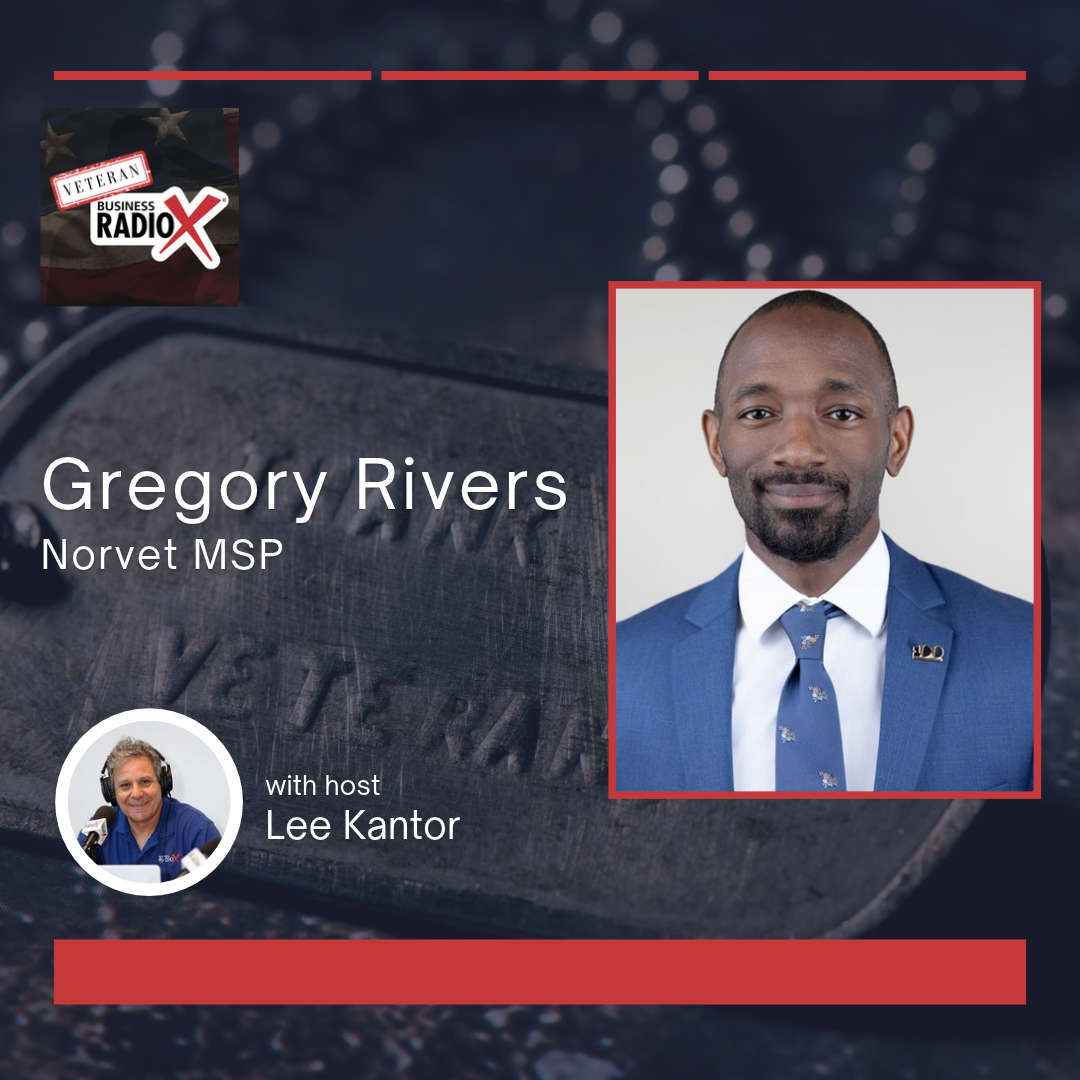

In this episode of Veterans Business Radio, Lee Kantor interviews Gregory Rivers, CEO of Norvet MSP, about helping small businesses simplify technology, strengthen cybersecurity, and build reliable IT systems. Drawing from his Marine Corps experience, Gregory shares how discipline, communication, and mission-focused leadership shape his approach to business. He discusses the importance of proactive IT maintenance, protecting against cyber threats, integrating technology effectively, and reducing unnecessary payment processing fees. He also highlights how Norvet MSP helps business owners focus on growth while leaving their technology needs in capable hands.

 Gregory Rivers is a service-disabled Marine veteran and the founder and CEO of Norvet MSP, a technology company based in Lithonia, Georgia.
Norvet helps small and mid-size businesses figure out, buy, set up, protect, and support their technology, so owners don’t have to become tech experts to run their business.
He has more than 15 years of experience in managed IT, cybersecurity, and infrastructure, and he serves on the Decide DeKalb Technology Advisory Council. His specialty is explaining technology and card processing fees in plain language business owners can actually use.
Connect with Gregory on LinkedIn, Facebook, and X.
Episode Highlights
- Simplifying technology and IT management for small businesses.
- Strengthening cybersecurity through multi-factor authentication and regular security checks.
- Preventing cyberattacks with proactive monitoring and employee awareness training.
- Building integrated technology systems that solve real business problems.
- Reducing unnecessary credit card processing fees and technology expenses.
- Applying military discipline, communication, and accountability to business leadership.
 This transcript is machine transcribed by Sonix.
TRANSCRIPT
Intro: Broadcasting live from the Business RadioX Studios in Atlanta, Georgia. It’s time for Veterans Business Radio, brought to you by ATL Vets, providing the tools and support that help veteran owned businesses thrive. For more information, go to atlets.org. Now, here’s your host.
Lee Kantor: Lee Kantor. Hear another episode of Veterans Business Radio. And this is going to be a good one. But before we get started, it’s important to recognize our sponsor, ATL Vets, inspiring veterans to build their foundation of success and empowering them to become the backbone of society after the uniform. For more information, go to atlvets.org. Today on the show, we have the CEO with Norvet MSP, Gregory Rivers. Welcome.
Gregory Rivers: Hi. Thank you.
Lee Kantor: Well, I’m excited to learn what you’re up to. Tell us about Norvet MSP. How are you helping folks?
Gregory Rivers: Yeah. So MSP came about to for us to really help out businesses. Uh, we want to help small businesses figure out by set up and protect, uh, their technology so the owner doesn’t have to become the tech expert. So most of the time I spend a lot of my time just translating tech and car fees and into plain English so they can understand what they need.
Lee Kantor: So what’s your backstory? Can you talk about how you discovered your skills in this area and how you wanted to serve the business folks out there who are struggling?
Gregory Rivers: Yeah. So, uh, well, I come from a natural background of technology. I couldn’t run from it if I tried. And I definitely tried. My uncle, my father, pretty much all the men in my family were engineers, so I couldn’t. Tried my best to run from it. Then I went to the Marine Corps to run from it, and that was more the mission first thing. And, you know, learning how to be disciplined and, you know, work with a plan and backup plans and know truly owning the outcome. That was pretty much what I really learned from that.
Lee Kantor: So the owning the outcome that stuck with you in your business career?
Gregory Rivers: Absolutely, absolutely. You know, it’s keeping the people connected and understanding what’s going on. You know, being a radar operator in Marines, you kind of understand communication is huge, right? And as an engineer, you kind of get isolated and very. What is it called? Quiet sometimes, right? You don’t want to talk to people. But that’s the biggest key. And to me, the biggest gap between it and, and people in this time period.
Lee Kantor: Now, when you’re working with the business owner, like you mentioned, most of them aren’t experts in technology, but they know how important technology is, and they lean on technology quite a bit. How do you help them? Kind of. How are you the bridge to help them get what they want, without getting bogged down with all the expertise necessary in order to solve some of these complex problems?
Gregory Rivers: That’s a great question. You know, the first question I start with, what’s slowing you down or causing you money? Not what software do you use or how does your business work? What’s slowing you down and what’s costing you money? Because if we can understand how your business works, you know how your business model needs to improve, then we can actually get you some actual solutions, right? Maybe it’s just something as you need backup Wi-Fi. Maybe it’s something that, you know, you need a good phone system you can use or a password, uh, uh, login that that can help you have one, place to have all your passwords for the business or any tools that this can help solve something that’s really real instead of, uh, you know, here’s a tool that you can do all your marketing, here’s a tool. Can you do all that? That doesn’t solve a problem that just adds to the bills.
Lee Kantor: Yeah, I see that quite a bit. Like all of a sudden a small business owner, they read a blog or they watch a video and all of a sudden they’re like, oh, I need that. That’s what that’s what’s missing in my business. And they just keep adding to this tech stack. And the tech stack doesn’t talk to each other. Each thing is doing its own thing. And like you said, it causes more problems sometimes than what you started with.
Gregory Rivers: Absolutely. And I think that’s one of the biggest problems in our society right now is that business owners don’t have the time to actually set it up and integrate it, and then train our team or train themselves on how to actually use it correctly.
Lee Kantor: So what is the typical place where you begin? Do they are they coming to you because they had a problem? Like all of a sudden? Maybe they get some, you know, they they’ve been hacked or they got some, um, you know, their emails not working or something happened in their business where it’s, they can’t fix it. And it’s not like, you know, you if in your house, if the, if the faucet’s leaking, you’re like, I’m going to call a plumber. But, but like any one aspect of your business, you don’t think of calling an IT person usually.
Gregory Rivers: And that’s truly what usually happens is it’s usually a problem. Or when a business first starts, um, they kind of get bogged down. So the biggest problems that we usually see is that, hey, their former IT company is not doing their job and they want, they’re starting to look at other companies. And that’s usually our biggest point of entry. And then from there, it’s, um, hey, we’re just doing a new build out. We are moving to a new location. We are growing too fast. You know, that’s usually when we see our customers. Want to talk to us? Um, they start to understand that I can’t just be that, uh, that whiteboard operation anymore. It needs to be more of a solidified solution with or without me.
Lee Kantor: So you help people kind of transition from like, um, maybe a cobbled together a series of, of, of software into one integrated system that everything’s working, you know, hand in glove.
Gregory Rivers: Absolutely, absolutely. That true white glove service and helping guide them to what’s their next step is because sometimes you just don’t know what you need. Right. Um, I know a lot of businesses, they don’t for the small business, when they first start, they don’t know they need a CRM. Right. And what a CRM is, or even a point of sale, like how do you actually get the money into your actual business, into your bank account. Those are really big things because we think of, you know, we can use. Not for very micro businesses. They can use Cash App or Zelle to take payments. But. That’s not something that banks want to see when they actually want to give you loan offers or grow your company or investors.
Lee Kantor: Now, there’s so much, especially lately with kind of these, um, cyber outages and cyber attacks that are happening. Is there any advice you can share with a small business owner to protect themselves from some of this noise that’s out there nowadays? Because it seems like it’s affecting really big businesses and it’s really obviously disrupting the economy as a whole. How does a small business protect themselves from some of these things that are happening? It seems like from a nation to nation level.
Gregory Rivers: I’m so glad you asked this because, you know, just over the last. What last week we’ve seen Microsoft go down. We’ve seen, uh, F a go down right now. Uh, the NSA. And, um, even, you know, issues where possibly Nvidia could have been compromised as well. Uh, small businesses right now truly need to use multi-factor authentication, right? Um, MFA or 2 or 2 ways to authenticate who you are to get into your accounts. I know I get it, it’s a, it’s a pain in the butt, right? It’s a different, uh, way to log in and it may feel like it slows you down, but I’d rather you’d rather be slowed down just five seconds more or a minute more than to have all your information out and blasted with and somebody trying to ransom you for, you know, thousands of dollars so you can get back into your account. Um, we, you know, we’re seeing the major attacks to, to the bigger companies, but the small companies are getting attacked right now too. They definitely are.
Lee Kantor: Now there’s been, um, some of the things in Europe that’s been happening with the refrigeration systems. I read that that was just because those people never set a password on some of these, uh, internet of things devices that they have around their, their business and they just assume that it was safe. Is that another area of weakness for some small business owners?
Gregory Rivers: Yes it is. And, you know, even how to secure a, uh, you know, how to write a good password is the problem. So usually when, when companies set up their, um, their networks and their devices, you know, sometimes it’s just their, their nephew that’s doing this or themselves. So instead of trying to, you know, make a complicated password, they just make it something simple or leave it as a default. And now everybody knows who that default is, especially a criminal, right? They can just Google these things and see what it what it may be. Uh, another thing I see people using is like Claude and ChatGPT, they created their own, you know, application or software or their vibe coding, not realizing that when you upload these things, you got to secure them as well and you’re showing the passwords. So the good thing is these things can be fixed very quickly. All it takes is a few minutes. I like to, uh, have, have my customers do a tech hygiene day when we first start or once at least once or twice a quarter, just to make sure that everything is what it’s supposed to be when the first time you’re going to do it. Yes, it’s going to take maybe a day to get it done. But once you get into a routine, it probably taking less than five minutes just to make sure that everything is correct.
Lee Kantor: And isn’t that difficult with a lot of business owners, they don’t like to do preventative things like that. It always it seems like they wait until something bad happened. Then they have to triage something bad instead of just doing some preventative work. That just takes a short amount of time, but you have to do it regularly in order to prevent the bad thing from happening.
Gregory Rivers: Well, just like anything, right? Car maintenance. Once things start to pile up, you know it gets worse. And if it’s really a mindset and as a business owner, we have to change our mindset of what do we, uh, risk? Do we want to accept? You can’t accept these risks of your company shutting down. I mean, if your company shut down just because of technology, you’re losing thousands of dollars a day. Whatever the value of how much you make a day for your company.
Lee Kantor: So and that’s the thing that you probably see that on a regular basis where the business owner, everything looks fine until it’s not fine. And, and that’s the thing. It doesn’t happen as frequently as somebody like you probably sees it. So the owner thinks they’re okay, but they’re really not okay. They’re just kind of a ticking time bomb.
Gregory Rivers: Absolutely, absolutely. And we, we do see this every day. And we, we see some customers actually get, you know, be hacked from and they call us and try to help them save it. And we have to really negotiate sometimes and report report to the FBI and let them and let the FBI know that, hey, we got an issue where customer’s information may be let out if we don’t get this person out of the system very quickly. And we’ve been successful at getting people out, but it’s not an easy task every time.
Lee Kantor: Now, another part of your business is helping with credit card processing fees. Can you talk about, um, that business? Because that’s one of those things and I’ve been in business a long time. I’ve seen it. Sometimes you get kind of hooked into a credit card processor and all of a sudden the fees just start slowly creeping up and creeping up. And you don’t notice them because it’s a little bit here and there, and then all of a sudden you’re looking at what you paid and you’re like, that’s not what I used to pay at all.
Gregory Rivers: Right? And it’s usually within at after your contract is done, after those first three years. Um, the first person that probably gives you your point of sale or your, you know, your, your processing is your bank, right? And then from there, you don’t never know who, how to switch it again. And you see these fees just again pile up, right? It’s because they write this contract that you probably never really read the terms and services of it. And it’s, it’s written that way for to increase over time. Uh, and if this does happen to you, of course, just reach out to us and we can help you out with that. We can actually set it to being a one flat fee for the rest of your business life. That’s how it should be.
Lee Kantor: And that’s one of those things where, again, it’s an out of sight, out of mind thing that you don’t notice it until you notice it.
Gregory Rivers: But you can check your mission statement. You should always get a mission statement that should go to you, right? You should be able to see where the where those dollars are going, where those cents are going, because those cents add up. I know, um, one of the biggest ones we always see is stripe. Stripe is the major payment processing right now. And usually they take out 2.9%, which you think is, uh, that’s, that’s not bad. And then you get hit with 30 $0.30 per charge. Yes you do. That adds up very quickly.
Lee Kantor: Now, when is that part of your services that you can audit that on a regular basis? Or is it when they switch to what you’re recommending, they don’t have to worry about it anymore?
Gregory Rivers: Oh, no. Once we, uh, once we change it to a service that that works for them and keep them involved, right? The main thing is keeping the business owner involved in what’s happening. They don’t have to look at it.
Lee Kantor: So then that kind of solves the problem once and for all.
Gregory Rivers: Once and for all.
Lee Kantor: Now when you’re, um, you mentioned that there’s, um, a typical point of entry, uh, when you’re working with folks, uh, can you talk about what it’s like? So okay, I raised my hand and I’m like, Gregory, I’m in. I want you to be my IT team. Uh, what does that those kind of what does it look like when we start a relationship?
Gregory Rivers: I love that. So the first discovery, right? We want to actually understand what’s going on with the company. So we actually, if you have a storefront, we like to come to your storefront, um, do a inventory, see what basis, how you guys work, you know, what type of devices that you may have from there, uh, we start our process and offer you a proposal. And then, uh, we will install our remote monitor agents so we can actually be able to access your computers, your devices, make sure that they are working correctly. Uh, and then from there show you how we communicate with you guys. I love as an MSP is that we make sure that we have a technician come on site once a month. This is the preventive maintenance that you don’t have to do. You’re the owner. Run your business. Let us be the IT people. Let us take care of that. You don’t have the time and we get it. But we do want to always have a meeting with you, with your designated IT person every two weeks. Let them know what we’ve done. Uh, understand what you guys want us to do. And then from there, every quarter, we want to have an executive meeting as well. We want to show you guys what’s been going on all the way. We want to be very transparent because if we’re not being transparent, we’re not understanding what you guys needs are. We can’t do our job correctly.
Lee Kantor: Now, um, what is kind of that ideal client profile for you? So obviously they have to have an IT person on staff. Is that the perfect person, or can it be, like you said, maybe somebody who’s just starting out a mom and pop that doesn’t have a dedicated person that maybe they were using their nephew, like you mentioned, is there, do you work with those folks too, or those people too small for you?
Gregory Rivers: Ideally, yes. We like people who kind of already established who does have an IT person already. But no, we do work with those small businesses as well. If you have anybody that can, you know, be able to communicate with us, why you can’t, that’s the perfect situation for us. Um, that it nephew that it niece or somebody that you know that you trust that local person that’s perfect for us because now we’re helping them actually solve these problems faster instead of, you know, you have to get somebody else that you don’t even know or trust to say, hey, come work on my it.
Lee Kantor: Now, being part of the community is important kind of part of your culture and your organization. Can you talk about why it was important for you to become part of the DeKalb Technology Advisory?
Gregory Rivers: Yeah. Uh, you know, I’m so glad that I live in a county where the technology is actually technology started to be a big thing. Um, so a lot of us as community leaders, we came together so we can actually start making sure that our local kids and schools can actually know what we do. Uh, the biggest issue, I believe, you know, as I was growing up, I didn’t know all these different routes and two technology and what MSP was or how I related to like being a, a small IBM or censure. How can we actually help out? So I’m glad that we, you know, we, we do this once a quarter where we have a meeting, we set out what we’re going to do, how we’re going to help the community, how we’re going to, uh, work with schools. And we had, uh, you know, goals that we really wanted to figure out. Like we started just from scratch about two years ago. It’s been very great to be a part of that organization.
Lee Kantor: Now, in your work, is there a story you can share that maybe illustrates what it’s like to work with you? Don’t name the company or the the person that you did the work for, but maybe share the challenge they came to you with and how you were able to help them get to a new level.
Gregory Rivers: Yeah, yeah. So give an example. We, we, we had a, a law office customer where the customer came in, they, they just had been hacked, unfortunately. And they wanted to see how they could truly see how they could secure their services. What we did was we came in very quickly, right? We made sure that there was no one else’s in the system. We authorized that. Only the employees that that was on that was currently hired could still have access. Um, we made sure that their security was affordable for them and then also made sure they had cybersecurity insurance to prevent these issues from happening again. Right. If if these things did happen, they need to be able to have some type of insurer that can help them get back on top. And we was I’m so glad that was happening. Happy to do that.
Lee Kantor: Now, is that kind of a common way that you work together that once you kind of identify the issue, then you’re able to kind of put things in place that keep it on track?
Gregory Rivers: Absolutely. And always, always do some 24 hour monitoring, even if you don’t have again, a great thing about us being in this age is that technology can help us identify these issues and alerts. Um, we do have 24 hour human monitoring as well, but, you know, having these alerts can, can truly see what’s going on and where, where is it coming from? That’s the biggest thing. Where is the threat coming from? Is it coming from email? Is it coming from my network? Is a. Is it coming from a human being that’s on site and locking them out quickly?
Lee Kantor: Yeah. That’s, uh, I’m sure kind of the human element of this is a lot of times at the heart of the problem, right? That the person, uh, made a mistake or they clicked on the wrong thing, or they didn’t set a password up properly. Like it’s a human error thing that the bad guys are trying to exploit.
Gregory Rivers: Yes. And that’s where it comes into, you know, really implement a security training and awareness program. Um, taking five minutes a day, uh, five minutes out of your day, once a week, once a month, just to understand, hey, this can’t happen to you. We do simulate, uh, email phishing attacks as well, uh, just to keep people fresh. And, you know, it can really happen to anybody. It can be your CEO, it can be your janitor, whoever has email access, they are liable to be attacked. And this is why we have to make sure that everybody has access to what they’re supposed to and not have access to everything. And I have to get on my executives, um, you know, our CFOs, our CEOs, CEOs, they want to have access to everything. They want to see everything. You got to trust your team. You got to trust your team. You don’t need access to everything. Because if you do get hat, you’re the main person that really shuts down the company.
Lee Kantor: Now, you mentioned, um, kind of law firms. Is that one of the niches that you serve? Are those kind of professional services organizations like law firms or medical, uh, health care companies or those, the areas that you like to work in.
Gregory Rivers: Absolutely. Uh, we do medical law firms, uh, tax offices as well, uh, professional services when it comes to plumbing, roofing companies. We recently did a roofing company out of my hometown. So that was a pretty cool project to work on. I always love working in, um, for the state of Georgia. Man, I’m born and raised here, so giving these business owners an opportunity to grow that makes my day.
Lee Kantor: Well, if somebody wants to learn more, have a more substantive conversation with you or somebody on the team and maybe get ahead of something before it really bites them, what is the website? What’s the best way to connect?
Gregory Rivers: Yeah. So our website is www.norvetmsp.com. And then or you can just give us a call at (833) 281-9898. Uh, thank you again, Lee. This has been a great, great time. And I think buyers as well.
Lee Kantor: All right Gregory, well, we thank you. We appreciate you coming on and sharing your story. You’re doing important work and we appreciate you.
Gregory Rivers: Thank you.
Lee Kantor: All right. This is Lee Kantor. We’ll see you all next time on Veterans Business Radio.