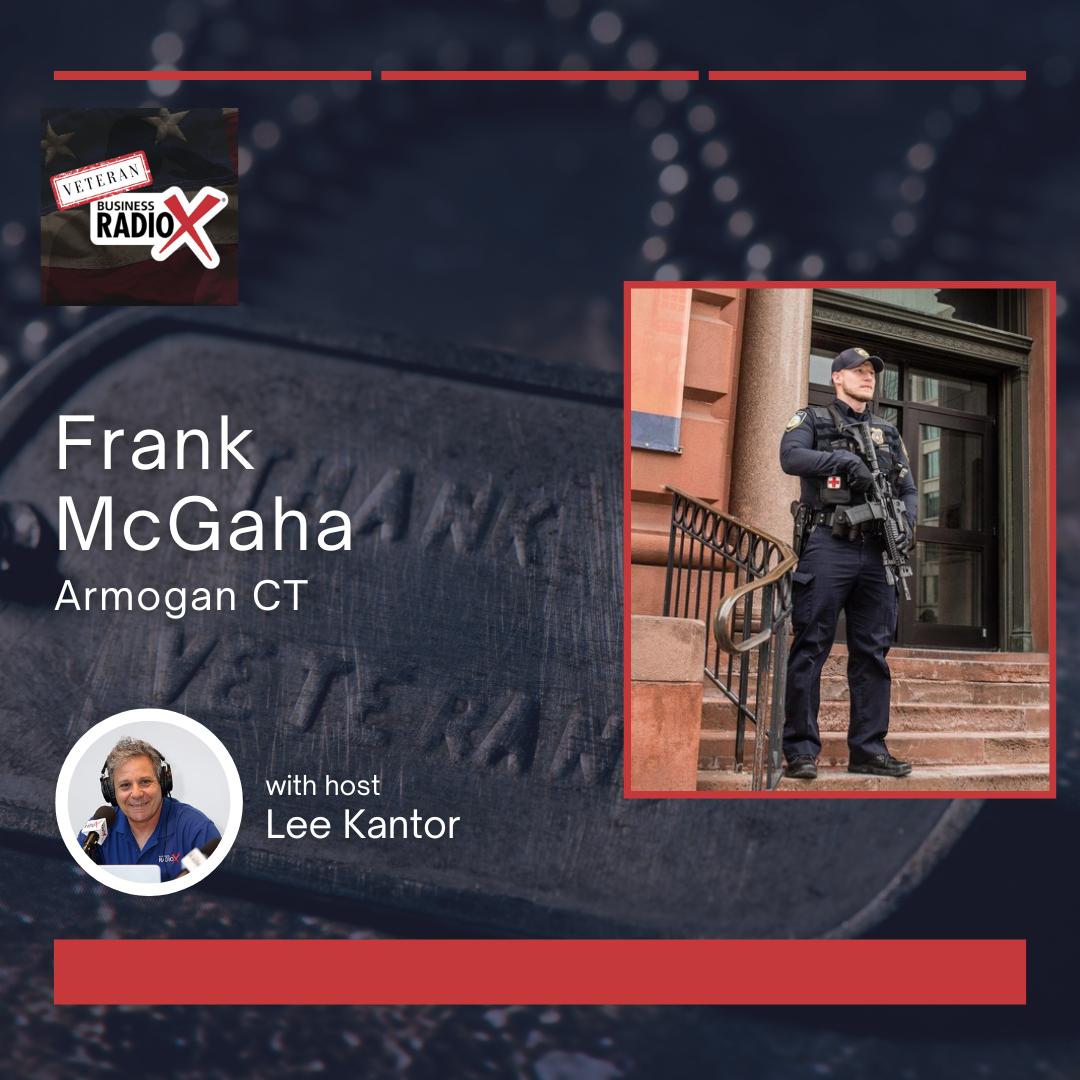

In this episode of Veteran Business Radio, Lee Kantor interviews Frank McGaha, founder of Armogan Consulting and Training. Frank, a Navy veteran and former federal law enforcement officer, explains how his firm helps candidates — particularly veterans — navigate the complex law enforcement hiring process. He describes services ranging from online courses to one-on-one coaching, helping candidates avoid common pitfalls like misunderstanding legal terminology during polygraph screenings.
 Frank McGaha is a seasoned federal law enforcement professional and training specialist with a career grounded in service, integrity, and operational excellence.
Before entering law enforcement, Frank served six years as a U.S. Navy helicopter crew chief and gunner, completing three deployments to the Middle East and leading high-risk aviation operations.
Following his military service, Frank transitioned into federal law enforcement with the National Park Service, where he operated as a remote and backcountry law enforcement officer.
In this role, he conducted a wide range of enforcement operations and served as a lead responder for high-risk search and rescue missions—experience that shaped his belief in decisive action, ethical conduct, and the importance of rigorous training.
Episode Highlights
- Overview of Armogan Consulting and Training’s mission and services.
- Assistance for veterans and prospective law enforcement officers in navigating the police hiring process.
- Various stages of the law enforcement hiring process.
- Coaching and training methods offered, including online courses, group coaching, and one-on-one mentoring.
- Importance of ethical policing and community trust in law enforcement.
- Challenges candidates face during the hiring process and how to overcome them.
- The significance of proper articulation and understanding of legal terminology in applications.
- Insights on the future of law enforcement and the potential for cultural shifts within the profession.
 This transcript is machine transcribed by Sonix.
TRANSCRIPT
Intro: Broadcasting live from the Business RadioX Studios in Atlanta, Georgia. It’s time for Veterans Business Radio, brought to you by ATL vets, providing the tools and support that help veteran owned businesses thrive. For more information, go to ATL vets. Now here’s your host.
Lee Kantor: Lee Kantor here. Another episode of Veterans Business Radio. And this is going to be a good one. But before we get started, it’s important to recognize our sponsor, ATL vets, inspiring veterans to build their foundation of success and empowering them to become the backbone of society after the uniform. For more information, go to ATL vets.org. Today on the show we have Frank McGaha. He is with Armogan Consulting and Training. Welcome.
Frank McGaha: I appreciate you having me on. Thank you.
Lee Kantor: Well, I’m excited to learn about your practice. Tell us about Armogan consulting and training. How are you serving folks?
Frank McGaha: Yeah. So we, uh, we’ve kind of branched out into a law enforcement training firm, mostly starting off with new officers, helping new officers navigate not only the police hiring process, but then the early stages of their career so they can set it up successfully. You know, go out there, support the community, be ethical officers, get out there and kind of help build back that camaraderie, that trust with law enforcement in the communities they serve, everything along those lines. That’s the quickest way to sum it up.
Lee Kantor: So what’s your backstory? Uh, what made you the right person to be taking on this challenge?
Frank McGaha: Yeah. Whether I’m the right person or not is yet to be seen. But ultimately, I did, you know, six years in the Navy rotated out after that, got into federal law enforcement, became a backcountry law enforcement ranger with the National Park Service. And then lateraled up to Washington, D.C. with another federal agency. And just throughout my career, I was blessed. I had really good mentorship, really good guidance. My career was able to to take off. I was able to get a lot of training, a lot of instructorship. And then ultimately my, my military injuries started coming back to bite me. And patrolling out there on the street wasn’t conducive anymore. So I rotated out into instructing full time. And then I did what every veteran and law enforcement officer that decides to step back does. And I created a consulting and training firm. And, uh, and then that was, that was rough at first because we were kind of doing a gambit of everything. And then I, once again, good guidance, good mentors from some people, and then just listening to the right people and getting some self-investment and training in myself, I managed to niche down to where we are now, Which now we’re actually expanding and going back the other way and bringing in additional things. But ultimately we’re, we’re, we niche down to law enforcement candidate training and, and prep and everything like that. And it just took off. And we’ve been blessed ever since.
Lee Kantor: So you’re a bridge for a person who says, you know what, I’m thinking about getting into law enforcement and you help prepare them to have a successful career. Or are you part of are you part of the, you know, the, the police academies and things like that?
Speaker 4: So we’re, we’re prior to that.
Frank McGaha: So most people don’t understand the rigors of going through the law enforcement hiring process. A standard hiring process looks like this, a written exam followed by a physical exam, followed by a board interview with, you know, anywhere between 3 to 10 officers or what have you, um, followed by a chief’s interview, followed by a background packet, which is roughly 60 pages of your entire life that you have to get perfectly accurate, followed by a background interview followed by a polygraph prescreening form, which is another, you know, 1020 pages of criminal history, followed by a polygraph pre-interview, followed by the actual poly, followed by polygraph post interview, where they’re actually allowed to lie to you and tell you, hey, I saw that you were lying. What was going on here? Um, followed by a a medical evaluation, a psychological evaluation, both test and interview and then potentially even a community review. So there’s a lot of stages to the hiring process. And a lot of good candidates have no experience or have no knowledge or no, uh, no one to reach out to to help navigate it. And, you know, a lot of things like understanding what legal terms mean when it comes to criminal history can really fry a candidate, even though they might be one of the best candidates out there.
Lee Kantor: So how do you deliver your consulting and training? Is this something that’s one on one group training or is it, you know, do do I do it on my own pace virtually? Like how does it work?
Frank McGaha: All the above. So the way that we do it is we have, um, we have a community and, uh, online course access program or you can go in, you’ll get access to, uh, two instructors and, uh, live calls with myself or even another instructor, you know, weekly, uh, where you can come in, ask questions. That’s one aspect of it. And then there’s some other things in there. We just incorporated our new fitness instructor where she’s teaching two classes a week just in our community and online, um, course access program. And then we have our group coaching where you get assigned a primary instructor, you can sign up for individual calls with them from time to time and everything like that. Plus you get everything that’s in the community, of course, and you get additional community calls as well. And then after that, we have our one on one coaching where you have your primary instructor, you’re in private calls with them for a certain amount of time, going all the way through every stage and preparing you every step, helping you pick the departments that not only are you eligible for that are the right fit based on what you’re telling us, and then walking you through every step of the process for articulation and success.
Lee Kantor: So, um, as part of your service, kind of maybe telling someone, uh, giving them some tough love of, hey, maybe this isn’t for you.
Frank McGaha: All the time, all the time. Yeah. There’s times now ultimately we don’t get to make that decision, right? That’s up to a department. But there’s some critical factors that will, um, that will immediately disqualify any candidate. Let’s take the military for instance. Um, most people don’t understand that if you receive a dishonorable discharge from the military, you can never be law enforcement because you lose your right to carry and possess a firearm. So a dishonorable discharge is an immediate disqualification from any law enforcement role whatsoever. It could be anything along those lines. You know, if you’ve ever, uh, have major, uh, substance use, those can be immediate disqualifiers. Obviously criminal history can be a major, uh, disqualifier depending on what level. Um, now we don’t typically see individuals that have these permanent disqualifiers too often because a lot of times that is a Google away. You can Google, hey, am I eligible for law enforcement based on this? But other times people will just not know how to articulate something as simple as a past traffic infraction. Some people think of past traffic infraction might rise to the rank of a misdemeanor. And miss mark that on maybe their background package or something like that.
Lee Kantor: So, uh, do you mind sharing some advice for that person that’s considering this? What are some of the ways they can maybe, like you said, rearticulate some of their past struggles or weaknesses so that they don’t look that way when they’re applying.
Frank McGaha: Yeah, this is one I typically love a lot. I’ll see this all the time is have you ever have you ever operated a motor vehicle while intoxicated? Um, and most people will mark yes to that because maybe they, they consumed an alcoholic beverage at, uh, at, you know, maybe a party or a restaurant with their, with their spouse or a friend or what have you. Um, but then two hours had passed. They consumed food and water, but in their mind, hey, I consumed alcohol. And then I operated a motor vehicle roughly 2 to 3 hours later. Well, it’s not necessarily based on time. I mean, time has a factor of it, but it’s the laws. Don’t say, hey, you cannot consume alcohol the day or you cannot operate a motor vehicle the same day you consume alcohol. Well, if that was the law, then you could consume alcohol at 1158 at night and then operate a motor vehicle at 1202 the next morning. Right. And you’d be legal. No, that’s not the standard. The standard is were you inebriated? Were you intoxicated and were you unsafe to operate a motor vehicle? The nice part about that is usually there’s a legal standard of 0.08 across the nation. For that. Every country might have a different one. But typically here in the US that’s what it is. So a lot of times someone will say, hey, yeah, I operated a motor vehicle after consuming alcohol. And I tell them, that’s not the question. The question was, was it were you intoxicated? And if you were, you need to put that up whether you were caught or not. But if you consumed, you know, a glass of wine at dinner and then you guys went for a walk and three hours later you drove home. Chances are you were probably not under the standard of legally intoxicated.
Lee Kantor: And that’s something that the candidate might think they’re being honest because especially if they know there’s a lie detector test coming around the corner. So they might be just preemptively kind of eliminating themselves.
Frank McGaha: Yeah, exactly. Something as simple as that. You know, our fastest candidate we ever got hired. We got her hired in under two months, and she almost admitted to three felonies. She’s never committed just because she couldn’t understand the legal jargon of how, you know, things are written. You know, most people will think of, you know, like Grand Theft Auto, right? They think, hey, that’s stealing a car. But in some states, the legal terminology might, might be unauthorized use of a motor vehicle.
Lee Kantor: Right? So they sound the same, but they could be vastly different.
Frank McGaha: Yeah. And someone’s thinking like, oh, yeah, unauthorized use of a motor vehicle. One time I borrowed my mom’s car when, you know, she was out of town because my vehicle broke down and I had to go to work. Well, I didn’t explicitly have permission to borrow it at that time. I’m like, all right, well, were you insured and licensed driver on the vehicle? Well, yeah. Okay. Were you? Was there any reason that you couldn’t borrow it? Was it reported stolen or anything like that? Well, no. Well, then that’s probably not a felony conviction.
Lee Kantor: Right.
Frank McGaha: Of a stolen vehicle.
Lee Kantor: So now that you’ve, uh, worked with, I would imagine at this point, it’s thousands of candidates, right?
Frank McGaha: At this point, yeah.
Lee Kantor: What is kind of what’s your gut feel about the future of law enforcement? Are you okay with how, uh, you know, are these future leaders entering the field? Are you are you bullish or bearish?
Frank McGaha: I’m always optimistic because you have to be right, at least from my point of view. If I didn’t feel that I could make an impact or that there wasn’t hope, then what’s the point of even doing it? Um, so yeah, I’m very hopeful. You know, the big thing that I found with the law enforcement officer, let’s, let’s go to the veteran, right? With all the contention around law enforcement, someone’s a, a veteran or let’s say their, their military member. And you know, everyone, people will walk up and say, oh, thank you for your service. Thank you for your service. Um, you know, thank you for everything you do. And then six months later, they just graduated the police academy. And then it’s. Oh, I hate you. You’re the worst thing possible. Uh, and I what changed between that person in six months besides them just going to. They haven’t even operated as a law enforcement officer. So a lot of it, just like anything else in the world, is just misunderstanding. But at the same point in time, I remain optimistic that if we can get to training, especially at an early point, you can get officers to go out there, be ethical, serve their community, because that’s the role of a law enforcement officer and and protect the community like they’re supposed to.
Lee Kantor: Now, do you see the culture maybe changing of the the police in terms of, you know, the serve and protect, like you mentioned, you know, being more serving than it is being kind of punitive and looking for, you know, um, you know, kind of throwing their authority around.
Frank McGaha: Yeah. So, uh, I’m not going to sit here and say every officer is, is a good officer. Matter of fact, the whole reason we do this is to try and put good officers on the street to eventually have, or hopefully have more good officers than bad officers. Um, officers are, are humans, right? They, they can have a bad day. They can be, uh, their child could be, you know, in the hospital, they could be going through a divorce. They could have spilled coffee on themselves that morning. Uh, now, the thing with that is I don’t think that gives law enforcement excuse. No one held a gun to anyone’s head and said, you must become a police officer. So in my training, everyone has to understand you signed up for this. You knew what you were getting into. You signed up for this. You don’t get to sit there and have frustrations with the community in which you serve. Doesn’t mean you’re going to deal with some of the worst people in in the world. You’re also going to deal with some people that are just having the worst day of their life, and your presence might not necessarily make it better. So with that regard, if I can train officers beforehand before a, a another officer that maybe is already jaded or, or has an issue or has bad training habits, if I can train them beforehand and get them out there and say, hey, don’t lose your way. No matter what anyone tells you, remember what you got into this for. Remember, you wanted to help people. Then I think we have a better shot of of changing that perception, um, with the individuals who maybe don’t necessarily agree with law enforcement.
Lee Kantor: Now, is there a story you can share? Don’t name the name, but maybe a person that came to you was maybe, you know, maybe in your eyes wasn’t a great candidate, but after the training was able to, um, you know, become the police officer and have a successful career.
Frank McGaha: Well, I’ll give you one that’s a bit of, of both. Um, because it’s not always just the candidate. Matter of fact, a lot of times it’s. It’s the department or maybe even the department’s third party evaluator. So I had a candidate. I can’t name names, but I had a candidate. She went through the hiring process, went all the way through, and she failed the psych. She failed the psych because the psychologist, she she announced to the psychologist that she was a devout Christian. And the psychologist broke all professional decorum and said, hey, well, I’m an atheist, and I think your Christianity is a detriment to law enforcement and failed her. Now, obviously she didn’t write that in a report. I think what was written in the report was individual does not possess the right coping mechanisms to deal with stress. Right. Of course, that’s that’s the political way to write it. Uh, candidate goes through, uh, tries to go through another agency, goes through another psychologist, rattled from the first one fails the second psychologist. Well, this is two failed psychologists that that, you know, a normal person would say, I shouldn’t even say a normal person. Some people would say, hey, that person doesn’t. If they can’t pass a police psychological exam, that person doesn’t need to be a police officer. But what really happened was they failed one psychologist because of a bias, right? And because they couldn’t properly articulate themselves and deal when the psychologist, you know, hit them with something completely unprofessional like that, they didn’t they didn’t expect that going through such a highly professional career path.
Frank McGaha: And then the second psychologist was shortly after the first one, so just relied on what the first one had said, right. Then the then they go through, they reach out to to me and to Armageddon. And we sit down and we discuss it. And I said, hey, here’s where your articulation hurdles are. This is where you’re struggling. Ironically, she went to another department, and that department used the same exact psychologist company as the first one, and it had only been eight months. So typically psychologists won’t even give you a fair chance until after a year of 12 months for a rereview. But it was with the same psychologist company and she got to sign the same psychologist. Well, a couple months of of guidance and coaching and instruction, she went back past with the same original psychologist from an eight month time frame, from the first time she visited her to the second time. And the psychologist said, you’re like a whole new person. Completely changed. Came back to me in tears, saying, Frank, I’m more rooted now in my Christianity than before. You just taught me how to articulate it.
Lee Kantor: And that’s really the power of coaching, right, where you’re able to help a person kind of get out of their own way and give them the tools and resources so they can be the best them when they need to be.
Frank McGaha: That’s exactly I say all the time. If I can get you to flip that switch in your brain. And here’s the funny part is the training I’m giving them is all the the courtroom and articulation training that I got throughout my law enforcement career. I’m just giving it to them ahead of time so that they can effectively use it to present themselves the best way possible.
Lee Kantor: Right? And you’re, you’re teaching it to them in a safe environment. Where in your world before they even are in in the room with these people, you’re giving them a chance to practice.
Frank McGaha: Mhm. Yeah. You’d be surprised how many people will stumble on the question. Tell me about yourself and some. A simple guidance of take your resume, invert it, read it from past to present, and sprinkle in little affectations or little examples of your personal life. And there’s your perfect answer as to tell me about yourself.
Lee Kantor: So what do you need more of? Uh, how can we help you?
Frank McGaha: I mean, well, I appreciate one you having me on. It’s always a pleasure to come out here and share the story and share the growth and all the all the success we’ve had already. We’re we’re just out here sharing what’s going on, you know, trying to some people say bridge the gap between law enforcement and the community. I don’t like that term. Law enforcement is literally community members. They take off the badge and they take off the uniform. I want everyone standing side by side. So the big thing is just going out, reaching out to people, letting them know that, hey, law enforcement is still there. There’s still individuals that have that true passion of community service, of sacrifice and giving back to the community. You know, from where we stand, we’re, as I said, we’re blessed. The company is growing. We just closed on our new, um, our new training center here in Western North Carolina. So we have new trainings and everything like that coming out. We have new programs coming out not only for existing, our officers that are getting hired, but then help them stay protected as they, uh, as they are going through their early stages, such as the academy and their field training, because they’re not done. Once they get hired, they’re still in training and everything like that. And sometimes they might run into a bad FTO. So we’re signing up agreements with certain organizations to help give them some like administrative protections and things like that. But for us, it’s just sharing, sharing the information out there. And, and that’s where we’re at. So we thank you for that already.
Lee Kantor: And then you’re trying to get in front of people who are considering, uh, the police, uh, as a, as their next move. And you want to help them be as prepared as possible when they take that step to apply and to successfully go through the process.
Frank McGaha: Yeah. I mean, we put out just original pieces of content and it’s repurposed through multiple platforms, but we put out nine pieces of original content a week for free and guidance and answering questions and things like that. So it, they don’t even have to jump onto an actual paid mentorship program. If they can filter through all the content and they’re decent at research and can go out there, filter it now, it doesn’t give them direct guidance for their situation. But at the same point, all that information is out there for free. We put it out every single week, like I said, with with different contexts for different whether it be the psych review, whether it be the polygraph, whether it be a board interview, uh, what have you. And so people, if they’re looking to pursue a career in law enforcement or some type of emergency services, we’re always out there to offer them any guidance we can. But ultimately, like I said, the real goal here is to just put good officers on the street so that they can, you know, work hand in hand with their community that they serve.
Lee Kantor: And they could be anywhere in the country. Right. This isn’t just limited to where you’re at.
Frank McGaha: Oh, I mean, we’ve helped count. We’ve we have multiple candidates in Canada. We’ve helped candidates in south, uh, South Africa, Australia, uh, England. So I mean, typically we operate out of the North America region, but in the US. But yeah, we’ve helped plenty of people within Canada and other countries as well.
Lee Kantor: Well, Frank, thank you so much for sharing your story today. You’re doing such important work and we appreciate you.
Frank McGaha: I appreciate it. Thanks again for having me.
Lee Kantor: All right, this Lee Kantor, we’ll see you next time on Veterans Business Radio.














