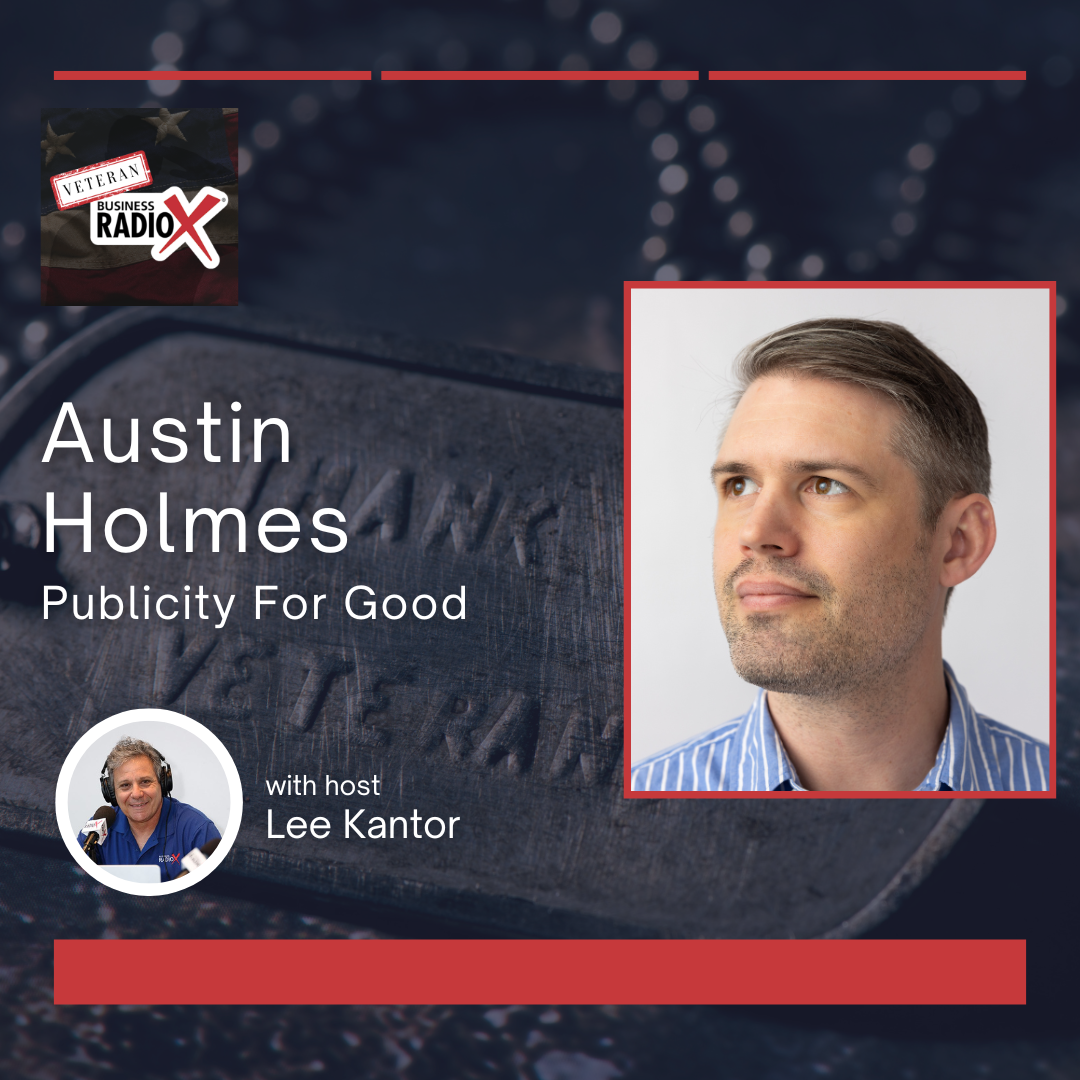

In this episode of Veterans Business Radio, Lee interviews Austin Holmes, co-founder of Publicity For Good, a PR firm he runs with his wife. Austin shares how his Navy background and his wife’s PR expertise shaped their purpose-driven business. They discuss the importance of authentic storytelling, consistency in media outreach, and building brand visibility without crisis management. Austin offers DIY PR tips for entrepreneurs on a budget, explains how AI is transforming modern PR practices, and reflects on how military-instilled repetition and clear communication strengthen company culture and leadership.

 Austin Holmes is the owner and president of Publicity For Good. He spends most of his time helping purpose-driven brands grow and share their message in a way that truly makes an impact
He is highly hands-on in everything he does. He likes to stay involved, solve problems, and ensure things are moving in the right direction. He cares deeply about the people he works with and strives to show up as someone who is straightforward, reliable, and easy to work with.
At the end of the day, he believes in doing things the right way, building genuine relationships, and creating something meaningful through the work he and his team do.
Connect with Austin on LinkedIn.
Episode Highlights
- Background and military service of Austin Homes
- Overview of Publicity for Good and its focus on purpose-driven brands
- Importance of storytelling and authenticity in branding
- Approaches to PR and media outreach for entrepreneurs
- Role of technology and AI in modern PR practices
- Strategies for effective communication and relationship-building
- Insights on working with clients and understanding their needs
- Success stories and case studies in PR
- DIY PR tips for entrepreneurs with limited budgets
- Influence of military experience on leadership style and company culture
 This transcript is machine transcribed by Sonix.
TRANSCRIPT
Intro: Broadcasting live from the Business RadioX Studios in Atlanta, Georgia. It’s time for Veterans Business Radio, brought to you by ATL vets, providing the tools and support that help veteran owned businesses thrive. For more information, go to ATL vets.org. Now here’s your host.
Lee Kantor: Lee Kantor here another episode of Veterans Business Radio. And this is going to be a good one. This episode of Veterans Business Radio is brought to you by ATL Vets, inspiring veterans to build their foundation of success and empowering them to become the backbone of society after the uniform. For more information, go to atlvets.org. So excited to be talking to my guest today. I’ve got Austin Holmes with Publicity For Good. Welcome, Austin.
Austin Holmes: Hey, it’s great to be here. And we’re having some rainy weather up here in Nashville. So perfect time to stay inside.
Lee Kantor: There you go. For folks who aren’t familiar, can you share a little bit about publicity for good? How are you serving folks?
Austin Holmes: Yeah. Publicity for good is the company that my wife and I operate together, which is always fun. We are a traditional PR firm on one hand, and also do our best to stay on the leading edge with all of the crazy technology stuff going on, which, you know, is all in service to our clients.
Lee Kantor: So what’s your backstory? How’d you get involved in this line of work?
Austin Holmes: So I met my wife out in San Diego. I was stationed out there and she had Heather DeSantis public relations, and I got to see the formation of publicity for good as partially a rebranding. And then the actual business shifted over there as well. But she was doing PR a lot in the food and beverage space, and she had done conscious conscious capitalism at Georgetown. I had grown up with service on the faith side. I had then joined the Navy. And so there was a service aspect to what we wanted to create with that, and honestly a standard to hold ourselves to that we were doing some good in the world.
Lee Kantor: So had you done publicity or PR before? This was your wife’s thing, and then you figured out, I can do this too. Like what? Like, what kind of was your impetus?
Austin Holmes: Yeah, I learned by sitting beside her for several years, and I experienced enough to where I could perform the role. But I always say it this way. She’s the publicist, I’m the operations side. And so I pulled a lot of my military experience as well as I have a degree in business management. And so I pulled way more of that side into the business to help. Initially started with hiring and some basic stuff. But you know, now my role is really leadership. But you know, we talk about communications all the time. We talk about it from an internal standpoint. We talk about our clients, where they’re at, what they’re succeeding with. And so I’ve learned a tremendous amount about what it takes to effectively communicate a person to person level, but also from a brand level, and how you can get a message out there to drive the result that you’re looking for. And that’s part of the reason we love working with the clients we do is they all have a purpose driven element, and it makes our days a lot easier to wake up to when we know we’re serving up something that’s moving the world in a positive direction.
Lee Kantor: So now when you talk about kind of purpose driven brands, How are they kind of raising their hand to you and say, hey, we’d like to work with you guys. Uh, and then you kind of figure out if they’re purpose driven, or is it something that you’re seeking out purpose driven brands and then trying to persuade them to kind of join the fold.
Austin Holmes: Our marketing and our branding is very much around that. So we do attract a lot of people that already have that in place. Um, but we’ve also worked with clients that don’t have it as apparent in their story, but it’s hard to found. It’s hard to find a founder led business that doesn’t have a purpose behind it. Um, and being in the food and beverage space early on, and we’ve expanded since then, but a lot of those people started that because, you know, they had a health issue or they had a pet with, um, specific dietary needs. And so that that is a common thing is there serving that dietary niche. Um, but purpose driven is really a broad thing. It’s, you know, what positive contribution are they trying to make in society? And that takes a lot of forms. Um, there are people who just approach it from a financial where it’s like, hey, I’m going to give 5% of my revenue to this cause, um, there’s a bunch of branding around that and, you know, people use it for the right and wrong reasons, but I think it still is about the outcome at the end that it is helping people. Um, but you have people who their entire business model is to give back in some way. Toms shoes was one of the early huge examples of this where it was, buy a pair of shoes, give a pair of shoes away you. We love working with those brands because the mission is core to how the business is run. And that’s an easy story to tell that people want to hear, and then they want to go and support those brands. So we love working with those folks.
Lee Kantor: Now, you’ve mentioned the word story several times. Can you talk about, um, maybe some advice or some tactics or techniques you’ve learned when it comes to sharing your story in a way that is relatable, that helps an entrepreneur stand out and maybe, um, helps them get that next client? What are some of the dos and don’ts when it comes to, uh, personal branding and storytelling?
Austin Holmes: Yeah, I’ll start with the big one. Uh, you kind of just have to do it more. Um, consistency is what we’ve seen in our data that pays off. Uh, the more somebody is telling their story to more audiences, more people, uh, bigger reach that. That’s what moves people forward in a predictable way. Yes. Of course, there’s the moments of virality and, uh, stories that capture the nation’s attention. But for the rest of us, it is about consistency and building that consistency into your schedule. And you can you can communicate in so many channels now. You can spend your time doing podcasts. You can spend your time on social media. You can spend your time one on one just calling people. Um, there’s so many different methods and they all work and, you know, finding that methodology that works for you in communicating your brand and the values behind it. Um, and then just doing a lot of it. So that’s first, but there are definitely practical things. Um, authenticity is something that gets brought up a whole lot. And that’s how you’re going to create those connection points with people for sharing your story. Uh, and authenticity to me isn’t just, hey, be yourself, it’s be yourself with intention. What are you trying to create here? What impact are you trying to have? Those are the relatable points. It’s, it’s one thing to relate with somebody because you’re both from Iowa or like you both served in the military even. Um. But. Okay. What are you doing with that? That’s going to cause people to take action as opposed to just relating with you. And so I think you need both elements to really have authenticity in your storytelling.
Lee Kantor: Now, how do you kind of a lie? I talked to a lot of business owners and they don’t like to be salesy or pitchy. How do you tell the story without kind of being too thirsty?
Austin Holmes: Yeah, there’s different approaches and you see it kind of in the sales realm when you study that world. Um, different sales trainers have different techniques because it’s what worked for them. For us telling our story, it’s okay. What kind of language are you using? It’s, you know, how direct are you? That’s part of your authenticity going back to that of being who you are. There’s different personality types and different people relate to the other personality types in different ways. Um, when you look at my wife and I, we’re 50% alike, 50% different with the whole personality thing. And so some of our communication, some of our working together is very, very easy. And other parts of it, we have to be very intentional with how we communicate what we’re communicating. And, you know, as you grow beyond just exactly who you are, you have to find that level of communication where you can communicate with anyone. And so I think that becomes a skill of being able to effectively communicate with all of the different types of people out there. Um, but you can, you can start with being you and communicating in your style. And for some of us that’s very direct. So your ask might be, hey, can you buy my product? Or you hear it on all of the platforms all the time of follow, like share, subscribe. Um, that that’s a direct ask. And you know, you do have people who want to build the relationship and start with that and Just develop that so that they can work together. Um, and I think those are kind of the extremes, but everything in between is just what’s the different communication style that you’re using, but you still have to make a direct ask. It’s very hard to get somebody to work with you or to buy your product if you don’t ask them to.
Lee Kantor: So but isn’t that one of the challenges in using PR and leveraging a firm like yours if you get a placement for me. Um, there’s not going to be like really a call to action. It’s just like, hey, Lee’s a smart guy and he can, you know, give a good quote when it comes to this subject that this, um, journalist is writing about.
Austin Holmes: Yeah. That’s an interesting thing. Um, I forget where this is from, but there’s a study that’s like when somebody looks at seven hours of you, that’s about the time that it takes to build that relationship. And you can never have mentioned what your product or service is. But if they’ve seen seven hours of your YouTube channel or if they’ve listened to seven hours of your show, then they’re gonna. And if they like you, that’s the other kind of qualification they’re, they’re normally going to seek out. And that’s where it’s a numbers game. That’s where growing your audience and growing your attention just becomes part of the numbers game. And you get to get in front of so many more people that at a certain point, you don’t even need to make that ask. Uh, and there are entire business models around that. Um, it’s just spending time and building a relationship with people to where they actually seek out what you’re doing and want to support you. Um, you have a whole entire environment of creators that are purely funded by their viewers and you could say they don’t have a product or service, but it’s kind of entertainment or education. Um, and people will find a way to try to support you. Um, and I think that’s a beautiful part of humanity.
Lee Kantor: Now, what’s it like to work for publicity for good? What did your, how do your clients come to you? Are they, are they in kind of a crisis that, hey, I need a PR person to help me out of this situation? Are they like frustrated with their marketing or their sales have plateaued? What is kind of the typical, um, reason a client comes to you to learn more or to be, you know, be either be in the prospect mode or be ready to hire you.
Austin Holmes: Yes. Uh, I’m very thankful that we’re not in the communications or the crisis communication space that is a large portion of PR firm or like PR spend out there. Uh, but I will say it’s much less expensive to get your story and your messaging and your visibility right before something bad happens. Um, but there’s of course the saying that all PR is good PR and that has its use case, but we really like working with people who have established their systems, have figured out the fundamentals of business and then want to expand. And that takes different forms depending on what industry they’re in. But that expansion phase of trying to take it to the next level where they’re trying to say, hey, what? How do we get more attention? How do we get our brand known? A lot of people talk about it, especially on the personal branding side, but branding and like, how do you do that? Well? It’s you communicating your story to more people and that builds a brand in society. Um, so that people are talking about you rather than you marketing to people. And I think that’s the difference of marketing. And PR at its core is PR is about what people are saying about you versus what you’re saying in your email copy or in your advertising.
Lee Kantor: So what are those kind of conversations look like when you’re first meeting with a client? What are some of the questions you’re asking them? Or maybe some of the pre-work you’re giving them before you start working together?
Austin Holmes: Uh, it’s what have they already done? Um, kind of us finding out, okay, how far have you taken it? What is the backstory? Uh, that’s one of the most interesting parts of those conversations to me is finding out what their reason for running their businesses. And, uh, as any business owner will tell you, it’s not an easy path. Um, and so listening to those stories, us finding relatability and seeing how we can help them, that’s the majority of a lot of the conversations, but often it’s, um, hey, let’s work together on this thing. Um, or, hey, this person introduced us. Uh, what do you need? Um, I think this should be true. And it isn’t for service agencies, but like, it’s in the name, like we should be there to serve our clients. That’s what we love doing. And, um, I think that’s a huge reason why we’ve been successful.
Lee Kantor: Is there a story you can share about a client? You don’t have to name their name, but maybe share the challenge they came to you with and how you were able to help them get to a new level.
Austin Holmes: I’ll share this story and don’t have to go into detail, but, um, these were second time founders and they had worked with a PR firm in their first company, and they were regional in Southern California and they knew they needed attention to get retailers to get more investment. Um, even though they had been very successful in their first company. It. It was a lot of consistency because they knew what it would take to get there. And, you know, we’ve, we’ve made mistakes like this too. Oftentimes in the process of building something, we delay action. We take longer to do what’s required than we need to. But when you stack that activity or that action, whatever it is, whether it’s in the PR space or on anything you’re doing in business, if you compress that action into a shorter period of time, one, it often creates less overall that you have to do. It shortens the time period to when you can get to the next thing. And that’s what we were able to do with them. We did a very intensive campaign over the course of a couple of years and took them from a small regional brand to nationwide. They ended up exiting a couple years later, and now they’re on shelves in every supermarket that we go to.
Austin Holmes: And that’s a reminder because we have a couple brands that we’ve done that with. Now it’s a reminder that, you know, when you know the plan or when you get the plan from somebody else who does know what they’re talking about in their specific area of expertise. Just following that plan is normally a good call, because very few of us are smart enough to reinvent the wheel. Um, and those guys are very, very successful often, but going with what works, going with what has been proven over and over, looking at the leaders in whatever space you’re in and saying, what, what did they do to be successful? And their challenge was, how do we build a second thing? But I think they were able to do it so effectively because they had the experience, they knew what they needed to do. And we can tap on so much knowledge. There’s so many resources out there. There’s courses, coaches, YouTube is full of good information, takes a little sorting through. But, um, you know, trying to avoid the mistakes, I guess is the summary, um, by learning from others.
Lee Kantor: Now, is there any advice for the, um, entrepreneur out there that might want more media exposure, but maybe can’t afford your services? Is there a do it yourself advice you could share with somebody who wants to try this on their own?
Austin Holmes: Yeah. And the thing that PR takes is time. Um, and so just like I talked about spending more time doing stuff, if you’re going to do PR efforts for your brand, uh, ChatGPT has made this much easier than it used to be. Find your local producer. Find your local radio show. Um, there’s so many resources for online articles now. Start there. Um, and just do reach outs. Uh, you can ask ChatGPT, hey, what’s the person’s email at w whatever station? And it’ll give you that information. You send them an email. Um, I will tell you our success rates are under 3% as an agency with sending those emails. So it’s a volume thing. It’s a building relationship. There’s mixers, there’s events. It does come down to that relationship. The networking. Doing that on the local level can be practical. Um, and where an agency like us comes in or PR professional coming into your company, that’s where you can scale it and change the number of reach outs from like 10 to 15 for your local stations to thousands, uh, at the national level.
Lee Kantor: And what is kind of the conversation you’re trying to start with these people, I understand like building this local list, but what is kind of in that email? What is the message you’re trying to give them that could possibly help you get that media exposure?
Austin Holmes: Yeah, there’s a bunch of approaches. And if you want to dig further into this, it’s search pitching the media. But a very common one is looking at what that journalist has done recently. What is the story they covered that’s that can be relevant to your story. So whether that’s your product or service that’s relevant or your backstory, or even if you have relatability to the media member, um, that’s one style, another style that’s, uh, pretty effective is we just had Memorial day and veterans stories are pretty easy to pitch around that time period for Christmas. There’s tons of stories, there’s gift guides. So finding what awareness days are coming up, you really want to be 6 to 8 weeks ahead of this. But, um, looking at what’s coming up on the calendar that’s relevant to your product or service, and that’s a great way to generate interest and just saying, hey, I’m a local business owner is another effective one. That’s why I always recommend people start on a local, because there’s a lot of publications on the local level who want the local entrepreneur story.
Lee Kantor: Now, can you share a little bit about maybe this even goes back to your time in the military, some of the leadership lessons that have had the greatest impact on the way that you’re building out the culture and scaling your business today?
Austin Holmes: Yes. Uh, there’s one that I absolutely hated when I was a junior guy. And it’s the repetition. It’s a huge aspect of leadership is repeating yourself and that we call it a bunch of different things. Setting the standard would be one, and the military does an incredible job of this. The standard is established. It’s been around for hundreds of years. Um, as that gets passed on, it gets repeated by every chief or every sergeant, um, to their teams. And guys are indoctrinated, for lack of a better term into that standard. And you have to do the same thing in business. You have to set the standard as the entrepreneur and you have to repeat that constantly. Um, we know some high level entrepreneurs and that’s the lesson they tell us and that we see them do. Um, and it’s every day, it’s multiple times a week of, hey, what is the ethos of what we stand for? What is our mission? Who are we serving? What are we all about? So just like you have to tell your story to the world, you also need to tell your story to your team. And that takes repetition.
Lee Kantor: So more is more when it comes to this. You can’t tell it enough. It might be getting boring to you, but it’s not getting boring to the people you want to hear it.
Austin Holmes: It definitely, it definitely gets boring. Um, because you feel like you’re saying the same thing over and over. And, uh, that that frustrated me when I was, uh, more junior and had not, um, had the experience that I do now, but people forget they have 100 different things going on. Life comes at them and repeating what the expectations are, what the mission is, and asking questions is another great way to not feel like you’re repeating yourself a hundred times, um, asking them what the mission means to them. And that’s a powerful way to get buy in as well.
Lee Kantor: Now, early on, you mentioned, um, one of your kind of, I guess core values is keeping up with technology and being kind of ahead of the game when it comes to technology. Can you talk about how AI is impacting your business and where you see opportunities for business owners when it comes to leveraging some of this new technology and these new communication tools?
Austin Holmes: Absolutely. The I’ll start with where you started earlier of the do it yourself level. Um, you have to do the work of writing down your story and establishing what you believe and what your mission is. But once that work is done, you can use AI to craft things around that. So if you’re not sure how to pitch the media, you can ask AI. Hey, based on my story, based on the context, based on what we’re trying to accomplish, how should we pitch the media? What type of media should we be pitching and what’s going to make the biggest impact in our business. So that’s a very easy place to start with it. But you know, we’re deep in it. We have a development team. We have our own software. There are so many opportunities, um, at every level, at every industry to build systems. And systems have always been an important part. Process procedure. Another thing that the military definitely teaches well, um. And, uh, building those in your business is going to save time in the long run. It is a lot of work up front, but AI is making it easier. You have tools like open claw clawed Co-work grok came out with one. I’m sure everybody else will over the next couple of months, but using the genetic tools to build process and workflow in your businesses, it will save you a lot of time and remove the work that is repetitive so that you can focus on strategic activities. Everybody talks about it in terms of working on your business versus working in your business. You can remove a lot of the work for you and your team members on the working in the business side so that you guys can work on, hey, how do we actually move forward with our mission? How do we help our clients move forward? Um, that’s how we’re using it and it’s helped out a lot.
Lee Kantor: Now, you mentioned that your ideal client is a kind of a purpose driven organization. Can you hone it down a little bit when it comes to size and number of employees or amount of revenue, they generate a year to kind of get a little clearer on who that ideal client is for you?
Austin Holmes: Yeah, I talk about it this way? The. The purpose driven is the most important part, but we work with people a little at a lot of different levels from startup all the way to nine figure. And there is a core, um, just having the business system set up the back end set up to take advantage of PR, uh, where we’re getting tens 20s of interviews per month. There’s some systems that need to be in place to be effective with that. You need your social media going. You can greatly benefit benefit if you have your ad system going. And again, this kind of industry specific, but there’s also a level where people will start paying attention to you more because of the success you’ve already had. Um, and that isn’t always a financial, a lot of times in the entrepreneurial space, it is where there’s kind of an expectation, hey, what have you already accomplished? Why should I listen to you? And so when people are past that, or they have the 20 years of experience and they’re seasoned professionals, that does make our job a little easier. But we also love working with the startup side because there’s so much excitement. And maybe it’s a story that’s never been told. Maybe it’s a cutting edge product that is going to help people who didn’t have a solution before. Um, we saw this with the CBD space. Um, we were involved in that kind of early on as it was starting to trend and it was helping people in ways that they didn’t necessarily have access to outside, outside of opiates. And that was an exciting time to be in that space. Um, another example is like gluten free, like it was relatively unknown. And then it became a trend and we got to work with one of the most established players in that space. So whether it’s a startup company that’s been in business for 12 months or somebody that’s been in business over 100 years, it’s about the story. It’s about the mission for us. And those are the people we love working with.
Lee Kantor: So if somebody wants to learn more, have a more substantive conversation with you or somebody on the team, what’s the website? What’s the best way to connect.
Austin Holmes: Publicity for good.com?
Lee Kantor: All right. Well, awesome. Thank you so much for sharing your story today. You’re doing such important work and we appreciate you.
Austin Holmes: Thank you Lee. Just trying to continue making a positive impact and making the conversation positive instead of tearing society apart.
Lee Kantor: So it sounds like a good mission. Sounds like a good purpose driven organization. You run there.
Austin Holmes: Yeah, we’re we’re held to it for sure.
Lee Kantor: All right. This Lee Kantor, we’ll see you all next time on Veterans Business Radio.















