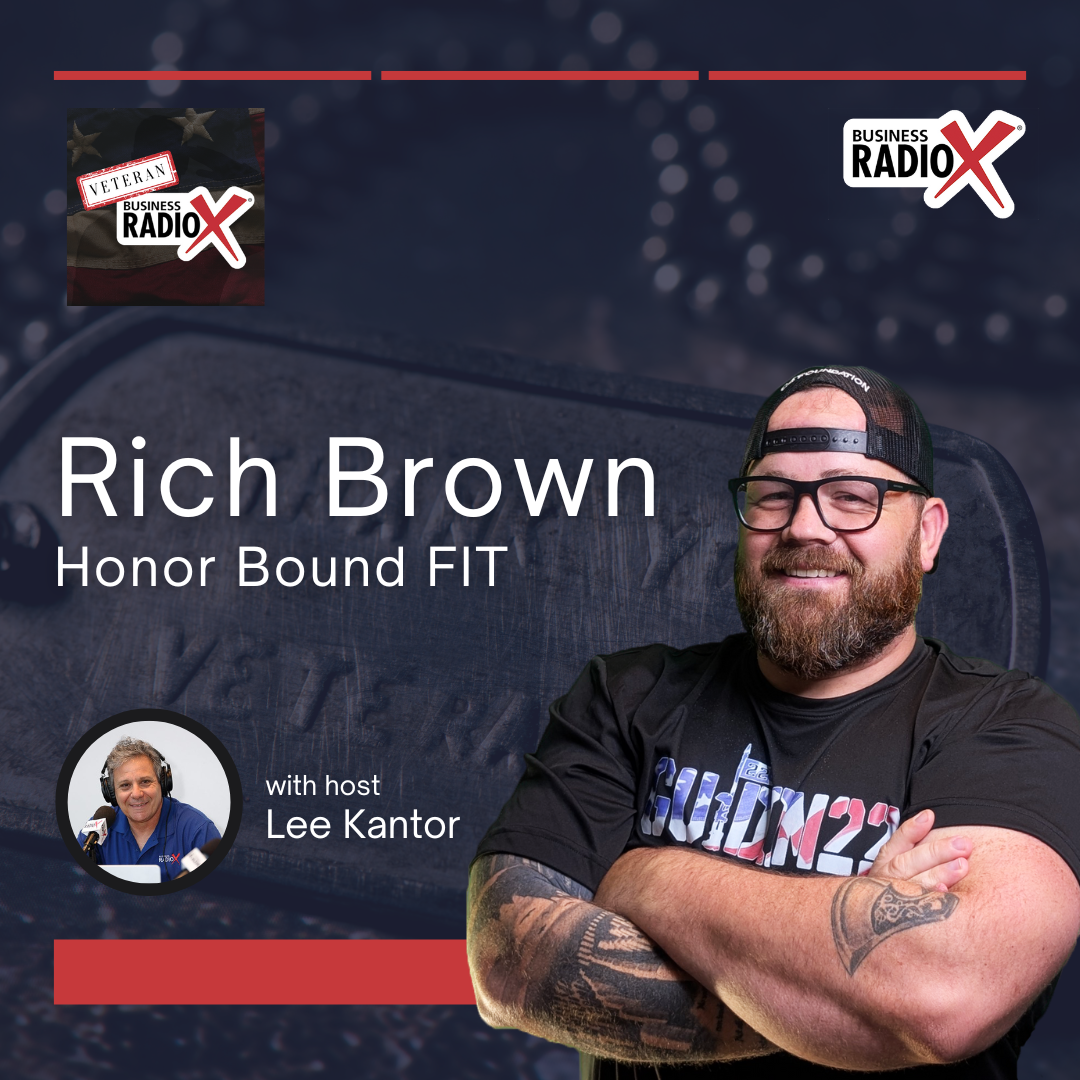

On this episode of Veterans Business Radio, Lee Kantor talks with Rich Brown, Marine veteran and co-founder of Honor Bound FIT. Rich shares his journey from military service to entrepreneurship, describing how he helps veterans and the broader community rediscover purpose and connection through fitness. The episode delves into the challenges veterans face after leaving the service—particularly the loss of tribe and mission—and explores the impact of community-driven events like Guidon 22, a 22-mile ruck honoring veterans and raising suicide prevention awareness.
 Rich Brown is a Combat-Service-Disabled U.S. Marine Corps Veteran turned executive protection specialist, gym owner, and event director.
After eight years leading Marines in combat and training warriors from around the world, Rich transitioned into the private sector with the same mission: prepare people for the battlefield of life.
He co-founded Honor Bound FIT, a veteran-owned strength and conditioning facility that builds strength, mobility, resilience, and injury prevention into every member’s routine.
As the Event Director of GUIDON22, Rich leads an annual 22-mile ruck—22 pounds on your back, one mile for each veteran we lose daily to suicide.
It’s a community-driven event that unites veterans, first responders, and patriots in a shared mission of remembrance, awareness, and purpose. 
Rich’s core values—discipline, service, respect, and relentless personal growth—are not just words on a wall. They’re the foundation of how he leads, trains, and lives.
Connect with Rich on LinkedIn, and follow Honor Bound FIT on Facebook and X.
Episode Highlights
- Rich Brown describes launching Honor Bound FIT with a fellow veteran, starting as parking lot workouts and growing into a dedicated gym space rooted in core values and patriotism.
- The importance of finding purpose after military service and how the gym provides camaraderie, accountability, and a renewed sense of mission for veterans and civilians alike.
- The symbolism and purpose behind Guidon 22, a 22-mile ruck to honor veterans and first responders, spotlighting the urgent need to address veteran suicide and community isolation.
- How Honor Bound FIT incorporates service back into the community through events like the food bank ruck, emphasizing teamwork and giving back.
- The gym’s inclusive, values-driven environment has attracted a diverse membership and become a community hub, surpassing initial expectations and providing a new sense of belonging for participants.
 This transcript is machine transcribed by Sonix.
TRANSCRIPT
Intro: Broadcasting live from the Business RadioX studios in Atlanta, Georgia. It’s time for Veterans Business Radio, brought to you by ATL vets, providing the tools and support that help veteran owned businesses thrive. For more information, go to ATL vets. Now here’s your host.
Lee Kantor: Lee Kantor here another episode of Veterans Business Radio and this is going to be a good one. Uh, but before we get started, it’s important to recognize our sponsor. This episode of Veterans Business Radio is brought to you by ATL vets, inspiring veterans to build their foundation of success and empowering them to become the backbone of society after the uniform. For more information, go to ATL vets. Today on the show we have Rich Brown, who is the co-founder of Honor Bound FIT. Welcome. Before we get too far into things, tell us about Honor Bound FIT. How are you serving, folks?
Rich Brown: Yeah. So, uh, a close friend of mine, I’ve been. I’ve been running business since two years before I got out of the Marine Corps. Mostly private security, executive protection, workplace violence mitigation, that kind of thing. But a close friend of mine, about two years ago went through a divorce and, uh, was kind of struggling to find purpose. And so I kind of cornered him one day and said, hey, man, when are we going to start that gym you’ve been talking about for for years now. And so, uh, after a little bit of hemming and hawing, a little bit of convincing, uh, we started Honor Bound. Fit in the parking lot of a black rifle coffee, uh, here in Fredericksburg, Virginia. And, uh, Memorial Day of 2024. And it’s been off to the races ever since we started with, uh, with just, uh, parking lot workouts and church parking lots and parks and that kind of thing. And we evolved to eventually move into our own space. Now we have a 4000 square foot gym.
Lee Kantor: So how important is it after the military to identify something that’s gets you fired up, that gets you kind of passionate and, um, kind of leads you maybe into a more positive direction?
Rich Brown: Um, personally, I think it’s everything. We have 14 core values on the wall in our gym, and one of them is is only two words. And I think even though it’s only two words, it carries a lot of weight because those words would be useful. You know, when you’re struggling to find purpose. And let me let me back up a little bit. I think that one of the biggest issues facing veterans as they leave active duty military is they lose two things. They lose their tribe and they lose their purpose. And so the faster you can identify that purpose, the better off you’re going to be. There’s kind of this status quo right now that especially among the younger veterans that, you know, I’m going to ease, I’m going to separate from the military, and I’m going to use my dd214 as rolling papers and play video games and collect a disability check and just live. Live life on Easy street for the rest of my life. And you know it’s fine to decompress after service, but you need to stop there. And any further down that direction just leads to isolation, and that’s not good for anybody involved. And so back to being useful. We try to tell especially young veterans, you know, when you stood on those yellow footprints, when you raised your right hand and you said, you know, you swore to defend the Constitution, find that energy again, find a way to to find value in yourself by being useful to others. Find a cause in your community and rally around it.
Lee Kantor: Why do you think it is that when you’re in the military, it’s we’re all in this together, you know, never leave a soldier behind. But when we get out of the military, then it’s, I have to do this on my own, and this is my problem, and I don’t want to be a burden to anybody else.
Rich Brown: It’s a really tough question, and I’m not exactly sure how to answer it other than, you know, a lot of times we get out, uh, either because, you know, I think on one hand, sure, people get out because it’s just not what they thought it was. But I think a lot of times, personally me, I wasn’t able to re-enlist because I suffered a TBI in Iraq. Uh, they told me they were they would allow me to finish out my contract, but I was not going to be able to lead troops in combat again. And so when you have a type of, uh, uh, sentence like that, I’ll put it that way, right when you, when you get, when you get handed that diagnosis and told that you now aren’t as competent as you once were. Um, mentally, a lot of men, especially veterans especially, we tie a lot of our self-worth to our competency and our ability to protect and provide for others. Uh, and so when the most profound way of doing that by serving your country is gone, you kind of have to reevaluate yourself and question some of the things that you didn’t have to question before.
Lee Kantor: And then how is honor bound fit, um, at least creating that space for folks to come in there and feel part of a tribe and a team and, and kind of, you know, kind of reevaluate and reboot themselves.
Rich Brown: Um, we’ve certainly created the space, right? So, like I said, we have a 4000 square foot gym direct dead center. In the back of the gym is a 65 foot American flag hanging from the ceiling. To the left of that, we have our core values, uh, and they range. Right. The first and foremost is, is a quote from George Washington. It’s the duty of all nations to acknowledge and be grateful to almighty God. Uh, but we also believe a man’s most sacred duty is to protect women and children, uh, that good friends have hard conversations. Respect is given before it’s earned. Treat others as you wish to be treated, not how they treat others, not as you wish to be treated, but how they wish to be treated and treat all people like individuals, not obstacles or objectives. Aside from that, you know, and trying to to demonstrate those values and encourage others to embrace those values. Like I said, we have it’s very Americana, bro. Rah rah in the gym. But we have we have a security post on top of our office. Looks like it’s straight out of Iraq, complete with a replica 50 cal and a mannequin standing post. We’ve built our our POS, our checkout area to look like stacked ammo crates and footlockers. Um, so it’s definitely inviting to that community. I will say we joke about once a week, uh, that we’re not a women’s gym, right? Because we we want that target audience. But right now we have about 80% female clientele. And we’re honored by that, right? They we value that. They feel comfortable and want to be in this environment. But that’s that’s simply not the the group that we set out to advertise to.
Lee Kantor: And then why did you think that, um, fitness would be the way to, um, create that space for this, this group of people?
Rich Brown: For one, there is a connection, right? That’s that’s becoming more and more evident through medicine that there is a connection between physical fitness and mental wellness. Um, if you, uh, feel like you’re, you’re sluggish, if you feel like you’re spinning your wheels, uh, a good way to, um, motivate yourself and feel good again is to go out and exercise. Uh, but we also, we try to use our fitness for a cause, right? So we do a food bank ruck in the spring, um, where we, we encourage everyone to gather food to donate it to the food bank. Right. But our spin on it is we make them put it in backpacks and carry it for miles to donate it. We have organized into teams of of ten ish, and then they have to to ruck the food from point A to point B to donate it. And then the team that gathers and collects and moves the most food in a 12 hour period wins $1,000 and a trophy and bragging rights and all the things. We have another ruck coming up, actually, November 22nd. It’s called guidon 22. And it’s it’s the way that we really communicate that purpose. I was talking about earlier. Right. So the guidon, uh, if you go back to before Modern Communications, right before we had radios on the battlefield, we had battle standards and we had drums, and that’s how we communicated. And that battle standard, the guidon was the original way on the battlefield that we said, hey, I’m over here, I’ve got your six and it represents your unit, but it also represents a sense of responsibility. When you have a change of command ceremony, one commander passes off that guidon from the next. And so that’s the symbolism behind guidon 22 is like I said, you need to find a cause in your community. You need to find something to rally against some way to be a role model and to communicate to your community like, hey, this is what we should be doing. Pick up your guidon and lead people.
Lee Kantor: And 22 isn’t just a random number.
Rich Brown: No, it’s I think most people know now. Hopefully most people know now that, uh, it’s kind of an older statistic and it varies every year. But in 2013, it was decided that 22 veterans take their lives every day. Uh, that doesn’t include the veterans who are removing themselves from society through homelessness instead of suicide. It only counts suicide. It also doesn’t, uh, account for those those military members or veterans who are using drugs as their weapon of choice. Uh, or a motorcycle. Right. We don’t count those as suicide, even though there probably is some overlap there. Um, and like I said, that number varies every year. I think now it’s as of 2023, the most recent number is 17.5. But if you add in first responders, which we do. I consider first responders to be the home team. Right. I wouldn’t have deployed to Iraq and Afghanistan unless I knew there were people here who were willing to, uh, support and protect my my family members. Uh, add those people back in, and it’s over 23 a day.
Lee Kantor: Now, when did you when you started the gym and you were starting working with this group? When did you start kind of getting the traction and that moment where you’re like, okay, this is making a difference. We have to lean into this. We have to, you know, get out of the parking lot into a facility.
Rich Brown: Well, the the parking lot into a facility was more of a environmental necessity, right? We’re up here in Virginia where we do have ice on the on the roads. We do have much colder winters. Uh, and so if we were going to keep our, our band of merry members, uh, working out through the winter, we needed to bring them indoors. Um, you know, we’re still right on the edge of breaking a profit over a year and a half later. So we’re still putting our own money into making rent and that kind of thing. But it is. It is growing and we get feedback every day, whether that’s in the form of, um, you know, new members or, uh, sorry, uh, people, uh, talking about us on social media, etc. we, uh, we live for that positive feedback.
Lee Kantor: And you mentioned how the community’s kind of embraced what you’re doing in a way that you, you probably didn’t anticipate when you started. Can you talk about that and how you’ve maybe you’ve made some changes to accommodate that group?
Rich Brown: You mean strictly how we how we joke about not being a women’s, right.
Lee Kantor: And then you.
Rich Brown: Haven’t really we haven’t really had to make any changes. Um, and I think that’s that’s kind of the point, right, is that we, we didn’t seek to, to bring women in. We just we live a certain way, we train a certain way. And we we present ourselves to the community in the most authentic way possible. Who we are and what we’re about. And you know, it’s difficult to get veterans, uh, to try anything new or especially, you know, outside of a military unit to take instruction or guidance from another man. That’s a big ask a lot of times for the veteran community. Uh, and so, uh, I think women have just been a lot more open to giving it a shot. We do have some veterans in the gym. I’m not saying that we have we have none, or it’s been an impossible task. Uh, we have a good portion, but, uh, it’s just funny to us that a lot of times there’ll be just 12 women working out in the gym. We’re not a women’s gym.
Lee Kantor: Wow. Maybe you are.
Rich Brown: Maybe we do. I don’t know.
Lee Kantor: Um, you.
Rich Brown: Still want it to be, you know, a place for for veterans to find a tribe again.
Lee Kantor: Are the women, uh, spouses of veterans or veterans themselves, or. They’re just kind of women in the community.
Rich Brown: We have a couple of veterans. We have some, uh, some veteran spouses. Uh, a lot of them are just, you know, we call them civilian patriots right now.
Lee Kantor: Has, uh, anything you’ve learned that Jim impacted your work in the protection world?
Rich Brown: It’s a good question. I hadn’t thought about that. Um. No, I can’t say that it has. Other than I have used it kind of as a recruiting tool. When I see people who are, um, you know, have a positive attitude and they’re training hard and they’re doing all the right things, I occasionally I’ve reached out to and said, hey, you want to I want to try executive protection. Have you thought about getting into the protection world?
Lee Kantor: So what do you.
Rich Brown: Need from that? Uh, I don’t know that there’s a whole lot of overlap between the industries.
Lee Kantor: I don’t know if if the way you dealt with your team was there. There was any kind of overlap in that way. I mean, is that a perk that they get access to the gym if they work with you? Uh.
Rich Brown: Uh, no, we’re not offering a free membership or discounts to my employees yet. Uh, maybe. Maybe when we’re done putting our own money in the rent, I might consider that as an option.
Lee Kantor: Now, what do you need more of? How can we help you?
Rich Brown: Well, I’m trying to spread the word as far and wide as possible. About died on 22. It’s a it’s an event that’s dear to my heart. I’m very passionate about it. Again, it’s a 22 mile ruck with 22 pounds on November 22nd for veteran and first responder suicide prevention. Um, we start at 6 a.m. here in Fredericksburg, Virginia, and there’s a I’ve laid out a 22 mile course, and we stop every three miles or so about every hour and let people hydrate and have snacks and adjust their gear. And then we start each leg by having, you know, last year it was me. Last year I read the story of a different veteran who took their life and how it affected their family and their community. Every time we stopped, um, this year, I’ve invited the families of veterans who’ve taken their lives and ask them to tell their stories. And so that’s one major step we’re taking in that direction. Um, so the people who might have said at 12 or 15 or 18 miles, uh, you know, I can’t go on anymore. This hurts too much.
Rich Brown: You know, they kind of get that that catharsis and that thought process of, well, I’m not hurting as bad as they were. Right. And so, uh, we started with 37 participants our first year and finished with 35. Uh, and those two that that couldn’t make it to the end. It’s not because they were unable or didn’t want to or weren’t motivated. They just they didn’t do their homework and realized that we weren’t moving at the, uh, the Army or Air Force, uh, qualification standards for rucks. So we were moving a lot slower than they thought, and it was going to take more time. And they had other commitments. Uh, but everyone who who made the time and wanted to be here and set out on that, that, uh, uh, course, uh, finished with us and we’re very proud of that. And we’re very am humbled and honored that we had as many participants as we did. But this time we’re trying to make it look like a range walk, right? So we had 35 finished last year and I’m aiming for 200 this year.
Lee Kantor: So if somebody wants to learn more about that or about the gym, what’s the website? What’s the best way to connect with you?
Rich Brown: Yeah, the website is on ft.com and you can find out more about Guyon 22 there. We’ve also started a couple of educational podcasts that are going to be available on the website soon. Um, so it’s on. Com. We’re on Facebook, Instagram, LinkedIn, all the socials and it’s always on our bounce fit. No spaces, no periods. Just on or bound fit.
Lee Kantor: Well Rich, thank you so much for sharing your story today, doing such important work. And we appreciate you.
Rich Brown: I appreciate you. I’m honored to have had the opportunity to speak to your audience.
Lee Kantor: All right. This Lee Kantor we’ll see you all next time on Veterans Business Radio.














