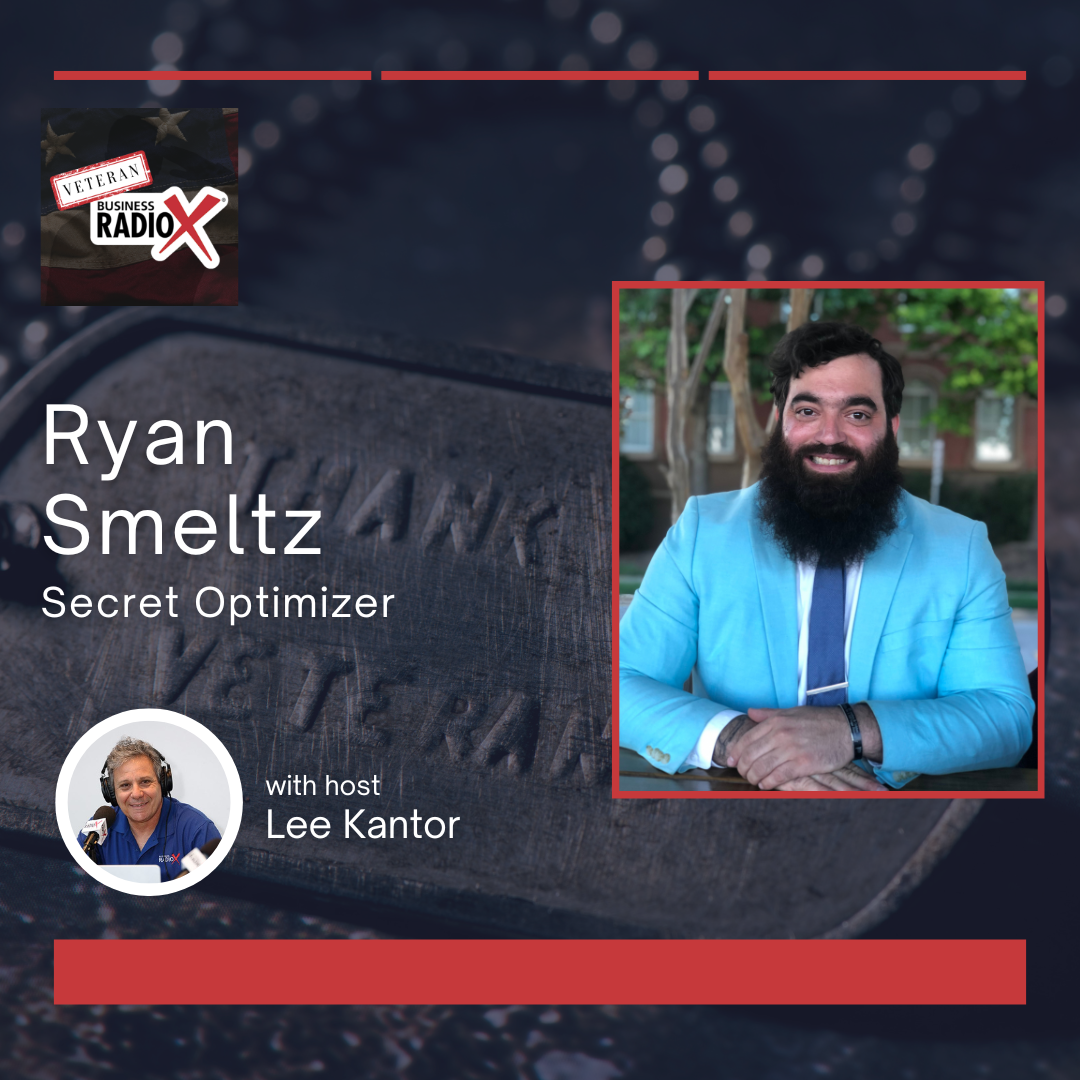

In this episode of Veteran Business Radio, host Lee Kantor interviews Ryan Smeltz, Army veteran and owner of Secret Optimizer. Ryan shares how his military background in systems and processes helped shape an AI-first SEO and digital marketing company focused on helping small businesses compete online. He explains how AI is transforming search engine optimization, why local visibility matters more than ever, and how business owners can use automation to save time while attracting more customers.

 Ryan Smeltz is a US Army Veteran and founder of Secret Optimizer, an AI-first SEO agency based in the Triangle area of North Carolina.
After separating from the Army, he built a local business agency designed to give independent service businesses — plumbers, HVAC companies, salons, contractors — the same search visibility that used to require a big budget and a big agency.
Secret Optimizer focuses specifically on how AI search tools like ChatGPT, Perplexity, and Google’s AI Overviews are reshaping how customers find local businesses, and what owners need to do right now to stay competitive. He lives in Zebulon, NC with his wife Latoya.
Connect with Ryan on LinkedIn and X, and follow Secret Optimizer on Facebook.
Episode Highlights
- The connection between traditional SEO and modern AI-powered search optimization.
- How AI is changing the way customers find local businesses online.
- The importance of systems, processes, and automation in scaling a business.
- Why time savings can be one of the biggest benefits of AI adoption.
- Practical ways small businesses can improve their online visibility without large marketing budgets.
- How creating consistent content supports both search rankings and customer engagement.
- The role of Google Business Profiles in local search success.
- Proven strategies for generating more customer reviews and improving credibility.
- How AI can maintain a brand’s unique voice while producing content at scale.
- The value of combining technology with personal, relationship-driven customer service.
 This transcript is machine transcribed by Sonix.
TRANSCRIPT
Intro: Broadcasting live from the Business RadioX Studios in Atlanta, Georgia. It’s time for Veterans Business Radio, brought to you by ATL vets, providing the tools and support that help veteran owned businesses thrive. For more information, go to ATL vets.org. Now here’s your host.
Lee Kantor: Lee Kantor. Here, another episode of Veterans Business Radio. And this is gonna be a good one. But before we get started, it’s important to recognize our sponsor, ATL Vets, inspiring veterans to build their foundation of success and empowering them to become the backbone of society after the uniform. For more information, go to atlvets.org. Today on the show, we have the owner operator with Secret Optimizer. Ryan Smeltz. Welcome.
Ryan Smeltz: Hey, Lee. Thanks for having me.
Lee Kantor: Well, I’m excited to learn what you’re up to. Tell us about Secret Optimizer. How you serving folks?
Ryan Smeltz: Yeah, absolutely. So, Lee, I was in the Army for ten years, deployed in support of Iraq. 0709 and one of the biggest things I learned before, during and after that experience was just systems and processes. So learned really how to design, develop and implement SOPs or standard operating procedures that lead to a specific preferred outcome. In doing so, I implemented that into my business. And over the past four years have been learning how I can leverage AI in my business in order to help support small local businesses. And in doing so, those systems and processes as well. And what that allows us to do is traditionally, most SEO companies might charge on a range anywhere from three to, say, $7,000 per month. You’re talking big business, especially established at that point. And a lot of small businesses can’t necessarily they may not have the resources to be able to do something like that. And I wanted to change that. So being AI first simply means that essentially I don’t have a lot of overhead. I’m able to execute very quickly, more often than not faster than the old school SEO agencies, and obviously keep costs low enough to be able to help those small business owners.
Lee Kantor: Now, can you explain for our listeners how SEO has maybe changed since this AI age that we’re in right now?
Ryan Smeltz: Absolutely. That’s a really good question, Lee. Early on in the AI rollout, if you will, because some people might know AI has been around for quite a long time at this point, but it’s gotten more mainstream even in the most recent five years. And a lot of folks are like, oh, a e o, which is essentially answer engine optimization or AI search. And Google recently published something that basically said there is no difference between search engine optimization and AI search optimization or a e o. And the reason for that is because, especially if someone goes to Google, they can see how when you search, you get that AI summary at the very top of Google. And that’s because AI search is essentially built on top of search and search engine optimization. So the number one thing to know if you are someone who is either doing things correctly as far as SEO and ranking number one. Then just keep doing what you’re doing. Well, if you’re someone that’s working on it, continue to focus on what you want to improve upon. And if you’re someone who’s just now being introduced to it, then make sure to do a lot of research and focus on the old school, traditional things that have always helped SEO, because your Google business profile or your keywords, your website schema, all of these things are going to basically connect those dots to help you in your AI search and answer engine optimization. At the end of the day, the number one thing, Lee that’s changed is now when people search, more often than not, instead of getting an entire list of results, they’re getting one. So it’s almost like you’re going from, well, I want to rank on the first page of Google to I want to be the number one being recommended.
Lee Kantor: And, uh, and the structure of that’s changing as well, right? Like if you type in plumber before it would list, you know, like you said, the first page filled with plumber, of which probably half of them on the first page are sponsored plumbers that paid to be on the top of the page. But now it’s going to write you a paragraph about plumbing, and it’s going to have it’ll name names of some plumbers. And if you’re not in that pile, you’re kind of out of luck, right?
Ryan Smeltz: Of course, obviously there are nuances there. You know, you mentioned paid and some of these, uh, chat engines. Uh, I believe ChatGPT was experimenting with the sponsored aspect so you could have someone showing up first because they paid more money. You could have someone showing up because they’re just doing the correct things. But you’re, you’re absolutely right. Uh, the ultimate goal here, and that’s one reason why I focus on small business, is because the ultimate goal is to be the one that shows up, like you said in that AI summary, if you search, say plumber or electrician, Hvac, something like that, um, you do have a small advantage, especially if they search, for example, something like plumber near me or plumber in Atlanta. Um, you have a little bit more leverage, I guess. Uh, one way of putting it is there’s riches in the niches. So, uh, that locality really helps you leverage that.
Lee Kantor: Now, what’s your backstory after the military? Were you always involved in SEO or marketing? Like, how did you get to, um, where your business is now helping these small to midsize companies be found?
Ryan Smeltz: Yeah, that’s a, that’s a good question, Lee. Um, I have, uh, probably started and failed more times than I would like to admit, uh, as far as small business goes, but always been involved in the kind of web development social media marketing space. About ten years ago, I started going pretty heavily into the SEO section. The main obvious reason for that is because I wanted me and anyone else I might be working with to show up first. And so as I did my research, I really started to notice kind of the trends in a sense that, um, yes, this, this type of thing can change and change very quickly. But generally speaking, it is all a system that once you learn it and you understand it and you’re able to implement it. Of course, keeping up with the new things such as AI in this example can be a bit of a challenge, but it’s not a complete pivot or restructure to your business. And so one thing some people might find is I think I have a tendency to offer quite a bit more in way of education and materials for free on my website and just in conversations with business owners. The main reason being because I’m much more interested in, uh, when I do take someone on as a client, making sure that I am saving them time. Uh, I always tell people there’s, there’s no real significant difference between what I’m doing and what you’re able to do yourself, except that if someone hires me to do it, then I save them time. And so really, that transition from military to civilian life and allowing me to notice, um, you know, as I was more broad in the website and the marketing space and just kind of narrowing that down to SEO, I just really like the kind of step a, B, C rinse and repeat type method.
Lee Kantor: And then you decided to focus on kind of bricks and mortar businesses geographically near you? Is that the niche that you primarily serve right now?
Ryan Smeltz: That’s a good question. Uh, the short answer is no. I’m nationwide. Uh, there is one reason why there appears to be a heavy focus locally. And that’s because obviously if someone say in Atlanta or California or anywhere wanted to hire me, I’m definitely open to it. And of course, in 2026, we can do the Zoom or Google Meet if necessary. However, uh, I really liked face to face and so I am able to, uh, go out. Uh, I guess the, the best way to answer this is being an AI first company, I’m able to do everything from posting, scheduling API connections, uh, the schema on page SEO with AI. I don’t necessarily need to be there once I have the SOP or standard operating procedure and the skill implemented, it just takes off and does it. So that raises the question what does Ryan actually do with his time? And the short answer to that is face to face. So very heavy in the the local area, because I want to meet these business owners, I want to shake their hands. I want to have coffee with them and answer any questions they might have, but definitely open to, uh, nationwide, um, help and support in the small business community.
Lee Kantor: So now what is it like? Um, well, let’s first talk about kind of what, what is the pain that a prospective client, whether they’re near you or anywhere else? What, what’s the pain they’re having where they should be calling Ryan and his team?
Ryan Smeltz: That’s a good question. Uh, the number one general answer to that is time. Uh, so a lot of people will download Claude or investigate ChatGPT. I think OpenAI’s, uh, equivalent as codex or open claw. And they’re learning a whole new thing. So, uh, to, to raise your example earlier, you’re a plumber. You spent this whole time learning how to do plumbing, you know how to do plumbing. Now you’re a business owner. Of course, when you entered into the business owner space, that was a whole nother thing as well. So now you’ve got to learn this new, how do I run and operate a business in addition to being a plumber? Maybe you want to grow. You have two, you have five technicians. Um, you have to manage payroll. And then AI rolls out and you’re like, oh, sweet. I can automate things like maybe my inbox. And so the challenge is that business owner might sit down and say, okay, let’s automate this. And they might do it incorrectly. So they’re not getting the output that they expected and they’re unhappy with it. It might fall by the wayside. They’re trying to save themselves time and it’s not working. So they get to the end of the first month trying to use AI or implement some sort of automations and it doesn’t work. And next thing you know, they’re still just as frustrated spending an extra hour or two hours a day on email or text or replies or who knows? Um, in my industry specifically, that would be, uh, you know, SEO.
Ryan Smeltz: So I want to save them time so they don’t have to learn this new skill or this new thing. If anyone were to take a look at my website right now, I think we still have a few slots left for the founders, um, promotion that I have going on. So if somebody looks at that number, my main question is how many additional jobs would you need to get or earn in order for that to make sense? And if the answer to that question is one or 2 or 3, but it saves you five hours of work per month or 10 or 15 hours of work per month, then it’s like, all right, what is your hourly rate? How much is your hourly rate actually worth and how much are you saving? So I think at the end of the day, Leigh, to answer your question, it’s really how much time can I save these business owners so they can focus on what they’re actually really good at, which in again, in your example would be plumbing instead of learning a whole new skill.
Lee Kantor: Now, AI is kind of a blunt instrument. There’s AI for every aspects of business. When you’re talking about AI, are you specifically talking about kind of lead generation and business development? Or is it like, you know, oh, I would like my emails to be read and tell me which are the important ones. Like you. Ai can do lots and lots of things, but your, your firm is a specialist in certain things. Right?
Ryan Smeltz: Right. And, and that’s another good question, Lee. So we do have a kind of back end, I would call it a little bit more of a premium feature, which is those custom conversations. Right now, I’m working with somebody, again, locally that we’re basically they have an HR and app and they’re getting all these candidates in and they have a number of interviews. And the problem is that HR app connects to, say, monster and indeed and all these other platforms. And so they’re not able to send emails or text messages because each platform’s set up or structure is different. And so the problem they’re having is the show rate. So these people are applying to the job. They’re earning an interview, whether through the phone interview or whatever, and then they’re not showing up to the interview because they forgot something better arrived or there was no confirmation. So there is that kind of premium customization. But in general, across the board, it is that SEO aspect, which is the search engine optimization and of course, the marketing. So whether that’s, you know, social media or paid advertising. So the primary things that we have set up and structured are, for example, social media posts, blog articles is a big one because obviously used to write blog articles by hand.
Ryan Smeltz: A 1500 to 3000 word article might take you, you know, a couple of days to a week to write and post. And now we can do it in again very quickly, uh, matter of minutes. And then the images, the alt text, the H1 and H2 tags for those blog articles. Um, we also do, uh, comment or review responses. Um, so basically I have a skill that I’ve built that goes out, um, it learns the business’s voice or the business’s, the business owner’s voice. However they decide to have that structured. And so if they want all their comments and, uh, posts and reviews to be responded to, then we can build that engine as well. Uh, so anything from on page SEO to the advertising, when I say social media posts, obviously we’re talking X Instagram, Facebook, LinkedIn, uh, we can cross-post the blog articles to medium.com. We can put those on LinkedIn as well. So, uh, the goal, as I always tell people to kind of bring it all together is if I work with someone, I want more door swings and phone rings. That’s the ultimate goal.
Lee Kantor: And then, um, so when you’re working with them, the, I guess a package is kind of this SEO, social media management, uh, content creation and distribution. That’s kind of your base that you begin relationships with typically and then build out from there. Once they start getting like, oh, that was great. You fixed that. Now can you fix this?
Ryan Smeltz: Yeah, that’s another good question. So it’s kind of funny because my packages, Lee, are kind of all inclusive. There is a little bit of a difference between the first two packages, which is anchor and authority. And that’s because, uh, it really just the difference between those two is really just frequency. Um, if you wanted a lot more blog articles being posted or social media posts going out, then you might want to go with authority, especially if you’re already established and have really good rankings on, say, Google. Whereas if you’re just getting started or more kind of want the, uh, dip the toe in the water experience than you might want to go with the anchor package. The third one that we offer is a Multi-location that’s pretty self-explanatory. So if you only have a single location, that’s probably not going to be for you. But when I say everything’s included, that’s everything. I just listed out the blog articles, the social media posting, really anything that you can tie back to SEO outside of the paid advertising, obviously, that’s still included in those packages. You would just be covering the budget for the paid advertising. And again, the reason I’m doing that is because I did consider doing add ons. And I was like, this is kind of silly because again, the cost up front for me is so minimal that it doesn’t make sense for me to gatekeep those, so to speak.
Ryan Smeltz: So if somebody came on and they wanted the whole package, it’s kind of all included. If they wanted to slowly get started, we could ease our way up. Usually by the 90 day mark. I can have everything implemented, like say they don’t have accounts for certain social media or Bing or, um, you know, next door or something like that. We can get those all created and implemented. Um, you know, everything up and running 100% by the 90 day mark, I’d say at the latest, but if they’ve already got everything and they say, hey, we want you posting everywhere, responding to all the comments and stuff. And obviously that is way quicker to kind of bring it full circle. The custom automation automation that I mentioned earlier is, is really just that. So somebody says, hey, um, just for an example, I’ve got a security system, but I get these notifications over here via text from my other security system. Maybe they’ve got two locations and these aren’t communicating with each other. I’d like to bridge that gap. That’s where we would sit down. And that would kind of be a proposal. And then they accept the proposal and custom pricing and all that. But from an SEO marketing standpoint, anything anybody needs for those purposes is already built into the three packages I have.
Lee Kantor: Now, when you’re creating content, you mentioned the voice of the customer. How are you kind of how are you building that voice of the customer? And does it require the customer to input new content or new post for you to then distribute, or is it something they do one time and then you take it from there?
Ryan Smeltz: That’s a good question. So, uh, I have run into one off scenarios where it’s a little challenging because they weren’t heavy on social media. Um, and maybe there are some older folks and their business is brand new, so it might be difficult, but basically, uh, I have a skill that runs deep research through all of their existing, I guess you would call it platforms and, and Lee that’s everything from Facebook to, uh, your email inbox to anything public facing anything private that you’d like included. They can send me documents. I basically outline everywhere that this thing is supposed to go to review. And what it’s doing is it’s picking up on their specific nuances. So to give you an example, I know we all have spell check and some people are real big, especially me If I put something out there, I want it to be spelled correctly. But I had a business owner who was like, you know, years ago when I started my business. Um, you know, I didn’t know how to spell very well. I worked really hard at it, but, uh, didn’t have that spell check or disabled it. And that just kind of became a part of the brand. So when this thing goes out and crawls, it learns that.
Ryan Smeltz: And so when it learns that, it creates what’s called voice of the client, and that voice of the client file is what it references. So Lee, to give you an example, if it wrote a blog article for me, everything that it wrote would be spelled 100% correct. And it would sound very similar to the way I had been typing and writing up until I started using AI so heavily. But if it did a blog article for that same client who was like, hey, you know, I don’t want everything literally misspelled so that it’s confusing, but the occasional. The way I normally misspell things is okay. Then when it. Right. If it were to write the same article for that person, it’s going to have that tiny little, I guess you would call it wink included in that blog article. So it is a one time thing. We can feed it anything we want to, we can retain or keep from it anything that we don’t want included. But it basically learns how either that business or that individual already communicates up to this point, and then it creates that voice of the client document, and that’s what it uses to create all the content.
Lee Kantor: Now, is there a kind of regular cadence of communication where I can say, okay, this month we’re going to run a special on this or, you know, I got a lot, a lot of ham that I want to sell this month. Uh, I got a good deal. So there’s gonna be a lot of ham specials. Like, can you customize it based on, you know, what’s going on in my world.
Ryan Smeltz: Yeah, that’s that’s another good question, Lee. Absolutely. Um, so being the business owner I am and the stage we’re at, and I don’t know, this could change. It could be five, ten, 15 years down the road. I don’t know. But I’m very big on, uh, personal cell phone number. You know, just text me, shoot me an email. Um, they can do that. Of course, I have AI connected in a way that, you know, heaven forbid somebody sends me something. I don’t want to miss it. But especially at this level, I’m pretty good about reading and responding to things right away. And even though I think my, uh, service level agreement might be 24 hours, they normally get a response much quicker. Uh, so that would be where, you know, Lee, you reach out to me, say, hey, I’ve got a bunch of ham. I want to run a special, uh, let’s kind of alter that calendar that’s coming up this week, next week, whatever. Can absolutely do that. I can pull the one that’s already scheduled. We can revamp it. If it’s far enough in the future, we can create the calendar.
Ryan Smeltz: Shoot it over to you for approval. Excuse me. That’s basically I tell people it’s your show. I’m just holding the camera. So fully customizable. Uh, you know, just touching on the approvals real quick. They can say, hey, I want to approve literally everything that gets published under, under my brand. Or once you do it for a week, then I’ll give you free reign. Um, or I want to approve everything that goes to Instagram and everything that goes to my website. You’re fine. You can auto publish that. Uh, another example is I’m working with a client who doesn’t want any AI generated images, which is perfectly fine. I use that, uh, rather heavily on Instagram and Facebook myself and Google business profile. I use all real photos. Uh, that’s actually a nuance of Google itself. So fully customizable. If they say they want AI stuff, they don’t want AI stuff, whatever it is. Uh, obviously we’re going to hold that conversation. But yeah, you want to sell some ham, we’re going to help you sell some ham.
Lee Kantor: Now you mentioned Google my business. Can you talk about maybe some advice or some tips, uh, and do’s and don’ts when it comes to that, because that is kind of the lifeblood for a lot of, uh, small to midsize businesses for sure.
Ryan Smeltz: That’s an excellent question. I’m really glad you brought that up. So first of all, fill it out. If it’s an empty box, you need to complete it. Secondly, in order to fill it out, especially like we’re talking whether you have an existing Google business profile or you’re just setting it up for the first time, uh, go to your competitors. What do they have listed? What are their categories? What are your categories? Do you have any categories that are unique compared to your competitors? That’ll give you a lot of the information that you need to put in there, but fill it all out because Google Maps now has the Google Maps feature, which is Gemini built in. And so you want to make sure you complete all that because your Google business profile is where it’s pulling that information from. So the first piece of advice I would give is complete. All of it. The second piece of advice I would give is get over 50 reviews. If you’re not already, get over that 50 review mark. That’s really where the game starts to change and Google recognizes you. Um, getting over 50 reviews, I would say is not hard. Some people might disagree with me. Ultimately, at the end of the day, a closed mouth doesn’t get fed.
Ryan Smeltz: So if you want reviews, you ask for reviews. If you do that and you do it consistently, you can get it. I actually have a system I learned years ago which is extremely effective, especially for those home service based businesses. That really helps them out. And I’m happy to dive into more detail on that. But the third thing I would say, Lee. So number one is complete it. Number two, get over 50 reviews. And number three is just post. It doesn’t matter if it’s text or an image, you can do both. You can do one image a week and then three posts per week in total. That way you’ve got two text ones going out because they’re short and sweet. And then in image one, you know, maybe Monday, Wednesday, Friday. But what that post is doing, and Lee, you and I both know that people don’t read those posts. However, that’s signaling Google that you are an active live business that’s actually staying up to date and putting out those updates. And so those are the three primary things I strongly recommend to small business owners, which are really, especially if you look at your competitors, they’re really going to help set you apart.
Lee Kantor: Now, is there a story you can share that maybe illustrates how you work with your clients? Um, you don’t have to name the name of the organization, but maybe share the challenge they had when they came to you and how you were able to help them get to a new level.
Ryan Smeltz: Yeah, absolutely. And I think the biggest example I can give you goes back to the Google reviews. So I learned years ago again that if you want reviews, you ask for it. And somebody came to me and they were basically like, look, you say reviews, everybody says reviews on Google, on Yelp. Uh, you know, getting those reviews even, um, you know, on just on the website or maybe on Trustpilot, uh, is super important, but I just don’t know how to do it. And so, um, depending on where you’re at as a business owner, you can get certain tools that integrate, which is what we did. I’m not saying you have to go that route, but basically the person leaves a review and it very easily walks them through a path. So leave a review on Google and they write it out and they hit the five stars. And then when they hit next, the screen goes, would you like to also post this review on Trustpilot? So it’s a very simple path of least resistance for the customer, and it earns that business an additional review on an additional platform. So again, don’t have to go that route. But that’s what we chose to do. And here’s the reason, because these people were going into the homes of their customers. And so the technician goes in and they provide all this value. Obviously, here’s what we’re noticing. You know, whether it’s a plumber or an electrician, this was Hvac in this instance.
Ryan Smeltz: But they notice that once the technician gets done, a lot of times, especially if you’re talking about fixing air conditioning in the middle of summer, the homeowner is extremely grateful and you’re at the peak of that feeling. You know, they haven’t, uh, physically seen the money leave their account yet. Um, so it’s not that detrimental from an emotional standpoint. And they’re no longer sweating their butts off in their house. Trying to figure out how they’re going to get their AC fixed. So this Hvac technician is like the cream of the crop to them. So all we did was I said, you have your technician at that moment with his, you know, tablet or cell phone or whatever he’s doing to have them sign the documents, check here, initial there, whatever, before he hands that device to him, he looks at him and says, you know, just based off of everything I did for you, I came in, I evaluated, I gave you some hints, tips and tricks to help maintain it and do maintenance to it, as well as replace that part. And I got you back up and running. On a scale of 1 to 5, how would you say you would rate my work today or our customer service today? Now, if the person answers a four or a five, that’s where we go to the device. If it’s anything less than that, the next question should be something along the lines of what would get us to a five, because now we’ve got a problem that we really want to address.
Ryan Smeltz: But if they say a 4 or 5, then the next question is how would you feel about filling this review out for me right here on this device? He’s already got it pulled up. Their client information is already entered because this syncs across all of those, uh, cool apps and platforms that these service businesses have. So they hit a button right there that says leave a review, they hand the device to the client and they go, just go ahead and fill that out for me real quick. You know, nine times out of ten, it takes 60s Max for them to fill it out. Do the five stars enter something in and in the off chance that they say, no, thank you, I don’t have time or I’ll do it later, just send me an email. That’s no problem because obviously the system will send them an email. But we did that and we saw 125 review increase in under 60 days. Uh, in that specific example, which is phenomenal, especially for a guy that was he was essentially a one man band. He did have one guy that worked, uh, some jobs, uh, to help him out and wasn’t necessarily full time, maybe three days a week. But to see that kind of increase in that number of reviews so quickly just reinforces what I said at the beginning, which is if you want to just ask for it.
Lee Kantor: Well, if somebody wants to learn more, have a more substantive conversation with you. What is the website? What’s the best way to connect?
Ryan Smeltz: Yeah, absolutely. Website secretoptimizer.com. The easiest way to get in touch with me, ever Lee is ryan@secretoptimizer.com.
Lee Kantor: Good stuff. Well, Ryan, thank you so much for sharing your story today. You’re doing such important work and we appreciate you.
Ryan Smeltz: Thanks, Lee.
Lee Kantor: All right. This Lee Kantor. We’ll see y’all next time on Veterans Business Radio.















