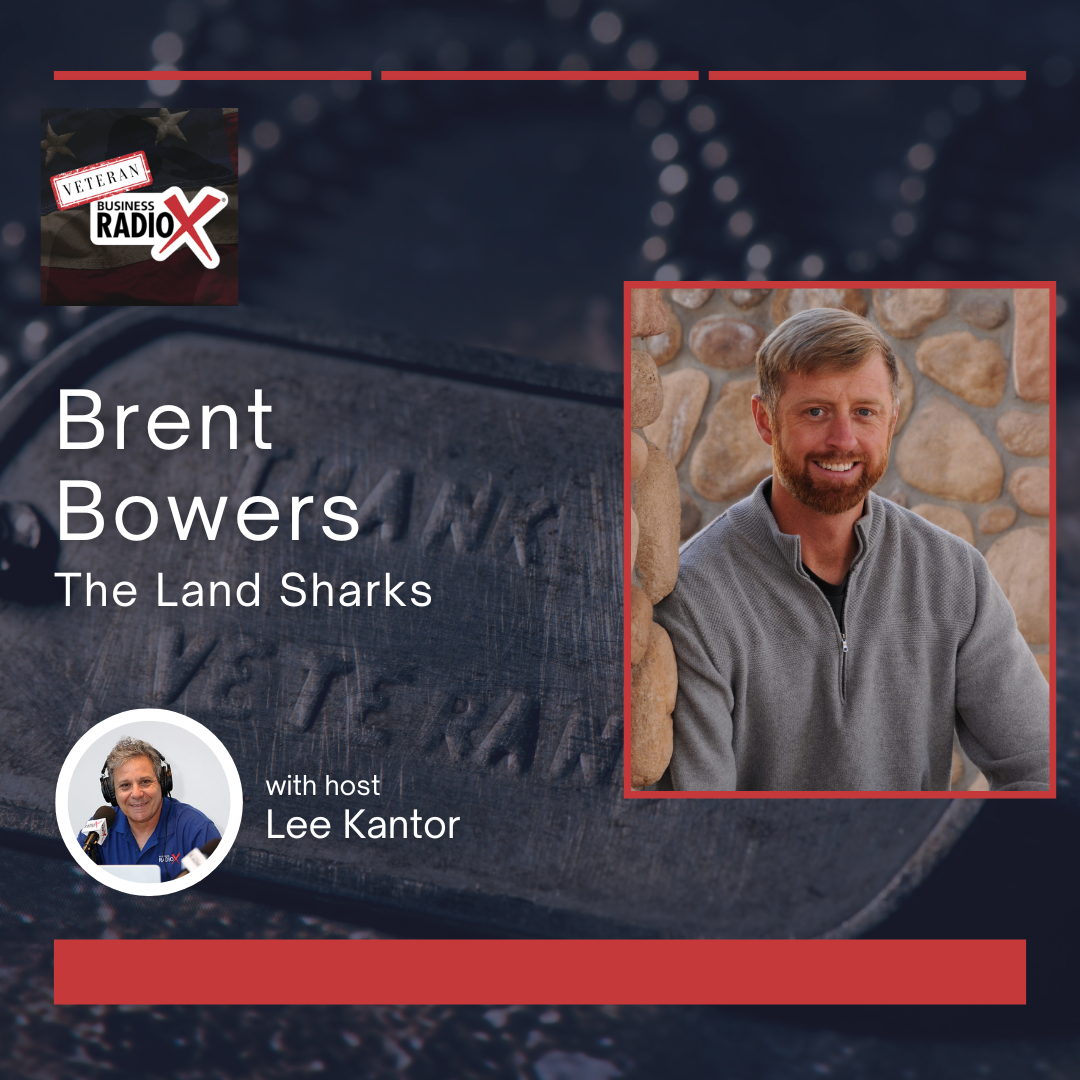

In this episode of Veteran Business Radio, Lee Kantor interviews Brent Bowers, a former Army officer and founder of The Land Sharks. Brent shares how financial pressure during military service led him to discover vacant land investing, buying parcels at significant discounts and reselling them for profit. He explains his evolution from flipping raw land to developing properties with manufactured homes, addressing the affordable housing crisis. Brent also discusses his coaching program, helping clients achieve substantial profits, and emphasizes that veterans’ discipline makes them ideal candidates for this business model.
Brent Bowers, is an investor and coach with a focus on buying and selling vacant land. As an Army Officer with over 8 years of service, Brent was spending a great deal of time away from his family, and he knew he needed to make some changes in order to be more present with his wife and children.
In a short period of time, Brent was able to expand his business, hire a team, and (most importantly) spend quality time with his family while still working hard and helping others. While Brent invests in many different types of real estate, his favorite investment strategy deals with buying and selling vacant land, and he enjoys sharing his expertise in this area with his coaching clients.
Brent chooses to live his life based on Bob Burg’s quote, “Your influence is determined by how abundantly you place other people’s interests first.” He is passionate about helping other people find success in real estate investing, particularly in land investments.
Connect with Brent on LinkedIn and Facebook.
Episode Highlights
- Transitioning from military service to civilian entrepreneurship
- Real estate investing, specifically in vacant land
- Strategies for buying and selling land profitably
- Developing land by placing manufactured homes
- Importance of understanding financial metrics in real estate
- Coaching others in the real estate investment niche
- Marketing techniques for land acquisition and sales
- Risk management in land investment and development
- Opportunities for veterans in real estate investing
- Building a sustainable business model in real estate
 This transcript is machine transcribed by Sonix.
TRANSCRIPT
Intro: Broadcasting live from the Business RadioX Studios in Atlanta, Georgia. It’s time for Veterans Business Radio, brought to you by ATL vets, providing the tools and support that help veteran owned businesses thrive. For more information, go to ATL vets.org. Now here’s your host.
Lee Kantor: Lee Kantor here another episode of Veterans Business Radio. And this is gonna be a good one. But before we get started, it’s important to recognize our sponsor, ATL vets, inspiring veterans to build their foundation of success and empowering them to become the backbone of society after the uniform. For more information, go to ATL vets.org. Today on the show, we have real estate investor, coach and former Army officer with The Land Sharks, Brent Bowers. Welcome, man.
Brent Bowers: Hey. Hey. Thanks for having me, Lee.
Lee Kantor: Well, I’m excited to learn about Land Sharks. Tell us how you’re serving, folks.
Brent Bowers: You know what? So, yeah, I started in land about 2015. How I serve people is with the Land Sharks as we show people how to buy and sell vacant land. I was in the military in 2015. I ended up getting out in 2018 by buying land at a discount. A lot of this land was not buildable, not accessible, landlocked stuff. And then I turn around and sell it for sometimes ten, 20, 30% more than what I actually paid for it. And I would a lot of times sell it on payments. So it was almost like having rental properties that I never had to go and repair.
Lee Kantor: So what’s the backstory? How’d you even know to get involved in this?
Brent Bowers: Oh my goodness. So I had a huge why. My back was against the wall. I was about I was training to go on my third combat deployment to Into Afghanistan, and we had already had a baby. It was a newborn baby. And then we literally got pregnant again. And my wife was like, at her wit’s end. And I’m like, oh my God, I can’t keep deploying. I’d already had one divorce happen because I was never home on my second deployment. So I’m like searching for answers, listening to podcasts, radio shows just like this, listening to audible every time I’m driving down the road. And I was like, what can I do? I’m already in real estate. I have seven rental properties, but they’re not paying me anything. Literally, if I quit my Army job, I’d probably lose the rentals because they suck. When I was terrible at it. But I heard a guy on a podcast talking about flipping vacant land. Like he would buy it for a couple hundred bucks and sell it for like several thousand the next week. So I was like, Holy cow. I can do that too and not have to quit my job. And so I just kind of went head first into it, made a lot of mistakes and things started happening for me.
Lee Kantor: So how do you just even begin the process? How do you know even what land is available? And how do you know what Like what’s good land from bad land.
Brent Bowers: Yeah. Right. Because when I started, I bought a lot of bad land. Not like the bad lands, but I was so this, this podcast I was listening to, this guy was going to tax auctions and buying this stuff. There’s no way I can go to tax auctions because I worked like 13 hours a day for the Army. But what I could do, I was like, I can catch these people before they actually lose the land. So I would mail them postcards. They would basically say, hey, my name is Brandon. I’d like to buy your land at, you know, one, two, three Main Street. If you’re interested in all cash, fair price offer, call me, text you, text me. God bless you. Um, so I send these out, my phone ringing like crazy, and I’d end up buying these parcels of land for like 100 bucks, 200 bucks, sometimes 500 bucks, and I sell them for 5000 and a lot of times on payments. Um, but yeah, a lot of it was non-billable not accessible land locked stuff. And I found out that it takes just as much time to make $5,000 as it does to make 50,000. So I started actually, well, let me back up. I actually started coaching people on how to do this. And I started learning from the people I was coaching. Like, these guys are making like way more money than I am. And I’m doing it full time now. And they’re doing it part time, like looking at what they’re doing, like they were mailing more expensive landowners. And it came down to demand, is this land in demand? Is it buildable? Will a realtor sell it? And when I started doing that, my income like skyrocketed. And I started working less hours and I didn’t have to sell the land now because realtors are selling it. So that’s kind of how I got away from buying the bad land that I’m doing air quotes right now, uh, was buying land that other people are buying. Other people are interested where I see land selling.
Lee Kantor: So like, what are some signals or clues to you that, hey, this land is going to go up in value.
Brent Bowers: I don’t care if it goes up in value or not, because I’m buying today with profit in mind. I want to be profit immediately. So if the land’s worth, let’s just say I’m going to use easy math 100 grand and I want to make $10,000 and I have a realtor sell it. So okay, I need to, uh, backwards or reverse engineer this. So if it’s worth 100, my buyer is probably going to want a little bit of a discount. So they buy it quick. So let’s just, let’s just discount it five grand. If I want to make ten grand, let’s discount it. Ten more grand. And I’m also going to pay a realtor to sell it for me. So subtract six grand plus closing costs. Oh, and yeah, I’m going to pay my lender. So I need to offer like $74,000 if I want to make ten grand. So that’s how I come up with my offer. I literally go into it with $26,000 in equity. That’s a very round example. It doesn’t always work out that perfectly. Um, but that’s how I make those offers and I don’t care if it appreciates. Now if it goes down in value, I might have to give it away for for what I what I’m into it for. So you always want to kind of figure out, you know, what if what if the market tanks tomorrow. Well, most of the time, if you’re at a 30 $0.30 on the dollar, I’m sorry, 30, 30% off. So that’s like $0.70 on the dollar. It usually doesn’t fall that quickly looking at history. Um, but I might, I’ve had pieces of land. I’ve had two parcels of land now. I pretty much had to sell for what I paid for them. Didn’t lose money, but I darn came. I, I darn sure came close. So you can’t just buy any piece of land. You want to make sure you’re getting it at a discount.
Lee Kantor: Now, are you buying only land near you or are you can buy land anywhere.
Brent Bowers: Anywhere in the United States?
Lee Kantor: And then do you have a preference like I like land near a highway or I like land near water or like, is there kind of some elements that you look for or don’t look for?
Brent Bowers: Yeah, I call those attributes, you know, mountain view, water view. Uh, yes. I, I will not buy any more land that does not have road access, legal road access. I’ve I’ve I’ve I’ve done enough of those deals. Again, those are usually deals I have to work harder to sell. Um, but no, I’m not necessarily interested in all the attributes. I really want to see land moving.
Lee Kantor: And then how long do you hold on to it typically.
Brent Bowers: Uh, my typical is about 30 days. Now, if I go past that point, it’s usually a two two problems. So one or the other, uh, one I’m asking too much for it. Two, I don’t, my marketing is not not good. Um, it’s usually the price side though, because we’ve kind of dialed in the marketing, you know, really we’re in the marketing business. At the end of the day, our product is just land.
Lee Kantor: So you’re so you find land and you immediately put it for sale.
Brent Bowers: Yeah. A lot of times, uh, once the offer is accepted for my parcel of land from the seller and we know they want to sell it to me, and I know it’s at the right price where I need to be at. They sign an agreement saying that I can go ahead and start looking for my buyer. So really I’m able to market it before I even own it. A lot of times I’ll have the buyer, uh, in, in mind or in place before I even take ownership of the land. Um, now something recently my land deals, um, you know, started to take a little bit longer to sell in a couple of years ago. And I did some research on what I’d done in the past. And I looked at my, my largest profitable land parcels, and it was usually because it allowed a manufactured home. Well, the country is going through, you know, quite a, a problem with the affordable housing. And I noticed that the house is that we’re selling the fastest are manufactured homes. So we started placing manufactured homes on our land about two years ago, and it’s been more of a consistent, profitable business, but it’s also allowed us to sell for much higher profit also to a larger buyers pool because, because now when we improve the land and put a home on it, people can get FHA lending, they can get VA lending or conventional loan or USDA loan, or even non QM like s a, you know, nontraditional loans like for investors.
Lee Kantor: So so you become a developer.
Brent Bowers: Yeah. I’ve, I’ve graduated into developing.
Lee Kantor: So does that um, increase the risk. But it increases the reward.
Brent Bowers: It does increase the risk a little bit because now we’re placing more, more, uh, money into the land. But at the, at the same time, it decreases the risk because if I get stuck with a piece of land, I can’t sell. Now I’ve got a brand new manufactured home on it that I can rent out, or I can refinance out of and get my cash out of it and then rent that property. Now I have a brand new home that’s got like ten years warranty, two years warranty on the systems. So generally I can rent it out for what I, uh, like to cover the mortgage of what I’ve got into it. So I guess it increases the risk, but it also decreases the risk. There’s so many ways it decreases the risk because now we have a way bigger buyers pool, because most people don’t realize the work it takes to develop a piece of land to get the electricity and the water and the septic system or the sewer, and then to get the certificate of occupancy and, you know, have all the permits pulled correctly and closed out correctly. But once you do one, it’s a repeatable system. And most people don’t want to buy a piece of land, or they think they want to buy a piece of land and develop on it. But most people in this country have never done a real estate deal. So they they get into these parcels of land and they never build on them. Well, that’s where I’m kind of like just putting the two together. Where I used to sell to developers, I used to sell to builders. I used to sell to the first time home buyers. Now I’m just providing the home as well. It’s almost like I’m cutting out a lot of the kind of the cutting out the middleman.
Lee Kantor: Are you finding opportunities for those kind of tiny homes? Are you building kind of developments that are, you know, filled with those tiny homes where you can put a bunch of homes in one space?
Brent Bowers: Smallest home I’ve ever built is 1500 square foot. So no, I haven’t done a tiny home. I want to build a house or a home. My my cup of tea is manufactured housing. I put manufactured homes. Um, I want to put a, I want to put a house on there that a lot of people can qualify for a mortgage on. Tiny homes are hard to get mortgages on.
Lee Kantor: Even though they’re less expensive.
Brent Bowers: That’s right. Yeah. The most banks, like a lot of times you can’t get an FHA loan or, or a VA loan on a tiny home.
Lee Kantor: Why is that? That seems counterintuitive.
Brent Bowers: Good question, I don’t know. I do not know.
Lee Kantor: So now um, so now you’ve kind of evolved from land to home to land and homes. Is that just part of the evolution of your work now?
Brent Bowers: Yeah. And I, I mean, there’s still money in land. Um, I just saw my land business slowed down a little bit and my, my manufactured homes being placed on land pick up. And maybe it’s because I’m more interested in that now. You know, my, my, my interest has moved. Maybe that’s why it’s doing so well. I mean, we’ve still got some land investors doing very, very well, even better than what I’m doing with than placing land. I’m sorry, placing manufactured homes on land, but I think it’s just because my interests have changed a little bit. I’m just I’m just passionate about I’m excited about it. Um, because, you know, one of our markets, the median home price, I’ll give you Greenville, South Carolina, $400,000 is about the median home price, depending on where you check and you know what day you check. But these manufactured homes on land that we’re selling, we’re selling them for half the median home price around 220,000. So someone can go out and buy a fixer upper for 400,000, or they can buy a brand new home from us on land for 220,000. Not everyone’s going to qualify for a $400,000 loan, but they might qualify for $220,000 loan.
Lee Kantor: Now, is there any advice you’d give entrepreneurs out there who are thinking about getting into this type of real estate investing when it comes to scaling and building a team?
Brent Bowers: Yeah, I mean, know your numbers first. You know, the right team is is absolutely crucial. Be careful. Scaling is dangerous. I’ve scaled many times and I’ve also, uh, retracted, uh, or, uh, I guess slimmed down quite a few times. You know, indigestion is the biggest killer of businesses. You know, you want to know your numbers. You want to make sure you’re not wasting a lot, a lot of, you know, money. At one time, I had 15 team members and I was doing deals just to make payroll. And my wife was like, you’re not a business owner, you’re a slave. And it kind of punched me in the gut. I was like, why would you say that to me? Like, uh. She’s like, yeah, you’re, you’re, uh, you know, fake it till you make it. Like she gave me a hard time and it really hurt my ego. And then I realized I was like, yeah, you’re right. I’m spending so much money just to just to pay all these people. This is not why I got into real estate. I was doing that to build my ego. I had the office, you know, big, big truck and all the toys and and I shrank down to one employee. Now.
Lee Kantor: So now you have systems in place that allow you to kind of do similar kinds of work with fewer employees.
Brent Bowers: Fewer employees, fewer deals, fewer taxes, fewer expensive. Uh, we rented the office out. It’s actually paying for itself and, and paying down the mortgage and making money. Um, you know, now it’s like we got AI. I could probably replace my office manager with a with an AI agent. So it’s incredible what we’ve got in 2026.
Lee Kantor: So now how does the coaching business work?
Brent Bowers: Yeah, that’s that’s a, I have a blast doing it. I actually, this is what gets me out of bed in the morning is, you know, seeing people do their first deal. I got a 25 year old guy out in Georgia. Uh, we’ve been coaching him for right at nine months now. He has completed seven projects where he has purchased a piece of land. On average, he’s purchasing this land anywhere from 8 to $12,000, putting a brand new manufactured home on it. He has about 148 to 168 in each of his projects, and he’s selling these things for anywhere from, you know, 215,000 to 230,000. So some of these he’s profiting 70 grand. I mean, this guy is going to be a multi millionaire before he’s 30.
Lee Kantor: So how much money do you need to kind of get into this business. Is this something that you better have, you know, a hundred grand In cash somewhere that you can start buying this? Or is this something you can start with much less funds?
Brent Bowers: Yeah, I’ve seen people start with like -$100,000, like credit card debt. Um, and I’ve seen guys with, with cash in the bank, you know, I, I say everyone starts where they’re at. You know, we’ve got people in our community that are very good at finding deals. Hence the, the 25 year old guy that I mentioned, he was 24 when he started. Very good at finding deals, but people trust him and they’re investing money with him where they loan him the money to build the. I actually funded two of them myself for him. Um, and now he’s got his own cash. He really doesn’t need us anymore. But, uh, and then there’s people out there with a lot of money, but no time to go out and find the deal. So I always tell people, start where you’re at. If you don’t have 150 grand in the bank, then don’t let that stop you. You know, I surely didn’t when I was buying, you know, my first parcels of land for $285. I was scared to death to spend that money, but I had to start somewhere.
Lee Kantor: So is, um, is land investing as competitive as it seems? Real estate investing where like everybody and their mother is a real estate agent.
Brent Bowers: You know, I don’t think so. I mean, they’re not they don’t have a HGTV show about flipping land yet or placing manufactured homes on land. Everyone wants to flip a house. Everyone wants to be a real estate agent. Every time I turn around, a friend of mine gets a real estate license. I’m like, how much money have you made? They’re like, oh no, it took me a year to get it. Like, how much money have you made? Well, I spent a bunch of money on that. How much money? Nothing. So, you know, uh, I don’t think it’s as competitive. No.
Lee Kantor: Are there, um, certain states that are more conducive for this than others? Like, uh, when you’re because you said kind of the US is, is kind of the market. Are there states you would avoid doing this kind of investing in and ones that you would, you kind of keep going back to?
Brent Bowers: Yeah. I don’t know if there is any state I would avoid, as long as there’s there’s land that’s selling and they’re there. I mean, we want to success leaves clues. We want to see actual land selling or manufactured homes in the area selling. So I can tell you all the states that I’ve done it in Colorado, Arizona, California, Georgia, Tennessee, South Carolina, North Carolina and Florida is where I’m I’m heavily invested.
Speaker 4: So is there is there is there a.
Lee Kantor: Story you can share about an investment that you made that maybe is the one you’re the one that’s the one you tell everybody about like one that you’re most proud.
Brent Bowers: I’ll tell you what, the one I’m absolutely most proud about is the first and the second one. At first, when I told you about for $285, I bought the land. It wasn’t buildable. It was two lots. I sold it to a realtor the following week for $5,000. That one was awesome, but the second one changed my life. I actually used that money at $5,000 to buy a second parcel of land for $500, not accessible. So it was landlocked by state property right next to Fort Carson, Colorado, where I was stationed in the military. And I sold it to a guy on Craigslist for $500 down. So I got my money back out of the deal and $400 a month. That one changed my life because that one was paying my truck payment. And I thought I told my wife, Emily. I was like, you know, if we do this ten more times, we’re financially free because our expenses are about $4,000 a month. So the next one, I think I’ve covered the water bill. The next one, I covered the gas bill and eventually covered the diaper bill, and eventually I covered the mortgage payment. Before I knew it, I was at $12,000 a month coming in by selling like inefficient raw land just in Colorado. So that’s, that’s what changed my life is it’s almost like owning a bunch of rental properties. Now eventually people pay me off. So I had to keep feeding the beast. Basically, it was like owning rental properties I never had to make a repair on, and I’ve done over 350 of them now at this point.
Lee Kantor: So you like having that kind of in the background for cashflow?
Brent Bowers: Oh my gosh. Yes. Because if you cover your, your monthly nut, your monthly expenses, like, you know, a lot of these loans are five years or more or almost like, well, how fast do you have them pay off? I don’t care if they want to pay me off in 30 years because I’m creating notes where people have to go to work every day to pay me. So yeah, these are always running in the background.
Lee Kantor: So when someone becomes a coaching client, they learn all of this stuff to get all the forms, they get all the information that they can be in, in business.
Brent Bowers: Yes, sir. That’s it. Because a lot of this I didn’t create, I learned it from other people along the way. And I paid a lot of coaches. I’ve been going to real estate seminars since 2004. I always tell people I’ve been practicing real estate since 2004. But the fastest way to get results is find someone that’s already doing it. What you want to do and living a life like you want to see. Like you want to know they’re actually the real deal. Like look at their HUD statements or their settlement statements. Know they’re actually doing this and they don’t have to be doing huge amounts. I think when I was the best coach is when I had only done a couple deals, you know, because like, I still remembered what it was to start, how it was to start when I didn’t, I had to put my mailers on a credit card.
Lee Kantor: So why is this a good thing for veterans to take a look at?
Brent Bowers: Oh my goodness. Yeah, that’s a great question. Um, I was in the military. I had about a three year runway on my last contract, uh, eight and a half years in the military. I built up my land business $12,000 a month before I got out of the military. Um, because I was scared to death to get out, you know, serving eight and a half years. My paycheck came in every two weeks. You know, I didn’t have to think about what I was gonna wear that day. Um, but you really got to start before you get out. And what’s amazing about veterans is we, we, we can, we can be disciplined on a system. And all this is, is a system, a system of exactly what to do each day to bring a return on investment.
Lee Kantor: So if somebody wants to learn more, have a more substantive conversation, what is the website? What’s the best way to connect?
Brent Bowers: Yeah, I’m all over social media. Brent L Bowers but, uh, I guess the easiest way to connect with me, um, or someone on my team is the land sharks.com.
Lee Kantor: Well, Brent, thank you so much for sharing your story today doing such important work. And we appreciate you.
Brent Bowers: Lee. Thanks for having me.
Lee Kantor: All right. This is Lee Kantor. We’ll see you all next time on Veterans Business Radio.















