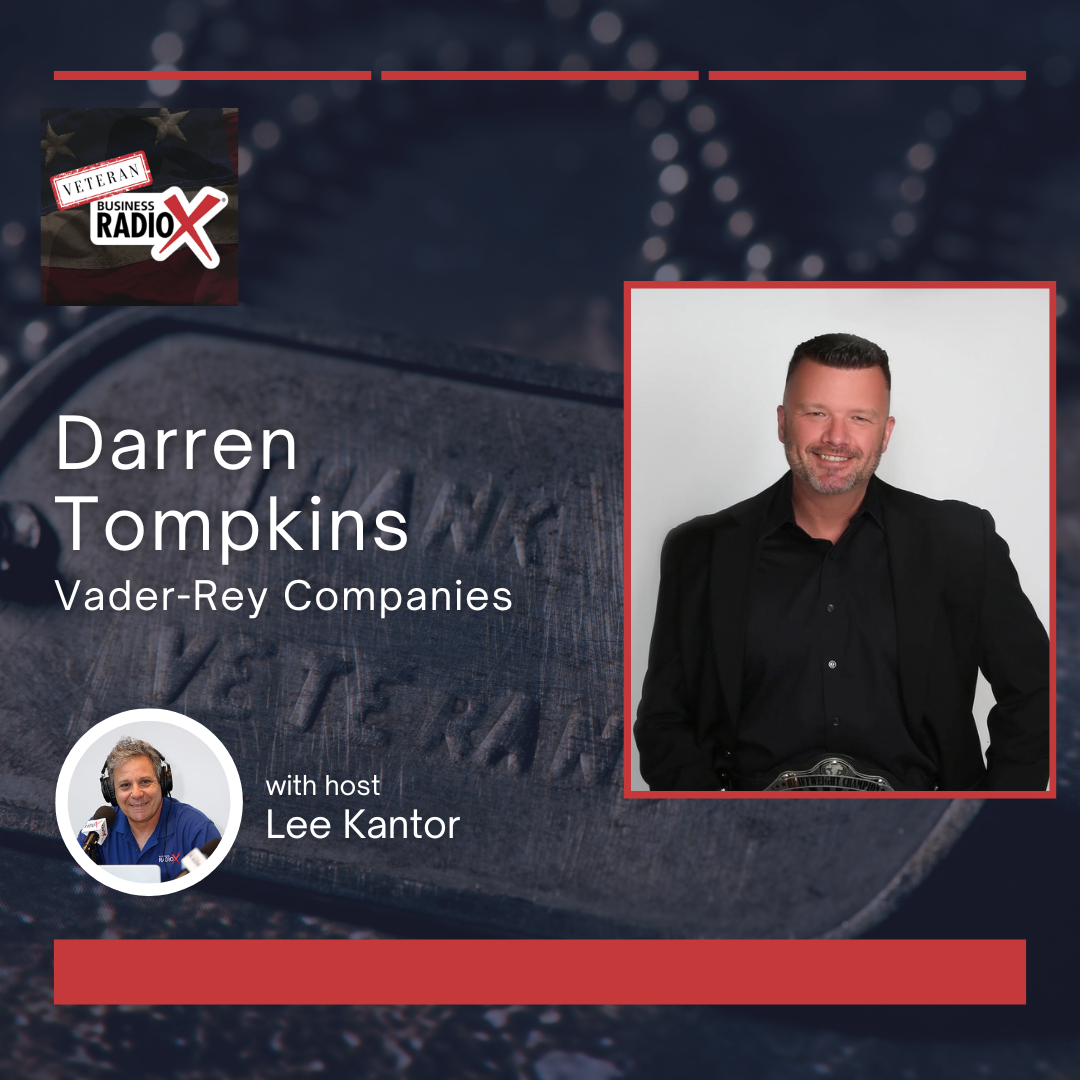

In this episode of Veteran Business Radio, Lee Kantor talks with Darren Tompkins, founder and CEO of Vader-Ray Companies. Darren discusses his military background and how it shaped his leadership style, then explains how his company provides recruiting, engineering, and virtual assistant services, including a team based in the Philippines. He highlights the use of AI and virtual professionals to streamline hiring, the importance of cultural fit, and building long-term client relationships. The episode offers practical advice for both businesses and job seekers, emphasizing efficiency, trust, and veteran entrepreneurship.

 Darren Tompkins is the Founder and CEO of Vader-Rey Companies, a multi-division staffing and talent solutions firm supporting engineering, construction, and operations teams across high-demand industrial and data center projects.
After serving in the U.S. Army and building experience in oil and gas, Darren stepped away from traditional recruiting models to create a company that treats talent as long-term partners and clients as strategic allies.
Under his leadership, Vader-Rey has grown into a trusted workforce partner for organizations that require experienced professionals who can deliver from day one. Darren is known for blending operational discipline with strategic brand building, helping companies scale with the right people in the right roles at the right time.
Connect wtih Darren on LinkedIn and follow Vader-Rey on Facebook.
Episode Highlights
- Overview of Vader-Rey Companies and its three subsidiaries: Vader-Rey Recruiting, Vader Engineering, and Vader-Rey Virtual.
- Discussion of the recruiting industry, focusing on sectors like oil and gas, data centers, and engineering.
- The impact of military service on entrepreneurial leadership and business practices.
- Challenges in the recruiting process, including candidate management and competition with other firms.
- Use of artificial intelligence to enhance recruiting efficiency and reduce costs.
- Strategies for building strong client relationships and transitioning from transactional to strategic partnerships.
- Importance of cultural fit and candidate preparation in the interview process.
- The role of virtual assistants and outsourced help in improving operational efficiency for businesses.
- Insights into sourcing candidates and leveraging technology for recruitment.
- Advice for candidates on optimizing their LinkedIn profiles and presenting themselves authentically.
 This transcript is machine transcribed by Sonix.
TRANSCRIPT
Intro: Broadcasting live from the Business RadioX Studios in Atlanta, Georgia. It’s time for Veterans Business Radio, brought to you by ATL vets, providing the tools and support that help veteran owned businesses thrive. For more information, go to ATL vets. Now here’s your host.
Lee Kantor: Lee Kantor here. Another episode of Veterans Business Radio. And this is going to be a good one. But before we get started, it’s important to recognize our sponsor, ATL vets, inspiring veterans to build their foundation of success and empowering them to become the backbone of society after the uniform. For more information, go to ATL vets.org. Today on the show, we have the founder and CEO of Vader Rey companies, Darren Tompkins. Welcome.
Darren Tompkins: Thanks, Lee. How’s it going, man?
Lee Kantor: It is going great. I am so excited to learn what you’re up to. Tell us about Vader Rey. How you serving folks?
Darren Tompkins: Yeah, yeah. So Vader Rey companies is actually three subsidiaries into one. They kind of funnel into each other. Vader Rey recruiting, which is traditional recruiting here in the oil and gas and data center space as well as, you know, like engineering and whatnot. Vader engineering, which we provide 1099 type project type workers, depending on whatever you need, whether it’s a construction build or back office support. And then we have VRA virtual, which is a virtual professional virtual assistant company. That’s where most of my people are based in the Philippines to help you with whatever help makes your life easier as an entrepreneur.
Lee Kantor: So what’s your backstory like? What’s your origin story of this?
Darren Tompkins: You mean as far as the company goes or.
Lee Kantor: Yeah, well, I mean, I’m sure they are go hand in hand, but wherever you like to start.
Darren Tompkins: So I actually only got into recruiting at the end of 2020. I’d been working in oil and gas for quite some time, like an IT project manager and you know down here, as I’m sure it is in Atlanta, no matter what you’re doing, you get called on by a lot of shitty recruiters, just really bad experiences. And, and, you know, these are people that are just punching out jobs with hoping that something will stick. And when you go through that enough, you start to kind of get it into your head. You know, there’s got to be a better way of doing this. And so I took a job as kind of like a second in command of a small boutique recruiting company. Again, at the end of 2020 where there was no work happening and learned the biz really fast, learned how lucrative it could be for an owner rather than just being somebody in a W-2, moved to a an international firm, but get a little bit of experience, but then launched Vader while I was still there. And, you know, we’ve we’ve been rocking and rolling. Our last year was like our real, you know, build year. And you know, here we are on your show.
Lee Kantor: So what, like, what did you take from your military service that helped you, you know, take this entrepreneurial tact.
Darren Tompkins: Yeah. You know, I kind of ran the entire gambit of military. You know, I was, I was enlisted right at 17, spent a year on the delayed entry program at a very small town called Salem, Virginia. Uh, the only thing people know about it is that Virginia Tech is about 30 miles away. It’s really the only only spot in Appalachia. You know, I was enlisted in the military police. I became an NCO in the reserves in a civil affairs special operations unit. And then I took the ROTC scholarship. So I went from, you know, lower enlisted to NCO to officer. And it’s when you tell people you’re a veteran, especially when you’re dealing with a decision maker who’s a veteran, it’s a little bit easier conversation here in the civilian world. Now, my challenge is always were when I first like when I first took my, my actual first corporate gig, right? Was, uh, I told the engineering manager this, it’s really hard because in the Army, you can just tell people how bad they suck and they have to deal with it, you know, and they do push ups for their bad work transitioning into the civilian world, you got to finesse it a heck of a lot more.
Lee Kantor: Um, maybe they should be adding the push ups. See how that works?
Darren Tompkins: Yeah, no, it might help depending on where you work.
Lee Kantor: So, um, what when you were, um, decided to go the route of, okay, I’m an entrepreneur and I’m going to build this recruiting firm. What, um, what was kind of that? Were you just copying what you had seen and just kind of just taking their playbook? Or were you, did you learn stuff from them to say, okay, I can do this different and better and this is how this is what makes me special.
Darren Tompkins: Yeah, I did take some of the more traditional mindset of recruiting, which is, you know, you get resumes, you match it against the job description, but it was really meeting somebody that told me about virtual professionals that you could use, uh, that were less expensive than traditional American based recruiters. And then, you know, coming in at the end of 2020, you know, AI was really starting to take off. And I saw that we could totally use this to cut time. Cut expenses. You know, not blow people’s budgets by having a big support staff. And we used AI into our process of recruiting, which has turned, you know, our time to to fill is what it’s called when you, when you finally get somebody hired on, on our side is very short now. As long as the right person comes around and that is a cost benefit to our clients as well as us here internally.
Lee Kantor: Now is the hard part in your business getting companies to say, hey, um, I’m going to use you to recruit talent or is it to actually find the talent?
Darren Tompkins: I mean, so sales is always tough, right? Because there’s a million recruiting companies out there and they want to know how you’re differentiated. Um, I’m very fortunate. And then probably about 75% of my work, our work so far has been referrals. Um, companies that I worked for before are now came along with us when I went out on my own. Um, and the sales part is tough because everybody’s offering the same thing. It’s just you have to get through that gatekeeper, explain your ability to do the job of what they’re looking for, and why are you going to be faster, cheaper than everybody else? You know, the way our company is set up is to accomplish all of that. But sales is still something we always struggle with, no matter where you are. And the candidate stuff. I have a million stories I could tell you about getting a candidate to the end zone, and they just dropped the ball before they go over the finish line, whether that’s failing the drug test, finagling for more money, you know, just literally ghosting like you never hear from them again. You know, for whatever reason, it’s just there’s a million reasons when you’re dealing with people that they don’t do what they say they’re going to do.
Lee Kantor: But when companies hire you to find talent or candidates, um, or are they hiring just you exclusively? Or do they, you know, have five different recruiting firms out there looking around because in a lot of the industries you’re working in, it’s like a, an unemployment rate of like zero or negative.
Darren Tompkins: Yeah. If you if you know, if you have a, a company recruiting company, they typically work on what’s called contingency. Meaning we don’t collect any cash until we get the client, the candidate placed. Right. Um, that’s a certain percentage of the, the annual compensation. We have other companies like one oil and gas company here that’s had us for the past year as their complete outsource. So they were just like full time employees over there. We’re always go into a search assuming that we’re competing against somebody else because they’re getting pegged by a lot of different, you know, other agencies out there. But you also have to understand, when you’re in this business, you’re also competing against the client because they’re getting referrals. They might they might have a recruiter, internal recruiter that’s out there looking at the same time you are. It’s, I call it a foot race. It’s who can get to the finish line first with the best possible speed. And you know, that candidate being hired on who’s perfect is the, the award.
Lee Kantor: So how do you go about, you know, finding candidates faster and more effectively and matching the right ones. Like, do you have some secret sauce to this or that, or is it just kind of grinding? I gotta just, you know, I gotta go through a million people to find that the right fit.
Darren Tompkins: You know, you’re like the third host in the past week that has used that term secret sauce, which is something that I use all the time in recruiting. And here’s something that, you know, I might get some hate mail for on the process side, as far as the platforms we all use to find candidates, there is no secret sauce. We all use the same stuff. Right now. There’s AI platforms that are coming into fruition that can cut down some of the, uh, the legwork grind that you talked about, but we all still use, you know, LinkedIn indeed monster and some, some occurrences ZipRecruiter, all that type of stuff. It’s just how can you take that long process from the beginning to the end? How do you cut this down? It’s almost like folding space AI. We’ve, we’ve, we have fully embraced. So in the past, if you got a second for an example, we would get a resume. Somebody applied to a job that we posted on behalf of a client. You know, you have to look at that resume versus the job description, and you have the bullet points of what they have to absolutely do. Right. I think the old recruiting adage was, you have like 2 or 3 seconds to get the attention of whoever’s reading your resume.
Darren Tompkins: That’s still very, very true. And Vader, Rey, we use our own AI that we’ve been programing for almost two years now where we will just simply run it against the job, your resume against the job description, and it comes up with a numerical number. Um, there’s no such thing as a ten, which even guys like Dave Portnoy, the pizza guy will tell you. Um, but there’s a sweet spot in there. And if you hit a certain number, then we go to interview and then we complete this long worksheet of both, uh, functional, which is the job description and the cultural piece of what you need somebody to do. And then we will run it again on the AI and see what the number is. So then I will, if it’s a senior role, I’ll do an additional kind of cultural fit interview. So by the time Lee, you get that that candidate, you know, we’ve gone through 3 or 4 different stage gates to ensure that they’re the best possible one that we can get in front of you.
Lee Kantor: But are all the candidates someone who’s raised their hand and say, I’m looking for a position or some of these because most of the people, uh, that you’re trying to place aren’t, don’t they already have jobs?
Darren Tompkins: Some do, some don’t. Um, you know, LinkedIn has a feature where you can secretly tell recruiters that you’re open to work. Uh, that’s a frame that we’ve, that when we use LinkedIn recruiter tool, we can see, and those are the people that we typically go for first. If it becomes a grind, like you said, then we’ll, we’ll start to look source and kind of poach people from jobs that they may already be in. But if we think they’re perfect fit, um, then we just do outreach and there’s other software packages that you can use to dig up people’s phone numbers and that type of thing to make the, the communication piece happen faster. The grind is absolutely that, man, you never know what you’re getting into. We’ve had jobs where something very simple where it’s like, it’ll drag out for months, you know? And then the client just ultimately gives up and doesn’t want to hire anyone because they’re looking for a unicorn. We’ve had very high technical jobs where we filled it in a week because the right person is looking at the right time and they’re paying the right and everything else just kind of works, which is beautiful to see because nobody wants to wait months at a time to find the next worker, you know?
Lee Kantor: Right. So is there something, is there any advice you can give a candidate who wants to be found? What are some things that you kind of get your attention? So you’re like, okay, this person I’m going to put on my list to contact like, like, how do you, what can a candidate be doing today that’ll so they can be found tomorrow?
Darren Tompkins: Absolutely. And that’s a great if we’re talking LinkedIn, which is, like I said, a overwhelmingly where we find talent. Um, if you know what the format of that looks like, recruiters will never talk to you if they don’t know who you are, where you are, or what you do. Um, and what you look like is, is another piece. Like if we have candidates that are trying to like ageism is a real thing. You know, I’m about to turn 52 and it’s out there and I see it all the time now. You know, candidates will try to hide, hide their age, you know, but eventually you’re gonna have to get in front of somebody, right? But if we look for, say, your whatever software developer, um, if you don’t have that in your job title and this is what you’re doing or we don’t know where you are, maybe we’re looking for something in Atlanta, right? And the guys in Houston, if we can’t tell immediately, we’re going to pass you up real quick because there’s lots of other candidates out there who you are, where you are and what you do are key. Get rid of all the fluff, you know? Um, cover sheets, cover letters and that kind of stuff are a thing of the past. Just get your resume down to the nitty gritty, right? Get rid of all the AI generated, uh, keywords. You know, anytime I see somebody has dynamic on their resume nowadays, it’s like, okay, they use AI to create that. Um, and if we think it’s AI created, we will run it against our AI and come up with a percentage. What do you think the probability is that they use AI? And if it goes over a threshold, some companies don’t want us to talk to them because it doesn’t show your authentic self in the transaction.
Lee Kantor: Now, um, when you know, there are certain, obviously there are certain mechanics of doing this kind of work, but this is always, I’m always curious about this because in some industries, like we just had the NFL combine, the NFL combine, people run and your, your time is your time. Like in a lot of work. Like if I’m an engineer, like, how are you judging if I’m good or not? Like, what are some signals that you’re looking for to ascertain somebody who has like kind of a normal, you know, middle management business job, like is better than somebody else. Like, how can you tell the difference other than just taking their word for it?
Darren Tompkins: Yeah, and if it’s industry specific, I’ll use oil and gas. Obviously, I’ve been around a long time, and I know what a lot of these companies are looking for when it comes to things like engineer, whether it’s a chemical engineer or mechanical, whatever, the job description will tell us what they need to be able to do. And, but there’s additional stuff. If people are in an engineering field long enough, they’re going to get like little certifications. Um, you know, they’re going to understand some of the lingo we might throw out at them. Um, and that’s the difference because some, you know, some of these larger companies, they might hire an engineer and all he does is sit behind a desk, you know, in an ivory tower somewhere. Others, they want them out on the, in the refinery, in the, in the, uh, the terminal, wherever the tank farm every single day. Um, and you have to ascertain, are you comfortable with wearing a hard hat and going out in the Texas heat and doing these things? Um, most people will continue to say yes because they’re looking for better pay or better culture because that’s why people typically leave companies.
Darren Tompkins: But at the same time, uh. Do you have to figure out if the cultural, uh, piece is now with engineering? Again, some of these can be done very quickly based on if the job description is written well and they match up. Others, you know, it could take several types of interviews in person type things where they’ll fly people in from all over. Uh, just to make sure you’re the right fit because nobody wants to hire for short term anymore. And, um, determining who the perfect candidate is, you know, we get to a certain point in recruiting because we’re not an internal to your company. Our job is to get present the best candidates, and then it’s up to you to figure out if the cultural fit is going to work. If you want, if you’re capable of working for them, making sure their motivation is good because, you know, we’re not always able to interview face to face. Uh, a lot of times it will be a Zoom call. Um, and then they’ll get in front of the client and it’ll either be high fives or, you know, pointing towards the door.
Lee Kantor: So in your kind of, um, relationship building within, uh, you know, your client. So they ask you to find some talent, you go about finding some talent. It all works out. You high five. Great job. How do you move beyond kind of that transactional? Okay, I did this thing for you to okay, let’s elevate this to a more strategic partnership.
Darren Tompkins: Strategic partnership is always the goal, uh, especially for me because I’m, I did not build this company because I want to have 100 clients that I might talk to once every hundred years. You know, um, the partnerships that we have are small and they’re, and they’re powerful. Um, we, there are what we call one offs where a company will, will hit us up on a referral. Uh, we need whatever, let’s just say, um, some type of, we’ll go back to developer, software developer, whatever it is. And you know, you get it done and they’re like, hey, thanks, we’ll, we’ll talk, you know, but it’s up to you as a recruiter to make sure that you’re still working the relationship even after it’s done, you’re checking in a month after you’re checking in with both the candidate. Hey, how’s your how’s your new job doing? And then you check in with the hiring manager or the HR, whoever it is that that initiated the conversation. That’s how you keep it going. And for me, it doesn’t matter if we’re hiring like a warehouse worker or VP of ops, uh, we use the same process to keep people engaged because the business relationship side, like with anything else, is key to, uh, putting the best foot forward and longevity in this business.
Lee Kantor: Now is your, when you’re, when you identify a candidate, do you feel that you have to kind of coach them up sometimes and give them, you know, at least some tools that will help them navigate the interview process? Like, is that part of your service as well, working that side of the equation?
Darren Tompkins: Definitely. Because remember, we typically don’t get paid until that person gets hired. So we will give them tips along the way. Uh, you know, one right now is we have a client, uh, that’s hiring, um, the owner. It’s a large distribution company, right? But the owner is in the office day to day, and he brings his big ass dogs with him. The cane Corso and a Doberman pinscher. And he kind of like dogs because, you know, you’re going to be interacting with them, whether you’re just picking up your paycheck or maybe you work in the office, right? That is a cultural question that you wouldn’t have really asked ten years ago, but it’s that type of detail that we get into nowadays. Um, the typical stuff. Are you bilingual and all that? Um, you know, what is your preferred quality of life? Um, you just pick up on it and we do social media scrubbing, depending on the role to make sure things are gelling. Right? And because we know if, if it’s an important job, the candidate is also going to be researching us, they’re going to be researching the hiring team and all that. Uh, and they’re going to have questions along the way. So you don’t necessarily have to like be 100% forthcoming because we want them to initiate some conversation as well.
Lee Kantor: So now let’s change gears a little bit and talk about kind of the, I guess it’s, it’s not the recruiting or the for the engineering or anything like that, but it’s more for the, the entrepreneur, that virtual assistant slash, um, outsourced help component of your job. How did that, was that from the beginning? Or is that something that once you found these resources, you were like, oh, this is, this is going to be really good for us.
Darren Tompkins: Yeah. I had, uh, when I first started the company literally like putting the paperwork together. I had met, uh, through some mastermind groups, which everybody, every entrepreneur should join, one that had really pushed, uh, virtual assistants, right. Um, and there’s virtual assistance programs in every country in the world. Um, this one just happened to be from the Philippines and I got introduced around all virtual, of course, um, ended up when I realized that, man, I could hire a recruiter from the Philippines for far less than, uh, here in America, run them virtually where we don’t have to have a big office or anything like that and cut those costs down that would, you know, bring our margin of our requirements down as far as what we charge people. And so it was very successful immediately. Um, and so like my, the oil and gas client I told you about, we’ve had a virtual recruiter there for an entire year. Um, they’re assigned an email address, access security access somebody that they will never meet face to face, but this recruiter has a masters and, um, human resources. She already knew all the systems, all the platforms that they had. It’s been a slam dunk success. You know, we’ve gotten their what we call time to fill down to 23 days across the board on average, which is incredibly fast given the variety of, of work that we’re doing. Virtual professionals. And I’m really trying to change that word because a virtual assistant is just somebody who just does like secretarial work, you know, they do your calendar and that kind of stuff. Virtual professionals, which we haven’t been doing everything from marketing to website development, sales, um, Um government contracts, organization, everything on down. They, uh, they, they, you know, they’re, they’re just awesome. I’ve had an incredibly positive experience working with them.
Lee Kantor: And then so that evolved into kind of a generic, uh, professional assistant for clients. So like they don’t, it’s not, you’re not recruiting, you’re like, uh, if you’re an entrepreneur and you’re like, hey, I need, uh, more hands on deck. This person could become, you know, my chief of staff in essence.
Darren Tompkins: Could be, yeah. I mean, we, um, and what we do is if we have new clients that are typically smaller companies, right? Um, that are growing, um, you know, maybe the CEO or maybe that chief of staff, uh, just needs some help organizing if we can score a, you know, a recruiting contract or we’ll place a person or two, I have no problem with with pitching, you know, we have this VP, VP program where we can help organize you a little bit. And I don’t mind slicing off time from these guys because they work for me full time anyway. Of giving them some hours out of the day to organize your life a little bit. Test it out. Almost like test driving a car. Come back in 30 days and let me know how everything’s going. And once they do that, then we can do, um, you know, program where we assign somebody full time, part time, whatever they need. So.
Lee Kantor: So do you have a service where if a person’s an entrepreneur out there and, you know, wants to hire somebody, they can hire this virtual professional as to handle multiple tasks that they don’t do necessarily.
Darren Tompkins: Yeah. Or they’ll do tests you never knew you needed done. That has been the biggest surprise. Um, we have have had people come in and we’re like, oh, well, I need you to do calendar organization, you know, or do cold calling. Then all of a sudden they’re putting together training programs because all the people that we hire out all have college degrees and people do forget that. Um, so it ends up being like, Holy crap, not only can they just do this, but man, I think this might be our next marketing head of marketing person. I mean, it really is amazing to see. See everything people can do.
Lee Kantor: So if somebody goes that route, um, the reason I’m asking is we have a lot of listeners that are entrepreneurs and a lot of them are solopreneurs, business coaches, people like that. And they’re always kind of behind because they get hung up on some of these tasks that aren’t necessarily revenue generating. And, you know, that’s not the thing that they’re selling. It’s just the thing that helps them sell the the work. So this sounds like a solution for those folks that they can have some, they can offload a bunch of this stuff that maybe isn’t revenue generating, or maybe some of it can be, but it’s kind of all the stuff that they’re dreading doing, holding them back. The stuff they don’t like to do. You can find a resource for them that might be able to take some of that weight off their shoulders.
Darren Tompkins: We call it getting your time back. And that is so key when you’re an entrepreneur or solopreneur, whatever it is, right? You just mentioned it. I got to spend 6 to 8 hours a week preparing expense reports or something like that. You know, we can get somebody for less the cost of an hour for somebody mowing your lawn or babysitting your kids, you can get a professional who’s experienced to do that, whatever the heck it is, uh, for you, you know, it could be anything from website building to, like I said, organizing your calendar or just doing the cold calls or just moving your calendar around, make, you know, calling your, your A’s and B’s every week. Um, it is a way to get your time back so you can focus on what matters.
Lee Kantor: Now in the relationship though. Is it okay? Say I have a need for that kind of a resource is my is my point of contact Vader. Rey. And then they’re just finding a specialist for whatever need I asked for. Or am I working with Bob?
Darren Tompkins: No, no. So with Vader Rey, I have an office in the Philippines. I have a business partner over there. And that’s key because you can go on Upwork or whatever and try to find them on your own. But if one day they’re just gone, they’ve got all your stuff, right, there’s no legal recourse or anything like that. You know, we’re vested in the Philippines. We have an office over there. Um, the people we go through this again, it doesn’t matter if it’s an appointment center, we’re going to go through this long interview process to make sure that you have the right person and that there’s trust, um, between the client, which is you, me, the owner, and then the team in the Philippines who’s going to be helping you manage this stuff. You’re never going to get a rando from us. Um, they’re all vetted out and it’s a big community over there. Our VA team over there does have a coaching section where they’re bringing in new VA’s to teach them how to work with US companies. Um, that’s very different because you can still get the same people that are working for companies in the UK or Spain, wherever, in Europe. Right. Um, but these people that we’re tasking are learning and they’ve become experts on dealing with the US culture and whatnot. An example of that is we we hired a cold calling team recently where, you know, they were doing European cold calling, which is vastly different. It’s a long blown out conversation takes forever. Just on the initial call here, I’m like, you’ve got a half a second to get somebody hook right to hook them in the door. Um, and here’s how we’re going to change all that up. Um, and it is just simply a cultural and business shift that you have to do. But if you try to do it yourself and just kind of go out there willy nilly, it may not work. We’re offering the kind of a guarantee to get you the right people.
Lee Kantor: So what do you need more of? How can we help you?
Darren Tompkins: Oh, as far as Vader. Rey.
Lee Kantor: Yeah. In your business, what do you need more of?
Darren Tompkins: Referrals. Referrals from your. Your show would be perfect.
Lee Kantor: Um, so who is that ideal client?
Darren Tompkins: Ideal clients for us, which again, we have massive companies that we work with. We have small companies, a company that’s, you know, anywhere from like, um, 20 to 100 people worth between 5 and $15 million. That’s on the up and up. Startups are key. Also, anybody that has a military background, um, I’m happy to trade stories and share a beer with, you know, one of the key things is I’m always a point person. It doesn’t matter if we’re hiring a temporary warehouse worker or VP of ops. Um, I’m always going to be the guy who’s talking to you. Um, and that’s by design because again, I like being the face of the company and doing conversations just like we’re having right now.
Lee Kantor: So now, is there a story you can share that, um, kind of illustrates how, how you could help a company like don’t name the name of the organization, but maybe share something that was meaningful to you or impactful when it comes. So they came to you with a problem and you helped them get to a new level.
Darren Tompkins: Yeah. So we’re actually finishing one up right now. We have an oil and gas client, um, that is a privately owned. So it’s not out there on the stock market. You said there’s not a lot of information, but I’ve been working with him for about five years now. The. See, the. The CEO slash president is planning to retire in the next 6 to 7 years, we think. Right. It’s always a guess. They need the new vice president of operations. This guy’s retiring now. We’re working on what’s called executive succession planning, where their next VP of ops isn’t just the vice president of ops. They want that person to take over the president role when he’s ready to go. So this has been about an eight month project, a long, long, long runway, because where there are people flying in, they’re doing panel interviews, and then they’re going out to dinner and they’re flying home, they’re coming back and they’re with them, uh, in the refinery and all that all day long. Um, this is a big deal, as you mentioned at the beginning about, about building relationships because this next VP of ops, because we’re, we’re maintaining the, um, you know, the relationship with this person as a candidate will eventually could be short time, could be a little bit, uh, might be our next employer, uh, as Vader recruiting and they’re going to remember us and the great job we did. And you know, our future is bright on that side for any client.
Lee Kantor: So if somebody wants to learn more, have more substantive conversation with you or somebody on the team, what’s the website? What’s the best way to connect?
Darren Tompkins: Yep. That’s Vader V a d e r r e y. That is a, uh, for your listeners, a Star Wars reference. We are a very pop culture family. My daughter’s names are Jose Vader Tompkins and Izzy Rey Tompkins. Uh, Vader, Rey. Virtual professional virtual recruiters just kind of worked. That was my wife’s idea. And yeah, you can find us on all the socials and especially LinkedIn.
Lee Kantor: Good stuff. Well, Darren, thank you so much for sharing your story today. You’re doing such important work and we appreciate you.
Darren Tompkins: I appreciate you and all the help you’re giving veterans.
Lee Kantor: All right. This is Lee Kantor. We’ll see you all next time on Veterans Business Radio.














