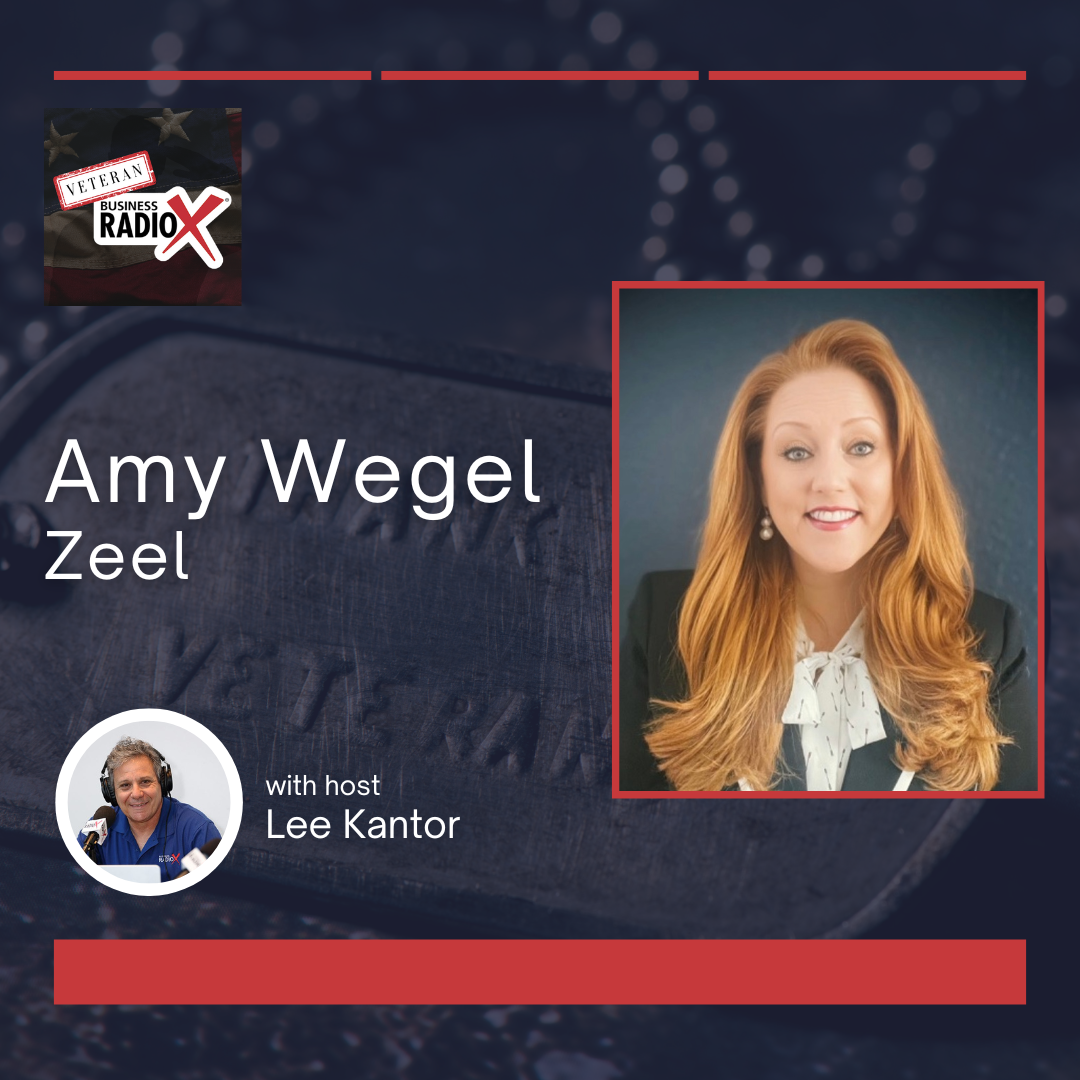

In this episode of Veteran Business Radio, Lee Kantor talks with Amy Wegel from Zeel, a company offering in-home, non-opioid pain management for veterans through medical massage therapy. Amy discusses Zeel’s nationwide services, the measurable benefits for veterans—including pain reduction, decreased medication use, and improved mood and sleep—and efforts to destigmatize massage therapy as a medical treatment. She also highlights Zeel’s tele-behavioral therapy for veterans and shares inspiring success stories.

 Amy Wegel is the Director of Government Solutions at Zeel. She oversees national strategy and delivery for Zeel’s government healthcare programs, pioneering non-opioid pain management solutions for the Veteran community through innovative in-home medical massage and tele-behavioral therapy services.
A recognized voice in Veteran healthcare and wellness innovation, Amy is a frequent speaker and media contributor, offering insight into non-opioid pain management, healthcare delivery innovation, and the intersection of technology and wellness.
Under Amy’s leadership, Zeel has delivered over 150,000 treatments to Veterans, achieving a greater than 90% reduction or elimination of reported pain among recipients and a significant decrease in reliance on prescription pain medications.
A deep personal commitment as the proud spouse of a combat Army Veteran fuels her leadership.
Connect with Amy on LinkedIn.
Episode Highlights
- Introduction to Zeel and its focus on non-opioid pain management solutions.
- Overview of in-home medical massage therapy services specifically for veterans.
- Discussion of the benefits of medical massage for veterans, including pain reduction and improved mood.
- Explanation of how Zeel operates through an app and website for booking services.
- Addressing the stigma surrounding massage therapy as a luxury rather than a therapeutic option.
- Data on the effectiveness of medical massage for veterans, including pain reduction statistics.
- Insights into the frequency and customization of massage therapy sessions based on individual needs.
- Comparison of professional massage therapy to handheld devices and massage chairs.
- Exploration of the integration of tele-behavioral therapy services for veterans alongside massage therapy.
- Emphasis on the importance of holistic care and support for veterans dealing with chronic pain and mental health issues.
 This transcript is machine transcribed by Sonix
TRANSCRIPT
Intro: Broadcasting live from the Business RadioX studios in Atlanta, Georgia. It’s time for Veterans Business Radio. Brought to you by ATL vets, providing the tools and support that help veteran owned businesses thrive. For more information, go to vets. Now here’s your host.
Lee Kantor: Lee Kantor here another episode of Veterans Business Radio and this is going to be a good one. But before we get started, it’s important to recognize our sponsor, ATL vets, inspiring veterans to build their foundation of success and empowering them to become the backbone of society after the uniform. For more information, go to ATL vets.org. Today on the show we have Amy Wegel. She is with a company called Zeel. Welcome.
Amy Wegel: Hi. It’s nice to meet you. Thanks for having me on today.
Lee Kantor: Well, I am so excited to learn what you’re up to. Tell us about Zeel.
Amy Wegel: Yeah. So Zeel is actually a, uh, a non opioid, uh, solution for folks who are in pain. So we deliver medical massage therapy. Uh, as a treatment option. And we happen to be doing this for veterans right now, which is extremely rewarding. And, uh, that’s what I’m here to talk to you about today. I’m really excited about it.
Lee Kantor: Well, can you share a little bit about your backstory? How did you get involved in this line of work?
Amy Wegel: Oh, gosh. Yeah. So I guess it’s kind of a long, twisted, weaved story, but, uh, I a million years ago. I live in Florida, actually in Central Florida, and, um, used to perform at the theme parks and did all of that fun stuff for many years and then transitioned into the world of, uh, spa. And so massage therapy kind of was ingrained in me. I was a spa director for several companies. Uh, and then when I heard about this Zeel thing, I thought, well, this is amazing. So what Zeel is, is kind of a newer concept, but it’s great. The massage therapist comes to you for the massage, so similar to other apps that you would download, instead of other things being delivered to you or coming to your home. It’s a massage therapist to deliver a massage therapy appointment for you.
Lee Kantor: So you. So they come to your house and then they just deliver the service instead of you having to go to the spa.
Amy Wegel: Yeah. Which is great because when you’re especially if you’re in pain, which is generally what we’re doing on our medical massage side of the business here, which is where I’m at, these folks are in pain. So the last thing they want to do is get in a car and drive and then have a massage, feel good, and then get back in the car and drive again, you know? So I, I started with Zeel actually right before the pandemic. And I was here when we launched our program for veterans, and I am just so excited of where we’re at today. We’re in, uh, we’re treating veterans in almost every single state across the country, so it’s great.
Lee Kantor: So how did kind of that transition go from just, uh, regular folks to focusing in on the veteran community?
Amy Wegel: Yeah, it was something that happened. Um, believe it or not, during the pandemic, uh, for our company. So we were kind of already in, in conversations. Um, with this. So, you know, there’s all kinds of medical treatments that come to you like chiropractors, uh, physical therapists, occupational therapy. So really, it’s just that same concept with massage therapy. And we already had the technology on our end. And that’s, to be honest with you, that’s really what’s made us successful because we have thousands of massage therapists all across the country. So the transition to, you know, providing veteran care, uh, was great because we’re able to help some of the veterans that live in more rural areas, or maybe not in a right in a city. Um, which is great, and it’s proven to be needed.
Lee Kantor: Now, is there a kind of research that talks about kind of outcomes when it comes to veterans using massage?
Amy Wegel: Yeah. So we’re we’re tracking outcomes on our end. Um, which is great and and really, truly amazing. Um, there’s still some of the stigma that massages spas and hot stones and relaxations only. Uh, but medical massage, what we’re focused on on this side of our business is clinical, outcome driven and, like, goal focused, uh, oriented care. So our therapists are working towards really measurable, functional, functional, functional. Wow. I can’t say that word goals. Um, we’ve got and let me just look really quickly here. We’ve got, uh, 94% of our veterans are reporting pain reduction after regular massage, 52% reduction in prescription medication, which is amazing. As you know, with the opioid crisis that’s going on, 90% move improvement, mood improvement and then something we didn’t really even consider. But I mean, it’s truly amazing. Is 8,485% better sleep. So it’s great.
Lee Kantor: And how often are they getting the massages.
Amy Wegel: So it comes from a doctor, from a prescription, from a doctor. And it’s generally translates every every patient is a little bit different. But it generally translates to one a week or one every two weeks. But of course it just depends on what the doctor ultimately is prescribing for.
Lee Kantor: And is it like a 60 minute session or a 30 minute session?
Amy Wegel: Yeah, that’s another thing that’s pretty customized based on the patient. And they’re really their specific need. Um, most massages translate to about 60 minutes. Uh, but, you know, it really just depends. I’d say 60 minutes is probably the most common, though.
Lee Kantor: Now, what about all those, you know, they have the handheld massagers or they have the the chairs and the you know, there seems to be all kinds of devices that do massage like things. Are those effective at all?
Amy Wegel: Yeah. I mean, I think different things are effective for different people, of course. Uh, you know, there’s some people that just don’t prefer to be touched in general by another human. And so I’d say in that case, um, certainly some of those, uh, tools can be used, a lot of our massage therapists and not necessarily on our medical side of our business for medical massage therapy, but there’s, uh, chair massage events that participates in, uh, we’re in the talks of participating with a, uh, a veteran owned company that’s doing a race, and it’s too early to to go into too many details because we’re just in the beginning talks. So that’s going to be next year. So our massage therapists will be at the end of this veteran race, uh, giving, you know, chair massage to those guys and gals that just ran a it’s massive. I think the guy said they’re running or they’re doing like a, uh, with their jump packs. So keep in mind they’re holding all of this equipment, fake guns and running, and I believe it’s 62 miles or something. Absolutely insane. So of course, those those folks will love a massage at the end, I’m sure. Um, but yeah, I think that those tools can be incorporated into massage therapy, um, as a, you know, as a, as a tool to help. Of course. Yeah. There is a lot though. You’re right. I feel like I see so many of those.
Lee Kantor: Well, it’s just hard to know which are the real ones and which ones are kind of not so real.
Amy Wegel: Yeah, I kind of feel like having an actual massage therapist from a licensed professional is always, you know, that’s going to be.
Lee Kantor: Yeah, that’s the gold standard, right?
Amy Wegel: Yeah. Of course. Right. Because then they can custom tailor it to, to your specific need.
Lee Kantor: Now why do you think that medical massage isn’t being used as much. Um, even though it seems to be so effective.
Amy Wegel: I think it kind of goes along with what I was saying before with. There’s just a little bit of a stigma still with massage therapy that it’s just this luxury treatment. So I think it’s all about how can we break that stigma. And so that’s why we’re tracking those outcomes. It’s really important to show not only just talk about it. You know we I’ve got tons of quotes from veterans that are, you know this is changing their life. They’re able to walk again. Um, I always think it’s funny when I hear from a veteran who says their spouse notices the changes because they’re not, they’re not they’re not as irritable or, you know, but but of course, when you’re in pain, you don’t feel good, and it affects every element of your being. So, um, I just think it’s all about breaking that stigma. And the best way to do that is, is data. You know, so here’s the actual numbers of what it’s doing.
Lee Kantor: Right. And just educating people on, you know, a massage doesn’t have to be kind of at a spa with incense burning like it can be done with a professional trying to solve a pain problem.
Amy Wegel: Absolutely. Yeah. And, hey, listen, I love spa massages.
Lee Kantor: Yeah. I’m. There’s. I’m not right.
Amy Wegel: There’s a time and a place for all.
Lee Kantor: Exactly.
Amy Wegel: It’s it’s just a little bit different. And I say a little bit. It’s really. It’s quite different, actually. Um, this is definitely a therapeutic approach to massage therapy.
Lee Kantor: And, and I don’t think everybody understands there’s a variety of kinds of massages, like, there’s some that, you know, are just very lightly touching you and some that you’re like this. I know, I know, something’s happening here. Like, there’s a variety. There’s a whole spectrum of what a massage can be.
Amy Wegel: There is. Yeah. Massage therapists, when they go through training, they’re they’re pretty well versed on all different types of modalities that they can offer and how to how to do that. Um, my experience in this industry for as long as I’ve been has been that massage therapists, uh, generally can do a little bit of everything, but just like any, uh, career, they tend to kind of lean into one. So if they like spas, they tend to, you know, want to be a spa massage therapist. If they’re more therapeutic, They tend to lean more into this medical type of approach, which is what we’re talking about today. But a lot of them can do all of it. You know, some are pretty well rounded. So just I guess it just depends on the person. But you’re right, there’s so many different options out there for massage. It’s pretty wild actually.
Lee Kantor: Yeah. So how does you find the, um, the different practitioners and all the different places that you’re in?
Amy Wegel: Oh, gosh. Yeah. We have a massive team behind the scenes that’s recruiting. So, uh, we hear, uh, of certain areas where there’s veterans that need this treatment. So in, in, I’d say we really focus on that instead of casting a huge wide net all the time. But, you know, honestly, we just have a lot of massage therapists already loaded into our practice. We’ve been we’ve been providing this in-home massage therapy. Not with it, not through, you know, for veterans, but just in general since, uh, 2013. So we have a lot of massage therapists just loaded in already doing this. Um, but if there’s a specific area of need, um, we would, uh, focus just recruiting in that area based on the need.
Lee Kantor: So then, um, so how does it work if you’re a veteran and you’re curious about this? Where would you go to kind of learn more?
Amy Wegel: Yeah, I would I would strongly suggest anybody that’s interested to, uh, to go to the website zeil.com. Uh, from there you can get anywhere you need to go. There’s a million different prompts. If you’re a veteran, click here. But really, if you go zeil.com backslash military, that’s going to give you some information. Um, we are offering a discount now to all active duty military, um, as well as veterans. It’s 20% off. So even if this doesn’t come to you by way of a prescription from a doctor, you can still take part of that Zeel discount, which is great. We believe that that’s really important that veterans know that. So I appreciate you for letting me get the word out.
Lee Kantor: No, we’re excited to be doing it. Anything that can help the veterans is something that we believe very strongly. And and then, uh, is Zeel an app or is this just a website that people go to and then like plug their, um, zip code in and they just get you just match them up with somebody close by.
Amy Wegel: Oh you’re good. Yeah. It’s both. So you can go, uh, from a desktop computer, uh, and get the information. You can also download the app from your app store. We’re in Android and in iOS. Um, but really, just if it’s if somebody that just has some basic questions, I’d encourage you just to hop on the website first. You can, um, pretty much see everything that you need to know about what we do. If we had any questions. Um, from there and then our team is always available, uh, to kind of help and fill in the blanks.
Lee Kantor: Now, has any have you gotten any kind of, uh, stories of people, uh, reaching out back out to you saying how this helped them? Like, do you mind sharing one of those stories if you have one of a veteran that maybe was skeptical and then had had an issue and then tried it and then really liked it.
Amy Wegel: Yeah, I’ll be honest, we have so many, right?
Lee Kantor: I don’t name the don’t name the name, but just if you could just share maybe what their challenge was and how this helped them relieve some pain or get a good outcome.
Amy Wegel: Yeah. I think, um, I think it’s important to know that a lot of the, a lot of the patients that we see are quite frustrated because they’ve tried other things, uh, and it’s not working for them, and they’re in pain, so they’ll try anything. And so it’s funny to hear from some of the veterans and I in my role, I’m lucky enough to get to, uh, interact with veterans frequently. And I hear all the feedback. So to your point, yeah, there’s a lot, but I’ll share some of my favorite things. So, uh, a veteran will commonly be like, ah, massage. Yeah. Right. You know, but but they’ll try anything, right? Because they’re in so much pain. And, um, we had a veteran and I don’t have the exact quote in front of me, but it is really amazing to me. This gentleman could not even walk for long distances. He was in so much pain. He had sciatica pain. He had rotator cuff pain. He was just in chronic pain all the time. And he said after massage therapy for he and he was continually doing massage therapy. His doctor was thankfully prescribing and, you know, continuing this for him because they were seeing improvement. He was after his like fifth or sixth session of massage therapy. He was able to walk just to the corner and back. And it’s amazing to me because he was not able to do that for who knows how many years before before this. There’s no side effects. I mean, really, it’s kind of like, why wouldn’t you try it, you know, especially if you’re in pain as a veteran, you’re experiencing all kinds of pain. Um, and I just, I, I love that this is being offered to veterans. And I hope that everyone that feels it’s an appropriate, uh, use for them will take advantage of it.
Lee Kantor: Now, as part of the, the, um, solution, the pain management solution that you’re offering, obviously is in-home massage. Is there also a telehealth component to it as well?
Amy Wegel: Well, so interesting that you asked that. So I think throughout just veterans healthcare there, there are of course as many telehealth options. But Zeo as a company actually also provides tele behavioral therapy for veterans. Um, and that is on the. We’re kind of expanding that part of our practice right now. So we’re starting on the West Coast. Um, but yeah, so that’s, that’s a little bit more, uh, focused on mental health. Um, in terms of actual virtual care for massage, I don’t think there’s anything like that right now, at least not through how we’re operating. But, um, that’s not to say that there that there isn’t. We do have all kinds of, uh, things. Once a patient gets going with Zeel, we’re really focused on. So remember, I was saying is a very therapeutic approach. So we’re really focused on how can we get the long term benefits from this massage therapy once a week. So what can they be. What can the veteran be doing in between sessions. And so our massage therapists are really trained to work with the veteran on their specific needs, on some stretching, uh, and just some educational tools, uh, based on what they need to do in between sessions that also we believe really helps.
Lee Kantor: Yeah. That’s great. And if there is a tele behavioral therapy that you can add to it, I can see it as an an not an Or it’s not a substitute. It’s just kind of an enhance that can give them maybe some relief in a different kind of way. But if you’re giving them kind of homework to do in between sessions involving stretching and maybe some of those kind of, um, devices we were talking about earlier, maybe that helps them keep the pain, at least at bay in between sessions.
Amy Wegel: Yeah. There is. What is the statistic? It’s like six over 6 million veterans that are living with chronic pain. That’s not a statistic. That’s just you can Google that and find that. And then, you know, then you get into the whole can of worms of opioid use disorder and all of that that goes along with it. So we believe exactly what you said. It’s not a or it’s an and I mean, I would love to see down the line, you know, massage therapy use for much more than just chronic pain because we know that it is helping much more than chronic pain for these veterans. But right now, we’ll, we’ll we’ll continue to do what we’re doing with the with the pain element and then just get those added bonuses of the veterans that are feeling better, sleeping better, getting off their medication. You know, all of that’s just added added bonuses for us.
Lee Kantor: Yeah. And I’m with you 100%. This is something that really the side effects are is nothing. There’s nothing bad that’s going to happen at the end of this. Even if it doesn’t work for you, you’re going to feel better at the end of the day. So there’s really no risk from a side effects standpoint.
Amy Wegel: It’s honestly it’s it’s a game changer. It is. And I love that it’s being offered. And I love that the there’s a little bit more holistic care options that are being given right now. I think it’s it’s needed. Uh, it’s about time. And we’re really excited, honestly, to just kind of lead the way in this. And I personally, I didn’t mention this, but it’s just, you know, a lot of us have really personal connections to the military side of our business. And I’m married to a combat veteran. So for me, this is very, very personal. And I just this is a group of folks that certainly deserve this. So getting the word out there any way we can is, is my goal.
Lee Kantor: Well, if somebody wants to learn more one more time, the website the best way to connect.
Amy Wegel: You got it. It’s zeo.com backslash military Zulu echo echo.com.
Lee Kantor: Well Amy, thank you so much for sharing your story today. You’re doing such important work and we appreciate you.
Amy Wegel: Thank you Lee. It was awesome to meet you. Hope you have a good rest of your day.
Lee Kantor: All right. This is Lee Kantor. We’ll see you all next time on Veterans Business Radio.














