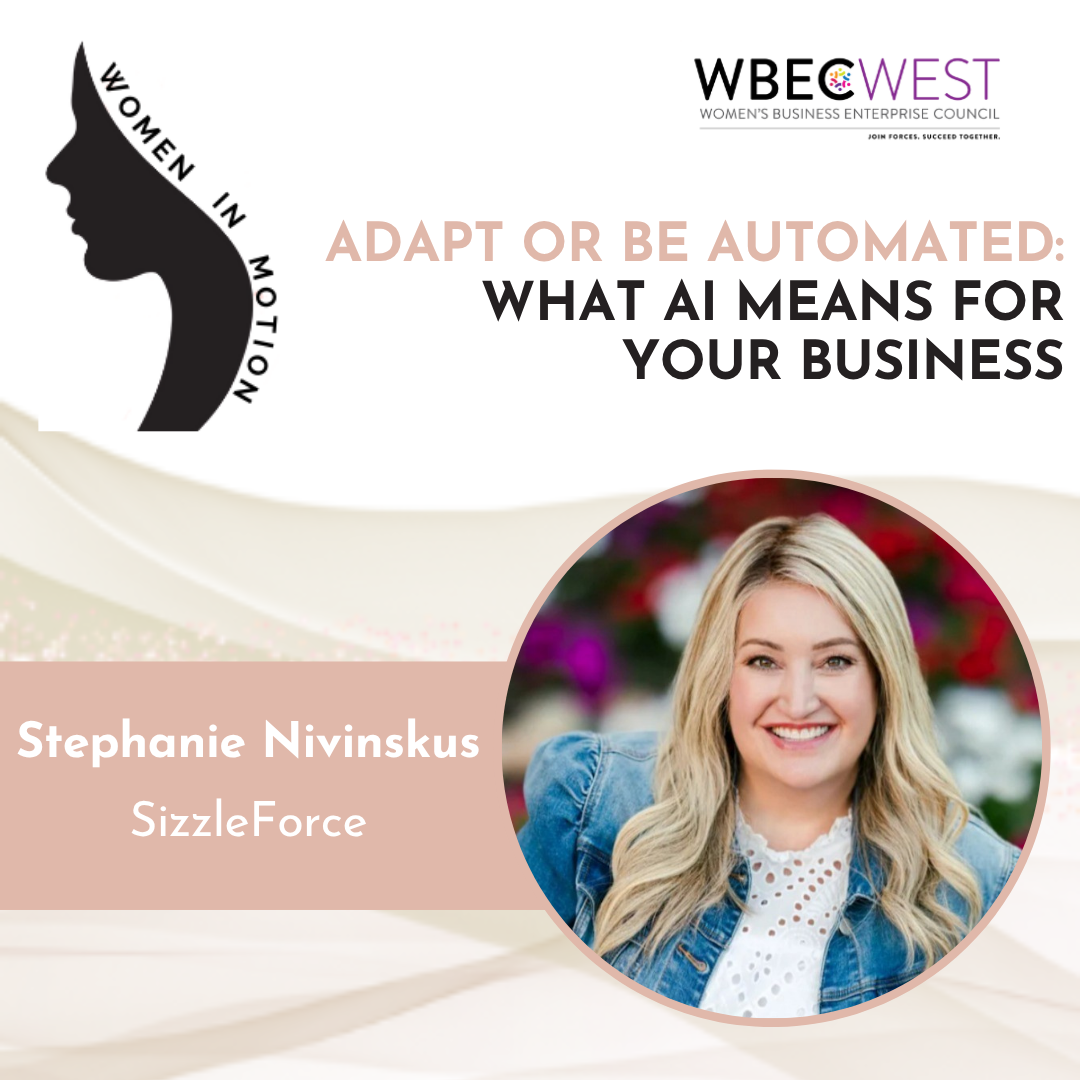

In this episode of Women in Motion, Lee Kantor, Renita Manley, and AI marketing expert Stephanie Nivinskus launch a three-part series on artificial intelligence in business. They discuss the urgency of adopting AI, address common misconceptions and fears, and offer practical steps for getting started. Stephanie emphasizes the importance of human oversight, choosing the right AI tools, and using AI strategically. The episode encourages listeners—especially women—to embrace AI as a valuable tool for growth and competitiveness, setting the stage for deeper dives into AI integration and authenticity in future episodes.
SizzleForce Marketing is a very carefully curated team of certified fractional CMO’s, AI marketing strategy & execution specialists, digital marketing strategists, content marketers, copywriters, website designers and developers, branding experts, and social media marketers. Every day we strategize and execute marketing solutions for mission-driven, scaling companies. We service a broad range of clients, but we have an extra special place in our heart for pet brands. It might have something to do with the fact that we have not one, but two dogs on staff.
 Everyone’s got a story to tell, and Stephanie Nivinskus, CEO of SizzleForce, knows how to tell them. Since 1995, she’s helped thousands of business owners, big and small, transform their mission and vision into strategic marketing plans, compelling brand stories and meaningful marketing messages that humanize commerce, maximize opportunities and win customers.
The international #1 bestselling author of Absolutely Unforgettable: The Entrepreneur’s Guide To Creating A Heart-Centered Brand That Stands Out In A Noisy World, Stephanie is well-respected in the marketing industry.
She has written for Forbes and Entrepreneur and shared the stage with some of the world’s most renowned marketing and business growth experts, including Les Brown, Jasmine Star, and Suzy Batiz at Digital Marketer events as well as at countless business-building conferences including Level Up Live, The Copywriter Club IRL, and more.
Connect with Stephanie on LinkedIn.
Episode Highlights
- Introduction to the significance of AI in the business landscape.
- Structure of a three-part series on AI, focusing on its urgency and practical applications.
- Overview of AI’s relevance and historical development in various sectors.
- Discussion of common misconceptions and fears surrounding AI adoption.
- Practical steps for individuals to start using AI effectively in personal and professional contexts.
- Importance of communication etiquette when interacting with AI tools.
- Implications of not adopting AI for businesses and the risk of becoming obsolete.
- Gender disparities in AI adoption and encouragement for women to embrace AI as a tool.
- Identifying market signals indicating the need for AI adoption.
- Leveraging AI for strategic thinking and decision-making in business.
Music Provided by M PATH MUSIC
 This transcript is machine transcribed by Sonix
TRANSCRIPT
Intro: Broadcasting live from the Business RadioX Studios, it’s time for Women in Motion. Brought to you by WBEC-West. Join forces. Succeed together. Now, here’s your host.
Lee Kantor: Lee Kantor here, another episode of Women in Motion. I’m so excited to be doing this series that we’re about to launch, it’s a three-part series on AI, and this episode is Adapt Now or Risk Being Automated. I’m joined with my co-host, Renita Manley. Welcome, Renita. How are you doing?
Renita Manley: Hi. Hi. Hey, Lee. How are you doing?
Lee Kantor: I am doing well. I am so excited that we’re talking about this topic, it’s so important and so relevant today. And I’m excited that we’ve got an expert, a true expert in this matter. We have Stephanie Nivinskus, and she has been in marketing for many years, and she’s an author, she’s a speaker, and she’s done so much work in this area. But before we get started, Renita, why don’t you kind of explain what this series is about?
Renita Manley: Yeah. Okay. Great. So, you know, today is kicking off our three-part AI series. Part one is going to be focusing on awareness and urgency and what AI means for your business right now. And in part two, Stephanie is going to be talking to us about building your business using AI with purpose, how to choose the right tools for your company, and how not to overwhelm yourself, because this technology is moving at a rapid pace and it can get very overwhelming. And in part three, we’re going to tackle staying authentic while using AI tools for your content and brand. All right.
Lee Kantor: All right. So, Stephanie, why don’t we get into it? Do you mind for folks who aren’t familiar, just kind of giving your macro view of AI in general and where you see it fitting into kind of a person’s marketing or even just their business nowadays.
Stephanie Nivinskus: Yeah. Honestly, I see AI fitting into every aspect of business starting now, starting two-and-a-half years ago actually. But for those that haven’t jumped on the AI train yet, it is critical. AI is infiltrating every sector of business and personal lives. And so, it’s really, really urgent right now for everybody to start learning about this, to start embracing it, start using it, and start seeing what’s possible.
Lee Kantor: And can you kind of define some terms, like what is AI? Is AI like my Alexa at my house? Is AI ChatGPT? Kind of can you define some of the terminology and what the tools are?
Stephanie Nivinskus: Yeah, absolutely. So, AI stands for artificial intelligence, and technically it has been in development for almost 100 years, which always kind of freaks people out. They’re like, “What? I didn’t know that.” But to your point, Lee, yes, your Alexa is AI, your Siri is AI, ChatGPT is AI. So, there are a lot of different versions of all of this. It is a technology that is learning about how humans reason, like how humans reason, how humans think.
Stephanie Nivinskus: And what we’re going to be talking about today mostly is conversational AI, which is when you can go back and forth with the AI and literally have a conversation and work through an idea.
Lee Kantor: And then, for folks who aren’t using this, are they just not using it because, oh, that’s too scary or I don’t understand it? Or are they not using it because kind of philosophically they think it’s cheating in some manner.
Stephanie Nivinskus: I think both could be true. I think it depends on the person. I think there is a lot of fear around AI. And I think there’s also a lot of misinformation. There’s a lot of everything really. There’s also a real persistent myth that circulates that you have to be techie to use this, and none of it’s true, right? None of it is true.
Stephanie Nivinskus: There’s another fear, too, that I’m seeing people have, like they’re afraid they’re going to make mistakes. I remember when the internet first started becoming mainstream and people thought, “Oh, my gosh. If I strikethrough this word in a Microsoft Word, I’m going to blow up the entire company.” Do you remember that when people were so scared? It’s the same thing, people are afraid that they’re going to make some huge, costly mistake by using it. But, really. I mean, it’s possible, but it’s pretty hard.
Lee Kantor: Now, when a person is beginning using it, what are kind of some of the baby steps to ease your way into the technology? Do you have to, like, pick one of the AI kind of platforms? Because it’s not just ChatGPT, there’s quite a few platforms out there, Perplexity, Claude, I mean, Google has one, Facebook/Meta has one, X/Twitter has one. There’s a bunch of them floating around, do you kind of have to just pick one and just kind of start playing with it?
Stephanie Nivinskus: Yeah, that’s usually how people start. Most people start with ChatGPT just because it’s the most popular one, and, you know, you can get access to it for free, and it’s gotten the most buzz. It’s very user friendly and you can jump in and start using it right away.
Stephanie Nivinskus: And how you start using it, I like to think of it as if you all turn back the hands of time and go back to high school, and when you were in high school, your English teacher would say, “All right. Everybody’s going to write an essay about what they did over the summer.” And the prompt is, what did you do last summer? AI is the same sort of thing, you’re giving it the prompt though, instead of the English teacher. Does that make sense, Lee?
Lee Kantor: Yeah. I mean, I understand, but for some people it’s challenging because the blank sheet of paper is scary, because that means I can ask it anything, but because I can ask it anything, I don’t know where to begin, and so I don’t ask it anything.
Stephanie Nivinskus: Right, right, right.
Renita Manley: I think we’re going to actually get into more of that in our episode two, aren’t we, where we’re going to be talking about how to use it? More specifically, you got a lot of gems to give us. Is that true, Stephanie?
Stephanie Nivinskus: Yeah. We are going to be talking about that. But, you know, to help the people right now who just want to get started, I think one of the best things that you can do is start using it for a personal task before you use it for something professional.
Stephanie Nivinskus: Like literally, you can say to it these are the ingredients I have in my refrigerator, tell me what I can make for dinner tonight. That’s it and just see what it can do. That’s when you’re going to start to see that this tool actually works for you, not the other way around. And once you start doing some of these simple, simple tasks, then you’re going to feel more confident to start using it in a business capacity.
Renita Manley: So, what you’re suggesting to our WBEs and anyone else out there listening, if they’re feeling a bit overwhelmed just even introducing themselves to AI, just try using an AI tool, as you suggested ChatGPT, and just play around with it.
Stephanie Nivinskus: Yeah.
Renita Manley: Just play.
Stephanie Nivinskus: Yeah, just ask it questions. Pretend you’re going to coffee with your best friend and you have a question about something. You know, maybe it’s a question about what are people saying about the new movie, Mission Impossible. Throw that into ChatGPT, see what it says.
Stephanie Nivinskus: Or maybe let’s say you’re going to a dinner party and you don’t know what to wear, you don’t know what’s appropriate to wear, and you’re going to meet some big who’s who. You could go into ChatGPT and say I’m going to a dinner party, I’m going to meet somebody that’s very influential in my field, this is where the party is going to be held, what should I wear? What’s appropriate?
Stephanie Nivinskus: Don’t overthink it is my message. Don’t overthink it. Don’t overcomplicate it. Just ask it questions.
Lee Kantor: Is there an etiquette when you’re communicating with it? Like some people I noticed use like please and thank you. Some people just ask the prompt kind of directly. Is there some do’s and don’ts around that?
Stephanie Nivinskus: Yeah. So, it’s funny, this is a hot topic. Actually, there was a report that just came out probably about six weeks ago that talked about how all of the pleases and the thank yous are actually costing OpenAI, which is the company that owns ChatGPT, like millions, maybe even billions of dollars. So, they’re saying like, Don’t say that. But then, there’s all this fear people have that the AI overlords are going to take over the world, so they’re like I better be nice to them in case they do.
Stephanie Nivinskus: I don’t subscribe to any of that. I believe that this is a robot, and this is a robot that works for me, and so I don’t say please and thank you to it. I speak to it like I’m giving it commands because it is a tool that I am commanding, not a person.
Renita Manley: Oh, God. I’m one of those people that says thank you.
Stephanie Nivinskus: It’s lovely. It’s a lovely thing to do. It’s just funny. It’s very interesting, there’s like reports about how much more energy it’s taking, and therefore wasting, and that’s a whole other rabbit hole.
Lee Kantor: Now, when you’re using AI in your business, there was something that somebody told me a while ago at the beginning of some of these automations, that if you can put your work in a checklist form, that’s probably something that can be automated. Is that kind of a similar type of thinking when it comes to AI? If you can write kind of a list of things and tasks to do then there’s a good opportunity there to maybe have the AI help you with that.
Stephanie Nivinskus: Yeah, sure. But that’s not exclusively what it can do. But absolutely, if you have a checklist that is indicative of something that AI can help you with and oftentimes automate for you, making it so that you’re not having to do these redundant time sucking tasks that are just slowing you down and costing you money, because time is money, right?
Renita Manley: Yeah, it’s a lot of money and time is moving fast. So, I know we’re keeping everything light right now, but I do want to ask you one heavier question, I know you’re ready for this. But let’s say a small business owner refuses to adopt AI, are they risking sabotaging their chances of staying relevant? Like, if we don’t get with the program, are we going to fall behind as small business owners?
Stephanie Nivinskus: Yeah. Absolutely. And honestly, it’s not just like you might fall behind kind of way. It’s more like you’re going to disappear from the conversation kind of way. AI, at this point, it’s not just a nice to have. It is a visibility tool. It is a decision making tool. It is a productivity tool. If you’re not using it, you need to be aware that your competitors are. And because they’re using it, they’re reaching your buyers faster. They’re showing up in more places. They’re pitching smarter. Their positioning is data backed. So, yeah, if you are refusing to adopt AI, it’s kind of like riding a tricycle in a formula one race.
Renita Manley: Okay. So, I’m thinking like a WBE right now, and, Steph, I heard you say I risk disappearing. So, with my WBE cap on, the first thought that I had was, how the heck am I going to disappear if I don’t use AI? So, can you explain what exactly you mean my business would disappear if I don’t start integrating AI? That scares me. I’m a WBE, it’s worrying me.
Stephanie Nivinskus: And I’m not trying to instill fear in anybody. I’m trying to instill awareness, all right? The reason the business would disappear – I said it would disappear from the conversation, to be clear, okay?
Renita Manley: Yes, you did. You did.
Stephanie Nivinskus: So, your business isn’t technically going to disappear. However, if all of your competitors are using it and they’re faster and they’ve got more data and they’re doing more things than you are, then you’re just going to kind of slide back behind the curtain. You’re not going to be as seen. You’re not going to be as informed. You’re not going to be as fast. And that’s going to get in the way of you staying on top of things and staying a leader in your industry.
Renita Manley: Got it. So, if I heard you correctly, what you’re saying to all of our WBEs listening is, if you don’t start integrating AI, you’re going to be missing out on all the benefits of it, such as the data information that you can get. And other businesses are going to be using their data from AI to move their company forward while you’re still checking emails.
Stephanie Nivinskus: Yeah.
Renita Manley: Okay.
Stephanie Nivinskus: Yeah. Just for anybody that was around when the internet first became a thing, I always point people back to that. I know I touched on this a little bit earlier, but it’s so true, you guys. For the Gen Xers in the room that are listening and some of the older millennials, you guys might remember this, there were a lot of people that said I am not going to use that internet thing. I’m not going to do it. I don’t need it. I’m fine the way I’ve been doing business all of these years. And think about it, where are they now?
Stephanie Nivinskus: If there’s anybody on this planet that is still refusing to use the internet, how relevant are they? How much are they part of the conversation? They’re not. The same thing happened with, you know, social media, there is a segment of the population that’s I’m not going to do it. I’m not going to use it. I won’t do it, I won’t do it, I won’t do it. And the conversation continued, it just continued without them. I don’t think anybody in business wants the conversation to continue without them.
Renita Manley: So, I actually read a lot of articles, Steph, that kind of go into what you’re talking about. A lot of women – and this is not just me saying this. These are articles that I researched before coming on this podcast. I read these articles and women are more so not implementing AI. We’re implementing it. We’re integrating it at a slower pace than our counterparts. So, why do you think that’s happening specifically with women?
Stephanie Nivinskus: Yeah. I think women are more susceptible to being afraid of change than men are. And I know some people might be like, “What are you talking about? I’m not afraid of change.”
Renita Manley: We didn’t say this. It was the research.
Stephanie Nivinskus: I think that you are. I think that we are. I think we’re wired differently. We are. We’re wired differently. And that’s okay. That’s okay. But we have to decide, because we’re wired differently, how are we going to move forward.
Stephanie Nivinskus: And like I was telling Lee a little bit ago, you know, there’s so much fear around something new, something unknown. How is this going to work? Is this going to replace me? This is so overwhelming. You know, we have all of this negative mindset stuff, just like going around in circles in our brain, and we need to just stop. And we need to remember this is a tool. This is a tool that’s here to help me and I can start small. And no, I’m not going to blow up the world by asking AI the wrong question or giving it the wrong command.
Lee Kantor: Now, what are some kind of symptoms that I might be in a space in my industry or my work that others are using AI and kind of they’re out competing me? Or is there some kind of symptoms or signals maybe from the marketplace that are kind of telling you, but you may not be noticing it, that AI is around you and you’re slowly disappearing, like you mentioned earlier?
Stephanie Nivinskus: Well, I think, you know, sometimes when you get on a call for an RFP, you get on these group calls where they’re answering questions, I think those Q&A sessions are going to continue to look real different than they used to, because a lot of people are going to do their research with AI ahead of time so their questions are going to change.
Stephanie Nivinskus: And so, if you’re asking the same old, same old, and you hear other people asking questions and you’re like, “Wow. I didn’t even think about that. Oh, my gosh, that never occurred to me. Huh,” that’s an indicator that they’re using AI to help them come up with really insightful questions that will help them move forward. And that’s a red flag to you, like hurry up, get with it, get on the train.
Lee Kantor: And you mentioned that AI is extremely powerful. And it isn’t just for kind of some of the low hanging fruit, like you mentioned, regarding tasks or some basic automations. But you think that there’s also a place for it when it comes into, like, strategy and more of the kind of big picture thinking and maybe longer term thinking, like that’s an opportunity if you start leveraging in there.
Stephanie Nivinskus: Oh, absolutely. I mean, that’s what I do. I’m an AI marketing strategist, and so I am constantly using it to help me play out different strategic initiatives. I’m constantly using it. I like to think of AI as my sparring partner. I actually tell it to act as my sparring partner. Because what I want it to do is not just give me answers to things, I want it to help me dig into a strategic initiative and a direction that I may be thinking of going.
Stephanie Nivinskus: And then, I want it to give me this different perspective and tell me all the reasons that might not work, or all of the blind spots I may not be seeing, things like that. And then, that makes my critical thinking process go even deeper and be more effective, because I’m not just thinking from one vantage point, I’m thinking from vantage points that are not like naturally at the top of my mind. Does that make sense?
Lee Kantor: Yeah. One of the things I like to also do is I want it to be the expert in the area. Like I’ll give it parameters in helping it help me. And I want it to be best in class or I want outside the box thinking that, you know, an average player wouldn’t think of. And I want it to push and I don’t just want it to answer.
Stephanie Nivinskus: Yeah. And there’s a couple things I’ll say about that, Lee. One mistake that I see a lot of people make is that they will say things like be a smart assistant and give me time saving solutions. A prompt like that or a parameter like that is pretty vague and it’s up for interpretation by the AI. And so, you could get exactly what you want and you could get something that’s totally off from what you’re looking for.
Stephanie Nivinskus: And I’m a huge believer that AI responds much better to being shown what you want than being told what you want. And so, what I mean by that is when you go into ChatGPT or Perplexity or Claude, or whichever one you choose to use, whenever you can upload examples of what you’re talking about, you’re going to dial in the results so much faster.
Stephanie Nivinskus: So, for example, if you want it to help you work on an RFP, give it an RFP with any private or sensitive information blacked out. That’s critical. Make sure you do that. Because I’m going on a little tangent here, but just so you know, do not act like anything you do on any AI is going to be private. I don’t care what anybody says to you. You need to be very aware of the fact that, especially right now, there’s a court order out actually right now that is requiring OpenAI to save all conversations, including deleted conversations for a certain amount of time. It might get overturned. Who knows what’s going to happen with that?
Stephanie Nivinskus: But back to the point, once you’ve blacked out any sensitive information, upload that into, let’s say, ChatGPT and say analyze this RFP that I won. Tell me what I may have said in this RFP that made the people that hired me choose me over my competitors. Like, have it analyze things and then say apply this same framework to helping me fill out this next RFP.
Lee Kantor: And so, the more specific you are upfront and give it source material, then you’re going to probably get a better output from it.
Stephanie Nivinskus: Absolutely. You know, even if you want it to help you write something, well, don’t just say write something that’s smart. Give it a little sass and make it friendly. Don’t just say that because it’s so subjective. Give it an example of something that you’ve written already that you love that is those things. Or it doesn’t even have to be your own thing. It could be something somebody else wrote, and say, you know, I love the way that this was written. This stood out to me because X, Y, and Z. Try to mirror this tone. Even asking it sometimes, how would you describe the tone of this communication? I want it mirrored in what you do for me.
Lee Kantor: Now, where do you kind of draw the line when it comes to delegating kind of this type of job to your AI? Is it something that you ask it to do something and then you cut and paste the answer, or is it more of you’re still having to kind of put your secret sauce onto whatever comes out of it. Like, do you delegate or do you abdicate when it comes to the outputs from AI?
Stephanie Nivinskus: Yeah. The biggest mistake people make is putting something into ChatGPT or whichever AI they’re using, and copying and pasting it without giving it their human intelligence. The biggest mistake they make. Number one, it makes you sound like everybody else. Number two, it can often be filled with inaccurate information. Number three, can misrepresent things. Number four – I mean, I could go on and on and on.
Stephanie Nivinskus: I am a huge believer also that AI without HI, meaning AI, artificial intelligence, without HI, human intelligence is dangerous. You absolutely need to be supervising it, overseeing every output that it is giving you. Now, things are advancing very, very rapidly, and there are now things called AI agents that are much more hands off than the basic things that a lot of people have been doing the last couple of years, you still have to oversee it.
Stephanie Nivinskus: I built an agent probably two months ago, and this thing is insane. It’s amazing what it was able to do for me. However, I still went through every single word it gave me, and I found inaccuracies, and I found things that I had to shift to make sure that it was relevant, full of integrity, and useful for the purpose that I had for it.
Lee Kantor: Can you explain what an AI agent is for people who aren’t familiar with that term? And is it something you purchase or is it something you create? Like what is an AI agent and how can somebody use one?
Stephanie Nivinskus: Yeah, there’s a lot of arguments out there about what an AI agent is, and there’s a lot of people that are calling things agents that are not actually agents, so I’ll start with that. But I will tell you that an agent in the truest definition is something that can work autonomously. So, something like ChatGPT is conversational. You write something, it writes something, you write something, it writes something.
Stephanie Nivinskus: An agent, for example, there’s one called Manus that I use. This is what I did a couple months ago on Manus, I wrote a very, very, very long prompt. It was actually 46 pages in Google Docs. I wrote a 46 page prompt of exactly what I wanted it to do, and then I said, go to town, have fun, I’m going to bed, Manus. And I went to bed. I woke up the next morning and I received a product that would usually take me about a month of time to complete, but it did it literally while I slept. It’s crazy. That is a true agent.
Stephanie Nivinskus: Like I said, I still went through it and redlined it because you have to. I mean, that’s just responsible use of AI. But the fact that it can do things like that, as opposed to just converse with you about things, write a social media post, write a blog post, respond to an email, blah, blah, blah, that’s the simple kind of starter point. The agents are more like, nope, we can do this from start to finish. Good to go without your involvement.
Renita Manley: So, what you’re saying is, if we have a more profound task for AI, we should be using Manus and not the conversational ChatGPT?
Stephanie Nivinskus: No, no, not necessarily. And again, that’s subjective, too, what makes something profound, right? You know, the reason I went to Manus was because I was testing if this could literally replace me in a certain aspect of my work. And so, I gave it an assignment that, like I said, takes me about a month as a senior level marketer. I’ve been in marketing for 30 years, you guys, I’m not new to this. As a senior level marketer, I laid out this 46 page long prompt explaining exactly what I do, how it needs to be done, da, da, da, and threw it into Manus and said, now do it and let me see how good you are. I wanted to evaluate my threat. And it was good, but it wasn’t good enough without human intervention.
Renita Manley: Yeah. Human intel, yeah, so that HI aspect was missing?
Stephanie Nivinskus: Yeah. The human intelligence, it was. It gets redundant too. That’s another thing that happens a lot. When you’re doing some of the more complex work, it will start to say the same thing 15 different times in 15 different ways. But then, if you read through it, you’ll be like, okay, I got it. I got it the first three times you said it. So, you’ve got to go through and you’ve got to edit. I like to think of AI is going to get you 90 percent to the finish line, the other 10 percent is where your human intelligence comes into play.
Lee Kantor: Now, for the folks that are going to do this now, they hear what you’re saying and they feel the sense of urgency. Is it something that you can just rely on the free versions of all these AI, or is it something that you have to really pay whatever, $20 a month or whatever it is for any given one of these tools?
Stephanie Nivinskus: Yeah. I think it depends on your usage, like what are you trying to do. I think that if you’re doing simple things like help me write an email response, you can get away with the free version of stuff. When you’re doing more complex tasks, when you are doing tasks – you know, I use probably about five different AIs every single day, multiple times throughout my day, and then I use other ones outside of that.
Stephanie Nivinskus: So, for me, I might be considered a power user. And for me, I need to have the paid versions of these tools because I do get better results from them. I get access to different features than someone who’s just using the free version gets. I get access to things faster than a free user would get. Just like anything else, you can use an app on your phone, you can use the free version and you’ll be able to do some stuff. But if you want the really good stuff, you got to pay. AI is the same way.
Renita Manley: Okay. So, this might be a little bit intrusive, but I bet someone was listening and wondering what five AI apps is Steph using every day. So, don’t give us five because I don’t want you to give us all your secret sauce, but maybe share like two or three apps that you’re using every day. That already made me overwhelmed again.
Stephanie Nivinskus: Yeah, yeah. Don’t be overwhelmed. Be excited at the opportunity. Oh, my gosh. There’s so much I could do for you.
Renita Manley: I’m trying. I’m trying.
Stephanie Nivinskus: Yay, AI. That’s what we’re doing. Okay. I have ChatGPT open all day, every day. I have Perplexity open all day, every day. For those of you guys that aren’t familiar with Perplexity, I am telling you it is your BFF. You will never use Google again once you use Perplexity. It is such a better experience.
Stephanie Nivinskus: Like you know how when you go to Google and you put in a query for something and it’ll serve up some ads, and then it’ll serve up ten different blue links that you can read the little Meta description of and decide whether or not you want to click on it to get more information, that’s the Google experience, aside from the AI overviews that they’ve started integrating up at the top.
Stephanie Nivinskus: When you go to Perplexity, it doesn’t give you a bunch of links that you need to research. It gives you the answers that you want, and then it gives you the citations that you can click on if you want more information on the topic. It’s so much more effective. It’s faster. It’s more thorough. Oh, my gosh. If Perplexity could be my boyfriend, it would be.
Renita Manley: It would be the perfect one, huh?
Stephanie Nivinskus: Yeah. Right. Right. This coming from a very happily married woman for 25 years.
Renita Manley: Okay. Same. Hey, hubby.
Lee Kantor: So, let’s talk a little bit about your book. Can you share what kind of prompted you to write the book, Sizzle Or Fizzle? What was kind of the impetus for writing it? And what are you hoping the reader gets out of it?
Stephanie Nivinskus: Yeah, the reason I wrote it is really because there is such a sense of overwhelm out there, and people don’t know how to use this stuff correctly, right? They’re getting a lot of mixed messages. And so, I wanted to write it as someone who is not just an AI expert, but a marketing expert, because those two skills combined make you see things from a different vantage point, if that makes sense.
Stephanie Nivinskus: So, what I did in the book, it’s much more than just a typical book. It’s not something you’re going to sit down and spend a couple hours reading through and be done. At the end of every chapter, there are exercises for you to complete, there are terms for you to learn, there are step-by-step things that you’re supposed to do. Like it will say for the next 30 days, here’s what you need to do in days one through seven in order to reach this goal. All the goals are things about how to establish yourself as a leading voice in your field, how to build your authority, how to build your personal brand.
Stephanie Nivinskus: So, I have chapters on things like creating communities online, and a chapter on writing content, and a chapter on speaking, and a chapter on all these different things that people do to market their business, but I’m teaching you how to use AI to speed up the process.
Renita Manley: So, your book, Sizzle Or Fizzle, what you’re telling me is it’s all about how you can position yourself to be the go-to expert in your industry?
Stephanie Nivinskus: Absolutely. How to use AI to do that.
Renita Manley: Yeah, yeah, that’s really cool to know, but let me ask you this, why is it important right now for WBEs to be using AI to position themselves as the authorities in their industries, and specifically how can Sizzle Or Fizzle, your book, help our WBEs do that? And again, how can your book, Sizzle Or Fizzle, help us position ourselves as go-to authorities in our industry?
Stephanie Nivinskus: So, the book is going to help you with those 30 day implementation plans that are at the end of every chapter, starting with chapter three. So, that’s what it’s going to do, you’re going to read that chapter and then dive into the 30 day implementation plan. And it’s going to break it down into step-by-step things to do, so it’s going to crush that overwhelm. It’s going to crush that misinformation. It’s going to crush the lack of clarity, because I’m literally telling you day one, do this right, and when you read the chapter, you’ll understand how to do it.
Stephanie Nivinskus: Now, the one thing I did not include in the book that a lot of people are like, “Oh, how come you didn’t include a list of AI tools?” And I’ll tell you exactly why I did not do that. I would have loved to do that, but I’m telling you, my book would have been irrelevant by the time it went to print if I did that because the AI tool landscape is changing literally on an hourly basis.
Stephanie Nivinskus: And so, if I had written like, “Oh, yeah. You need to use Claude for this,” that answer would have been totally different today, right? You need to use, you know, ElevenLabs for that. Well, maybe, maybe not. So, I don’t have a list of recommended AI tools in there for that very reason.
Stephanie Nivinskus: But if anybody has questions about specific tools that I recommend for specific purposes, you know, please reach out. That’s what I do. I’m here to answer that question. I’m actually on TikTok, so those of you guys that are TikTokers should find me. My handle is @sizzlefrce, the name of my company, S-I-Z-Z-L-E-F-O-R-C-E. Sizzle like bacon, force like may the force be with you. I am on TikTok usually two or three times every single day dropping very relevant, very practical AI usage tips. And anybody, whether you’re a beginner or you’re an advanced user, anybody can learn from this.
Lee Kantor: And kind of the bottom line message from today’s episode, though, is don’t wait. There’s no perfect time to start. Today is the perfect time to start.
Stephanie Nivinskus: Yesterday was the perfect time to start. Today is the next best choice.
Renita Manley: Today is the perfect time to go to sizzleforce.com – is that what it is? – and get Stephanie’s book.
Stephanie Nivinskus: Oh, yeah. Actually, you’re going to find my book – I need to put it on my website. It’s not there yet. Just go to Amazon, because then if you’re a Prime user, you can get it shipped for free.
Renita Manley: Oh, that’s fancy.
Stephanie Nivinskus: And so you guys know, it’s available as an audiobook, it’s available as an ebook, it’s available as a softcover book, and it’s available as a hardcover book. So, however you like to read, I’ve made it possible.
Renita Manley: If you want to get started with AI today, then I recommend you all go check out our WBE certified Steph Nivinskus. Go to Amazon, type in Sizzle Or Fizzle and it should pop up, is that what you’re telling us?
Stephanie Nivinskus: That’s exactly what I’m telling you.
Renita Manley: And that’s exactly what any WBE listening to this should do right now.
Stephanie Nivinskus: That’s right.
Lee Kantor: And, Renita, what is the second episode going to cover?
Renita Manley: Well, let me see here. Let me check my notes. I believe we’re going to be talking a little bit more about some current tools. So, I know she doesn’t have those listed in her books, but we’re going to be talking a little bit more about some tools that you can use to help with your overwhelm, and that’s pretty much it. That episode might be old in like three months, according to Stephanie.
Lee Kantor: Right.
Stephanie Nivinskus: But it’s going to be really helpful for people that listen to it right away. It’s going to be real helpful. And we can always do a follow up conversation. This is what’s neat, honestly, you guys, this is one thing, if I could just drop this before we wrap up.
Stephanie Nivinskus: It is so important to stay on top of all of this stuff. When you’re running a business outside of this space, it probably feels impossible. I tell you honestly, this is my business and it still feels impossible. So, that is my strong suggestion to you, find an expert who makes this their life, and look to that expert to summarize things for you quickly and what you really need to know. Because a lot of it you don’t really need to know, right? But there are some things that will absolutely change everything for your business, and make you so much more productive, so much more efficient, and honestly, so much more profitable if you use it right. It’s good stuff, you guys. The opportunity is amazing and I hope you will start using it.
Renita Manley: Today – or yesterday.
Lee Kantor: And, Renita, before we wrap, can you remind the listeners about the upcoming Unconventional Women’s Conference.
Renita Manley: Absolutely. If you are not registered to attend our Unconventional Women’s Conference, it is coming up July 23rd at Newport Beach in California. You just want to go visit our website, wbec-west.org, click on events at the top of the page, look for the month of July and register to come to Unconventional Women’s Conference, July 23rd, Newport Beach, California.
Lee Kantor: And, Steph, thank you so much for sharing your story today. You’re doing such important work and we appreciate you.
Stephanie Nivinskus: Thank you for having me. It was a joy.
Lee Kantor: All right. This is Lee Kantor for Renita Manley, we will see you all next time on Women in Motion.














