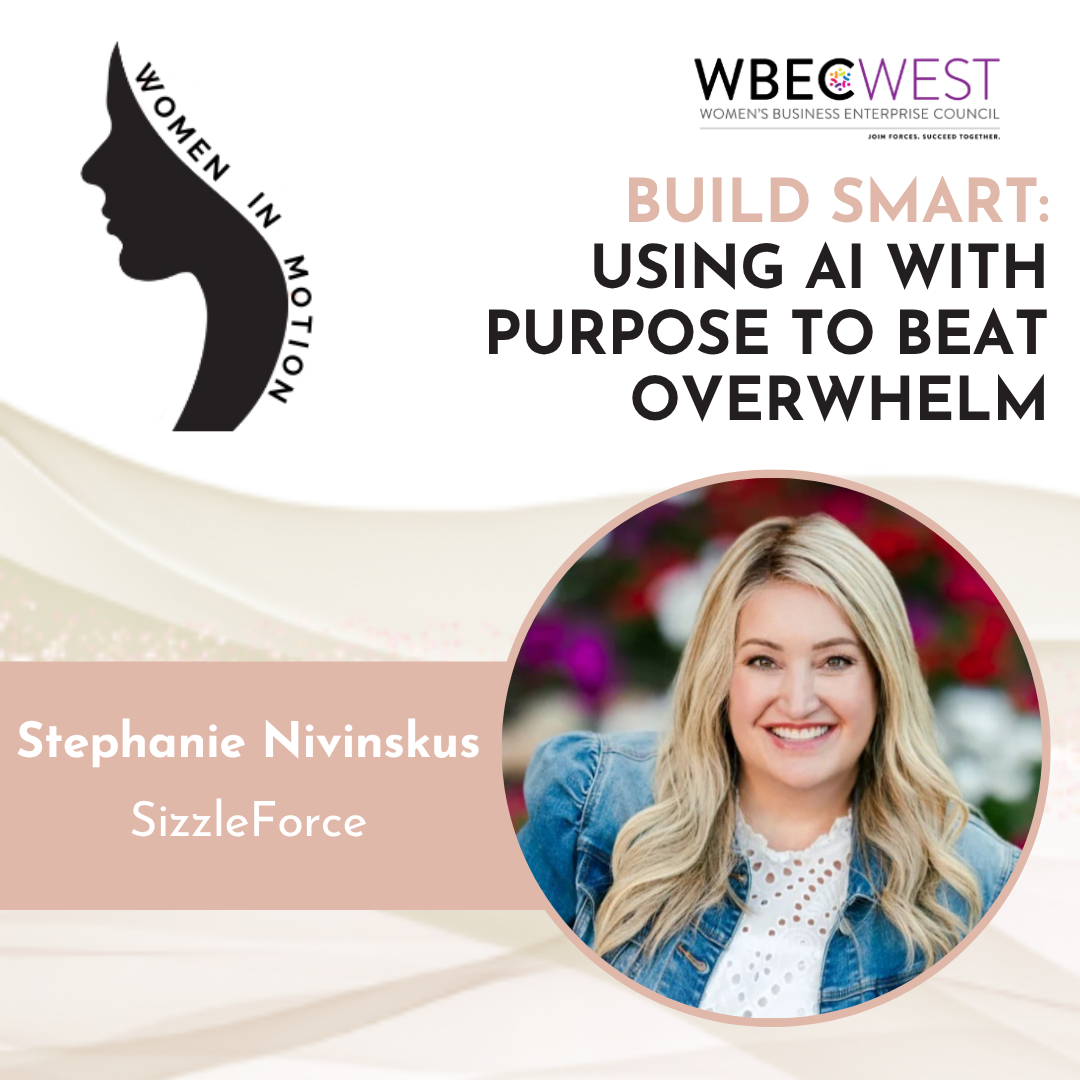

On today’s Women in Motion, Lee Kantor and Renita Manley are joined by AI expert Stephanie Nivinskus to discuss practical strategies for integrating artificial intelligence into business. Stephanie explains the importance of detailed prompts for effective AI use, shares top AI tool recommendations, and offers advice on overcoming overwhelm when adopting new technologies. The conversation emphasizes thoughtful, incremental learning and highlights Stephanie’s book, “Sizzle or Fizzle,” as a resource for business owners seeking to leverage AI for greater efficiency and impact.
SizzleForce Marketing is a very carefully curated team of certified fractional CMO’s, AI marketing strategy & execution specialists, digital marketing strategists, content marketers, copywriters, website designers and developers, branding experts, and social media marketers. Every day we strategize and execute marketing solutions for mission-driven, scaling companies. We service a broad range of clients, but we have an extra special place in our heart for pet brands. It might have something to do with the fact that we have not one, but two dogs on staff.
 Everyone’s got a story to tell, and Stephanie Nivinskus, CEO of SizzleForce, knows how to tell them. Since 1995, she’s helped thousands of business owners, big and small, transform their mission and vision into strategic marketing plans, compelling brand stories and meaningful marketing messages that humanize commerce, maximize opportunities and win customers.
The international #1 bestselling author of Absolutely Unforgettable: The Entrepreneur’s Guide To Creating A Heart-Centered Brand That Stands Out In A Noisy World, Stephanie is well-respected in the marketing industry.
She has written for Forbes and Entrepreneur and shared the stage with some of the world’s most renowned marketing and business growth experts, including Les Brown, Jasmine Star, and Suzy Batiz at Digital Marketer events as well as at countless business-building conferences including Level Up Live, The Copywriter Club IRL, and more.
Connect with Stephanie on LinkedIn.
Music Provided by M PATH MUSIC
 This transcript is machine transcribed by Sonix
TRANSCRIPT
Intro: Broadcasting live from the Business RadioX Studios, it’s time for Women in Motion. Brought to you by WBEC-West. Join forces. Succeed together. Now, here’s your host.
Lee Kantor: Lee Kantor here with Renita Manley, welcome to another episode of Women in Motion. We could not be doing this show without the support of WBEC-West. Without them, we couldn’t be sharing these important stories and covering these important topics.
Lee Kantor: And today, we’re digging in deep again on the topic of AI, and today’s episode is Build Smart Using AI with Purpose to Beat Overwhelm. And once again, we have our resident expert in AI, Stephanie Nivinskus, and she’s with SizzleForce, and author of the book, Sizzle Or Fizzle. Renita, this is going to be a great show.
Renita Manley: Yeah. So, this is part two of our AI series, and like Lee said, we’re discussing Using AI with Purpose to be Overwhelmed. So, we’re diving into how to thoughtfully integrate AI into your business, how to choose the right tools for your business goals, and how to avoid AI overwhelm and overload.
Lee Kantor: So, Stephanie, you want to kind of get us started on this topic, AI is everywhere but does it belong in everything?
Stephanie Nivinskus: AI is everywhere for sure, Lee. Does it belong in everything? I don’t think so yet, but yet is the key word in my answer. I think right now there are specific applications in life and business where AI is critical, and some other things not so much.
Stephanie Nivinskus: You know, for example, my daughter is almost 18, and she wants to get into the child care industry. And I don’t really see a place for robots running a classroom with 25 three year olds. You know what I mean? I don’t really see that happening. I could see it assisting in some ways, but there’s still going to be a human that’s needed in that space. But in terms of your typical office routines, your administrative operational tasks and marketing tasks, I think AI is a must.
Lee Kantor: Now, you’re using AI and robots kind of side by side. Are they a similar thing? Like, how are you kind of discerning the difference between AI and robots?
Stephanie Nivinskus: Well, when I’m thinking of AI, I’m thinking of bots, which is short for robot. So, you know, this is a complicated question, it’s kind of a funny one for you to ask this. Have you ever been to Vegas?
Lee Kantor: I have.
Stephanie Nivinskus: Okay. Have you met Aura, the humanoid?
Lee Kantor: No, I have not.
Stephanie Nivinskus: Okay. What about you, Renita, have you?
Lee Kantor: You’re muted, Renita.
Renita Manley: Yeah, I sure am muted. No, I have not met that robot.
Stephanie Nivinskus: Okay. All of you guys, the next time you go to Vegas – actually I think it was when I was in Vegas with WBEC the last time that I went to the Sphere, and they have a whole exhibit where you can meet the humanoid robots. And humanoid, meaning they’re built to kind of look like a human frame, and they talk and converse with you, and do all this stuff. That’s super kind of sci-fi-ish right now, right? It’s very entertaining. It’s fun to think of it.
Stephanie Nivinskus: Like I asked it – her name was Aura – and I said, Aura, are you funny? Like can you laugh at a joke? And she went, “Yes, I can. Ha. Ha. Ha.” So, that’s a robot. It’s a humanoid. When I’m thinking of bots in an AI sense, they can also just be little worker bees behind the computer.
Lee Kantor: And then, these worker bees are just code, though.
Stephanie Nivinskus: Yeah.
Lee Kantor: I mean, for the listener who is not – you’re immersed in this technology all the time, so a lot of things I think that you maybe just take for granted or understand just through being in the world that you are so much, I don’t know if everybody who is working in another area understands it in the level you do. So, I just want to get clarity around some of the terms that we’re using.
Stephanie Nivinskus: So, I think that the best way to break this down is to say that all bots are actually robots, but not all robots are bots. Okay? So, if that’s not clear as mud, here’s the difference. A robot has a body, not necessarily a beating heart body, but it has the figure of a body. It can move. It might have arms. It might have legs. It might have a head. It could be in the form of a dog. It could be in the form of a human, whatever. A bot is digital. It is. It’s just code. So, it is what automates the tasks inside the computer.
Lee Kantor: And then, by leveraging that code, we’re able to have the computer, we can lean on its knowledge base of lots and lots of data that it’s kind of accumulated, plus maybe some of our specific data in order to help us think through strategic questions or tactical questions, and help us physically create tools that can help us grow our business faster. So, the topic is overwhelmed, so this can help us kind of lessen our overwhelm, because we have this partner here that’s helping us with some of the things that are overwhelming us.
Stephanie Nivinskus: Yeah, a lot of people will refer to a tool like ChatGPT as an AI assistant.
Lee Kantor: And that’s how we should be treating it, right? We should be asking it to do things for us. We should ask it questions of things we don’t understand, maybe. And then, its job is to just answer the questions and be useful to us.
Stephanie Nivinskus: Yeah. Yeah, that’s exactly right.
Renita Manley: Okay. So, I have a question for you, what’s the easiest way to gut check your current business operations to see where AI can actually lighten the load instead of overwhelming yourself?
Stephanie Nivinskus: Great question, Renita. Oh, so good. I think the best place to start is really by thinking about the tasks that are very repetitive in your business, and which of those tasks could an assistant help with little training. It could be something like, you know, summarizing a meeting or drafting a proposal or following up on a lead. If it feels repetitive, if it feels like a time suck, there’s a very high likelihood that AI will be able to help with it.
Stephanie Nivinskus: So, I always say, you know, you’re never going to know if it’s really going to help you unless you test it, right? So, run a small experiment with a tool or a workflow and see if it helps you. If it helps you, great, do more of it. If it doesn’t help you, figure out if it didn’t help you because maybe you didn’t give it the right instructions, or if it simply wasn’t helpful for you. Because even though there’s a million AI tools out there that can help people, that doesn’t mean every single tool can help every single person.
Renita Manley: Yeah, yeah. Okay. So, right before we hopped on today’s podcast, Steph, I was actually scrolling on Instagram and I was getting bombarded with ads telling me that I’m almost 100 years old because I’m still using ChatGPT, and there are 50 other apps that I should be using. So, what do you say to WBEs and other small business owners who are like me, still on Instagram or scrolling on Instagram and we’re just constantly seeing, “Hey, you’re using ChatGPT. You suck”?
Stephanie Nivinskus: Okay. Well, that’s funny that you’re saying that. I have not come across that, so I must be 200 years old and they’ve just given up. But no, I mean that’s ridiculous.
Renita Manley: Let me explain it, I don’t know what actual ad it was, but if there’s anyone out there listening and maybe you have experienced this same thing with me. So, Steph, I’m scrolling on Instagram, there’s actually a horsy call, something that’s telling me that I can learn 50 AI tools in four weeks if I try.
Stephanie Nivinskus: I’ve seen that, yes.
Renita Manley: Okay. Well, what do you say to a WBE who sees that, and then they’re like, “Oh, my gosh. What am I supposed to do?”
Stephanie Nivinskus: I think it’s total overwhelm. I think it’s designed to give you the highest level overview of a whole bunch of tools, and you probably only need three or four of them. And so, I think what’s going to happen is you’re going to learn about all these things and you’re going to be like, “Oh, my gosh. I can do this. I can do that. I can do the other thing.” And, “Oh. Well, that’s not really relevant in my business. I don’t really need that.” Or, “No, I already have a system that’s working just fine for me in this capacity.”
Stephanie Nivinskus: That’s my take on those things. I don’t think really anybody needs to know that many tools, unless this is your life like me, right? I need to know that many tools because this is my livelihood. But the rest of you guys, no. It’s silly. And it’s also like, okay, well, you can learn a tiny bit about a million different tools, or you can learn to use two or three or four of them really, really well, and you will get far better results if you do the latter.
Lee Kantor: Now, how do you know if it’s better to hire an expert like yourself or just kind of dig in there? Because a lot of folks are feeling the overwhelm of this is too hard, there’s too many choices, and these ads are probably trying to do that and create kind of that fear and overwhelm. But as a business owner, how much should I be diving in and really having knowledge and ownership over this? Or should I just say, “You know what? I don’t do my taxes. I hire an expert for that. Why don’t I just hire an expert for this?”
Stephanie Nivinskus: I think it really depends how much you intend to use AI, as well as how much time you have to put into learning it. Because anybody could get on ChatGPT and enter in a couple of, you know, basic prompts and get something mediocre out. That’s easy and anyone can do that.
Stephanie Nivinskus: But if you really intend to integrate AI into multiple facets of your business, AI and automations, then I think you probably need to bring in someone like me. If you don’t have the time or maybe you just don’t have the interest, maybe you’re just like, “You know what? I don’t want to do this. I want to go play pickleball” or “I can’t do this. I need to be in a meeting closing a sale,” that’s when you bring in someone like me to come in and do the heavy lifting for you, and then simplify it into step-by-step solutions that we can teach you how to implement on a daily basis really easily and really fast, so it will shorten the learning curve substantially.
Stephanie Nivinskus: And really, for you to get the most out of these tools, there is quite a bit of a learning curve. Sometimes people will be like, “Oh, I’ve got ChatGPT figured out,” “Why do you think you have it figured out?” I’ll say, and they’ll say, “Well, you know, I know how to prompt. I tell it my tone of voice. I tell it a couple things about me, and I get great stuff. I’m really happy.” Okay, if that’s where someone’s at, well, more power to them. Run with that.
Stephanie Nivinskus: But I will tell you, you do not have ChatGPT figured out at all if that is what you’re saying, because it goes so much deeper than that, so much deeper, and it is capable of so much more. But you don’t know it because you don’t know the intricacies, and that’s where a professional can be helpful.
Renita Manley: I think that your book Sizzle Or Fizzle might be the perfect bridge between should I hire an expert or can I do this myself? Shameless plug, but do you think so too?
Stephanie Nivinskus: Yeah, I think it’s definitely an option for someone that’s in the middle, someone that’s like I want expert guidance. Because otherwise, what are you left with? You’re either left just kind of pushing buttons on your computer and hoping something works, or maybe you watch a random YouTube video here or there, or you go to a session at a conference once in a year, and then you try and implement it at home, you’re like, “Well, I don’t remember half of what I learned.”
Stephanie Nivinskus: My book, definitely, because it’s filled with these 30 day implementation plans at the end of every chapter. It will guide you through learning how to use AI if your goal is to build a personal brand, grow your influence, and become the go-to authority in your industry, because that’s what the book is about.
Stephanie Nivinskus: If you want to learn things like how do I make an AI avatar of myself, how do I make a clone, a digital clone of myself so I can have a YouTube channel, but I never have to actually show my face. I can have a digital replica of myself and my voice running the whole channel. If you want stuff like that, that’s not in my book, and that’s probably stuff that you don’t want to try and learn on your own, but it is so stinking powerful, oh, my word.
Stephanie Nivinskus: I have a girlfriend who did this. She’s actually a pretty big name in AI, and her name is Julia McCoy, if you guys want to look her up. She’s very much a thought leader in this space. And she started a YouTube channel, I want to say it was in January of 2024, if I remember correctly. And I think it was around June or July, we were on the phone one day chatting about all the AI nerdiness, and we started talking about her YouTube channel, and I think at that point she had something like 80,000 followers.
Stephanie Nivinskus: And I was like, “Oh, my gosh. Your YouTube channel is cranking. You did that in seven months. That’s great.” And she goes, “Oh, that’s nothing. No, no, no. I need to get it to a million.” And she’s like, “I’m going to do it. I’m going to do it by January.” And I was like, “All right. You know what? If anyone’s going to do it, it’s you, Julia. You go, girl.”
Stephanie Nivinskus: Well, fast forward and it’s now January of 2025. And Julia came down with this very mysterious, debilitating illness, to the point where, like, in bed for months unable to do anything. Now, turn back the hands of time a couple of months, and she had been working on creating a digital clone of herself on YouTube. Just experimenting with this.
Stephanie Nivinskus: Okay, so now we’re back in January, she’s super sick, but she has this clone and she’s like, “Hmm, what can I make the clone do while I’m sick?” The clone has since run her entire YouTube channel, and it has absolutely exploded, absolutely off the charts explosion. And she doesn’t get in front of a camera, ever. She does behind the scenes stuff, but there’s literally a digital clone of her. Does that make sense?
Renita Manley: It does make sense. That’s so cool. Sometimes I watch YouTube videos and I wonder, like, how does this person never sick? Like, they are always pumping out videos. I just wonder if they’re using AI clones.
Stephanie Nivinskus: Yeah, yeah. And I mean, she has videos that are getting 113,000 views and it’s not her. It’s not her. She’s at home resting and healing her body.
Renita Manley: Definitely that’s so cool.
Stephanie Nivinskus: Yeah. So, it’s pretty amazing what’s possible. If you want to do stuff like that, bring in a professional. Don’t try and figure that out on your own.
Renita Manley: So, who do you think your Sizzle Or Fizzle book or what type of WBE is that perfect for? So, let’s say our WBEs out there listening and they’re like, “Hmm, I want to be an AI industry expert,” what kind of WBE do you imagine your book would be ideal for?
Stephanie Nivinskus: I think it is ideal for somebody who is really in a place of needing and wanting to establish themselves as a leader in their space. Maybe they’ve got, you know, a decent amount of experience doing what they do, but they’re kind of still a secret. You know, they have some clients, but they’re capable of so much more, they want to have a voice that’s bigger, they want to be known as a thought leader in their space, this book is perfect for that person. And that person has to have time to actually do the 30 day exercises. That is the ideal person.
Stephanie Nivinskus: And, you know, I mean, some of this stuff while I break it down and I make it step-by-step, that doesn’t mean it’s going to be done in 30 minutes. You’re learning a whole new technology. You’re learning an entirely new way of positioning yourself. So, you know, it’s a time investment, and if you have the time or you can make the time, and you want to be positioned as a leader, a thought leader, you want to become a bigger influencer, then, yeah, my book’s a perfect fit for you.
Lee Kantor: Is there any actionable advice you can share for the person other than get your book and follow the 30 day plan? But some things, the low hanging fruit they can be doing, you know, when they’re frustrated of being that best kept secret, what are some of the things that can elevate them a little bit, at least the baby steps? And maybe it’s kind of sharing some of the big kind of chunks that, that 30 day kind of game plan will allow you to do.
Stephanie Nivinskus: Yeah. Well, I think the first thing that somebody needs to do when they’re kind of on this mission is you need to figure out what your place is. Like, what is the unique value that you bring to the market, and how are you going to strategically position yourself, right? This isn’t an AI question. This is a you question. This is a, well, what do I want to be a thought leader for? What do I want to be known for? Where do I want to plant my flag, so to speak? That’s step one, and that’s something that you do without AI. You’ve got to figure out not just where you want to plant your flag, but also why people should trust you.
Stephanie Nivinskus: For most of us, you can throw a nickel and hit ten competitors, right? So, you’ve got to figure out where are you going to plant that flag and what makes you trustworthy. And that could be anything from, you know, your education, it could be your experience working with certain clients, it could be awards that you’ve won. There’s a million different differentiators, but you got to get clear on that stuff and you’ve got to be able to articulate that, and then you jump to the next steps.
Lee Kantor: And that’s where they should start before even attempting to kind of plug AI into whatever system.
Stephanie Nivinskus: Yeah. Yeah. Absolutely. Clarify your unique value proposition. Figure out why they should trust you. Oh, and one other thing, identify the unique problems that you solve for people. So, everyone’s got problems, what problems do you fix or solve really, really well? And what do you really like to solve?
Stephanie Nivinskus: Like, I love to solve the AI overwhelm problem. When people are overwhelmed, they’re like, “Ah, I’m pulling my hair out. I don’t know what to do” or “I’m just getting this mediocre regurgitated fluff from AI, and I want good stuff that sets me apart.” I love working with someone like that. Who do you love to work with? What fires you up and makes you feel like, yeah, today was a good day at work?
Renita Manley: I like that approach. So, what are two or three questions that a small business owner can maybe just go to ChatGPT, since we’re all so familiar with that, what are two good prompts that we can write down and save for later? Or, you know, ask ChatGPT to help us get started with integrating AI into our business.
Renita Manley: So, let’s just say, “Hmm. Steph is right. Let me see what I can do. I’m going to ChatGPT and I say, hey, ChatGPT, how can you help my business grow?” I know I wouldn’t start with that question because, you know, it’s just way too bland, but what are two very good questions that an unfamiliar WBE to AI can use to start off her prompt experience with AI.
Stephanie Nivinskus: Okay. Well, here’s something that I’m going to tell you about prompting that a lot of people don’t know. Most people will do prompts that are one to three sentences long. Unless every word of those one to three sentences is like sharper than a sword, you’re going to get very mediocre results from those kinds of prompts. They might sound better than something you could write yourself if you’re not a writer, but it’s going to be mediocre because you’re not giving the AI enough, in this case, ChatGPT, you’re not giving ChatGPT enough to work with for it to really give you the good stuff.
Stephanie Nivinskus: So, a proper prompt is going to be longer. That doesn’t mean it has to be, you know, like I talked about in the last episode, my 46 page prompt, that’s not what I’m talking about either. But you need to think of it the same way you would if you were training a human being to do something for you.
Stephanie Nivinskus: You wouldn’t hire an assistant and say whatever – you wouldn’t hire an assistant and say something like write an email to this client. They would be like, “Well, who’s the client? What’s the email about? What’s the tone? I mean, are we happy and friendly? Are we congratulating them on something? Are we angry with them? Are we demanding payment on something?” You would tell them, otherwise that person would just sit at the computer and be like, “I’m supposed to write an email to this person, but I have no idea what to say.”
Stephanie Nivinskus: ChatGPT is the same way. It doesn’t know what to do unless you tell it what you want. And the more detail you can give it, the more it will dial in exactly what you’re looking for. So, yes, you’ll give it the command to write this email, but give it all the background information. Give it all the tone information. If you have a desired length for the email, tell it that.
Stephanie Nivinskus: If you want it formatted in a certain way – like a lot of people when we were growing up, most of us learned you have to have five sentences in a paragraph. I don’t know if you guys remember hearing that as as a kid, but that’s what makes a paragraph, five sentences. And you never, ever, ever have one sentence has its own paragraph.
Stephanie Nivinskus: Well, the digital world has completely changed that and turned that on its head. And now, one sentence paragraphs are the easiest way for people to digest information. So, if you want your emails written like that, you got to tell ChatGPT that’s what you want. So, I don’t have a specific prompt to give you to start with. I have more the concepts of the things that you need to share with it.
Stephanie Nivinskus: And like I said in the first training that we did here or the first podcast, sharing examples of what you want it to do for you will do so much more than anything else. So, if you have an example of another email that you’ve written, or maybe another five emails that you’ve written that have gotten the desired result that you want from this email, feed it to ChatGPT. Let it see it.
Stephanie Nivinskus: You can upload a PDF, you can upload different kinds of documents and you can say, “Analyze these emails and tell me what patterns you see.” It will say, “Oh. Well, I see that you have a friendly greeting, and then I see that you bring up a shocking statistic, and then you talk about an action, or you explain why something is happening, and then you talk about a suggested solution, and then you have a call to action in it, and then you sign off the email.” It might say something like that.
Stephanie Nivinskus: And then, you say, “Great, let’s make that a framework for how I write emails for this particular reason. And so, now, I need you to write this email using that framework with this kind of tone, to this kind of person, in this length, in this style, blah, blah, blah.” Making sense?
Lee Kantor: Do you think that it’s possible to ask the AI to write the prompt for you, like you mentioned, like in a general way, I would like to write an email about this, can you write the prompt that will help me prompt you better, so that you will write the prompt that’s going to get the outcome I desire?
Stephanie Nivinskus: You can, but you have to be very clear, again, with the outcome that you desire to get the right prompt, because it’s going to give you mediocre at first.
Lee Kantor: Right, but then you can edit, once they gave you a prompt, now you’re not working off of a blank sheet of paper. Now you have a framework that the AI kind of understands. So then, now, you can take that framework and then change the words to get the outcome you desire.
Stephanie Nivinskus: Yeah, you can do that. It’s just that’s kind of like a step one thing. If you want something that is better quality and going to be more effective, then that would be your starting point, but not your finishing point. You can always ask ChatGPT, “I want to do this, what do you need to know in order to help me get this task done?” That can be a great place to start with all of this if looking at the blank page is overwhelming. That gets you started.
Stephanie Nivinskus: But you’ll notice the more you start using tools like this that it’ll give you an answer to something. And then if you push it, it might change its mind. It might take you in an entirely different direction. And what a lot of people do is they take that first answer and they’re like, “Okay. Not bad. I’ll take that and then I can dot I’s and cross T’s on it and make it my own.” But it’s like you’re only scratching the surface of what’s possible.
Stephanie Nivinskus: You can go deeper and deeper and deeper and deeper and you can say, “What is it about this email that’s not going to be effective? Tear it apart. Tear it apart like you are my biggest competitor that’s trying to outsell me.” And ChatGPT will take the email it just wrote for you and destroy it and tell you all the reasons it won’t work. “Oh, okay, ChatGPT, well, let’s go a step farther then. Tell me this.”
Stephanie Nivinskus: So, don’t say tell me what you need. Give it exactly what it says and then take that output and run with it, unless you think it’s absolutely spot on. Because by default you’re going to get mediocre from it. It was trained to be mediocre.
Stephanie Nivinskus: I don’t know if you guys know this, ChatGPT and many of these – they call them – LLMs, these were trained to be mediocre. They were trained to not offend people. They were trained to kind of just be please all generic kind of outputs. And so, if you don’t want generic, if you don’t want to sound like somebody that’s regurgitating the same information everybody else is saying, you’ve got to learn to prompt differently. And that’s a whole workshop in and of itself.
Renita Manley: So, LMS, that is Language Model System for anybody listening, is that correct?
Stephanie Nivinskus: LLM, Language Learning Model.
Renita Manley: LLM, Language Learning Model. Okay, got it. So, if you’re using ChatGPT, you can go in there and say, “I need you to sound edgy and rough. You can offend me if you need to.” And then go on with the prompt since it’s been trained to be, you know, mediocre?
Stephanie Nivinskus: You can say it —
Renita Manley: Or not be mediocre?
Stephanie Nivinskus: Yeah, you can, definitely. I train versions of ChatGPT for people that are so spot on. You would be shocked, that if you met this person and you talked to them in person, you would be shocked that they did not personally author every single word of what has been written, whether it’s a book or an email. But that that doesn’t happen with a few sentences.
Stephanie Nivinskus: When I’m doing stuff like that, I’m usually spending at least three hours developing my prompts for what it’s going to do. And that’s me as someone who’s been writing copy for 30 years. If you didn’t have 30 years of experience as a copywriter, this would take you weeks, months. I don’t even know if you’d be able to do it.
Stephanie Nivinskus: So, yeah, it’s an interesting thing that we’re talking about, but, yes, you can say things like write something edgy and whatnot, but again this is subjective. What does that actually mean? You know, what’s edgy to you might be mild to me. And I’m like, “Oh, Renita wants to be edgy,” and then I read it and I’m like, “This is so soft,” because you left it to ChatGPT to figure out what the heck that means. That’s where giving it examples is going to be a huge difference.
Renita Manley: Understood. So, before we head out of here today, well, in our previous episode, you mentioned that in addition to ChatGPT, you use this other app. It starts with the letter P. I can’t quite remember what you said.
Stephanie Nivinskus: Perplexity.
Renita Manley: Perplexity. Okay. So, besides ChatGPT, I’m going to ask you to share with us two or three AI tools that we all should absolutely be using and why.
Stephanie Nivinskus: Yeah, okay. I will give you the ones that I think most WBEs could really benefit from quickly. And the reason that I’m going to share these is because they’re pretty easy to use, even if you don’t consider yourself techie at all, and you’re not going to have a big old learning curve, and they’re going to help you do things that most of us have to do.
Stephanie Nivinskus: So, obviously ChatGPT, you need to have that. For anybody that is writing a lot of stuff, Claude is much better at writing what we call long form content than ChatGPT is. So, for example, a blog, an ebook, an actual book, Claude is going to do that a lot better than ChatGPT. So, ChatGPT is great for your shorter writing tasks. Claude is better for your longer writing tasks.
Stephanie Nivinskus: Another one, and this isn’t going to take any training – these two don’t take any training on your end at all – Fathom. I love Fathom. Fathom is an AI that you can use to record and summarize your meetings that you’re in online, when you’re on a Zoom meeting or Teams or Google Meet, whatever it is. The thing I love about it is that it’s not just recording the meeting, it’s recording the video, it’s recording the audio, it’s summarizing all of it. Once it’s done, then you can send that summary to the other people that were on the call or you can just grab a clip.
Stephanie Nivinskus: So, let’s say you were on an hour long call, and there was one part of that conversation that applied to somebody in your organization who wasn’t able to be on the call. You could just pull that one clip from that hour long conversation out and share it with that team member.
Stephanie Nivinskus: Something that’s saved my backside more than once is when I’ve been on these long, long, long, long calls and I’m like, “Gosh, I know we talked about something -” you know, it might be a week later, I’m like, “Gosh. I remember we talked about that one thing, but what was it that they said? Ahhh.” You know, I’ll bang my head against the wall a few times and it won’t come to me, and I can go on the Claude and I can literally enter the words that I do remember, or even one word, and it will search the transcript and find it and give me that clip. And then, I can watch it again and I’m like, “Oh, yeah. That’s it.”
Stephanie Nivinskus: So Fathom, amazing. Also, it gives you like – I sound like I market for it. Maybe they should hire me. I promise I’m not involved with these financially at all, but maybe I should be. Fathom also will give you action lists. So, you know, you’re talking with someone, you’re like, “Okay. I’m going to do that. You’re going to do this. I’ll do that part. You do that part.” You can go into it after the call and it will say, “Who’s doing what?” I mean, it’s just so helpful.
Stephanie Nivinskus: Another tool that I love is – there’s not a lot of people that talk about it, and I don’t know why because it is awesome, it’s called Tango, like the dance. And you can use this tool to create SOPs effortlessly.
Stephanie Nivinskus: Like with my company, we have so many different SOPs. This is how we do this and that and the other thing, da, da, da, da, this needs to be involved. And that’s really important for all of us, because if you’ve got an employee that has a lot of knowledge in their brain, and then God forbid that person gets hit by a bus and nobody else knows the stuff that was in their brain, your business is very vulnerable. And so, you need to get everybody doing brain dumps.
Stephanie Nivinskus: And writing SOPs is painful for a lot of people, so any tasks that are done online, you can actually get Tango and it will watch what you do online. You just go through what you normally do every day. It will watch what you do, and while you do it, it will capture screenshots and summarize step-by-step exactly what you’re doing. It writes the entire SOP with screenshots, pictures, italicize things, bold things. It’s like a dream. I got 100 SOPs from that thing in a matter of less than an hour.
Renita Manley: That’s amazing. I’ve tried to create SOPs with my own screenshots and I never finished, so that sounds amazing.
Stephanie Nivinskus: Yeah, exactly. And, you know, there’s a million other tools, but you asked for two or three, so there you go.
Lee Kantor: So, as we wrap here, is there anything you can share, maybe, to kind of differentiate between the overwhelm of a big picture I should learn about AI strategically and kind of in a macro view, and then tactically, there’s so many things within it, are there some do’s and don’ts when you’re kind of working kind of big picture and then small picture?
Stephanie Nivinskus: Yeah. I think big picture, you don’t need to become an AI expert at all to stay on top of what you need to know in the changing landscape of business right now. What you need to be is an expert in what you need to perform at the best capacity that you can, to be the most efficient and the most productive.
Stephanie Nivinskus: And you’re probably not going to know that off the top of your head, so that’s when you want to align yourself with someone who does this for a living that can teach you. Not teaching you generalities that apply to everyone, but teaching you what actually applies to you for your business.
Stephanie Nivinskus: On a micro level, I would say just learn one tool at a time, and maybe you make it a ten minute habit every day and say, for ten minutes today, I’m going to learn how to write better prompts, or I’m going to learn how to create better data sets. That’s the information that you feed it when you’re showing it what to do. And maybe you do that for ten minutes every day until you’re like, you know what? I’m writing killer prompts. And the reason I know that is because the outputs I’m getting, it doesn’t sound like what anybody else would say.
Stephanie Nivinskus: Can we talk real quick before we wrap? I have a list of over a thousand words that I have forbid my ChatGPT, Claude, et cetera, from using, because these words have become synonymous with you use AI, don’t you? I think everybody should have a list of forbidden words. They change, but in the beginning of all of this stuff, when it started taking off, the words – what were they? – unlocked, harness, leverage, those were words that everybody was putting in everything that they were writing. Unprecedented, that was a huge one. I will say now the word fluff is what unprecedented was two-and-a-half years ago. Everybody is saying fluff. Just look for it, you guys. Look at emails. Look at text messages. Look at blog posts.
Renita Manley: You know what I dislike?
Stephanie Nivinskus: What?
Renita Manley: You know what I dislike while you’re talking about this since we’re calling things out? I hate when I get an AI generated email from somebody, and I can tell because they just didn’t take out the bolded words and they leave all the hyphens in it, I’m like, “Come on, you could have at least unbolded it and took out the hyphens.”
Stephanie Nivinskus: And all the emojis, right?
Renita Manley: Oh, yes. Yes. AI social media post with numerous emojis, like AI goes emoji crazy. Take out your emojis, WBEs. If you’re using AI for everything, take the emojis out because it looks very AI-e.
Stephanie Nivinskus: Now one thing I will tell you, like you call them hyphens, some people call them em dashes or en dashes, that’s that long dash, right? It’s very trendy right now to rip on the em dash. A lot of people are doing that saying, “Oh, my gosh. I know you use ChatGPT because blah, blah, blah.” And ChatGPT does use those all the time.
Stephanie Nivinskus: But I will tell you also, as someone who has written copy for a living for three decades, the em dash is a beautiful, beautiful punctuation symbol and it carries great weight. And I’m in love with the em dash. Don’t kiss it off and say it’s evil because it’s not. It’s a beautiful friend. Just use it properly. Do I sound like a total word nerd? Yeah, I kind of.
Renita Manley: You sound like a writer. That’s exactly —
Stephanie Nivinskus: Thank you. That’s better than a word nerd.
Renita Manley: Okay. Well, any last parting advice for WBEs who are still feeling the overwhelm? Just one little piece.
Stephanie Nivinskus: Well, stop talking about how you’re feeling overwhelmed. Because the more you say you’re overwhelmed, the more overwhelmed you’re going to feel. And instead say, You know what? Today I’m going to spend ten minutes learning something. And every time you’re tempted to say “I’m overwhelmed by this. I’m not techie. I’m not blah, blah, blah,” say, “Ah, today I spent ten days learning how to do this, and I was able to get something better. Look at me. Yay, me.” Give yourself a high five and then take yourself out for lunch.
Lee Kantor: Well, if somebody wants to learn more, Steph, for your firm and your book, website, what’s the best way to connect?
Stephanie Nivinskus: My website is sizzleforce.com, sizzle like bacon, force like may the force be with you. And you can follow me on TikTok. I’m doing a lot of stuff on TikTok right now. Really, really, really short tutorials. I’m going to move them all over to YouTube and whatever eventually, as soon as I get my act together. But for right now, they’re on TikTok. And my book, Sizzle Or Fizzle, you can find on Amazon.
Lee Kantor: Well, thank you so much for sharing your story today. You’re doing important work and we appreciate you.
Stephanie Nivinskus: Thank you so much.
Lee Kantor: And, Renita, before we wrap, can you share about that upcoming conference, the Unconventional Women’s Conference that’s happening at the end of July?
Renita Manley: Oh, yeah. Absolutely. July 23rd, Newport Beach, California. Make sure you guys go. Guys and gals who want to be WBEC-West. Wbec-west.org, go up to our events calendar and make sure you’re registered. And don’t forget to go on Amazon and look for the book Sizzle Or Fizzle. That’s what I’m doing as soon as we’re done recording because I’m in the gray area stuff. I need to be the bridge.
Stephanie Nivinskus: I got you, girl.
Lee Kantor: All right. This is Lee Kantor for Renita Manley, we’ll see y’all next time on Women in Motion.














