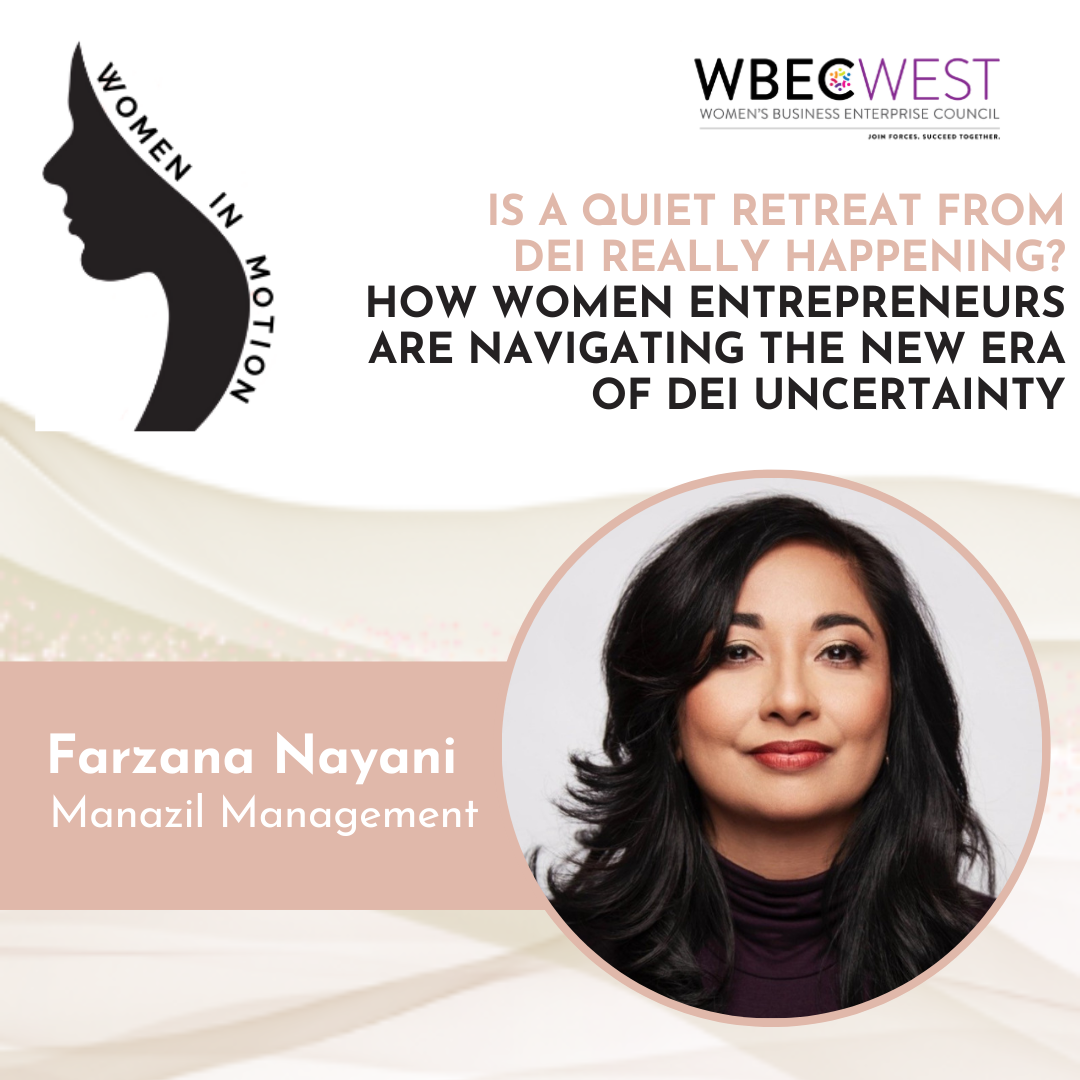

In this episode of Women in Motion, Lee Kantor and Renita Manley talk with Farzana Nayani, founder of Manazil Management LLC, to explore the evolving landscape of diversity, equity, and inclusion (DEI) initiatives. Farzana discusses the potential “quiet retreat” from DEI in the business world and emphasizes the importance of ownership, opportunity, and equity for women entrepreneurs. She shares insights on navigating current challenges, the significance of mentorship and community support, and the need for resilience and adaptability. The episode underscores the value of building strong relationships and taking actionable steps toward business growth and inclusivity.
 Manazil Management, LLC was founded in by Farzana Nayani (she/hers), a long-time consultant and established leader in the community.
Her vision was to create a boutique consulting firm that could meet the needs of our ever-changing environment. Manazil Management, LLC is a women-owned and certified, and minority-owned and certified small business.
Headquartered in Los Angeles, CA (Gabrielino-Tongva lands), the company’s team members spans locations across North America and represent a wide array of identity backgrounds, skills, and expertise. 
Connect with Farzana on LinkedIn.
Episode Highlights
- The potential “quiet retreat” from diversity, equity, and inclusion (DEI) initiatives in the business landscape.
- The shift in focus from DEI to ownership, opportunity, and equity for women business owners.
- Navigating the complex and contentious current environment surrounding DEI.
- The significance of building strong, authentic relationships in business.
- The need for adapting language and terminology in DEI discussions to resonate with a broader audience.
- The emphasis on action over mere rhetoric in DEI commitments.
- Identifying genuine commitment to DEI initiatives within organizations.
- Leveraging opportunities for women entrepreneurs despite challenges in the DEI landscape.
- The importance of resilience and adaptability in navigating business challenges.
- The role of mentorship, community support, and networking in overcoming obstacles for women entrepreneurs.
Music Provided by M PATH MUSIC
 This transcript is machine transcribed by Sonix
TRANSCRIPT
Intro: Broadcasting live from the Business RadioX Studios, it’s time for Women in Motion. Brought to you by WBEC-West. Join forces. Succeed together. Now, here’s your host.
Lee Kantor: Lee Kantor here with Renita Manley, another episode of Women in Motion, and this is going to be a good one. But before we get started, it’s important to recognize our sponsor, WBEC-West. Without them, we couldn’t be sharing these important stories. Today’s topic is a very important one, is a quiet retreat from DEI really happening? Renita, this is going to be an awesome show.
Renita Manley: It is. Thanks, Lee. Okay, so let’s jump right into this. Now, there’s been a lot of quiet and not so quiet movement around DEI lately, and not all of it has been straightforward. But here’s the thing, for many women business owners and WBEs, DEI was never really the end goal. It was always about ownership, opportunity, and equity that actually shows up in government contracts and businesses.
Renita Manley: So today, on part one of this two part series, we are going to go right into this DEI noise, stay honest about what’s really going on, and how women entrepreneurs are navigating the changes and landscapes of DEI.
Lee Kantor: Cool. And who’s the guest?
Renita Manley: Well, today we have Farzana Nayani that’s going to be joining us. Take it away.
Lee Kantor: All right. Welcome to the show, Farzana.
Farzana Nayani: Thank you, Lee and Renita, it’s wonderful to be here.
Lee Kantor: Now, can you tell us a little bit about your organization? How are you serving folks?
Farzana Nayani: Yes, my company name is Manazil Management, LLC. I’ve been operating for over eight years and have been in the industry for over 20 years. My firm works with different corporations, nonprofit organizations, government, public agencies, and higher education institutions to help workplaces thrive and people to work better together. We do that through consulting, advising, and coaching, and my specialty is on diversity, equity, and inclusion. Although, as you know, those terms are under fire right now. So, I also do work in people and culture consulting.
Lee Kantor: So, what’s your backstory? How did you get involved in this line of work?
Farzana Nayani: I have always been interested in cross-cultural communication. My degree is in that. I have a higher education degree in that. I’ve actually written a couple of books on the topic, one is on Employee Resource Groups and one is on Raising Multiracial Children. So, not only is it a passion of mine, but it’s something I embody as someone who’s a daughter of immigrants and someone who’s multiracial themselves. It’s something I believe in, and I really want to create inclusion for everyone around us.
Lee Kantor: So, let’s get into the topic a little bit, so do you believe that DEI was never the goal and that ownership and opportunity really were?
Farzana Nayani: Definitely. There are different paths to the outcome which we’re looking for, which is presence in the workplace and in business. And as a woman certified business owner, I know that one path to that is for me to own my own business. And why that’s so important is because systems take a long time to change, and the way that we can make a big impact is if we show up and be the leaders that sometimes aren’t around us ourselves.
Farzana Nayani: And unfortunately, in the workplace, there is a high rate of a lack of, for example, women in certain leadership positions, people of color in certain leadership positions. Of course, there’s a presence of women and people of color and LGBTQ folks, et cetera, everywhere. But what happens with minoritized communities is that there’s bias that kind of creates barriers to us succeeding. And so, as a result, we have to create our own opportunities, and the way I see that happening is for us to do business with big companies.
Farzana Nayani: And at the same time, the work that I do is I teach leaders how to be more inclusive. So, I’m kind of doing both sides of the work at the same time and modeling it to others.
Lee Kantor: Is there anything actionable you can share about, you know, in respect to the WBEs, how they can navigate this, something they can do as they’re kind of dealing with the new environment we’re in.
Farzana Nayani: Definitely. I think the key is relationships. As you can see, there’s a lot of noise and a lot of, quite frankly, chaos going on with a lot of turbulence in the environment, and sometimes decisions that are quick, or maybe they’re done behind closed doors. And the way that WBEs or any business owner can really leverage not only their skills, but offer their services, is through relationships.
Farzana Nayani: And what I found in the work that I do and the clients that I have, is that people have good relationships with, they are very transparent. I know exactly what’s going on. They’re very honest with me. I’m honest with them. And they’ll tell me, they’ll say, “Hey, Farzana, you know what? Our hands are tied right now. We can’t do certain work, but we can do this other type of work.” And with that, we pivot together.
Farzana Nayani: And I am in a pivot right now. Transparently, it’s been quite a ride to be in just watching what’s been happening. But I have a ton of perseverance and a lot of support. And with that, and the guidance that I have around me through mentorship, through organizations like WBENC and WBEC-West, the abilities to really look at the opportunities here are limitless.
Farzana Nayani: And the way I look at it, it’s kind of like COVID. You know, during COVOD, we all had to pivot hard. We had to figure it out quick. And for me, my in-person stuff went virtual. And I remember teaching my clients, I’m talking big banks, I’m talking large corporations, how to do stuff on a wide scale virtually. It was, you know, my small but agile company teaching these big corporations how to adapt to these environments that are changing.
Farzana Nayani: And I feel like as a women-owned business and certified businesses, we can actually bring that expertise and that spirit, that rigor and that ability to harness our own resilience and teach those around us, including our clients.
Lee Kantor: Now, in order to be able to really pull that off for clients, though, you had to have a lot of trust and the relationships had to be authentic and deep. And without that, it would be more difficult to achieve that type of trust in the boardroom.
Farzana Nayani: Yes, that is very true. And the relationship I’ve built with my clients is that they come to me with their biggest, darkest problems, and I have the most confidentiality and trust through that. Because when they have issues, who can they turn to when they’re getting battered on social media or there’s misrepresentation of their leadership or their initiatives? They need help too, and they can’t find all the answers within. So, what we can do as supporting businesses, as people who are consultants, as people who are on the outside of these organizations and institutions is offer a fresh perspective.
Farzana Nayani: So, I have always been that way. To be honest, I’ve never advertised. The work comes to me through word of mouth because people know the quality and the caliber of what I do and also the trust. So, I think with that, we deliver the results. And a key part of this is that we partner with people. It’s not just about us serving them or them serving us. It’s a true partnership. And we really work together to make the best solution for everyone. So, with that spirit, I think people really do deepen that relationship.
Renita Manley: Okay. Farzana, I do have one follow up question. Earlier you mentioned that after all of these DEI changes occurred, you had to curate a slight pivot. Can you, without giving away too much of your source, tell us about this pivot that you had to make with your business?
Farzana Nayani: Yes, definitely. I think it’s worth it to mention that there’s certain terminology that has been under fire, meaning it’s seen as controversial. And quite frankly, it’s been co-opted and used for different campaigns and different results and the meaning has been lost. And because of that, my choice is to actually use terminology that resonates with a wider audience and doesn’t create that volatility.
Farzana Nayani: So, for example, the word diversity, the word equity, the word inclusion can mean different things to people. And in some spaces, I continue to use that. In other places, I use workplace engagement, people and culture. And that seems to get the same message across, but it isn’t creating that triggering effect.
Farzana Nayani: And the reason why that’s important to me, and I don’t see that as a compromise, is because my thought around this and my belief is really to reach people where they’re at. And if I’m constantly working with people that only agree with me or only have my own views at hand, then I’m not doing my job. I need to be able to reach people that normally I’m not in contact with, and for them to see my perspective and for me to see their perspective.
Farzana Nayani: And if I need to do that by creating a new way to discuss this, then I’m open to it. Because the work doesn’t stop, and to be honest with you, the true work actually is integrated deep into the business, and it can’t be canceled anyways. The companies I’ve seen do this very well are continuing, and maybe they are navigating the current times and the way that they need to, but the work continues, and I see that through actions.
Farzana Nayani: So, I think as women business owners, as any business owner, what we need to look at is action, not the words. We are told a lot. There have been a lot of pledges in recent years towards certain initiatives, but what really has been done? And so, if we go by that, I think that’s a good marker of who’s committed and who’s really continuing the good work.
Lee Kantor: Now, Renita, do you have another question?
Renita Manley: Yeah, I was going to ask, it might be a little bit more an edgy question, but you did mention that companies come to you with their dark secrets, without giving away too much of that information, can you just give us possibly a fictional example of what type of company comes to you and what’s their problem, and then how do you solve their problem?
Farzana Nayani: Definitely. There are a lot of public facing companies that have brands that are household names, let’s say entertainment and finance and tech apps that we use, search engines, whatever it is. And the issue with thinking about DEI and, let’s say, the rollback of it is that, to be honest, the people they serve are diverse. So, our marketplace is diverse, so how do you continue the work and the services if there’s scrutiny over the words we’re using and the things we’re doing, but we need to because of the market.
Farzana Nayani: And so, the way I advise people is to think about the business as it’s a method to connect with people. And if truly that’s what we’re doing, whether it be by selling products or offering services, then we have to understand our market. And if we have to understand our market, we need people that connect with that market or are a part of that market. So, just by nature of understanding good business practices, we therefore need inclusive leadership, we need a diverse team, and we need to understand what the market is asking for.
Farzana Nayani: So, a good example I can give of that is when a company comes to me and they say, “Hey, you know what? Our leadership is a bit shy now about continuing our groups that are based on identity.” And so, those are called employee resource groups. I help set those up and run them at organizations. Maybe it’s your Black employee network or your Asian Pacific Islander group, or your LGBTQ plus pride network, et cetera. So, people say how do we continue that, because it’s seen as marginalizing the majority or it’s seen as segregating from the rest of the community.
Farzana Nayani: And so, that’s where when push comes to shove, we have to explain to leadership that this is strengthening your workforce. This is allowing people to let their hair down and feel comfortable at work, or this is allowing us to understand new emerging markets that we didn’t know. And so, the responsibility we have is to challenge our leaders, but to bring it in a way that reduces fear. And we can do that through metrics, we can do that through making sure we have the right data and the right mindset. But fear and scarcity, those are the things that are kind of penetrating the human psyche right now that are stopping us from being able to really maximize on what we’ve built already.
Lee Kantor: Now, you mentioned that some organizations are kind of leaning into this and some are giving lip service to it. Is there anything, any tip you can share with the WBEs listening on how to discern which are the organizations that are giving lip service and which are the ones that are really committed.
Farzana Nayani: Definitely. As we can see some programs are being canceled. And part of us understanding the environment right now is knowing what is canceled, what is being sunset, and what is actively being terminated. And so, I have studied this and have been speaking with legal counsel and understanding the environment, and there’s a bunch of different things going on and I just want to explain it to our listeners.
Farzana Nayani: One is that there is the directives that are coming from government or the administration on how businesses should run and how higher education institutions should lead. And so, that is one directive that’s coming out through executive orders and such. The other is pressure from stakeholders and how even boards are getting proposals to roll back DEI.
Farzana Nayani: So, those are two different things that are happening, but I want to explain a third thing, in no way is any of this illegal. Let me repeat that. In no way is having a DEI program illegal. DEI programs are not illegal unless they’re excluding people. But if they’re done properly, and I’m not saying all are done properly, but if they’re done properly, they will include everyone.
Farzana Nayani: And the confusion is right now is that people are gaining jobs or they’re gaining access to opportunities because they don’t deserve it, they’re underqualified and they need a leg up. That is absolutely not true.
Farzana Nayani: So, if you think about, let’s say someone’s applying for a job and let’s say they’re from a community that isn’t in that field, you don’t see a lot of that person from that community in that field, that’s not because those people aren’t good enough. Let me just say, that’s because there’s some bias or some barrier that hasn’t penetrated to be able to give that person or that community access.
Farzana Nayani: So, I’ll give a concrete example. Let’s say we look at the data and there are fewer Black engineers than other community groups in the environment, in the industry. Well, why is that? Are we saying that certain people are not as qualified? No. What we’re saying is that there’s bias that prevents people from getting through the different interviews, or getting chosen, or getting the opportunities to be a project manager, or what have you, to rise in the ranks in that field. And I could say that about women. I could say that about people who are veterans. I could say that about a lot of people, people who are neurodivergent. And so, my job and other people’s jobs in DEI is to reduce the barrier so you get the best talent.
Farzana Nayani: But there’s something out there being said around how people are DEI hires and they’re getting the leg up, they’re getting the handout so that they get the job. But that’s just not the case. I think every single company wants the best talent, and wouldn’t you want there to be barriers removed so you get the best talent and you get the best person no matter who they are. It just makes more business sense to have the best person in the role.
Farzana Nayani: And so, that was the whole point of DEI is to create equity. Equity in this case meaning equal playing field or the ability to have access. And another part of equity is the business equity where we gain ownership and we gain the financial presence and power. Both of those equities are important in our discussion here today.
Farzana Nayani: But what I’m trying to say is that people are misunderstanding what DEI is about. And it’s not illegal. And there are mandates from different states saying some things are illegal. That’s definitely the case. I would say that federally that’s still being worked out or that’s being defined, I would say. And so, it’s left up to interpretation by each state. And then, the trickle down is that companies have to take that interpretation and either continue their work or adapt it or cancel it, but that is up to the company. That’s up to the institution. That is up to the leadership.
Farzana Nayani: And so, I was on a great webinar talking about this, and they said that here’s what you need to do. You need to think about how much you want to do that doesn’t get anybody the scrutiny, or the trouble, or the backlash, but don’t just do nothing. We can’t do nothing. We can’t just sit on our hands and just watch everything go by and not try to continue what we built already in the past.
Farzana Nayani: And so, definitely, I was one of those people at the beginning of the year thinking, What am I going to do? What is happening? It’s all unraveling. It’s so sad. It’s a shame. But I’ve snapped out of it. And I think the LA fires and everything here that happened – I live in Southern California – gave me inspiration because I saw people rebuild. So, I needed to see that happen in front of me to understand that we are in a rebuilding phase and we need to build this differently because, quite frankly, it’s not resilient enough. It needs to be stronger for it to really be infused into our organizations better.
Renita Manley: A few moments ago, you mentioned the word legal, and it’s that word, legal, around all of this DEI conversation that has everyone walking on eggshells. So, what advice do you have for our WBEs and our supporters how to navigate these changes in DEI in a legal way? Are there resources that they can go to to make sure that they’re using legal words or legal terminologies or not so triggering terminologies? And is there maybe like resources where they can learn maybe which areas are operating where their stances are with DEI, and just pretty much how to stay legal with everything?
Farzana Nayani: Definitely. I would say the easiest, quickest thing is to mirror the language of the organization you want to do business with. And I can say that firsthand that in the last six months, I’ve actually seen massive bids from the State of California asking for training, asking for, in particular, implicit bias training, asking for racial equity advising. And I had to pinch myself, I said to myself, is this current? Am I looking at a 2025 bid? And the work is still out there.
Farzana Nayani: And so, what that tells me, and I’m heartened by that as a business owner, because I’m applying for these bids, I’m submitting, I’m putting teams together. You should see me out. I’m out here right now. I’m here for it because what it’s telling me is the work is not done. And I know, again, it does make a difference based on what state you’re in, and definitely nationally and federal government, that’s a different case, things are being canceled for sure.
Farzana Nayani: But what I’m saying is that opportunity has not dried up completely. There are still people that are rewording it. I just saw a bid from locally here, an agency here. They just reworded it a bit. They used the word leadership and they focused on coaching. They didn’t say DEI, but everything that they’re talking about was around inclusion and belonging and those concepts. So, what we need to do is play detective and mirror back the language that the clients are using and we can still continue our services.
Lee Kantor: And this example as you mentioned earlier, with COVID, you know, you have an issue that’s affecting people and you just have to adapt. I mean, you can’t just sit back and say, “Oh, well. We had a good run,” and call it a day. You have to adapt your language. You have to adapt the approach to relationships that maybe emphasize some other areas that you weren’t maybe putting enough time in order to build the relationships in order to have the opportunities.
Farzana Nayani: Definitely. And, Lee, I think you’re making a really good point. You know, what era are we in right now? Part of navigating this current time is observing. We need to actually observe. We need to not be doing so much and and try to learn and listen and see what’s happening.
Farzana Nayani: And so, part of my strategy for this year is to continue to do writing. I’m being asked to write another book, and so I’m working on putting ideas for that together. I’m learning myself. I’m in different programs. A few years ago, I finished the 10,000 Small Businesses Program. I just got into the multicultural entrepreneurship program. I’m bettering myself. I’m leveling up myself in the meantime.
Farzana Nayani: And we all need patches of time where we just pause for a moment, and COVID was that for us. COVID allowed us all to take a breath and reassess our lives and make them better. And so, I think now in this landscape, we, in our lives, need to assess and take a look at who we want to work with, how we want to do business, who we want to partner with, and that is actually a gift.
Farzana Nayani: I am so grateful for this time because it’s allowing me to pause. It was like a washing machine. It was a turnstile the last years. It’s just been nonstop. And I’m so grateful for the opportunities, and my business grew, and I feel like I’ve matured, I’ve deepened in my leadership. But now is the time for me to reassess everything all over again and figure out what’s next. So, I think we need to embrace this pause or this period to take a look at everything again.
Lee Kantor: Yeah. There’s a book I read called The Obstacle Is the Way. These obstacles aren’t there to stop us. They’re just part of the journey, and we have to be able to go over them, under them, through them. We have to find a way around. We can’t just sit in front of it and say I’m stopped. I’m going back. Like, that’s not the way forward. You have to figure out a way to get past the obstacle no matter what it is.
Lee Kantor: And you mentioned an important point earlier, and that’s why I think experts like you are so important navigating kind of these rough waters and organizations like WBEC-West. You have to have mentors. You have to have experts. You have to have community to help kind of weather the storm here. Can you talk a little bit about the importance of bringing in an expert to help your clients or partnering with an organization like WBEC-West to help a person get through kind of this tough time or just to help even from an education standpoint?
Farzana Nayani: Definitely. So, on a personal note, there is a group of us that meet every two weeks. We’re all women certified, WBEC certified business owners. And our secret sauce is that we support each other through very difficult moments, conversations. We advise each other and we even partner. So, we have our own mastermind that has come out of just networking and people we trust that we rely upon for each other, so we are each other’s experts. I think that’s the key, is we don’t realize we have in our immediate network people who can be that expert.
Farzana Nayani: And so, for one of these bids, I was just partnering on, I was looking for a resource in a particular subject matter expertise, and I was racking my brain. And you know what I did? I went on LinkedIn, and I was like, my goodness, this person is one degree away from me. I know them, I talk to them, but I forgot that they do this thing that I need. And so, we partnered up on the bid. And I wouldn’t have thought of that if I hadn’t looked at the certification. And people have gone through the programs because we think the same way, like, let’s go for it. You know, we don’t hold back. We push ourselves.
Farzana Nayani: And let me just say one more thing. In order to get certification, you have to be on top of your stuff. Like it takes people a long time to kind of get ready and then go through it. But once you’re on the other side, you can see the difference. You can see that you’re prepared to go for SBE certification, or for me, I did DBE certification. I was so ready because I had my numbers together. I felt confident.
Farzana Nayani: And then, I’m seeing all these other amazing programs that WBEC-West is doing, different pitch programs and stuff. I can’t wait to sign up. They have this event that happens every summer where we get on boats in Southern California and network. I’ve been hearing about this thing for years. I need to get myself on the boat and network with these amazing other people.
Renita Manley: That event is called the Unconventional Women’s Conference, and it is coming up this July in 2025. Check our website for more details.
Farzana Nayani: Yes, that’s the one. Thank you. Renita. So, I think it’s just keeping our spirits up. And, you know, not just the DEI conversation, but tariffs, the economy, everything we’re navigating. We’re getting kind of like hit in the chest, punched in the stomach, knocked upside the head, and we still get up and get back in the ring, because, guess what? We have that courage and resilience and we have each other.
Farzana Nayani: And so, you feel like you’re not alone. Like I feel like I have a whole team. In addition to my own team, I have like another team, and I have mentors I can call. But I personally am so inspired, even having this conversation, I feel very re-energized that people are listening and maybe they’ll go and do something, or push themselves, or challenge what’s around them to talk about what we’re talking about and to make a difference. So, I think everything plays its part.
Lee Kantor: So, what advice would you give a WBE out there that’s listening and maybe is energized by the conversation? What’s maybe an easy first step, a baby step they could take when it comes to adapting to these times? And maybe also throw in leveraging the WBEC-West certification and community.
Farzana Nayani: Definitely. One thing to do is I feel like we have to kind of like lift up the hood and look underneath there, and see what needs to tune up, how we can adjust, what has been that thing that’s been making noise, maybe it needs a little fix, and do that. Now’s the time to do that. I think we have to also listen and see what our clients need and match the needs. Find out. Do those calls.
Farzana Nayani: One of my business mentors said, hey, Farzana, you’ve got to call 100 people and ask them what’s going on, what’s on their minds, what do they need. I’m about 25 people in and I’ve already learned so much. So, I pass that advice on to you to go and call your top 50 and just see what’s happening, what’s on their minds and what you can offer.
Farzana Nayani: I also recommend using AI as a sounding board. Just throw some ideas in AI and ask it. What are your thoughts on this? What are your thoughts on that? How can I pivot this? How can I use different terminology? It’s definitely helpful. And I think, you know, why not embrace technology and do that. It’s built on the minds and brains and the training of so many bright and brilliant experiences. It has its drawbacks. Of course, fact check and double check everything. But just to kind of get you started, get some ideas going, I think that’s a great place.
Farzana Nayani: And also turn to each other and build an informal network and get together. The LAX Coastal Chamber I’m a part of, they have hikes, they have social mixers. They’re putting on a DEI program, it’s called Creative Inclusive Workplaces. We came up with that name to make it more accessible and relatable to a lot of people. So, just look around, there’s tons of opportunities to plug in and to continue the work that we’re doing and be inspired in different ways.
Lee Kantor: And, Farzana, if somebody wants to learn more and connect with you, is there a website or a best way to connect?
Farzana Nayani: Yes, my website if you want to connect with my company, it’s www.manazilmanagement.com. If you want to book me for speaking or consulting, then it’s my first and last name, so www.farzananayini.com. And I am all over LinkedIn. I love connecting with people on LinkedIn, so you can find me there as well.
Lee Kantor: Renita, any last words before we wrap?
Renita Manley: No, I think that was all great. Thanks for sharing all that, Farzana, this is really good. But we’re not here to point fingers. We’re just here to highlight the type of people that’s still showing up for our women-owned businesses, and to highlight Farzana and the great work that she is doing to advocate for businesses, period, all businesses, to help them be even more engaging.
Renita Manley: In our next episode, we’re actually going to be digging a little bit deeper, because this is a two part series, so we’re going to dig a little bit deeper into corporate procurement and what that looks like going forward. And, Farzana, you’ll be joining us for that episode.
Farzana Nayani: Yes, I’ll be back I can’t wait.
Renita Manley: Sweet. Lee, you can take us out.
Lee Kantor: All right. Farzana, thank you so much for sharing your story. You’re doing such important work and we appreciate you.
Farzana Nayani: Thank you so much.
Lee Kantor: All right. This is Lee Kantor for Renita Manley, we will see you all next time on Women in Motion.














