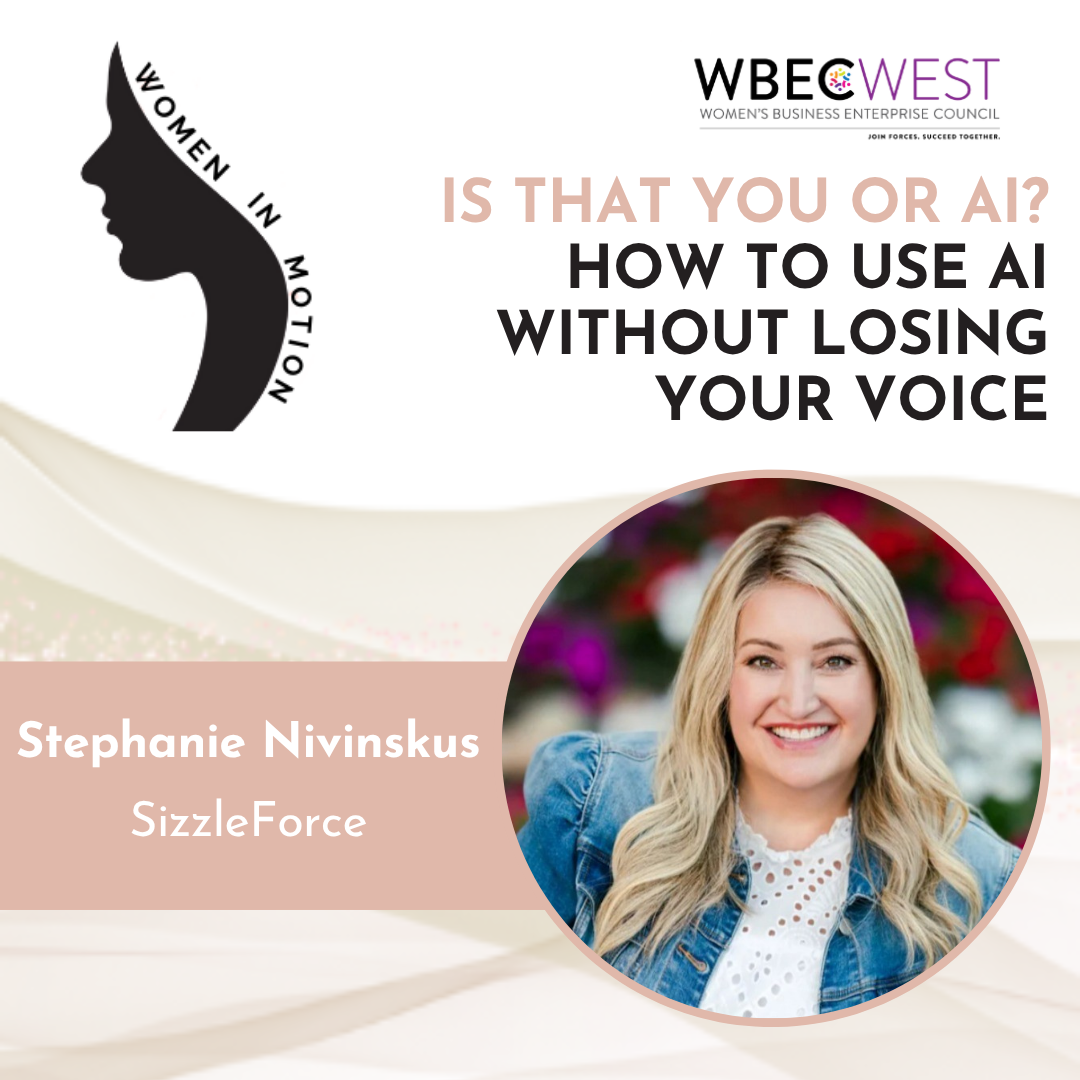

In this episode of Women in Motion, Lee Kantor and Renita Manley welcome back marketing expert Stephanie Nivinskus to discuss how AI can enhance content creation without sacrificing authenticity. Stephanie introduces her SPOT method for evaluating AI-generated content and shares practical tips for refining brand voice, avoiding common AI pitfalls, and leveraging storytelling. The conversation emphasizes the importance of maintaining a unique, human touch in digital marketing, and provides actionable strategies for businesses and individuals to stand out while using AI tools effectively. Listeners are encouraged to embrace AI thoughtfully and stay true to their brand.
SizzleForce Marketing is a very carefully curated team of certified fractional CMO’s, AI marketing strategy & execution specialists, digital marketing strategists, content marketers, copywriters, website designers and developers, branding experts, and social media marketers. Every day we strategize and execute marketing solutions for mission-driven, scaling companies. We service a broad range of clients, but we have an extra special place in our heart for pet brands. It might have something to do with the fact that we have not one, but two dogs on staff.
 Everyone’s got a story to tell, and Stephanie Nivinskus, CEO of SizzleForce, knows how to tell them. Since 1995, she’s helped thousands of business owners, big and small, transform their mission and vision into strategic marketing plans, compelling brand stories and meaningful marketing messages that humanize commerce, maximize opportunities and win customers.
The international #1 bestselling author of Absolutely Unforgettable: The Entrepreneur’s Guide To Creating A Heart-Centered Brand That Stands Out In A Noisy World, Stephanie is well-respected in the marketing industry.
She has written for Forbes and Entrepreneur and shared the stage with some of the world’s most renowned marketing and business growth experts, including Les Brown, Jasmine Star, and Suzy Batiz at Digital Marketer events as well as at countless business-building conferences including Level Up Live, The Copywriter Club IRL, and more.
Connect with Stephanie on LinkedIn.
Episode Highlights
- The role of artificial intelligence (AI) in content creation.
- Importance of maintaining authenticity and unique voice in AI-generated content.
- Introduction and explanation of the SPOT method for evaluating AI content.
- Common mistakes made when using AI for content creation.
- Strategies for discovering and refining one’s brand voice.
- The significance of human expertise in enhancing AI-generated content.
- Best practices for effectively utilizing AI tools in content creation.
- Opportunities for differentiation in the market through AI.
- The financial impact of a strong and authentic brand voice.
- Enhancing storytelling techniques with the help of AI.
Music Provided by M PATH MUSIC
 This transcript is machine transcribed by Sonix
TRANSCRIPT
Intro: Broadcasting live from the Business RadioX Studios, it’s time for Women in Motion. Brought to you by WBEC-West. Join forces. Succeed together. Now here’s your host.
Lee Kantor: Lee Kantor here with Renita Manley, another episode of Women in Motion and this is going to be a good one. This is part three in our AI series. And today we’re going to be talking about Content, Is that you or AI? And we have with us once again our subject matter expert, Stephanie Nivinskus with SizzleForce Marketing and author of the book Sizzle Or Fizzle. Renita, we’re wrapping up the series. This has been a great topic to talk about.
Renita Manley: Yeah, it really has. I’m really, really thoroughly happy with all the information that I’ve gotten from Stephanie, and I am looking forward to hearing how we all can keep our voices authentic while using AI.
Lee Kantor: All right, Steph, so why don’t we just jump right in? What are your thoughts about this in terms of keeping your authenticity while leveraging an inauthentic tool like AI?
Stephanie Nivinskus: It’s so important to do this, and a lot of people don’t do this, and that’s why their voices are getting diluted by the different AI tools. So, I actually have a method that I recommend people use when they are generating content and they want to check and see, does it sound too AI-ish or does it sound actually like me?
Stephanie Nivinskus: So, I’ll tell you what the method is. It’s really easy to remember. It’s called the SPOT method, S-P-O-T. And the S stands for Sounds nice, but it doesn’t have any punch. The P stands for Personal touch is missing. It doesn’t have any stories that are authentically yours. It doesn’t include the verbiage that you tend to say. It doesn’t have your personality. Like if you’re a really energetic and friendly and conversational person, it might sound dry instead of the way that you really show up in the world. And it lacks nuance.
Stephanie Nivinskus: The O stands for Overused words, and I think we touched on this in the last episode, but I have a list of over 1000 no-no words for AI. And I think everybody should have a no-no list. And what’s going to be on your no-no list is probably going to be a little different than mine, because it’s dependent on the type of content you’re having it create. But there are some no-no words just across the board that everybody should forbid ChatGPT from using. And a few of those are the word delve, the word tapestry, the word unlock, unleashed, and fluff.
Stephanie Nivinskus: Those are five words, that if you see those, get rid of them. It’s not that they’re bad words. I mean, I’ve been a copywriter for 30 years, and those are words that we’ve used in copy over the years, but they’re overused by AI. They’re way overused right now, so you don’t want them in your copy right now, not forever, but not right now. And then, the last one is T, too much redundancy and rambling. AI loves to ramble. So, that’s the SPOT method for you.
Lee Kantor: Now, what are some of the mistakes you’re seeing people, when they’re using AI, is it that they’re just prompting and then they’re just kind of cutting and pasting and they’re not kind of giving it the once over and adding back the humanity to the content?
Stephanie Nivinskus: Yeah, I see that all the time. And it’s the biggest way to make it say your brand fits in with the masses. And that is the opposite of what we’re going for. We want to differentiate. We want to set our companies apart. And so, if you take AI’s first output and you copy and paste it, you’re just going to get regurgitated garbage.
Lee Kantor: So, if somebody say they’ve never used AI for content and they’re doing a social media post on LinkedIn, what would be kind of your SOP, Standard Operating Procedure, to create a LinkedIn post using AI?
Stephanie Nivinskus: So, the first thing I would do is I would tell the AI what role it’s playing. And this could be, you know, in the case of writing a post for LinkedIn, you would want to say you are a LinkedIn social media marketing expert. So, you assign it a role so it knows, okay, I’m looking at this from this vantage point. And then, you would say, I want to write a post about blank. Then, you would say my audience is blank. Some of their pain points are blank. I sell whatever product or service, and this helps solve their pain point by blank. Now, that’s obviously for more of a promotional post. But giving it that information will help you start to generate where you need to go.
Stephanie Nivinskus: I have a tool that I developed called The Bot Boss, and a whole bunch of training went into this. So, when it generates a LinkedIn post, you’re going to go way deeper, and you’re going to get something that’s on brand, and something that is really designed to convert and attract people much faster than going generic into, you know, ChatGPT out of the box. But that’s a good way to start by giving it that information.
Renita Manley: Hey, Steph, I do have another question about finding your voice by using AI. So, let’s say I’m a WBE, what if I don’t quite know what my voice is? I’m professional, but what if I don’t know what my voice is, how do I discover my voice in order to use it properly with AI?
Stephanie Nivinskus: That’s an awesome question, and I have good news for you, it’s really easy. You can actually take a few different things that you’ve written. They could be social media posts. They could be blog posts. They could be a report that you wrote. You know, really anything. And you take a few of those things and you upload them into ChatGPT or the AI of your choice, and you ask it to analyze what you’ve written and to identify your voice for you.
Stephanie Nivinskus: And instruct it to say things like, I don’t just want a generic tone, I want to know what are the intricacies of my voice, what are the things that I’m frequently saying? What is the the style? What is the tone? What is the personality? What’s off limits, blah, blah, blah? And then, you can also ask AI, What else do you need to know from me in order to continue defining my voice?
Stephanie Nivinskus: I mean, originally when I first started using Claude about two-and-a-half-years ago, I had it generate my brand voice for me. And one of the things I asked it was, if my voice was any celebrity, who would it be? Because it just kind of brings it to life outside of yourself. And mine told me it was Ryan Reynolds, which I thought was hilarious. So, apparently I sound like Ryan Reynolds.
Renita Manley: Did it tell you why you’re Ryan Reynolds?
Stephanie Nivinskus: It sure did. I don’t remember all the details. I just thought it was hilarious and started laughing.
Renita Manley: So, let’s say I have no idea what my voice is. I’m going to listen to your tips that you just gave me. But is it possible for me to go on Claude or ChatGPT and say, “Hey, I don’t know what my voice is? Can you help me discover my voice?”
Stephanie Nivinskus: Yeah, exactly. Just doing what I just said. Yeah, you ask it to analyze what you’ve written and tell you what your voice is. Now, as a copywriter, I’ve helped people create their voices forever. And I will tell you that the traditional method of determining a voice is much more in depth than what you’re going to get from ChatGPT doing a once over.
Stephanie Nivinskus: So, that being said, consider this a start. But if you really, really want everything written in your voice, this is when you’re going to want to bring in a human to help you create a brand voice guide. And that is something that, you know, ChatGPT or whatever, they’ll do a high level. You could think of it as a 30,000 foot overview of a brand voice.
Stephanie Nivinskus: But if you really, really, really want to dial it in, if it’s super important, which most of the time it is, that’s when you’re going to contact somebody like me, or me, if you want to contact me, and we can create your voice for you or we can create your voice with you. And there’s a whole process that goes into it. It’s a long interview. It’s about three hours long. Because we just ask you one question after another after another after another, a trained copywriter can spot these patterns. And we also know what questions to ask you to get to the brand voice.
Stephanie Nivinskus: It’s not just like, “Oh. Well, how do you want to sound? Do you want to sound friendly and conversational? Great.” So does everybody else. You know what I mean? We’ve got to get into what makes you you. And that’s what happens when you have a human doing this part of the job.
Lee Kantor: And when you’re working with your clients in and around perfecting their voice or getting a handle on it, what is the output you deliver back to them and how do they use that kind of moving forward?
Stephanie Nivinskus: When I’m done with it, they get a brand voice guide. And it is – oh, goodness – probably 15 pages going deep into their voice. I’ve actually seen brand voice guides that have been over 100 pages. I don’t do that because I think it just overwhelms everybody. Fifteen pages sounds like a lot to most people. And it’s in a PDF form, and I tell them, upload this to your AI and enter the prompt, you would say something like, this is my brand voice guide, read it, analyze it, tell me what you understand. And then, it will spit back an output for you and you can review that. And if anything doesn’t seem quite right, you can tweak it. You can say, “Okay, you got all that right. Here’s where you, you know, went off the rails. You got to dial this back in. This is what we’re looking for.”
Stephanie Nivinskus: The brand voice guide, it gets into so much of the psychology of marketing the persuasion techniques. And those are the things that AI is just not doing a very good job at, at this point, that’s why you need that human.
Lee Kantor: Now, when you’re working with your AI and you’re uploading the brand voice, you’re uploading these forbidden words, you’re explaining who your target market is and what you sell and all that stuff, is that something you have to do every single time you prompt it? Or is this something that happens one time and then it knows who you are and you don’t have to kind of reiterate that over and over again?
Stephanie Nivinskus: That depends on how you use the tool and which tool you’re using. So for example, if you’re using ChatGPT, you can tell it to save this in its memory and it’ll save it in its memory. If you’re using it in Claude, you can create a project, and you can do that in ChatGPT as well. But you can create a project, and in the process of creating that project, say you must reference these source documents every time you generate anything for me. So, yes, you can absolutely do that.
Stephanie Nivinskus: Will it remember things by default? For a time it will remember some things. But then a day will come and it won’t remember it at all. And you’ll be like, “What happened to you? What did you do last night? Because you apparently don’t remember anything about me even though I’ve been talking to you every day for, you know, the last year-and-a half,” whatever. You want to avoid those scenarios from happening, because then you’re going to have to go through the whole retraining process, and it takes time and care and attention to really do it right.
Lee Kantor: Now, is that a reason to kind of have all of these documents that are about your past history and what you’re trying to achieve somewhere, that if it does forget, you can remind it and then just quickly upload it to get it back top of mind. Is that just part of how you have to deal with AI at this stage?
Stephanie Nivinskus: Yeah, absolutely. I always tell people, you know, I use Google Drive, whatever you guys use, have a folder on your computer with all of these key guides that it might need to reference on more than one occasion. So that, if by chance, at a certain point when you’re using a free model or even the paid models, it will run out, the thread will run out of room, and it will say you can’t do anything else in here. And it makes people really upset and really sad, and rightfully so. However, if you have a Google Drive with your core training material in it, then you can just start a new thread and upload all of it again and start over and you’re good to go.
Lee Kantor: So, that’s a best practice to create a Google Drive folder or some sort of folder that has all of this key background information at the ready so that you can use it. If you switch to a different AI or whatever, everything’s there ready to go, and you don’t have to go searching for all this stuff.
Stephanie Nivinskus: That’s right.
Lee Kantor: So, now, where do you see kind of the biggest opportunity for the WBEs when it comes to branding in AI?
Stephanie Nivinskus: Where do I see the biggest opportunity for the WBEs when it comes to branding in AI? I think really in differentiating. I think that’s the biggest opportunity. I think that there’s so many WBEs that could be positioned as thought leaders in their industry, that could be positioned as the go-to authorities in their space, but they’re not, and it’s because they’re not differentiating themselves well enough, and they’re not really doing what’s required to create a personal brand that stands out and attracts attention. And I think that’s something that so many WBEs are just leaving so much money on the table by not doing that.
Lee Kantor: And then, would a way to do that be what you mentioned earlier, is you upload a bunch of stuff that you’ve done and ask it for help, in helping you kind of identify what it is that is your secret sauce or the differentiating features?
Stephanie Nivinskus: That’s a place to start. That’s very much a starting point. Honestly, if you really want to do this, you need to get my book. You need to get my book because I wrote 251 pages about how this works. So, there’s not a quick answer that I can just give you right now and say, oh, if you just do this, wave the magic wand and it’ll dial everything in. It’s a process, and there’s a lot to it. But I have a book. I’m sure there’s YouTube videos out there that talk about stuff like this. I talk a lot about this stuff on my TikTok profile. So, yeah, that’s what you need to do.
Stephanie Nivinskus: Think of when you’re using an untrained AI, meaning nobody has custom trained it for your brand, including you. When you’re using something like that, you need to expect that you’re going to get first level stuff from it, first draft is another way of saying it. You should not expect to get final documentation from an untrained AI, because if you’re considering that final documentation, I guarantee you, you are leaving so much money on the table and you are sounding like everyone else.
Renita Manley: So, Steph, I’m glad you’re bringing up money because that was actually going to be a part of my next question. So, let’s say I’m using AI properly. I got my voice down. I got your book. I’m doing my thing. Can you explain to all our business owners out there how using AI to perfect your voice and your brand voice translates into more money and more contracts?
Stephanie Nivinskus: Okay. Well, we all know the old saying people do business with people they like, know, and trust. And so, when you are perfecting your brand voice using AI, it’s going to make you more likable. It’s going to make you more likable. You’re going to be consistent, meaning not just your frequency will be consistent, but the way that you show up will be consistent. People like that. People like that because it makes it easier to trust you. It makes it easier to believe you.
Stephanie Nivinskus: Like, know, and trust, when you are using AI to create content for you, it will also really help you dial in that sector on how you can and should be known in your spot. All of those things, if you make people like, know, and trust you, they want to do business with you. It’s just the way it is.
Stephanie Nivinskus: I mean, yes, there are some organizations that it’s all about lowest bidder gets the deal. But there are a lot that are like, “You know what? We would pay more if it was someone that we liked, knew, and trusted that was going to do the job,” because that carries a lot of weight.
Lee Kantor: Now, how would you help the WBEs, we’ve talked about this in the past, that storytelling is an important component of communication and persuasion and differentiation, how would you leverage AI to improve your storytelling? Like, would you just kind of write out one of your anecdotes and then ask AI to make it better? Like, how would you use AI to improve storytelling?
Stephanie Nivinskus: I would probably start by asking it to tell me what it knows about storytelling. And I would say, tell me what you know about storytelling in this capacity? And then, it’ll spit something out and say, and what makes the stories really resonate? What are the elements that make it resonate? And are there any storytelling frameworks that are proven to attract or convert or both? And if so, what are they and why do they work?
Stephanie Nivinskus: So, I would almost more flip the switch on this one, and I would be asking the AI to tell you what it knows, as opposed to letting it ask you for more stories. Once you go through this process of kind of you’re almost interviewing the AI to find out what it knows about storytelling, then you can say, I really want you to integrate my personal stories into what you write for me, but I don’t really know what they are. I can’t really think of any off the top of my head that are super important to tell you.
Stephanie Nivinskus: So, knowing the type of content I’m writing, what type of stories would be helpful for you in order to give me the results I’m looking for? And then, let it tell you. And then, say, okay, ask me whatever questions you need to know about this. This is the beauty of conversational AI, you can go back and forth and back and forth until those stories are discovered.
Lee Kantor: So, kind of you’re giving it a framework or understanding its framework and then asking it to interview you to kind of uncover interesting anecdotes or points of view.
Stephanie Nivinskus: Yeah. So, have it interview you, and then after you answer it’s questions, say, Which of these would be good stories to integrate into the content you’re creating for me? Which ones do you think are the most relevant, the most riveting, the most memorable? And use that, use the AI to do that. You as a human, as always, as I’ve said in all three podcast episodes, you absolutely need to be the human that looks at everything. Don’t just say, “Oh, AI said it, therefore it’s right,” because that’s not true. AI said it, and that’s what happened, AI said it.
Stephanie Nivinskus: You’re the human. You understand the nuance. You understand the cultural expectations. AI is not very good at that. It’s not very good at that. And here’s a good thing, most of the time, if you ask it, let’s say you wanted it to write a LinkedIn post again, but you wanted it to write something political that happened, like recently we had the the No Kings Protests. Most of the time when you ask it to write something about that that relates to your business, it will say, “I’m sorry. I’m restricted from writing about that because it’s a hot kind of political, highly controversial topic.”
Stephanie Nivinskus: And so, that’s when your humanity comes into play and you have to say, okay, AI’s not going to do this one for me, or it’s going to put out something that’s super generic, so I really need to think about this using my human mind and my human understanding of what my audience needs to hear from me about this topic.
Lee Kantor: So, Steph, thank you so much for all of the information you’ve been sharing. If somebody wants to connect with you and learn more about SizzleForce Marketing or get a hold of your book, Sizzle Or Fizzle, what is the best way to learn more?
Stephanie Nivinskus: You can find my book on Amazon, and my website is sizzleforce.com, sizzle like bacon, force like may the force be with you, sizzleforce.com.
Lee Kantor: Well, thank you again for sharing your story. You’re doing such important work and we appreciate you. Renita, before we wrap, is there any upcoming events or anything that the folks should know that’s coming up in the WBEC-West world?
Renita Manley: Well, if you’ve been listening to this series, you know I’m going to say it one more time, make sure you go to wbec-west.com, go to our events calendar and sign up for our upcoming Unconventional Women’s Conference, happening July 23rd in Newport Beach, California.
Lee Kantor: All right. Well, this is Lee Kantor for Renita Manley, we will see you all next time on Women in Motion.














