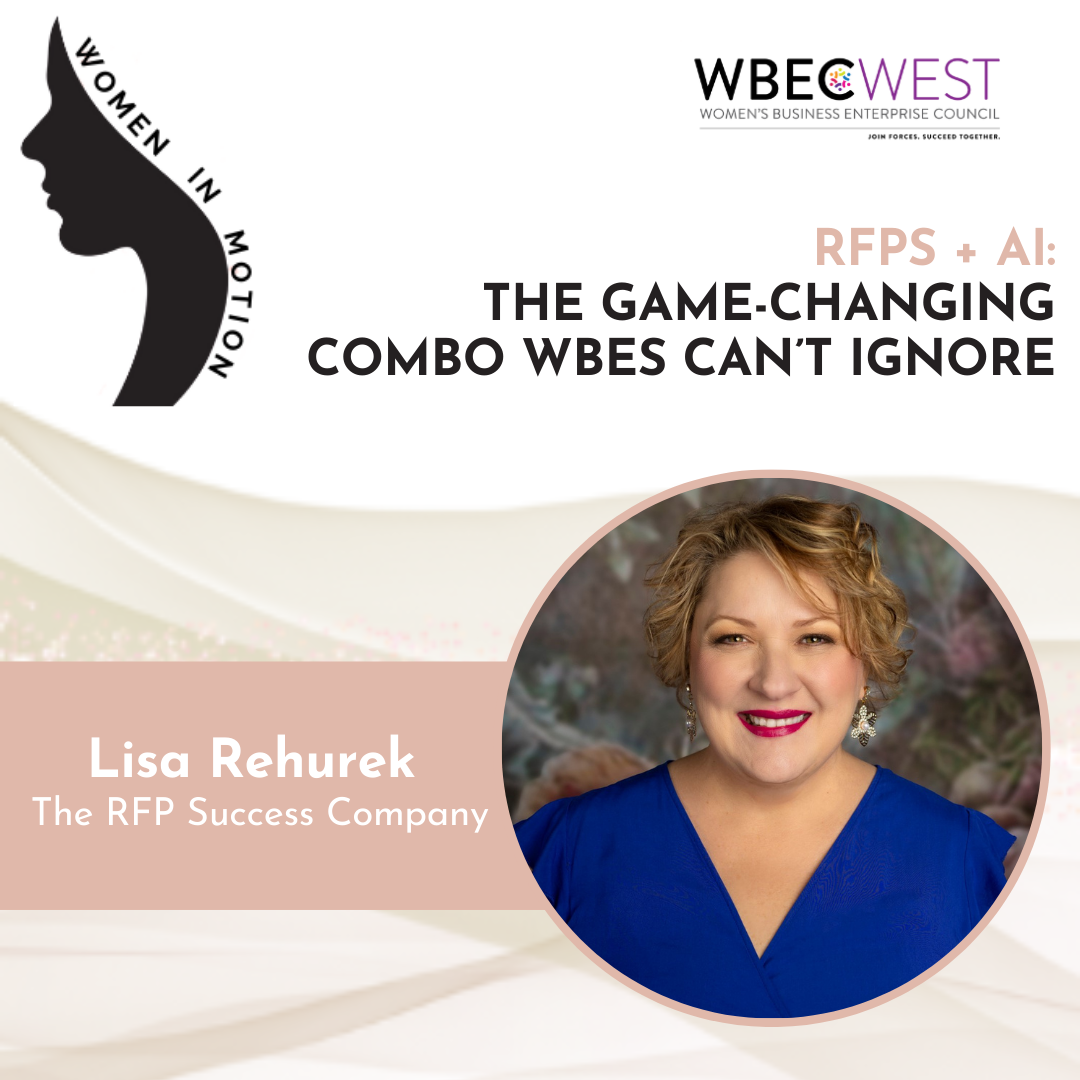

In this episode of Women in Motion, hosts Lee Kantor and Renita Manley speak with Lisa Rehurek of The RFP Success Company about leveraging AI to improve responses to Requests for Proposals (RFPs). Lisa shares practical strategies for small businesses to build authority, customize AI-generated content, and avoid generic language. She highlights the importance of showcasing credentials and thought leadership to establish trust with evaluators. The episode also previews Lisa’s upcoming workshop at the WBEC-West conference, where attendees will learn to create tailored AI tools and strengthen their RFP proposals.
 Lisa Rehurek is the powerhouse CEO of The RFP Success Company and the visionary behind RFP Success Express.
With a 78% win rate and over $500M in client contracts secured, she and her team know what it takes to win state and local government contracts through the RFP process.
The RFP Success® Company specializes in connecting the dots from Capture to Proposal to Results. It’s not enough to focus on the RFP that’s on your radar today; the best companies have a well-rounded culture and mindset that permeates the entire company.
Social Media:
- LinkedIn Personal: Lisa Rehurek | LinkedIn
- LinkedIn RFP Success: https://www.linkedin.com/company/rfpsuccess
- IG Personal: Lisa Rehurek (@lisa_rehurek) • Instagram photos and videos
- IG RFP Success: RFP Success (@rfpsuccess) • Instagram photos and videos
Episode Highlights
- The role of artificial intelligence (AI) in responding to Requests for Proposals (RFPs).
- Challenges faced by smaller businesses in navigating RFP processes.
- Importance of customizing AI-generated content to maintain authenticity.
- Common mistakes in using AI for proposal writing and how to avoid them.
- Strategies for training AI with company-specific data to enhance proposal quality.
- The significance of solution-focused messaging in proposals.
- The evolving landscape of proposal responses due to AI advancements.
- Tips for improving readability and engagement in proposals.
- The value of leveraging past proposals for future success.
- The importance of building trust and authority in proposals for smaller businesses.
Music Provided by M PATH MUSIC
 This transcript is machine transcribed by Sonix
TRANSCRIPT
Intro: Broadcasting live from the Business RadioX studios. It’s time for Women in Motion. Brought to you by WBEC-West. Join forces. Succeed together. Now, here’s your host.
Lee Kantor: Lee Kantor here with Renita Manley. Another episode of Women in Motion. And this is going to be a good one. But before we get started, it’s important to recognize our sponsor, WBEC-West. Without them, we couldn’t be sharing these important stories. Today’s episode is titled RFPs + AI: The Game-Changing Combo WBEs Can’t Ignore. Our guest today is Lisa Rehurek and she is with the RFP Success Company. Welcome, Renita. Welcome, Lisa.
Lisa Rehurek : Thank you.
Renita Manley: It’s nice to have you with us here today, Lisa. So Lisa’s actually going to be joining us at this year’s conference. Big West Conference out in Scottsdale, Arizona. And she has a workshop that she’s presenting all about this topic. So this podcast is kind of like an introduction to that workshop. And in the workshop you can expect Lisa to dive in with way more details. And we’re talking specifically today about your responses to RFPs and how to use AI to make sure your response stands out from the crowd. So, Lisa, can you start off by telling us what made you choose this actual topic for the conference?
Lisa Rehurek : Yeah. You know, um, AI is obviously all the rage right now, right? Everybody’s talking about it. Everybody’s trying to figure out how to use it. And when you think about RFPs and what people struggle with, particularly smaller businesses that might not have a professional team internally, RFPs are hard. They take a lot of time. And so there’s a lot of people right now searching for how to combine those two. How to use AI to respond to RFPs. And frankly, we’re seeing a lot of bad use of AI. So I love this topic because hopefully we can give some tips and tricks here to hopefully help people along and make sure that they’re using it better than they probably are right now.
Lee Kantor: Can you share some do’s and don’ts, like off the top of your head?
Lisa Rehurek : Yeah, absolutely. A lot of times what people do is they just put the question into AI and say, answer this. And then they take it and they copy and paste it. And that’s the end of that’s the end of that. Way too generic. You’ve got to customize it. You’ve got to really know how to work AI to get it to the right place. The evaluators are getting savvy. They know. They know when you’ve been using AI. So you want to customize it. That’s probably the number one red flag with the don’ts. A do is just start training your AI tool to your business. Start making sure that it understands who you are, what you stand for, what authority you have in your topic, things like that.
Lee Kantor: Now, when you say train, does that require me to do a paid version of the AI tool that I’m using?
Lisa Rehurek : Yes, you should always have a paid version. It’s going to be so much better. You’re going to be able to again, kind of get the bot is going to get used to you. It’s going to learn you. But if you have an unpaid version, it doesn’t store any of that information. So you can create a custom GPT. So for example, you could create a custom GPT that says like, here’s all of the authority that we have in the marketplace. Use this to answer any questions that I ask you around RFPs, and it’ll pull that information. But you got to have the paid version.
Lee Kantor: So it keeps kind of all your content there as a resource for the AI so it can help you, um, communicate a little bit better. It doesn’t have to relearn this every single time.
Lisa Rehurek : Exactly. But if you’re the free version, it’s going to have to relearn it, and you’re going to have to retype it in every single time. That’s no fun.
Lee Kantor: And then when you’re working with it, even if you are using the paid version, how important is it to kind of go go back and forth and not just take its first answer as the answer, but to kind of ask it maybe a different way or ask it to help using different language just so that you’re getting kind of a real next level answer rather than kind of the superficial first answer.
Lisa Rehurek : It’s so important. Lee, I’m so glad you brought that up, because and I think what people are doing right now is they’re just taking the first answer and they’re like, oh, this sounds really good. And then they’re dropping it into their proposal. But it you know, the evaluators can tell it’s not perfect. So, you know, what I like to say is if you’re going to go for the first, first round, which is great. I don’t know about you guys, but I hate looking at a blank piece of paper and having to start from scratch. So it’s really great to go into AI and say, hey, I need to answer this question. Give it a little bit of a prompt and see what it gives you, and then go back again. And maybe you say, you know what, I want to integrate a little bit more fun and spunky personality as I have. So add a little bit more of that, then I’ll do another version, and then I’ll say, you know, I’d like an analogy in here, and I don’t have one off the top of my head. What kind of an analogy can we add in here to make this a little bit more compelling? And so you just want to keep working it and keep massaging it. So it does take work still. But I’ll tell you what, it’s so much better than just that blank page where you got to come up with everything yourself.
Lee Kantor: And it’s and it’s using the tool, not like a thesaurus, but more like an executive assistant where you’re, you’re kind of wanting it to, you know, think a little bit and be better and not just give you kind of the surface. You, you want it to kind of get in there and make connections that maybe a human would have trouble with.
Lisa Rehurek : Absolutely. And, you know, again, you know, kind of back to my analogy of analogies, I am horrible at just thinking up an analogy. Like, it just my brain just doesn’t go there. And so it’ll give me and I’ll say like, give me three ideas for an analogy, and then I’ll pull one and and have it keep working it. And it’s unbelievably smart. I mean, it is pretty crazy how good it is already, but it’s not all the way there yet. Right. And so to your point, like it’s gonna it’s gonna pump out stuff better than my brain could, but it’s not quite. It’s just not quite there to be like, hey, this is great. Now I’m just going to copy and paste this. Now I gotta work it a little bit and massage it a little bit, but that shouldn’t take you that much time.
Renita Manley: So how exactly can a we be make sure she’s personalizing her? Um, her response just so she’s not sounding like, um, the next VB or the next small business owner. Pretty much. How can you use words or use AI or use a prompt to help generate responses that are very much so individualized.
Lisa Rehurek : Yeah. So, um, one of the thing well, so you know how I talked about that kind of custom GPT, you want to have something that is in your GPT that is, or whatever one you’re using that is that knows you, right? So the the way that I started was I just went in and I said, I’m going to tell you a whole bunch of stuff about me, and I want you to ask me some questions to clarify anything that you don’t understand. And then I just went in and started kind of brain dumping, like, you know, we’ve been in business for eight years. I have 30 years of RFP experience where, uh, we specialize in the sled space, which stands for State Local Education. I like to be a little bit fun and spunky. Um, we here’s what our brand stands for. So a whole bunch of that stuff. Here’s the authority that we have. Here’s some evidence I just started dropping a whole bunch of stuff in there. Then ChatGPT came back and ask me some clarifying questions and it was great. I remember asking me, do you have any quantifiable statistics that we can include here? And I’m like, oh yes, I have forgot about that. So I added that in. So what’s so great about that is all of those things make us different than anybody else that does what we do. Not just the quantifiable stuff and not just the, um, you know, here’s about our brand, but also kind of the personality of who we are.
Lisa Rehurek : And when you get all of that in there, your answers are going to just be a little bit more. They’re going to be your personality. They’re going to be your brand. And that’s going to stand out above everybody else. There are other things too. So, um, one of the biggest mistakes that we see people make in RFP responses is they are all about them. We help you this, we help you that. But the evaluators don’t really care. And it’s not going to it’s not going to make them lean in and really listen. What they what you need to do is start talking about how your solution is going to help them. It’s that whole classic what’s in it for me? Right. They want to know what’s in it for them. And so when you start crafting things that way and you can say, hey, here’s the answer that I crafted. Can you help me make this more about them, more about how our solution is going to help them flip the switch and think about the Wifm, and it’ll start to help you with that. You’re going to have to massage it, but it’s going to start helping you flip that around. So things like that will make a very, very huge difference.
Renita Manley: How how do you think um, the proposal responses looked before everyone started using ChatGPT and AI and afterwards, like like you’re an evaluator, you’re getting your responses for years, and now you’re like, okay, all right, everybody’s giving me A+ responses now. So how how are how are they how are they differing now.
Lisa Rehurek : So a couple of things, um, I would say that they were much more generic and bland before. So most people just blend it in. And what happens then is the evaluators give you like maybe the meets expectations scores, but you’re kind of average. Now one of two things is happening. We are seeing some better responses. And so you got to up your game because everybody else is upping their game. But we’re also seeing AI responses, which is not making people happy. So there’s some some certain signs em dashes. Ai loves em dashes, they love quotation marks. They love certain words like robust. Take that crap. Pardon my French out of there. Take it out. Because the evaluators know that that came from AI. Um, and it’s, you know, you got to pay attention to that kind of stuff. So in the new world, there’s kind of two things happening. We’re seeing either they’re getting really smart and savvy and everybody’s elevating up. And we’re also seeing kind of a little too much use and reliance on AI.
Renita Manley: Okay. Is that fatigue. Like how does that lead to like evaluation fatigue. Like here we go again with these AI responses. And it’s kind of making. So for using that AI response for a for proposals you want to make sure you one stay solution focused not all about yourself. Try to stay away from some of those AI tall tale signs like the Em dashes, or maybe even just spontaneous, um, bolded words. Every other sentence has a bolded word that seems to be like an AI response. Okay. Uh, what? What’s the best AI program to use for a proposal response?
Lisa Rehurek : You know, honestly, I just use ChatGPT. It’s the one that I started with. I love it because it knows me now, and it. And it’s getting to know me well. We’re actually building an AI tool specifically for proposals. And the back end of that is ChatGPT as well? So I’m a ChatGPT fan, but there are a ton of them out there. And you know, if you have time and inclination, it’s always fun to go out and test different ones for, you know, some of them are free, free trials, things like that, to just play around for with them. But there’s a lot we use ChatGPT again. And then I also have starry AI that I use for some images, and we use Jasper for some other very specific things, but ChatGPT for the main responses.
Lee Kantor: Now I’d like to get back to putting in the data to start with. You mentioned, you know, having it ask you questions and getting kind of a deep dive into, um, you know, the history of the company and all it can do and all that stuff. Is it a good idea to actually input proposals that you’ve done before, like even like, hey, I won this one or I lost this one and actually input that data into the is that useful or is that, you know, is it outdated? Is there value in doing something like that?
Lisa Rehurek : So I have a whole bunch of answers. Um, so I’m going to try to keep track of my. My mind is pinging all over the place to answer this. First of all, um, if it’s a good proposal. Now, if you’ve won the proposal, it doesn’t necessarily mean it was good. It just means that it was better than everybody else’s. So you always want to make sure you get feedback. And if you get feedback that your qualifications scored you really high, then you know that that section is probably something you want to keep and you want to you want to probably put that in and say, hey, this was a winning qualifications. Um, one of the things, again, kind of back to our platform that we’re building is we’re it will have a storage for library content for those kinds of things, um, organize that way. And ChatGPT you’re just going to have to put it in your, uh, your custom GPT to have it in there, um, to use to pull from for future things. So the answer to that is yes. Um, if you’ve lost, you probably don’t want to use that because, you know, and again, if you can get the scoring tools, you might have lost. But maybe again, your executive summary was great and it scored really high. Then you want to pull that in, but you don’t want to pull in the sections that got low scores. Now what you could do is if you’re somebody that really wants to learn is put in, hey, here’s the question and answer that we got scored really low on. Help me understand what I could have done better. And there’s more things you could maybe add to that prompt, but that would get you some learning. And then maybe a revised version of that that you could store.
Lee Kantor: Now what about, um, other proposals in other areas just so that it can learn things that win? Like, is that have any value that it may not be your specific niche, but it’s a winning proposal.
Lisa Rehurek : You know, it’s interesting. I’ve never tried that, Lee, to be honest with you. I’ve never even thought about that. It would be interesting to see how you could do that. The first thing that came to mind is, well, you know, maybe you could take the winning proposal from, from what you bid on and put it in against your proposal and say, hey, you know, give us some some things that we can improve on for the next time. But I don’t know if it would I don’t know how good it would be. I guess you could. Sorry. I’m thinking out loud as I’m thinking through this. I think you could probably put in a winning proposal and say this was a winning proposal. Extract out the top ten things that they did well. Something like that. And just see what it comes back with. For things that maybe you could then take and use in your next proposal. Kind of like a little checklist.
Lee Kantor: Now are there certain, you know, kind of scoring tips that you can share when it comes to this? Are there some things that, oh, you have to do this or don’t do this. Or are there some kind of low hanging fruit in that area?
Lisa Rehurek : Yeah, I mean for sure some of it we’ve already talked about, like if you’re too focused and not solution focused enough, um, there’s there’s some readability things. So, um, you know, there’s a, a standard kind of thought out there that you should be writing to a sixth grade reading level. Most people are writing to 11 or 12th grade and that just the evaluators gloss over it. It’s not dumbing down. It’s making it more simple for them to understand and score you on. So one of the things that I always tell people is you have to think about the fact that these are human beings on the other end of this proposal, right? They are they are scoring you and minimum maybe 2 or 3 others. And up to I mean, we had one the other day with 32 people responded to it. So these evaluators are having to go through this. The more that you can do to make it easy on them. Shorter sentences, less techy talk, right to a sixth grade reading level. Um, tell them what they need to know. And also, for the love of Pete, answer the question. I will tell you that 99% of the RFP responses that we look at somewhere in there.
Lisa Rehurek : They have answered questions that have not really answered the question. And sorry, I’m going off on a tangent here, but that’s another thing that you can use AI for is to do a checks and balances. Here’s the question. Here’s my answer. You know, do a checks and balances to make sure that we’ve answered the question appropriately. And it’ll give you some feedback. So a lot of times in the RFPs they’ll give you multiple questions in one question. And it’s really easy to miss pieces of it. Um, if they ask you for a process, give them a process. Tell them. Step one, step two, step three. Don’t just drop in a massive paragraph. These evaluators are probably tired. This isn’t their full time job. Maybe they’re planning their kid’s birthday party in their heads. I mean, if you lose their attention, that’s what they’re going to be doing. Grocery lists, kids birthday parties. What do we have to do tomorrow to get the kids to school on time? All of those things that swimming around in our heads. So you’ve got to make it compelling for them to lean in and pay attention. Otherwise you’re going to get at best average scores.
Renita Manley: So it sounds like when you say they had to make it compelling, it’s almost like they need to try to connect with that human that’s actually going to be reading their response. So that’s the tricky part when you’re trying to balance how to use AI to leverage your response. But at the same time, you got to figure out how to connect with this human being who may have to cook dinner later on, go to a kid’s soccer game, go grocery shopping, go catch the game at the bar afterwards. They they want that moment of reading the responses to be compelling, to not seem boring like the past five AI responses that I’ve just I just read. So I guess the question. Another. My final question would be is, um, what would be some savvy ways then to use AI without losing that human connection? And then I want you to follow up with, um, explaining to VBS how you plan on building off this podcast episode at your session? At our upcoming conference.
Lisa Rehurek : Yeah, absolutely. So, you know, one of the things that I think when I was an evaluator I appreciated was personality. So kind of back to what I was talking about before. Get your personality in there. And everybody’s so scared to do it. They’re so buttoned up because the RFP itself is so buttoned up. It’s like let loose and put some personality in there and maybe, you know, whatever your personality and your culture of your business is, inject it in there because that will the the they will appreciate it. Also storytelling and analogies and metaphors, those are things that they remember more. And remembering is going to help them absorb. One more thing I want to tell you is that 78%, 78% of people are skimmers of readers or skimmers, which means that if you’ve got a massive paragraph, they’re probably not going to read it. 78% of the evaluators are not going to read it. So what can you do to, like, hit on those those important points right out of the gate on the front end. That’s about them and how they’re going to be able to trust you and be excited to work with you. We’ve all seen it in marketing, right? It draws us in and we’re like, oh my God, I have to have that.
Lisa Rehurek : I have to have it now. That’s what that’s kind of the same feel that we want them to have. So, um, did that answer that question, Renita? Okay, great. Um, so then for the event, you know, we’re going to dive deeper into this and we’re going to have some activities so that you are building we’re going to have you build a custom GPT. We’re going to talk a little bit about, um, authority and evidence and building those things. One of the hardest things for smaller businesses is that and a lot of us, we are smaller businesses, not all, but um, and this stays true for everybody, but particularly smaller businesses is that you’ve got to build trust. They’ve got to believe that, that you’re not going to go out of business or that you’re not going to ghost them. There’s more trust with a bigger company. So it’s a little bit of a hurdle that those smaller companies have to to come over. So we want to make sure that you’ve got the authority, you’re showing your thought leadership, you’re showing them that you are the one. And we’re going to dive into that at the conference.
Lee Kantor: Now, is there any pre-work or homework you would like them to do in order to prepare in order to get the most out of the session?
Lisa Rehurek : You know, I think it would be great if they just came with kind of understanding what, you know, making sure that they come with their list of authority. And when I say authority, it’s things like, you know, have you won awards? Have you been quoted in media? Have you? What’s your customer service scores? Things like that. Obviously we’re not going to get everybody to do that because I don’t know how many people are listening to this that are going to actually be there, but it will help you go faster if you bring some of that stuff with you.
Lee Kantor: And then what would be kind of a a reasonable expectation of what they’re going to walk away with at the end of the session?
Lisa Rehurek : I would say that they’ll walk away with a custom GPT. And whether what I don’t know right now is if we’re going to all have Wi-Fi access. Um, so they might have to to do it manually and then go put it into ChatGPT or their system afterwards. Um, and then they’ll also walk out with, you know, some good thought leadership statements that they can use, that they can plug and play into proposals as well as their evidence and authority to build that trust.
Lee Kantor: And if somebody wants to learn more about the RFP success Company, is there a website? Is there a best way to connect with you or somebody on your team?
Lisa Rehurek : Yeah, absolutely. I mean, you can always go to our website, the RFP success Company.com. Um, I’d love for people to connect with me on LinkedIn. I’m just Lisa r e h u r e k I’m the only one. Um, and yeah, I’d love to connect with anybody, uh, that that wants to connect. And we, we do a lot of, um, we do a lot of blogs and we do a lot of free information and webinars and things like that to help teach people. So the website’s a great place to start for that.
Lee Kantor: And Renita, one more time, the coordinates of the event.
Renita Manley: Yes, it is December 16th through the 18th in Scottsdale, Arizona. So if you have not purchased your tickets to attend, make sure you do so immediately because it is going to be fantastic. I’m actually going to be there this year and I’m excited about that. So I get to meet some weebs. But yeah, um, come on out. Get ready. Um, make sure you have your pen and pad and everything together. So if you go to Lisa’s workshop, you are ready the next time it comes around for you.
Lisa Rehurek : Yeah. And I’ll also do a quick little plug. I’ve been going to this conference for years. It’s so phenomenal, you guys. I mean, obviously the content itself, but also just connecting with other women, business, enterprise, women, it’s a community that supports it’s just been such a phenomenal community and we need that in our lives. So I hope to see you there.
Renita Manley: Thank you, thank you. Yeah. In an RFP game is growing and changing rapidly. So I really do suggest you all, um, come on to the conference and come to these RFP workshops, because from what I’m seeing, it is the change is lightning fast. And evaluators are very savvy and so are corporations and companies needs. They’re very savvy. Things are changing. Local, local, local. You gotta come out and get all those other tips.
Lisa Rehurek : Yes.
Lee Kantor: Well.
Renita Manley: For me, Lee.
Lee Kantor: All right. Well, Lisa, thank you so much for sharing your story today. You’re doing such important work, and we appreciate you.
Lisa Rehurek : Thank you.
Lee Kantor: All right. This is Lee Kantor for Renita Manley. We’ll see you all next time on Women in Motion.














