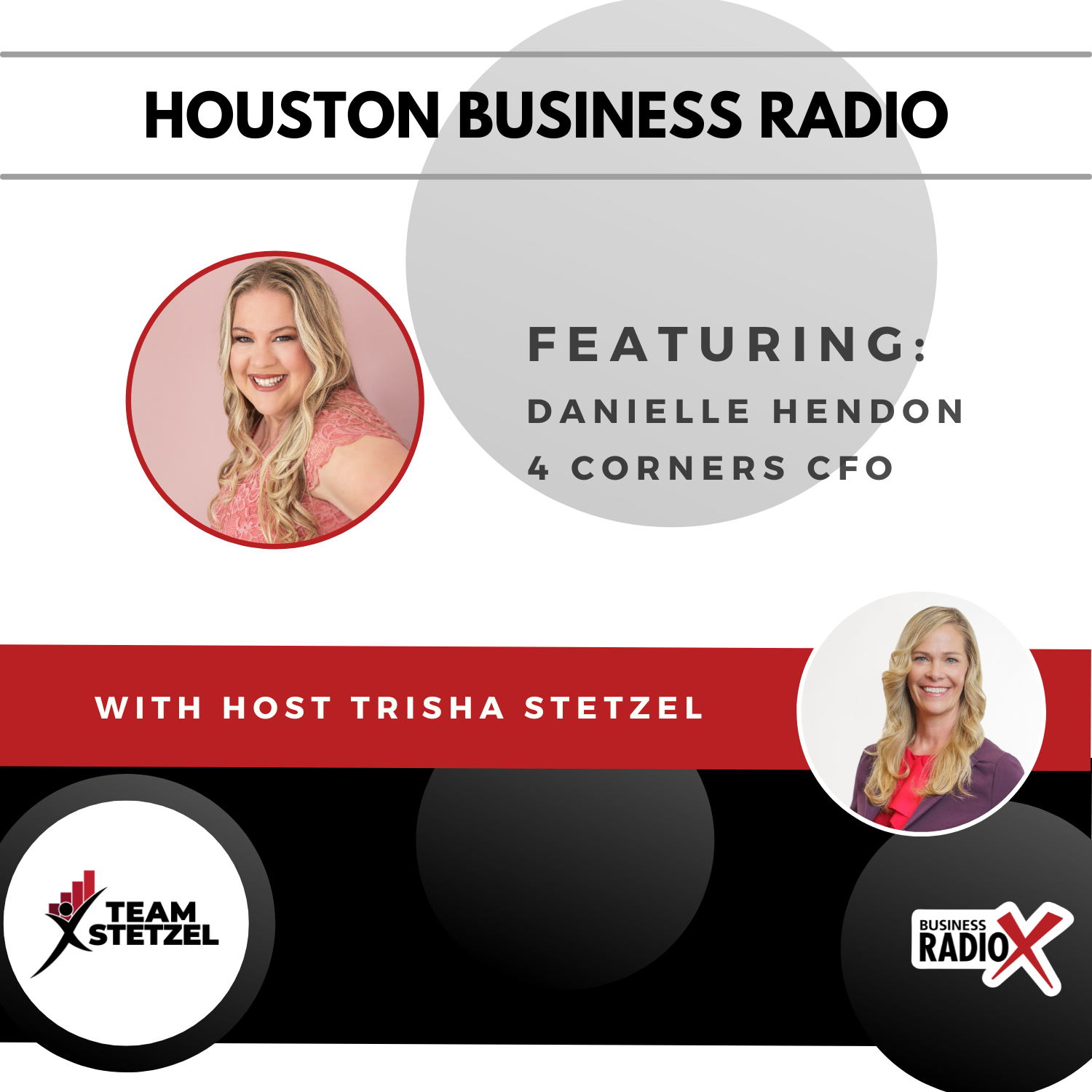

 Danielle Hendon is a dedicated wife, mom, and the founder of 4 Corners CFO. With over a decade of corporate finance and accounting experience and CPA certification, Danielle specializes in helping small business owners understand their numbers, grow their profits, and pay themselves what they’re worth.
Her mission is to empower business owners to make confident, intentional financial decisions by breaking down complex financial concepts into actionable strategies. Danielle combines her love for numbers with a genuine passion for people, making a meaningful impact on livelihoods and legacies.
Inspired by her experience navigating corporate closures, Danielle now focuses on transforming businesses from burnout to balance, helping entrepreneurs focus on their joy and purpose while building sustainable profitability. 
Connect with Danielle on Instagram and follow 4 Corners CFO on Facebook.
 This transcript is machine transcribed by Sonix.
TRANSCRIPT
Intro: Broadcasting live from the Business RadioX studios in Houston, Texas. It’s time for Houston Business Radio. Now, here’s your host.
Trisha Stetzel: Hello, Houston. Trisha Stetzel here bringing you another episode of Houston Business Radio. I am stoked about my guest today, Danielle Hendon, who has been a friend, a client, a partner, a collaborator for several years now. And as a matter of fact, we spent a whole lot of time talking before we even hit the record button. I’m stoked to have her here from 4 Corners CFO, Danielle Hendon. Welcome to the show.
Danielle Hendon: Thank you so much for having me, Trisha. I love any chance I can at least get somebody to think about numbers, because they’re not as bad as we all think they could be. Right.
Trisha Stetzel: And one of the reasons why you and I engage so many years ago is because I have so many clients that just bury their head in the sand. They’re so afraid of the numbers, they don’t even want to look at them, which is what gets us in trouble. And on the back end. Right. Or even on the front end for that matter. So it’s something that we have to do. And what I love about what you bring to the table, Danielle, is just the simplicity behind how you teach your clients, or even help your clients do what they do around their numbers. So before we dive into all of that fun stuff, the numbers, would you just do a quick intro? Where you been, what you’re doing, what your business looks like, and who you’re looking to meet?
Danielle Hendon: Absolutely. I actually I love to start off by telling people I went to college to be a music major. I thought I was going to make a living as an opera singer and, um, no. I learned very quickly that I don’t have friends in high places, and I was going to be broke and needed to figure out a out a better way to actually foot the bill for living life. Um. I did, however, have friends in the accounting school at the University of Houston, and I tried it. Loved it. Stuck with it. Got my degree in accounting, and did like all of us do, and went into public public accounting on the other side of it. But like most people, when you work 60 hour work weeks and you have a baby at home, it tends to create a little bit of conflict. And I didn’t want to maintain that pace with a newborn. So after having kids, I decided to leave public and go into industry, which being in the Houston area meant I landed in oil and gas. That’s where all my experience was. It’s what I loved doing. It’s the people I loved working with. That being said, I was there for over a decade when oil prices tanked. And we’ve all, we all, anybody who’s in or around the Houston area knows the price of oil dictates everything. Um, and when they did tank, they ended up going through bankruptcy, which was a unique experience and not something I ever would have wished for.
Danielle Hendon: But hindsight being 2020, it gave me a lot of tools and a lot of flexibility and adaptability that has actually allowed me to create the business that I have today. So as they were downsizing from this billion dollar business to, I’m going to be honest, closing their doors, I was running the audit department, getting the phone call saying, look, I’ve got two people left. How do you want me to do this? Because I can’t do it the way we were. And we were constantly changing processes and procedures on the accounting and finance side of things, so that we could keep meeting our standards and our covering our risks, which was my job as the audit supervisor to make sure that we were doing. So all of that being said, they did finally close closed their doors, um, right in the middle of the pandemic. So I had what I will say is a unique opportunity. Oil and gas takes care of its people. And I was not left high and dry, but I was left unsure of what the future could hold while also having this eye opening experience. And I don’t want to take away from anything that people have struggled with because of the pandemic or the pain that people went through and the suffering that happened. But I think all of us experienced a silver lining in the sense that life slowed down. It had to. It was so much slower than the pace of normal American business, and for me, that meant getting a completely different perspective of parenting.
Danielle Hendon: I had two kids home at the time, and I became make sure they’re on their calls for school, and I know what they’re doing and how can I help them do it. And figuring out swim when or when it was or wasn’t still happening, and getting to know the parents and the friends and the coaches and the teachers in a way that I had not done before. We were honestly looking for a nanny before all of this happened, because I was like, throw somebody else at it. But I realized I didn’t want to throw somebody else at it. I wanted to get to do it. So taking a big step back in life, I was like, what? What can I do that allows me to do what I love and be there for the people that I love? And I love numbers. I know that sounds totally cheesy, but like, I can geek out over some spreadsheets and some numbers and strategy and it just makes my day. I also love being with my family, and I don’t want to be working ridiculous hours or driving two hours back and forth downtown. So I started Four Corners CFO to help other small business owners take control of their numbers and really understand the story that the that the numbers are telling. Because when you realize your numbers are just like any other language and they tell a story, you get to help write that story going forward.
Trisha Stetzel: Oh my gosh, I love that so much. And you know, opera singer accountant I don’t know. I don’t know. I’m just I’m not sure about that one. I thank you for telling the backstory. You’re so much fun to be around because you have such a diverse background and you do love numbers, unlike many of us, right? And the simplicity that you bring to the table. So I’m thinking about pulling out the one word because a lot of people are talking about their one word this year, and you happen to share yours with me, which I think is very interesting. So would you share your one word and what that really means to you and your business, and how you might share that with others?
Danielle Hendon: Yeah, so I know, thinking back through the four years now that I’ve been in In business, we’ve gone through slowdowns with Covid to burnout. On the other side, when life got back to normal, too. I don’t think life’s ever going to get back to normal, and we all just sort of feel in this overwhelmed state. And I say all because so many of my clients are going through something similar. And it brought me to the word homeostasis because balance doesn’t cover it. And sometimes there isn’t balance. A lot of times we have no control over what’s going to happen in the future, but we can set up systems, whether that’s people or technology or coaches or whatever it is, that help bring us homeostasis between the business and our personal life.
Trisha Stetzel: I love that. So where as as I’m thinking about I don’t like numbers or I know people who don’t like numbers. Well, really, I don’t like numbers. Uh, where do we start? Where? How do we start to build this homeostasis in our lives. Because you’re right. I mean, honestly. So. Yes. Oh my gosh. It’s slowed down in 2020. And it was amazing. And now we’re going ten times faster than we were before we even went into the shutdown in 2020. So people are running themselves ragged ragged. How do you see homeostasis happening? Where do we start as business owners?
Danielle Hendon: This is going to sound totally cheesy, but you’ll get it. As a coach, it really starts with understanding why you are in business. I have had and I’m almost positive you’ve said this to me at some point, but I’ve had multiple, multiple people say this to me in the sense that I very quickly went from working my butt off in a corporate environment to working my butt off for myself, and that makes no sense. Like why I built this to not work my butt off. So asking yourself why you’re doing this. And a good friend of mine was actually like, if you’re just going to keep working your butt off, take away the anxiety of running a business and go do it in corporate. Like, if you’re not building a business that’s working for you because you’re working for it, what are you in this for?
Speaker4: Mhm.
Trisha Stetzel: Yeah, absolutely. So ask yourself why. Why am I in this business. What was the passion that I had before I started. Before I named the baby right. I had this passion for this business. So now I found that passion again. And I really want to make 2025 the best year yet. What do I do now?
Danielle Hendon: You define that. What is the best year yet? Means so many different things to people. I will tell you for me, because I know that I’ve been working my butt off homeostasis. The best year yet means my team doesn’t need me this year. And I’ve actually told them I could care less if we add any additional clients or revenue this year. I want everybody functioning fully efficient, doing what they need to do, and they don’t need me. That would be my best year yet. But for some people and some very good friends of mine, that best year yet means we ten-x revenue or the best year yet might be doubling revenue. You need to know what you need from your business and what the best year yet means to you personally, and translate that to what the business needs to do to serve it.
Trisha Stetzel: Yeah, I love that. Okay, so let’s talk numbers. I know everyone’s favorite subject. No, wait. It’s Danielle’s favorite subject.
Danielle Hendon: It is, I love it.
Trisha Stetzel: So, uh, a lot many business owners get into business. They don’t know the numbers. They don’t understand them. They’re afraid of them. They don’t look at them. The only time that we’re looking at numbers is when we send our books, which may or may not be done right over to our CPA, uh, April 14th, hoping that they that they might actually, you know, file on time or just file an extension and then do them in October. Right. So, hey, give me an extension. I’ll just get it done in October. Well, by the time we get to October, we’ve already lost a whole nother nine months worth of data moving into the next year. So we’re so far behind because we’re not even looking at the numbers. So for those that are just completely terrified of looking at the numbers, besides that terrible number that they see in the bank account every time they go and look at it, right, to see if they can write the next check. Where do we start?
Danielle Hendon: Now is the perfect time, because while you do have until April to file, your bookkeeping should be wrapping up right now for multiple reasons. First of all, you need to make sure everything’s booked and you know who you’ve paid and who paid you because 1090 nines are due in January. That doesn’t wait until April. So if for no other reason than to make sure you’ve got everything booked and you send off all the 1099, you need to be looking at your books this month. But also because I want you to look at last year and see how you did without judging yourself for it. No preconceived expectations. No. I wish we had this. You probably went into last year with a goal, but if you’ve never really looked at your numbers, that goal came from where? So take all that away and go look at last year’s. I want you to look at three things. I want you to look at your revenue. I want you to look at what is called your gross profit. So revenue minus cost of goods sold. When you look at a PNL, a profit and loss and income statement, whichever word meshes better with you, when you go look at that statement. You’re going to see revenue. You’re going to see a section for cost of goods sold. And then you’re going to see they’ll either call it net revenue gross profit. Something along those lines. I want you to know the overall revenue number for the year. I want you to know that gross profit number for the year. And then I want you to go all the way down, and you’re going to see a number that should likely say net income. And I want you to look at that number. The reason these three numbers matter revenue is what you sold.
Danielle Hendon: And I bet most of you have a pretty good handle on what that number probably looks like. A lot of people know their sales cost of goods sold, which then factors into your gross profit is all of those revenue generating costs. And if you are a service based business owner listening to this and you have zero there, I want you to go back and talk to your bookkeeper, because you and the people serving your clients in your business are a cost of goods sold. You need to know your profit margin. And then at the end of the day, what’s actually going to get left in your bank account is down on that net income line at the very bottom. I want you to know what those three numbers are. And then I want you to think, how did you feel about the year? Did 2024 feel like a gangbuster year for you? Did it feel weird? And I’m going to be honest, for a lot of my clients, 2024 felt weird. Election years are weird, and people have concerns that may have absolutely nothing to do with your business or what you do in business, but it will still keep them from spending money with your business. So think about what kind of year 2024 was for you, and what kind of year you want 2025 to be back to that, like where we were in the beginning. What do you want out of 2025? And reflecting on those numbers that you had for had for 2024. We’re not going to get super technical. We’re not going to even go look at monthlies or talk about budgets or all the other things we could do. I want you to have a goal for your revenue, your profit and your net income for 2025.
Speaker4: That’s so simple.
Trisha Stetzel: That’s why I love you. I’m so glad you’re here. Um, so I’m I’m. I’m thinking about how simple this is, and I’m thinking that there are still people out there like, oh, my gosh, way too technical. I’m not sure. I don’t know where to. I’m not I don’t even know what an income statement is. And what did she say? A p and a what? Uh, you know, so can you just real quick, wait before we go there, Danielle, if people are already interested and they want to find you, how do they find you right now?
Danielle Hendon: Best way to find me is going to be my website, which is the number four, not the word the number four corners cfo.com. And we will have a separate landing page just for you guys. And it’ll be Houston Biz Radio.
Trisha Stetzel: Freaking cool. Thank you so much I appreciate that. All right. So, um, back to my question. I think there are a lot of people who maybe confuse Danielle between the bookkeeper. And the CPA and what Danielle does. So can you explain at a high level, really, the difference between what you’re doing for business owners and what their CPA is doing for them already?
Danielle Hendon: I’m going to give a traditional accounting answer which says it depends because everyone’s a little different. But I will give you sort of the buckets that things sit in your bookkeeper normally, if all they’re doing is bookkeeping, is categorizing the activity that happens in your bank statement and on your credit cards. They’re categorizing the past of what you have already done in your business so that it can be reported on in those financial statements we talked about. Generally, a CPA, if they are tax focused, is helping you file your tax returns. Making sure you make any estimated payments throughout the year. And I hope if you’ve got a good one, they’re helping you strategize every quarter to spend as little money as possible in taxes. Occasionally you will see some mesh between bookkeepers and CPAs, just like you will see some crossover between bookkeepers, CPAs, and CFOs. There are three different types of CFOs you might experience. One is the let me go get funding CFO. You just got started. You’re looking for venture capital, equity loans. You’re looking for funding to get going. That is a very specific type of person that knows how to work that banking environment to help you get funding. There are also going to be what I would call project based CFOs as a company gets larger and they might need to go through an IPO. So they they want to go public or they need to go through different audit mechanisms for whatever their nonprofit requires.
Danielle Hendon: They might hire a CFO for a very project oriented process, or even implementing a new CRM or a new accounting system might take somebody to come in and do that accounting piece with you. Then you have CFOs that work very similar to how we do it for corners, and that is your operational CFO. They’re like your day to day accounting best friend. That’s going to be like, hey, what are we doing now? Oh yeah. This is this is what the numbers say. I think this will work. One of my favorite things to do with clients, from an operational CFO perspective is when they get the bright idea, because our entrepreneurs are often visionaries, when they have a bright idea and they’re like, oh my gosh, I’m going to go spend $4,000 on this thing because it’s going to be amazing and we’re going to do X, Y, and Z and wait, but how do I do that? And a lot of times people will reach out to a bookkeeper, accountant, CFO and say, can I, can I go do this thing? Can we afford to? And my response is always going to be, you can afford to do what you need to do in your business. You can always afford to. But what are we willing to sacrifice to get there? And how do we make sure you get an ROI, a return on investment on the other side of it?
Trisha Stetzel: Again, so simple. Right? Um, so let’s circle back to homeostasis. You know what you want in your business. You have a lot of I’ll call them products and services in your business that you can offer to other business owners. So if they too want to embrace the word homeostasis. What tools do you have to help them get started in that direction?
Danielle Hendon: In order to achieve homeostasis, you have to have systems, processes and people. And we embrace that by offering clients a variety of ways to learn your numbers. We know that not everybody can afford somebody else to do it for them. I’m going to be entirely honest when I tell you this. You are not going to want to be in your numbers. And I very rarely tell people we have a course because you’re not going to want to do it. But if you are really wanting to understand how to tell the story in your numbers, we do have a DIY course where it will walk you through all of our six part framework, as if you were doing it with us in a course format so that you know how to be your own CFO. By the time you finish it, you’re going to want to hire somebody. I’m just going to tell you that right now. But it’s a it’s a balance between time or money. And depending where you are in the business right now, it may not be the best move for you. If you are just getting started and just starting to look at your numbers. The first thing you want to do is make sure you’ve got a good bookkeeper. You’ve probably already made sure somebody’s filing your taxes, whether they’re strategic or not. That’s happening.
Danielle Hendon: I hope you’ve got you need to make sure you’ve got a good bookkeeper, because they’re just saying and I’m sure it applies in other industries, but especially in accounting, we always say garbage in and is garbage out. If you’ve got bad numbers going into that, you’re going to have bad numbers coming out in the reports and you’re going to make bad decisions. So a good bookkeeper is absolutely necessary. And our course is not meant to teach bookkeeping or how to use QuickBooks or any of that. We’re assuming that you’ve got someone on your team, but if you want to know how to tell the story that your numbers are, understand the Understand the story your numbers are telling. This course will walk you through how to dig in and build a budget and analyze your revenue. And what are your profit margins, and how can I cut my expenses and all of those things that help get you to that goal that we talked about. Now, if you’re listening to this and you’re like, there’s no way, no way I am going to do this for myself. Then we offered two other options. One is a VIP day where we will do it with you, and a very long six hours of finances. A lot to go through, but we will record it. We’ll do it with you.
Danielle Hendon: We will sit down and get through it together. And then we will follow up with you to make sure that you’re maintaining it. And we’ll do some quarterly strategy calls. Last but not least, if you’re like, I don’t want to touch it and I can afford not to touch it, and I’ve built a business so that I don’t have to touch it. You’re probably also thinking, what do I need this for? Because I’ve built a business without ever looking at it. I promise you, you need to look before you need to look because it’s really painful if you wait until you need it. That being said, getting someone on board to help you look, we do a done with you in the sense that we do all the numbers, but you make all the decisions, you have all the know, you have all the information to make that next best decision. And we do that in a done for you, done with you format along with the people, which is the next thing I’m going to mention. And this is a an offering. We are actually not yet launched but is in the works. So I’m going to tell you guys about it. We are working on our clockwork certification, which will help us help you work yourself out of the business and run a business like clockwork.
Trisha Stetzel: I love that. Oh my gosh, such a wealth of knowledge you guys! Danielle brings big corporate knowledge and all of the things that she’s done over the past decade or so to small businesses. What a special treat. I’m so excited to have you on today. All right, before we leave, we’ve been reflecting on the past. We’re moving into 2025. Do you have a favorite client story from last year? Something that you can tell us about?
Danielle Hendon: Oh my gosh, I just got an email that lit me up actually just this week. We have a client and this is to show you guys you don’t have to have somebody else do it. You really can if you’re committed to it. Do this yourself and the course and the VIP day and all of those things work if you work them. So I met with this client for the very first time for a VIP day three years ago, and she had just broke into the six figures, wanted to get more into her numbers. We meet on a quarterly cadence just to see how things are going, and when we met in Q4, she was a little bummed. Like a lot of our clients have been, 2024 was not the easiest year for a lot of people. And she just felt like, why? Why are we doing this? Why? Why are we working so hard? I’m not paying myself enough. You know all the things. She sent me an email and said, thank you for making me look at my numbers. I just compared the last four years and guys, she grew by 50% from the first time I met her to her 2023 number. And that 2024 number that she was so afraid to look at was just as good as 2023. It’s not as bad as you think it’s going to be in your head, and what your bank account shows you is not always true.
Trisha Stetzel: That does not tell the story. It does not by far. Thank you for sharing that. I’m so glad you came on with me today. Uh, would love to have you back after tax season so we can talk maybe in the middle of the year and talk more about strategy for the back half of 2025. I think that would be a ton of fun. Uh, anything that you’d like to leave our listeners with today?
Danielle Hendon: I’m going to make you laugh, Trisha, because, you know, I can’t go on one of these and not talk about how important it is to pay yourself. So when it comes to homeostasis, when it comes to burnout, one of the biggest reasons business owners quit is because we quit because we’re burnt out. And if you are not paying yourself, I don’t care how well the business is doing, you’re going to go out of business. And I get it. I serve from a heart centered passion place, and you want to help all the people you can. But if you can’t stay in business, if you can’t pay your personal bills, you can’t help anybody. So make sure that you are putting your profit first. And I’m going to tag that one. Who? Mike Michalowicz is a huge, huge book author that I love. Um, he’s also the author of clockwork. But if you have not read profit first. If you are not putting your profit first, practice putting aside just 1% of your revenue and paying yourself first. It will make a world of difference in your business.
Speaker4: I love that.
Trisha Stetzel: All right. Tell folks how they can find you one more time.
Danielle Hendon: The number four corners cfo.com/houston biz radio.
Trisha Stetzel: Awesome. Thanks so much Danielle for being on with me today. This is amazing. What a great way to kick off 2025. Thanks again for being with me.
Danielle Hendon: Thanks, Trisha.
Trisha Stetzel: That’s all the time we have for today’s show. Join us next time for another exciting episode of Houston Business Radio. Until then, stay tuned, stay inspired, and keep thriving in the Houston business community.














