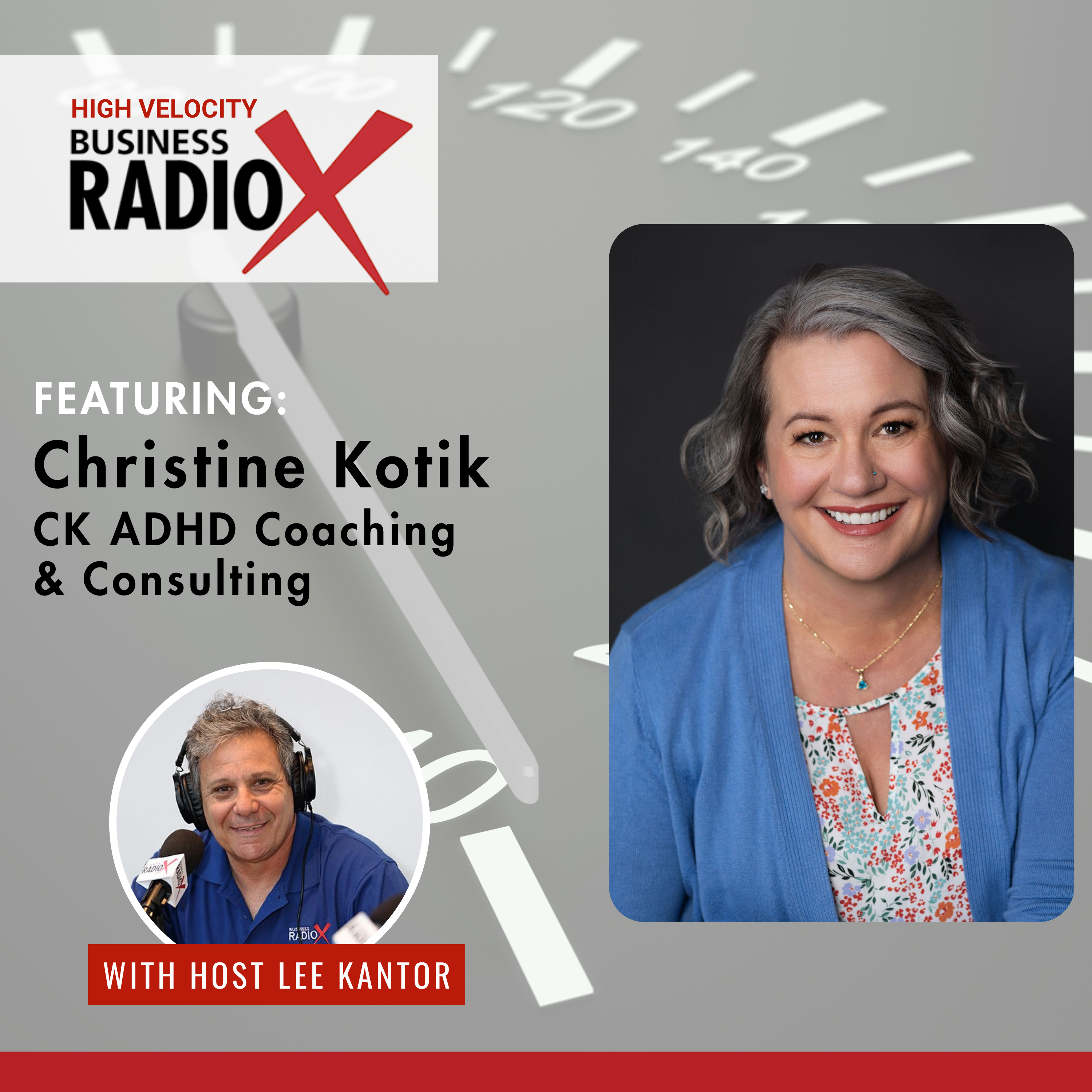

In this episode of High Velocity Radio, Lee Kantor interviews Christine Kotik,who believes success begins with identifying a better way—and sharing it. Drawing from her own experience living with ADHD, she understands the gap between potential and performance, and the transformation that occurs when individuals discover strategies that truly work for them. As an ADHD & Executive Function Coach, Speaker, and Trainer, Christine brings both expertise and lived insight to her work, helping adults, college students, and organizations rethink productivity and develop practical, sustainable systems tailored to the ADHD brain. Her mission is to empower people to work more effectively, build confidence, and thrive on their own terms.

 Christine Kotik believes success happens when we find a better way—and then share it. That’s been the through-line of her work and her life.
As someone who lives with ADHD, she knows what it’s like to feel capable and smart, yet still struggle to follow through, manage time, and meet expectations. She has felt the frustration of knowing she could do more—if only she could find a way that worked for her. And she’s experienced the transformation that comes from discovering that “better way” and using it to build a life she loves.
Today, as an ADHD & Executive Function Coach, Speaker, and Trainer, she helps others do the same. She challenges the status quo about what productivity “should” look like and helps people think differently—about their time, their energy, and themselves.
She works with adults, college students, and organizations, creating practical, customized strategies that work with the ADHD brain, not against it. Her approach combines professional expertise with lived experience, offering both the know-how and the understanding to create lasting change.
No matter the setting, Christine’s goal is the same: to help people work smarter, build confidence, and thrive—on their own terms.
Connect with Christine on LinkedIn and Facebook.
What You’ll Learn In This Episode
- ADHD in adults and students
- Running a business with ADHD
 This transcript is machine transcribed by Sonix.
TRANSCRIPT
Intro: Broadcasting live from the Business RadioX studios in Atlanta, Georgia. It’s time for High Velocity Radio.
Lee Kantor: Lee Kantor here. Another episode of High Velocity Radio, and this is going to be a good one. Today on the show we have owner ADHD coach with CKADHD Coaching and Consulting, Christine Kotik. Welcome.
Christine Kotik: Hi. Welcome. Thanks, Lee. I’m happy to be here.
Lee Kantor: Well, I’m excited to learn what you’re up to. Tell us about your coaching practice. How you serving folks?
Christine Kotik: Sure. So, um, I’m an ADHD coach and I’ve been doing this for ten years. I work with individuals from about middle school, so maybe around like 11, 12, 13 all the way up to my oldest client was in her 80s. So I work with them one on one. I also go into schools and help parents and teachers and go into companies to help them work better with their employees with ADHD.
Lee Kantor: So before we get too far into things, can you share a little bit kind of a macro view of ADHD and what it is, and then why someone would need a coach to help them?
Christine Kotik: Sure. So I feel like anymore like the idea of ADHD has exploded from when I started coaching ten years ago, it was still a lot more of like a quiet, um, stigma involved, um, disorder. And it has grown so much. I think Covid allowed a lot of people to gain a new understanding of what their students with ADHD were going through. And, um, there are currently, because of the increased understanding and the increased attention to it, a lot of adults being diagnosed later in life with ADHD. So oftentimes people think of ADHD as, you know, the the young boys in school who can’t pay attention, can’t sit still, can’t focus, and maybe are always getting into trouble. And what we know now is that is part of it. But that’s not all of it. That’s not true. That’s not you know, what ADHD really is. And so ADHD is a difficulty regulating your focus. So not lack of focus but regulating the focus that you have I liken it to being like a floodlight. And the problem is we’re getting all the things and we can’t always train it in on what we want it to. And then sometimes it does and we become hyper focused and we forget about the other things.
Christine Kotik: So that’s one piece of it. It’s also challenges with executive function and also with emotional regulation. So it’s pretty complex. If you know one person with ADHD you basically know one person with ADHD because it could look different in somebody else. So, um, I think there’s a lot of of false information out there, but there’s a lot of good organizations that are putting out good information about ADHD and why someone would want to work with a coach. Um, is generally because, um, coaching is a I don’t want to call it necessarily a treatment modality, but it is one way that helps people with ADHD understand. So get some psychoeducation understand what’s going on with their brain, and then coaching helps bring out what do we do now? Like, I know these things. I know these things about myself. I get what I’m doing and all of that, but I want to do it differently and so coaches can come in, help gain that understanding and then help push people into, um, into different ways of thinking and different ways of doing things that allow them to have that growth and success that they’re looking for.
Lee Kantor: Now, earlier you mentioned like three, I guess, uh, groups of folks that are that you deal with the younger folks kind of, uh, I guess the older, younger folks and then the then the adults. Um, yeah. Does it present itself differently to each of those groups, or is it kind of once? Uh, it is what it is at, at either at any stage.
Christine Kotik: Yeah. Yeah, that’s a great question. So, uh, it does it does present itself a little differently. Um, you know, I think as in younger and younger people. So children, adolescents, there’s a lot of outward, um, a lot what people notice more. Let me put it that way. What people notice are the outward signs of ADHD. That excessive energy. Talking fast. Um, you’ll notice I haven’t grown out of that. So I still talk fast. But that talking fast, that kind of moving around constant energy, maybe struggling to control behaviors, those sort of things, those are often what people see in younger folks as people get older. Like we learn coping mechanisms, right? We learn how to deal with some of those things. Some things are positive ways of dealing with it. Some are not so positive ways. So, um, I always say like the things that I work with, um, on my older adults, my more wiser, wiser adults, it they’re the same issues. It’s just the environment changes. Right. So now I still might struggle. You know, a young person in school might struggle with procrastination, and it affects their ability to be successful in getting their schoolwork done and all that. But as people get older now, it’s procrastination in work situations and it’s Fascination in, um, home situations. Um, so I think it just those things are the same. It’s just the severity ebbs and flows. A lot of times people in transition found that they had things that were working for their brains and that they were able to, you know, kind of get things done like they wanted to and be the person they wanted to be. And then there’s some sort of life transition, could be a new job, could be a a Covid shutdown that now has them working from home instead of in an office. And so now those tools and skills and things that they put in don’t work the same anymore. And that’s where those ADHD symptoms start popping up again. So they’re always there that they just kind of morph and change. Um, throughout the lifespan.
Lee Kantor: Now um, is ADHD, um, is it kind of neutral or, or like or is it some of it like a Super power or some of it, you know, frustrating. And then you gotta, you know, cope with it like, or just is it just something and then it’s just you got to figure out how to, to make it work for yourself.
Christine Kotik: Yeah. Um yes yes yes and yes. So to answer all those. Right. So there are, there are people, I mean ADHD, some of the, the symptoms of ADHD, for instance, since we use hyper focus and that’s that. So as a as a parent. Parents are looking at their kids and saying my child can play video games and get to all these levels for hours and hours and hours, but I can’t get them to sit and do their homework. Right. So ADHD is is interest based. So interest in video games is huge. And I can hyper focus in that. Like that’s a that could be a negative because I’m not focusing on what is expected of me at the time, which is, you know, homework and schoolwork. But I can hyper focus on a game. You take that same hyper focus and move that to somebody in their career, and they are maybe an engineer and they have a project that they’re working on. They might go into hyper focus on that project because that’s I mean, high interest. It’s novel. It’s just the right amount of challenge. And they can’t wait to jump in and get involved in it. So that’s a superpower to be able to do that. Um, but they might be then neglecting all the little things outside of there. So while they’re hyperfocusing, they’re missing out on the focus on maybe paying bills and remembering to pick a child up from daycare at the end of the night because they’re so focused. So like the things that are strengths, they it just has to be managed well so that you can also pull out the things that make you, um, that give it make it a challenge, if that makes sense.
Christine Kotik: So there’s all those pieces of it. And what also happens is sometimes the pieces that make people great, um, oftentimes folks with ADHD are great in a crisis because they have that that ability to be fast thinking and calm in a crisis. They are creative thinkers. They’re out of the box thinkers. Um, they’re so as an employee, that can be amazing. But if they’re also experiencing a lack of executive functioning skills that are helpful in a workplace, they’re showing up late to work, they’re late to meetings, they’re struggling to be focused on what’s the main point of a meeting. They’re struggling to get work done on time, all those sort of things, you know, a workplace, depending on what they’re valuing and how they’re supporting their employee, that could look really awkward because the employee could be getting dinged for all the negative things while they’re not being allowed to really, like, live into the things that are amazing about their ADHD brain. So it’s a it’s an up and down with people. And that’s one of the things I think that can be really hard for folks without ADHD to understand. Like, you’re so amazing here. Why can’t you just do this right? And it’s like, well, you know, you’re probably really amazing at something that you can’t just do this either. And that’s how our brains work. So, um, I think that that’s probably the best way to answer that.
Lee Kantor: Now, when you’re working with folks, um, are they getting kind of an official diagnosis or do you go somewhere to get diagnosed? Is there some sort of an assessment or a test that can determine if you have ADHD? Or maybe it’s something else, like could it be an obsessive compulsive disorder. Or you could be on a spectrum like, are these things because it sounds similar to other things, but it just depends, I guess, on the severity or how it’s impacting their day to day life.
Christine Kotik: No, that’s a great question. And as a coach, I don’t, um, I don’t diagnose ADHD. Um, so that’s not one of my that’s not one of my areas of scope, but I, you know, when someone thinks they might have ADHD, like to send them to a, a licensed clinician that can do that work. And it’s it is people sometimes people say, well, I think I have it, you know, isn’t that good enough? And for some people, that could be good enough. Um, and I don’t like you don’t have to have a diagnosis to work with me because things that help folks with ADHD, like they help everybody, right? They’re not just like an ADHD. You know, it’s not like glasses that help people see better. They’re things that are good for everybody. It’s just that folks with ADHD sometimes really need that specific help. So when when people are thinking that they might have ADHD oftentimes and you kind of hit the nail on the head, maybe without realizing it, but ADHD often doesn’t travel by itself. Um, there are a lot of it’s called comorbidities. So people with ADHD often have experience of, um, dyslexia, dysgraphia, dyscalculia, um, anxiety, depression, um, you know, and OCD is part of anxiety is a, you know, a form of anxiety. Um, there yeah. Autism spectrum. All those different things can also happen along with ADHD. So for me, like helping making sure someone like if someone is severely depressed, if they have ADHD, those symptoms are going to be we’re not going to be able to coach really well because it’s the depression that needs to be, um, that needs to be treated in one way or another.
Christine Kotik: And so, you know, if you just can’t get out of bed because you’re depressed, that’s different than struggling to get motivated because of your ADHD to get out of bed. So being able to, like, know that, um, and help people find the best, um, treatment and plan for them is super important. But yes, and oftentimes too, um, it’s helping them find the right diagnostician. I guess that’s a big word, but find the right person because it’s important. If someone suspects they have ADHD to find a mental health provider, a licensed, um, you know, health provider that understands ADHD because oftentimes, especially women, people with the inattentive type of ADHD, there’s two different presentations. Um, there’s the hyperactive and inattentive, and then there’s a combination. And oftentimes people with inattentive ADHD can get diagnosed with anxiety or with depression or told, well, you’re too smart to have ADHD. And so making sure that somebody that you’re working with really understands what ADHD is. And the current research out there about ADHD, so that they get the right diagnosis and are getting help in all areas.
Lee Kantor: Now, what is happening in the life of somebody right before they contact you? Are they are they the ones that contact you, or are you kind of a referral from somebody who’s working with them? Like is there a trigger or something, a symptom, a sign that that tells a person, hey, maybe it’s maybe I should contact Christine and get some coaching?
Christine Kotik: Yeah, I love that question. Um, it’s a little bit of both sometimes, um, with my students, even my college students Oftentimes I the first contact comes from a parent. Right. So a parent is recognizing wow, my my child is struggling. I don’t have the tools to help them. We’ve tried these other things. The school hasn’t been able to help them enough. Let’s look at ADHD coaching. So I oftentimes get you know, that, um, that’s where that comes into. And for a parent that might mean like a child who is has, um, a bright average to bright level intelligence, but there’s all these other things that are happening that are a struggle for them. They’re not getting their work turned in. They can’t sit down and do their homework. They’re waiting till the last minute, and then everything is piling up. And then they’re anxious because all of this is piled up and how am I going to get it done and all of that. So that’s oftentimes what prompts parents to reach out to me. Um, sometimes it’s in college, I have kids that come to me, um, after, you know, a rough start to a semester, and they’re missing class and they’re missing assignments, and they’re, you know, I have sometimes at the end of a semester, a student who did great in high school, they get to college, right? There’s still the same student. There’s still the same bright brain that got them to do well in high school. But the problem is the the guardrails are off. The parents aren’t there to oversee as much. They’re on their own. There’s a whole lot of new that that transition, a lot of new environment and new life experiences. And they don’t have the maybe the executive functioning skills or the student skills to do well.
Christine Kotik: And maybe they’ve had a semester where all of a sudden they’re on academic probation. And so parents are reaching out, or sometimes a student reaches out and says, hey, we need to figure this out. So there’s that aspect. Adults, sometimes adults I get come to me because they are um, maybe have been put on a I think it’s a pip a performance improvement plan at work. Like there’s something going wrong and they can’t figure out how to change it and work. Can’t figure out how to change it. And they hear about, oh, ADHD coaching. Let me look into that. So I get clients coming in because of that. I get clients who’ve maybe been in therapy for a while, and they’ve talked through all the emotional sides of things and the, you know, the experience growing up and getting a late diagnosis. And what’s that mean? And now they’re ready to, like, figure out, I’m here and I want to be here. What are the steps like the actual action steps I need to take to do that? How do I get that accountability and those sort of things? So sometimes I get clients that are coming from therapy and wanting to work on things in a different way, and that’s what coaching does. Um, so sometimes I get people who are struggling in their relationships, um, because a spouse or a partner feels like, well, they don’t care. They’re not listening to me. They’re not participating. They’re leaving things, their responsibilities out. And so maybe a partner, a spouse had said, hey, can we look at this and see what we can do? So that’s another way that, you know, something that could be happening right before someone comes into coaching.
Lee Kantor: So what’s your backstory? How did you get involved in this line of work?
Christine Kotik: Well, so, um, that’s a great question. I’m trying to think, how do I tell this quickly? Because I feel like it’s a it’s it involves story. But. So I was someone very successful all through school. I very driven um, k through 12. I always wanted to do all the things and show everybody I was smart and I could do these things, and I was a rule follower. I thankfully had a mother and fantastic teachers who chased me around to pick up all the pieces to remind me to get stuff turned in to finish this thing, get started on this thing. All of these pieces that at that time nobody said, oh, that’s ADHD. That wasn’t, you know, back when I was growing up. That’s just not how ADHD looked to people. So I like I said, I did well, I was valedictorian of my high school. I went to college on a full tuition scholarship. Um, the problem started happening when I got to college, because I had had the structure of high school and schooling where you did all the things and like I said, people running around to help kind of manage me. And I got to college with the same intelligence that I left high school with. But it didn’t look that way because I could not get myself to sit down and study when it was time to study, because I didn’t have that.
Christine Kotik: I just didn’t have that, like, skill, that understanding of how that worked. So I wasn’t doing that. I didn’t get how to You plan my workout, which in college you have to do differently? I didn’t know how to budget my time. I didn’t know how to do any of those things, and the people that had helped me do that obviously didn’t come to college with me. Um, and so I kind of I didn’t know what to do. I floundered, I was on academic probation, I withdrew from classes. I started classes really strong, got overwhelmed, shut down, couldn’t figure out what was going on. Why was this happening? I was embarrassed, I felt like I couldn’t. I don’t want to tell my parents this what is happening. I don’t know how to do this. I didn’t want to tell professors because I had always been the smart one. So now how do I say I’m lost? I can’t keep up. I don’t know what to do. All these emotions, strong emotions going through, all the shame. Um, eventually figured it out. That’s the good part of the story. Um, I always tell people I walked across, um, you know, the stage at graduation and got at that time they actually gave you, like, your diploma, but I didn’t get mine.
Christine Kotik: I had to finish two classes over the summer before I could actually graduate, which was embarrassing and something that I like hid from, like even my own mind sometimes. Um, got a job and did okay. Um, and things were going fine. And then I had kids and things started falling off the rail. I was married and had kids taking care of a house, and all of a sudden things started getting challenging again. And it was embarrassing. And I hid it, and I felt bad about it. But bills weren’t getting paid on time. Um, kids school stuff like, you know, getting the call from the school. Um, Mrs. Kotek, you know, your son’s not gonna be able to go on the field trip because we don’t have his permission slip, and we gave it to, you know, and this and that, all these things. And it was just messy. And I didn’t understand why, um, I stayed home with my kids. I then went back to school as an adult, which was very different and was a different experience, and got a teaching degree and taught school at a fantastic place here in Columbus, Ohio. Uh, the school for kids who learn differently. And I realized I was that kid. Like, that was me. And it answered a lot of questions. And so as an adult, I received my ADHD diagnosis, which cleared up so many things, gave me answers to questions I had been asking, things that I was burying about myself and feeling bad about myself.
Christine Kotik: And so through my time at that school, I taught there for six years. Professional development was ADHD and executive functioning. I joined Chadd, um, which is the national ADHD organization, um, that does advocacy and support. Um, really got involved with that and went to a conference, heard about ADHD coaching and was like, oh my gosh, this is amazing. This like puts my interests and all the things that I love to do with my personal experience, my business experience of owning a company, and so left my teaching, um, that fall. That spring, after taking courses, uh, coach training courses and, um, getting coach certified and all that and left and started my business. And that was in 2015. I have not looked back. It has been a great experience being able to help people figure out what works for their brain, to understand that it’s okay to have the brain they have, and if they have a way of one, they’re the only one that something works for that that’s not silly. That doesn’t make them less than. It’s just their way. And if it’s successful, that’s awesome. So that’s that’s the long winded story of how I got here.
Lee Kantor: Now, is there a story you can share that maybe illustrates how the impact of the coaching, uh, don’t name the person, obviously, but maybe share the challenge that they had, you know, before and then once working with you, they were able to get to a new level.
Christine Kotik: Um, yeah. So I have worked with, um. Trying to think the best story to tell. So I worked with a small business owner, and he was really struggling to figure out like he knew he was successful. He could know these things. But the challenges of running a business and having employees and growing his business the way he wanted to, like the struggle, felt unbearable to him. He was frustrated that his business wasn’t growing like he wanted to. He was always exhausted. He felt like he was letting his employees down because he was not on the same page as them when they were on one page and trying to figure all this out. And so we, you know, spent time working together and talked about a lot of things. And for him, what he realized in all of this was he wasn’t managing his time and his ADHD energy in a way that worked for him. So, you know, he knew that there were times where he was really low energy and he would just kind of slag through things and not really do anything about it, but struggle. There were times when he was high energy and almost too much energy, and then people around him were like, whoa, slow down. We can’t keep up. We can’t do the things. So we did a lot of talking and kind of came up with a system that worked for him. One of blocking out time that was like his own time to do the the thinking work that he needed to do and which he wasn’t leaving time for that.
Christine Kotik: And that’s what made him successful in starting this business, was being able to think about those things, but he wasn’t taking the time. So building in time in his day, that was saved for that kind of work. Um, versus all the have to’s of running a business, you know, the administrative stuff and the team meetings and all that. But that time just for him. So that was really important for him to realize he needed that. That’s what made him successful. That was his ADHD brain doing. Its amazing thinking. But he let that go as he started running this business. So finding time for that. And then the other thing that he realized was he had to like gauge where he was during a day and know that if he was running at low energy, what were the things that would build his energy in a positive way? So, you know, he’s like, I know I could drink, you know, a Red bull and some Mountain Dew and those sort of things. But then that just makes me kind of frantic and crazy. So in talking about that for him, he realized that what he needed was to get outside of his office and take a walk, um, actually get outdoors and come back in and be ready to focus and in a higher energy, but not a frantic energy. And those were his.
Christine Kotik: Those were his actual words. High energy, frantic energy. So we worked on creating this energy scale for him that he could sit and like, examine. Okay, gosh, I need more energy right now, but what kind and how do I work with it? And so doing that with him, giving him that time to process all of that during our coaching and then, you know, him building in that time for that, that like creative business work that he needed, that was really huge for him. Um, it it calmed him down. It enabled him then to focus better when he got home with his family. He had a young family. So it enabled him to work better with that, um, and manage those things. And so, like, sometimes people think of, you know, coaching is, is coming up with some maybe some specific target or something like that. But this was actually like, like Lessening the administrative work he did to give him time for the work that made him successful, and that gave him like that. That overall sense of feeling productive during the day was actually taking that. I don’t think he ended up some days it was an hour and some days it was half an hour, and some days it was an hour and a half depending on the flow of his work. But that was his time. That was a break from all the busyness of work for the thinkingness of work, and that was huge for him.
Lee Kantor: Now, is there any advice you can share? I like advice for two different groups of people. One is a parent of a child that they might suspect has ADHD, and the other is advice for an adult that might be struggling with ADHD. Can you share like one piece of advice for each of those groups?
Christine Kotik: Yeah. So one of the things and you know, for a parent, there’s there’s often so many struggles and sometimes parents are struggling with their own ADHD, which then makes it hard to manage and deal with your child with ADHD. Right. So one of the things that I, I really try to talk about with, with the parents that I work with and families that I work with, is that that children with ADHD tend to push our buttons. They do things that seem illogical to our adult brains and that, you know, they don’t make sense. They don’t seem to learn their lesson. They don’t seem to follow the plan. All of those things. And when I tell parents, the biggest piece of advice is to know that that is not intentional. Your child isn’t getting up in the morning to purposefully be slow and take forever to get ready for school. That’s not intentional. That’s not their plan. That’s their brain wiring. And so if we can support them and provide tools and strategies to do things differently than they can behave in a different way. So like that behavior that they’re seeing often has a different reason than what parents put to it, which is sometimes they just, you know, they’re not trying hard enough. They’re not doing this. They’re not well. Kids will do well if they have the skills to do that. So look for what’s missing for them. What is it that they don’t get about the situation? What is it that’s happening? So that’s my thing is to not put motive to what they’re seeing in their child’s behavior and try and kind of be an investigator and be curious about what’s happening for them, what they’re thinking, what they’re feeling and what they’re experiencing, so that then you can help support them in maybe changing the environment, maybe changing their thinking, maybe changing the thinking of those around them to help them be successful, um, as they’re going through things.
Christine Kotik: So I think that’s my advice for parents for an adult with ADHD. Uh, I think it’s it’s somewhat the same, right? So often it’s just a little different. You know, folks with ADHD are living in a world that is not built for their brains. Oftentimes, you know, a very, um, like a, like a regimented place. So thinking about that and understanding that is super important. I have this thing. It’s kind of silly. It’s called my me hat. It’s actually a hat. It’s a bucket hat that I ordered off of Amazon that I had me, me printed on. And so when I get frustrated, when I’m trying to do all the things to fit into this narrow box that the world has made, I put that in me hat on and sit there, or I look at it, it’s sitting over here in my office. I look at that and say, am I like managing my energy right? Am I like getting am I out of whack? How can I manage my energy to fit this situation better? Am I in charging in the right way and setting boundaries for myself, or am I just saying yes to everything to prove that I can do it because I feel like I’m less than? I don’t I don’t need to do that.
Christine Kotik: I can say, no, I can’t do that. I, I don’t need those things. I don’t have to. Because oftentimes people with ADHD will tell me they feel like they’re running at 110, 150%, and it appears like they’re keeping up at 70%. So that feeling, it’s important to understand that. How do we how do we manage that if our brain is overstimulated or understimulated, how do we manage those things? And so knowing that you don’t need fixed, that’s not what this is about. It’s not about fixing something. It’s about understanding how you can best fit into the world around you and knowing what you can do to, um, to, to kind of to do those things, but accept who you are because you’re amazing that way. Um, so that’s I feel like that didn’t quite hit all the things, but but that’s kind of that’s what it is. Like, we don’t have to be less than who we are. We’re amazing the way our brains are. It’s just understanding that you come about things in a different way and finding your way in the world that is set up for a neurotypical brain and figuring that out.
Lee Kantor: And that’s really where the impact of coaching comes in. I mean, you’re just, you know, kind of dealing with them the way they are and just giving them strategies and techniques to manage things. And then, you know, they’ll take what works for them and they can leave behind what doesn’t.
Christine Kotik: That’s exactly right. Yeah, I appreciate pulling that together. That’s one of my things. Sometimes my brain gets ahead of my mouth and then I’m like, wait, what was I saying? So thank you. Yes. And that’s what it is. It’s how do you know the world isn’t designed for your brain? So what do you what are you creating? And coaches help with that. Help you create that vision for yourself in those skills and strategies that allow you to. To do that. Because you should not have to live yourself. Live your life being running that high. Because what what’s going to happen is an employee. You’re going to burn out as a spouse, as a partner, you’re going to burn out. You can’t keep that up. So being taking care of you in those ways helps you be able to do all the things you need to do. You can’t just be more organized. You have to have a plan and a system in a way to be organized that works for you and help other people understand that that’s my way. This works, and it doesn’t have to work the way you want it to work, but it works for me, and it’s going to make everybody better if I’m allowed to do it this way.
Lee Kantor: Well, if somebody wants to learn more, have a more substantive conversation. What is the website? What’s the best way to connect?
Christine Kotik: Sure, they can connect with me at WW. I am also on Instagram and Facebook and LinkedIn. So I post things that are important to folks with ADHD and Neurodivergence and about helping your company understand your family understand and you understand about your amazing brain.
Lee Kantor: Well, Christine, thank you so much for sharing your story, doing such amazing work and we appreciate you.
Christine Kotik: Great. Thank you. I am so glad to be here today.
Lee Kantor: All right. This is Lee Kantor. We’ll see you all next time on High Velocity Radio.














