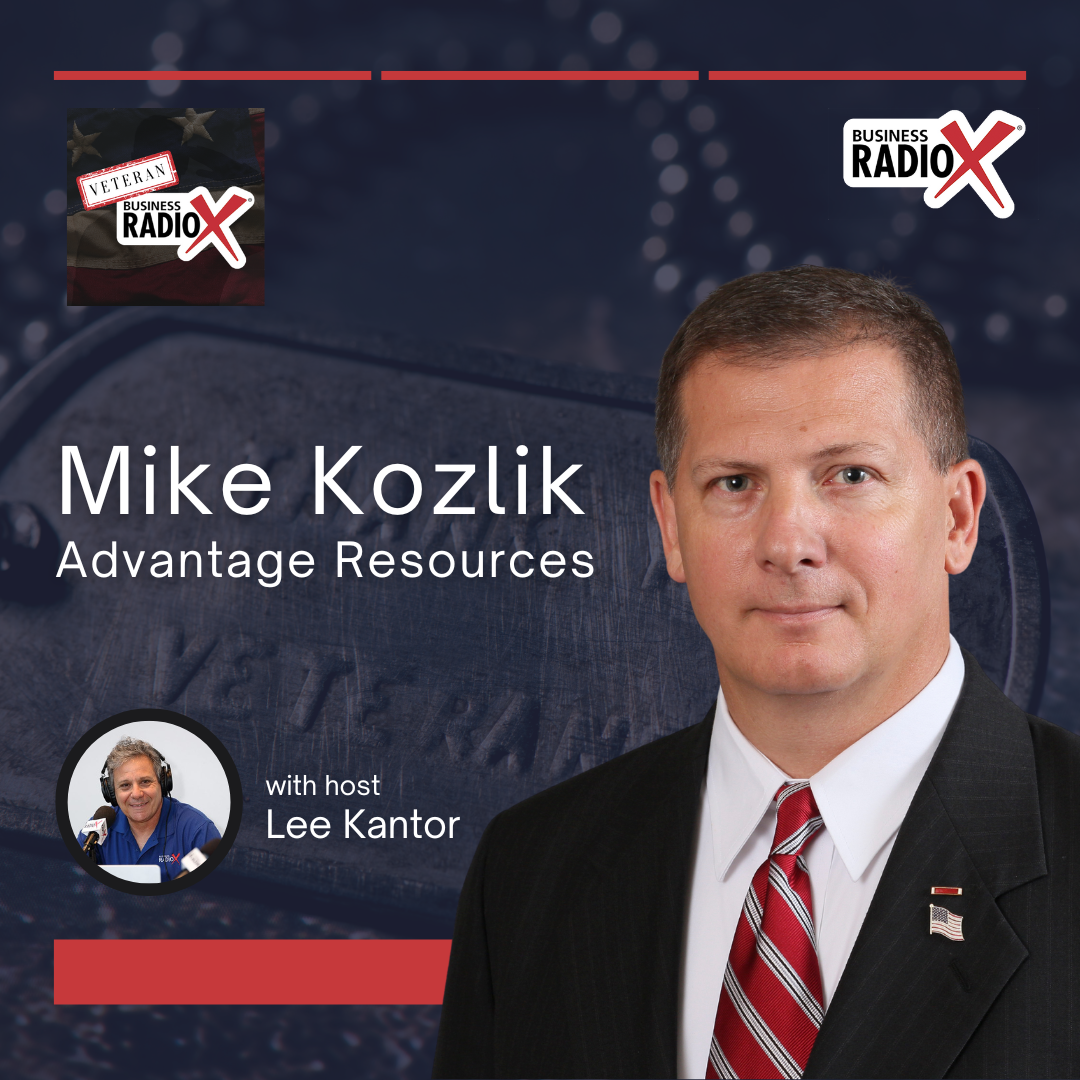

In this episode of Veteran Business Radio, Lee Kantor is joined by Mike Kozlik , owner of Advantage Resources and an Army veteran. Mike shares insights from his military and business experience, emphasizing the importance of leadership, strategic planning, and standardized business development systems. He discusses common challenges faced by entrepreneurs, the value of coaching versus consulting, and practical delegation strategies. Mike also offers resources for business owners and highlights the foundational elements necessary for long-term success, providing actionable advice for veterans and entrepreneurs looking to grow and strengthen their businesses.

 Mike Kozlik is President of Advantage Resources, Inc., a business coaching and services firm based in Birmingham, Alabama providing individualized Business Coaching, and customized business development services to privately owned businesses.
Mike is focused on helping privately owned businesses and their owners become More Efficient, More Effective and More Profitable, by providing Business Development support, Strategic Analysis, Strategic Planning, Strategic Plan implementation, Business Development training; project and program management, and business operations management consulting.
As part of Advantage Resources Inc., Mike uses the techniques from his first and second books to help business owners craft strategies that are exceptionally effective in developing more clients and bringing more “Dollars-In-The-Door”.
The “secret sauce” is to connect these techniques together to get an exponential ROI, not just an arithmetic one! These unique, customizable, and cost-effective methods provide privately owned businesses with the Advantages enjoyed by large businesses.
Mike’s 30(+) year career spans the commercial, military, and government services sectors where he built and grew companies and operations for small businesses, as well as large multi-national corporations.
He has also started and built three companies of his own, with ARI being the most recent. Industry sectors included Business Development, training and training development, logistics and logistics engineering, Recruiting Process development, and Leadership Development.
Mike has an extensive 20+ year experience in Government Contracting both as a Military Officer and as a Government Contractor himself. He has also served 32 years as an Officer in the Army, serving in the National Guard, Regular Army, and Army Reserve, retiring as a Colonel. His expertise has been in Business Development and Business Development training, strategic planning, and operations. He has helped many businesses, including specifically veteran owned businesses, become more successful and more profitable.
Follow Advantage Resources, Inc. on LinkedIn and Facebook.
Episode Highlights
- Importance of leadership in organizations
- Transitioning from military to civilian business environments
- Challenges faced by small business owners, particularly in growth and client acquisition
- Development of standardized business systems for consistent results
- Distinction between business coaches and consultants
- Creation of personal and business visions for strategic alignment
- Simplifying business planning in a fast-changing environment
- Delegation strategies for effective business management
- Foundational elements necessary for business success
- Personalized coaching approach and ongoing support for clients
 This transcript is machine transcribed by Sonix
TRANSCRIPT
Intro: Broadcasting live from the Business RadioX studios in Atlanta, Georgia. It’s time for Veterans Business Radio. Brought to you by ATL vets, providing the tools and support that help veteran owned businesses thrive. For more information, go to ATL. Now here’s your host.
Lee Kantor: Lee Kantor here another episode of Veterans Business Radio and this is going to be a good one. But before we get started, it’s important to recognize our sponsor, ATL vets, inspiring veterans to build their foundation of success and empowering them to become the backbone of society after the uniform. For more information, go to ATL vets.org. Today on the show we have Mike Kozlik. He is the owner President of Advantage Resources. Welcome, Mike.
Mike Kozlik: Well, hello.
Lee Kantor: Well, I’m excited to learn what you’re up to. Tell us a little bit about Advantage Resources. How are you serving folks?
Mike Kozlik: Well, we are a, uh, where I am a business coach, and we provide a variety of services to business owners to help them create a business that is efficient, effective, and profitable.
Lee Kantor: So what’s your backstory? How did you get involved in this line of work?
Mike Kozlik: Well, I was in the commercial world for a number of years. I’ve been I was in the Army for 32 years. The last 17 of that. I was a reservist, so I had to have a real job, you know, when I wasn’t on weekends. And I entered the commercial world and I got mobilized back in 2003, and I was working for a firm, and it was an eight month mobilization that turned into three years mobilized and deployed. So when I came back, they had had a little Enron problem type problem when I was gone and there was no job for me to come back to. So I started my own business, and Advantage Resources has gone through, you know, a couple of variations since that time. All of it still being focused with a core competency of providing privately owned small businesses with the resources they need to become successful.
Lee Kantor: Now, is there any kind of commonality that you find when you begin an engagement with one of these businesses? Is there some like a number one thing that these business owners look to you for help with?
Mike Kozlik: Yeah, I think number one, the number one thing that I get talked, I talked to business owners about initially is their desire, their need. They’re very focused on business growth, bringing, you know, more clients and, you know, having a business development process. So I help them design and implement business development system, which is a standard set of procedures that creates consistent and predictable results for them, that allows them to manage the system, to either dial it up or dial it down as they need. It also allows them to be able to troubleshoot very precisely when the process isn’t delivering, which is really in the beginning. It’s more important than anything else, because if if you’re not, what you’re doing is not providing the results you need, you get to figure out why. So most clients today, they don’t use a standardized system. The ones I talk to, the entrepreneurs and the privately owned business owners. Generally when I talk to them, what I get is this explanation of what I call spaghetti on the wall, throw spaghetti on the wall and see what sticks. And that’s not really an effective way to generate consistent and predictable results. They have more than one person doing business developing with or for them. There are as many ways as there are people doing the business development tests. Well, this is impossible to track. It’s impossible to measure or adjust. So the number one thing I think business owners asked me to help them with is create a system that they can. They can rely on. To present that consistent and predictable results so they can make business decisions, good business decisions.
Lee Kantor: So when you’re helping them with this, creating the this system, what is the first thing you do in order to make sure that the system is going to deliver the outcome that the client desires?
Mike Kozlik: Well, we go through a number of let’s just call it exploratory processes. And we look at what they’re doing and how they’re doing it, what tools they’re using to do it. And we decide, you know, together whether these are effective for what they’re trying to do. You know, sometimes guys will buy a Cadillac when all they needed was a Yugo to get to work. And sometimes a guy is riding a bike when he needs a pickup truck. So we have to make sure that we look at what they’re doing, how they’re doing it, and the tools they’re using to do it, so we can adjust that to kind of be aligned. So it’s a a standardized system. Everybody that’s going to be involved in business development will use the same systems, the same tools, and that allows the owner of the business to. Uh, those are the kind of things that we work on initially. We kind of look at, you know, what are the means, the methods and the processes that they have in place to generate the kind of new clientele that they need on an, on a consistent basis.
Lee Kantor: Now, a lot of times you’re working with people who have never had a coach before, or these people who have gone from having a coach to just trying something new with you.
Mike Kozlik: Well, it’s about 5050. Um, I would say that a lot of the people that I’ve talked to have used some form of, uh, professional help, and they’re not always coaches. Uh, there’s a big difference between a coach and a consultant. And many times they would have gotten engaged with a consultant and they were expecting a coach, or they hired a coach and what they really needed was a consultant. So it’s about 5050. But either way, you know, we kind of I kind of lay out a very simplistic, uh, easy to understand process that we will follow as, as a team, uh, to kind of get them wherever they want to go.
Lee Kantor: So how do you kind of differentiate between the consultant and the coach?
Mike Kozlik: Well, um, there’s one big differentiator that, that I use is that a consultant generally will come in and they will do something specific for a business. Um, and they’ll do it as a project. It may last a couple of weeks, a couple of months, but generally it’s a it’s a point in time activity that is just gets done. And when they’re done they’re gone. Okay. Their process is over. They hand it off to the owner. Uh, and it’s their it’s their responsibility to continue it. A coach, on the other hand, is a a long term personal relationship with someone that you trust. That you can ask anything of. And have a, you know, a deep discussion about what’s best. What. Have you seen it before? What can I do? I’ve tried all this. What else is there? And a coach is is there on on a long term basis? Now I have a, um, a guide that I wrote several years ago based on my experience in the last 20 years helping businesses. And that guide is, um, will help a business owner decide whether it’s a coach they need or a consultant. It’ll also help them understand, um. What kind of questions they need to ask to ensure that the person that they’re engaging is the right person for them.
Mike Kozlik: So if any of your listeners want a copy of that, um, that guide, they can text me at 053325524. Say they heard me on Veteran Business Radio. Provide their email and I’ll send them a PDF copy that they can have and enjoy. It is their pleasure reading. And then I’ll also be open for discussion of specific questions they might have after that reading. But the bottom line is, as a business owner, you have to make sure that you’re you’re engaging the right kind of person and that they are aligned with you, that they’re going to match your personality. Um, some of that is, are they going to tell you what to do, or are they going to lead you to different ways to do it? And then you pick one. But you got to be comfortable with that person or it’s never going to work. So my little guide kind of lays all that out and helps people develop the questions they need to ask anybody that they’re talking to about, uh, providing them, you know, more professional health.
Lee Kantor: Now, when you’re working with, uh, a client. And you mentioned usually the first point of interaction is around business development. Are there any other kind of fundamentals that you cover when you’re working with a client at the beginning stages?
Mike Kozlik: Uh, yeah. In the very beginning, one of the things we have to do, and I’m a big believer and my, my clients have begun to call them, uh, Mike isms. All right. So the first Mike ism they learn is it’s better to plan, uh, you know, failure to plan is planning to fail. It’s better to plan and and adjust than it is to try to, uh, do something every day when the, you know, uh, something happens. So the very first thing that we do with our clients is this we look at, at fundamental elements that makes a good company, and then I help them understand what the secret sauce of that is. So the two fundamental elements that they start with are vision. And there’s two kinds of vision. The first vision is your personal vision. That’s where you decide what it is you want, really want in life. You know, everybody starts out with the, you know, the objective things they want to, you know, the great house on the beach, they want the Lamborghini. They want the trophy wife. But after we get to talking, we generally come up with a different set of things that they want in their life, about their achievements, about what? How they want to be known, the legacy they want to leave.
Mike Kozlik: Then we take that. And what’s important is that paints a kind of a word picture of what they want in their life. And then we craft a business vision that will build a business that gives them that. And that’s the secret sauce. You just don’t do a business vision. You know, a generic business vision isn’t going to get you to, um, you know, ground zero. So you have to have that business vision nested in something that’s important, and that is what you want in your life. So then we go through great detail about creating a business vision that that lays out the plan, as it were. Uh, to provide you with that life that you painted in that vision, that personal vision. So that is kind of one of the most important parts. It’s the very first thing that we do. We start with the end in mind. I’m a big Stephen Covey guy and we start with the end in mind. So when you build the foundation elements and you integrate them to work as a system, you begin to gain consistent and predictable results. That’s a mantra I use with my clients all the time.
Lee Kantor: So when you’re how do you help the client that, um, is dealing kind of with the chaos of today where there’s, uh, you know, so much talk of AI replacing jobs, um, how to leverage these new technologies fast. How do you kind of marry that with, uh, you know, kind of staying the course?
Mike Kozlik: Well, you know, one of the things that we, we talk about again is planning. You know, and I’m not talking about building a strategy or a plan that’s like equivalent to the complexity of the invasion of Europe on D-Day. I call it a blueprint. Okay. So we craft a simple to understand, um, overarching plan that identifies some of the major muscle movements that are going to have to happen in order for that business to achieve the vision that the business owner, um, you know, create, we create it together. So you get the business vision and the personal vision. You got to know what you want, and then you got to build what your type of business to get it. You cannot take every day. And here’s the big problem. Here’s the thing that happens with all of my clients in the beginning. Every day they try to take each day as it comes with no planning, no looking over the horizon, no understanding, you know, being positioned for what comes next. We call that getting smacked in the face with the tsunami of now every day. And if that happens, your business will fail. You cannot deal with a business on a day to day basis as the owner, as the strategic planner. You’ve got to be like I tell my clients, you may be doing today, today, but in a month from now you’re going to be doing next week, and in six months from now, you’re going to be doing next year. And that’s what a business owner needs to be thinking about. Some percentage of his time or her time needs to be focused on that. If you’re not going to do that, you’re not going to be successful at all, ever.
Lee Kantor: So is there a story you can share? Um, don’t name the name of the client, but maybe explain the challenge they came to you with and how you helped them get to a new level.
Mike Kozlik: Uh, yeah. I mean, there’s I could, boy, we could be here all day. Um, so one of the one of the challenges that clients face, you know, they’re all entrepreneurs. I work with privately owned business owners. They’re all entrepreneurs. And as such, They’re raging personalities, just like myself. And because of that, it’s very hard for them to let go of the things that they have always done in their business. They have difficulty in trusting anyone to do those things. So let me tell you a story about one of my clients. So I had a client. We’ll call him Tony. Uh, he was third generation owner of a construction company. And, uh, he started working in that company when he was a teenager for his grandfather. And he did everything from sweep to floors, uh, worked his way up to, you know, making the coffee and up to ordering, you know, materials for the superintendents on the projects and blah, blah, blah. So one day I came in for one of our weekly meetings, and, um, he was on the phone. I sat down and I waited, and he was on the phone. On the phone, on the phone. He was 30 minutes on the phone and he was ordering supplies for two, two of his projects that he had out there. And when he hung up the phone. It was about 34, 35, 40 minutes into our program. We started our meeting and I ended it right when I was supposed.
Mike Kozlik: He said, wait a minute, we just got started. I said, well, you just got started. I was here on time. You elected to do basic, you know, work that your office manager does, by the way, better than you. And she’s sitting out there reading a magazine while you wasted 40 minutes here. And so we have this kind of a come to Jesus meeting about what is important for a business owner to be doing and ordering a length of pipe or, you know, whatever is not an effective use of their time. So he had to let go of that. He’d been doing that since he was 16 years old, and he had to let go of that and just hand that off to his office manager, and his superintendents would talk, tell her what she needed and when they needed it on the site, and she would do it. So I teach my clients this this simple process. There’s three ways things get done in a business source. Resource, outsource and end source. And in that order. So the main thing is to move from the resource where the business owner is doing something or all things to a point where someone else is doing it for them. That’s outsourced. And a good example of that is not everybody is an accountant. And the very first thing that most businesses outsource is bookkeeping, because it takes up a lot of time.
Mike Kozlik: And business owners tell me they hate doing bookkeeping, they hate paying the bills. They hate doing payroll, they hate calculating all this crap. So that’s the first thing that they outsource. As an example, over time, as the business gets bigger, you bring that that capability back in-house with an in-house bookkeeper, maybe part time to begin with and full time as the business is larger. So you go through this series of source, outsource and source. The main goal is to free up the business owner to do things that are strategically more important than everyday busywork, so they’re not doing. The doing someone else is doing it, but they don’t lose control. I teach them a way of delegation that’s not a shovel pass. They still get the process done. They’re still on top of where they are, you know, in the process of getting it done. And they get to make decisions. And but they’re not actually physically doing the doing every day. And that’s important because that’s a major challenge with with entrepreneurs is when they start their business, they’re doing everything and it’s very hard for them to let go. It really is. So that is that’s a key consideration that I talk to my clients about ahead of time. And sometimes we get into, let’s just say heated discussions. We’ll just call it that.
Lee Kantor: So now is there anything you can share with our listeners about maybe some of the leadership that you learned from your time in service and how it pertains to the business world?
Mike Kozlik: So leadership is one of the four foundational elements that we help our clients create for their companies. And in it. We call it the glue. And, you know, our audience today is largely composed of veterans. So they’ll understand a little bit better than those who have not lived in a military discipline life. But leadership is not a soft skill. It is very hard, but when you do it correctly, it’s a force multiplier in an organization. Basically, it makes two plus two equals six or more. So leadership is an intrinsic part of every aspect of a business. It doesn’t matter whether it’s the marketing, the business development. Hr doesn’t matter. Every element of the business is affected by the leadership environment and the way that people that are put in charge of other people. Actually do leadership. Now we make a big deal in our, uh, you manage things, you lead people program where we, we show that management is not something that you do with the the living beings that are you’re entrusted with. That is something you do to make sure the copy machine has enough paper or toner or whatever that has. Leadership, on the other hand, is a way is a responsibility where and we teach this at three different levels, where if you’re a leader in an organization and we we shy away from the word manager, you’re responsible for for teaching, coaching, training, mentoring and developing those people that are placed in your care and under your responsibility, just like we do in the military. That is one of the main aspects of of the fourth foundational element, which is leadership, is that a leader can only be chosen not because they’ve been there longer, but because they’ve demonstrated the ability to lead and demonstrated the ability to handle responsibilities at the next higher level. If they’re not doing that, then a company is going to have trouble. Uh, from a morale perspective, from a consistency see. Perspective and leadership basically affects everything. Everything in a company, everything from, uh, you know, when people come to work to how people are promoted.
Lee Kantor: So is there a niche that you work in primarily, or is this kind of industry agnostic your work?
Mike Kozlik: Well, pretty much industry agnostic if it’s a small, privately owned business. I’ve worked with, uh, startup companies, entrepreneurial startup companies in every, uh, market and industry. You can you can name. I’ve had builders, architects, engineers, I’ve had marketing, PR, uh, website development companies, website management companies, social media companies. Um, I’ve had manufacturing companies. And basically every business has the same foundation. It doesn’t matter what the business is. You have to build. And we use the the analogy of a building in order to build a building, you have to have a strong foundation. The stronger you make that foundation, you can build anything on it. If you don’t build a strong foundation to begin with, you’re not even going to be able to build a one storey edifice on it. So we talk about the foundational elements that all businesses, every business in the world, whether they’re Apple or Microsoft or, you know, bombs, lawn service, have the same foundational elements that they have to make sure are in place and functioning synergistically together in order for that business to be successful.
Lee Kantor: Now, how do you deliver your services? Is it one on one coaching group coaching? Do you form cohorts?
Mike Kozlik: Uh, it’s one on one coaching. I meet with all my clients one one hour a week, minimum, at a designated day and time that we we kind of coordinate together. I’m available if we’re working on a project. Uh, there’s clients that I meet two and three times a week. And, you know, there’s no unlike a consultant, there’s no extra cost to that. If we’re working on a project that is in the in their, uh, their strategy or in their plan. Uh, and they run up on a brick wall then. Then I afford whatever time I have that week. For anybody who wants it. So I meet once a week, every week with our clients. Um, and, and we walk through in the beginning, we’re kind of building it. We’re building an airplane while we’re flying in it. So in the beginning, uh, we’re talking about our vision. We’re laying out the framework of the strategy. We’re looking at the processes we we need to create and implement, starting with the business development process, followed by the build a world class team. That’s our 90% solution, uh, process. And then then, uh, total quality customer service and then leadership. So those are the four bases. There’s others, but those are the four basic ones. So I work once a week for an hour minimum more if they need it.
Lee Kantor: And if somebody wants to learn more, have a more substantive conversation with you. Is there a website? Is there a best way to connect?
Mike Kozlik: The best way to connect Really is, is call me or text me. Uh (205) 332-5524. If you’re going to text me, just tell me. Hey, I heard you on Veteran Business Radio, and I’d like to learn more about, you know, I’d like to get your, your, uh, guide for how to pick a coach or. I like, I like to know more about this or that. And they can they can reach out to me and we’ll set up a zoom meeting. And that’s what I do with everybody.
Lee Kantor: And the business is Advantage Resources, Inc. and the website is Advantage Resources, Inc. Com.
Mike Kozlik: That is correct. Yes.
Lee Kantor: Well, Mike, thank you so much for sharing your story today. You’re doing such important work and we appreciate you.
Mike Kozlik: Well, I appreciate you for having me today. Thank you very much.
Lee Kantor: All right. This is Lee Kantor. We’ll see you all next time on Veterans Business Radio.














