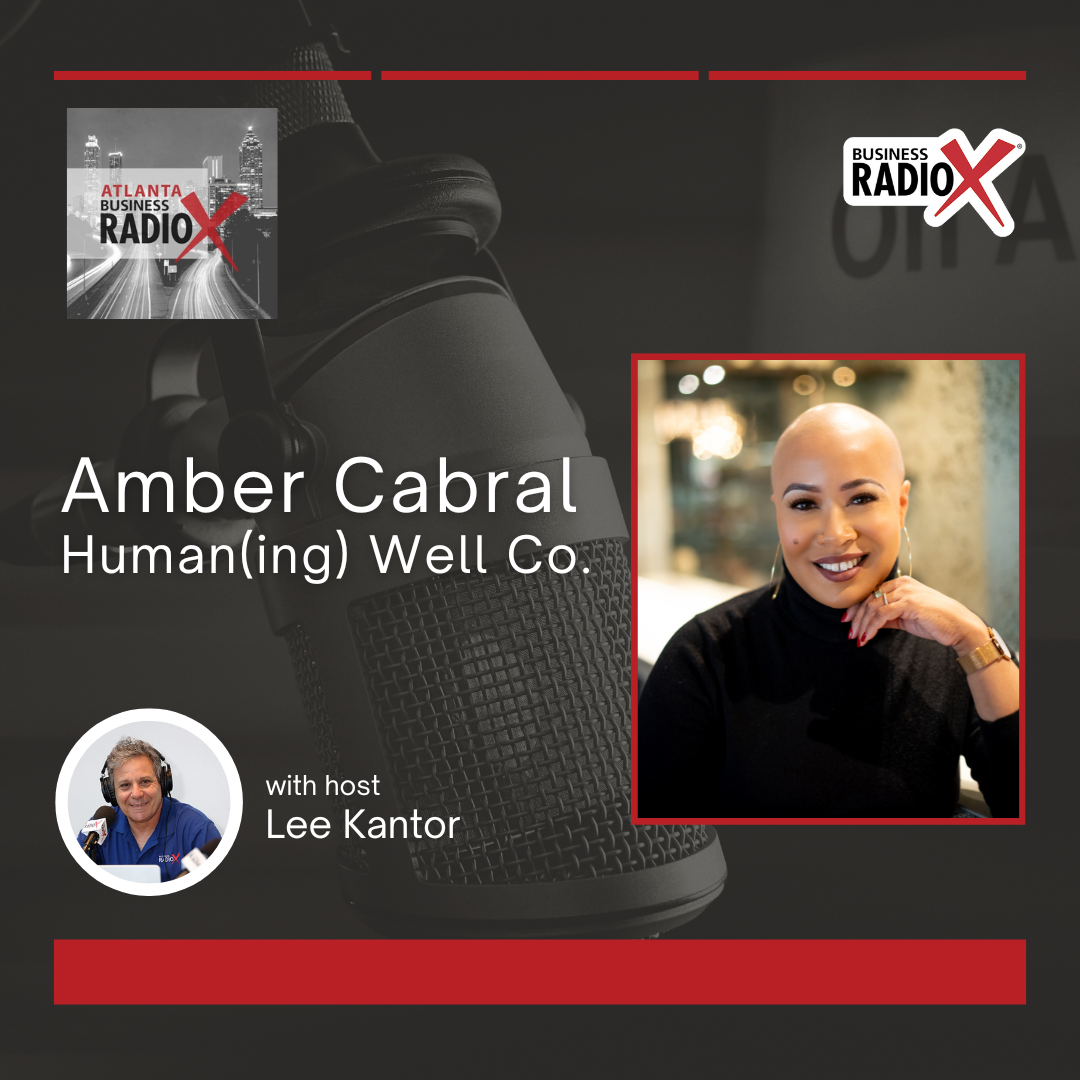

 In this episode of Atlanta Business Radio, Lee Kantor interviews Amber Cabral, founder of Human Well, about the evolving challenges of leadership and communication in today’s workplaces. Amber discusses the impact of technology, generational differences, and remote work on interpersonal skills, emphasizing the need for psychological safety and resilience. She shares insights on bridging gaps between corporate and frontline employees, highlights the importance of empathy and intentional development, and offers practical strategies for fostering healthier, more connected work environments. Amber also introduces her podcast, Human(ing) Well, and invites organizations to engage with her leadership development services.

 As a culture and communication strategist, TED speaker, and twice-published author, Amber Cabral teaches people how to be good humans at work and in life. She helps us learn how to respectfully speak our minds, purposefully define our goals, and strengthen our relationships while avoiding burnout.
She’s known for her authentic approach, practical solutions, and powerful communication techniques, all of which are showcased in her weekly podcast, Human(ing) Well, on the SiriusXM radio network.
Connect with Amber on LinkedIn.
What You’ll Learn In This Episode
- What it means to “human well” in business today
- How leaders build resilience in their teams during change
- Why high-stakes conversations trip up even seasoned leaders
- How people speak up without damaging relationships
- The ROI of better humans at work
 This transcript is machine transcribed by Sonix.
TRANSCRIPT
Intro: Broadcasting live from the Business RadioX studio in Atlanta, Georgia. It’s time for Atlanta Business Radio, brought to you by Kennesaw State University’s Executive MBA program, the accelerated degree program for working professionals looking to advance their career and enhance their leadership skills. And now, here’s your host.
Lee Kantor: Lee Kantor here, another episode of Atlanta Business Radio. And this is going to be a good one. But before we get started, it’s important to recognize our sponsor, CSU’s executive MBA program. Without them, we couldn’t be sharing these important stories. Today on the show, we have Amber Cabral, who is a leadership strategist, a TED speaker, an author, and a podcast host with Human(ing) well, welcome.
Amber Cabral: Hey, there. Glad to be here today.
Lee Kantor: Well, I’m excited to learn what you’re up to. Tell us about Humaning. Well, how you serving, folks?
Amber Cabral: Yeah. So Humaning well is a leadership development company, so we mostly do training, consulting, coaching and executive development for pretty well known brands. And I’ve been doing that work in general for the last 20 plus years. But the humaning element really took off this year when I realized that there was a lot of things that we were trying to do in the workplace without considering what we as people need to be able to do that. So that’s the work that I do, and it has just grown to add the human element more recently.
Lee Kantor: So how are you defining Humaning? Well.
Amber Cabral: So with Humaning, well, as a framework, there are four pillars. That’s health, wealth, relationships and growth. Generally, thinking about what makes humans well, we usually have to have a little something good going on in each of those. But in a grand sense, what Humaning well is really asking us to do is to make sure that we are considering our needs as we’re making decisions. So whether those are workplace decisions, whether they’re decisions in our personal lives, whether they’re decisions about how we’re going to spend our time. We have to think about how we are taking good care of ourselves in the process so that we have the capability, and, more importantly, the resilience to navigate whatever we may encounter on that journey.
Lee Kantor: Now, in today’s world, it seems like there’s an endless amount of conversation around artificial intelligence, around automation, around robots, all this kind of stuff that aren’t really human. Can you talk about how all of this technology is impacting the ability to human well in business?
Amber Cabral: Absolutely. So we are seeing this in a generational window as well. So we are finding at least my company, we’re finding that organizations are reaching out to us for more basic leadership skills. You know, how to effectively communicate, how to give and receive feedback, how to navigate challenges at work when you’re on a team, because a lot of that isn’t necessarily being learned the same way that it used to be, which was when we would do things together, like going to school or, you know, navigate being out in the world or hanging out at the mall. A lot of that has been replaced with engagement with social media. And so what’s also happening on top of just those transitions is exactly what you said. Now we also have workplace AI. Now we have AI in the way that we are navigating spaces in our personal lives too. And so it’s further impacting what it looks like for us to engage with one another. So those fundamental skills that are important to how we get things done as teams, how we are productive and build together when we are, you know, having to aim toward the same goal, those skills are not as common. And when they are present, they need building. And so I would say that AI, while helpful, has to be applied strategically, and we have to be more intentional about making sure that we keep some of the human stuff that makes it easier for us to be able to connect together also gives us the clarity about where we as people should be showing up, and where we should leave the work to the machines.
Lee Kantor: Now, are you finding you mentioned generational? Um, are you finding that the digital natives are are less inclined to believe that this type of human interaction face to face, you know, look someone in the eye shake their hand, you know, have a conversation, uh, verbally, um, is is as important to them as it is to maybe the older generations that that that isn’t maybe table stakes in a way that it used to be for older folks.
Amber Cabral: So I think it’s a little bit of I’m not sure that this is as important, but more I don’t actually know how. So what we’re finding is that organizations are hiring talent that have achieved really well from an education standpoint. Um, getting them through the interview process, but then finding when they’re on teams, they don’t necessarily know how to engage with their teammates, they don’t know how to effectively engage with their leaders. And many don’t realize that they’re not doing it well. So not even necessarily the, you know, hey, I don’t value this as much. I’m not necessarily interested in the in-person engagement more the lack of awareness that you’re not engaging well. And so the skill set is a little bit tricky because the first thing that has to happen is folks have to get a little bit of self-awareness. And that isn’t always present when we go into an organization. There are a number of leaders who will say, yeah, I have a couple team members who just don’t really seem self-aware. They don’t feel as connected, and I’m not even sure if they really know that they’re not doing that. And so being a digital native does make connection mean something different, because folks are connecting across the digital divide where if something is funny, you type lol, you don’t necessarily have to have a smile on your face, But when you’re having a conversation with someone, when you think something’s funny, we usually are intentional as humans about how we express that. But when you haven’t had that habit, it may not occur to you that people don’t understand that you’re having the LOL moment in your brain. And so that’s a little bit about how we’re hearing it show up in some of the workplaces that I work with.
Lee Kantor: Now, in some of the workplaces that you work with or have they, um, or are they considering or have they done kind of the transition back from remote work to more in the office work?
Amber Cabral: So I have a mix, um, I work across a lot of industries. So retail, for example, retail is still very much in the, you know, the stores. And so there’s not a way to necessarily take all of that away, though we do definitely do a lot more online shopping. Um, but there are organizations that have a mix of hybrid and in-person. That’s the most common format that I see. But then in addition, you know, you do have folks that are saying, hey, I want folks that are working for us back in the office, you know, 4 to 5 days a week. And so that’s showing up. It just really depends organization to organization. Larger organizations that are very visible, I think have done a bit more mandating people to come back to the office, largely because they have so much property. So if you’ve got all this, you know, shared space, you know, people want to use that space and actually have an opportunity to enhance the in-person connection. And so we’re getting more contact from organizations that are in person on how to better connect in the workplace across generations. But some of the conversations that are happening are connecting to the hybrid space or the remote workspace, because even as people go back to the office, we do business globally now. And so we’re no longer, you know, businesses are not just in the United States or even just in, you know, New York City businesses are operationalizing around the globe. And so you may have to have a conversation with your team in Dublin or in India or wherever. And so being able to know how to use your connection skills to be able to work with colleagues in different parts of the world is also critically important to how we human well together as well.
Lee Kantor: So what is the typical pain that your clients having right before they reach out and contact you? How is this showing up in their world? What are the symptoms of a problem or an issue that you can you might be able to help them with?
Amber Cabral: Probably a couple of things that come to mind more recently. Number one would be, uh, psychological safety in the workplace. As the world becomes more polarized, people tend to bring a bit of that polarization into the workplace, or at least worry about what it will look like when it shows up in the workplace. So regardless of if we’re talking about an organization that is remote and hybrid or in person, we live in a world right now where there are just a lot of beliefs and a lot of perspectives and a lot of change, and a lot of that has a bit of a political angle to it. And so people are just very hesitant to Connect across what they perceive to be differences and don’t know how to talk about what to do. Should there be a concern that arises? So I typically will get contacted for something like that. I’m not sure that my teams are connecting. I’m not sure that we’re seeing the psychological safety necessary for us to be able to produce and be effective and communicate well. How can we create, you know, a better, more meaningfully connected set of leaders and teams? The other thing that I get very often is that people are just, um, trying to figure out how do I just communicate better. And that communicate better can be across generation. It can be across from, you know, client to consumer. It can be navigating the evolving landscape kind of to your point about, you know, we’ve got social media all of a sudden, how are we navigating that? Well and how that’s showing up in the workplace. So communication is a constant element that I feel like I get tapped a lot for as well.
Lee Kantor: So how do you kind of deliver those services? Is it through training? Is it through coaching?
Amber Cabral: It’s a bit of both. So depending on what kind of organization it is, if, you know, I work with a lot of executive leadership teams, if the executive leadership team isn’t communicating well guess what? The organization probably isn’t either. So I work with a lot of executive teams about how they can develop effective communication with one another. And effective communication doesn’t mean we are always nice to each other. It means that we know how to have the hard conversations and walk away from that without feeling offended or, you know, personalizing things and still knowing how to engage going forward. So people don’t necessarily have that skill set natively. I think that’s kind of been the case over time, and I think the digital element is just maybe made it a bit worse. So I work with executive teams from a coaching standpoint, group coaching or individual. But then I also do training with leadership teams or specific parts of the organization. So for example, a marketing team may be having some challenges with an idea that’s been put forth that people may have perceived as being, you know, maybe rub some, you know, certain groups the wrong way. How do we have the conversations to make sure that we’re putting out the kind of imagery and messaging that resonates with what we want to say and how we want our consumers to feel, and making sure that we’re also being sensitive to the possibility that someone could be rubbed the wrong way and how we manage that. So sometimes it’s a team specific circumstance. It really just depends on the organization that I’m working with. But yes, training is an option. Coaching is an option. Sometimes it’s consulting, sometimes it’s how, you know, how do we work to build an organization that uplifts its values across the entire enterprise. And so that would be more of a consulting opportunity. It just really depends on what the organization’s needs are now.
Lee Kantor: How do you find, um, the teaching of communications throughout for young people? Are you finding because like, these digitally native young people, um, are brought up in a world of texting and emojis and shortcuts. Um, like you mentioned that they don’t have kind of the experience on how to how to communicate in person. Uh, you know, the softer skills around that. Is it becoming a lost art, or is it something that that, you know, maybe parents can do or, uh, schools can do to help, uh, educate younger people on how to be more effective when it comes to in-person communication.
Amber Cabral: I think in-person communication works best when people hold folks accountable for doing it well. So whether that’s parents, whether that’s schools. I think it will become a lost art if people are not intentional about holding folks accountable for communicating. So if you are a parent, you know, maybe we don’t sit down and all have dinner together because, you know, life works a little bit different than that for a lot of folks these days. You know. But what does it look like for you to have some intentional dialog with the young people that you are bringing into the, you know, bringing up so that you are developing humans that are able to communicate in school? I remember when I was in school, you know, we had to get up in front of the class and, you know, maybe read a passage or we had to talk about, you know, a topic of some kind and give a small presentation. So on something that we’ve researched, what does that look like today? You know, yes, we have computers and we can type essays and do all of that. I mean, I guess even that’s debatable because a lot of folks are using ChatGPT to do their homework now. But, you know, what does it look like for you to really intentionally put people in a position to have to communicate? Because I do think it can be a lost art, and I think that there’s a lot more that’s lost than just the message in the moment. It’s also the ability to connect. We hear a lot of information these days about, you know, the loneliness epidemic and folks are having a difficult time with making friends. And there’s all this content around. Well, here is what you can do to make friends.
Amber Cabral: And it’s like, yeah, some of this is just communication. I’ve got to be willing to take a chance and say hello and be willing to try to carry a conversation, be willing to practice being interested and also knowing the ways that I am interesting. And those are things that we did very naturally when we didn’t necessarily have a phone in our hand. And we all went outside to play. So what does it look like to manufacture those opportunities? Whether you are a parent or you are a teacher, um, or you happen to be in the workplace? You know, I ran an intern program when I worked at Walmart. And one of the things that was really important for that program was to make sure that that intern got connected to a myriad of relationships, their mentor, their manager, myself, you know, the team that I supported. And we were intentional about making sure that they understood that for this business, you know, we’re talking about at that time, 2.2 million people globally. If you want to be able to work here, communication is key. So how are we making sure that we’re helping you to have the tools necessary to be able to do that? You know, when you’re locally right on site in Bentonville, but then also when you’re at your desk and you’re connecting across zoom or sending an email. And so I think it’s making sure that we understand that even with the advanced technology that machines is providing, are providing us, you know, the opportunity to grow in that way. We still, as people have a need to connect. We still have to have that to be able to grow forward and to do the jobs that we want to do every day.
Lee Kantor: Yeah. I think an unintended consequence of all of this digital connection and the reliance on digital communications has really hurt a generation when it comes to, like you were saying, even just playing and the ability to have a conflict and resolve it without things escalating or being super sensitive about issues and being able to be resilient and not and feel and not feel like you have to be on eggshells like those kind of communication skills that we learned, you know, in a chaotic way as children, I think are being lost in a lot of places. And then you get into a more of a high stakes world where it’s your job at stake and things like that, and they don’t know how to cope with just some of this stuff. And, and it’s really a gift you’re giving them to be able to teach them how to kind of navigate this world. And it’s a shame that they’re having to learn it, you know, you know, ten, 15, 20 years after, they probably could have learned it.
Amber Cabral: Absolutely. I do think, too, like some of it is just the the language that we use and the overabundance of information around certain things. It’s like everything is therapy, language now, you know, and I when I open up a conversation about resilience, you know, people think I mean, knowing how to be tough and take it on the chin. And it’s like, that’s not exactly what resilience is asking you to do. What resilience is asking you to do is make sure that you’re getting what you need so that when you encounter a tough circumstance, you have the ability and the skill to navigate it. So I’ve gotten what I needed in terms of making sure I have the skill set to communicate. So when I encounter a tough conversation, I’m not saying it won’t be hard or it won’t be uncomfortable, but I have the tools that I need to get through it. People, I think, frame resilience now as like, you know, having to take it or, you know, just muscling through and it’s like, no, there’s there’s another layer to that. It’s making sure that you know why your body needs rest, you know, so you aren’t exhausted, you know, so you have the ability to have the strength that you need to do some of the tough stuff that comes along.
Amber Cabral: It’s making sure that you’re moving your body so that you have the physical ability to navigate some of the tough stuff that comes along. And so it’s I think that there’s also, in addition to the challenges we have with just communicating in general, it is the volume of information that is available and the way some of that is weaponized. You know, it’s almost like we have people that are like, oh, that’s uncomfortable. And so now you’re crossing my boundaries and it’s like, no, like, this is uncomfortable is a part of the way that we get through life. And if we are unwilling to do the basics of discomfort, there are a lot of things that we’re going to be behind on, including how we connect and build friendships and, you know, avoid being lonely and find partners and all of those things outside of, you know, the workplace.
Lee Kantor: Is there a story you can share about don’t name the name of the company or the organization, but maybe they the challenge they came to you with and how you were able to help them get to a new level?
Amber Cabral: Yes. Um, well, let me think about that one that I feel like that I can share in a relatively short frame. So I’ll just say, say it this way. I think a lot of, uh, retail organizations are challenged by some of the same things. When you think about a retail organization, most folks consider just the store experience because a lot of us are consumers. But with a retailer, you also have, you know, the Home office, you or the in-office side of the business. You know, the folks that are the buyers for the business, the folks that are, you know, doing all the HR stuff and, you know, the things that are not necessarily happening right there on the ground in a store. And what happens very often with retailers is that that home office in office population has one experience, and that on the ground, navigating customers every day group has a different experience. And so one of the things I am often asked to do is help our in-office employees and staff know how to better connect to what the experience is in the stores. And so what I do is kind of build a bit of a program depending on what the organization is, where they’re located, what they sell.
Amber Cabral: You know, all of those things play a part, but the objective is to intentionally make sure that we’re giving that home office population the tools to be able to connect to a group of folks who essentially have a completely different skill set, and also encounter a completely different set of things. They’re dealing with angry customers. They’re seeing the politicization of whatever’s happening in, you know, our, uh, social atmosphere in a much more personal one on one way, they’re knowing what it looks like when folks come into the store frustrated or angry. And so there are some skills and some tactics that have to be built by that population that are very different than the skills that are built by the Home Office population and vice versa. And so what I will usually do is come in and build a series of learning experiences. And I if I if, if allowed, also actual in-person immersion experiences that help both sides of the business be able to better understand each other, communicate about what’s happening and have the resilience to support whatever changes need to be made so that the business can function more effectively.
Lee Kantor: So what do you need more of? How can we help you?
Amber Cabral: Um, I’m always open to more clients and customers and business. Um, I would like more of that at any point. Um, I also have a podcast. My podcast is called Human Inkwell. And what Human Inkwell is aiming to do is make sure that folks have some of the skills that we’ve talked about in this conversation so that we can show up in our workplaces and play spaces and life spaces with more resilience. We have a lot less, you know, honking and middle fingers when we’re driving down the road and a bit more grace and patience as we do that. Um, so Humaning well is aiming to help us be able to live better in that way. Um, so yeah, the two of those, that’s probably all I’m ever looking for is more folks to lean in. And, you know, if you’re struggling with how your organization is experiencing psychological safety or resilience or inclusion or equity or any of those kinds of things, communication, definitely tap in. Um, happy to help support on that side if you’re looking for coaching that’s available. But also if you’re just looking to learn, you can always go and tune in to the podcast.
Lee Kantor: And then that ideal client you mentioned, retail. Is there a niche that you serve or a size company that is ideal for you.
Amber Cabral: I work with I have worked from fortune one on down so there is not a specific size organization. Most of the organizations that I work with are actually fortune ranked. So um, probably the fortune 200 are most of my clients, but we work with itty bitty tiny nonprofits as well. So if you are an organization that we can serve, we’re happy to chime in and lean in where we can.
Lee Kantor: And if somebody wants to learn more, have a more substantive conversation with you or somebody on the team or find the podcast, what is the website? What’s the best way to connect?
Amber Cabral: The best way to connect is to go to Amber comm. That’s a m b e r c a b l.com.
Lee Kantor: Well, Amber, thank you so much for sharing your story today. You’re doing such important work and we appreciate you.
Amber Cabral: Thank you so much for having me. This was a great conversation.
Lee Kantor: All right. This is Lee Kantor. We’ll see you all next time on Atlanta Business Radio.














