Business RadioX ®

  • Home
  • Business RadioX ® Communities
    • Southeast
      • Alabama
        • Birmingham
      • Florida
        • Orlando
        • Pensacola
        • South Florida
        • Tampa
        • Tallahassee
      • Georgia
        • Atlanta
        • Cherokee
        • Forsyth
        • Greater Perimeter
        • Gwinnett
        • North Fulton
        • North Georgia
        • Northeast Georgia
        • Rome
        • Savannah
      • Louisiana
        • New Orleans
      • North Carolina
        • Charlotte
        • Raleigh
      • Tennessee
        • Chattanooga
        • Nashville
      • Virginia
        • Richmond
    • South Central
      • Arkansas
        • Northwest Arkansas
    • Midwest
      • Illinois
        • Chicago
      • Michigan
        • Detroit
      • Minnesota
        • Minneapolis St. Paul
      • Missouri
        • St. Louis
      • Ohio
        • Cleveland
        • Columbus
        • Dayton
    • Southwest
      • Arizona
        • Phoenix
        • Tucson
        • Valley
      • Texas
        • Austin
        • Dallas
        • Houston
    • West
      • California
        • Bay Area
        • LA
        • Pasadena
      • Colorado
        • Denver
      • Hawaii
        • Oahu
  • FAQs
  • About Us
    • Our Mission
    • Our Audience
    • Why It Works
    • What People Are Saying
    • BRX in the News
  • Resources
    • BRX Pro Tips
    • B2B Marketing: The 4Rs
    • High Velocity Selling Habits
    • Why Most B2B Media Strategies Fail
    • 9 Reasons To Sponsor A Business RadioX ® Show
  • Partner With Us
  • Veteran Business RadioX ®

Amy Franko and The Modern Seller

December 21, 2022 by John Ray

Amy-Franko-Inspiring-Women
Inspiring Women PodCast with Betty Collins
Amy Franko and The Modern Seller
Loading
00:00 /
RSS Feed
Share
Link
Embed

Download file

Amy-Franko-Inspiring-Women

Amy Franko and The Modern Seller (Inspiring Women, Episode 53)

Amy Franko, author of The Modern Seller, joined host Betty Collins on this edition of Inspiring Women. Amy talked about the primary misconceptions services providers have about sales, imposter syndrome, delivering value, negotiating, and much more.

The host of Inspiring Women is Betty Collins, and the show is presented by Brady Ware & Company.

Betty’s Show Notes

Amy Franko helps organizations transform sales culture, ignite sales growth, and build high-impact leaders through her strategic selling programs. Recognized as a LinkedIn Top Sales Voice, Amy is the leading expert in modern sales strategies—including in-demand sales training programs, sales strategy, and as a sales keynote speaker and leadership keynote speaker. She guides growth-oriented organizations to significantly improve their results through B2B sales strategy and sales team skill development.

In this episode we find out more about Amy, and

  • why she credits coming from a large family with her success in sales
  • what does “modern selling” mean?
  • what are the misconceptions of today’s selling situations?
  • what are her observations about women in sales?
  • what has she learned from her successes and failure?
  • and finally, her 3 pieces of advice (you will love #!)

Learn more about Amy and her background here.

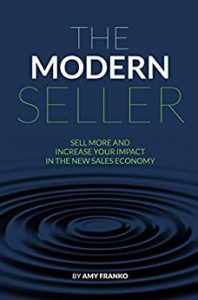
And grab a copy of her book right here.

Hosted by Betty Collins, CPA, and Director at Brady Ware and Company. Betty also serves as the Committee Chair for Empowering Women, and Director of the Brady Ware Women Initiative. Each episode is presented by Brady Ware and Company, committed to empowering women to go their distance in the workplace and at home.

For more information, go to the Resources page at Brady Ware and Company.

Remember to follow this podcast on Apple Podcasts and Google Podcasts.  And forward our podcast along to other Inspiring Women in your life.

TRANSCRIPT

[00:00:00] Betty Collins
I’m Betty Collins. And today we are going to talk about something that scares me to no end, and that’s called sales. And when you’re a business owner, which I am and I’m a shareholder and all those things, part of my job, part of my responsibility is making sure that my clients are served. But it’s also out there getting new clients, new clients. And it’s a frightening thing for me. It always has been. If I can, just knowing that I’m out talking to someone, I’m not afraid of it. But if I think I have to sell something, that’s another story. So we’re going to talk about this topic today with someone who really, really knows a lot about selling. In fact, she knows so much about it that she’s written some great book. And I think you will will find her very, very engaging today and she will really help you get through some things. I’ve known Amy Frankel for quite a while. We are very involved in the central Ohio, Columbus area with a lot of the women’s organizations. So today we’re going to talk with a truly an expert because she’s written a book that is on the Amazon bestseller list, by the way, and it’s called The Modern Seller.

[00:01:15] Betty Collins
And so I think you’re going to love engaging with Amy Franko, who wrote this book. And I’ve known her again for a while, and we’ve kind of been in the same circles in businesses. And we’ve also done a lot with women’s organizations within the central Ohio area. She’s very big in the Girl Scouts of America. So just to get started, you know, Amy is Franco is the leader in modern sales strategy. She helps those mid-market organizations to grow sales results through a sales strategy, you know, advisory and skill development programs. And again, her book, The Modern Seller, which is an Amazon best seller. She is recognized by LinkedIn as a top sales voice. And she’s also, as I said, the board chair for the Girl Scouts of Ohio Heartland, a top 25 nonprofit in the Columbus region, serving nearly 18,000 members. And you can find Amy at w w w dot Amy Franco. So, Amy, I’ve talked a little bit about you, introduced you. We’ve had some fun. We’re going to have a great conversation today. Why don’t you just tell us a little bit about yourself before we get started on that thing called selling? Sure.

[00:02:28] Amy Franko
Absolutely. Well, thank you so much for having me here. I was so excited to have this on my calendar and have this conversation with you and Betty. I’ve learned something new about you that you are selling like strikes fear in your heart. So I would have never known that about you.

[00:02:45] Betty Collins
Absolutely. Absolutely does.

[00:02:48] Amy Franko
But but to but just to just to give our listeners a little bit more about myself. I am I was born and raised in Ohio, grew up in Cleveland. I’ve been in the Columbus area now for 25 years, which is hard to believe. And from a from a personal standpoint, I am married to Dave and I have a wonderful, energetic black lab by the name of Roxy who gets all of my time and attention. Yes. And and and when when I’m not doing things sales related or related to the Girl Scouts or nonprofits, I love all things fitness and I love to travel. So I’m very excited to be able to get back to traveling. So that’s a little bit about me, and I’m sure we’ll uncover some more stuff here as we go.

[00:03:38] Betty Collins
We will. So what’s your favorite place to travel before we get started? What is it?

[00:03:42] Amy Franko
Oh, well, probably my most exotic place I’ve been to was we did a two week, two and a half weeks safari to Kenya in the early part of 2020 before the pandemic. And had you asked me, like, if Kenya was on my travel list, I it’s Kenya itself was not on my travel list, but being on doing a safari was we had some friends that planned the trip, invited us to go along, and it was absolutely life changing. And if we have time, I will tell you a story about that trip that ties into the book.

[00:04:17] Betty Collins
Okay. We definitely want to make the time to do that. So. All right. But I love to travel as well in my older age. Not old, but my older age. I like going back to the same places, so I’m really glad. In the forties I traveled everywhere, you know, and had that adventure side because now I’m kind of like, Here’s my favorite spot going to hang there. So but even talking about even having this introduction today of we’re going to jump into sales, it makes me a nervous thing, which really is crazy, right? Because I mean, I love the marketplace, love being out there, love seeing the success of it, because when it succeeds, you know, the country succeeds. And so sales is just part of that, especially as you have to be a rainmaker or you have you. Want to have growth and you’re that owner and you want to get out there, or maybe you work for somebody and this is what you have to do. So, you know, what is your background and how did you get into the sales profession?

[00:05:13] Amy Franko
So. So a little known fact about me is that I’m the oldest of five. I have four younger sisters and there’s a ten year age difference between me and my younger sister. So I think that perhaps sales and leadership, my sisters might call it being bossy, but I call it leadership. And so has probably probably been with me, right? It’s probably been with me since I was young. Right. So just like that’s the desire to start something or lead something has always been in my DNA as long as I can remember. But for those of you listening, if that’s not you, please don’t shut off this podcast because we’re going to give you some great ideas for sales. But so that’s kind of how I’ve grown up, but how I specifically got into the sales profession. I was doing an internship in college, basically, I had a summer job. I worked at a tech company in my hometown in Cleveland, and I answered phones. I answered phones, and I just did all kinds of things in the company to learn the business. And one of the things that I observed was that the salespeople seem to be having the most fun. They were always the one. They were always the one with the customers. They were coming and going. They they always look like they were having a great time. And I’m not sure, like I said, Oh, let me pick that as a career, but I think I might have tucked that away. And it’s like, Oh, like, this is interesting. If you’re going to spend a lot of time doing something, do something you like, right? Correct.

[00:06:51] Amy Franko
But but so I think that was maybe my my first taste of what the profession could be like. But I didn’t study sales in college. Now there are sales certificates and sales programs. The profession has come a long way in that regard with college programs and university programs. It’s not something I studied, but I got my first job out of college, working in an inside sales role for a tech company, and that was really my first journey into sales. And for my for the first ten years of my career, I had a variety of sales roles, starting with with that college internship and had a variety of sales roles and tech for the first ten years of my career. Then I took a pivot into entrepreneurship about 15 years ago, and that was my next foray into sales, which I kind of think of is more entrepreneurial type selling. I was running the company and I also had to sell and bring in all the clients, not unlike what you shared in the beginning in your intro. So I have really been selling for my entire career. It is just looked different depending on whether I was working in an organization or now. I work for myself and I work with organizations, CEOs, sales leaders. I help them with sales strategy and I also help to skill up their sales teams. And I’m, as you could probably tell, I am really passionate about about sales and all things sales and leadership. So I really get a lot of joy out of being able to do what I do.

[00:08:27] Betty Collins
And you’re still hanging with all the fun people, right?

[00:08:30] Amy Franko
I do that, I hang with the fun people and it opens up all kinds of doors that I would have never, never thought of. So I’ve had a variety of experiences, from big enterprise to entrepreneurial selling and the customers I get to work with today.

[00:08:46] Betty Collins
Well, your book is titled The Modern Seller. So. So of course, I think of, Oh, you don’t have to go door to door. Knock on the door. Right. But what do you mean by modern selling? Like, what does that mean?

[00:09:03] Amy Franko
Yeah. So, so as I was just a little bit of context as I was researching the book and the catalyst for this really came from the work that I was doing with my clients. And I’m a learning and development person. I love learning and I’m the person who loves to go to the conference and sit in the front row and take notes. So I’m a learner at heart. And what I started to observe in myself and also in my clients was, Hey, there’s there’s all these different sales and also marketing activities that we do and organizations on a day to day basis. But what I was starting to realize was that there were some other skills that were equally as important and maybe even more foundational to helping us be successful in the everyday activities of selling. And so as I was researching this and pulling this together, I have uncovered what I see as five capabilities of the modern seller. And we can certainly. We dig into those as well. But if I were to give our listeners just a working definition of the modern cellar, think about your clients and prospective clients that you maybe haven’t worked with yet. And there are some things that they expect of us today that maybe clients didn’t expect of us 15, 20 years ago. Our clients really expect us to be a differentiator in their business and we need to be recognized for that because our clients have so much choice these days.

Pick an industry, they have so much choice. Also, a modern seller is somebody where you individually provide so much value to your client or your prospective client that they really can’t separate you from what it is your firm does or your company does. Whatever you sell a product, you sell the service, you sell a suite of solutions. You are so important to that that they can’t really separate you from it because otherwise you’re a commodity. Yeah. And then the last thing I would offer up for people to think about is how much do you help your clients be a have a competitive advantage in their industry? What you bring is unique that helps them to be better. And they look at you and they say, You know what, I really couldn’t imagine doing business without you. So so those are some tenets of modern selling that I see as as they’re foundational, but I think they’re even more important today. And if we can focus in on the way in which we show up and develop ourselves, that’s going to help us sell better and it’s going to help us help the clients better.

[00:11:45] Betty Collins
Yeah, absolutely. Of course, you had me at there’s five things you do because I’m a CPA, right?

[00:11:51] Amy Franko
Right.

[00:11:53] Betty Collins
If we have time, where to get to those five things? I absolutely. I love that. But, you know, again, as you heard me say in the beginning, sales is a scary thing for me. And a lot of it is really misconception probably on my part. Right. But what are some of those misconceptions about selling in today’s market, especially post COVID post pandemic? The word pivot. I’m so tired of it, but I mean, what are some of those misconceptions about today’s today’s clients when it comes to selling?

[00:12:24] Amy Franko
Yes, If you had buzzword bingo in front of you, pivot might be that center square and buzzword. Bingo, bingo.

[00:12:31] Betty Collins
Buzzword bingo. I like that. I like that.

[00:12:34] Amy Franko
But, you know, so if so, think about some misconceptions for for a moment. So many things have changed with COVID. It’s kind of interesting. Many things have stayed the same foundationally with selling, but many things have changed as well. So so a couple of misconceptions that I would would offer up for people to be thinking about is the idea that the sales is something that you that you have to do to someone, right? Yeah. I like if you were to envision in your mind’s eye working with your clients or a prospective client and then sort of envisioning being across the table from them, envision vision, kind of walking the path with them, and we can envision ourselves as walking the path with them. That takes some of the barriers down. And our role is really to be somewhat this is another buzzword, but the buzz phrase being a trusted advisor to our clients and our perceptive clients, when we take that mindset versus, Oh my gosh, I’ve got to sell this product or solution, I have to get a certain price for it. When we look at it as we’re walking with our clients and helping to navigate the terrain together, that’s that’s a bit of a different perspective. So I would bust the myth that you have to be doing something to someone versus you’re walking the path with them, right?

[00:14:00] Betty Collins
I love that. I mean, that’s like saying, Hey, let’s have lunch or Hey, can we break bread? There’s just different connotations. I love I like that taking the path with them.

[00:14:11] Amy Franko
And another misconception is that your clients don’t want to be sold to. And here’s what I mean by that. Our clients and our prospective clients, they they’re engaging with us. We’ve either engaged them or they’re engaging with us because they feel that there is something of value there to have a conversation about. So our clients actually have an expectation that we are going to walk them through a decision making process to help them figure out what is it that I need to do next. And if we take ourselves out of that equation, we’re not desperate for a sale. We are confidently helping a client to to navigate that. We’re empowering them to make a decision. So it’s not manipulation, it’s empowering them to make a decision. And that’s part of our role, is to empower them to make the right decision. Hopefully that right decision is working with us, but sometimes it’s not, and we have to either kind of disqualify that potential client out. We introduce them to someone else, or maybe there’s an entirely different solution altogether. So so don’t discount the fact that your clients, they want to be walked through a decision making process, be the leader that helps them to make that decision right now.

[00:15:38] Betty Collins
Those are excellent, excellent points, especially when you’re you have a fear of it or you think it is something that it’s not, and then you don’t have success with those two things hanging over you. Right. So.

[00:15:51] Amy Franko
Right.

[00:15:52] Betty Collins
Those are good. I’m going to take a second here and clear my throat. So that’s Brett. We’ll cut all that out. So as you know, this is inspiring women. And so the audience is going to be primarily probably women, honestly. And and women today. I always hate the terminology. Well, it’s a man’s world. I say it’s a woman’s world. I say it’s a sales world. Right. But what are the observations that you have about women when it comes to sales? Like what is it that you see specifically for them?

Yeah, And and these are generalizations. So I want to make sure that, you know, some some of these things, if you’re if you’re listening, you may say, oh, this doesn’t really, really apply to me and that’s totally fine, but I invite you to just reflect on these and see where maybe some of these things are, bringing up some, some challenges or let’s call them opportunities, right? To, to, to develop. I really believe that sales skills are leadership skills and they’re also life skills. So if we can embrace the idea that building our sales acumen is it can help us create a lifestyle that we want, it can help our clients create the business and the life that they want. There’s so much upside to embracing the idea that sales skills are really a positive thing and they are leadership skills. But I would say I’d say one of the things I’m seeing right now, Betty and I coach a lot of of clients and a couple of the conversations I’ve had of late with some really, really sharp women who are by any means they are so successful. But I’ve seen some struggles with confidence and a little bit of that imposter syndrome. So that is one of my observations that I tend to have that conversation more with women than I do with men.

[00:17:53] Amy Franko
And the idea that, gosh, I’m I need to need to build this or have that or I’m not good enough at that, or how am I ever going to to be successful with this and that. Those are little things that eat away at your your confidence. So that’s an observation that I have that a lot of very successful women still struggle with confidence. If that happens to be you listening, you are not alone in that. But I bring it up as an observation to reflect on for yourself if that is something that that you struggle with. So I would say confidence is one thing. And then the second thing is, and this may be is also a misconception that you have to be really aggressive to be successful in sales. And and my opinion, that couldn’t be further from the truth. And today’s buyer today’s client doesn’t appreciate aggression. I believe that they appreciate assertiveness, they appreciate confidence, but they don’t appreciate aggression. And so my observation is many times women shy away from the profession or they avoid sales altogether because they believe you have to be aggressive in order to be successful. And I would say you need to be assertive and you need to build your confidence, but you certainly do not need to be aggressive.

[00:19:21] Betty Collins
Sorry. Let me ask you this just because I think, first of all, when I when maybe this is a misconception sales, but negotiations are what we think they are. Right. And men are better at negotiating than women. It’s proven fact. But how do you see the negotiation process in sales or should it be? This is not a negotiation.

[00:19:47] Amy Franko
Good question. So I when I’m working with my clients, what I ask them to do is they’re going is they’re analyzing their own processes, how they engage the client and what their client’s decision making processes are. I encourage them to separate mentally the different parts of the process into sales skills and solutions and negotiation. Not not that you’re telling the client, well, hey, this is my sales skill bucket and now I’m moving into my negotiation skills. But for you to mentally compartmentalize these and the reason that I encourage clients to do that is sometimes we can muddy the waters and we can make things really complicated. So if you’re real clear on what parts of the process you need to be negotiating on. But maybe I can illustrate this with a story. So I was I was working with a client maybe six months or a year ago. We were talking about this very topic on negotiation. And and it was it was a mixed group of men and women. And so the person I was working with was working with their client, and their client had gotten to the end of their decision making process. Right. So we’re ready to sign an agreement. Yes. And so they get to the point where they are ready to sign the agreement and the client asks, Would you be willing to give us a 20% discount before they’ve got the pen in their hand?
Right.

[00:21:24] Amy Franko
And they’re getting ready to sign? Will you give me a 20% discount? So that’s your first data point that you really aren’t at the end of the decision process or the negotiation process because they’ve now asked for something different. And the kneejerk reaction many people have is let me see if I can do that for you. Instead of asking the questions. Tell me a little bit more about why this is important to you. Tell me walk me through your thought process around this. And so in my in my story and my coaching story, the my client had negotiated with their client a 10% discount before signing. And my question back to my client was, so what do you think that they’re going to do the next time you get to the agreement stage? They are going to ask you for more discounting because that is what we’re teaching them to do. And they’re like, the light bulb went on, right? Like, oh, boy, right now we teach our clients many times how to treat us and buy what we agree to do and how we navigate processes. So what you could do differently the next time is ask a question about why they’re thinking that they need that discount, because the discount is is a trade off for value.

[00:22:48] Amy Franko
Sure. And when you understand what that is, and I think one of our knee jerk reactions often is that we want to give the discount or we want to just rush to the end because they’re so close to signing the agreement. So I always encourage my clients, look at what they’re really asking for. You may need to negotiate some terms of your agreement or parts of your solution or your product, which you don’t want to do is put yourself in a position where you are giving them the same thing, but you’ve now dropped your price by X percent because that just that ends up being a race to the bottom. It eats away at your margins, but it also eats away at the relationship. And I think that’s sometimes what people don’t remember is when those types of trade offs are given, it can eat away at trust and credibility on on both sides. Right. So always ask yourself, is the decision that I’m making here a potential trade off not just financially, but a trade off in the relationship that might have some unintended outcomes?

And the reason I think of negotiations why I ask the question was, I love the movie Pretty Woman, right? And in this, you know, Richer, Richard Gere wants to hire Julia Roberts for the week to basically be his escort. Right. And so she starts out with a big negotiation, right? Like, well, I need that. And then he said, How much is it? Just tell me what that is. And he and he gives her the money and says, Now that’s over. We’re done. So let’s really talk about how this week is going to go. And I think that’s where I look and go. We tend to get focused on the Julia Roberts contract before we talk about the value of what we’re going to do for the week. In this case, he just needed somebody who could go in ten things with him. And yet she was really all all about the contract before she was about, hey, here’s how this week’s going to play out. And so I don’t know why I always think of that when I think of negotiations, because she was really thinking price was the whole negotiation, not here’s the value you’re going to get for the week and Right. And I think we can look at that with our clients as well. What is the value you’re you’re going to give them and then deal with the negotiation piece? Because if they see you as an expense, you’ve really lost, but they see a value that you really won at the end of the day.

[00:25:10] Amy Franko
So there is a one last point on that. There’s a book that I really like. It’s called Getting to Yes and Negotiating and Negotiating Agreement without Giving In. And it was written by a couple of a couple of gentlemen from Harvard, the Harvard Negotiation Project. And the idea being that we often see negotiation as this zero sum game. If I win, you lose. Yeah. And what if instead we looked at it as the ability to create? I like to think of it as a win win win. It’s a win for your company. It’s a win for the client and it’s also a win for you individually. And sometimes we leave ourselves out of that equation. So I how can you make something, a win win win? And but without giving away the farm, if you will.

[00:26:07] Betty Collins
Right. Know all those good points. Good points. We’ve got to keep moving on because I want to hear the safari story.

[00:26:13] Amy Franko
I we.

[00:26:15] Betty Collins
Do that. But you know, give us what’s a either a success or a failure that you have experienced and what did you learn from it as as you’re out there consulting with companies and people?

[00:26:28] Amy Franko
And I when I when I think about I’m I’m going to I’m going to share a success, I think we can learn as much from our success as we can, from our failures. And make no mistake, I’ve I’ve had I’ve had more than my share of fair share of failures in this. Profession. I think we can learn. We can learn from both. But I go back to a client that I had a number of years ago, and we don’t actively work together at this point, but we have we are still in each other’s networks and we’ve known each other for a long time. And this was a really, really big organization that I had the opportunity to earn a big contract with. And maybe one other misconception is if you’re a small company, don’t let that deter you from really going after the clients that you want to go after, because that can often be an advantage. Don’t don’t let it don’t don’t fool yourself into thinking that you have to be as big as your competitor to be successful. So so this was a really big contract, probably the biggest one I had in my career. And it was it was a lengthy RFP process requests for proposal.

[00:27:37] Amy Franko
I had to submit, submit a very lengthy proposal, and then I was chosen to be one of the three finalists to present to the clients and ultimately selected. So knowing that I’m a smaller firm, I’m thinking, All right, how can I get creative here and really build great relationships with the client? Because they were going to be a number of people in this presentation and showcase myself and to stand out because I said a modern seller is someone who is a differentiator, who really stands out and there they are attached to the value that they that the company brings. So any job in sales is our job is to legally, ethically, morally, on even the playing field, our customers subconsciously look to even the playing field because they think that that makes their decision making process easier when in fact all it does is drive the conversation toward price. So I’m thinking, all right, how do I on even the playing field and really stand out? So I asked my client, could I set up 30 minute conversations with each of the people that will be present at the presentation? I’d like to get to know them. I’d like to understand what’s important to them, and I’m going to use that in my presentation.

[00:28:55] Amy Franko
So my decision maker says, Well, yes, absolutely, you can do that. There was a naysayer in the group that said, Well, wait a second, shouldn’t we make this an even playing field for everybody and allow all the all the finalists this same access? And I had a very savvy decision maker who said, well, you know what, If they ask for it, I will give that to them. But if they don’t ask for it, I’m not going to I’m not going to just grant it to them, which is a really different way of thinking. Right. And so I was the only one that thought of that strategy. I got 30 minutes with probably six or seven people that would be a part of this. And I was able to create a presentation that nobody else could match, and I ended up winning the business. It was the biggest deal my firm had ever closed, and it was that one strategy that really made the difference. And it cost me nothing. It cost me nothing but creativity and my willingness to ask because I had I not been willing to ask, I would have never received it.

Right, Right. Awesome story. Awesome. Awesome. You know, and people don’t realize the gift of what you did. I mean, you really step back before you. Did just the same thing as you always do. I mean, you step back and say, this is a different this is a different deal. I mean, this could be a deal breaker. This could be the one, right? This could get me over. And then if I can get through this one, think of the other ones I can have, because now I’ve got a great resume on. Absolutely. So you have to you know, and that’s where in sales, I think I look at more as it just kind of happens with me. And that’s not always a great strategy. Instead being intentional, it’s got to be where you’re at no matter what you’re proposing. I think so.

[00:30:43] Amy Franko
And the willingness to be uncomfortable. I was uncomfortable asking for that. Right? Sure. But once once I got over myself and that that fear of that discomfort, you know, then I’m like, gosh, that just gave me more confidence for the next time to say, okay, how can I be creative and what can I ask for the next time?

[00:31:01] Betty Collins
Right? And, you know, women don’t ask. Men will ask. They don’t have one hesitation. So women in the audience learn from her success of her largest contract. She asked for something that would set her apart. And and that’s I mean, that’s huge success to me. You know, one of my funniest success stories and it was no intentional it just happened was I went to a meeting and and I went in and I said, I’m Betty Collins and I’m here to see so-and-so. And they said, okay. So they took me to a room and I’m sitting with all these people and I hand out my cards and they’re handing them out to me and I’m talking away. And, and and then I realized I’m in the wrong meeting. I’m not in the right meeting. And they started I go, This isn’t where I’m supposed to be, is it? And one person looked over because, Yeah, but you’re really entertaining. This was really good. I said, Okay. And about six months later there was an influencer in that room called the Owner, and he was so impressed with how I handled my exit from that room that he hired me a year later. But that has nothing to. It was my greatest story of sales that I have, right, because it was just so bizarre how it landed. But that’s not being intentional, you know, that’s not getting in there going. This is why I have success in sales. That was just one of those situations. But but once I realized I was in the room and I had to make an exit, I did have to become intentional, right? I did have to go, okay, how am I going to play this out? And then I ended up having success later, but I just thought I would throw that in there.

[00:32:40] Amy Franko
So well, and that’s a great example of not taking ourselves too seriously. Yes. And, you know, stuff is going to happen, whether it’s whatever it is. And great example of not taking ourselves. You didn’t take yourself too seriously. You just had the confidence. Maybe maybe you had to manufacture some confidence, but certainly have the grace to realize, all right, I’m not in the right room. Let me figure out how to exit here and maintain my my sanity. Yes. And people people do watch how we react. They watch how we react. They watch how we handle ourselves, like the gravitas that we have in these situations. And they do remember it.

[00:33:22] Betty Collins
Right? Right.

[00:33:24] Amy Franko
Well, that’s awesome. I love that story.

[00:33:26] Betty Collins
Yeah. It just was one of those. I will I and I’ve learned from just the little things about it. You kind of expanded on it at the time. It was just happening. But so so to the audience, what are your three pieces of advice? The best ones, right, for for them to take away today? And then I do want you to end with the Safaree story. So.

[00:33:48] Amy Franko
All right, sounds good. So so I would say my my first piece of advice is to invest in yourself, whatever that looks like for you at the point in time you’re at in your career. And investing in yourself is taking the time to listen to this podcast. Investing in yourself may be stretching yourself to go to a conference that maybe you wouldn’t go to or you wouldn’t necessarily pay for. Like you are waiting for somebody to pay for it for you. And they didn’t investing in yourself. So always ask, how can I invest in myself today, this year so that you are always working on yourself and showing up as the best version of yourself? My second piece of advice would be to get involved in a passion project of some kind. So for me, my the Girl Scouts of the Heartland is my passion project. They get my time, talent, treasure and ties and because I have invested in them, just see the outcomes that we’ve been able to create. And the reward it has brought to me is more than I think I could ever give back to that organization that those passion projects can really fuel you. So find that passion project that you love and want to kind of throw yourself into. And then my last piece of advice would be to. Have the ambitious life themes. This goes back to your comments about being intentional. So much of life can happen to us. I believe that the people who create the most impactful lives are the ones who intentionally have ambition about the life that they want to create, whether it’s their professional life, it’s their personal life. It all. It all mingles together. We get we get one life. So be as bold and ambitious as you can. Dream it up and and go after it. Because you don’t you don’t get necessarily get a second chance to go do that.

[00:35:49] Betty Collins
Great advice. Great advice. Especially the third one. I really definitely like that. Definitely. Very good. Okay, let’s. I got to know about this safari. Let’s finish that up.

All right. I’m going to try to give the short version of this story, but. So we took a safari to Kenya in February of 2020, right before the pandemic hit. And we got to travel to four different locations in Kenya. And when you when you get there, you take small bush planes from location to location. So we’re in a small regional airport in Nairobi. And there’s this young gentleman, Kelvin, who I came to know later. This young gentleman is our concierge. Really sharp. He was just wonderful and just walked us through everything, got our bags, helped us to our gate, the whole nine yards. And because it’s a bush plane, there’s only ten or 12 people on the plane. So this young guy is reading the manifest and he’s checking off everybody’s names and he gets to my name. And he said, Are you the Amy Franko who wrote the sales book?

[00:37:01] Betty Collins
Oh, my goodness.

[00:37:03] Amy Franko
Right. And of course, I’m looking at my husband. I’m looking at my two friends. And I’m like, all right, which one of you put him up to this?

[00:37:12] Betty Collins
Yeah.

[00:37:13] Amy Franko
I’m eight time zones away. And here’s this here’s this young man who asks me, maybe Franco that wrote the sales book. And I said, Well, yeah, And I totally did not believe him, Right? I’m like, Well, yeah, I did write the sales book. And he’s like, I would love to get a copy. How do I get a copy of your book? And I said, Well, probably the best way is to order it on Amazon. So we’re just kind of bantering back and forth, and I’m totally not believing this guy. He walks us to our plane and we go on our way. Three days later, we come back through the same airport and who greets me at the airport. But my new friends Kelvin. Wow. And he’s like, Ms.. Franco, Ms.. Franco, how do I get your book? And then he starts naming some other, like sales professionals, like people in the industry that my husband would know, probably, but my, my friends would not. And I’m like, You’re really serious, aren’t you, Kelvin? I said, You’re not joking, right? And he’s like, No, that’s what I’ve been trying to tell you.

[00:38:12] Betty Collins
Oh.

[00:38:13] Amy Franko
How do I get your book? And I said, All right, so here’s the deal. I said, Because Amazon is there, but it’s not there. It’s a challenge, right? So I said, All right, I’m going to take a photo of your badge. Let’s take a photo together. And I am going to mail you a copy of the book. So fast forward, I get home, I look up his airline, which is a tiny airline, and say, okay, I hope I have the right address. I mailed him a book and I’m okay. I don’t know if this will ever get to him. Three or four weeks later, I get this wonderful email from my friend Kelvin, who just this long email just thanking me for taking the time to send him the book. And he had photos of him with the book and went on to tell me about his brother and their nonprofit that they run together to help children with technology and so on and so forth. And it was just such a wonderful lesson and you just never know who you’re going to meet or who you’re going to influence. And now I have this friend who is halfway around the world. We couldn’t be more different, but I would say and all the ways that we are important and that are important, we’re very much, very much alike. So so that’s my my Kenya story with the.

[00:39:33] Betty Collins
Book that is just stunning. I mean, that’s just it’s not hilarious. That’s not a great word. I mean, that’s just amazing.

[00:39:41] Amy Franko
You can’t make.

[00:39:41] Betty Collins
That up, right? I mean, it’s it’s funny to the point, but it’s like, wow. And you’re right. What impact and influence you’ve had. So that’s that is cool. Now, I do see where you can download your latest e-book for the top two sale growth frameworks that help your teams excel and disruption.

[00:39:59] Amy Franko
So yes.

[00:40:00] Betty Collins
So they need to get to your website at w w w dot Amy Franco excuse me dot com so they can see the different things that you have out there because I think you could have great impact on some organizations for sure. So well thank you for being with me today, being my guest. And I’m still scared of sales. Amy Franco But maybe I’ll, maybe I’ll get some courage, as you have given me that today. So. But.

[00:40:28] Amy Franko
Oh, that’s funny.

[00:40:29] Betty Collins
Yeah.

Thank you for having me.

[00:40:30] Betty Collins
Oh, it was absolute pleasure. And we will make sure that also we get your link to the book so that they can see it when they listen to the podcast. So I’m Betty Collins, and I just want to thank you for joining today. And hopefully if you have a position where you sell or you want to sell or you want to learn more about selling, I think Amy Franco’s your person. And I really appreciated the insight that she gave us today. Amy Franco That is it.

[00:41:00] Amy Franko
Hey, that was a lot of fun.

Automated transcription by Sonix www.sonix.ai
Tagged With: Amy Franko, b2b sales, Betty Collins, Brady Ware, negotiation, Sales, Selling, The Modern Seller

Decision Vision Episode 176: Should I Continue Investing in Sales and Marketing in a Recession?- An Interview with Amy Franko, Amy Franko Associates

July 7, 2022 by John Ray

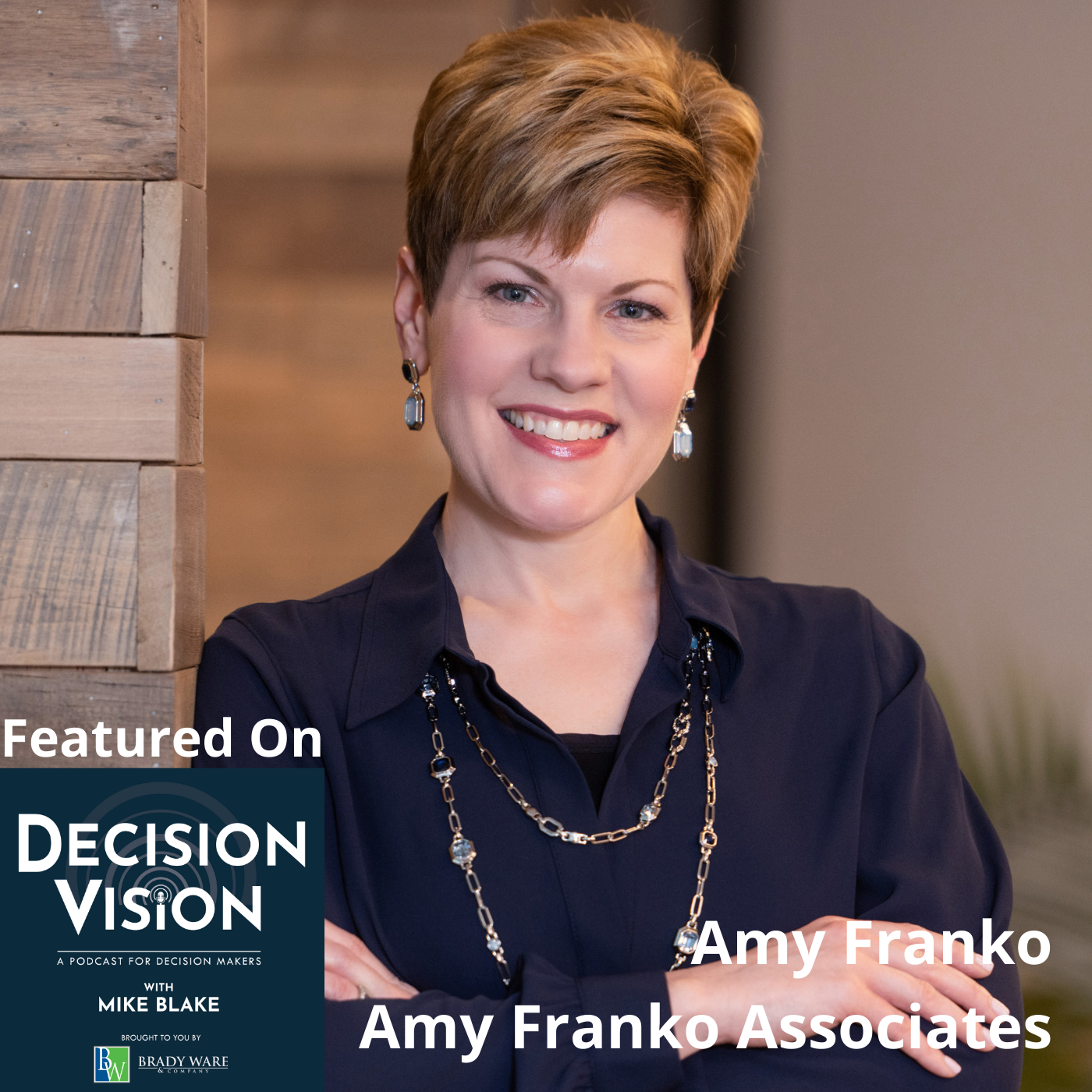
Amy Franko
Decision Vision
Decision Vision Episode 176: Should I Continue Investing in Sales and Marketing in a Recession?- An Interview with Amy Franko, Amy Franko Associates
Loading
00:00 /
RSS Feed
Share
Link
Embed

Download file

Amy Franko

Decision Vision Episode 176: Should I Continue Investing in Sales and Marketing in a Recession?- An Interview with Amy Franko, Amy Franko Associates

Tempting as it may be to cut expenses such as sales and marketing when faced with the prospect of a recession, Amy Franko argues that is a mistake. Joining host Mike Blake on this episode of Decision Vision, Amy, the author of The Modern Seller, discussed sales and marketing as an investment, the ramifications of putting the brakes on it in an economic downturn, sensible strategies to prepare, the need for Sales and Marketing departments to be in alignment, and much more.

Decision Vision is presented by Brady Ware & Company and produced by the North Fulton studio of Business RadioX®.

In his introduction, Mike mentioned this 2020 Harvard Business Review article on marketing in a recession.

Amy Franko Associates

Amy Franko Associates works with mid-market and enterprise-level organizations to significantly grow their sales results. This includes consulting on sales strategy, and learning programs focused on growing sales team performance.

Company website | LinkedIn

Amy Franko, CEO, Amy Franko Associates

Amy Franko, CEO, Amy Franko Associates

Amy Franko is the leading sales strategist for growth-oriented mid-market organizations. She works with a variety of sectors to grow sales results, through both sales strategy and skill development programs. Her book, The Modern Seller, is an Amazon best seller and she is also recognized by LinkedIn as a Top Sales Voice.

Amy is the Chair of the Board of Directors for Girl Scouts of Ohio’s Heartland, a Top 25 non-profit in the Columbus, Ohio region. She resides in Columbus with her husband Dave and their very energetic black lab, Roxy. She loves all things fitness, enjoys travel, and is usually reading several books at once.

LinkedIn

Mike Blake, Brady Ware & Company

Mike Blake, Host of the “Decision Vision” podcast series

Michael Blake is the host of the Decision Vision podcast series and a Director of Brady Ware & Company. Mike specializes in the valuation of intellectual property-driven firms, such as software firms, aerospace firms, and professional services firms, most frequently in the capacity as a transaction advisor, helping clients obtain great outcomes from complex transaction opportunities. He is also a specialist in the appraisal of intellectual properties as stand-alone assets, such as software, trade secrets, and patents.

Mike has been a full-time business appraiser for 13 years with public accounting firms, boutique business appraisal firms, and an owner of his own firm. Prior to that, he spent 8 years in venture capital and investment banking, including transactions in the U.S., Israel, Russia, Ukraine, and Belarus.

LinkedIn | Facebook | Twitter | Instagram

Brady Ware & Company

Brady Ware & Company is a regional full-service accounting and advisory firm which helps businesses and entrepreneurs make visions a reality. Brady Ware services clients nationally from its offices in Alpharetta, GA; Columbus and Dayton, OH; and Richmond, IN. The firm is growth-minded, committed to the regions in which they operate, and most importantly, they make significant investments in their people and service offerings to meet the changing financial needs of those they are privileged to serve. The firm is dedicated to providing results that make a difference for its clients.

Decision Vision Podcast Series

Decision Vision is a podcast covering topics and issues facing small business owners and connecting them with solutions from leading experts. This series is presented by Brady Ware & Company. If you are a decision-maker for a small business, we’d love to hear from you. Contact us at decisionvision@bradyware.com and make sure to listen to every Thursday to the Decision Vision podcast.

Past episodes of Decision Vision can be found at decisionvisionpodcast.com. Decision Vision is produced by John Ray and the North Fulton studio of Business RadioX®.

Connect with Brady Ware & Company:

Website | LinkedIn | Facebook | Twitter | Instagram

TRANSCRIPT

Intro: [00:00:01] Welcome to Decision Vision, a podcast series focusing on critical business decisions. Brought to you by Brady Ware & Company. Brady Ware is a regional, full-service accounting and advisory firm that helps businesses and entrepreneurs make visions a reality.

Mike Blake: [00:00:21] Welcome to Decision Vision, a podcast giving you, the listener, a clear vision to make great decisions. In each episode, we discuss the process of decision making on a different topic from the business owners’ or executives’ perspective. We aren’t necessarily telling you what to do, but we can put you in a position to make an informed decision on your own and understand when you might need help along the way.

Mike Blake: [00:00:42] My name is Mike Blake, and I’m your host for today’s program. I’m the managing partner of Brady Ware Arpeggio, a data-driven management consultancy which brings clarity to owners and managers of unique businesses facing unique strategic decisions. Our parent, Brady Ware & Company, is sponsoring this podcast. Brady Ware is a public accounting firm with offices in Dayton, Ohio; Alpharetta, Georgia; Columbus, Ohio; and Richmond, Indiana.

Mike Blake: [00:01:06] If you would like to engage with me on social media with my Chart of the Day and other content, I’m on LinkedIn as myself and @unblakeable on Facebook, Twitter, and Instagram. I also host a LinkedIn group called Unblakeable’s Group That Doesn’t Suck, so please join that as well if you would like to engage.

Mike Blake: [00:01:23] Today’s topic is, Should I continue investing in sales and marketing in a recession?

Mike Blake: [00:01:27] So, as we record this on June 21st, literally the longest day, but I don’t think John Wayne’s making an appearance. I miss him. Speaking of Dayton, Ohio, by the way, I think he’s a native of Dayton, but anyway. It seems more likely than not certainly the people who claim to be in the know about these things, and I’m not, but I just read and pair it what other people who say they know what they’re talking about say that a recession seems more likely than not and maybe it’s even necessary. It may take a recession to sort of snap us out of this inflationary funk that our economy is currently in. And, who knows, maybe Paul Volcker is walking through that door.

Mike Blake: [00:02:10] So, I’m of the age where I do remember vaguely anyway the recession of 1980 and 81, where the Fed slammed on the brakes in a big time way. I remember having a CD that offered 18% interest, which is like credit card rates now. I don’t know if we’ll go that high. But it does seem like by hook or by crook in a recession, and if you don’t buy the Fed narrative, there’s always the Russia-Ukraine War and spiking oil prices, spiking food prices, and now monkeypox. Right? We’re not so afraid of murder hornets anymore, but thank God we have monkeypox coming to take its place. So, not necessarily a whole ton of optimism in the economy.

Mike Blake: [00:02:54] And so, given that a recession is at least forecasted by many, and let’s face it, we have pandemic aside from, and I realize it’s a bigger side, we have had a pretty long run, 2008 and ’09 to 2022 is a 13-year run without a recession. I don’t know exactly the history, but I’ll bet you that’s one of the longest runs in history. The only one that’s longer that I can remember is Reagan from ’82 to ’92 up until the Gulf War, the first Gulf War. So, we’ve had a long run. So, from a business cycle perspective, I guess we’re due.

Mike Blake: [00:03:34] And now, for good or ill, I’m old enough to have been through a few of these cycles now. I guess one of the benefits of having gray hair and two arthritic ankles is that companies now have to make a decision on how they’re going to allocate capital. Right? And, the ever-present Elon Musk, who apparently never misses an opportunity to say something inflammatory and he’s got the audience to do it, first announced that basically anybody who’s not in the office just isn’t working at all. And then, he decided to put an exclamation point on that by laying off 3.5% of Tesla, which really in the greater scheme of it, there have been much bigger layoffs, especially in the car industry.

Mike Blake: [00:04:20] So, not to minimize it but, frankly, if you’re in a recession, I want to be let go at the start, not in the middle of it. You have a chance to find a landing spot more quickly, but anyway. And having been through a couple of recessions, one of the things that has been a common theme that I have observed is many companies decide that they’re going to cut back on their sales and marketing under the guise. Well, nobody’s buying anyway, so why bother investing and selling? We’ll kind of come back and get them at another time.

Mike Blake: [00:04:51] And according to The Economist, advertising and marketing spend in the United States actually decreased by 13% in the first quarter of the 2008 recession; 13%. That is a massive number. I’ll bet it’s the largest that has ever been, sort of the Great Depression. But on the other hand, a 2020 Harvard Business Review article by – I hope I’m getting these names right, I’m probably not but we’ll have this in the show notes – Nirmalya Kumar and Koen Pauwels advise not to cut marketing expenditures during a recession. So, who is right? The people who are making the decisions or people who are writing to tell people about how to make the decisions? And I don’t know. I’m a finance guy, so I don’t know the first thing about marketing.

Mike Blake: [00:05:40] So, to help us with this conversation, I have brought in somebody who is an expert, and her name is Amy Franko, who is the leading sales strategist for growth-oriented and mid-market organizations. She works with a variety of sectors to grow sales results through both sales strategy and skill development programs. Her book, The Modern Seller, is an Amazon bestseller, and she is also recognized by LinkedIn as a top sales voice. You can learn more at amyfranko.com, with a K by the way.

Mike Blake: [00:06:10] Amy is the chair of the board of directors for Girl Scouts of Ohio’s Heartland, a top 25 nonprofit in the Columbus, Ohio region. She resides in Columbus with her husband, Dave, and their very energetic black lab. I think that’s redundant by the way. I have a black lab as well. Yeah, separate conversation. But if we ever have a power outage, we’re going to put it on a treadmill and a turbine because I think she can power air conditioning. She loves all things fitness. That’s Amy. I have no idea what the lab likes to do.

Mike Blake: [00:06:10] Amy loves all things fitness, enjoys travel, and is usually reading several books at once. Amy Franko Associates works with mid-market and enterprise-level organizations to significantly grow their sales results. This includes consulting on sales strategy and learning programs focused on growing sales team performance. Amy Franko, welcome to the Decision Division podcast.

Amy Franko: [00:07:01] Mike, it is so good to be here. Thank you for having me.

Mike Blake: [00:07:04] I want to talk about, from a very foundational standpoint, when we talk about investing in sales and marketing, what exactly does that mean? Because I think a lot of people don’t necessarily think of sales and marketing as an investment because that implies an asset. When we say that, what do you think it means?

Amy Franko: [00:07:24] So, before I answer that question, I just have to say, as I was listening to your opening monologue, as I was listening to that, I wrote down a phrase here and you talked about the funk. Sales and marketing can be one of your solutions for the funk. So, I want to open with that, and then share with you – I love that question about sales and marketing being an investment because that is what it is. Because when you make those investments and you being a finance guy, these things drop to the bottom line, the investments that you make in sales and marketing ideally should help improve the bottom line if you’re making the right investments.

Amy Franko: [00:08:07] But as I think about the elements of what it means to invest in sales and marketing, these are things like your sales and marketing strategy, the way that sales and marketing are integrated. And today, more than ever, sales functions and marketing functions are much more integrated, or they should be, if yours or not, in your organization. It’s also investment in talent and having a talent pipeline of sales professionals and marketing professionals. It’s investing in education. It’s investing in your key market segments. It’s innovation.

Amy Franko: [00:08:41] So, there are a lot of different things that we can kind of pick apart here when it comes to actually the investment in sales and marketing. But if you, as a leader, look at sales and marketing as an investment, that will guide your decisions differently than if you look at it as a liability or just something that you have to do, but not something that you want to do.

Mike Blake: [00:09:05] So, what about the argument that you’re in a recession, it’s too hard to sell anyway, got to conserve resources, let’s just sort of retrench a little bit and kind of ride this out. What do you think of that argument or that mindset?

Amy Franko: [00:09:20] I don’t love that mindset. As I was looking at, thinking about questions, I had a big no. Just one. A big no with an exclamation point. Sales is really your revenue and profit engine, and it should be your profit engine, not just your revenue engine. And, marketing is your awareness and your lead generation engines. And if you put those engines into idle or you turn them off completely, you’re not going to be able to move forward. At some point, you are going to be stuck and your competitors or the markets will pass you by. And not to say that you may not need to make some strategic adjustments to your investments.

Amy Franko: [00:10:08] So, for example, pandemic, live events during the pandemic is a really easy one. A lot of that stuff was cut. But if you’re going to be successful in the long run, if you are planning to be in business and successful five years from now, 10 years from now, you can’t turn off the marketing and sales engines today, you need to continue to invest, but you need to invest smart. And you may need to make some strategic adjustments here and there. But if you make wholesale cuts or you are not doing them with a strategic focus, you may not feel that today but you’re going to feel it down the road.

Mike Blake: [00:10:46] And, I wonder if a lot of this discussion has to do with a mindset, you know, and maybe this just means I’m a classical toxic male, but I like to be on offense. When I’m in business, I don’t like to be reactive and responsive. I like to be on offense. And, because life has taught me that when I’m on offense, better things happen, because at least you can force some of the action, right?

Mike Blake: [00:11:13] When you decide you’re going to kind of shut her up and shut down or step back, you’re kind of ceding control of the market, aren’t you, right? To me, that’s a much more defensive stance. And, you’re all about trying to prevent something bad from happening. And, to me, I would find it very difficult. And then, this recession coming up, it would be my first time running a company in a recession, but I would find it very difficult to stay on defense for very long. I find it very difficult to motivate my people to stay on defense for very long.

Amy Franko: [00:11:47] Yeah. And to probably use an overused sports analogy, successful teams have a combination of strong offense and strong defense. You absolutely need both in order to be successful. I personally take a similar viewpoint where the sales and marketing activities are offense-type activities. You may also be keeping your competitors out, which is more of a defensive type of play. But I do see sales and marketing as being offensive. It’s being market forward.

Amy Franko: [00:12:23] One of the mistakes I see organizations make is they shrink back during tough times. And that’s not a good posture in the marketplace. Your clients and prospective clients might start to question how healthy you are as an organization. So, it’s a matter of really thinking through if we make this decision here, what might be the cascading consequence, whether it’s tomorrow or a year from now.

Mike Blake: [00:12:51] So, in my view, we are in a period of measurement. We want to measure everything. We’ve figured out that we can measure a lot more things than we historically have. It’s been revolutionary in marketing, right? I don’t think many people are saying anymore that they’re wasting half their money on advertising. They don’t know which half. Right? That’s something that you’re fired now. But 10 to 15 years ago, that was the state of the art. Right?

Mike Blake: [00:13:18] And that’s a long preamble to the short question, which is this, that in a recession, now that everything is measured, it’s now putting quotas at risk, potentially compensation at risk for salespeople that are commission-based or marketing people or teams that have to meet certain targets on marketing that may or may not be realistic in a recession. So, as management, how do I react to that? And is there a balance you have to walk or establish between still trying to be aggressive and achieve goals, but at the same time not enabling and kind of letting people off the hook altogether because, oh, because recession?

Amy Franko: [00:14:04] Yeah. I think what makes the recession conversation interesting, some people don’t like to talk about recession because they think they’re going to bring it about by talking about it. But recession is often you’re looking out the rearview mirror. It’s, you know, GDP lowering over the course of I think it’s, what, two quarters in a row, so six months of time.

Amy Franko: [00:14:31] So, you realize that you’ve been in a recession when you’re looking in the rearview mirror, you can’t always anticipate what’s happening. And there are lots of companies that thrive during contracted periods of time in recessionary periods. So, just because the markets might be experiencing a recession, that doesn’t necessarily mean your organization is going to experience it if you are diversified, if you are smart about your product and solution mix, or where you happen to be.

Amy Franko: [00:15:05] But to directly answer your question about the quota piece of it, leaders do need to strike a balance, because what you don’t want to do is kill your sales culture. If you have something – I was thinking about this this morning and thinking about vulture culture, which means you might be going after the wrong customers to meet a bottom line. You might be changing compensation plans for your sales teams, which is a surefire way to have issues, let’s just say, you’re essentially creating an unhealthy culture.

Amy Franko: [00:15:44] So, as leaders, we have to really think about the decisions that we’re making when it comes to, you know, you might need to rightsize in the sales quota, you might need to rightsize some things, but to not do it in a vacuum and to think about how those changes could have cascading consequences, and to keep morale, you want to include your sales teams as much as possible in the conversations so that you could potentially come to some solutions together and, as leaders, you’re not just relying on one or two leaders making the decisions without input.

Mike Blake: [00:16:21] You know, in that part about culture, and I think by extension if I can put words in your mouth a little bit, almost a scarcity mentality.

Amy Franko: [00:16:30] Yeah.

Mike Blake: [00:16:31] Reminds me, actually, I watched – for the first time ever, I’m not a big movie guy, but on Friday for the first time ever, I actually watched the entirety of Glengarry Glen Ross, not just the coffees for closers thing. By the way, how Alec Baldwin gets third billing for about 5 minutes of dialogue, he must have had the best agent in the world. But anyway talk about a case study on a toxic culture where in effect most of those people felt like they were behind the 8 ball and frankly could not succeed and there was an absence of leadership and there was an absence of resources to at least make the salespeople feel like they could succeed in an ethical way. Right?

Mike Blake: [00:17:17] And I can’t help but think, as I was watching this – I didn’t do it to prepare for this podcast, just sort of worked out that way. But there is a risk I think even in 2022, so-called modern management, that a boiler room mentality can return, right, unless you adjust expectations and compensation structures.

Amy Franko: [00:17:41] Yeah. And there are plenty of tales of caution out there of those types of sales cultures that might work in the short term. But for the long term, you hurt your culture, which takes a long time to rebuild and probably would also mean a turnover in leadership to do that rebuild and you risk losing market share. So you might be chasing something for the short term, but for the long term, you lose out.

Mike Blake: [00:18:14] So, let’s talk a little bit about the disruption element of a recession. I think that sometimes people forget that some of the most interesting companies have actually been born during recessions, Apple being one during the first oil crisis. Can a recession be thought of perversely as an opportunity?

Amy Franko: [00:18:34] Yes, absolutely. I think there are a lot of opportunities that a recession can provide. You may have competitors that exit, that provide market share opportunities. To your point, you might create an entirely new business during a recession. You have the opportunity to maybe open a new market or find a new way of bringing an existing service to market. If you’re a company of strong cash reserves, you might be able to invest where others aren’t.

Amy Franko: [00:19:07] To prep for our conversation today, I was just doing a little bit of homework on the types of organizations that, or types of businesses I should say, that really thrived during the pandemic. So, these can be lessons for all of us even if we aren’t in these industries. So, like the cleaning industry, the delivery industry, the fitness industry, COVID remote testing, that type of industry. Those are examples of industries that really grew during the pandemic. And now the job of those companies is to continue to capitalize on that. And obviously, there are other challenges around supply chain and staffing shortages.

Amy Franko: [00:19:49] But just because we might be in the midst of a recession if we do look at it as an opportunity, and that comes back to your comment about mindset, we can choose how we look at it, and then if we choose to look at it as an opportunity and we use our actions and behaviors as leaders to look at it as opportunity, then we’re going to be in a much better position to actually find the opportunity versus just shutting our minds and shutting our eyes to finding them.

Mike Blake: [00:20:17] Yeah. You know, and the thing about recessions, it brings to mind a writer that I’m fond of, Nicholas Taleb. He wrote The Black Swan in addition to other things. He also wrote another book called Antifragile, which is effectively a book about resilience. And he made a fascinating observation, which I think is so profound, which is the difference between organisms and mechanisms, is that mechanisms, as they are used, depreciate and deplete. Organisms as they are used actually become stronger. Right?

Mike Blake: [00:20:51] So, people, as we use muscles, for example, they become stronger. Under stress, they become stronger. But machines under stress become weaker, more fragile. They’ll have to be maintained and overhauled. Right? And, I wonder if there’s – as I think about this upcoming recession, I think about and wonder, is that an opportunity for us to become stronger because it is going to create stress, and stress actually can produce very useful things. What do you think about that?

Amy Franko: [00:21:19] That’s such an interesting observation. And it’s reminding me of a conversation that I had with another sales consultant. I was interviewed on his podcast. His name is Victor Antonio, and he has an excellent podcast called The Sales Influencer, for anybody who’s interested in those topics. And what we were talking about, the observation was that in the last year or so, with things like supply chain shortage, resource, human resource shortage like staff shortage, we’ve both talked to so many organizations where sales professionals were saying, “I have so many orders. I can’t even fulfill the orders that I have because we have supply chain problems. We are growing like crazy because there’s so much demand for our service or a product.” You know, fill in the blank.

Amy Franko: [00:22:13] Now, what you’re seeing, and this was his observation which ties to what you just shared, is what sales skill atrophy, if you will. The muscles have not been used because they haven’t had to be. And now we might be entering a period where we have to flex those muscles again, but it’s going to take a few more workouts to get that strength back.

Amy Franko: [00:22:37] So, it’s a really interesting scenario. The people that have continued to work out all through this and keep those skills, whether it’s a leader making the investments or an individual continuing to sell, they’re the ones that are going to thrive. Whereas you’re going to see a lot of organizations that have had that atrophy and they’re going to have to figure it out.

Mike Blake: [00:22:59] I think that’s fascinating. I think that’s a really smart observation, because in a boom time like we’ve had, I do think that it’s been a good time for order takers. Right? But in a recession is when you really appreciate the order makers. Right? And you’re right if you have not been flexing that. And COVID is a perfect example. Right?

Mike Blake: [00:23:25] I went to my first networking meeting about, I guess is, last month in about two and a half years, and I basically drooled on the floor most of the time. I didn’t know how to talk to people anymore. I couldn’t have found my business card if you’d given me 10 minutes and a magnifying glass. Right? I was not at my smoothest, and, you know, a sales – we’re so not used to scarcity right now when it comes to revenue for a lot of us, now that I say this I’m going to lose all my customers tomorrow, so I’ve got to be really careful; knock on wood. But there is a muscle that probably is going to need to exercise.

Mike Blake: [00:24:03] So, with that in mind, I’m going to go off script a little bit because this brings to mind a really interesting – in my mind, a really interesting question. Assuming that people believe the same as I do that some form of recession is coming in the next, let’s say, by the end of the year, how can companies start to prepare now to either at least not be terribly hurt by the recession from a sales and marketing perspective, if not actually position themselves to thrive? How do you – what’s the equivalent of sort of buying all the storm windows before the hurricane hits?

Amy Franko: [00:24:40] Yeah, right. So, where I would counsel my clients to start is you need to get out your sales strategy and you need to get out your marketing strategy, and hopefully those two things exist in your organization. So if they exist, you need to pull them out and this is the time to take a look at them and to determine where you are and where you want to go into the future. If you don’t have these things, it’s not necessarily time to hit the panic button, but you want to get those things in place as well as you can because those can be your North Star, if you will. So, that’s where I would counsel my clients to start.

Amy Franko: [00:25:33] The other thing I would counsel my clients on is to not pivot too hard because I’ve seen organizations chase unproven markets where either they don’t know, they haven’t done their research on what the outcomes could be, or they don’t have enough of their own market share or visibility in those unproven markets. You can squander resources without return.

Amy Franko: [00:26:00] So, you want to take a look at where those resources are being invested and you want to take a look at your numbers. Where are you investing in sales? Where are you investing in marketing? Do you have the return on those investments? So, those are a few places that I would counsel my clients to start.

Mike Blake: [00:26:19] So, what are the landmines? What are the most common mistakes that companies do make in terms of responding to a recession from a perspective of investing in sales and marketing?

Amy Franko: [00:26:31] Yeah. I think the word react really comes to mind. It’s being reactive instead of proactive and not staying the course with the strategy that you’ve designed and not to say that strategy should be stagnant. You know, I am working with clients who are working on strategy that’s maybe a year to 18 months. So, I will work with clients on their sales strategy. And you want to stay the course, but you also want to take a look at what are the returns on those different investments. So, I would say a mistake is to not know your numbers when it comes to sales and marketing return.

Amy Franko: [00:27:17] One of the things that I see organizations do pretty regularly and it doesn’t matter, it’s not necessarily a comment on the recession. It’s really easy to hang on to resources whether they are people resources or other types of investments that you know aren’t performing. They’re dragging on the organization in some way, shape or form, whether it’s organizational morale or dragging on the bottom line and not being proactive with that. That hurts more during a recession. But I see it regardless of what the economy happens to be doing, and that’s a very common mistake.

Mike Blake: [00:27:59] You know that’s interesting because one of the benefits of recessions is, it does sort of separate wheat from the chaff. Right? And though you can – sometimes you can put up with mediocre performers because the recession allows you to do it, but, boy, a recession tends to reveal people’s shortcomings, especially on the sales and marketing side pretty quickly, doesn’t it?

Amy Franko: [00:28:20] It can. And this is where, even – you know, even really high performers, elite performers, aren’t immune to things that happen during a recession. I have seen very elite performers just the industries that they are selling into have hit slumps and some industries were hit much more heavily than others during the pandemic.

Amy Franko: [00:28:44] So, again, that is to your point where you separate the elite high performers from the others. Because the elite high performers, whether it’s in a sales function or a marketing function, they’re the ones that are going to be more resilient and they’re the ones that are going to say, “All right, things do not look good right now. I might be at 50% of my number or maybe even less. But here’s what I’m doing. Here’s how I’m thinking. Here’s what I’m going to go into the market with.” And they aren’t letting it – they aren’t letting it stop them from thinking creatively and being strategic. They’re not just going to sit back.

Amy Franko: [00:29:20] So, in the absence of seeing hard performance numbers like reaching a quota or numbers of leads generated from a marketing campaign, this is where leaders have a great opportunity to really get to know what their individual folks are doing and what their thought processes are and how they’re approaching because that’s going to tell you a lot about how they’ll recover when we do come out of whatever the latest disruption is.

Mike Blake: [00:29:48] What’s an example of a company that got marketing and sales right during the last recession? Can you think of one?

Amy Franko: [00:29:55] Well, you know, this may not be a recession conversation, but I think it’s a unique and interesting story that just speaks to kind of staying the course with strategy. And it’s an Ohio company. It’s a Gojo Industries, which is up in the Northeast Ohio area. And having been a family-owned business, you may not know who Gojo is, but you probably know the brand Purell. You know, Purell is on par with brands like Kleenex and Coke. It’s not hand sanitizer. It’s Purell. Right? But there was a time where that was a market, not a market, it was a loss leader for them. And it took them about a decade to get that product to where it is today, to profitability.

Amy Franko: [00:30:50] And, as I was reading about this, what really struck me was the leadership choices that the organization made, the leaders in the organization to say, you know, if we were perhaps a publicly-traded organization, this is an example of something that would have been cut years ago. But we really believed in it and we wanted to continue to bring it to market even though it took the time that it did and that investment paid off.

Amy Franko: [00:31:14] Now, that’s not necessarily a recession story. It is a story of understanding what your company values are and where you want to invest your resources and those decisions that you make from there. But, again, some of those industries, we could take some real lessons from industries that have thrived during pandemics. And I mentioned a few of them, but a couple of others are health care, telehealth, behavioral health, things like that. What are the lessons we can take from those and apply to our own businesses?

Mike Blake: [00:31:50] Your observation draws me to an observation I love you to react. I wonder if from a purely strategic perspective, privately-held companies actually have more freedom to operate in terms of recession and making investments because they at least have the freedom. Maybe they do or don’t do this, but they have the freedom to think in five and ten-year increments. Whereas in the public company sector, right, when a recession happens, you are expected to slash and burn. That’s what Wall Street wants to see. That’s where people’s bonuses are going to come from in terms of stock price, right, and not necessarily financial performance directly. Could the case be made that private companies actually have an advantage over public companies during a recession?

Amy Franko: [00:32:39] I think you can make the case that there is an advantage there. I think there’s also an advantage to – I think smaller organizations could have an advantage. They may not have the deep pockets, if you will, of larger organizations, but they can often be more nimble and more creative because they’re not constrained by their own mechanisms. Right? They have that ability to be a bit more creative.

Amy Franko: [00:33:04] I agree. I think a privately-held company could absolutely have an advantage. And even in uptimes, publicly-traded organizations are often running quarter to quarter and making these adjustments and pivots to product mix, how they’re incentivizing sales teams, what focus they’re going, what product focus or solution focus they’re going to put their time and attention toward because external forces are pressing down on them to make those decisions. Whereas a privately held organization, they’re going to have internal pressure, but they can make those decisions from the inside out versus the outside in.

Mike Blake: [00:33:46] So, you’ve brought up a term a couple of times that I want to pause on for a second because I do think it’s really important, and that is about reallocating resources. So, when a recession hits, I want to talk about first marketing and then sales. So first, how do you see companies or how should companies think about potentially, if not, reducing the amount of resources in a recession, how those same resources are allocated?

Amy Franko: [00:34:16] So, probably a recent one that can we probably all wrap our heads around is with the pandemic and just the fallout from that, the lack of live events, whether it’s a networking event, it’s a conference, you know what have you. The conference industry, of course, was rocked really hard by the pandemic. And it’s going to take multiple years for them to, for that industry, to recover. But that’s probably a pretty top-of-mind type of example, where if you’re an organization that put a lot of your marketing dollars into things like tradeshows, all of a sudden you had a complete marketing channel that you relied on heavily, it just completely dried up.

Amy Franko: [00:35:04] So, now as a leader, marketing leader or otherwise, you are faced with, all right, here’s this bucket of dollars that we are putting into one channel. I now have some decisions to make on where to reallocate that to. And if you have not had any diversification in those channels, you’re a little bit behind in the game to figure out where to reallocate those dollars or those people to. The other part of that is the replacement mechanisms, which were virtual conferences, a lot of my clients, frankly, did not get ROI out of virtual conferences because of the way that they are structured and just the way that you meet people and cultivate opportunities. It just wasn’t there.

Amy Franko: [00:35:52] So, you have to think about the replacement. Is the replacement going to be as good or better? And if I have this bucket of dollars and I’m going to pull it away, am I going to pull it away permanently, or am I going to maybe put a portion of those dollars back as things start to come online? So, that’s an example of where leaders have decisions to make about where to allocate marketing dollars and do they want to put the pie back to where it was pre-pandemic or pre-recession, or did they make those changes permanent?

Mike Blake: [00:36:29] So, I’ve read that social media tends to be the weapon of choice during a recession now. Have you heard that? Is there any truth to that? Is there any validity to that, or is it maybe –

Amy Franko: [00:36:44] Yeah. You know, I have a bit of an opposite viewpoint. Social media absolutely has its place. And for anyone that connects with me, you will see my presence on social media and definitely more on the business platforms. I use LinkedIn. I mean, I would argue that all the platforms can be used for some type of business.

Amy Franko: [00:37:07] Social media absolutely has its place. Where I see mistakes being made is that companies swing the pendulum so far in that social media direction that it can become a lot of noise. And, I’m a big believer that you have to have a really smart, business-oriented sales force to complement what you might be doing on social media. So, I believe in diversifying. And if all of your eggs are in a social media basket, I believe that you’ll be challenged as an organization moving forward.

Mike Blake: [00:37:45] Now, what about reallocating personnel, particularly sales force, during a recession? Is there a way to do that? Are our salespeople capable, willing to contribute in some other way that they just have to change the way that they sell? Are cutbacks perhaps inevitable whether deliberately or people are just sort of leaving to find a better opportunity? How do you see – what do you think best practices are for companies confronting personnel decisions during a recession?

Amy Franko: [00:38:18] Yeah. So, a lot of the things that you just talked about kind of wrapped up in that question about reallocating resources to other functions or how do we, for lack of a better phrase, rightsize the sales function? I think it starts with as a leader and this is whether you have a small sales team or you have multiple sales teams and you’re a global organization, having the right structures in place really show themselves during recessionary times or in disruptive times. And I mentioned this before that a lot of organizations hang on to professionals that are not not performing.

Amy Franko: [00:39:04] So, as a leader, you do have some options. You may need to cut back on your sales force. You may have some low performers on your team, which every organization has them. I’ve yet to come across an organization that doesn’t. This is also a choice where if you have really savvy sales professionals are going to find a way to stay productive and to continue to build relationships and to set themselves up for moving out of the recession, you have to know who those people are as a sales leader.

Amy Franko: [00:39:45] Most sales organizations don’t have the right sales processes. They don’t have the right skill development, and they don’t understand the skills of their team. If you understand the skills of your team and where they have strengths and weaknesses, that’s going to put you in a lot better position to understand the changes that you might have to make if you hit a period of contraction or some other type of disruption.

Mike Blake: [00:40:13] And what about the balance, if you will, or maybe the relationship between sales and marketing? Does that change? Do you – would you – do you think that best practices would indicate that companies are going to maybe tip the balance in favor of marketing in terms of lead generation? Or are they going to tip in favor of sales in terms of trying to close more of the leads that they have?

Amy Franko: [00:40:38] Yes. The best organizations that I see and work with are working toward an integration of marketing and sales. Now, you may have a chief sales officer or a VP of sales, and you may have a chief marketing officer. You may have people that are sitting in those roles and they’re leading their respective teams. But that type of sort of separated approach, you need to have those leaders that are on the same page moving forward, which is why I will often advocate for a sales and marketing strategy together. Even though you might be doing different activities, your marketing efforts have to support your sales teams, and your sales teams need to take what is created, assuming its quality, and move it through your sales process and your sales pipeline.

Amy Franko: [00:41:35] So, I find the best practice to be an integrated approach to sales and marketing where those leaders are in lockstep, and then that message kind of cascades down to the teams. And if I’m a sales professional, if I’m smart, I want to learn about what’s new in marketing and what my marketing team is doing. If I’m a smart, savvy marketing professional, I want to understand what’s happening in the sales landscape and spend time with my sales teams.

Mike Blake: [00:42:05] Now, what about the choice or the decision on whether or not you’re going to focus on maybe doing more work, more business with your existing customers versus new customer acquisition? How does a recession change, if at all, that calculus?

Amy Franko: [00:42:25] My philosophy is retaining and growing your existing customers is one of your best methods of offense during any type of period of contraction, recession, pandemic, or otherwise. And, every organization is a little bit different. But understanding what the right balance is for your organization, I tend to see a 70-30 split between expanding your existing customers and finding net new logos to add.

Amy Franko: [00:43:00] So, I think professional services, Mike, is a great example of where there’s been a lot of addition to what professional services firms offer. And especially, I work with a lot of public accounting firms, so about half of my business is public accounting and consulting. And, the organizations that have added ancillary high-value services to their portfolio now are in a great position to be able to go to current clients and offer these new services, new ways of thinking that maybe the client didn’t realize, “Oh, my gosh. I didn’t even realize you consulted on this. I absolutely need you to help me with this.” That’s offensive and defensive because not only are you providing a new value, which is offensive, you are ideally keeping your competitors out, which is a great defensive play.

Mike Blake: [00:43:50] So, not all recessions are created equal. Of course, the one that we went through in ’08 was really bad. It was a balance sheet recession that required systemic realignment throughout the economy to sort of rebound from. Others have not been nearly as severe. And so, my question is, does the – and this one doesn’t look like it’s necessarily going to be as severe as ones we’ve had in the past. Does that change at all how one should react to a recession or address a recession or approach a recession from a sales and marketing perspective, if you believe that the recession, for lack of a better term, just frankly just won’t be that bad?

Amy Franko: [00:44:33] Yeah. Sometimes I think it’s kind of the equivalent of pulling out your magic 8 ball and trying to figure out is it going to be bad or is it not? As I was thinking about our conversation today and kind of reflecting on that 2007 to 2009 period, we often talk about it like it was last year, but it was 13 or 14 years ago now. And if you look at your workforce, there’s probably a good portion of your workforce that were in high school when that 2008 recession was here, right, and they’re in their late 20s, maybe early 30s at this point.

Amy Franko: [00:45:13] So, I share that just as a way to give us a little bit of perspective that, like you said, not all recessions or contractionary period, contractive periods are the same. And it’s important to take the lessons that we’ve learned but to know that you may have a portion of your workforce that wasn’t even in the workforce when the last one hit so they may not have a frame of reference and just to treat each thing like its own individual time period and how can I be successful in this time period and also look to the future.

Mike Blake: [00:45:54] I’m talking with Amy Franko and the topic is, Should I continue investing in sales and marketing in a recession. Should a recession alter a company’s risk posture? And in fact, could an argument be made that a recession might be actually a better time to take risks?

Amy Franko: [00:46:12] Yeah. I think every leader is looking at, how do I maximize my upside and minimize my downside, right? So if you are looking to do that throughout your company’s history, whether it is an uptime or we’re hitting a period where we may hit some downtime, if we are smart and doing scenario planning while times are good, then we can minimize our downside ideally in downturns.

Amy Franko: [00:46:50] So, yes, if you have been, if you have good cash reserves, you have maintained a healthy balance sheet, you have diversified products and services, you can absolutely maximize downside. And companies are doing that all the time. It’s whether or not you have put yourself in a position to be one of those companies.

Mike Blake: [00:47:14] You’ve used the term a couple of times in this conversation that I want to come back to, because it’s a very important term, and that’s pivot. How do you decide whether or not the things you need to do or should do in a recession are of a nature where you’re simply rebalancing and adjusting versus a wholesale pivot, which to me implies you’re just going to abandon something and do something else because the thing you were doing just isn’t making it.

Amy Franko: [00:47:44] Yeah. Pivot’s one of those words you could put on a buzzword bingo board.

Mike Blake: [00:47:49] Absolutely. We’ll take that bingo board to the next level with that one.

Amy Franko: [00:47:53] Right. Right. So, between the words pivots and nimble and agile, I feel like we have a whole new game of buzzword bingo. So, yeah, how do you decide whether to pivot strategy, tactics, products, all of that? I think your scenario planning ahead of time can help you with that. Personally, I think that there is a balance between capitalizing on a market opportunity that can present itself during a downtime versus you pivot so hard and you put so many resources into something that isn’t going to pan out. And then, you find that now you have these resources that you’ve wasted.

Amy Franko: [00:48:39] So, your scenario planning ahead of time can be really important. Like, hey, if we do hit a downturn, what are our options? Or you’re in an uptime, what are the markets telling us what we might be able to capitalize on something and then when there is a downturn, you’re in a position to do that? So, it’s continually scanning the environment. So, when I’m doing strategy work with clients’ sales strategy primarily, we’re looking 12 to 18 months out instead of, say, the traditional three to five-year plan that typically gathers a lot of digital dust. And your risk tolerance will determine how hard you take, how sharp is that pivot.

Mike Blake: [00:49:22] So, before we wrap up, there’s a question I want to ask you. And I’m going to admit the question is blatantly unfair. In fact, it’s so blatantly unfair. And I kid you not, there’s no hyperbole here. I think it’s the most difficult question I’ve ever asked in the podcast. And this is episode 173, I think, 170 something.

Amy Franko: [00:49:41] You saved this one for me.

Mike Blake: [00:49:43] Yep.

Amy Franko: [00:49:44] All right. Let’s do it.

Amy Franko: [00:49:44] Because I think you can handle it. So in a recession, the reality may be that even though you advised a client to continue financing their sales and marketing operations, they may not have the money to do so. Right? They may be losing money, right? And they just got a cut. So, my blatantly unfair, horrible question is this. Assuming that the company had a clean, fairly strong balance sheet and assuming that the business owner had fairly middle-of-the-road risk tolerance, would you go so far as to advise a client or to yourself, if you’re in that situation, to actually consider taking on external money from a bank or an investor to keep up your sales and marketing during that recession until operations can recover and pay for it on its own?

Amy Franko: [00:50:43] That’s a really good question. When I think about taking on outside money, outside money could be you’re dipping into your line of credits. Outside money can be you are taking on an external investor who is putting money into your organization and now you have another stakeholder. So, there are probably a lot of considerations for taking on outside investment.

Amy Franko: [00:51:12] So, my answer to that, it’s a conditional yes, and here’s why. I am not opposed to companies taking on or using their debt instruments or outside investment instruments if they have a really clear picture of how they want to use it. If there isn’t a clear picture on how to use it, that can start to become another stressor on the balance sheet and on you as a leader, quite frankly, that you want to consider.

Amy Franko: [00:51:49] So, this is where having outside perspectives, whether it’s my perspective or might even your perspective with your areas of expertise, and really thinking through whether or not that outside investment is going to pay off. If the outside investment, especially if it’s like a line of credit and it’s a low-interest rate on a line of credit and that is a fairly low risk, then that might be an easier decision than taking on an actual outside investor who now has a say in how your company is run.

Amy Franko: [00:52:23] So, a long answer to your question, I wouldn’t leave it off the table, just having very clear parameters on how that’s going to play out and what your exit points are if you see it not working out.

Mike Blake: [00:52:38] Very good. You rose to the occasion. You answered a very tough question. Thank you. Thank you for doing that.

Mike Blake: [00:52:46] Amy, this has been a great conversation but we are running out of time. I’m sure there are questions that our audience wished we would have talked about or maybe talked about longer. If someone wants to contact you for more information about this topic or something related, can they do so? And if so, what’s the best way for them to do that?

Amy Franko: [00:53:03] Yes, please. I would love to hear from you. Two ways. The first is LinkedIn. I’m Amy Franko on LinkedIn. And, please mention that you heard me on our podcast here and I’d be happy to connect with you there. And then, also you are welcome to go out to amyfranko.com and reach out to me that way.

Mike Blake: [00:53:21] That’s going to wrap it up for today’s program. I’d like to thank Amy Franko so much for sharing her expertise with us.

Mike Blake: [00:53:28] We’ll be exploring a new topic each week, so please tune in so that when you’re faced with your next business decision, you have clear vision when making it. If you enjoy these podcasts, please consider leaving a review with your favorite podcast aggregator. It helps people find us so that we can help them.

Mike Blake: [00:53:44] If you would like to engage with me on social media with my Chart of the Day and other content I’m on, LinkedIn as myself and @unblakeable on Facebook, Twitter, and Instagram. Also, check out my LinkedIn group called Unblakeable’s Group That Doesn’t Suck. Once again, this is Mike Blake. Our sponsor is Brady Ware & Company. And this has been the Decision Vision podcast.


Tagged With: Amy Franko, Brady Ware & Company, Decision Vision, Mike Blake, recession, Sales and Marketing, sales strategy, sales teams, The Modern Seller

Business RadioX ® Network


Our Most Recent Episode

CONNECT WITH US

  • Email
  • Facebook
  • LinkedIn
  • Twitter
  • YouTube

Our Mission

We help local business leaders get the word out about the important work they’re doing to serve their market, their community, and their profession.

We support and celebrate business by sharing positive business stories that traditional media ignores. Some media leans left. Some media leans right. We lean business.

Sponsor a Show

Build Relationships and Grow Your Business. Click here for more details.

Partner With Us

Discover More Here

Terms and Conditions
Privacy Policy

Connect with us

Want to keep up with the latest in pro-business news across the network? Follow us on social media for the latest stories!
  • Email
  • Facebook
  • Google+
  • LinkedIn
  • Twitter
  • YouTube

Business RadioX® Headquarters
1000 Abernathy Rd. NE
Building 400, Suite L-10
Sandy Springs, GA 30328

© 2025 Business RadioX ® · Rainmaker Platform

BRXStudioCoversLA

Wait! Don’t Miss an Episode of LA Business Radio

BRXStudioCoversDENVER

Wait! Don’t Miss an Episode of Denver Business Radio

BRXStudioCoversPENSACOLA

Wait! Don’t Miss an Episode of Pensacola Business Radio

BRXStudioCoversBIRMINGHAM

Wait! Don’t Miss an Episode of Birmingham Business Radio

BRXStudioCoversTALLAHASSEE

Wait! Don’t Miss an Episode of Tallahassee Business Radio

BRXStudioCoversRALEIGH

Wait! Don’t Miss an Episode of Raleigh Business Radio

BRXStudioCoversRICHMONDNoWhite

Wait! Don’t Miss an Episode of Richmond Business Radio

BRXStudioCoversNASHVILLENoWhite

Wait! Don’t Miss an Episode of Nashville Business Radio

BRXStudioCoversDETROIT

Wait! Don’t Miss an Episode of Detroit Business Radio

BRXStudioCoversSTLOUIS

Wait! Don’t Miss an Episode of St. Louis Business Radio

BRXStudioCoversCOLUMBUS-small

Wait! Don’t Miss an Episode of Columbus Business Radio

Coachthecoach-08-08

Wait! Don’t Miss an Episode of Coach the Coach

BRXStudioCoversBAYAREA

Wait! Don’t Miss an Episode of Bay Area Business Radio

BRXStudioCoversCHICAGO

Wait! Don’t Miss an Episode of Chicago Business Radio

Wait! Don’t Miss an Episode of Atlanta Business Radio