
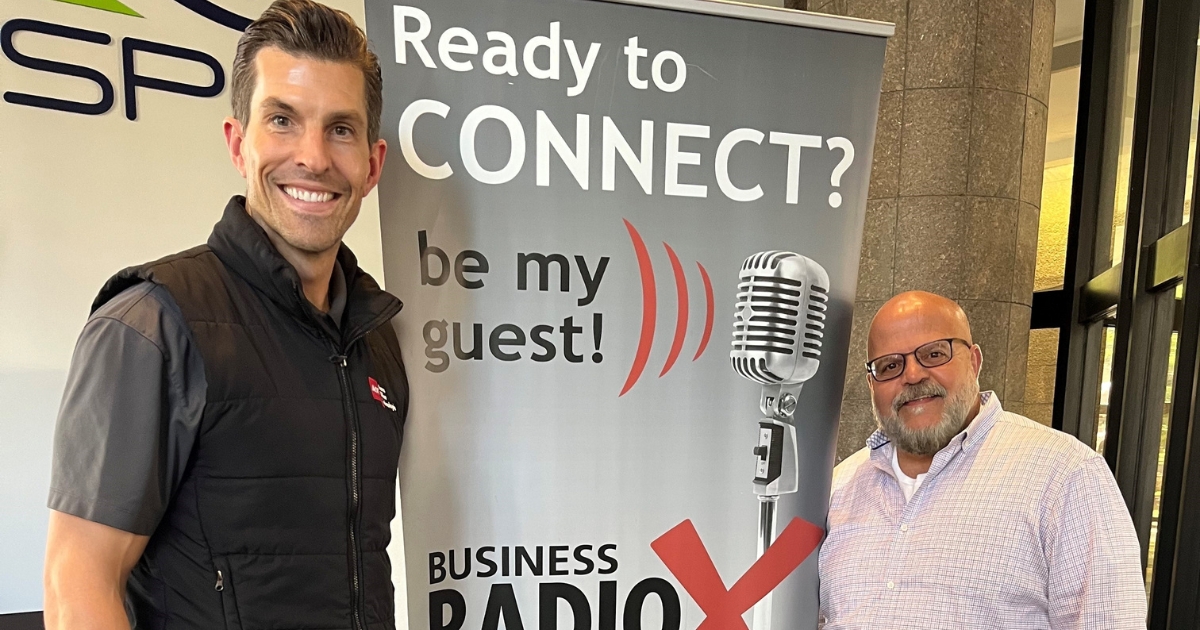
In this episode of Greater Perimeter Business Radio, host Ramzi Daklouche interviews Phil Van Gelder, co-founder of AOT Office Technologies. Phil shares his unconventional journey into the office technology industry, initially aspiring to be a professional athlete and later a broadcast journalist. He discusses the founding of AOT Office Technologies, which provides enterprise print management solutions to small and medium-sized businesses. The conversation covers the importance of hiring the right people, customer retention, and the challenges of marketing. Phil emphasizes the value of focus, perseverance, and building strong client relationships for sustainable business growth.

 Phil Van Gelder, co-founder of AOT Office Technologies, oversees sales and new business development.
AOT is an Atlanta-based, locally owned and operated, office equipment and automation company. The founding members of AOT have over 150 combined years of industry experience.
Since our inception, we have witnessed exponential growth throughout the entire USA, serving more than 1,600 clients in 44 states. The success of AOT is not derived from a secret formula or unmatched wit, but rather, simple principles that continue to not only produce results, but a world-class customer experience.
AOT is focused on offering powerful solutions, in really simple ways, around these commercial technologies:
- Copiers and MFPs: We work with clients that have one machine, and others that have a thousand
- Printers and Managed Print Services: We take the headache of managing these units off your plate
- Software: Print management software, document retention and workflow software, intelligent scanning
- Wide Format Printers: We bring construction and engineering to life with these units; up to 48” wide
- Thermal Printers: We provide the label and shipping printers to the e-commerce, logistics and warehouse industries
- Audio/Visual: Interactive touch panels, video conferencing, noise cancellation, and microphones/speakers
What makes AOT different?
- We hire service and support staff, before salespeople. We know we’re good enough to earn your business, but we want to be great enough to keep it! You’re not going to call us to tell us we’re doing a great job. You’re calling because you have a problem. We never want a client to wait for their need to be addressed. Staffing to that need is critical to differentiating our business.
- We are debt-free. Operating a business that holds a strong liquidity position is vital to the longevity of that business. Furthermore, we see it as a responsibility to our clients. We need to have every element of our business fully-stocked and ready, so that nothing is ever delayed due to limitations in our credit worthiness.
- We have size and scale. We are a dealership, which means we buy our products from the manufacturer and then sell and service that product to and for our clients. Our size allows us to have incredible influence with our OEM partners, helping to ensure industry-leading prices and top-notch support. We believe our clients deserve that.
We operate AOT with a mindset that, “Bigger is not better. Better is better.” It’s not that we don’t want to grow, but rather, we want to make sure that we’re growing our business in a fundamentally sound way. That requires profit and reinvestment, not just more zeros on the topline.
Follow AOT on LinkedIn and Facebook.
 This transcript is machine transcribed by Sonix.
TRANSCRIPT
Intro: Broadcasting live from the Greater Perimeter. It’s time for Greater Perimeter Business Radio. Now, here’s your host.
Ramzi Daklouche: Welcome to Greater Perimeter Business RadioX, where we highlight the innovators and leaders driving business forward. I’m your host, Ramzi Daklouche. Today’s episode is sponsored by VR Business Sales of Atlanta, trusted advisors and business sales, mergers and acquisitions. With over 20 years of real world experience. VR helped business owners maximize value and exit on their terms. Learn more at world.com or call (678) 470-8675. Joining us today is Phil Van Gelder, co-founder of AOT Office Technologies. Phil leads sales and business development for a team serving over 1600 clients nationwide with smart, scalable technology solutions. Welcome, Phil. How are you?
Phil Van Gelder: I’m good. Thanks. I feel like now I’ve got to live up to what you just said. Oh, I feel they. What did they say? Your reputation precedes you. I’m like, wow, this sounds a lot better than I ever imagined.
Ramzi Daklouche: So it’s really not 1600. It’s like more than 12. Round, 1200 rounding up. Fantastic. Well, listen, Phil, you’ve been in this business for 20 years. What originally brought you into Office Technologies and how has that journey evolved?
Phil Van Gelder: Well, I would probably tell you that I didn’t dream about doing this when I was a little kid. I didn’t fall asleep thinking, oh, if I could just sell copiers or printers in life.
Ramzi Daklouche: You were not playing with printers when you were young?
Phil Van Gelder: Not so much, I thought. I thought I was going to be a pro athlete, much like any young guy, and fall asleep in my uniform and dream about big money and lots of opportunity. I actually came out of school with no, no real professional endeavor that I was going to go do I. I didn’t have anything defined for myself. I got a I got a degree in broadcast journalism, so I was going to be on TV. That was kind of my goal.
Ramzi Daklouche: Well, you’re on radio now. You use your talent. Use your talent.
Phil Van Gelder: Uh, so. So this was not at all what I thought I was going to get into. Didn’t ever take a job in the industry. I found out it was terrible for family life. And it was important for me that I was going to be able to be available to my future family and my future kids, etc. but I had a buddy that was in sales technology sales, which I found out was copiers and printers or print management, and he said, hey, we’re looking for salespeople. Would you be interested in this? I said, well, I don’t know anything about this. I mean, I can spell it, but that’s about as far as it goes. And he says, come on in. He said, do an interview. Did an interview, still didn’t fully understand the capacity of what we were trying to sell. But I learned that everybody I was talking to was making money. And I thought, okay, I’m money motivated. Like, this is an opportunity where the harder I work, the luckier I get. That was my introduction to copier sales 20 years ago, as soon as I got out of school and never done anything different.
Ramzi Daklouche: Same company, same place, same everything.
Phil Van Gelder: Not so. I came right out of school, worked for an Esop company that had about 250 employees at the time. They were probably about $40 million a year and enjoyed that. It created some golden handcuffs. I learned a lot about how the intricacies of a business works and what motivates people to stick around, but ultimately, you hit your cap pretty quickly in an environment like that. And I got recruited away by Xerox, which was the biggest brand in the industry at the time. Big opportunity from a sales leadership standpoint and had really grown to love the industry, figured out how to make money. Not just that you could, but the the way the sausage was made figured out. Okay, this is how I can lead a team and perhaps help more people do what I’ve already gotten the chance to do. And I found out really quickly I was not cut out for corporate America. Um, I wasn’t good at the bureaucracy, the red tape, the politics. Uh, it was way I’m more of a black and white person. Um, and it was, it was far more about, are you pleasing the right people? Are you making decisions based on maybe a publicly traded shareholder or what this senior manager wants? And as a VP, I still felt kind of hamstrung.
Phil Van Gelder: And, um, so I got two guys together that I really trusted. And we spent about two years talking of starting a business. And the culmination of that ended up being Aot. And we were going to buy somebody. So we said, hey, you know what? It’s a lot easier to just to acquire a small business, invest our know how into it and blow it up really quickly. Um, it’s math, not magic. And a lot of small business owners think their business is worth more than it really is. We went through due diligence about a half dozen times with different companies throughout the southeast. Um, we were coming from Indianapolis. We wanted to get away from the snow. And, um, the last guy we looked at was here in Atlanta, and we didn’t come to an agreement on that. We just said, hey, you know, this is probably a tale of two cities. We’re going to go our separate ways. And we decided then and there we were just going to start from scratch. So that was a little over ten years ago, uh, Aot became a reality with no customers, no revenue. All my money in the middle of the table and a 50% pay cut. We said, there you go. Let’s go chase the American.
Ramzi Daklouche: Do it right. Yeah.
Phil Van Gelder: No skeletons in the closet. But also, uh, no money in the bank.
Ramzi Daklouche: So did you have kids, young kids to deal with at that time? Because that’s usually the worry about small business startups.
Phil Van Gelder: Uh, it’s definitely a motivation I had, uh, I’ve got three total girls and a wife. And at the time we had two of our girls and my wife was due about three months later with our third and our final. And, um, there’s nothing that makes you throw the covers off and get out of bed like people wanting a paycheck every two weeks. And for people that are depending on you to provide. And so, um, you get a couple sleeves of business cards and, uh, your partners together and you say, let’s go tell the world about who we are.
Ramzi Daklouche: Great. Later in the in the broadcast, we’re going to talk about, you know, uh, you know, what kind of help can you offer and lead with, you know, for small businesses, because I think it’s very important that, you know, at some point people need to know what does it take, what’s at stake, and what does it take to really succeed in small business? Because it’s very hard. It’s not as easy as people make it out to be, sometimes easier to be corporate, uh, employee. Even though if you don’t like it, then a small business. But the small business is very rewarding as well.
Phil Van Gelder: I think if people knew exactly what was going to be involved, they’d never do it. It was like, yeah, no way.
Ramzi Daklouche: Yeah. So for those new to Aot, what exactly do you offer and what type of businesses do you serve?
Phil Van Gelder: Great question. The simplest way I would tell you is we offer enterprise print management solutions. Now, that’s even a fancier way than I would probably tell somebody. But we sell and service commercial office equipment, things like copiers, printers and audio visual solutions. Um, we like to affectionately say that everybody needs what we sell, and no one likes dealing with it. Uh, it’s, uh, a generic but also a requisite part of any kind of business environment where people are putting black and colored dots on white paper. Uh, the illustration I’ll use a lot of times is an average piece of paper is worth a penny or less. It’s not a valuable commodity. However, you print a contract on that piece of paper, it could be worth $100,000 to your business.
Ramzi Daklouche: I never thought of it this way, but yeah, that’s absolutely right.
Phil Van Gelder: And when you when you need somebody to sign on that dotted line. I know DocuSign exists and we use that a lot too for contracts and things like that. But if you print a contract out and you need somebody to sign that contract, that can be a life changing amount of money to your business. And when you need that printed out, you got to have dependable equipment and company providing that to you so that you can get it out on time. So that’s probably the most simple way I could describe what we do is help move and manage information around people’s offices on a daily basis.
Ramzi Daklouche: Great. And what size business do you guys serve? Like what’s your is there a sweet spot or you serve an office of five to office of a thousand 2000. How does it work? Sure.
Phil Van Gelder: I tell people I use an analogy or metaphor. Um, everyone likes cake, and a three layer cake is really good because there’s usually icing in between each layer. But when you think about that three layer cake, the bottom is probably the people that have the smallest type of business, right? And the people spending the least amount of money will waste the most amount of your time. Those are those 0 to 5 employee type practices. Um, they tend to stress a lot about things and they can kind of slow. They oftentimes can slow down the sales process. The top layer of that cake is the enterprise. Let’s talk chick fil A, UPS, Delta, uh, Home Depot. We’re never going to go after those kinds of people. Those people want the sun, moon and the stars and they don’t want to pay anything for it. And it takes a cast of thousands to support an organization like that. We love to be in that middle layer of the cake. That’s the small to medium sized business owner. Hopefully they’re locally based so that we can shake hands, press flesh and be able to service them. They understand and appreciate value because they’re doing the same thing for their client. Their value proposition is probably not hey, I’m the cheapest, so you could just go with me. They understand they need to make a profit in order to support their organization. And we love partnering with people that do that if they have locations across the country. Fantastic. The DNA profile of that is paper intensive environments. Typically, if you want to cut something out of the market, I would say it’s that 25 to 500 employee organization that’s paper intensive, that’s printing contracts information on a daily basis.
Ramzi Daklouche: That’s awesome. Very good. So most companies, as I was reading a little bit more about your company, most companies hire a lot of salespeople and figure out the rest later. It seems to me you guys got it wrong or they got it wrong. So you hire. I mean, you really go after service and support team first and then you hire salespeople after that. Explain that to me because that’s different, you know? Yeah. Way of doing business, I don’t know.
Phil Van Gelder: So, um, I’m a big baseball fan. Now, in this part of the country with Atlanta and the Braves, um, I’m a Dodger fan. I was born and raised in Los Angeles.
Ramzi Daklouche: I stopped right now.
Phil Van Gelder: I was just going to say the Dodgers are a big deal to me. So I’m going to use a baseball analogy. Sure. Uh, the the evil empire were the New York Yankees of the 90s, and they would overpay for all the greatest talent. And by overpaying for that talent, they’d have a stacked lineup. But they won World Series by doing it. Now, it’s not always the way to do it. We have taken a similar approach. Bigger is not better. Better is better. I can hire 12, 15, 20 different sales reps, and the majority of the time you’re going to have a bottom third that’s underperforming that you either need to performance improve or you need to get out of the business. You’re going to have that top performer who’s that top third that’s really producing, paying for themselves, making lots of money, and they’re happy in the same breath. You got that middle third that’s kind of hiding there hoping you don’t get. They don’t get called out or they don’t have to try and step up and meet the demand. And we just made a conscious choice that we’re going to we’re going to make sure that we get the best of the best, and we don’t need as many people to get the results we want, because we’ve got that talent and we’re willing to overpay for it a little bit. And by doing that, you get a really predictable outcome. It helps you manage your cash flow better. Your business ultimately grows, and then as a byproduct of that or bifurcating that, you have the opportunity to reinvest in a greater capacity with your service and support people. Because I’m not having an SG&A or sales expense line item on my business that is sucked up by 20 or 30% more salespeople than I really need.
Ramzi Daklouche: Yeah, there’s a couple of things you said that are very, very important. Because really, if you just keep a big group of people selling for you or whatever, whatever department, and you don’t kind of weed out the people that take up a lot of your time, just like the customers that take up a lot of time. Sometimes we all have that. You end up spending a lot of time on, on stuff that you really shouldn’t be spending time, right. Unproductive stuff as as the owner of a company.
Phil Van Gelder: 100%. And it becomes sideways energy. So we are a very renewal based business. So our contracts are typically 3 to 5 years long. Um, so although you’re signing up in a transactional format, you’re signing a contract, you’re implementing a solution, um, it becomes a marriage. I am then tied to that business for three, 4 or 5 years.
Ramzi Daklouche: Right.
Phil Van Gelder: So the expression I like to use a lot is we are good enough to earn your business, but we’re great enough to keep it. And the whole idea there is, everyone’s going to tell you that they’re going to provide great customer service, because that’s how they differentiate supposedly over that 3 to 5 year period. I get the opportunity to prove that to you, and you’re going to find out whether or not, because I can guarantee you over a 3 to 5 year period, something’s going to go wrong. And hopefully we get the chance to prove just how good we are.
Ramzi Daklouche: And in industry, you can measure it. If they renew after three five years, you can measure that. So you churn numbers probably if they’re low that means you’re doing something right. If people want to can’t wait to get out of that contract, you’re doing something wrong.
Phil Van Gelder: So we maintain about a somewhere between a 95 and 96% retention rate.
Ramzi Daklouche: That’s incredible.
Phil Van Gelder: Um, and even then, a lot of that, uh, a lot of that washout or attrition is really attributed to acquisition, divestiture, uh, going out of business or something like that, a true organic loss of client just because they went with someone else. Uh, does not happen terribly often.
Ramzi Daklouche: Yeah. You talked also about finding the best people, which is in, uh, small business because they’re competing with big business sometimes. And their employees, uh, it’s very difficult. How do you guys go about that? Because having the right people really makes a difference for a small business. Very much so.
Phil Van Gelder: Uh, I’d be on a beach somewhere if I had the perfect answer to that, because I’d just turn around and sell that same practice to everybody else. Uh, I would tell you, it’s it’s a science. It’s really more of an art. Um, the best way I could describe it would be higher hard and give people reasons to stay. If I do enough good vetting on the front end of things I know I’m acquiring, or I’m partnering with the right person and they know what they’re getting into. And in the same breath, once they’re on board, you’ve got to do everything you can to ensure and help them understand they’re a valuable component to the team or the overall outcome.
Ramzi Daklouche: Right.
Phil Van Gelder: And that you are putting things in place that create an opportunity for them beyond what they were originally hired. And the best, the most concise way I can say that is we have this expression we use internally. If I lie to you, I expect you to quit. Because if you lie to me, I’ll fire you. And the whole idea there is we have to have a base or core level of trust that operates beyond all of our relationship. And the reason I say that is if if you sit down across from me, I know you’re not here for spiritual reasons. You’re here to make money. This is a job for you. You’re trying to feed your family. You’re trying to pay your mortgage, whatever the case may be. And I’m hiring you for this particular role. But then beyond that, I know you’re going to want to make more money. You’re going to get promoted. You want to have more responsibility? Potentially. Some people have ambitions, some don’t. But if I know you want to move your career forward, you want to make more money. I’m hoping you do it here with me. And so if I make you a promise that if you accomplish X, Y, and Z, you’re going to get this opportunity.
Ramzi Daklouche: Yeah.
Phil Van Gelder: If I don’t follow through on that and you do the things I’ve asked you or told you to do, you’re never going to trust me. So you should leave because we’ve broken that promise. And in the same breath, I know that if we make a mistake, that’s okay. Let’s own up to it. We’ll spend a $10,000 to prove a $1,000 point. As long as you’re honest with me, as soon as you tell me. Oh, yeah, I took care of that. Don’t worry about it. But then I find out that that wasn’t the case. Now, I can never trust you further, with more responsibility, more money, and more stake within my business. So as a result, it’s a two way street. And when people have that level of clarity, they understand that everything you’ve told them is the honest truth. And everything they’re telling you is the honest truth. We’re pulling on the rope to service our customers as best we can.
Ramzi Daklouche: I do believe in any role. It doesn’t matter small company, medium company or enterprise. Clarity is very, very important. Sometimes it’s lacking, but the clarity is really very important to kind of get people to work as a team, right.
Phil Van Gelder: Oh my.
Ramzi Daklouche: Goodness. We want everything else. We want money.
Phil Van Gelder: Yeah. We went through this book at church. It was called I said this. You heard that. Oh yeah. And it’s like the whole concept of communication is like, we may sit here and we both nod and say, oh yeah, I got it. And they walk away with two different messages. And if that’s the case, it’s again a tale of two cities. Those, those will never meet.
Ramzi Daklouche: Now tells you why I love to do this radio broadcast. Because it’s very clear. We listen to each other. We’re actually looking at each other, listening to each other. So very good. Okay. How do you market your business? Because it seems like you guys have a lot of competition. I mean, this is very competitive market. I mean, it is. Yeah.
Phil Van Gelder: Um, it’s difficult. Uh, so everything, anything and everything we do is organic. It’s all internal. Uh, we don’t outsource any of that business development, any of the marketing, messaging, communication that we, um, cultivate or generate on behalf of Aot. It all comes within our four walls. Um, I don’t know if that’s by default or by design, but the reason that that’s important to us is that there’s a chain of custody, that if we’re making a promise or a commitment or we’re messaging something to a client, it didn’t come from somebody else. It comes from our ability and our know how industry knowledge to be able to deliver on what we’re telling. Um, the if I could give you an idea of how we market, it’s primarily done through our salespeople. Our salespeople are involved in their community. They’re involved in associations, um, particular groups, whether that’s networking or, uh, closed environments where people have strategic focuses or best practice sharing. But the best way I could probably analogize it would be what I described a little bit off air before we began today, which was so much of our industry is push marketing. People are knocking on doors, sending emails, making phone calls, trying to tell this customer or this prospect, hey, you want to do business with me? Call me back. This is a good time. Let’s talk about this now.
Ramzi Daklouche: I have something that’s gonna, you know, give you 70% growth in your business.
Phil Van Gelder: I’m gonna cut cost and increase efficiency.
Ramzi Daklouche: These text messages and emails all day long.
Phil Van Gelder: Yeah, yeah, we like to say, hey, there’s more sizzle than there is steak, but you got to call me back. This is a great thing. That’s push marketing. And we’ve just tried to develop and create and we have to do that. That’s a requisite part of the business. We have tried as best we can to create a pull marketing strategy when it comes to doing business with Aot. And what that means is you’re watching us from a distance, hopefully in some facet or capacity, and you notice those guys, those folks there are doing something different or they’re doing it differently. And this is all derived from a podcast I listened to many, many, many years ago, which it described. The human brain has a very difficult time determining when something is better than something else. So if I tell you, oh, you know, the the best steak in town, you’ve got to go here. Well, that’s my subjective opinion. Your ability to decipher whether that steak is better or this steak over at location B is better, you’re going to struggle with that. But if I tell you how one restaurant or one product and service is different than another, the human brain has a really easy time determining or deciding that’s different. And that’s what we’ve attempted to do with our marketing, is not just telling you we’re better than everybody else, because that’s a really indecipherable thing. But if I tell you how we’re different, people can hold on to that quicker.
Ramzi Daklouche: Yeah, I think I got to go back to one thing that works for small businesses. And I hear a lot about, you know, people waiting by the phone or making phone cold calls. I was talking to somebody today. I’m doing cold calls. What do you get out of it? Well, you know, it’s probably eventually work. It doesn’t work anymore, right? People want face to face, especially in small business. Sure. And they try to impact the world where they all have to try to impact your zip code, how to impact, you know, just a block around your house if you can, before you try to impact the world. So there’s a lot there. And I believe networking. And you said that, you know, closed group networking or networking in general, right. I think for small business to medium business is very, very important to do.
Phil Van Gelder: You got to create zealots for your cause. Um, everybody’s so wrapped up in what they’re trying to do. I mean, you know, they go to a networking event and sure givers or gainers and that kind of thing. But the reality of the situation is everyone is there thinking about their business, their practice, their focus.
Ramzi Daklouche: Yeah.
Phil Van Gelder: And it’s very difficult to create zealots for what you’re trying to penetrate the market with. But the more that you can create, um, that swirl, that, that centrifugal force that pulls people in to going, hey, I don’t even know if these people need what you offer, but you just approach things the right way. I got to at least introduce you guys. You guys are. You guys are gals. You are two great professionals. I think you should really spend time together, because I think there’d be a mutual benefit. That and you can do that all you want on your own cold calling, handshaking, etc. but if you all of a sudden have 35, 40 people in a group that believe the same thing about you, your chances of success go way up.
Ramzi Daklouche: And even going to a group, take for example, you know, chamber or BNR or any of these groups, if you just go and show up for that 45 hour. You’re wasting your time. It’s like going to church but not never praying again, that I go to church on Sunday. Well, what else do you do? I really don’t. You’re not going to get anything out of it.
Phil Van Gelder: My Bible study teacher likes to mean on Tuesday mornings. He likes to say no one’s getting changed in 52 hours a year.
Ramzi Daklouche: No it’s not. You know, some of us listen to that. You have to put the time into it. You got to go meet one on one, talk to people, let them know exactly what you do, understand why they do the things you do. Because the experience that they got to remember, it’s not the like you said, I’m going to remember you because the experience, you know, you provide and all that stuff. So awesome. Very good. So with 1600 plus clients, what’s your approach to customer retention on ongoing service.
Phil Van Gelder: From a sales perspective? So one thing that I don’t know how people necessarily divide these responsibilities up within their organization. When we talk about sales, sales is all encompassing. So if I acquire a client, let’s say the average sales rep has 150 to 200 clients at their servicing. In that scenario, they’re acquiring that client they are then managing and doing ongoing support for that relationship in that 3 to 5 year period. It’s not, hey, we set it and forget it. I don’t I don’t hunt and kill and then throw it over the fence to an account management team like that. Customer service experience is really the tip of the spear as that salesperson, because maintaining that relationship allows that renewal to be that much easier. So I would say that’s probably the primary focus. That’s the immediate point of contact. The other differentiator I would give somebody else is if you call our number during business hours, a live person picks up the phone, you’re not getting a prompt system. And the reason we say that is because you’re not calling me to tell me I’m doing a great job. You’re calling me because you got a problem? Yeah. And so the last thing you want is press one for this, press two for that. Hold here. Wait for this. You want to call? You want a live person to pick up the phone? In the event that there is an issue, that person on the phone can address that issue by placing a call through dispatch. While you’re on the phone, you get a call from a technician within the hour. They’re on site within less than four hours for business hours. Ours, um, that that chain of custody, that ownership of problem resolution or problem solving is probably the secret sauce as to why people can understand there’s a value in doing business, because the more someone is up on a daily basis, the more chance they have to print and produce documents.
Ramzi Daklouche: Yeah. And you know what? You said something that’s so very important is that a human voice at the other side? And a lot of enterprise companies, medium sized companies, can abandon this or farming that out to people that don’t know what they’re talking about. Not that, you know, but I’ve not seen a good solution where I can go through it and they use bots and all the stuff, and it’s confusing as confusing can be. I don’t get it. I don’t get it. Yeah. We have the same, you know, strategy. We pick up the phone, everybody, even my my, you know, my office phone rings on my, uh, mobile. So I pick it up anytime. So. And that really helps my business because I don’t never know when it’s not complained. I don’t know when it’s a sale. Even you know.
Phil Van Gelder: Well, in the same breath, if there is a problem. Yeah. We like to say that problems create opportunities. So if somebody’s calling with heartburn or they’ve got an issue with something, don’t look at that as like, oh man, I want to try and avoid this. I’d rather not have to talk to this person. You have no idea what hangs in the balance of an opportunity that’s presented to you in that way. And you kind of intimated this a little bit earlier. Nothing new under the sun. Everything comes full circle when email, text, voicemails and all that stuff was new or first coming to the marketplace. It was cool. Like everybody wanted to get a text message, everybody wanted to get an email. Now everybody avoids it. What old? What was old is now new again. Yeah. If you compress the flesh, you can give people a human experience. It’s different than what they’re probably used to.
Ramzi Daklouche: Yeah, absolutely. 100% agree with you. So one thing I know about the company that you guys are debt free and maintain strong liquidity. You know, some people may say, well hold on. You got to reinvest. How do you guys manage that? What’s the idea behind that?
Phil Van Gelder: Um, this might not be the case for most companies and even most companies our size that are in different, let’s say, a services space, that’s all intellectual property. They don’t have to maintain a warehouse. Um, it’s not it’s not nearly the same cash intensive type business that we are, right? We are incredibly laden with the responsibility of having supplies, equipment available at any given time. We’re running trucks every single day. We’re delivering both equipment and supplies on a daily basis. As a result, we have discounts available to us with cash if we do a cash with order position. So all that to say, we maintain a very strong cash position and debt free status. And the reason for that, it gives us a couple of things that differentiate. It allows us to buy equipment in bulk, which create greater discount opportunities for us. By buying in bulk and creating discount opportunities. We have equipment at more aggressive rates than a competitor may, so that we can be as cost efficient as possible for a client when our when we’re creating an offer of some sort or a proposal and you say, well, what does that help? How does that help our client? When you contact us, we’re going to be able to turn around and install something quicker than anybody else, depending on what your schedule is. We can do some. We’ve done stuff even same day, but it’s going to be a lot quicker than most individuals because our inventory is in stock and available for.
Ramzi Daklouche: So you keep your inventory in stock. That means you have narrow focus on. You don’t have the width of printers that others would have. Or do you focus on specific printers? Specific. And I’m saying printers, but you guys do a lot more than printers, of course, equipment to have that service level, otherwise the cash would be an issue if you’re going to carry brands that are not as popular.
Phil Van Gelder: The best analogy I can give you there is, um, let’s say you have a Honda Accord that you drive and you want that serviced. Now let’s pretend it was a little bit more difficult, and it wasn’t quite as obtuse as servicing a vehicle. You want to take that to somebody that’s factory trained by Honda has the parts, the OEM requirements available that when you pull in it’s up on the rack, it’s fixed quickly and you’re back on the road, and it’s mitigating any sort of downtime or inconvenience to you. You take it to a jiffy shop of some sort and that technician is servicing Honda. It may be a Lexus the next time. Here comes a Ford. Chevy’s pulling in VW right after that. He may be a Swiss Army knife, and he may have a lot of intellectual know how, but that’s when you get the call that says, hey, Ramzi, good news, bad news. We figured out what’s wrong with your engine. It’s this, this and this. We don’t have those parts on hand. It’s going to be about 3 or 4 days before they arrive. We don’t have any loaner vehicles, so you’re going to have to either Uber. You can come pick the car up if it’s drivable. You have to wait a little bit. None of that happens when you’re dealing with us.
Ramzi Daklouche: I call that Cousin Joe that doesn’t know anything about cars.
Phil Van Gelder: So yes, to your point, we’re very micromanaged and we’re extremely focused on the products we do offer and ensuring that we have all the elements in stock and available to be able to fix and turn those as quickly as possible. So we have technicians that drive around the city, the of the state, the country on a daily basis, and in doing so, their stock and inventory within their cars is inventoried every 90 days. So the machines, the machines that are in the field, that they’re servicing, we know that they’ve got the arrows in their quiver to fix whatever they come across when they’re out there on a daily basis.
Ramzi Daklouche: What a great lesson for small businesses, especially when they start up, because they try to get, you know, revenue any way they can. So they try to be jack of all trades and carry everything. Yep. And soon they found out I’m out of money because I’m way overspent on product or inventory or, you know, time. They just don’t have time to kind of focus on my core. So that’s very, very important.
Phil Van Gelder: Everybody wants to talk about diversification, multiple streams of income, all this different.
Ramzi Daklouche: Stuff that way.
Phil Van Gelder: And I would tell you there was a study that was done by Forbes. This was a handful of years ago. They interviewed, interviewed about 200 billionaires, and they were looking for personality traits that all of them shared in common. And of course, there was a lot of bleed over and cross over between those individuals. But the one thing that came up most common as it related to success was focus. Yeah. And the whole idea is do something that’s challenging or difficult for like 20 years. And if you’re not successful, you should probably try something different. But I guarantee you, if you give all your focus and effort to a singular idea or singular focus, you’re probably going to get the outcome you’re looking for.
Ramzi Daklouche: I tell you what, I can’t tell you how often I get that because influence social media, right? Everybody talks about I got to diversify. I got to do.
Phil Van Gelder: Those streams of income.
Ramzi Daklouche: Right. They have. And I have to explain to them, are you really good at what you do? Have you reached a peak at what you do? The peak could be local. Could be national. Whatever it is. Have you reached where you want to reach? No, no, but I have this business that’s running. But I have to be there 100%. So I really need another business. And so are you. Debt free in this business? Like, where do you think you are first before you go do anything else? Because they look at athletes like they have. They play basketball and they have seven different businesses. They really worked hard to be really good at basketball first before they did anything else. And I think people miss this. Oh my goodness, really good at one thing. And just do it. And don’t think national. Don’t think global. Even if you’re not that you know you don’t have the infrastructure. Just think locally. There’s enough local for you to worry about. Don’t worry about bigger things.
Phil Van Gelder: Make that impact on a micro level basis. Because if you can do that, you’ll become the best at what you’re doing. Money is certainly important, but the modern day currency is busyness. How busy am I? And I understand that everyone wants to feel like they’re important. They’re needed, they’re busy. But I would tell you focus a lot more on being productive.
Ramzi Daklouche: Yeah. Yeah. And by time. By by time, you can. So, um, what’s the vision and the and the outlook for the industry in general? And, you know, and now especially for you guys, I would have to believe and I again, I haven’t done any research on it. I have to believe it’s picking back up again, because people have to go back to work and the offices are filling up. I know in my building where I am, the office is filling up really fast. I hate it because I have to wait to go to lunch and. But parking? Yeah, parking. How does it look for you guys? What’s the outlook for 2526?
Phil Van Gelder: Every time you think you’ve got something figured out, it seems like the old analogy or the metaphor is the pendulum swings. Yeah. Um, for for the longest period of time, people have been talking about the paperless office. And as soon as everybody says, oh, here it comes. And Covid was an accelerant to that, everybody thought, this is the end of the corporate office, the physical environment. Um, and the pendulum swung pretty far. And here we are just a few years later, five years post Covid. It swung back the other way. And everybody says coming back into the office when people are in the office, documents get printed, documents get produced. Right now, I would not be naive enough to sit here and tell you that our industry is completely up and to the right. I’m extremely sober about the reality that people will print less and less. We’re probably still two generations from that being kind of a common occurrence. And in that period of time between now and then, I don’t need this to last in there 60 years. I’m not that young. But it gives us the opportunity to ensure that, uh, the greatest number of people that need this in the marketplace, we have availability to go capture that business. We built the business starting with zero. So I like my chances of being able to maintain a growth trajectory in this marketplace, which is a very pro-business environment. If we were in different parts of the country, I might have more concern, but there are 168,000 registered businesses in greater metro Atlanta area. I like my chances of that continuing to grow as we maintain our status of being the most pro-business state in the country.
Ramzi Daklouche: Absolutely. So ten years now in the journey you guys have grown, you have great reputation in Atlanta market. Have you thought of acquisitions or do you want to grow organically?
Phil Van Gelder: Really good question. And we’ve debated this back and forth. Um, what would they say. The hunted have become the hunting. Have become the hunted. Um. We have been both approached about selling the business.
Ramzi Daklouche: I’m pretty sure you have.
Phil Van Gelder: And we have had several opportunities where people have asked if we’re interested in buying their business. To this point, we have not made any acquisitions. Are we open to that? We are. And we’ve entertained a few of those. Um, the real rub we have goes back to staying true to our roots debt free. If we did make an acquisition, it’d probably be a cash acquisition. We don’t want that burden. Borrowers slave to the lender. We want to maintain our agility and kind of the DNA of who we are. Um, so it would be extremely strategic. I’ve always heard that acquisitions should be done in two for two specific reasons vertical integration or geographic expansion. Yeah. Um, and most of the time at this point, it’s been geographic expansion that we’ve considered. Um, we haven’t been able to land the plane on those. But the thing that’s also kind of difficult is we’ve grown on an average, uh, probably about 22 to 23% over the last 4 or 5 years, and it’s difficult to justify spending money for additional growth when we’re doing that kind of double digit growth on an annual basis without having to acquire anybody. So I think once the trend of growth slows down, it may become something we’re more serious about. But we’ve been kind of laissez faire and casual about it, and we have no plans to sell the business. We’re all too young to do that.
Ramzi Daklouche: So yeah.
Phil Van Gelder: At this point it would be the opportunity to buy somebody and we just haven’t gotten to the altar yet.
Ramzi Daklouche: Fantastic. And I think acquisition is not going to go anywhere anytime soon. There’s a lot of opportunity to be acquired or acquire somebody. It’s just happening all the time. So question for you with and you know, I’ll be remiss if I don’t ask a question with I know everybody talks about AI a lot. I would say 80% of people don’t even know. They talk about don’t even really know what AI is or how it works. Not at ChatGPT level, but in general. How does it impact your industry, or do you see now more Our technology service business with AI built in.
Phil Van Gelder: Yeah. Um, the first kind of creep we saw. Well, let me answer it this way first. We don’t know yet. It’s a little bit too early. But the first couple of iterations I could give you that have been kind of how it’s creeped into our industry. Um, was the first was the idea of the Internet of Things. So every if we, if we’ve got plus or -10,000 machines in the field, those devices are reporting back to us about every 30s. So each of those has kind of an automated beacon that’s running on the device. It’s reporting its diagnostics to us. And our dispatch, our coordination team is watching those. It’s receiving alerts and it’s either dispatching technicians or it’s sending supplies proactively to respond to that. Um, one way in which the AI has alleviated some of that human burden, we used to have to have human beings watching those alerts in order to turn around and execute on a supply order. We now have the ability to put an automated system in place. It receives the alert from that Internet of Thing beacon. Once that alert comes in, it places an order automatically for itself with the dispatch and fulfillment center in our warehouse. That order goes out the same day and arrives in the next UPS shipment. All of that happens without human intervention.
Ramzi Daklouche: That’s incredible.
Phil Van Gelder: And how how that morphs in the future, how that becomes cancerous to the operational side of our business. We don’t know yet.
Ramzi Daklouche: But can I give you a suggestion?
Phil Van Gelder: Sure.
Ramzi Daklouche: As somebody who actually owned a print shop. Yeah. If they can come up with a small robot that takes care of the of the paper.
Phil Van Gelder: The paper.
Ramzi Daklouche: The paper jams or breaking inside a machine. Right. That would be phenomenal. That would. They would win.
Phil Van Gelder: Hey, you and me both, brother, let’s come up with an idea.
Ramzi Daklouche: That is probably. I’ve been on, like, I feel like I was on the cars, but it’s a printer. Actually. Just trying to figure out where a7 B is. I have no idea.
Phil Van Gelder: And I guarantee you it’s going to happen at the worst possible time.
Ramzi Daklouche: Oh, absolutely. Yeah. We used to print catalogs and, you know, you know, with the the binding. The binding. Oh, my God.
Phil Van Gelder: Always the worst time.
Ramzi Daklouche: Yeah, we spent a lot of nights taking care of that. Okay. Well that’s great. So I have a question for you. So now I’ll be also remiss if I don’t ask questions. A lot a lot of new businesses open every day, right. You know, ten years in the journey, at some, once you pass the five years, the success rate, you know, and you already mentioned that it gets really, really higher, right. What’s your advice? I mean, just give advice to new business owners that will be listening to this on how what to do the first year, what to do the first six months to really help them build, you know, a structure built on not built on sand. Right. Built on concrete.
Phil Van Gelder: Uh, well, at the risk of sounding repetitive or repetitious in the process, I would say two things I would probably tell them. The days are long. The years are short. And when you’re starting a business, it is everything. You eat, sleep and breathe, right. You wake up thinking about it. You go through your day thinking about it, and you go to bed at night thinking about it. It’s very difficult to be present in your personal life or your family or what have you. But what I would tell you is when there is a little bit of extra money, or you do start to taste a little bit of success, your immediate human innate desire is to taste some of that and say, oh, you know, we just had a great month or things went really well. I want to pull some of this out to go do x, y, and z. And the thing I would encourage you to do is if you’re in it for the long haul, reinvest. Don’t take that. Proceed. Don’t take that opportunity and put it in your own bank account. Keep it in the business. If you reinvest in that business, it will pay you back tenfold. And then the other thing I would couple with that is again, to be repetitious would be the idea of focus. It is going to feel you’re going to go through lots of different periods and seasons where you go, this is failing. Like this is not working out. But if you’re at a minimum maintaining what you’re doing, fundamentals never lose. Hustle never loses. I would say keep your head above water and keep keep kicking because there is an industry. You’re in some sort of industry and there is a business opportunity within that industry. And if you keep running hard enough, most people quit on the fundamentals and that’s when you start to taste traction.
Ramzi Daklouche: Do you think there’s a difference? I mean, you start with two other partners. You said and probably were in the industry as well. Maybe not, I don’t know. But do you think there’s a difference when some, uh, entrepreneurs, new business owners trying to do it themselves versus. And what do you advise them. Because I believe they need they need a team behind them. They it’s very difficult on your own.
Phil Van Gelder: I that’s one of the things I’ve learned the most about probably in the last ten years is I have seen so many businesses fail because the partners couldn’t get along. The business was successful. The idea was working. The fundamentals were there. The the cash was there, the the financing was there. Business owners couldn’t get along. You know, I want to do this and you want to do that. I’m incredibly blessed. My two business partners, Matt and Bill, have we have complete alignment as it relates to how we want to do things. And at times, if we do start to feel like there’s a divergence in some sort, we’re able to come together. We’re talking about the pros and cons of things, and we always go back to some of those core principles that we established from the beginning, kind of that we’re not a big mission and vision type company, but there are some loose things that we’ve done by default, not necessarily by design, but default that we are going to be as a company. And that has helped us maintain our identity and not start to waver or get left of center. And I would tell you, that has been what has kept us on the right path in this to this point.
Ramzi Daklouche: That’s incredible. Yeah, I know Matt. I thought he was an upstanding guy and he’s he’s I don’t know, he’s, uh, driven differently, so. Very good. So anything that you want to talk about Aot or the industry itself that I didn’t ask or talk about.
Phil Van Gelder: Oh, wow. Um, you’re right, it is an incredibly competitive industry. A lot of the one thing I would say I probably pride myself, not myself. I would pride myself regarding Aot above all is we can easily be put into that commodity space. Yeah, everybody needs what we sell. And there are, like you mentioned earlier, 38 competitors in town that do the same thing. Um, being able to deliver value in a very commoditized space is a real badge of pride for us. Um, and so when it’s one of those things where you go, well, I’ve got to have somebody do this for my business. If you can tell somebody I actually like the company I work with that I do that, that, that does that for me. I feel like that’s a badge of honor that most people don’t get to have.
Ramzi Daklouche: Yeah, that is true. I could tell you from experience that you can buy Xerox from minolta, you know, big time machine anywhere, and you can do it online as well. It’s a service that you need, and if you have the bad service center helping you, especially when you have when you you know your business depends on it or if it’s a piece of paper that ends up with $100,000, you know, there you go. Signature on it. It changes how you think about printers and what printers do for you and all that stuff. Great. So if people want to get in touch with Aot or with you, how do they do it? Just kind of like to wrap this up.
Phil Van Gelder: Yeah, absolutely. You can go to our website. It’s your Aot Y-o-u-r Dot-Com. Um, I’m on social media, LinkedIn. We do have Facebook pages. We’ve got a Twitter account. Um, all the typical places you’d find somebody.
Ramzi Daklouche: Can you talk a little bit about before? I’m sure. And you just have to find Aot online and Google it. Great. So tell me a little bit about your, your your, uh, YouTube YouTube channel. You talked about it earlier today, but I really want you to plug it because I think it’s important to for people to if they can learn from it, great. If they can connect with you through it, that’s great too.
Phil Van Gelder: Um, I like to say that what I do for a living is not anything that really comes up at a barbecue. No one’s talking about their copiers and printers at a barbecue. Oh.
Ramzi Daklouche: I’m shocked.
Phil Van Gelder: And so it’s not like, hey, where do you get your taxes done? Or do you have a guy that can do what.
Ramzi Daklouche: Kind of printer do you. And they don’t talk.
Phil Van Gelder: About not at a barbecue. We we’re kind of like the fly at the barbecue. You want to try and get us out of your face? Um, so it’s not something that comes up commonly. However, I realized a couple years back, it was important for me that I was building a personal brand that somebody says, I don’t even know what this guy does, but I enjoy spending time around him, or he’s investing in other people. He’s promoting their business. I wonder what he does. Um, again, going back to that whole marketing. And so I started this podcast that, uh, about 18 months ago. Um, it’s highlighting local business leaders, their stories, how they do things. I call it on assignment. Um, I think one of the worst things you can experience over the course of your career is being successful in something that you don’t feel is like the right assignment for you. And I just like to find people that feel like they really are where they’re supposed to be, and they’re fulfilling their purpose. And we try and highlight that. I put out an episode a week. It’s a video podcast, and, um, I take the 45 minute conversation. I put it into 6090 second clips so people don’t have to invest a full 45 minutes. You can go kind of pick and choose from your a la carte menu. What what it is you want to learn about. I try and title the videos so that it tells a little bit about what’s in that clip. Um, and it’s been.
Ramzi Daklouche: And you do all the production yourself.
Phil Van Gelder: I do uh, it is uh, let’s say let’s call it a labor of love, because I had no idea what I was doing when I got started.
Ramzi Daklouche: That’s a lot of give back.
Phil Van Gelder: Well, um, it’s not without an intentionality tied to it. Um, if you give somebody something of great value and you don’t ask anything in return, they typically feel indebted and say, how can I help you?
Ramzi Daklouche: Absolutely fantastic. Well, Phil, thank you very much for being you.
Phil Van Gelder: This was great.
Ramzi Daklouche: Thank you. Appreciate it. I learned a lot. Thank you very much.
About Your Host
 Ramzi Daklouche is Principal at VR Business Sales. His mission is to facilitate seamless transitions for business owners looking to sell or scale. The organization’s four-decade legacy in managing transactions, from modest enterprises to extensive mergers, resonates with his expertise in mergers and acquisitions. Our collaborative approach consistently unlocks the true value of businesses, ensuring sellers’ peace of mind throughout the process.
His journey began when he left corporate world to venture into the challenging realm of entrepreneurship. After running their own business for several years and earning accolades for their dedication to service and quality, he decided to establish VR Business Sales Mergers and Acquisitions Atlanta. Their mission is to provide unmatched value through transparency, security, diversity, service, and experience.
At VR Business Sales Mergers and Acquisitions Atlanta, they empower business owners and buyers with clear, honest guidance and exceptional service throughout every step of the transaction process. While their office is based in Atlanta, they offer their services nationally and globally, embracing diversity and engaging with a broad spectrum of communities and businesses.
With decades of industry expertise, they aim to build lasting relationships based on trust and excellence, enabling their clients to achieve their business goals with confidence and peace of mind. Whether they are transitioning from owning their business or moving toward ownership, they’re here to support every step of the way, navigating the vibrant landscape of Atlanta’s business community and National & Global markets for remarkable success.
Connect with Ramzi on LinkedIn.















