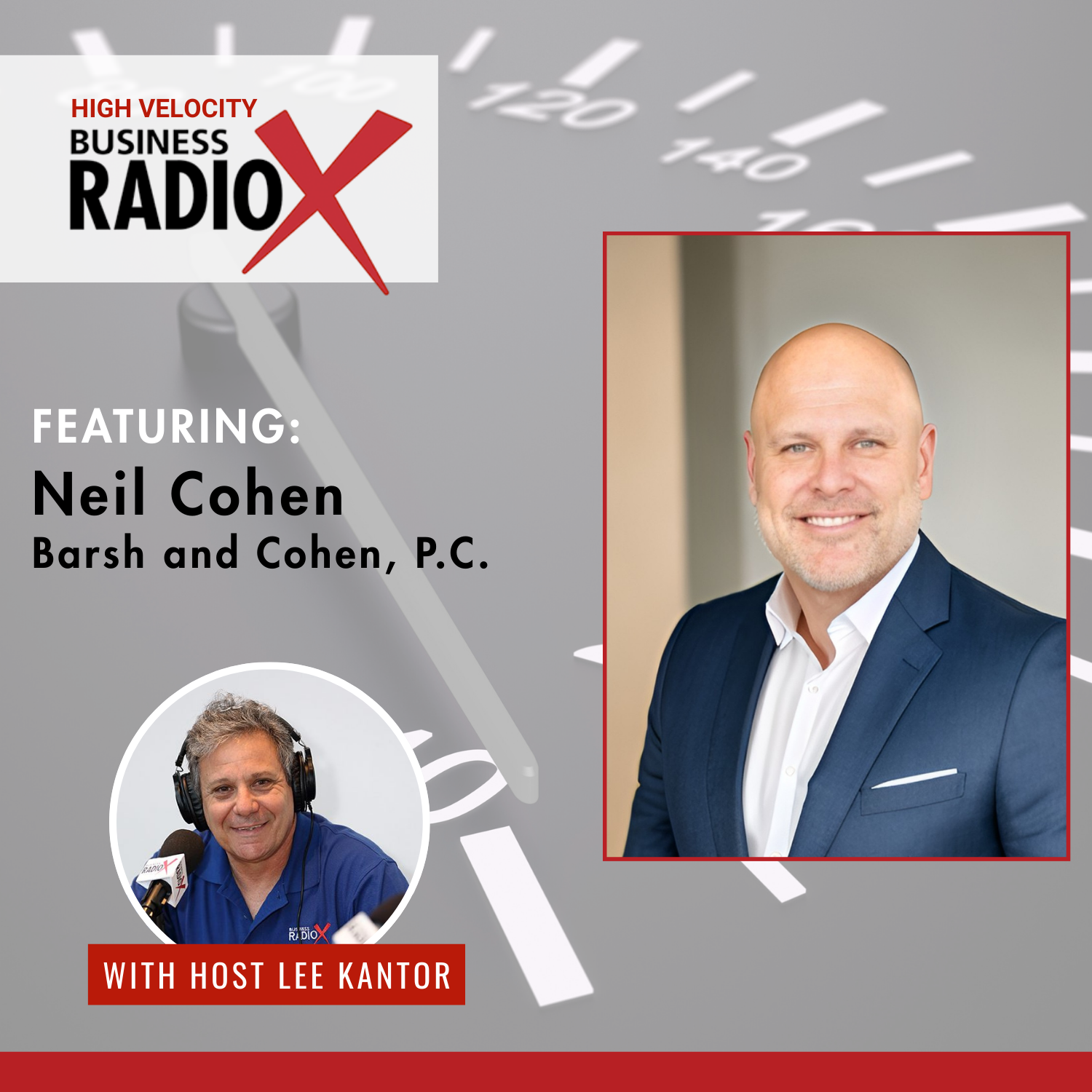

In this episode of High Velocity Radio, Lee speaks with Neil Cohen, president of Barsh and Cohen, a boutique law firm specializing in title, escrow, and default services for the real estate finance industry. Cohen shares insights on the current real estate landscape, noting early signs of change with slightly lower residential interest rates and a potential wave of commercial real estate defaults as loans reset at higher rates. Cohen also discusses affordable housing models, deed-restricted properties, and the growing trend of younger generations choosing to rent rather than own. Despite market uncertainties, he remains optimistic about the long-term fundamentals of real estate, emphasizing patience, relationships, and disciplined investment strategies as keys to success.

 Neil Cohen, President of Barsh and Cohen.
He has been involved for many years in the real estate, lending, and foreclosure fields. He has also served as a board member of various community groups.
In addition to being active in these areas of law, he has been part of two nonprofit agencies that work closely with the public on issues related to education and the health of children and their families.
His objective is to assist his clients by offering knowledgeable and objective legal advice.
Connect with Neil on LinkedIn and Facebook.
What You’ll Learn In This Episode
- Overview of the current real estate market outlook, including early signs of activity in 2026.
- How interest rate changes may impact residential and commercial real estate.
- Potential rise in commercial real estate defaults as older low-rate loans reset at higher rates.
- The ongoing impact of remote and hybrid work on office space demand and city occupancy.
- Challenges of converting vacant office buildings into residential housing.
- Discussion of affordable housing models, including deed-restricted homes and income limits.
- Insights into why many younger adults are choosing to rent instead of own homes.
- The effect of low mortgage rates (sub-3.5%) locking homeowners in place and slowing housing supply.
- Why relationships, patience, and timing are key principles in real estate investing.
- Long-term perspective that real estate fundamentals remain strong, despite short-term market challenges.
 This transcript is machine transcribed by Sonix.
TRANSCRIPT
Intro: Broadcasting live from the Business RadioX studios in Atlanta, Georgia. It’s time for High Velocity Radio.
Lee Kantor: Lee Kantor here. Another episode of High Velocity Radio, and this is going to be a good one. Today on the show we have the president of Barsh and Cohen, Neil Cohen. Welcome.
Neil Cohen: Thank you for that gracious introduction, Lee. Glad to be here.
Lee Kantor: Well, I’m excited to learn what you’re up to. Tell us about Barsh and Cohen, how you serving folks?
Neil Cohen: We’re a boutique law firm that’s in the title and escrow and default industry. We cover the New England states, and I have a collaborative with other people that have similar philosophies and institutions that cover the Mid-Atlantic and other areas of the United States, and we’re basically that full service title and escrow cradle to grave default solution for the real estate finance industry.
Lee Kantor: So here we are, um, at the still in the first quarter of 2026. What is your state of real estate in your mind today? What are you seeing out there?
Neil Cohen: I am a I’m the eternal optimist. How’s that sound? And optimism is that it’s starting to actually heat up in both ways, which would be really not making a decision. You’ve seen recently some lower, uh, interest rates for the residential world. You’ve seen a little bit a little bit of an uptick in default, as well as other people that have innuendos into our world are seeing certain things. I’m more of a feel guy. I don’t love the statistical analysis because I don’t always think that when you use that, as they would say, back in the baseball days with Moneyball, sabermetrics, when you look at sabermetrics, I don’t think you have the ability to get the entire picture. I did have a conversation with a colleague that is in the commercial space, the chief commercial lender at a local mutual bank in Massachusetts. And I said, it’s coming. And she said, what’s coming? And I said, plethora of defaults. When all these interest rates reset in the next 15 months of commercial deals that were five years at a low rate when there was 98% occupancy, 2% vacancy, and now there’s 60% occupancy, 40% vacancy, and the rate’s going to adjust to 225 basis points over the federal Home Loan bank of Boston interest rate.
Lee Kantor: So are you are you not seeing kind of this return to office that a lot of the larger corporations were clamoring for.
Neil Cohen: So I am seeing it with people I know in the institutions and industries, in the financial services. You know, Boston’s a big hub for that. And these people are coming and going, and they’re still somehow managing to figure out a way to skirt the entirety of being in the office all the time, whether that’s go to the gym in the morning at their big Boston office workout, work for a little while, and then make sure they’re out before the traffic and work remotely from home. My institution has always been an in-person type of facilitation. I like collaboration. I do see a lot of people that are still while it’s return to office, it’s 65% of the time, not 100% of the time.
Lee Kantor: But our companies. Just not, um, leasing office spaces. I mean, what is behind kind of the ratios you’re describing? I mean, that’s a big drop from 98 to 65. And if it’s not because of return to office, is it just less companies see the value of even having an office.
Neil Cohen: I can tell you that three of my larger institutional clients have either renewed leases at a substantial. Subtraction of square footage. And less space as they renew or have gone 100% remote because they don’t need the overhead. You know, there’s been inflation, there’s been, um, discord in the industry. There’s been, you know, people talking about repurposing industrial and office space in the city. And I think that’s a real hot button topic that people have overlooked in terms of, um, you know, what do you do with this vacant space?
Lee Kantor: Right. But it’s not that simple to just take an office building and make it into condos. I mean, the plumbing is all messed up. It takes a it’s you don’t just flip a switch and say, now there are condos.
Neil Cohen: No, you absolutely do not. There’s a long there’s a runway to that. There’s an expense to that. There’s a, um, basis of. You know, rehabilitation that needs to take place. But there are if you go through downtown, it has not, in my opinion, gotten to the level of where it was pre-pandemic, nor has it seen its, um, recharge in terms of full space. I have a client that has a $75 million office building in downtown Boston, and hasn’t been able to lease any new space in two and a half years.
Lee Kantor: So what do you see? Like, what’s the way out of this? I mean, it just seems like this is such a tricky challenge because you have so many people that are looking for some sort of affordable housing. You have the downtowns of both cities kind of hollowed out because nobody is like, you know, you’re dropping if you if if every large city is like Boston and they’re dropping, you know, 35%, 30% of the amount of bodies that are downtown, that has a domino effect to all the businesses that are downtown. Uh, it’s it’s really a tough situation that a lot of these big cities are in when it comes to commercial real estate.
Neil Cohen: Um, I couldn’t agree with you more in the sense that. It affects, um. It affects the office space. It is it. It affects the investors. It affects cap rates. It affects debt to income ratio in terms of debt service coverage. It affects rehabilitation. I don’t. I don’t know if what the specific answer is, but I think there’s going to be. Pain along the way and it’s going to be more painful than joyful.
Lee Kantor: So you’re not seeing the cranes back out?
Neil Cohen: I am not seeing the cranes back out to the extent they were. I think a lot of that has to do with that. The deals that people were doing don’t pencil out anymore based on higher, um, cost of funds, higher costs of development along with higher labor costs. I think that there there has to be some, uh, regeneration of those numbers and those deals that didn’t pencil out at different times earlier on. And unfortunately, I’m not sure that, um. I’m not sure how we see that, to be honest with you. I’m. I like to say that, um. That they’re smarter people. There are smarter people than me that know more than I do and have some of the answers, but probably not all the answers.
Lee Kantor: Well, let’s change gears and leave commercial and let’s go back to go to residential. Is there a place for these kind of tiny homes in today’s residential, um, kind of landscape? Is that a place where we can kind of create homes for people who can afford it? Maybe they’re smaller, but at least they’re homes that they own. And it’s not they’re not renters anymore. They can build equity in and resell those things down the line and build wealth. Um, are you seeing any kind of, uh, effort to build more communities of tiny homes?
Neil Cohen: Um, when you say tiny homes, I think of tiny homes. Is the TV show on A&E? Is that.
Lee Kantor: Well, they have the smaller homes that just they’re not kind of the the homes that exist now. They’re much smaller footprint. You know, some of them are being, you know, it’s, you know, less than 1000ft² homes. They’re they’re very small and they have a smaller footprint. But a person could live there. They could, you know, uh, own it. It’s theirs. They could build equity with it. Uh, it’s not kind of low rent. It’s an actual home that’s theirs.
Neil Cohen: Right? Um. Not so recently. There’s been a push for ADUs.
Lee Kantor: Right?
Neil Cohen: In the Commonwealth.
Lee Kantor: So that’s like in the backyard of somebody or in their their property.
Neil Cohen: Yep. Um. But the tiny home, per se, you know, you found a little corner lot that you can carve out to build 1000 square foot, single story ranch isn’t isn’t really on the forefront, and I don’t see a lot of people discussing it. Not not in this area. Not in New England.
Lee Kantor: So how are they dealing with, like, people are clamoring for more affordable housing? How are they addressing that?
Neil Cohen: Um. From a political sense, I think that stems from the, um, individuals that are looking for rent control.
Lee Kantor: Right. But from a I maybe explain to me because I never understood affordable housing is affordable housing where you’re just renting somebody a cheap apartment and you’re kind of, um, holding that price down. But they never own anything. They’re just renting and they’ll just be replaced by somebody else that’s renting. Um.
Neil Cohen: That’s a more of a, um, restricted rental. And people get from a rent control perspective, from an affordable housing perspective, there are interesting, um, bylaws throughout the Commonwealth for each city and town as to what level they have in terms of, um, affordable housing units that are available to income restricted owners.
Lee Kantor: But is ultimately when you have affordable housing and you say, okay, we’re going to make this area have X number of homes that are affordably housed. Isn’t it just the nature of capitalism that if that area becomes desirable, the house will become less affordable? It’ll become more valuable?
Neil Cohen: So the way. Yeah. Well, if there’s a deed restriction. No. And you’re not, and you’re stymieing the individual’s ability to generate wealth and real estate because they’re not afforded the same upside as someone else.
Lee Kantor: Oh, so that’s how they do it. They just don’t allow them to profit.
Neil Cohen: They they restrict the margin of sale.
Lee Kantor: Is that true? That’s how it’s done.
Neil Cohen: It’s it’s there’s usually a deed rider. The deed rider says you can have X amount of income and then the um resale, there’s a resale formula and it can only go up X amount because the value can only increase x amount. It’s the same idea when these people that have purchased this feel as though they have equity, and they want to get some form of additional home equity line of credit or margin or some type of account where they are able to borrow. And those people then in turn, um. Do not get the full upside of where it is.
Lee Kantor: Because that’s just how the deed was written. So they’re not allowed to kind of profit from the, the value around. So what stops us? Like why would those people keep trying to make it nice. Why would they keep mowing their lawn and doing all this stuff? The upkeep of their house, if they know there’s no upside? And wouldn’t that kind of be a domino effect that would affect all the other houses nearby? Because all of a sudden these are not as nice houses?
Neil Cohen: There is a, um, there is an upside. It’s just not as large. So if growth can be X, it’s restricted to Y in terms of resale. And uh, I still believe in the pride of ownership and that people are um. Are people are still have pride in, uh, you know, a white picket fence, a nice lawn and flowers by the doorstep.
Lee Kantor: Right. But if there’s upside, I understand if I have a sense of ownership and I’m going to benefit if if I make my house look nice and the whole neighborhood looks nice, we’re all going to benefit. But if I have a limited upside, you know, I don’t know if I’m going to, you know, mow my lawn every week. Maybe once a month is good enough.
Neil Cohen: Um, yeah. I hear what you’re saying. I just, I think that there’s such, um, a runway to obtain one of these affordable houses through a housing authority where you have to go to class, you have to do certain things to get the down payment assistance, to get the growth, to get the restricted price. You know, these people, they a lot of times will call it, um, 40 be in Massachusetts. They restrict the housing and there’s income restricted units. So they have to meet a criteria in order for the builders to build other houses in the neighborhood, they have to make two of the 18 houses in the subdivision affordable with with a deed restriction. And, and these people have to go into a lottery and they feel fortunate and they understand that without this there wouldn’t be homeownership. And they do have a pride of ownership. And they do have a feeling, a sense of of of that it’s theirs. And circumstances change. While they can only make X amount on their upside of a resale because there’s a resale restriction, income levels change. And at that point there’s a different pool of people to where sometimes, you know, you’ve gotten out of that affordable pool, you’ve had a change in circumstance, and the change in circumstance allows you to spend more money, and you take your limited upside and move into something that’s unrestricted.
Lee Kantor: So Is it is it working? Is that kind of helping alleviate some of the the desire for a lot of folks to move into that first home?
Neil Cohen: Um, so my personal opinion is that I don’t know whether it is or is not working because I don’t have a great feeling as to the I don’t have enough information to make a determination one way or the other. I will tell you that dealing in the multifamily space of commercial real estate, that this generation of of people in the 25 to 3840 year old range. I personally feel like they don’t want to be homeowners. They would rather rent something with bells and whistles, and somebody else’s problem of keeping the lights on in terms of the switch is broken. I don’t have to fix it. Then be a homeowner, have a mortgage, and worry about, uh, replacing the hot water tank.
Lee Kantor: So you’re seeing a lot more individuals comfortable with renting, maybe renting longer than they have in previous generations. And that’s okay, because they want the flexibility. They want to be able to leave when they want, and they want to have all the bells and whistles they refer to. Yes.
Neil Cohen: As well as there are some people that haven’t returned to the office and their job doesn’t require them and never will require them to go back to the office. Their corporate companies have eliminated the need to pay downtown rents, and they’re living in areas that are, you know, warm 363 days a year, the two cold front days they tolerate, and then they go and, you know, they’re in the sun, they’re in a lower state that doesn’t have, uh, you know, as much, uh, inflation or overhead or costs or cost of living to be higher, and they’re satisfied with that. And they’re also transient. After a while they’re like, hey, I don’t want to be in Florida. I want to move to Texas, right? Okay. I don’t want to be in Texas. I want to be in California. So if I have to work from, you know, 4 a.m. to. 2 p.m. my Pacific Standard Time, I’ll do it. And then I can be out in the afternoon. So there’s a there are a lot of mitigating factors as to what you’re going to see in terms of the housing stock. One of the biggest problems we have is that the markets are locked. Think of how many people are in sub 3.5% mortgages. That aren’t going to move because they don’t want to give that up.
Lee Kantor: So you’re not seeing any you don’t see the interest rates going down to those levels any time soon.
Neil Cohen: Uh, 3.5%. No, I would, I would love it. Would be great. Stimulate the market for a title and escrow firm like you wouldn’t believe. You’d see a lot of the last three years of people that have paid higher interest rates would refinance their purchase money, mortgages. There may be some stimulation in the in the, in the movement of these institutions that would allow for, um, you know, transactions along with other smaller ups, other smaller items that would allow for upside, if you know what I’m saying.
Lee Kantor: So now is there a rule of thumb, like when interest rates go down 1%, that’s when you start, when the math starts mapping, when maybe it’s time to, um, refinance.
Neil Cohen: I don’t know if that would be from a, from a lawyer’s perspective or a title and escrow guy. I don’t know what the numbers are. If I had more in depth knowledge of the underwriting process, the actual expense to the borrower, from a lender’s perspective, it might be easier to quantify that or qualify that from my perspective. Uh, a refinance or a rewrite of your mortgage or additional indebtedness is best to when it’s needed in terms of your personal preference. Like to me, the my house would never be considered an ATM. Oftentimes, as the market increases, people, uh, use their equity faster than others. They will take it out and use it, and some of them will inevitably reinvest it in their house, and some of them will use it to go on a vacation to the Caribbean, you know, and that’s a that’s a personal preference. And my personal preference, again, is, is to manage economics in the most advantageous way. For me, my business, my family and who I am.
Lee Kantor: So what do you need more of? How can we help you?
Neil Cohen: What do we need more of? I need more good people in my life in terms of people to network with, to bounce ideas off of relationships, to build throughout the industry, throughout the state, throughout the United States, throughout the world. I’m a guy that wants to talk to everybody.
Lee Kantor: Are you seeing more young people getting involved in real estate?
Neil Cohen: Nope. It’s like the oldest generational thing that there possibly could be. If you look at the average age of a loan officer that lends residential money or commercial money, it’s north of 47.5 years old right there aren’t you know, when I’m at a family firm right now. My dad started this. It’s a generational aspect of this. It’s building relationships and building knowledge to the point where there are people that when we when when my dad first got in this business, there were people that went into training programs at financial institutions that trained you on all types of skill sets in the commercial world. Underwriting, lending, sales, recovery. They don’t have those programs anymore. The financial institutions don’t. A lot of people go into a commercial world and they become a relationship manager or an underwriter, one or the other, and then decide they want to pry the other aspects of the business. They want to be a lender and they don’t know how to be a lender. So they have to learn how to be a lender. There’s no training programs left in this business. And the young people and I use that as a broad based scope, depending on what age you consider that the that the the. And I’m not old at 53 but the younger demographics are more interested in, um, a quicker ascension to the top and to leadership as opposed to learning the, the nitty gritty and the small pegs going into the round holes and all of that stuff.
Lee Kantor: But you’re still optimistic. You you still see, um, aspects of real estate where there’s opportunity, um, maybe different markets are better than others, but still kind of the fundamentals of real estate still are attractive to you.
Neil Cohen: The fundamentals of real estate are strong 98% of the time they’ll be strong. Um, the other couple percent of the time is more likely to be greed, where they people will get over their skis, and that ends up torturing or putting stress on the on the numbers in the industry. So once there’s so when there’s a lot of the people you’re going to see are generational real estate people and that and it gets passed down from generation to generation. And they there are people that want to do more than the generation before them did. I have a generational client that’s third generation in terms of real estate. The first generation bought, uh, distress, the second generation bought distress and some, uh, undervalued assets and put value into them. And the third generation is turning those assets into self-fulfilling, less managing triple net commercial spaces in the industrial world.
Lee Kantor: So there’s always opportunity just you have to know where to look.
Neil Cohen: You have to you have to be you have to bide your time, be patient and understand the pitfalls of being too aggressive.
Lee Kantor: And there’s certain times where the best move is not to make a move 100%.
Neil Cohen: Uh, I will go back again and give kudos to my father. Your first loss is your best loss, and that’s often displayed in. You know, I didn’t make a move, and I lost out on an opportunity that I thought was going to be better. And that opportunity that was better went up in smoke. And the opportunity that I remained in is stable and Generally generally a good investment.
Lee Kantor: So, Neal, if somebody wants to learn more about your firm or connect with you, what’s the website? What’s the best way to connect?
Neil Cohen: Best way to connect is email. I love email Neal. At BRC hyphen.com LinkedIn’s a good way or give me a call in the office. I still like to use the telephone. 617332 4700.
Lee Kantor: All right. Well, thank you so much for sharing your story today. You’re doing such important work and we appreciate you.
Neil Cohen: Thank you for having me. I appreciate being on.
Lee Kantor: All right. This is Lee Kantor. We’ll see you all next time on High Velocity Radio.














