Business RadioX ®

  • Home
  • Business RadioX ® Communities
    • Southeast
      • Alabama
        • Birmingham
      • Florida
        • Orlando
        • Pensacola
        • South Florida
        • Tampa
        • Tallahassee
      • Georgia
        • Atlanta
        • Cherokee
        • Forsyth
        • Greater Perimeter
        • Gwinnett
        • North Fulton
        • North Georgia
        • Northeast Georgia
        • Rome
        • Savannah
      • Louisiana
        • New Orleans
      • North Carolina
        • Charlotte
        • Raleigh
      • Tennessee
        • Chattanooga
        • Nashville
      • Virginia
        • Richmond
    • South Central
      • Arkansas
        • Northwest Arkansas
    • Midwest
      • Illinois
        • Chicago
      • Michigan
        • Detroit
      • Minnesota
        • Minneapolis St. Paul
      • Missouri
        • St. Louis
      • Ohio
        • Cleveland
        • Columbus
        • Dayton
    • Southwest
      • Arizona
        • Phoenix
        • Tucson
        • Valley
      • Texas
        • Austin
        • Dallas
        • Houston
    • West
      • California
        • Bay Area
        • LA
        • Pasadena
      • Colorado
        • Denver
      • Hawaii
        • Oahu
  • FAQs
  • About Us
    • Our Mission
    • Our Audience
    • Why It Works
    • What People Are Saying
    • BRX in the News
  • Resources
    • BRX Pro Tips
    • B2B Marketing: The 4Rs
    • High Velocity Selling Habits
    • Why Most B2B Media Strategies Fail
    • 9 Reasons To Sponsor A Business RadioX ® Show
  • Partner With Us
  • Veteran Business RadioX ®

Breaking the Glass Ceiling with Sandy Doyle-Ahern: From Environmental Leader to Affordable Housing Advocate

September 13, 2023 by John Ray

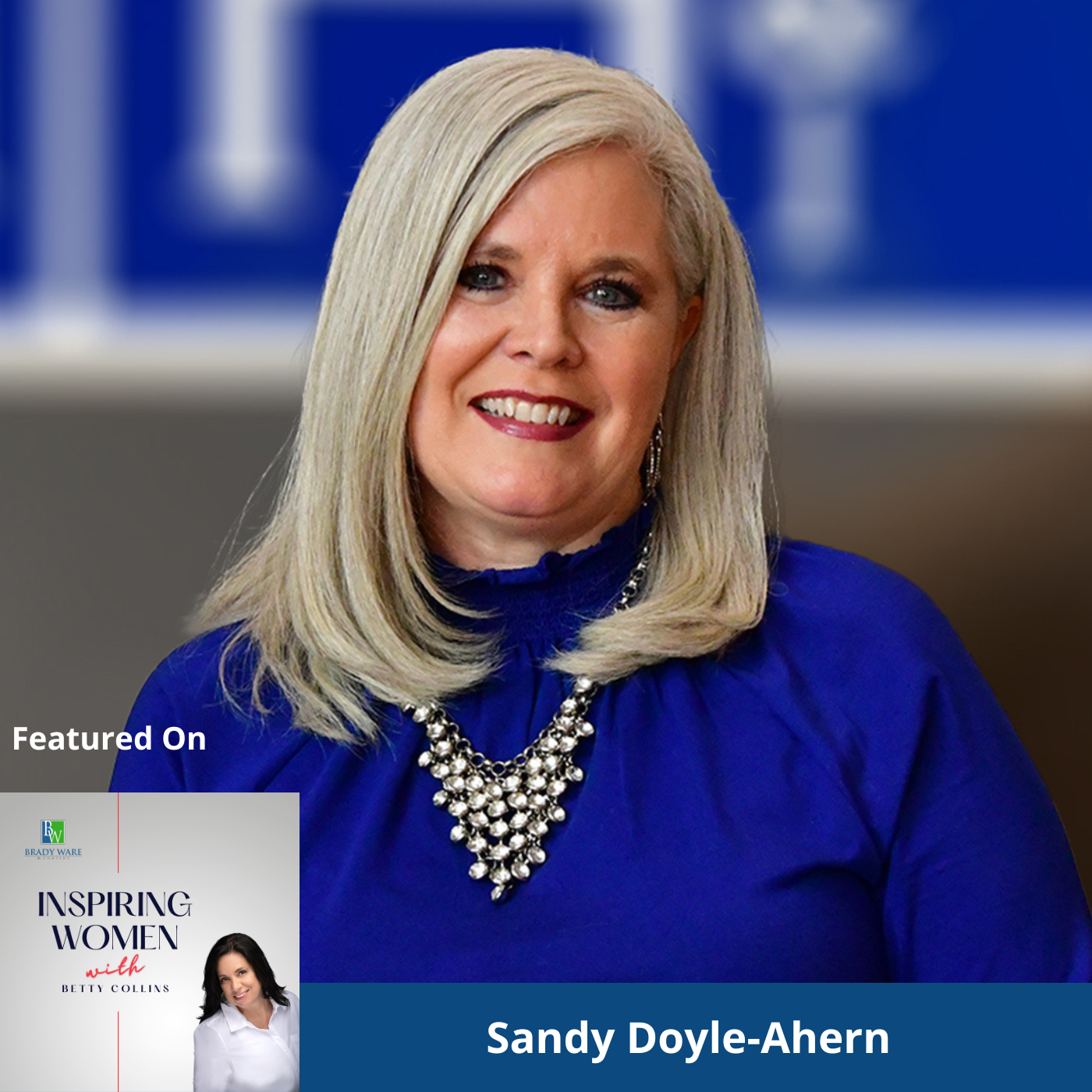
Sandy Doyle-Ahern
Inspiring Women PodCast with Betty Collins
Breaking the Glass Ceiling with Sandy Doyle-Ahern: From Environmental Leader to Affordable Housing Advocate
Loading
00:00 /
RSS Feed
Share
Link
Embed

Download file

Sandy Doyle-Ahern

Breaking the Glass Ceiling with Sandy Doyle-Ahern: From Environmental Leader to Affordable Housing Advocate (Inspiring Women, Episode 60)

On this episode of Inspiring Women, host Betty Collins welcomed a genuine trailblazer in her field, Sandy Doyle-Ahern. Sandy discussed her journey as a female in the male-dominated construction industry, her role as president of one of the largest engineering and survey firms in Ohio, the role of taking risks and following through in her success, and much more.

The host of Inspiring Women is Betty Collins, and the show is presented by Brady Ware & Company.

Betty’s Show Notes

I interview Sandy Doyle-Ahern, a pioneer for women in the male-dominated industry of construction and housing. From facing sexist comments to becoming the first female shareholder in her company, Doyle-Ahern shares her experiences and insights on leadership, risk-taking, and advocating for affordable housing in Central Ohio.

Through her inspiring message, women are encouraged to take small steps toward success and to make a positive impact in their communities. Listeners will be inspired to take risks, find ways to be impactful for others, and strive for success in their careers while making a positive impact in their communities. This podcast is a must-listen for anyone looking for inspiration and practical advice on achieving career goals and creating change.

Hosted by Betty Collins, CPA, and Director at Brady Ware and Company. Betty also serves as the Committee Chair for Empowering Women, and Director of the Brady Ware Women Initiative. Each episode is presented by Brady Ware and Company, committed to empowering women to go their distance in the workplace and at home.

For more information, go to the Insights page at Brady Ware and Company.

Remember to follow this podcast on Apple Podcasts and Google Podcasts.  And forward our podcast along to other Inspiring Women in your life.

TRANSCRIPT

[00:00:02] Betty Collins Has anyone ever inspired you to change your life that made you more fulfilled? Well, as a leader in your business and in your community, what are those questions that you ask yourself on a daily basis? It’s these questions that we explore on inspiring women. I am your host, Betty Collins, and I’m a certified public accountant, a business owner and a community leader who partners with others who want to achieve remarkable results for themselves and their organizations. I am here to help inspire you to a positive step forward for a better life. Well, today on Inspiring women, we have a guest that in central Ohio is somewhat of a legend. She’s a big deal. She is. She’s already laughing. But it’s true. Sandy Doyle is. She’s she I’ve heard her speak at NAWBO events. She’s all over. She’s everywhere. And she’s a champion for women, that’s for sure. So today, you’re going to get to hear just some great things that she’s doing and great things that can help you as a as a woman that is trying to be inspired. Right. So Sandy, she’s the president of EMH&T, that’s one of the Ohio’s largest professional engineering and survey firms. And she lends her talent and leadership skills to a range of organizations to beyond what who she were or what she works with, but such as like Affordable Housing Trust for Columbus and Central Ohio.

[00:01:26] Betty Collins
The Columbus Metropolitan Library, Columbus State Community College and Franklin County. Rise Together Innovation Institution or institute? I’m sorry. And among the many awards she has received, she’s been twice been named the most admired CEO and a member of the Power 100, a progressive women honoree and named CEO of the Year. But she is truly a legend and she’s a woman in a man’s industry that is becoming more women. But she’s definitely been a trailblazer. So, Sandy, welcome to the program today. Welcome to my podcast and thank you for the time that you’re going to give us today and give us some great insight. We really appreciate it. Well, thank you for having me. That’s part of the day. Yeah. There we go. There we go. Well, I love that. I love it. So before we get started, though, I always, like just take 30 seconds, 45 seconds and tell us something fun. Tell us something fun about you. Something maybe that that, you know, is not all your words and your, you know, all this stuff.

[00:02:25] Sandy Doyle-Ahern
Oh, gee, let’s see. Um, I was actually born in Canada, so that maybe is a little different. I grew up outside Philadelphia, but became a US citizen when I was 21. I think Awesome. And I’m a huge hockey fan. So is my favorite sport by far and the only one I actually really understand.

[00:02:44] Betty Collins
Yeah. Yes. Columbus Blue Jackets. And I assume you’re a big you go to those games.

[00:02:50] Sandy Doyle-Ahern
I do.

[00:02:51] Betty Collins
You know it’s one of the fastest paced games which I’ve gone to several, but not a lot. But it’s fun stuff. So. Well, I want to get down to kind of a little bit of background on you. Thank you for sharing about love hockey, too. But as a biology major from the East Coast, how did you end up in Columbus? How did you end up Ohio as the president of of your company this big, you know, huge, huge impact to the Columbus area for sure.

[00:03:19] Sandy Doyle-Ahern
So I’ll start by saying if you had told me that I was going to be the president of EMH and T someday, I would have laughed. So, you know, life is funny, but I actually ended up in Ohio for graduate school and that was a little bit of a coincidental thing, but it came from an internship opportunity that I had. I had started working for an environmental consulting company every summer between college semesters when I was 18, and I went back there every year. And when I graduated college, I was ready to go to grad school and they were all East Coast schools that I looked at, except there happened to be a gentleman I worked with who went to Miami University for his environmental science program, and I applied. And that was back in the day when you couldn’t look anything up on the Internet. So you had to actually go and see the place. And I did. And I remember driving out for my interview thinking this wasn’t going to be where I ended up. And then I did. You did. And, you know, it ended up being a great grad program for me. But what led me then to Columbus was actually an internship I needed to complete for the master’s degree, and it was going to be temporary, and I was going to be here just for about a six month to maybe 12 month period to to do the work for that degree. And I loved it. So the long story short is my husband also went through the same graduate program and he ended up in Columbus. And we kind of always thought we would see how it went. We had no family out here. We didn’t really know that many people thought we would go back to the Philadelphia area if it turned out that either one of us just, you know, weren’t happy here or whatever. And that never happened. And that was over 30 years ago. And we’re clearly not going anywhere now. But yeah, that’s just it was internships in school.

[00:05:06] Betty Collins
Yeah, I know. I’m like you. It’s like if you if you would have said to me, you know, when you’re almost 60 years old, this is going to be your life, right? I’d be going. Not a chance. I don’t see that happening. But we’re glad you’re in central Ohio. We’re glad. I mean, and Oxford. Did you like Oxford, though? Where where the. I mean, I just think it’s such a quaint town, that’s for sure. Yeah.

[00:05:28] Sandy Doyle-Ahern
Yeah. No, it was great. And it led me to such a huge opportunity here. So it just it all was circumstantial.

[00:05:34] Betty Collins
Yeah. Well, one of the great things about your resume beyond many things, but, I mean, is that you are the president of this company and you became the president. And with a career path that really is predominantly male and male is going to dominate that position for sure. And the leadership, you know, what challenges did you face throughout the year? Tell us a little bit about how that all came to be.

[00:05:59] Sandy Doyle-Ahern
Yeah. So when I first came to Columbus, my background’s in environmental work and I was around engineers all the time though, so a lot of what I was doing was regulatory compliance. It was restoration of natural habitats and it interfaces a lot with engineers. And so I started getting involved in projects really that MH was a part of, and I eventually ended up joining MH and T to open up their environmental division. And I think that was 1997. And, you know, honestly, it was a great opportunity because the owners of the company at the time said, you know, we don’t really understand what you do, but we know our clients need your help, so we’re going to let you just do what you do and do it here. And that’s literally what happened. So they’re very gracious about that and kind of gave me the opportunity to figure out how to fit within the realm of this engineering firm. But at the time, gosh, almost all of my work was out in the field. So I was out a lot with our survey crews. I was out with other engineering people. I was out with the clients literally in the field doing the work. And so over time, I just got the opportunity to to work on this environmental division for the company and it grew. So there’s there’s more to it. But I’ll stop there for a second and just talk about that first. Really nine, nine, ten years in my career with the I was doing that work and I loved it.

[00:07:25] Betty Collins
Yeah, Yeah. So, so with you probably being one of the few females and then you do something very, very different that they aren’t too sure. Yeah. Yet you become the president of the company and you’ve told this story a little bit at NABA where you were in the room with all the pictures on the wall and they were all men. Right? So, so tell us about this. The time that, hey, we’re going to become the president or I became the president, you know, I mean, I now I’m not just climbing up the hill for 9 to 10 years. I’m actually going to be in this leadership role.

[00:08:04] Sandy Doyle-Ahern
Yeah, I think it was a lot of things coming together. You know, obviously I didn’t go into working at EMC having any idea this was going to happen. But the reality is there’s a couple of things I had both. That my children, when I was young here at MH and running the environmental group, and that was kind of an early time when there there were almost no women here. Right? So at first I don’t think they knew what to do with me because I was the first female manager, kind of the first project manager. They weren’t really sure I wanted to keep working. I was not interested in being at home with my kids for very long. So I actually ended up bringing them to the office with me when they were really little. Wow. Um, and you know, I think back on that now and it’s funny because that that first time I did that when my, my first daughter was quite young, I walk into a room with a project meeting and I’ve got my briefcase and I’ve got a baby carrier and I’ve got all this stuff I’m walking into the meeting with. And the first couple of times with a couple of clients, they were like, What? What are you doing? Like, it’ll be fine.

[00:09:09] Sandy Doyle-Ahern
She’s sleeping. The meetings after that, they’re all like, Can we hold the baby? You know? And it’s really funny. But, you know, I think early all I know early in my career it was really challenging. I had I was around a lot of people who not an EMT. The company’s always been amazing, but kind of out in the field with some of the guys that like to make comments about what I was wearing make like to make comments about, you know, a lot of different things that were really sexist. But I wasn’t it didn’t really intimidate me all that much. It was just more I guess I was naive. I was more like, why would they do that or say that? And it didn’t happen a lot. Yeah, it happened once in a while. And there are a few memorable moments that I think about when I look back and think, Man, there’s some stuff that happened that should never really have happened. The truth is now no one does that to me anymore. I think I’m too old to care anymore. So, um. But you know what really ended up happening with the leadership opportunity really came about probably around 2005, 2006, when I had been running the environmental group.

[00:10:19] Sandy Doyle-Ahern
And what that did is put me in front of a lot of other divisions in our company. So because that group tends to kind of service some internal clients, you’re working with transportation, you’re working with them in development, whatever the case is. So I got to interface with a lot of different people. Um, and I’ve always kind of had a mindset around people, around the employees and what it, what we need to be doing as a leadership team. So I think early in my career I had the opportunity to become a shareholder, which was a big deal, you know, first female shareholder. It hadn’t happened before. A company that was doing really well had a strong reputation. I learned a lot in the process. And then frankly, what occurred was a few years later we had the Great Recession and my current partner and I who run the company together today were running the company then with the with the current president. And it was tough. I mean, it was, you know, all of a sudden you’re getting you get thrown into a situation where you have to make decisions quickly and you have to do what’s best for everybody as much as possible. And so, um, I think really it evolved out of that, partly that we, we were running things together and trying to make some tough decisions and, you know, watching the world around us really change.

[00:11:40] Sandy Doyle-Ahern
A lot of our clients struggled because we did a lot of home building work. So, you know, as we all know, the housing crisis happened. And so I think part of what emerged from that is I am a really big believer in in talking to the employees, telling them what’s going on, the good, the bad, the otherwise. And so when all that occurred, I did a lot of writing to the company at the time, and I wasn’t the president, but the president and myself and my other partner were all on the same page about the need for that kind of communication. So we started to push a lot of it out very quickly, and I’ve never changed that. So I fast forward to today running the company, starting at the end of 2011 into 2012. We’re still very much like that. Lots of lots of communication with employees, lots of employee update meetings on the status of the company, that kind of thing. So I’m getting a little ahead and we can come back to that if you want, but that’s kind of how things evolved.

[00:12:37] Betty Collins
Yeah, well, it’s interesting. You know, you have no idea how courageous you were bringing that child to work. I mean, at that time today, nobody would think a thing about it. And I think COVID finally has fixed that whole stigma, right where this is the way it is. This is there’s nothing wrong with it. Women don’t have to be exceptional to bring their kid to work. Yes. Or whatever it is. They just need to do their job. And and raising raising kids is parental, by the way, not just maternal. So I look at that and go, that’s huge that they would allow you to do that at that time. But, you know, for me, I know that a lot of times your opportunity, your nevers or your opportunity, you would never see you doing this, right. You would say, I would never do this. But you women that were able to be confident and courageous enough to say, My kid is really important, but I’m going to make this company a priority as well. We just have no idea, like right now what that means to us in today’s world. But COVID really kind of helped put that all to rest, right?
Hopefully so.

[00:13:46] Sandy Doyle-Ahern
Yeah. Yeah, We’ll see.

[00:13:48] Betty Collins
We’ll see. We’ll see. Let’s hope it does. Let’s hope it does. Because I know we could probably talk a lot about professional services in what we’ve got to do right now. Right. But in an article I recently read, you were quoted saying, I’ve learned to take risks and operate outside of my comfort zone. And you did that very early in your career. For young women, listening for any woman, listening for older women, whoever it is that isn’t comfortable taking risks, they’re not comfortable getting out of there. What suggestions would you have for them as they’ve started their journey or starting it or ending it or in between on risk and and operate outside that comfort zone? Let’s talk about that for a little bit.

[00:14:30] Sandy Doyle-Ahern
Yeah, no, it’s a great question. And I think you have to start by talking about the definition of risk. So I think the problem with the word is to even say it. People assume it means throw myself off the bridge, right? Something really risky. And that’s not what it means to me. It’s not what I’m talking about. I actually get this question a lot, and it kind of fascinates me because it’s a question that a 25 year old will ask and a 65 year old person will ask. And so and I think it’s partly because women kind of tend to not see themselves as taking risk all the time when in fact, they may be doing more of it than they realize. So what I mean by risk is it can be a small thing. It can be, you know, take the assignment that no one else wants. Yeah, that’s a risk. Or me showing up to work and saying I’m going to work on a project I’ve never done before because I’m going to tap the people I know that are talented. The risk on me is to do something I haven’t tried before. And so I think what it does is when you take small chances and you have a victory, it sort of develops your your confidence, I guess, around the fact that you can do the next thing that’s a little harder and the next thing that’s a little harder and you might fail in the process and that’s okay. But, you know, I, I did take risk early on. But again, it was small things.

[00:15:51] Sandy Doyle-Ahern
It was like getting put in a room where I don’t you know, I don’t know any of these people. I’m being asked to weigh in on some major decisions that they have to make as a client. So my job in that moment is to know what I’m talking about. And so kind of back to your comment a second ago about, you know, how did things evolve and how do they change? Well, for me, it wasn’t just about taking the risk. It’s I’m going to show up. I’m going to do what I said I was going to do. And if I fail at that or don’t know how to do it, then I’m going to go tap the resources I need. But you have to be the person other people count on. You have to be reliable. And so if you’re willing to take some small risks and you follow through, I think what happens eventually is you will take bigger chances in life. Yeah. And for me, how I ended up in this role, I mean, I honest to goodness would never have thought as the gal walking around in the field with mud all over my boots that this is what I would be doing. But I believe in it also, right? So I come here every day thinking about the people that are here, taking the risks themselves and what I can do to support them. So a little bit of a long answer to your question, but I it all kind of interrelates for me.

[00:17:04] Betty Collins
No, I love it. And I hope my audience heard the one thing from that comment that I’m still thinking about. I showed up and a lot of times who shows up, wins, who shows up, who is in the room? I deal with it with my own company. When I first came into Brady, where in 2012, I there were two shareholders we had I think at that time we had 26 and there are different levels of shareholders, but 26 people in the room, two women. So I didn’t think a thing about being in that room. And then as we were trying to encourage other women to come to the room, they didn’t think it was for them because it was mostly men. And I said, Get in the room, you know, show up, be there, go. I’m I mean, I’m totally different than most people in my company. And and I do things completely different. Kind of maybe like you in the terms they didn’t really what to do with me at that time but showing up and then and then it shows others. I am in the room. You can be here. You don’t need to not be here. So I love that. I love that in your answer. So I’m going to shift gears a little bit because this is this is something you’re passionate about. Um, you become a strong advocate for affordable housing. I don’t know that there is affordable housing anymore. Right. But you are an advocate for it. And what challenges are you facing and what can we do to help and assist you with this? It’s a big issue. And you know, we’ve got a thing called Intel coming as well. We’ve got all kinds of things happening around our city and there will be people left behind.

[00:18:39] Sandy Doyle-Ahern
So I appreciate the question for a lot of reasons. And let me give you a little context to how I’m going to answer the question. I think you have to take a step back for just a second and look at the central Ohio region. You know, Columbus is a great place to be.
There’s no question about it. We’re still operating in some ways like a smaller city than we really are. And if you look around the country, it does not take much to understand what we don’t want to do. So if you look at some of the major metropolitan areas across the United States, we have a playbook right in front of us that says unless you want to become like city X, Y, Z, don’t do these things. So I think Columbus is in a place and I say that meaning the greater outer belt area, multiple counties where we still have some time to do something about the housing situation, but not a lot. And so let me let me frame it a little bit, a little bit better than that. You know, the situation really does stem from what happened during the housing crisis in 2008 because we were building here at a pace that was generally keeping up with population growth.

[00:19:50] Sandy Doyle-Ahern
But since that time, we are nowhere close to that. Our population growth is happening much quicker than the number of units we’re building and understanding affordable housing. It’s a tough term because it it means different things to different people. But we’re talking about everything from single family to multifamily to senior housing to even residential housing for for students. Et cetera. So where we sit today is we need all housing. It’s not just one price point or another, because what’s been commonly understood is that when you have a shortage, it’s just like anything with a supply and demand model. When you have a shortage of something, all of a sudden someone who could afford to buy something a little higher. Price point doesn’t necessarily do that. They’ll buy down because they’re going to use that income, that money that they didn’t spend on the house for something else. Right. And what happens is it affects the supply even more for someone that only could be in that price point if you follow what I mean. I do.

[00:20:52] Betty Collins
I get it.

[00:20:52] Sandy Doyle-Ahern
So that situation is what’s happening right now in central Ohio. It does put us thousands of units behind. And so if we level set that issue behind what’s happening with population growth, the number of units were behind is even more staggering. So there’s a lot of challenges here. And without making this into an affordable housing podcast, because it could be it’s okay.

[00:21:20] Betty Collins
It’s okay
[00:21:21] Sandy Doyle-Ahern
Yeah. You know, one of the things that we have to really pay attention to is what happens when we make decisions in individual municipalities. And so when we live in a state like we do, where where every municipality sort of makes their own rules around what housing is going to look like, what transportation looks like. Et cetera. That home rule model that we have does make it difficult to cross over municipal boundaries to try and do collective work together. So what you’re hearing more and more now is you’ll hear a lot of conversation more about a regional housing strategy, a regional housing goal, instead of what’s Columbus doing, what’s Westerville doing, What’s Grove City doing what? You know, pick whatever. Yeah. Um, the challenge is significant and often it is the NIMBY syndrome. And there’s no question about it. It’s, it’s, you know, you understand it to some degree. But on the other hand, it’s it’s probably the most depressing part about trying to build housing is when you have neighbors that say, we don’t want that person here, we don’t want that type of housing here. So I do think when you ask the question about what can people do, I think have an open mind to neighbors, have an open mind to how we live together, have an open mind to how we grow and do all the things right for everybody. So it’s not just improving housing opportunity for people. It’s also transportation changes that need to occur over time. Here we have so much good stuff going on. We really do. We’re lucky to be in a region that is generally very positive, but these real challenges that we’re going to have are going to begin to affect us pretty significantly if we’re not careful. There’s a whole other aspect of this around homelessness that I want. I mean, I won’t go down that path, but I just have to mention it because the aspect around what it takes for somebody who’s not. Earning a true living wage to survive right now is getting more and more difficult.

[00:23:20] Betty Collins
It is. It absolutely is. I mean, we were talking today about just the cost of everything is like this and wages just are not following it. And so it creates other crisis and that’s just real. I appreciate your boldness and your tenacity about the issue. And I think just to get your thought on this, do you think having we got intel on this side of town and we got Marysville right now and they’re both doing major things right, that are going to take housing for everybody, It’s going to take infrastructure for everyone. Do you think the word region will become more about instead of Gahanna there and Dublin here? Because Intel’s here, you know, the stuff going on in Marysville, it’s it’s all encompassing. So maybe that will help us be more about a region.

[00:24:11] Sandy Doyle-Ahern
Yeah I think time will tell. You know what I worry about the most is the window to make those decisions gets smaller every year goes by. But I do think that there’s more conversation now than I’ve ever seen about thinking about a regional strategy. The one comment I would make, though, I think it’s something really important for people listening to think about in order for all of the regional success to go on, we have got to keep a strong core downtown. We need strong core neighborhoods. We have got to talk about redlining. We have to understand the effects of redlining and how we have to do what we can to reverse it, because it’s easy for us to say we’re going to build housing units in Union County and Lincoln County and Northern Delaware County or whatever without understanding that the impact on the core, what I call City of Columbus, really is incredibly critical to all of this happening. So as much as we want to look outward and think about impacts and housing and transportation, we also have to look inward and all of it needs to be successful. So that means reconciling with some really difficult situations to do that.

[00:25:24] Betty Collins
What’s great is you’re so beyond empty. And what I love is I see that as probably, Hey, this is what I do, this is my platform, this is my venue that I can now have impact in something like this. That kind of relates obviously with, you know, you build things, you’re building communities. But I mean, at the same time, there’s a lot of passion behind it. And to my audience, women, you know, this is part of the role when you play the roles that that Sandy plays that are that we all covered, that we all look at and go, this is a legend. There’s other sides to it besides EMH and T, But this is this is probably the coolest thing about you. There’s tons of it. But this is this I love. A few years ago you formed what is now dubbed as the Edge Sisters. It’s a group of women in leadership positions to lift up the community. Right. And push equity and drive change. Just talk to me about how that started and how you you know, what are you going to accomplish out of that? Because it’s pretty cool. And I really want viewers to look into this and see it because it’s neat. It’s cool. So.

[00:26:30] Sandy Doyle-Ahern
Well, thanks for asking. And I would start by saying, anybody can do this. This is not it’s not a club. It’s not an organization. It really what it stemmed from was all of us are in some way, shape or form in not only in our professional lives, but in our personal lives involved in community work. So we would see each other all the time. This philanthropic event, that event, whatever. And so every single time that I would see one of these women at one of these events, when you get past the, Hey, how’s the family doing? We’re all quickly in our conversations going to what’s happening in the community. Are we are we comfortable with the pace of change? Are we confident the things that need to happen to lift up other people? This is never going to be about us. This is always going to be about other people. Are we confident that that change is happening? Are we confident that we are doing what we can to kind of help push along a community that really looks at equity through the lens of opportunity and not just a buzzword, which it can be? And so what ended up happening was I guess it was right, It was right before the pandemic. I just sent a dinner invitation out to a bunch of these women and said, you know, I don’t know if there’s something here, but it just feels like we’re all talking about the same things all the time. So let’s go talk about it. And you really can’t get a group of 13 Typekit women together and not be like, Yeah, we’re going to do something. So Exactly. You know, we ended up having a great dinner. We talked for a long time about kind of what we all were seeing and what our concerns were and how could we help. So it ended up that we started down the path of meeting frequently for dinner and then the pandemic happened.

[00:28:14] Speaker3
Mm.

[00:28:14] Sandy Doyle-Ahern
And it was just the most bizarre and fortuitous thing because what actually ended up happening with all of us is we’re now all in these positions where we’re trying to figure out what the heck is happening and what we need to do to lead our organizations. So we ended up on weekly calls, and it was it was unbelievable. Some weeks, you know, you might be laughing about other things. Sometimes everybody was crying. I mean, it was just so much. But what we basically did is we we we brought Robin D’Angelo to to town to talk about race issues, which was, you know, controversial. And we knew it would be and that’s okay. But we purposefully wanted to try to bring people into a setting where they could just listen and learn and do with the information what they wanted. We also wanted to reach into the community to talk to some other women who had come into Columbus or central Ohio during during the pandemic. So I guess it was about a year and a half ago or so. We just sent an invitation out to all these women and we didn’t really know a lot of them, but we knew that they’d either moved here to take a job of some kind or had moved in. Their role in their organization didn’t know anybody. So we hosted an event basically and just said, Why don’t you come and we’ll get to know each other? And we’re actually getting ready to do the same thing here in about 2 or 3 weeks.

[00:29:38] Sandy Doyle-Ahern
We’re going to do it again. You know, we have all together, the group of us done some work around racism, the 13 of us, and been very honest with each other about it and learned together. It, you know, it’s been an incredible journey, really. Just to have them as as trusted sisters really is kind of how it is. So what are we going to do? We’re going to continue to in all the hats we all wear and we’re all in lots of different rooms around the community. We’re going to continue to push for doing what’s best for other people. I mean, it’s that is really how simple this is. I don’t think you’re going to see some big list of events we’re going to do. That’s not it. We’re just going to continue to kind of drive and push for change, especially with a region that’s really going through tremendous transition. Now you can see shifting power structures. You can see shifting dynamics about how to think of ourselves again, as a region much bigger than we used to be. We’re competing now with cities across the world, not just in Ohio. I mean, the whole situation is very different, and that’s the space we’re going to continue to be. We’re really kind of about that next generation and really, truly providing opportunity for everyone, not just certain people.

[00:30:57] Betty Collins
Right? Yeah, I could just sit and listen to you. I’m totally engrossed in what you’re saying. I truly love it. But, you know, to me, you know, what I like to have on my podcast is women who inspire other women. And you’ve certainly done that today. And it’s not just about I made it to the top in this company, you know, I’ve made it to the top. Okay. But these are all the other things that play into it. And and women need to be courageous. They need to show a lot of courage by touching and, you know, bringing your kid to work, coming together for racism, whatever it is. I mean, these are these are bold things. These are courageous. And it takes someone of courage to be that courageous. So I appreciate you coming on today and just talking and telling your story. I’ve heard it before. I always love it. I heard it pre-pandemic, but I had not really heard much about the Edge Sisters and I when I saw it, I thought I got to know more about that. So I really, really, really loved it. But thank you again for coming on today. And I would just ask you to do one last thing. What is it that you would want to say to the audience today for women who have they don’t need to be you know, Betty Collins is shareholder here and and Sandra does this and Jane Jane Greer. I mean, women every day, ordinary every day activities. What are we what’s the what’s what’s the word you what’s what? How do you want to encourage them? How do you want to inspire them as the last thing on the podcast?

[00:32:32] Sandy Doyle-Ahern
Well, I appreciate you asking. I guess I’d say two things. I think to the extent that you can do it, try to come from a place of gratitude. And that’s not easy for everybody. You know, some people have much, much more difficult situations they have to deal with every day. But finding gratitude, I think, makes you really begin to understand how impactful you can be because you’re not looking for what’s what’s going to be better for me. You’re looking for what’s going to be better for somebody else. So I think being grateful really matters a lot. And then I’m going to go back to the beginning risk. I think women need to be okay with taking chances. Women need to put themselves out there more. They have to be willing to take the assignment. Be the person that shows up and does something that no one else has done or do the assignment better. Because what happens is when you become that person who’s taken the chance and you become someone who delivers on what they say they’re going to do, you’re known as the reliable person then. And so this is what people forget when a colleague or a client or whatever says, I’ve got this assignment. Who do I want to work with?
They’re going to think of you because you are the reliable one. You are the one who showed up. You’re the one who admitted if you made a mistake, all the things that come with being reliable and it evolves, you know, it’s not like you have to kick in every single door all the time. Sometimes you do, but not always just be the person who shows up. And I do think risk taking gets easier for women when they try little things at a time to do it. Lady, you got this? Do it.

[00:34:07] Betty Collins
This is why I started the podcast with She’s a Legend. So again, thank you so much. Again. And I know my audience is going to love the love the time that they can spend with you.

[00:34:18] Sandy Doyle-Ahern
So thank you. Well, thanks for your time. It was good to see you. Yes.

[00:34:23] Betty Collins
As your career advances continue, your financial opportunities will continue to grow. Be prepared. Visit Brady World.com Backslash Resources to find everything about inspiring women. This episode, plus an outline of Brady wearing company accounting services can be found in the episode show notes.
Tagged With: Betty Collins, Brady Ware, EMH&T, Inspiring Women with Betty Collins, Sandy Doyle-Ahern

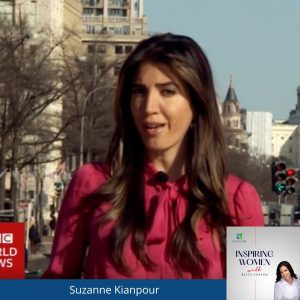
Beyond the Headlines: Unveiling the Hidden Power of Women with BBC’s Suzanne Kianpour

August 16, 2023 by John Ray

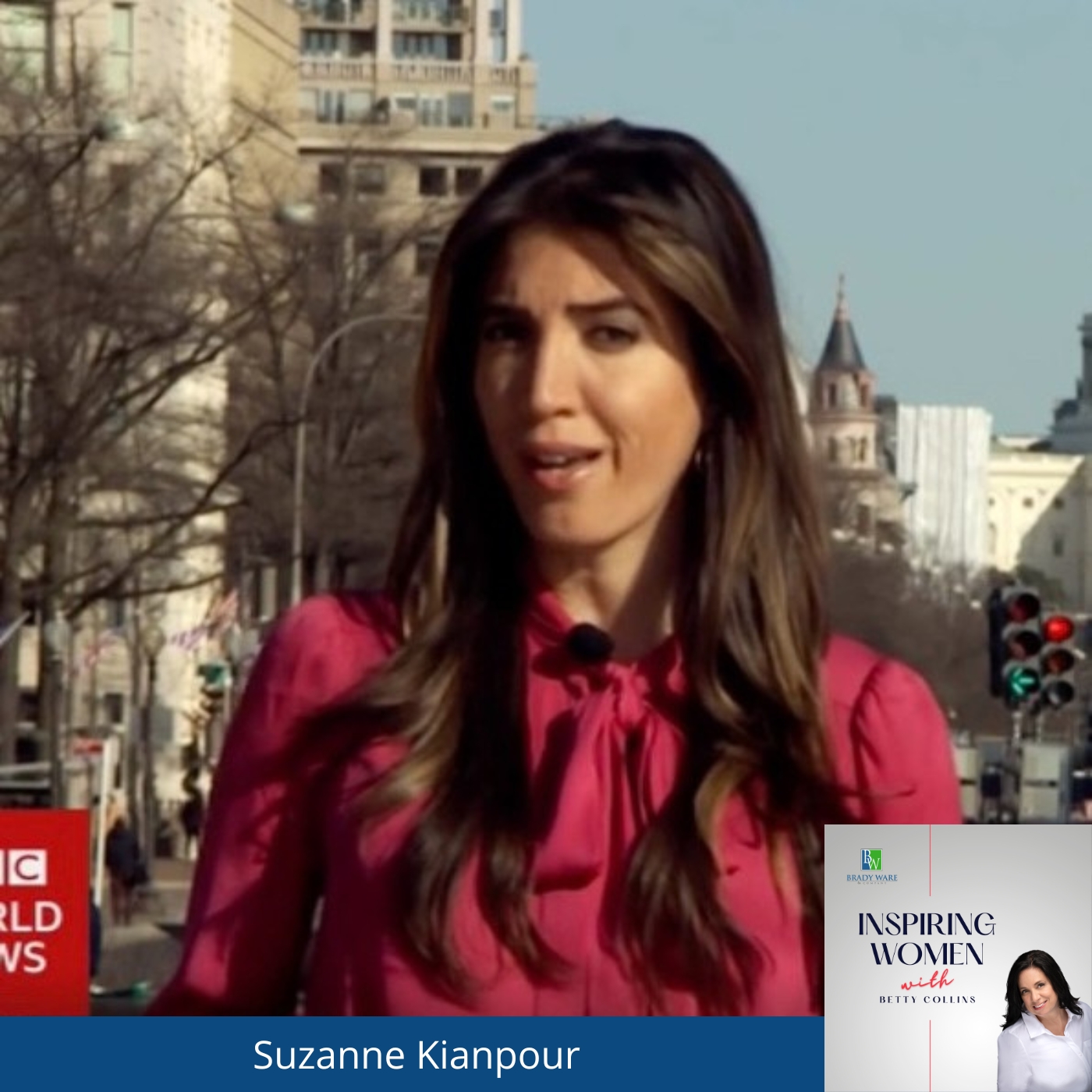
Suzanne-Kianpour
Inspiring Women PodCast with Betty Collins
Beyond the Headlines: Unveiling the Hidden Power of Women with BBC’s Suzanne Kianpour
Loading
00:00 /
RSS Feed
Share
Link
Embed

Download file

Suzanne-Kianpour

Beyond the Headlines: Unveiling the Hidden Power of Women with BBC’s Suzanne Kianpour (Inspiring Women, Episode 60)

“Women don’t need empowerment. Women are power. We just need a spotlight on women in power.” Hear the BBC’s Suzanne Kianpour as she speaks with Inspiring Women host Betty Collins on her experiences as a woman in a male-dominated field, the importance of journalism, her determination to support instead of blocking the progress of other women, and much more.

The host of Inspiring Women is Betty Collins, and the show is presented by Brady Ware & Company.

Betty’s Show Notes

Suzanne Kianpour is a journalist who has covered war zones and international events for the BBC. Fluent in multiple languages, she has made it a priority to highlight the stories of women in conflict zones. Her most recent project looks at the hidden power and politics of women in the Middle East. Kianpour believes that women in the region are often underestimated and that there are lessons to be learned from them.

In this episode, Kianpour discusses her experiences as a woman in a male-dominated field. She recounts a time when a senior female correspondent got in her way, preventing her from getting a job that would have put her on the Secretary of State’s plane. But Kianpour is determined to be a woman who supports other women, not one who blocks their progress. “Somebody has to take a chance on you,” she says.

Kianpour also talks about the importance of journalism and the responsibility of journalists to hold those in power accountable. She recognizes the seductive nature of those in power and the importance of maintaining objectivity, impartiality, and integrity.

Kianpour’s work in elevating women’s voices throughout the Middle East through the Center for New American Security’s Middle East security program highlights the importance of representation and storytelling in bringing about change. She emphasizes the need for more women in positions of real power.

As Kianpour continues her work, it is clear that she is a woman who believes in the power of journalism and the importance of supporting other women. Her dedication to highlighting the stories of women in conflict zones and her commitment to holding those in power accountable make her an inspiring figure in the world of journalism.

Hosted by Betty Collins, CPA, and Director at Brady Ware and Company. Betty also serves as the Committee Chair for Empowering Women, and Director of the Brady Ware Women Initiative. Each episode is presented by Brady Ware and Company, committed to empowering women to go their distance in the workplace and at home.

For more information, go to the Insights page at Brady Ware and Company.

Remember to follow this podcast on Apple Podcasts and Google Podcasts.  And forward our podcast along to other Inspiring Women in your life.

TRANSCRIPT

[00:00:00] Betty Collins
So today on Inspiring Women. This is a very exciting podcast for me. This is really kind of strange. In 2023, year five of doing podcasts that I’ve had really someone internationally known and has a business outside of the US. And then I have this amazing woman, Suzanne Kianpour today, and she is an Emmy nominated journalist and she travels all over the world. I mean, you’re going to hear some of her story. It’s pretty cool, but she’s been an anchor for over a decade of experience in TV and radio digital journalism, and she’s working on the front lines of some of the world’s biggest breaking news stories. As we know, those are so prevalent today, landing some high profile profile, exclusive interviews and providing insight and analysis on leading political, foreign policy and security issues. I mean, that in itself is a lot of hot topic right there. Right. But she spent again in foreign affairs public journals. She’s been in over 60 countries and she’s shuttling from war zones to Washington, from Helmand’s to heels. It’s kind of an amazing you got to look her up on the Web because you’ll find some cool stories and great interviews. She’s landed some multiple high profile exclusive interviews, including the Iranian foreign minister, Trump’s lawyer, as we’ve all heard about in the news these days, Michael Cohen and President Obama post the Iran nuclear deal. Her BBC film America’s Place in the World, features her exclusive sit downs with some names you would know, like Secretary of State Mike Pompeo, Senator Mitt Romney, the Australian Prime Minister, Kevin Rudd.

[00:01:41] Betty Collins
I mean, these are big, big people. So she was born and raised in Atlanta, Georgia, with a Persian and Sicilian background. She’s fluent in quite a few languages and she has to be because of where she lands for the BBC. She’s a graduate of Emory University, where she studied both abroad at Oxford University and attended Georgetown University. Post grad. So welcome today, Suzanne, and thank you so much for being with this. I really am in awe of your work and just the impact that you have. And I want to have a conversation about those things, especially with the world we live in today, and your impact on the international stage, especially for women. I know that in the US we get very wrapped up in the empowerment of women and opportunity or lack thereof, and sometimes we feel we’ve come a long way and sometimes we feel we’ve got a long way to go. But you’ve really seen the side of what other women face in other nations. So let’s get started and just give me a two minute bio, You know a little bit about just something about you and why you’re back. You’re back in the US this week.

[00:02:51] Suzanne Kianpour
Well, thank you so much for that introduction. I’m really happy to be able to discuss this topic of women and power with you as it’s dominating most of my work these days, and it is a topic that became front of mine while I was shuttling Washington and war zones, as you said, mainly because these the stories of these women were not at the time. And this is this is about almost a decade ago now when I was really in the war zones, when ISIS was chopping heads off in the Middle East. Right. Um, grimly. And and I noticed that these stories of these women were not really making headlines. Um, and so slowly but surely, throughout my work, I have made it a priority to highlight the stories of women. And I started my BBC series Women Building Peace, which is all about women and conflict and connecting high profile women like Hillary Clinton with women in conflict zones like Afghanistan. And this week I am in Washington for the White House Correspondents Dinner, which used to be just a dinner on Saturday night of correspondents and the president roasting the press. But now, in recent years, it’s become White House Correspondents dinner week, where there are loads of events surrounding the the dinner itself. And actually, on Friday, I’m going to be attending a event hosted by Elle magazine, which is all about women of impact. And so I’ve seen even in this little ecosystem, which is really a uniquely Washington bubble event, but I’ve seen the the highlight of highlighting of women and our work. And I think often we hear the words women empowerment.
[00:04:46] Suzanne Kianpour
And I like to push back on that and say women don’t need empowerment. Women are power. We just need spotlight on women in power. And I’ve been commuting between D.C. and Dubai. A 14 hour commute. Come to me for travel tips. I’ve got them all now. And part of that is because I am working on a project that looks at the hidden power and politics of women in the Middle East. Which, funny enough, this this recent exchange that I had in Washington with a congressman very much solidified why I’m doing this work. I mentioned to him that I was working on this and he said, Oh, women in power in the Middle East. That’s that’s kind of an oxymoron. I mean, can women even drive, which is a very tired view of the region, but also further illustrates how important it is to tell these stories right now, because, as you say, women in America especially, we feel like we’ve come such a long way. But ironically, being in the Middle East, I’m looking back at myself and my fellow American women with a completely different perspective and realizing how far we behind we still actually are and again, paradoxically, what kinds of lessons we can learn from women in the Middle East, which is traditionally, from a Western perspective, we’ve looked back and thought, oh, women in that region are suppressed. When look at the women of Iran, I would I would say, yes, they’ve been attempting to be suppressed and oppressed and it’s not working.

[00:06:26] Betty Collins
Right. Right. Well, I know when I you know, we see you on video clips or on screen and it looks so simple, right? Laugh out loud, of course. But in reality, I mean, you’re traveling you are called in the middle of the night for a deployment. Right. Or you’re covering tragedy and maybe hopefully more triumph. And you’re crisscrossing not just the US, but the world. And it’s got to be tough. But you have a front row seat at so many things. And when we talked about this interview, even in getting you scheduled, it was kind of hard to do. And at one point you emailed me, you said, I will get to you, but I’m in the middle of a woman’s revolution. And so I just that grabbed me and I thought, man, I’ve got to hear some of it. But can you talk a little bit about the front seat? Like you’re on that edge. You know, you’re sitting here watching a revolution. What’s the what is it like to be on that front seat? I’m sure it’s beyond that is exhausting. But tell us about that.

[00:07:26] Suzanne Kianpour
I’ve been I’ve been so lucky, frankly, to have been on in the front seat of history unfolding throughout the last decade in my career. I mean, some of some of the more surreal ones were actually I missed my birthday party in 2013 because John Kerry was my ride home back to Washington. And I was stuck in Geneva because John Kerry, aka my ride home, was in the diplomatic negotiating room with the P5 plus one members, and they were coming up with the interim Iran interim nuclear deal. And so at least I got a good news story for my birthday. If I missed my birthday party, at least I got a good news story because after months of negotiations, they finally came up with a framework. And it was a big deal because I was I was quite literally in that front row seat. Literally, I was in the front row of the press conference where the Iranian foreign minister and the American secretary of state together on stage two countries who are technically at war with each other do not have diplomatic relations, formally announced a, you know, a framework that led to an eventual nuclear deal. Right. Um, and and that that was just one of many. I was on I was front row seat to Hillary Clinton losing the presidential election in 2016 because I was traveling with her, covering her presidential campaign. You know, right now I’m in Dubai for a lot of the time and I’m 70km from Iran, where we’re seeing the first woman led revolution. And that’s about as close as we’re going to get because we can’t be on the ground as Western journalists are not allowing us in. And and so it’s it’s been wild. It’s been wild. But also, I think as journalists, when we’re in those positions, it’s really important to recognize the gravity of our job because we are quite literally the first draft of history.

[00:09:29] Betty Collins
Right. Well, that’s a great segue into because I’m just had all kinds of different questions and this is my next one. So it’s kind of that’s a great segue. You know, I read on your on your website and it’s putting people over politics to keep public service in journalism. I mean, what a statement to me. I read that and went, okay, that’s first of all, very needed. Right. And it’s encouraging because we don’t always think of that side in today’s world with the journalists. So and here you are embracing that and you’re living it, you know. Tell the audience, of course. I mean, it’s kind of a no brainer, but why is it so important? And how do you keep that perspective of of keeping people, you know, over politics and its public service? You know, because democracy relies on a media with integrity and public service attitude, you know, so that we can be informed of the truth and see history and see things playing out. We’re so used to that now. We’re seeing it as it’s happening, but you have a good perspective on it, and I don’t see that normally. So can you talk a little bit about people over politics and public service for media?

[00:10:45] Suzanne Kianpour
You know, it’s really interesting being back in Washington because Washington gets a lot of flak about not putting people over politics when it comes to the politicians. But actually, I think the media itself, as journalists, we every single day have to remember that we are here to hold the people in power accountable for the people who have elected those people in power. And so it’s really important for us not to get sidetracked, to get seduced. And mind you, those people in power are trying to seduce us all the time. So this this whole week, this White House Correspondents week. And I’m really glad we’re having this conversation right now because it’s the perfect example of the thin line that we have to walk to maintain our objectivity and our impartiality and our integrity, because Saturday night, I’m going to be at this dinner and I’m going to be rubbing shoulders, shoulders with all of these people in power, and we’re going to be having dinner and drinking champagne. And, you know, there’s going to be a few celebrities there. There usually are. I mean, who knows which ones? It’s a bit of a weird cast. I literally got an email asking if I could help place Anna Delvey. I don’t know if you know who that is. She’s the one.

[00:12:12] Betty Collins
Wow. Yeah.

[00:12:13] Suzanne Kianpour
So she was a fake heiress. There’s a Netflix film about her called Inventing Anna. She’s like, defrauded a bunch of people in New York. Yeah, it’s a crazy story. Look it up. But anyway, just to give you a bit of insight into what this dinner is like. Yeah, but mind you, you know, these kind of events start out with good intentions, but can very quickly end up, you know, spiraling into kind of that swampiness that Trump really grabbed on to in his campaign around America to say, look, I’m here to drain the swamp because Washington is corrupt and the media and the politicians are all in in on it together. And to be frank, parts of it he’s not wrong about. And so we as members of the media have to be really conscious of this, really cognizant of what kind of image we’re reflecting back to America. And when I say putting people over politics, that is part of what I mean. And I’ve been lucky, I think, because I’ve I’ve been you know, I’ve been a journalist for the BBC for most of my career. And so I’ve covered my own country through the eyes of a foreigner. And so I’ve had a bit of a life as an insider. But from an outsider’s perspective and now I’m I’m in the Middle East looking back at America from the outside. And so it’s similar. I’ve kind of taken that onto a global scale. And one of my documentaries called America’s Place in the World that you mentioned at the time I did that documentary from Washington, and now I’m really looking and living, what, America’s place in the world looks like. And America’s place in the world does not look as strong as it used to. And it looks like China is getting closer and closer to taking America’s former place in the world. Right.

[00:14:14] Betty Collins
And the American public. I mean, I’ve never been abroad like that. I’ve been through the Caribbean. I don’t consider that abroad. I’ve never looked at the US from the outside, although I will tell you, the one app I have on my phone is the BBC, because I just feel like it’s very fair reporting. I just like the story. I want to know that there’s truth behind it and then I can decide what I want to do with it, Right? And I think we’re so there. And so when I saw that that is right there under helmet to heels, you know, it’s right there on your website. I thought, wow, what a conversation that we need to have. We need to have this conversation everywhere about the integrity of it. And anything, it doesn’t matter. It’s not just media. Right? I mean, it’s more than that. But I really believe I’m a news buff. I love it all, but I’m so disenfranchised with it. So when I can find someone who really lives and breathes this and this is how they’re reporting, it’s it’s amazing. So appreciate that. So so we’re going to really shift gears. Here we go. But you are known for elevating women’s voices throughout the Middle East and you’ve been part of this Middle East security program. I’d love to just talk a little bit about it. I know that’s a huge open ended question, but but what is that? What is this program?

[00:15:38] Suzanne Kianpour
So I am kind of touching on a bit before when I had that conversation with the congressman who, you know, there are all kinds of people who are elected to Congress. This particular member of Congress is is actually a worldly one. A lot of them are not. And so to hear that from him this, do women even drive in the Middle East just further, just further entrenched the need to elevate the voices of women in the Middle East And the Center for New American Security has given me a platform in order to focus on that. And so, yeah, I’m looking forward to seeing how we can grow that and where it can go, because I think it’s really important and I think not just the Middle East, I mean, I’m sort of starting with the Middle East for this particular project because I feel like it’s timely and it’s a it’s a good place to start because it is kind of the the greatest paradox from a Western perspective. But I you know, in women Building Peace, I did an episode on the women in Colombia and how how important their role was in the peace process. Women’s role was women’s roles were in the peace process, and that serves as an example of how and why we need more of that. On the on the peace building front, on the global stage, and representation matters, quite frankly. So storytelling is how representation ends up reaching the points where we need to see it change comes from within. And a lot of the issues that I think what I’ve seen, a lot of the issues are linked to, quite frankly, not having enough women in positions of real power.

[00:17:34] Betty Collins
Yeah. And you know, when you say that, I mean, I think of, you know, as as a US person, as a person in business, as a person who empowers women. But but now you have challenged me on that. So I like that. But I we don’t think of the bravery and the tenacity and the boldness we think we are that in the US, you know what I’m saying? And it’s like, no, there’s probably all kinds of quote, revolutions because the more I research and look at what you’re doing and look at the women that are so effective, it’s inspiring. It’s great to see that, you know, it’s great to know, yeah, this is happening not just because I happen to be a business woman in Columbus, Ohio, who has success behind her. I just go, No, I look at the stories you’re telling and going, Wow, there’s all kinds of women leading the way in ways that I would never know how to lead a revolution. I don’t need to have one, I guess. But anyways, I just thought it was interesting. I think we.

[00:18:37] Suzanne Kianpour
All have our own little we all have our own little revolutions of our of, you know, I think the definition of a revolution is is saying no to the status quo, challenging it and changing it. I love. And so a revolution doesn’t mean you have to have 100,000 people in the streets that you’re reading or that you’re leading. Rather, a revolution can be something that you’re doing on your own internally to change whatever it is that you feel strongly about. And I think I think we need to be talking about these things, and I think we need to encourage each other, particularly among women. I actually posted something on my Instagram yesterday with a group of my girlfriends. I’d found a picture that I liked, but I felt the need to write in the caption that the world often pits women against each other and it is important to not let that happen because there are so many reasons we as women are not where we should be still after all of this time. And we need to be aware of every single one of those reasons, even if it’s reasons that we don’t we don’t care to really admit, like the women that get in the way of other women and generational gaps and and mindset concerns. And so all of these need to be discussed and there needs to be a. Countability not just discussed. I think we do a lot of talking, but we need to be doing just as much if not more acting. Right?

[00:20:06] Betty Collins
The action, action, Action. And I love I mean, this is so funny. The great minds think alike, I guess, but I always am stressing about women supporting women. And and I always say that’s why men still rule the world. Because if we were so much more supportive one on one with each other or in bigger cases, you know, it doesn’t really matter. But it’s just women supporting women, you know.

[00:20:31] Suzanne Kianpour
But also women supporting women off the stage. You know, there are a lot of conferences and summits and whatnot that I go to that’s all about women and empowering women, women supporting women. You know, we hear we hear about leaning in. We hear about confidence codes. We hear about knowing your value. These are all catch phrases that that powerful women have come up with in order to share their knowledge and ideas and write books and turn them into summits, etcetera. That’s all great. However, that needs those speeches that happen on stage in front of a crowd of young women who are looking up to these these women who have been successful for inspiration that needs to translate off the stage. So when these women come off the stage and a young 20 something comes up to her and says, you know, I admire you, can I get your advice on X, Y, Z? There needs to be actual follow up and action on that. And and I will say that I recently went to a summit and some of the it was it was women under 30 mostly and women over 50 mostly and then some like 30s and 40s. But most of the women were in their 20 seconds and in their 50s and and the women in their 20s. Some of them confided in me that actually when they went up to some of the speakers who were on the stage afterwards and the kind of networking meetups that they felt like the the the speakers sort of gave them the up and down and were a bit snobby to them and they didn’t feel like the message that they had just, you know, spread on stage. They didn’t feel like they were living that message. And that’s a problem we need to have. We need to be living our story and we need to be authentic. When we speak up.

[00:22:21] Betty Collins
I’m going to use your line somehow of when we’re off the stage, Are we? I like that whole that not that you’ve seen that people on stage say one thing and then do another. But but there’s so much to that in the every day, even if you’re not a big name on stage, I mean you women supporting women is the only way, you know, that we can continue to go further as we want to go. And so, you know, I think we’re doing some things really, really well. And I think we’re doing we still have a long way to go in other ways when it comes to supporting each other. And there’s all kinds of ways you can support people, you know, when it comes to women, to women. But, you know, for you in your industry, because there’s a lot of women in your industry. Right. How do you find that your know, being in media, being the storyteller, being in the front lines like you are, how do you feel like you have women supporting you in your task?

[00:23:21] Suzanne Kianpour
You know, truthfully, I’ve had women who have actually gone out of their way to get in my way. But then I’ve also have women have had women who literally are the reason why I’m here today. And so I’ve had both experiences and I’m grateful for both types of women, quite frankly, because the women who went out of their way to get in my way just fueled my fire. And the the women who you know, there’s one woman in particular, Kim Ghattas. She was the BBC’s State Department correspondent. And I was in my mid 20 seconds, you know, bright eyed, bushy tailed, total imposter syndrome, had no idea what I was actually doing, but had all of the knowledge, right? I had I had all of the foreign policy knowledge and, and, and excitement and energy, but I didn’t have the actual experience at that time. And it’s sort of a chicken or the egg, right? You can’t get a job without experience, but you got to start somewhere, right? So somebody has to take a chance on you. And most of the time it’s men in positions of power who have the position of power to give you the chance. And so a lot of what ended up happening later on with MeToo, etcetera, really brought all of this to light, right? The need to have women in positions of power, in media in particular.

[00:24:41] Suzanne Kianpour
But Kim Ghattas went on book leave to promote her book that she wrote about Hillary Clinton when Hillary Clinton was secretary of state. And she handpicked me and told the bureau chief that I was really good and should fill in for her while she’s on book tour. And that’s how I ended up on the. Of state’s plane. And I was the youngest by far. And, you know, it’s also there aren’t as many women and the women who are in these positions have been one of the few. And so it just makes it even more competitive or has up until recently, I would say. Um, and so, you know, him was a woman who effectively made my career. But before that, about 18 months before this happened, I’m not going to name names. There was a there was a senior woman, a very senior woman who, um, quite literally got in my way from what would have ended up being a job that would have put me on the Secretary of State’s plane. So I ended up where I was supposed to end up anyway, but I and I had two, two different experiences with two different female correspondents. Yeah. And I vowed to be the Kim and not the other one.

[00:26:07] Betty Collins
Well, that’s a great way to talk about women supporting women and women not supporting women and and learning from it and fueling fire from it and making sure that, you know, when you can bring someone along, you’re going to you know, exactly, you know, it’s what it is. So but I mean, that’s.

[00:26:23] Suzanne Kianpour
What my that’s what Women Building Peace is about. The reason why I created this show specifically the way I did was so that I have I have a lot of access to high level, influential people, and I needed to put my Rolodex to good use. And so I, I effectively am bringing these high profile women in in the room, whether it’s virtual or literal, with young women who are coming up in their fields and normally wouldn’t have access to these people. So I’m quite literally facilitating this is reaching back and lifting up.

[00:27:01] Betty Collins
Yeah, I love it. I love it. Well, I mean, I am so pleased and amazed that you would be part of my podcast today. I am so. So. Women supporting women. Women supporting women. That’s right. I’m in year five and I’m really trying to get a totally different take this year on the different voices that can that need to be heard. And I’m just still so in awe of of and still I’m a little nervous interviewing this person who interviews people for a living. But let’s talk about your website, Poor World. Is that where people find Because that’s where I found a lot about you. It was so informative and so, so great. Is that where we would get our audience to find you and then maybe talk about we have the Women in peace and some other things, but what could they come and go find you and get inspired as well and see what you’re doing?

[00:27:53] Suzanne Kianpour
Well, Kim Poor world is currently expanding. Stay tuned. There are exciting things coming along in the world. Okay, I would say we’re most active on Instagram right now, but we’re going to be we’re we’ve got some projects coming up and some content that’s being created that will launch soon. Okay. And so we’ll be we’re we’re cross platform because we recognize that people like to consume their content on different apps and different forms of media. So. Okay, stay.

[00:28:29] Betty Collins
Tuned. Okay. We will stay tuned for sure. And hopefully today my audience, you have gotten just you’ve just heard this surface. We just scratched the surface with Suzanne. And I would challenge you to find her and go to the BBC or the BBC, the BBC app, and really get in touch with what she’s doing. So, again, thank you, Suzanne, for coming on today. And we will change the world together, right?

[00:28:58] Suzanne Kianpour
Yes, indeed. Inshallah, as they say in the Middle East. But there’s two different kinds of it means, God willing, there’s the Arabic version, which sometimes has this joke. That’s if somebody says Inshallah, that means it’s never going to happen. Okay. But the the Persian side is more of a hopeful inshallah. Actually, I’ll end with a funny anecdote around this. Okay. Speaking of of front row seat to history. Okay. When when the Iran interim nuclear deal was reached. So right before it when I was just wasting away on my birthday in Geneva and the Intercontinental. Yes, I, I got wind that that Javad Zarif, the Iranian foreign minister, was going to be taking a particular elevator. And when you’re covering this, this this like high stakes diplomacy, it’s so much of a hurry up and wait. I mean, there are hours where you’re doing absolutely nothing and then you have to, like find anything. That’s a little nugget of news. Okay. And so I got wind of where he was going to be entering the. Elevator and myself and another reporter went and we we did a stakeout of the elevator. And he finally it was just the two of us. So this was basically a scoop. Okay. And so he finally shows up and we managed to get a question into him, which is something along the lines of, is there going to be a be a deal? How do you feel? And he just says one word, Inshallah. And so I tweeted it and it went viral because it was literally the only new new thing that we had got. And and Kim actually, Kim sent me a message. She said, And so obviously, Zarif said this in Farsi. He’s an Iranian, so he’s a Farsi speaker. And she she messaged me and she said, Does Inshallah mean the same thing in Farsi as it does in Arabic? Because in Arabic is not a good sign.

[00:30:47] Betty Collins
That’s a great.

[00:30:48] Suzanne Kianpour
Story. I said I said, no, I think it means there’s going to be a deal. And I was right. I was right. Wow. I read the tea leaves correctly.

[00:30:56] Betty Collins
Okay. Well, I mean, I love the whole scoping out the elevator. I love that. So now again, Susan.

[00:31:05] Suzanne Kianpour
These these things because you forget. I forgot. I honestly forgot about that story until right now.

[00:31:09] Betty Collins
Oh, no, that’s wonderful. I love. I mean, I could talk to you for another hour. There’s no question. But I don’t. I mean, I just am amazed of the the front seat you have, how you’re using your venue and your platform. So appreciated and have fun at your correspondents. If you’re ever in Columbus, Ohio, which I would love for you to be, we definitely have to get together, so.

[00:31:30] Suzanne Kianpour
Well, Ohio is a swing state, so you may get your wish sooner than you think.

[00:31:34] Betty Collins
Okay. Well, if you’re here, you make sure you look me up. Otherwise, have a have a great one and we’ll we’ll get you information about when we’re doing this and how we’re doing it and what we’re doing with it.

[00:31:44] Suzanne Kianpour
So wonderful. Thank you so much.

[00:31:46] Betty Collins
You got it. Thanks. Bye bye. Bye bye.

Automated transcription by Sonix www.sonix.ai

Tagged With: Betty Collins, Inspiring Women with Betty Collins, journalism, Suzanne Kianpour

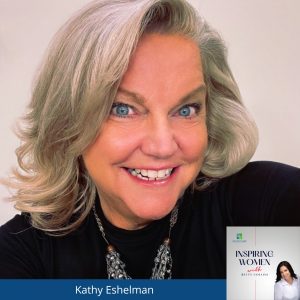
Marching Band, Entrepreneurship and Politics: The Inspiring Journey of Kathy Eshelman

July 15, 2023 by John Ray

Inspiring Women PodCast with Betty Collins
Marching Band, Entrepreneurship and Politics: The Inspiring Journey of Kathy Eshelman
Loading
00:00 /
RSS Feed
Share
Link
Embed

Download file

Kathy-Eshelman

Marching Band, Entrepreneurship and Politics: The Inspiring Journey of Kathy Eshelman (Inspiring Women, Episode 59)

From first female elected as President of the Texas Longhorns marching band, to founding Grade A Notes, to advocating for women-owned businesses, to running for political office, Kathy Eshelman has had quite a journey, and there’s more to come. On this edition of Inspiring Women, Kathy discussed her career and what’s ahead for her with PatrioticJewelry.com with host Betty Collins.

The host of Inspiring Women is Betty Collins, and the show is presented by Brady Ware & Company.

Betty’s Show Notes

Kathy Eshelman, a natural problem solver, collaborator, decision maker, enthusiastic team player, and an exceptional communicator with an entrepreneurial spirit, is my guest on this episode. During the podcast, Eshelman shares her experience in founding Grade A Notes, a note-taking service for students, at the age of 25, with $30,000 in investments from friends and family.

The business eventually expanded to six different locations across the country and sold custom course packs to over 100 universities. Eshelman’s entrepreneurial spirit led her to be appointed by the White House to the WSBA’s National Women’s Business Council and to serve as the PTO president of Junior Achievement. She holds a degree in journalism from the University of Texas in Austin and was the president of the Longhorn marching band for two years.

Eshelman represented the Women Presidents organization on the National Women’s Business Council, which aimed to provide information and support to women business owners. She ran for state representative in Ohio, receiving support from her Women Presidents organization and political friends, but ultimately lost by a few votes due to political maneuvering. However, Kathy encourages women to run for office and get involved in politics, as it can have a significant impact locally and nationally.

Kathy reveals her struggles with finding the courage to pursue her business dreams. She plans to relaunch her jewelry business and make it a real ongoing business.

Hosted by Betty Collins, CPA, and Director at Brady Ware and Company. Betty also serves as the Committee Chair for Empowering Women, and Director of the Brady Ware Women Initiative. Each episode is presented by Brady Ware and Company, committed to empowering women to go their distance in the workplace and at home.

For more information, go to the Insights page at Brady Ware and Company.

Remember to follow this podcast on Apple Podcasts and Google Podcasts.  And forward our podcast along to other Inspiring Women in your life.

TRANSCRIPT

[00:00:00] Betty Collins
So today we have a great guest on inspiring women, and her name is Kathy Eshelman and she is a natural problem solver. Aren’t all women right? But she’s very accomplished. I mean, her I can’t even read her whole bio. There’s so much here. It’s just amazing. And I know in her questions we’ll talk about it and get through it. But she’s a collaborator, which we need today, a decision maker, very enthusiastic team player. She’s exceptional with communication skills and her entrepreneurial spirit certainly thrives. You’re going to hear about that today. She’s she served as the PTO president of junior achievement. But also, this is a big deal to me is the White House appointee to the SBA’s National Women’s Business Council. I’ve been to Washington, D.C. once with Nabo, and it was the coolest thing. And we got to see some of this. And that was in 2019. You hold a degree in journalism. You’re from the and you went to the University of Texas or in Austin and you were the president of the Longhorn Marching band for two years. I love that. There we go. You played tenor sax. Do you still play?

[00:01:10] Kathy Eshelman
No, no.

[00:01:12] Betty Collins
No, I don’t. I don’t. The marching band is significant because she she marched in the inaugural parade for President Ronald Reagan and Vice President George Bush. And that was probably a big highlight. That would have been a cool, cool. It was amazing. Part of. Absolutely stayed.

[00:01:28] Kathy Eshelman
Stayed in the barracks in Quantico. Oh, my God. Yes. That’s awesome. It was really an amazing trip. Oh, well.

[00:01:34] Betty Collins
But and what’s great, of course, with inspiring women, we’ve talked we have so many listeners who are all about entrepreneurship. I mean, we have many of you are in business as well. But she owned her own business and you started a business at age 25 and you raised 30 million, $30,000, not 30 million, but 30,000 to start grading notes and then build it into a $1.8 million enterprise. That’s very impressive. You also have something called patriotic jewelry.com. That’s going to be fun to talk about. And you served as the vice president of membership for the Ohio Chamber of Commerce, where her team earned two national sales awards for member retention. So that’s really cool. You have a lot of passion. I think this is brave. You ran for the Senate. Anyone who’s in politics I think is brave, especially today. So we’ll maybe we’ll probably get into that as well. And you were featured. You were a Weld calendar. I was as well in 2020, the year of the pandemic.

[00:02:36] Kathy Eshelman
One was quite a long time ago, but I was still Miss August.

[00:02:39] Betty Collins
There you go, Miss August. I was. I tell my kids I was Miss December. They hate it when I say that, but.

[00:02:44] Kathy Eshelman
My family does too. I still do.
[00:02:46] Betty Collins
It. But you were also in the Columbus CEO magazine as boss woman and other media, including TV, newspaper and magazines. So we’re just going to connect and we’re just going to start right in. We have so much in common and so much synergy. I think today’s podcast will just be energy. You’re going to love it. This is a person who has an amazing resume and a lot of insight for us, but certainly I couldn’t even read. Your whole bio was crazy. So you certainly don’t allow any grass to grow under your feet. When you were 25 years old, you started a business and you founded Grade A Notes, as I said, was a $30 Million $30,000. Can you tell us what possessed you to follow this route at such a young age?

[00:03:29] Kathy Eshelman
Yeah. So it’s kind of like the horse trailer story from Texas, right? So my I went to school at the University of Texas and they had a note taking service. And I just thought it was fantastic. I thought it was ironic a little bit, too, because getting a journalism degree, you know, yeah, I was buying somebody else’s notes, but they were very affordable. And for me, they were just a supplement to you.
Make sure you kind of had every bit of information you could just to succeed in your classes and do well. And so from that, I decided, you know what? I’m going to I’m going to do one similar. So I looked around and the gentleman that owned that one was kind of doing some other universities in Texas and surrounding area. So I thought, Well, I’m going to get out of his hair. I don’t want him to feel any kind of competition. So I did some research. And Ohio State was the largest university in the country that did not have a note taking service. Wow. So that, you know, I don’t know how much deep research that was, but it was enough for me to loan my dad’s horse trailer, you know, come up with my. Yeah. And we, you know, my business partner’s dad drove us up. I mean, we were young, right? So. Yeah, Yeah. And I had got a friend of mine I knew from Longhorn Band to join me. He was fresh out with a advertising marketing degree, I believe, and thought I need a first job. Sure, I’ll go do it. Let’s do it. I don’t think he knew he was going to be getting ink under his fingers and printing a lot of things, but we had a really good time and got it off. Got it off the ground.

[00:04:52] Betty Collins
Well, what’s interesting to me is you knew Ohio State was the only school in the country that didn’t like large universities. You didn’t have. The Internet to Google. So you had to do your homework. Good point for sure. Right. And the other the other thing that’s interesting is back then, I mean, today, 25 year old young women start businesses, right? Absolutely. At that time, did you find that the glass ceiling was a real thing, all that, or was it did people not take you serious? You’re just some young girl. Your dad must have money, all that kind of stuff. You know, I think there.

[00:05:22] Kathy Eshelman
Was a little bit of that, but I didn’t feel like it was any kind of real negative.

[00:05:27] Betty Collins
It wasn’t a barrier for you?

[00:05:28] Kathy Eshelman
No, not at all. I mean, my dad always owned his own business. And so I think growing up and I thought that’s what I’m going to do on my own business. I mean, I just that’s what I saw. Right. He went to work for himself every day. And I just thought, I’m going to do this. My my mom thought I was a little crazy and she probably was a little right. But, you know, my friends and family, we put together a business plan and they invested $30,000 with us. And we were able to just move up here and open a checking account. You know, get an apartment, and you just start finding note takers. I often say people, you know, how do you do the marketing for that? Well, it’s one of the few businesses where, you know, where 100% of your clients or prospects are at any given time. So we we would take like notes the first day, have our note takers take notes. And then we had a little template that just said, get these notes at grade notes.
And it was brand new. So that was the kind of a little bit difficult thing I didn’t expect, is that you had to kind of explain to these students what this was. So it’s kind of like customized Cliff notes. Yeah, but we would literally go over there and stand at the entrance of the doors and people would come in and, hey, you can get lecture notes for this class, you know? So just really. Wow. Yeah. It was a it was a and it started taking off. You know, students didn’t have all the, of course, social media and everything now but they definitely still word of mouth spread pretty big. Sure.

[00:06:48] Betty Collins
Yeah. So you had an idea, you had a passion, you’re using your degree and now it’s reality. But how long did it take? Probably to really like, I can actually pay my rent. You know what I mean? Because a lot of entrepreneurs was young that are listening right now are thinking, Oh, I can just jump and do that. But it does take it does take some time.

[00:07:06] Kathy Eshelman
And it definitely took longer than I thought. Yeah. But again, you know, you’re 25 and you just I’m going to go do this. Right. And I you know, I think really it was probably I started in 87, so probably about three, four years before I could to pay the rent. But one of my business partners, one of my business partner, I had shareholders also, but the business partner, he actually, you know, kind of paid some of those bills. That was kind of his commitment. So I have a place over my head, a roof over my head.

[00:07:33] Betty Collins
No, but sounds like you thought it through. But that’s awesome. At 25 years old.

[00:07:37] Kathy Eshelman
We ended up opening six different locations across the country and physical locations. And what ended up being our best when, I hate to admit, was that at the University of Michigan. Sorry. That’s okay. Maybe they just need more notes up there. I don’t know. Could have to do with it.

[00:07:53] Betty Collins
Yeah, they’re just lazy. They want someone else, right? That’s right. I mean, I don’t know.

[00:07:57] Kathy Eshelman
They were, you know.

[00:07:58] Betty Collins
But you were. But you went to six different states because that’s that’s a task in itself. Not today. Today you can be in six states like it’s nothing, Right? Especially with the pandemic. Everything shuts down. You’re now we’re all on Zoom calls doing our thing. Back then it was you traveled and and or however you had. We did it.

[00:08:15] Kathy Eshelman
We traveled. You know. Absolutely. You know, we actually went we went Athens was our first our second location. And then it’s a longer story. But basically the bookstore at the University of Michigan, I got to know one of the VP’s of that bookstore chain. And they thought and I thought I kind of proposed to him, What if we put our grading notes store like in the in your store? So it’d be like a little satellite. And so I just that ended up being a wonderful idea. I mean, they, you know, they got their percentage and they took care of all the little expenses I had no, you know, the percentage was beautiful. Yeah. It was really a great thing. And that’s probably why the Michigan store ended up being so successful because that was a different model. Yeah, but we ended up with a University of Nebraska, Michigan State, University of Arizona. Anyways, it was it was wonderful. And then beyond that, we started doing custom notes. I mean, like custom course packs people might know them from getting them at a Kinko’s maybe. Yeah. And so we put those together and bind them and sell them to the students in the classes. And that’s how we went to doing over 100 universities. We sold them through bookstores all over the country. So that was that was fantastic.

[00:09:14] Betty Collins
Wonderful. Well, this year’s theme is courageous, being actually courage and being courageous. That’s a lot of courage. At 25, you know, when I was 25, I was already having kids. I wanted someone to be the employer and give me a check. I didn’t want to write the check. I didn’t want to, you know, do all the things. And so to me, when I hear someone that starts something like that, I. You can’t go back, man. If you’re 25 and you’re listening or you’re even 30 and you can go, I got this right. Don’t, don’t wait till you’re 38.

[00:09:47] Kathy Eshelman
Especially till you get more and more bills and house expense and children and. Right. You’re right. I just was.

[00:09:53] Betty Collins
You were courageous. You had a lot of courage back then to do something like that. Thank you. Maybe go. Oh, kind of sound like. To you is just like wearing going to earn my living. But to two people, watch it or hearing your story, it’s different. It was really awesome. Well, you’ve been the PTO president, a junior achievement teacher, but also a White House appointee to the SBA’s National Women’s Business Council. Those are huge things. Junior achievement is a big deal. I love Junior Achievement. It’s such a great thing. I wish there was more of it. I do too, you know? And it’s funny, as I’ve gotten involved with a little bit of university things, I spoke at a group of kids who their major was entrepreneurship. I love that When that went in the 80s, wouldn’t that have been great? We would have had. Right? And now they actually have it. But and then to be on the National Council, I’d love to hear more about that.
But have you always considered yourself a leader?

[00:10:48] Kathy Eshelman
I don’t know that I consider myself one, but I do like to be in charge. Yep, there you go. And I do love working with people and what I hope to think is motivating them and and I know like at great notes, we were, you know, I told everybody to treat it like a Jerome business. And when you empower people like that, they really do a fantastic job, right? I mean, we had a few full time people along the way, but we mostly had students that were either working in our store, you know, just as clerks or the note takers. A lot most of them were all just like seniors or grad students taking the notes in the class, maybe a TA. And then we had a couple of we we called him Father Time. I think they had a father time down, down at Texas. Also just an old guy, gray hair. Just I mean, he and he just wanted to sit in on classes. And we had a woman like that too, had been a retired teacher, so they were awesome because they would take 3 or 4 classes. And of course, their commitment was high. Right. And they really wanted to learn it. So they really took great notes.

[00:11:44] Betty Collins
Well, I mean, I look at leadership is if people follow your leader, I mean, to me that defines leadership. You can have titles, you can be in charge, you can do these things. If you don’t have a following, you’re really you’re not leading. So, you know, as a leader, what did you get to do with this SBA council?

[00:12:02] Kathy Eshelman
Well, it I actually represented the Women Presidents organization. I was a member of that. It was started in it started in New York City. A woman started it there. And then it was like a peer advisory group. So you’d meet like once a month and like a max of 25 women in it. And they were all had to be presidents of businesses that did at least $1 million in sales. If you were service based and 2 million of your a product based. So I barely snuck in at that point where we were. Right, right. But you got in that ended up being just one of the most I mean, some of my very best friends are from the WPA. Yeah. So the WPA held a seat on the National Women’s Business Council. There you go. And so Marcia Firestone, the founder, actually asked me if I would be willing to do it. She knew I was very involved and I loved it. Be anything. Yeah, this wasn’t really political, but it still was in that government public service. Yeah. So the greatest thing I think that happened was we had they had never taken the taken the information out to the people, if you will. So Tami Longaberger was actually the president at the time. Now, that was just coincidental. We were both from Ohio and I had met her a few times. Yeah. But we we had them maybe half a dozen of them around the country. And we ended up with the one in Columbus, Ohio. And it was by far the most successful. I mean, I think between Tami and I having, you know, enough contacts. And of course, Tami is just a great draw. So yeah, and it was we just brought people in and we had, you know, we had some just different speakers for them. And information about matters important to women business owners.

[00:13:33] Betty Collins
You know, I have clients who are in definitely in the WIPO and, and they don’t even see themselves as leaders, you know, but they really are. And they’re still trailblazers today because they’re still because the amount of businesses that are that are women owned that are not over $1 million is just awful, right? I mean, they’re just women were 40% of the women businesses that are starting are women business owners. Right. But they stop. It’s it’s stacked. It gets here. So to be over the million dollar mark, you’re leading the way. Definitely. That was great. Yeah, right. And I mean, you did it a while ago.

[00:14:10] Kathy Eshelman
So and I was surrounded by women who most of them were ahead of me, just, you know, for whatever reason. And it was just just imagine being able to sit around the table with women who’ve been wildly more successful than I had. You know, I’d like to think that I caught up a little bit, but and I’m still really good friends with them today. In fact, I hosted our monthly supper club Thursday night. Oh, nice. And, you know, we have 13 of us that just kind of started as a support one one woman we knew really well and needed some support. And we have a supper club every month doing like eight years, I think. And Thursday was at my house and it’s just amazing to get these women together. We’ve been friends, you know, depending somewhere around 97, but as people joined so it’s my best friends are from WIPO.

[00:14:53] Betty Collins
Well, in your spare time.

[00:14:55] Kathy Eshelman
You.

[00:14:55] Betty Collins
Ran for state representative for Ohio. Give us an idea what. That’s like, because I’ll tell you, women are running for office more and more right now. The Joanne Davidson’s the Betty Montgomerys in Ohio. They were trailblazers for sure. And what we’re even seeing at the national level now and state Senate, I mean, federal Congress. And it’s just off the charts. I would there’s a part of me who would just love to jump into it, but there’s a part of me going absolutely nuts. Do it now. You’ve got to do it. But tell me what it’s like to do it, because I love having women at the table in everywhere. I think it’s good to have a balance. I think it’s good, Absolutely.
Perspectives. But tell us about that whole process and what that was kind of like. You need to encourage women to do this.

[00:15:40] Kathy Eshelman
And that’s why I said you should. Anybody else watching you should do it. So it didn’t end the way I wanted, but it definitely was a pretty amazing experience. So what had happened was what had happened was, yeah, Mike Keenan was a city council member and then became mayor. But in the meantime, he had run for this district and at that time, 2010, it was it leaned a little left, not much. And I was, you know, I was a Republican at the time, so I still am sorry. I don’t know why I said that. Don’t apologize. It’s all good. It’s not to be political, But but, you know, it’s kind of like a everybody kind of understands if he’s going to run again, I’m probably not going to run for, you know, because he’s already in office. So our county chairman for the party called him to ask, hey, what are you thinking? And he’s like, I’m not doing I’m not running, I’m not running. And so he set up a meeting and I went over there and I remember thinking, I can this is when I kind of had that aha moment. I can do this. And he he’s, he reaches into a big cabinet and he opens up the cabinet and he’s got this kind of big banker’s box. He goes, I’m not running. You can have everything I have on it on the district, any of the issues, everything I had when I ran two years ago.

[00:16:50] Kathy Eshelman
And I’ll write you your first campaign check. Let me know when your account’s open. Wow. And that was early on in 2009. So I kind of got out early because, again, I wanted to kind of my idea was to clear the field a little bit. Yeah. And I mostly did. And then at the end, what I learned about politics, it’s very political. Yeah. And that may sound like. Didn’t you know that? Well, I did, but it’s just a long story and a lot of details. But essentially, you know, somebody had been upset because of something they didn’t get, I don’t know, eight, ten, 12, 15 years before that. And I was you know, I was on the team of people who had made that not happen for him. And he decided to just block whatever whatever. And he had a lot of power and just blocked my nomination. And it was I had raised more money than any other non-incumbent, you know, in the state, which I don’t mind asking for things. I mean, that’s just one thing about me. I will say that’s good advice. Don’t ask, don’t get. So and that’s probably the biggest reason why women don’t run, that they don’t want to have to raise money. They feel like they’re burdening people, but people want to help. That’s what I learned.

[00:17:57] Betty Collins
People want good candidates. They do, you know, and they want people that are going to get in there and be advocates for them on behalf of them or today, I think I think there’s still today. I mean, if it was you thought it was political back in zero nine, I can’t even imagine what it’s like behind the scenes. Right. But people want leadership. They want leadership, Right. You know, they want something to follow. They want something that they can believe in and go.

[00:18:22] Kathy Eshelman
And you just have to be able to communicate that to them. And and I did raise a lot of that money from my women presidents organization. Sure. Friends. So, you know, it’s just they were successful business people. And also from my I have another group of political friends that kind of become my our tribe, we call it. Yeah. And so I have two group texts on my phone going and just about any time. And I’m just blessed beyond all measure. I mean, those women supported me before they really even knew me because they knew of me and they met me. And so that’s what became really exciting. And then just, you know, I got out and met people all 2009, which was again, really kind of early. And but I loved meeting constituents. I loved meeting with all the central committee members, you know, that that I needed to get their vote. And the kind of interesting thing happened was we each got my the last minute candidate and I got to give a little speech in front of him. And then we. I don’t know. It’s like my people that were kind of some of the people for me are social like I am.

[00:19:25] Kathy Eshelman
So they cast their vote for me and then they decided to go down to the bar and go enjoy themselves for the evening. And it was a tie vote. It was a tie. I’ve heard Joanne Davidson say that so many times. One more door knock, one more door knock and I’ll be darn. It happened to me. I was like, Ty’s got to be so freaky. Well, freaky on me. I guess so. But yeah. So then, you know, it’s hard to go scramble my people back and then I end up winning. I mean losing by about 2 or 3 votes. But it was just heartening. I had some friends that never were really involved in politics, so were there with my my t shirt. Cathy Schulman for state Rep and a couple of them have just really had their, I don’t know, stomach turned about it. Like just I can’t believe that happened. I mean, I was the shoo in by most people would tell you that. Yeah. You know so anyways well I experience I learned a lot from it.

[00:20:14] Betty Collins
We need women to run. We need people. You need to be involved. If nothing else, you know, you look at the federal situation today and you go, it’s too uphill, it’s too big. But locally there’s a lot of issues. You can have impact locally. Right. And and go so but I just I always love talking about things like politics.

[00:20:33] Kathy Eshelman
One of the things that I met with Joanne Davidson, she was in Washington DC at the time and I was there for something else and we met for a late coffee. I love that woman. She has so much energy. She’s like, Well, I have a meeting tonight. Can you meet then?
Like Absolutely. Thank, thank you so much. And so she came and we talked a lot about me wanting to run for state rep and she said, you know, have you thought about city council? And I was like, Yeah, I thought about it, you know, but I live in a town that I think has run really well. What am I going to offer? You know, I love the town where I live in. Yeah. And then but, you know, it was 2009, ten, right after, you know, we were in a bad economy. So to me, being a small business owner, I thought I had a lot to offer as far as doing offering suggestions and things.

[00:21:16] Betty Collins
Well, people who show up win, Right. And so women need to do that more and more. It doesn’t matter what it is, but it’s a tough it’s tough hill to climb. But a mutual friend of ours described you as one of the most positive and optimistic persons that they’ve ever met. So can you share with us how you always remain so enthusiastic and upbeat?

[00:21:36] Kathy Eshelman
First of all, I am so humbled by her comments. I mean, I. Wow. To think somebody thinks that about you because you don’t know. So if nothing else, I’m just grateful this came up because I was able to feel that, you know, it was a great feeling, you know. So I my dad, both my parents were pretty positive. My mom always told me growing up, you can do or be anything you want in the world. Just use whatever you want. There’s no barriers. Just go do it. So when I was getting my degree in journalism at the University of Texas, I thought, of course I was going to be the next. Jane Pauley. Yeah, yeah. And then I was at Katie Couric that came after that. Katie get out. So I actually never pursued it, unfortunately, because the first jobs out of degree journalism with broadcast emphasis were down like, you know, tiny little towns on the border. And I just I wouldn’t mind, you know, having to work for little money, but I don’t know, It just seemed far away, even in Texas, you know, So and I just didn’t know.

[00:22:36] Betty Collins
You had entrepreneur in your heart.

[00:22:38] Kathy Eshelman
I did have entrepreneur in my heart. And that’s yeah, and that came along not too long after that. So I just I just loved it. So my dad always owned his business. And my dad, you know, he’s, he’s going to be turning 84 in April. My mom passed away with lung cancer, unfortunately, a few years ago. But but my dad always just had this can do spirit to him. Like, you know, for him also being an entrepreneur like he just I could, you know, we can do it. And I recently visited him cause he was having some health challenges and he still lives north of Houston. So I went down there and spent a couple of weeks. I hadn’t spent a couple of weeks with my dad in so many years. It really makes me kind of embarrassed and sad. But we had a wonderful time. But it was just I saw these people coming to see him and like the air conditioner guy put who he had been using for years. My dad had some rental properties and the guy walked in and he goes, Mr. Joe, I’m going to give you a free air conditioner. I’m going to install it. It’s not nothing charge for you. I’m going to do it. And if you need maintenance, let me know. And because my dad had just moved, that was all part of me going down there. And I was like, somebody just gave him a, you know, the guy was in the business and I just was so impressed. And then I talked to so many people along the way. You know, my dad’s very well loved in his community, and I kind of get teary eyed. But just hearing all these stories of people that say, oh, he did this for me and he did that for me, in fact, I’m thinking I’m not living up to that at all. But he’s just that, just that positivity. If he can help somebody, you know, he’s going to do it. And so it’s just pretty.

[00:24:10] Betty Collins
So you grew up around that? I did. So it’s just what you know. But today is a hard it’s hard to be positive today. You’ve got to work at it. So tell. The audience. What do you do today? I mean, you know, you’ve been away from your mom and dad. You’ve done so many things in life. You’ve got a full plate, full resume. But now it’s it’s hard. It’s hard to me, it’s I feel like every day is an uphill climb. Yes. You know, unless I choose to, to not think of it that way, which I.

[00:24:40] Kathy Eshelman
Bet you don’t think of it that way.

[00:24:42] Betty Collins
Well, you know, I have.

[00:24:43] Kathy Eshelman
To acknowledge it.

[00:24:44] Betty Collins
I work with small business owners who are exhausted. So my role as a CPA is not just to do taxation or whatever it is. It’s to keep them going. Like they got to be inspired. They’ve got to keep moving. Yes. You know, So how do you how do you do that today? Tell us how you do that. It’s not it’s not one of the questions, but I know you can answer it. That’s okay.

[00:25:04] Kathy Eshelman
Well, I mean, what’s interesting about that was I would say that I have struggled a little bit lately. I mean, but most people wouldn’t know that because I’m not a person that’s going to go out there and, you know, whine and complain. Yeah. But I just you know, every day I wake up, I journal, and then I, you know, I quiet and talk to God and I just figure out what’s going to be in store for me today. And then it was kind of funny driving over here, I was thinking, you know, I was running a little late. Sorry. Everybody knows that. I’m sorry, but I am sorry. Very sorry. Okay, But. But I was like, what music do I want to listen to? You know? And this is going to sound really crazy. Yeah. And I just looked really quickly through my. And I said, Born to be wild. Here we go. And I mean that, you know that song Get your motor run and and I was just like go just I felt like I was just born to be not necessarily wild, but, you know, optimistic and enthusiastic. I just like to be that way. It just feels good to me. Yeah. So and again, I, you know, I don’t know, just maybe I was born that way a little bit. My parents did that. My brother believes in me more than anybody. I have wonderful family and wonderful friends. It’s just it’d be hard not to be right. You know, You.

[00:26:16] Betty Collins
Have to you have to really be intentional about what you’re putting in. You’re in and out, right? My song is Bachman-turner Overdrive, which is that’s the group is taking care of business. I love that one too. There are days I have that just loud because I’m like, That’s what I got to do today. You got to take care of business. Take care of business today.

[00:26:35] Kathy Eshelman
Yeah. And that. And ain’t no mountain high enough. Ain’t no river low enough. And you know it’s to get to you. But for me it’s like to get to where I’m going. Yeah. So when we started the Michigan store, it was. It was hard work. I mean, we drove up there all the time. Yeah. And I would play that a lot. Just, you know, nothing’s going to stop me from getting up there and being successful.

[00:26:54] Betty Collins
So yesterday I did a podcast. We did recording on just my my approaches to life. It’s going to be really my four new approaches in this season because I’m getting ready to turn 60 this year. And and part of it truly is choosing to how am I going to get through the season? Oh, I bet. You know, it’s just tough. Yeah. But my mom will tell you optimism. I mean, she I mean, she the only war, of course, was World War Two, of course, the big war. And they saw depression. I mean, they did all what they had to do during that time. They saw a president assassinated. They saw the 60s come in after living this nice 50s. The 60s were like, what’s happened to the world? And in the 70s they’re in gas lines just like we are right now. And my brother paid. I remember when he talked about and I don’t know why I remember this because I was a teenager, but when his house interest was like 18% and went to 12, it was like a pay raise, you know? Isn’t that crazy? My mom will still say to this day she’ll go. But then came along Ronald Reagan, who led I mean, he just led with optimism. He did like optimistic people, ended up like liking him, whether they hated him or not. You know, they didn’t really I mean, especially as he won all 49 states out of 50 the second. Exactly. But he came in and he and he just said we’re we’re better than this, you know, And we’re I think we’re kind of waiting for that or we’ve got to be that right. We are one or the other.

[00:28:20] Kathy Eshelman
I agree.

[00:28:21] Betty Collins
I because his optimism in the coming out of with interest rates and all the things he he dealt with at that time. Yes. You just went okay. So it’s all up to us. But I mean, I feel for my kids generation. There’s that part going. You guys got to decide what you want this to look like and it’s on you.

[00:28:38] Kathy Eshelman
That’s true. And that’s that’s a tough, tough course. I will tell you. Might not be surprising to you. I do have a bust of Ronald Reagan on my buffet as you walk in my house.

[00:28:47] Betty Collins
I believe that.

[00:28:48] Kathy Eshelman
I love to. Right. I know some people might not agree with that, but, you know, there’s.

[00:28:52] Betty Collins
People that you aspire to. I mean, I could listen to Michelle Obama just in. She is an inspiring person. I could still listen to Reagan. Sometimes you see little flashes of him come up on social media that are just fun to watch. And you go, yeah, you know, you just, you know, or if I need it, I go to the Dean Martin days, you know, you go to those roasts and just they have fun. They just had fun. Have fun, Have fun. Having fun, making fun. It was just.

[00:29:19] Kathy Eshelman
You know, people kind of sometimes forget to have fun. Yeah. Not that they don’t want to, but they’re just so burdened with everything we all have to do. And I think social media is probably added to that. I’m very guilty, you know. But, you know, sometimes you just got to step out and say, what are we going to do? That’s fun, Right? Right.

[00:29:36] Betty Collins
Let’s get I mean, it’s a good day, right? It is a good day. Well, optimism. I mean, we could talk about that all day, But but our theme this year is courage. I just feel like we need courage in the every day in the big stuff. We need people willing to be courageous, which is willing and ready. Go. What would you say is the most courageous step you’ve ever taken?

[00:29:58] Kathy Eshelman
I appreciate you giving me the, you know, some ideas of questions you might ask ahead of time. And I have to say, this is the other kind of simple for me to fill in about my life. Right? And I really struggle with this a little bit. But I guess the thing that came to mind was when my mom was diagnosed with lung cancer in 2013 and I didn’t feel courageous. You just feel like I got to help my mom. Right? Right. But looking back on it, I mean, I realized that I didn’t know what I was doing. I mean, I needed to be a caretaker. I needed to be there with all the doctor appointments. And I mean, I remember, like, writing notes to myself, like, what can I do to do this better?
Right? And if things didn’t make sense, I always have this little saying. If it doesn’t make sense to me, it don’t make sense. So I love that, you know? Right. Because you hear people telling stories like. Right, right. But so ultimately, I kept looking and looking and I found somebody that could help me find they actually have a concierge at Ohio State. I don’t know if it’s the whole the whole hospital or just for the cancer center, but the concierge was a person who basically helped you maneuver, you know, the system because we didn’t know what the treatment would be. My mom was up for any treatment. And while I will say and I don’t know how this is going to sound, but my mom wasn’t necessarily the she was strong.

[00:31:17] Kathy Eshelman
I don’t know. That’s not right. She was strong. But I’ve never seen her be so strong as she was in that fight. I mean, she would take some treatment sometimes that were just she was just so weak. One time she really couldn’t lay flat on that bed to get the radiation. And she, you know, they finally just kind of gave up and brought her out in a wheelchair and she’s crying. My mother also didn’t cry a lot. Right. And I was like, Mom, she’s like, I’m sorry. I couldn’t do it. Like, she’s apologized to me. I’m like, Mom, it’s okay. We will find a way to get it done. And we did. It took some work, but we did find a way. And it’s just looking back on that, it was very every every new treatment, every new everything was kind of felt. Looking back, it was some courage to always be supportive of her. I always try to be optimistic and then also know my mom’s dying, you know? Exactly. So one thing that did happen to me, which I didn’t know if I was going to bring up or not, but that was in 2013 and blah, blah, blah, blah, ran into a person on on social media, actually, who was like a multi-level marketing company for a protein shake mix. So it was interesting. So I, you know, another diet. Sure. Here we go. Here we go. But take the.

[00:32:27] Betty Collins
Shake. Been there, done that. Right.

[00:32:29] Kathy Eshelman
So I started January. My mom was diagnosed in March and I was definitely falling off the wagon by then. I mean, you know, it probably started about four weeks in. And, you know, instead of taking the shake twice a day. Once a day. Once every other day. Right. And I remember, though, going to different doctor’s appointments with my mom. And I remember, you know, we needed we needed to meet with all of them. That was the plan. And we went to meet with the surgeon and the she’s like, I don’t want to meet with the surgeon. You know, I won’t survive. She’s unhealthy as well. I’m not going to survive a surgery. So we just skip that. I go, Mom, because I’m thinking, Oh my God, we have to go. Yeah. And so I print out a picture of him. He’s kind of a good looking guy. Yeah, I’m not going to lie. She’s like, okay, I guess I’ll go, Yeah. Again, what can I do to be creative to help my mom get through this? And I remember he walked in and he’s like, well, you know, got good news and bad news. And mom said she wanted the good news. And he goes, Well, the good news is you have a very small operable tumor. And I could go in there. It was in the upper left lobe of her lung. I could go in there and remove it. You wouldn’t lose much lung capacity. And I you know, and I think we could get it just like that. I’m like, oh, wow, dream come true.

[00:33:36] Kathy Eshelman
Good. And then, of course, like, what’s the bad news? He says, Well, I’m afraid if I put you on the table, I might not be able to bring you off because the other health issues. Can I just tell you, I did not know it at the time. I did not know it until I said her eulogy two years later at her funeral. I got on those shakes like there’s nobody business. And I didn’t I didn’t make the connection until the eulogy and I lost £100. Wow. I mean, wow, right? Wow. I never meant to lose that much, but it just worked. I started working out. I became an aerobics teacher. I was 53 years old. That’s crazy. I love it. But ultimately, of course, I’ve gained a lot of it back, so I got to get back on the shakes. But at our eulogy then I realized I was writing things down and it hit me. I got serious about losing that weight When I heard that surgeon say he could not brain her because of her health problems. And I think I said up here without even thinking, I’m never going to let that happen to me. If I have cancer, we’re going to go in there and cut it out. So my mom ultimately and her diagnosis ultimately, I think helped me. I’m still lighter than I was, but I still got to get it back off. Yeah, but I mean, that was an amazing time for me, just being all physically fit and, you know, £100, a lot of weight to lose.

[00:34:50] Betty Collins
You know, And the every day, the courage of the every day. That’s right. Drinking the shake every day, that is. We think courage has to be big, right? You know, we think it has to be like we got a cape on. We’re flying around. Yeah. I mean, you’ve done a lot of that. You have an amazing story. You need to tell it. You need to tell it all the time. Thank you. Because it’s just a lot of good in all that. I want to end with a couple of things. So tell me a little bit about the patriotic jewelry store or.com. I think that’s cool. Yes, I’d love to hear it.

[00:35:21] Kathy Eshelman
Well, a some friends and I started actually in 1999, kind of about the time they had all the hanging chads in Florida. And when my idea one of the other gals that I was on the beginning of AOL. Right and yeah yeah. Chat rooms so we one of them had the idea why don’t we, you know, if President Bush gets elected, why don’t we make a big W crystal pen and we’ll just take it to the inauguration and we’ll just sell them? Yeah, and that’ll be fun. And I was like, well, at that WIPO when they when WIPO started in Columbus, they held an info session, Bank one back in the day, sponsored it, and I met a lady there who also owned a business and she owned a jewelry making business, okay? And so she had I remember she had a pen that said Business is great and I had to have it. She actually like, I’m like, how much you want me to come to her shop? I’m like, I don’t do jewelry. Yeah, like, you know, I love it. So I had kept her card all that time and I go, I know somebody that can do this for us. And so I contacted them and sure enough, they absolutely sent me some drawings. And so we ended up getting a crystal one. And they were kind of, you know, they were kind of big. And then we got just a gold tone one and then we got red, white, red, clear and blue crystals. Yeah. So we got them made and we all went to the inauguration and we always laugh and say our best sales room was really on the elevators.

[00:36:43] Kathy Eshelman
We had our coats on. Yeah, like, can I interest you in a Rolex? Or how about some patriotic choice? How about a W? So her company also had patriotic items, so we carried some of those too. We probably sold more of the crystal w pins to the Texan, the Texan men who were there for the inauguration because they all had their black Stetsons on. Not all black, but a lot. Yeah. Boy, that crystal w looked really good on that stuff. So we’d laugh and go, Never thought about the man that’s, you know. So it just it’s just been a great business. I’ve had lots of fun experiences. I’ve gone to some national conventions, sold jewelry, and I just it’s just been a great I love it. And so I’ve kind of it’s kind of been a little bit like haven’t marketed it. I still have customers that still come because they know me. Yeah, but so is that a couple of jobs. So I’ve actually been working on it now and I’m going to relaunch the website and I just have new and expanded product line. You know, mostly I had pins, earrings, bracelets, all flag oriented. Very cool. So it’s just yeah, it’s been it’s been a great thing. And I mean, I love bling. Like, why am I not always get it on marketing? So it’s kind of like I feel like I You talked about turning 60. I turned 60 last year. Okay. And I just think this is my next chapter. I’m going to really dive in and make it a real right.

[00:37:56] Betty Collins
Ongoing business. Well, you’ve had amazing chapters. All the things we’ve talked about today. I mean, my audience, if you’re out there listening of what’s next, this is a person who’s lived what’s next and executed. Right? But I know when I look at 60, I, I go, okay, all I’ve ever known is accounting in business and doing what I’m doing. But there are things now that I want to do is I as I have different this different chapter. It’s not the last chapter. It’s just a different chapter. Right? Right. I look at someone like and I have a podcast on Aretha Franklin. She sang for President Obama and did her a Natural Woman. It’s a great video. It’s awesome. Right? But she’s singing like she’s 20. If you didn’t see her, you know, you would go, Wow, who is that?

[00:38:43] Kathy Eshelman
That’s a great way to.

[00:38:44] Betty Collins
Look at that. Right? And here she is, 70 and the crowds in her hands. She’s got the president, the person who wrote the song in the audience and it’s hers to take.

[00:38:52] Kathy Eshelman
Of that, you know so much.

[00:38:53] Betty Collins
She was at the beginning of the piano. She comes out in the middle stage, throws that fur off. You know, I love that thing. And she inspires me to go, no, whatever season because you’ve had all kinds of great seasons and challenges. I just look at this last, you know, kind of my last season as an employed person maybe, right? Which is a good five years out at least. But I’ll always want to be in the game. We’ll end with, is there anything you want to put out there or dangle a carrot? This is maybe something I would just love to take on as a challenge. I just need some courage to do it. Oh, that’s. Or is that another whole podcast? That’s probably another whole podcast.

[00:39:29] Kathy Eshelman
Well, I mean, you know.

[00:39:31] Betty Collins
I mean, what comes to top of mind like that? And then I’ll share mine if you share yours.

[00:39:35] Kathy Eshelman
Okay. I you know, I just I mean, I think for me, like, the patriotic jewelry business has always been kind of a side hustle. Yeah. I mean, we’ve had some really big events, if you can imagine. We started in December of 99 and then 9/11 came along and nobody carried patriotic items into retail stores. So we our business blew up and then we’re back down, right? But I’ve always had other lives going on, so I just really need the courage and I don’t know why I struggle with it a little bit, but I do. Well, I haven’t already done this like I have that self-talk with me all the time. Why am I why am I just letting that idle there?

[00:40:13] Betty Collins
Part of it is, I think probably patriotism is a hot topic. I mean, it is you know.

[00:40:18] Kathy Eshelman
What we talked about that maybe that is part of it.

[00:40:20] Betty Collins
But, you know, I would say if it’s there, be courageous and go for me. I have a dream, not a dream, though. I think it’s more other people’s dream. But I there’s a part of me that can’t let go of it. That’s to write a book I’d love to call it. I just know I’m 60. I just know. I don’t know if anyone would care about it, you know? But I have that. But. And then that’s the woman in me going, No one’s going to read what you have to say. Oh, my goodness. You know, and. Right. And I think.

[00:40:49] Kathy Eshelman
It is kind.

[00:40:49] Betty Collins
Of but it is it’s a it’s a daunting I look at that as a very daunting task. But I’d also love to take the advantage of the time we’re in with technology and Zoom and people are so much more taking webinars and come up with curriculum about being an entrepreneur. Oh, 101 man. And then there’s 201 and then you’re going to go to 301 and you’re going to want a partner.

[00:41:13] Kathy Eshelman
Or a contributor. Let me know. I would love that.

[00:41:15] Betty Collins
I would just love to have something where that happens. Right. And and you can inspire any age person you can to get. So that’s my maybe I can then my next chapter but you have you have a great story great book. Thank you for coming in. You didn’t write a book, but you’ve given us so much today. Thank you. And how can people find Kathy? So you’re on LinkedIn. I am. And you are? You have patriotic jewelry.com, but we’ll put your information out there too for people.

[00:41:44] Kathy Eshelman
That’s fantastic. Thank you. I guess if there’s one last thing I could do, I’d like to move to California and somehow find my way in a movie with Kathy Bates. So this is going to go worldwide. I’ll just put that on there. Kathy, if you’re listening. Yes, I could be like your and your sister, anything. I just think she’s amazing and I think I could be an actress.

[00:42:03] Betty Collins
There you go.

[00:42:04] Kathy Eshelman
There you go. Maybe that’s my 70 seconds. Hey, you never know. Thanks for having me. Really.

[00:42:07] Betty Collins
Thanks for coming today, giving us your time today.

[00:42:09] Kathy Eshelman
We appreciate it. You are fabulous. All right.

Automated transcription by Sonix www.sonix.ai

Tagged With: Betty Collins, Inspiring Women, Kathy Eshelman

The 3 Cs of Collaboration: From Combative to Collaborative with Teresa Harlow

June 19, 2023 by John Ray

Teresa-Harlow-Inspiring-Women
Inspiring Women PodCast with Betty Collins
The 3 Cs of Collaboration: From Combative to Collaborative with Teresa Harlow
Loading
00:00 /
RSS Feed
Share
Link
Embed

Download file

Teresa-Harlow-Inspiring-Women

The 3 Cs of Collaboration: From Combative to Collaborative with Teresa Harlow (Inspiring Women, Episode 58)

On this edition of Inspiring Women, mediator, coach, and author Teresa Harlow joined host Betty Collins to talk about her work championing conflict resolution & collaboration among co-parents, co-workers, and clients. Teresa discussed the three C’s of collaboration, civility, communication and caring, how to communicate in a healthy way, and much more.

The host of Inspiring Women is Betty Collins, and the show is presented by Brady Ware & Company.

Betty’s Show Notes

Teresa Harlow, the author of the Amazon best-selling book, Combative to Collaborative: The Co-Parenting Code, gives inspiring advice and strategies on how to transform combative relationships into collaborative ones.

Drawing from her 30 years of experience in the entrepreneurial and corporate world, Teresa shares her three C’s of collaboration – civility, communication, and caring – and discusses how to overcome the challenges of negative social media communication and nurture a respectful, collaborative relationship with others. We explore the power of collaboration and how it can open new possibilities in our relationships.

Get ready to take away powerful advice to help transform your relationships and communication!

Hosted by Betty Collins, CPA, and Director at Brady Ware and Company. Betty also serves as the Committee Chair for Empowering Women, and Director of the Brady Ware Women Initiative. Each episode is presented by Brady Ware and Company, committed to empowering women to go their distance in the workplace and at home.

For more information, go to the Insights page at Brady Ware and Company.

Remember to follow this podcast on Apple Podcasts and Google Podcasts.  And forward our podcast along to other Inspiring Women in your life.

TRANSCRIPT

Betty Collins: [00:00:02] Has anyone ever inspired you to change your life that made you more fulfilled? Well, as a leader in your business and in your community, what are those questions that you ask yourself on a daily basis? It’s these questions that we explore on inspiring women. I am your host, Betty Collins, and I’m a certified public accountant, a business owner and a community leader who partners with others who want to achieve remarkable results for themselves and their organizations. I am here to help inspire you to a positive step forward for a better life. Well, today, we’re going to have a great discussion on toxic communication. Yay. Right. But it is something that’s so needed in our society today, of course. And we have Teresa Harlow with us. You’re going to really, really enjoy her. Everyone knows that toxic communications can destroy relationships. The teams, it can even sink your business. What are you doing to ensure that your team knows how to prevent or defuse hostility? Yay, or move from combative to collaborative when tensions flare? So whether Theresa is co-parenting, running a business or working with large corporations, she has been transforming the combative relationships into collaborative, collaborative relationships.

Betty Collins: [00:01:22] See if I can say that again. While achieving extraordinary results for over 30 years, I admire anyone who can write a book, and she has one called Combative To Collaborative The Co-parenting Code, and it’s stayed on Amazon’s bestseller list for over 17 months. And it’s endorsed by Gary Chapman, amazing author of The Five Love Languages, and Jack Canfield, co-author of Chicken Soup for the Soul. So, Theresa, welcome to our show today. I’m so glad that you’re here for my audience. I think they’re going to find this very, very needed. They’re going to find that anything that you can get helps and tips we want to do. And at the end, we want to make sure they know how to get your book, where to get your book and your contact information. Sure. So we’re going to just jump right in. But tell us just take 30 seconds. Tell us a little bit about you. What do you do for fun? You know, that kind of just 30 seconds, 45 seconds of a little about you.

Teresa Harlow: [00:02:19] Well, what do I do for fun? Well, winter is a little bit difficult for me because, well, I’m a boater. Okay?

Betty Collins: [00:02:26] So not a place to boat. Ohio is not a place to boat. Yes. Right.

Teresa Harlow: [00:02:29] Right. So in the summer, we do a lot of that and travel to the Tennessee region and also northern Michigan and do water skiing and wake surfing and wakeboarding. Very nice. And of course, we have three kids between us and they’re all grown. So we’re constantly jetting off to see someone or spending time watching my son and his band up north and oh, very nice, Cleveland. Okay, so we do a lot of that.

Betty Collins: [00:02:56] There’s nothing like saying grown children. There’s nothing like saying adult children with jobs. That is the best, right? Yeah. Although I’m not real.

Teresa Harlow: [00:03:05] Fond of the idea. My son is now 29 and holding, as I’ll say now for the rest of my life. Yeah.

Betty Collins: [00:03:11] There you go. I’m good with it. My son is 31 and 30. My daughter is 30, so I’m right where you are. So. But good boating is a blast. Mid Lake Michigan is beautiful. All that’s just gorgeous up there. So but we’re going to talk about the fun stuff of confrontation, not necessarily confrontation, but toxic. Right. And how do we become collaborative? Collaborative. So your professional background is really varied. How did you end up on your current journey? Let’s talk about that.

Teresa Harlow: [00:03:38] Well, I like to say that my professional journey is a maze. Not amazing necessarily, but a maze, because I like that, you know, I kind of come in and out of two things that are that I have a love hate relationship with both entrepreneurship, starting businesses as well as corporate America and being an employee with a larger company and and really, I love how as an entrepreneur, you get to be creative and, you know, create something from nothing, right? And that’s kind of beautiful. And you get to follow a passion that you have personally and turn it into something that helps others. But let’s face it, having a business is hard, right? And you are your own support system. You don’t have technical support, marketing support and all that. Of course you can hire those things out, but as a solopreneur, you have to to think about all that. And there are no perks. You know, paid vacations are are something that don’t come with the territory.

Betty Collins: [00:04:46] Right? You take the vacation, but when you’re not working, no one’s getting paid. Right, Right.

Teresa Harlow: [00:04:50] Right. And then, you know, in my corporate journey, I was in that environment for a good 35 years. And I would. Really do quite well leading large teams. But I would come to a point where I felt like I was limited either creatively or just in where I wanted to take my passions. And, you know, while I love the perks and the paid vacations that come with corporate America, it can be stifling in that sense. And so I, I decided in 2020, right in the middle of the pandemic, know everybody.

Betty Collins: [00:05:28] A lot of people did. Yeah.

Teresa Harlow: [00:05:30] To step away from corporate America after my what I call my third tour of duty because it really felt like I had achieved what I was going to accomplish there. I was really ready to move on. And. And. Just come to a better place and being able to fuel that passion and bring it all together, really. So, you know, the book is about co-parenting, but it deals with relationships and moving from combativeness with someone to collaborative behaviors. And I found I was also living this pattern in my professional journey, bringing people together, figuring out how to overcome interpersonal relationship obstacles and turn foes into fans. And so after so many people telling me that they felt that I had something to share, I decided to combine all of those creative talents, my passion for it, and what I learned both in my personal and professional life with relationships and pour it all into this business.

Betty Collins: [00:06:46] Yeah. Well, today’s environment is nothing but combative. It doesn’t seem to matter what you’re looking at, whether it’s your school boards or your schools or your community or, you know, it goes beyond politics even and in business, definitely. Right. And people just they’re not knowing how. It’s like we have forgotten, forgot how to be professional and positive. Right. Or just interactive. The interactions of today can be positive, yet we can still feel different. We can still be different. But we we’re missing that. Right. So what prevents people from interacting more positively, professionally and personally? What prevents that?

Teresa Harlow: [00:07:32] Well, I kind of package it as what I call the three C’s of collaboration, civility, communication and caring. Right. And when I talk about civility, I’m really talking about the basics, politeness, courtesy, maybe a little empathy, just really understanding that things are happening to people around you and you have an impact on that. With every interaction you have, even with the person you pass on the street and they always say, you know, smile can be contagious. Right? And so I think we’ve we’ve lost a little bit of that awareness of of the need for civility. And also, I feel like we’ve really with all the abundance that we have of communication methods, right? You’ve got email and text and social media and all these ways to interact with each other. We’re doing it worse. And there’s just really a decline in our communication skills because so many of those modes are are really one sided. You put it out there and then you wait for a response as opposed to having conversations. So it’s a lost art, having a conversation. Our kids grow up texting each other and on social media and these things and we, you know, adopt slang sorts of interactions and lose sight of really the protocols that that make up language that is comprehensive and and caring.

Teresa Harlow: [00:09:06] And I think even starting with our our education system, I remember my son was like in fifth grade and fifth, sixth, seventh. And I remember when I was in school, I was diagramming sentences and understanding the structure of the English language and how to put it together in ways that people would understand what I was saying and the way I intended to. And I really felt like they weren’t doing that. They weren’t correcting grammar, and I was like, What is going on? But, you know, I think that that education is one area, but just in, in how we interact with each other, we need to practice that more, right? So the third one being caring is really about that idea of empathy and treating people the way you would want to be treated. Right. And how we’ve lost sight of that, in favor of thinking about where we want to go, what we’re doing. And so I really would love to see empathy be re infused into our everyday interactions. You know, thinking about the words you say, the actions you take, how do those land on the other person and would you want that to happen to you? Yeah.

Betty Collins: [00:10:27] You know, I think when you talk about live conversations, we just don’t have and you’re going to say something, you’re going to act totally different when you are live. Right. And I think that is part of the art of conversation has gone away because it is we’re going to do it and we’re going to wait for a response. And there’s no skin in the game because you’re not looking at that person. Yeah. You know.

Teresa Harlow: [00:10:46] Facing.

Betty Collins: [00:10:47] Someone, right. Right. Today I had a very interesting interaction. I had ordered stuff from Neiman Marcus or Marcus. Neiman Marcus. There we go. There we go. And I had one of the packages come. Didn’t really pay attention to that, the fact that I hadn’t gotten the other one. And so a woman from probably a half a mile to a mile away calls me and I see the number and I’m like, I don’t know who this is, should I pick up? But I’m trying to be more about someone’s reaching out to me, I’m going to pick up. So I pick up and she said, I’m so-and-so from Blacklick and I think I have your package. I said, Oh. And I said, She goes, Yeah. I think the driver probably was having a bad day and we just need to get the right packages. Do you by chance have my package? I said, I don’t. She goes, okay, well you’ll see another package on your on your doorstep today. Have a great day. And it was just refreshing. Yeah, it was just refreshing. It just that’s what we need to get back to. Even a neighbor call. I mean, I don’t know how she got my number even, except it must have been on the package. I don’t know. But it was. It was just as you’re talking about, having conversations, she just didn’t get mad at the FedEx guy. She just didn’t come and keep it. She didn’t just throw it. She reached out. Was intentional about having a positive conversation. She could have been a really negative. Right.

Teresa Harlow: [00:12:05] Well, and, you know, I, I think that even those I’ll say casual interactions we have can be really changing to someone’s day. Like if you have to call tech support or customer service because maybe you have a problem with Neiman Marcus or something. You know, if I’m feeling really reactive, I will tell someone if I’ve been going rounds with someone with a company for a while and then I have to call again, maybe I might give them fair warning. Look, I’m a little on edge about this so that if I do come across a little harsh that they realize it’s not directed to them. But, you know, just remembering that there’s someone on the receiving end of what you’re doing.

Betty Collins: [00:12:51] Do you think and and I’m digressing a little bit, but it kind of dawned on me when you said this. So you’re talking about people put it out on social media of all kinds, whether it’s I mean, doesn’t matter if it’s LinkedIn or Facebook or Instagram, TikTok, you name it, there’s all those venues, emails. I think we’re just used to seeing the bad behavior. We’re we’re seeing the negativity that we don’t even know maybe that we’re being negative when we put it out there because that’s just what we’ve gotten used to.

Teresa Harlow: [00:13:22] Yeah, there’s actually some level of acceptance that I think is damaging.

Betty Collins: [00:13:26] Yeah, Yeah, for sure. Well, you know, we’ve talked about how do we what prevents people from interacting a lot of is just they’re not interacting. Right? We’re living in kind of a negative world. What can we do to overcome these obstacles?

Teresa Harlow: [00:13:41] Well, I have a whole long list that I call Lessons for Mom. And it’s not me. Not me, the mom. They come from my mom. They come from your mom. They come from all of our moms or other caregivers that raised us. And these are basic things. I’m not I’m not inventing anything new here. I’m reminding people of basic principles. We were taught when we were very young, things like, if you don’t have anything nice to say, don’t say anything, right? And you need to practice to get better at something. So if you have a difficult relationship with someone, don’t shy away from it. That may be what you want to do, but it’s not going to improve if you don’t practice interacting with that person to learn more about them. Right. And understand what motivates them, what triggers them, and how you can overcome those things. And then above all, treating others the way you want to be treated. The golden rule is, is that and it’s it’s interesting because the more I say it, maybe it’s because it’s in my head so much. I see more and more authors and speakers and and others talking about that leaders. And I’m glad that I’m hearing it more and I just hope it sinks in.

Betty Collins: [00:15:06] Well, I think we need we on the positive side on collaboration. We need to speak louder for those who are negative and on the combative side. And if we speak louder, it’ll change and turn the course. My mother always used to say this, and we still say this to this day. She’s 86. She says False cheer is better than real crabbiness And she had that on her bulletin board for I can’t remember when it wasn’t there. Right. And she would Sunday mornings, you know, there were eight of us and getting up and going to church was in one bathroom. And you and you didn’t. I mean, you dressed up, right. Everybody went. And my mom. The false cheer is better than real. Crabbiness. We’re going to church. Everyone getting in the van. Get your smiles on. And you just that was just how you you thought whether you wanted to smile or not, whether you were happy or not. Sometimes that false cheer is better than the crappiness. Let’s go.

Teresa Harlow: [00:16:00] Well, it starts there, right? And, you know, there is something to be said for faking it until you make it right?

Betty Collins: [00:16:08] Right. I’m not saying you live there. You got to deal with problems. Absolutely. But in the basics, everyday routines, right? Yeah. So are there things we do unwittingly that triggers others to respond negatively to us? What do we do to set those triggers?

Teresa Harlow: [00:16:25] Well, so whether it’s in business, I was a people manager. Yeah, you’re a people manager or in your personal life where you’re coming to your spouse or your children or whomever in your family. When we want something, we come at them. If we’re if we’re more of a managerial sort, we may say, Hey, I need you to do this or you need to stop doing this. And we start there rather than setting up the conversation so that the other person is prepared to receive us and and understands that we’re not a threat to them. So I like to suggest that people start by remembering one, that everyone brings something to the table, and you can acknowledge that to start your conversation, I mentioned my son’s in a band and he started his first band when he was in fifth grade. Okay? And I was I was in bands before too. And so I sat the boys down and I told him, I said, There’s two things you guys all need to remember to do. One, leave your ego at the door. And that’s a hard thing to do when you’re dealing with something artistic because it is very personal, right? And two, remember, everyone brings something to the table and hopefully it’s different than what you bring to the table so that you you complement each other.

Teresa Harlow: [00:17:55] So don’t get upset because someone else doesn’t do exactly what you do. Look to what it is they do contribute and acknowledge that. So setting up a conversation that way by a simple acknowledgement, Hey, thank you for meeting with me today. Maybe all you can come up with if you’re really in conflict with someone, but it’s a start that that sets the tone. And then as the conversation progresses, remembering to I think we we tend to forget to listen. Yeah, we’re so caught up in thinking about what we’re going to say in response. We prepare our case, you know, that we actually don’t stop and hear what they’re saying, right? And we can then further acknowledge, Hey, I heard you. Now, that doesn’t mean you agree with them just because you acknowledge you heard them, it just lets them know that you’re listening. Right?

Betty Collins: [00:18:54] Right. You know, you’ll find this hard to believe, but I am a talker, so most people don’t think I listen. But a lot of times I really I’m already thinking something else in my mind. Why they’re finishing. Oh, yeah, a lot of people do. It’s a skill that we need to get back to the art of if we want to become more collaborative, right? Yeah, for sure. And I know when you talked about I’ve read a book and I’m going to have her on my podcast, She was at the Women’s Leadership Conference for Brady where last year and she has five core components to, to getting along with people. And one of them is the worst thing is not the only thing. Yeah, it’s not the only thing about that person. Right. You know, or about the situation. You have to sometimes just get pat, sometimes it’s hard to get past it. It depends on what it is. I’m not saying you just go, Oh, that’s just their worst characteristic, let it go. But it is helped me in approaching people because there’s other things than that.

Teresa Harlow: [00:19:51] Well, it can give you perspective, right? Yeah. Because then you’re not just focused on that that conflict. Because you know what I say when it comes to conflict and overcoming it is if you want to resolve conflict, then don’t focus on the conflict. Right? Focused on resolving it. So if you’re constantly thinking about what you don’t like about someone, then that’s where you’re going to live, right?

Betty Collins: [00:20:14] I had someone say to me once, I was telling them, well, under these circumstances and they said, Stop right there. Why are you under the circumstance, why are you not over and ahead of Interesting. Yeah, it was interesting. It made me kind of stop and go, oh, maybe, maybe. But anyways, but triggers are something in our society today that just are real. And you’ve got to be so aware when you have triggered somebody so you don’t do it again because or talk to them about their triggering because you have them as well. Yeah. So you know, when when someone is unloading. That negative energy on you, right? Which people do. What are strategies that you’ve seen in your 35 years and in your business that you have today? What have you seen that works to help the recipient of the combative behavior?

Teresa Harlow: [00:21:02] Yeah. Well, and I’ll start by saying I learned some of these lessons the hard way in my earlier career. I was very reactive. You know, the same mom that told me, if you don’t have anything nice to say, told me to speak my mind, right? So I was like trying to come to terms with those two. Took me a while, but, you know, understanding that you. You don’t have to react. You have a choice. No one can actually make you angry. Novel concept. You have a choice. And so remembering that there is a cost to reacting, there is a consequence that lives beyond that moment. And by all means, if you are communicating in a way that is documented, whether it’s email or text or social media or something that’s memorialized, even a voice message that’s saved. Yeah, don’t memorialize bad behavior. I mean, because then it absolutely lives beyond the moment. And while we all can get caught up and say things we regret, if you do that in the context of something that is documented, then it can be turned around and used as a weapon well beyond what you intended to convey in that moment. Right. And so we have to be mindful of that. And if necessary, pause. Ask the person, can we take this up later? You know, make some excuse for why you can’t handle it right now or literally bite your tongue or do whatever you need to do to take that pause. Right.

Betty Collins: [00:22:47] Well, it is it’s a hard that’s a hard on both ends to even maybe you are being negative and combative and then you catch yourself. Right. And you can’t go maybe go back. You can’t go back. You can’t, can you? Can You sure have to go. You don’t have to go. Well, I’ve already done it. Too bad. So sad, you know.

Teresa Harlow: [00:23:04] No, you can you can say, you know what? I’m going down the wrong path here. Let me back up. And I’ve done that with with my staff. I’ve done that with my managers. Right. And just said, I think I’ve I’ve gotten off track here. Let me try to say this differently.

Betty Collins: [00:23:18] It can be it can be the little things. I mean, last week I had this meltdown and I run our office. And so I put out this email with really shouldn’t have done this, put this email to all of Columbus. Right. And because people had left dishes in the sink again in the kitchen. So I went, I had this whole thing of do not in caps, you know, blah, blah, blah, underline, highlight, just ridiculous really, at the end of the day. And then two minutes later my admin team comes running in my office. We got it. So it was really simple. We just put all the hardware in a box and put paper aware only and didn’t make a big thing. We have a lot going on right now. We don’t need to talk about whose cup is in the sink. Yeah, right. And why I just went off like that was. It just looks ridiculous on my part, you know? And it was email. It’s already there. I’m sure it was kind of a laughable moment for people. But it’s a simple thing like that, though, that we just do because it triggered me that once again, we have stuff in the sink and it drives me crazy.

Teresa Harlow: [00:24:18] You know, I have a I have a solution for that little let me hear it reactive kitchen because, you know. Well, no. So in my last role in financial services, I had really large teams and, you know, communicating with potentially hundreds of people in any given email. And, you know, I spend lots of time revising, revising, revising emails. But if someone triggered me, even if it was just to one person back to them and I felt triggered, I would write it exactly what I wanted to say and put my name at the top in the to nobody else’s so that if I accidentally hit send, it was only coming to me. And if I was feeling particularly triggered by something, I would write that email like that, get it off my chest, send it to myself, then read it and start to realize, okay, that whole concept of how are my words going to be received on the other end? If I read them, how do I feel as a result of reading them? And then I can start to calm myself down and be more rational and whatever I put out there. So next time, send that to yourself would not be a bad idea.

Betty Collins: [00:25:33] My admin team responded immediately because they just know me, right? But I apologize to them the next day because I figured probably that they would respond and take care of it instead. I could have just asked them, but I promised him I’d stay away from the sink. That’s my solution at this point, because right now. I just need to stay out of sight. Out of mind. Right. Just stay away from the sink. So. But, you know, let’s talk a little bit about your book. You wrote a really good book and the title. When I first saw it, I thought, oh, this is for people going through divorce. But let’s talk about why you wrote the book and that it’s out there and where can people find it and what what would be who would this book apply to besides everyone?

Teresa Harlow: [00:26:12] Everyone, Right. Well, I mean, it is and isn’t about divorce. It’s really more about the relationship with two parents that are continuing to raise children after divorce.

Betty Collins: [00:26:26] They have a.

Teresa Harlow: [00:26:26] Commonality. Yeah. And I find that people are people, whether it’s your co-parenting relationship or your business colleagues or clients or suppliers that the same basic premises hold true, and how people want you to respect them and listen to them and acknowledge what they bring to the table. Right. And with that, we had when I say we, my son’s father and I had heard many times as we raised him from the time he was six on up, how they wished their parent had done that for them after they divorced or they wished that they had were doing this with their ex spouse. And I thought, well, obviously we figured something out because people compliment us. Why not put this information out there so that it could benefit others? And while the book in its current volume, the co-parenting code, is focused on the co parent relationship, the the ideas of how to overcome conflict and move to more collaborative behavior apply. And I really delved into a lot of conflicts that, frankly, my son’s father and I did not face, but that maybe I came upon as a step parent or in other roles in my excuse me, in my life to move a conversation forward. And some of those took years. And I’ve had some relationships in my life that have waxed and waned.

Teresa Harlow: [00:28:13] And, you know, they go from good to bad. But anyway, the book serves to help people understand the behaviors they they may be demonstrating that will trigger another person unwittingly. They may not realize they’re doing that to also cover if you’re on the receiving end, because I frankly started off by saying in the book, don’t do this. Don’t do that, you’re doing this. And then one of my friends read an early manuscript and he had went through the whole journey himself as a co-parent. He said, This is great, but my ex wouldn’t have read this book. I’d have been the one reading it. What are you doing for me? So I went back and infused in the book, added to it. Here’s what you can do if you’re on the receiving end of this to redirect the conversation, to avoid those triggers and to take the interactions back to a more productive place. So I go through the do’s and don’ts of both sides of that so that people can feel they get something out of it no matter what part of the journey they’re on, whether it’s something they’re going through now, they’re separating, whether they’ve been divorced for years or if they have, you know, maybe re coupled. And the whole step parenting thing is a whole other book. Yeah. Yes.

Betty Collins: [00:29:45] So, Well, I appreciate you being you know, today’s world is more combative than it is collaborative for sure. And we need to figure out how to switch that and turn that. Yeah, you can get the book on Amazon. This is Teresa Harlow. H a r l o w. And where can people are you on Twitter? Are you where’s all your media? You’re everywhere.

Teresa Harlow: [00:30:08] Yeah my my website is Teresa harlow.com. I like to keep it simple. If you misspell it I think I own several versions of that. Okay. And on all the social media mostly under Teresa Harlow one, two, three except for on LinkedIn and and of course the books on Amazon.

Betty Collins: [00:30:25] They’ll find you to my audience I would tell you toxic communication, destroying relationships being on the negative side, being the person, putting people on negative side, etcetera. We need to be more collaborative, not combative. And so today it takes courage to do that. It takes courage to choose to be cooperative versus combative. So I encourage you to read the book. I encourage you to think through. I encourage you to look in the mirror and say, Is this something I need to do? Thank you for joining us today. We sure appreciate it. Thank you.

Teresa Harlow: [00:30:56] Thanks for having me.

Betty Collins: [00:30:58] As your career advances continue, your financial opportunities will continue to grow. Be prepared. Visit broadwayworld.com Backslash Resources to find Everything about inspiring women. This episode, plus an outline of Brady wearing company accounting services can be found in the episode show notes.
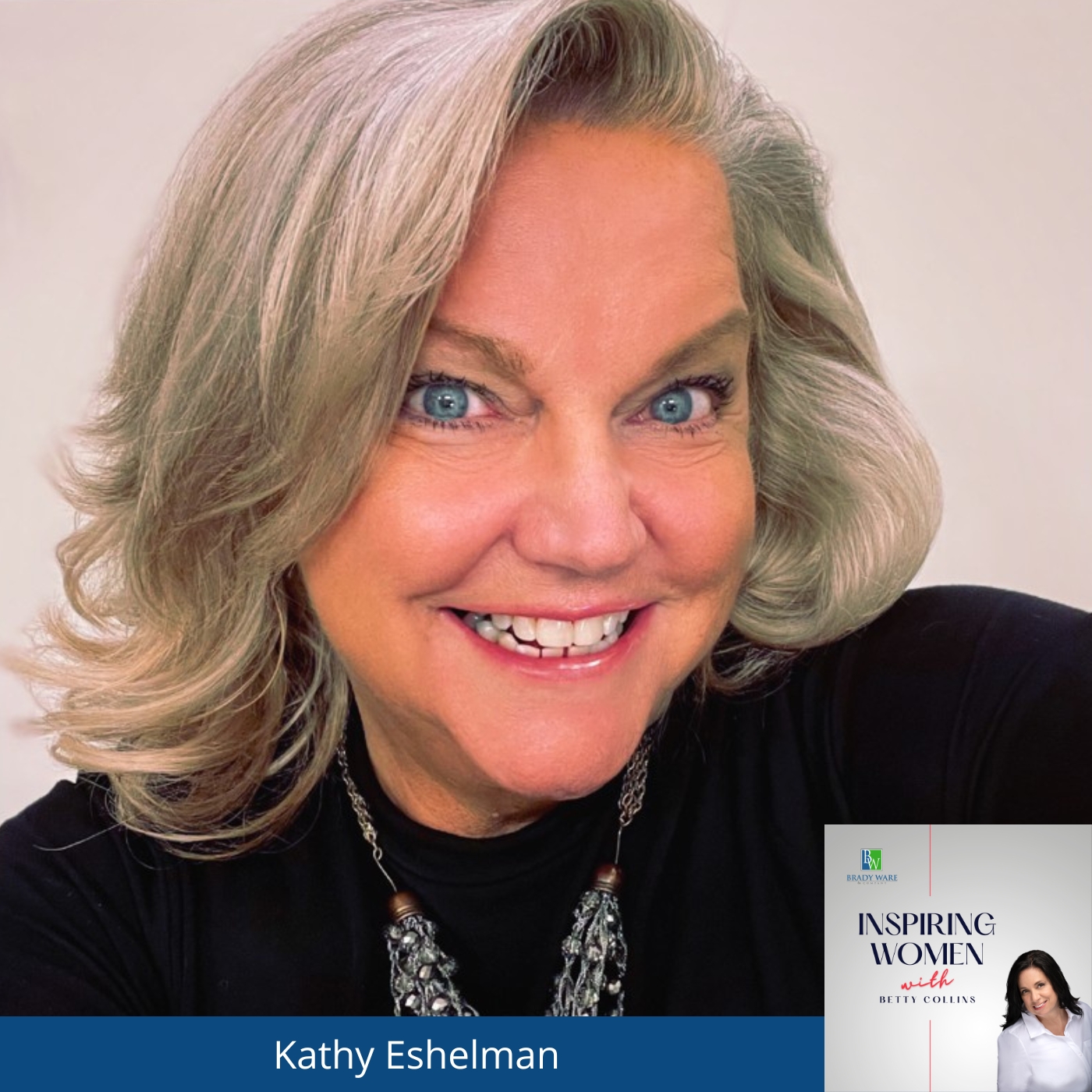
Tagged With: Betty Collins, collaboration, communication, Inspiring Women with Betty Collins, Teresa Barlow

Courage is Not Impossible: Making Fearless Moves

April 11, 2023 by John Ray

Courage-is-Not-Impossible-Making-Fearless-Moves
Inspiring Women PodCast with Betty Collins
Courage is Not Impossible: Making Fearless Moves
Loading
00:00 /
RSS Feed
Share
Link
Embed

Download file

Courage-is-Not-Impossible-Making-Fearless-Moves

Courage is Not Impossible: Making Fearless Moves (Inspiring Women, Episode 55)

In this episode of Inspiring Women, host Betty Collins discusses the importance of courage in unsettling times, with a particular focus on being courageous in everyday life. She provides examples of how courage can be defined and how it differs from confidence. Betty suggests that being courageous involves taking action in the face of fear, and offers tips on how to choose and tackle a courage challenge. Collins also introduces the four types of courage, namely blind courage, crisis courage, role courage, and core courage. She recommends using the “Snap” method to develop courage, which involves stopping, noticing triggers, acting, praising oneself, and processing the outcome.

The host of Inspiring Women is Betty Collins, and the show is presented by Brady Ware & Company.

Betty’s Show Notes

As we continue to face unprecedented challenges in our lives, it’s more important than ever to stand strong and stay courageous. That’s why this year, my podcast is focusing on courage. We’ll be exploring the questions and conversations needed to take positive steps forward for a better life, through my thoughts and my guests.

I will be talking to inspiring guests about how to identify and take on personal courage challenges and develop courage like a muscle. With inspiring quotes from Cindy Solomon’s books, “The Courage Challenge Workbook” and “Courage Goes to Work”, and the Snap Out Of It method from the movie Moonstruck, join me on a mission to help you unleash your courage and be ready and willing to do what needs to be done.

Hosted by Betty Collins, CPA, and Director at Brady Ware and Company. Betty also serves as the Committee Chair for Empowering Women, and Director of the Brady Ware Women Initiative. Each episode is presented by Brady Ware and Company, committed to empowering women to go their distance in the workplace and at home.

For more information, go to the Insights page at Brady Ware and Company.

Remember to follow this podcast on Apple Podcasts and Google Podcasts.  And forward our podcast along to other Inspiring Women in your life.

TRANSCRIPT

[0:00:00] Betty Collins: So I’m betty Collins, and I’m here with you today. And it’s an exciting day because this is year five of our podcast. I can’t believe that we have been doing this this long, but we are. And this year we are going to do something. Really, our theme is going to be centered around courage. And my guests and my interviews and what I’m writing will be about courage and being courageous. Those are two different things. Today’s, a moment. I believe that we need courage as well as we need people, especially women, to be very courageous. We live in times that are a little unsettling. Don’t worry, we’re not going to talk about pandemics and all the things that are terrible. My mom will tell you her generation, she’ll be 86 in March. They showed a lot of courage. They had unsettling times. They were courageous.

[0:00:51] Betty Collins: We could learn from that generation for sure. But what is unsettling to you may not be unsettling to me. It’s different. And courage is not always about the big stuff, right? So today’s podcast, this is about you. And where do you need to find courage and be courageous? This is an area that’s very hard for me. I’ll be very honest with you. Let’s not confuse courage with confidence. But I confuse I confuse courage with confrontation. I see it being hard. I see it as big. And it’s only where you’re climbing up a hill on a very hot day. I see it as something I have to muster up, and I see it as has to be emotional and a little sexy, right? It may be those things, but at in the day, I have to step back and I’ve been able to see it totally different.

[0:01:48] Betty Collins: I need courage and I need to be courageous in the every day. I’m just an ordinary person doing ordinary things, trying to be extraordinary, I guess. And I do have some big things I’m looking at, but I think it through first, and then I’ll execute those things. So courage can be defined as a lot of things in the strength of what it’s strength in the face of what to you, for me, it’s strength in the face as exhaustion. As a business owner, I mean, my clients are exhausted as well as business owners, my team is exhausted. So strength in the face of exhaustion, strength in the face of my health. Because 60s is coming very quickly. It’s daily. It’s never ending. What I did yesterday for my health is only for yesterday. And then transitioning out of my career, which, by the way, is going to be a while, and doing some of those wants, that’s pretty scary stuff. It’s going to take some courage, and it’s going to be taking some being courageous. Courageous can be defined as the ability to do something that you fear. It’s a mental or moral strength to do something. You fill in that blank.

[0:03:01] Betty Collins: It’s about soaring. Okay? It’s acting on one’s belief. Sometimes you just do it and you get it done. You don’t have to think about it. Having courage or being courageous is about being fearless or maybe fearing less. You need to think about that a little bit. And of course, being courageous, it undertakes whatever that is for you, boldly and it’s not lessened by difficulty. So those are some things I think of when I think of having courage. But being courageous is taking that courage, that badge, right, and being ready and willing to do. You fill in the blank. It’s doing something. And I didn’t say not without fear, but in spite of fear. So what holds you back? What holds you back from courage or being courageous?

[0:03:56] Betty Collins: For me, it’s plain and simple. It’s fear, like most of us, and I’m learning to confront it head on or I’m just going to do it afraid. But not having courage or not being courageous is not an option that we should be in today’s unsettling times or in today where you are going along in the path of your journey, whether it’s in your career or in your families. Also, another something that holds me back, quite honestly, is exhaust. It’s that overwhelming lifestyle that I’ve created, by the way, and built. Where have you, though, been complacent and you just played it safe? I did that in all aspects of my life, all my life. And honestly, until I was 38 and kind of had a reset and a meltdown, I was very a safe player. I was very much complacent. And I look back on those times and it seemed like it was easier and that it was okay. But did I really accomplish maybe the things I should have or wanted to? What are the barriers for you in not taking on courage, not taking on a challenge? Maybe it’s other people’s opinions, maybe it’s complacency, right, that I just talked about failure, your past, maybe emotions, they’re just the bad ones that get the best of you. But it’s time to push through those barriers and take on a courage challenge. When you have the will to push through a courage challenge all the way to the end, you did it.

[0:05:29] Betty Collins: You’ll feel fantastic on the other side. So my company, Bradywear, has a women’s conference each June. In fact, this year is year ten. It’s June 16 in Columbus, Ohio. And last year we had an amazing speaker, cindy solomon. She was the keynote for lunch. And wow. In fact, I’ll say that backwards. Wow. She nailed it and had to create a culture of courage. And that’s what she talked about for her. She wrote a very, very simple book. And it looks like this. It has yellow tabs and it’s highlighted. But it is the courage challenge workbook.

[0:06:06] Betty Collins: And it has been so impactful to me personally and professionally that I wanted to share it with you. So when I’m speaking a lot of today from here on out. It’s from the heart and mind of betty Collins but it’s really from a very courageous woman. Her idea is cindy solomon. Check out her book on Amazon. I would tell you you need to read it, you need to download it and you need to figure out how to incorporate a book club or lunch or something and learn with your team. It really is kind of very easy and hard all at the same time. It’s simple but it’s impactful. So think about your team in business, your social circles or your family or maybe your community and find the courage to be part of the everyday. You’ll see amazing changes and it’ll be for the good in today’s world. As I’ve talked about, we need courage and people, certainly women, not just the courage, but you have to be courageous, which is action. So the first step is you got to choose what’s the courage challenge I’m going to take and you need to understand the why behind it. cindy solomon challenges you to think about courage. I’ve kind of talked about definitions and I’ve kind of talked about the things that are out there. But here’s what you need to say.

[0:07:16] Betty Collins: It’s personal, it’s personal. It isn’t what everybody else is doing, it’s what you’re doing. Courage is not what you think. What was interesting at our conference is she had people stand up that thought about something and really she said only 50% of you are standing up that are supposed to be standing up right now. So sometimes courage is not what you think. Courage is not a superpower where we are wearing a big chest with a star and superman. It’s not that we think of courage as that’s the only thing that’s out there. But courage can be learned. So that’s the good news for you today. And here’s some tips when you’re picking out your challenge, because picking out the challenge is the hardest part. What am I going to do with courage and being courageous but tips, you got to be realistic and constructive. It’s got to be energizing but it’s also going to be a little uncomfortable probably and you have to be very clear, very specific. So here’s an example of a challenge. I wish I had the courage to ask for a pay raise. Okay, first you got to also go why do I want the pay raise?

[0:08:24] Betty Collins: Do I need the money or recognition? We all need the money. There is never enough. We’ll all take it, right? But really it could be more about recognition than it is about the money. So why do you want to have that? So when you’re making up your challenges or you’re thinking through that challenge where you need courage, you got to get to the heart of the why with it. That’s part of it. Here’s another example of a challenge that I’m trying to work through and get specific on and doing the things that she says, I wish my team would do what I want and get on board. Is that a very good way to say it? Probably not. I want the courage to inspire my team so that they see my vision. Why do I want that? Because right now, business owners are exhausted. They’re tired.

[0:09:12] Betty Collins: And this is one part of our country that needs to work, and I don’t want to see it slip away. There’s passion behind that. But I need the courage to do some different things. I need to be courageous with those business owners so that they will see to hang in there, they will see that it’s a journey and they’re going to make it. So that’s tough stuff. And so it isn’t the everyday accounting, it isn’t the everyday stuff. I need some courage and I need to be courageous and ready and willing to move it along. There are four types of courage that I think you need to be aware of, and then you know how to use them. Because there’s all kinds of courage. There’s blind that leap of faith. You go for it. If you are saying all the time, hey, that sounds like a lot of fun, it’s probably a blind type of courage. It’s that leap and it’s okay. Leap of faith is not what you do all the time. That’s why you need to know blind courage is just the impulse.

[0:10:12] Betty Collins: Maybe, hey, can’t hurt to do it. The other kind of courage, number two, is crisis. It’s completely instinctible. It’s life and death. It’s a pandemic. It’s PPP funds, it’s idle funds. It’s ERTC funds. We got to get this. And it’s not meant forever, by the way. It’s just for the moment because you’ll be exhausted if you live in crisis. Courage, it’s for what it says. It’s for a crisis. Here’s the one that has stuck with me, that has challenged me the most, and that is role courage. And it reads like this in her book. I love this line.

[0:10:51] Betty Collins: The confidence and fearlessness you experience when you fully understand the part you play in a particular situation. And that implied power and the responsibility that comes with it. And when I think about that, I think about I’m an owner in a company with 150 people counting on me to lead well. I’m a cpa advisor to over 300 people that need me to know that I’m confident and I’m fearless, and I play a role in their success. That’s called role courage. That’s what has spoken to me the most. And then there’s the core. This is good for cpas because it’s a step. You have a very clear vision of where you want to go. You’ve mapped it out, and you are so confident in that vision that you’re open to everyone around you jumping in with you, contributing, criticizing, accepting, praising, so that that vision becomes reality. It’s a core. It’s a long term type of courage. It’s not the blind faith. So that’s why it’s really important to know there’s different types of courage and there’s different types of when you use them and when you utilize them. So it’s time to tackle your courage challenge.

[0:12:10] Betty Collins: It starts and ends with only you. As I said before, it’s personal, right? So step back and take some time to figure out your challenge. That’s the hardest part of the step for me, the blind leap of faith in the crisis right now, that’s not applicable today. I’m not in a crisis. I don’t need to just jump. I don’t need to just get out there and go, I don’t need to go have fun. Right? For me, right now, it’s the role and it’s the core that I’m dealing with. The role is inspiring these exhausted business owners to stay the course with my team and what do I play in that and what’s my responsibility? And the core is about my transition. That will happen over the next five years as I changed a little bit about my life, right? Because I’m 60 or I’m going to be, and I’ve got some new ideas and I’ve got some new passions, and I want them to become reality. So core courage is what I need to invest in. There’s a really, really great method that is in her book that I would challenge you to get a team together and read through.

[0:13:14] Betty Collins: And it’s called Snap. Snap. And it’s inspired by cher in moonstruck. If you remember, the slap of the face where she goes Snap out of it kind of came from that. But Snap is about stopping, stepping back. Notice what triggers the things that you need courage with. Act. Use the right type of courage in the right moment. Praise yourself, which I don’t have problems doing that for me. And then process it, look back and go, wow, we really did it. It’s a really cool method. It’s a cool framework. Again, these aren’t my ideas and I want to claim them, but they’re really impactful. And because this year is about courage for me, I’m going to stick in this book for a while. And the book has really great ways of phrasing things where it works, where it doesn’t.

[0:14:01] Betty Collins: It’s cool stuff, but I’m grateful for getting to know cindy solomon, and I’m grateful that I dived into her workbook and she’s challenged me to take the challenge of being courageous. Having courage, I think it can change you as well. I would highly recommend to her as a keynote speaker, by the way, we’re a facilitator in your organization. Buy the book now. It’s got some great quotes in it. I’m going to read them to you and I hope that they inspire you. I hope that there’s something you go, wow, that helps me today. Courage is like any other muscle. If you’re strengthened by use, in other words, practice by Ruth Gordon, have the courage to write down the dream for yourself. No one else. You. Success doesn’t come to you. You go to success. Life shrinks or expands in the proportion of one’s courage. That’s probably my favorite in the whole book.

[0:14:57] Betty Collins: I’m going to read that one again. Life shrinks and expands whichever you choose in proportion to one’s courage. Nothing in life is to be feared. It is only to be understood. Now is the time to understand more so that we can fear less. And things are only impossible till they’re not. So I challenge you today to take the courage challenge. I challenge you today to dive into courage and become courageous. Have been ready and willing to do what needs to be done in your world, in your business, in your family. I’m betty Collins. Be courageous today. You’ve got it.

Tagged With: Betty Collins, confidence, Courage, Inspiring Women, Inspiring Women with Betty Collins

Courage In Ordinary Moments: Taking Small Steps Towards Big Dreams with Farah Ismail

March 13, 2023 by John Ray

Farah-Ismail-Inspiring-Women
Inspiring Women PodCast with Betty Collins
Courage In Ordinary Moments: Taking Small Steps Towards Big Dreams with Farah Ismail
Loading
00:00 /
RSS Feed
Share
Link
Embed

Download file

Farah-Ismail-Inspiring-Women

Courage In Ordinary Moments: Taking Small Steps Towards Big Dreams with Farah Ismail (Inspiring Women, Episode 54)

On this episode of Inspiring Women, Farah Ismail, founder of Interact Consulting, explains why courage is often most important in small, everyday moments, how she views failure as fuel for self-discovery, the power of learning in community, and much more.

The host of Inspiring Women is Betty Collins, and the show is presented by Brady Ware & Company.

Betty’s Show Notes

Farah Ismail, the founder of Interact Consulting, shares her journey to success and her fearless mindset.

Farah brings her fearless mindset and inspiring journey to the table, sharing her insights and experiences on how to live the life of your dreams. She guides listeners through the process of unlocking their courage and taking action, providing tips on forgiveness, planting new seeds, and finding someone else to enjoy the journey with. Farah encourages us to be brave enough to use our voice, bold enough to listen to our heart, and strong enough to make big changes in our life. Don’t miss this insightful conversation!

Learn how to make big changes in your life and be the master of your own destiny!

The Ultimate Coach

Interact Consulting

Farah’s books

Her coaching website

Facebook, YouTube and LinkedIn

Hosted by Betty Collins, CPA, and Director at Brady Ware and Company. Betty also serves as the Committee Chair for Empowering Women, and Director of the Brady Ware Women Initiative. Each episode is presented by Brady Ware and Company, committed to empowering women to go their distance in the workplace and at home.

For more information, go to the Resources page at Brady Ware and Company.

Remember to follow this podcast on Apple Podcasts and Google Podcasts.  And forward our podcast along to other Inspiring Women in your life.

TRANSCRIPT

[0:00:00] Betty Collins: So today on inspiring women this is a first for my podcast. I’ve been doing this for four years, this is year five and today I have my first international guest. So I am really excited. We’ve already been doing a lot of chatting but we got to get to this interview and you’re going to love, just love the energy that comes from her. Her name is Farah Ishmael and she’s an international ashley recognized facilitator, coach and speaker. She’s the founder of Interacting Consulting and she partners with entrepreneurs and leaders who find themselves frustrated imagine that. And unfulfilled despite outward signs of success. And when they work with her, they imagine their business. They craft a lucrative purpose driven enterprise that delivers more confidence, more connection, more revenue and more meaning. You’re just going to love this list, lady, I know you will. So welcome today and tell us just 2 seconds a little bit about yourself. I know we’re 18 hours difference in time, we talked about some Ohio connection but you can take 30 seconds to tell us a little bit about you.

[0:01:12] Farah Ismail: Thank you, Betty, it’s my pleasure to be here. Well, I’m thinking of what to tell you. Let me share that I used to introduce myself as fearless para and I think I have that fearless gene in me thanks to my parents who brought us up believing that we could have impossible things for breakfast. So there was no limits when I was growing up and of course that’s how I live my life. It’s really that limitless thinking and anything is possible. So I’m pretty fearless. But over this journey of dispute, thank God, life. And we had a series of rollercoasters and I would say that I’ve experienced the highs and the lows and I knew what fear is and I’m not fearless. I just realized that I fearless. I love it and that’s what I want to say. That to me, despite of the fear, it’s about taking inspired action and it comes through courage. So I would say I’m a courage catalyst.

[0:02:16] Betty Collins: There we go. I love it. See what I’m saying? It’s just going to be this way the whole time, I’m telling you. But our overall theme this year for the podcast is courage. And so can you tell us how courage showed up in your life?

[0:02:38] Farah Ismail: I think first, courage is something sometimes we think courage is really these big things but for me it’s ordinary day courage that I notice wherever I want to look. So I think if you start looking, you’ll find it everywhere. And for me, every day is an opportunity to perform a small act of courage. So it’s possible. For me, where it really showed up was at my deepest, lowest point. I think it was a personal story when I was I had a series of life changing incidents in my life that really came in the way of having a really successful marriage and I stayed stuck for a long time. And I kept telling myself that I was trying, but I think I was really not trusting myself that I could really take action to choose how I want to live my life after that. And I think it was that one day, and I think it’s a long time ago, I must tell you it was 2006. I can’t forget that moment. It was a summer, it was a morning when I woke up and I had this feeling that I actually looked at myself and I knew that this is it. And that feeling of choosing, trusting, choosing myself and deciding that I am not powerless, but I can actually choose to create the life I want to create. I think that required an immense deal of courage, that ability to just step out and take that tiny step. And I did that. And for me it might sound like a big thing, but I waited a long time. And that’s when I was able to walk away from an unhealthy relationship with a six year old daughter, a computer and nothing else.

[0:04:47] Farah Ismail: So I started my life from scratch. And I can tell you I was afraid. I was scared I had lost all my confidence, but I had this immense belief that I could make it. And I just told myself I could do it. I had it inside of me very all this while. That’s how I was when I was younger and until I came to that moment in life. And I just find that all of us have this inside of us. Sometimes we lose sight of it. And I think when I gave shone a light to that and decided to do things like even asking for help, even that is an act of courage. And that is where it all started. And I would say that after that, I reframed everything in my mind. Things like when I felt that, oh my God, my marriage is a failure and that I reframed it as it is a metamorphosis. This is what I’m doing to write a new chapter. So I think it was all those little things every time. I kept telling myself I’m alone and trying to stay stuck and trying to do everything like a superwoman.

[0:06:07] Farah Ismail: But when I shifted that, it required a lot of courage to seek support. And I had lots of it. I just was not allowing it inside my life. So I would say that I think courage showed up in many ways, but it can be with small things as well. It could be speaking up. Speaking up from your heart is also a big thing. Being vulnerable is another big thing.

[0:06:34] Betty Collins: Yeah, every day the ordinary. There’s courage all day long. And I like how you say you got to sometimes just start looking for it and you’ll find it. One of my favorite movies is Julia Roberts and it’s eat, love and prayer in some of those orders. But eat, love and pray is what I think it is. One of the moments in the movie, she said, I just want to slip away from the life I created. I had every part of creating every part of this life, but I want to slip away from it. And she finally had the courage to do it, and a lot of women don’t. So it doesn’t mean you’re terrible and you’re not courageous, but man, choose the courage path with it, just like you did. We all have the AHA moments in some areas that are major, right? But good for you. My goodness, courage showed up. I’m so glad. I’m sure you haven’t looked back. I’m sure you just continue to look forward.

[0:07:33] Betty Collins: So that’s awesome.

[0:07:35] Farah Ismail: Let me just add something there. I just want to share this for anyone who’s listening, that I shared that big moment right then. There were other moments as well, so you knew you it’s something. It’s like swimming. You need to swim to learn swimming. It’s by couraging. So it’s like one step at a time. And it’s not like the big thing I spoke. There were smaller things I did to reach there. And I just know that when you actually tap into these reserves that you have, it’s a muscle. We continue building it, but I just think it’s about making that tiny move, like stepping outside and finding something that will help you to try something else. Take a small risk. That’s where it lies. I think it lies in the gap between your thought and your action. You can choose it.

[0:08:33] Betty Collins: There absolutely great insight. Just wonderful. Courage is like a muscle. You got to work out to build it right? You got to practice. And it’s not always easy. And sometimes taking the little steps can be just as hard as the big one. But at least you’re taking it, right? At least you’ve got courage. You’re putting it out there. You’re doing it. So that I mean, great answer to the question, but what would you say is the book that transformed your life and business?

[0:09:12] Farah Ismail: I had a really interesting opportunity to write a book inspired by a book that changed my life. And so I wrote a book. So I have it right here. It’s called The Book I Read. And it is one chapter which is based on a book that changed my life. And I want to share that. I just shared the story of how I came out of these tough moments and then I continued to believe that I am a superwoman, that I needed to be perfect, perfect mom, because I really wanted to not make any mistakes. I wanted to be very courageous in my business. And what I was doing in that is in this quest for being this perfect without making any mistakes, et cetera, I realized that I was really numbing myself with a lot of things. I was really putting on a lot of armors. And while you would see me as really coming out strongly out of a tough experience, rising standing up tall with lots of self respect and living a life that anybody would see, wow, just look at her. I was again going into this paraly of trying to be very like the super, super woman until I had the opportunity to read a book of Dr. Brene Brown. It was dare to lead. And I must say that I had a partner in this journey who I met in Hong Kong.

[0:10:59] Farah Ismail: And we both realized that we had some amazing vision for creating something for women leaders and we took a year to live the work of Brene Brown. So this whole book and the course that we did on there to lead, we actually lived it ourselves. So I can say that the book that transformed me was Brene Brown’s book, which then helped me to become vulnerable, that then helped me to really deal with grief. I mean, I had thought I should hide my grief of losing a child. I lost a child in the beginning and there was all these things that I was hiding. And then I realized that who I am is becoming, is the one who is going to choose to be comfortable with being authentic. And that’s when I started doing all this work. And of course this took off as many armors as I can. So the book really helped me to create the kind of work that I do to show up authentically and to also help others to do that. And I just am very passionate about that. But I do want to add one more thing. This book helps me in living my life. And there’s the book that is changing my life right now. And I love to share the name. It’s called The Ultimate Coach and it’s by Amy Harterson and Alan V. Thompson

[0:12:40] Farah Ismail: It’s a book about who you are being. And it’s such a powerful book because you don’t read it about the number one ultimate coach in the world. Who’s Steve Artisan. You don’t read it about him. You read it about you. So in the book you find yourself, you find your aspirational self. And it’s changing who I am this year because I can choose. It’s not about what I want to do, it’s who I want to be. And the being is everything. So I want to say that that’s the second book that’s changed my life and also changing how I’m going to operate and I’m continuing to get transformed by it.

[0:13:25] Betty Collins: Well, we definitely want to get those books. We’ll get them to our readers, our listeners, excuse me, so that we can make sure that they are tapping into that. I’m a huge reader. Love to read, love other perspectives. Because sometimes you just need to get in someone else’s brain, right? You need to see what they’re thinking to help you be able to do it on your terms, not theirs. The book, though, that you wrote, the chapter, and can you put that up again? Because I want readers to see that as well. The book that transformed me, is that what it’s called?

[0:13:58] Farah Ismail: Yeah. I’d be happy to share that. Of course, you can download this on my website, which is https://www.coachfarah.com/ There are two books that I’ve written, and one of the books that is my favorite is very short read, but it was very powerful. Read it’s. Five Secrets of What You know, really helped me to be daring and being unstoppable in my business and my life. So I share five things that really serve me every day. And I would say that it’s such a beautiful read, and I’ve created some small what can I say? Some creative exercises. So you would actually do that for yourself. And I would say that I’m hoping that it will inspire you for the next step of your journey, wherever you are.

[0:14:48] Betty Collins: Okay. We will make sure we get those things out when we definitely have this podcast loaded, because we all can support each other. And one of those ways is, hey, read this or do this or try this. Right now, you work with entrepreneurs. Entrepreneurs are my favorite, and I just love the marketplace. I love the economy. I love it when people can take an idea and a passion to make it into reality. But it’s a lot of work to be an entrepreneur. It takes a lot to be a leader. So one of the things that in the last, certainly ten to 15 years is everyone’s got coaches, right? Okay. And they needed them. It’s a huge thing, especially when you want to go to new levels. But tell me more about your group coaching program.

[0:15:39] Farah Ismail: So I love coaching because I love to be a catalyst for change, and there are opportunities to do one on one coaching. However, learning in community is very powerful, and it happened during the pandemic when I created a group coaching program called Courage to Sew. Of course, you know now that the theme will be Courage, because I believe that we can’t become what we need to by remaining what we are. And so I created this exclusive. It’s my signature program, which was really helped at that point. It was only for women, women leaders, women entrepreneurs, women changemakers to help them unlock courage and really write a new chapter of their life and be braveful and purposeful. When I started, it was a short six week program, and now I have created it into a three month program and a twelve week program in which I would say that this program is for you if you are here for transformation and not information. You enjoy breaking the status quo and are willing to take action, and you’re willing to really test new things in your life, sometimes creating the impossible. So I find that this program is very powerful and the women who went through this created some quantum leaps in their life and shifted incredibly because they had an opportunity to really have a huge self discovery and a clarity of direction and understanding their personal power. So I would use two things that is really leading from within and then also looking at how you create that impact in the world. So it’s a very structured but very creative program that pushes you. And so if you can’t handle being uncomfortable, this is not for you. If you want to know one, two, three steps to follow, well, you know, this is going to surprise you. And if you’re unwilling to go deep and this is not for you. So I find that I normally have one cohort a year and I do it once because the rest of my time is really doing it’s quite full.

[0:18:07] Farah Ismail: So I’m actually launching the 2023 Cohort in March. Okay? And so, yes, I’ll be happy to share the link if anybody wants to have a conversation with me to get to know more about it. But it’s something that I would say has impacted many women and I love it as well.

[0:18:27] Betty Collins: Anytime we can get resources to help and have great outcomes right, and impact that we want to do it, we want to tap into it. I mean, you could tap into a lot of things, but what’s great about not great about a pandemic, but I will say during the pandemic, I used to do everything with my podcast locally, right? Then people were like, I need to get on the air somewhere. And podcast became this massive thing. It was already a big thing. And so I always like being in person, but I found myself that I can do online things like this and still get a lot out of it. It still comes down to what you want to do and do you want to go dig deep? I like that. If you don’t want to dig deep, don’t do this course, right? But you’re going to launch it tomorrow. Okay.

[0:19:17] Farah Ismail: If you want to create the impossible, this is where you should be because you don’t want to have any limits. So you have a beautiful community to be actually doing it as well. And I love coaching people to get there. Yeah, create that life coaching.

[0:19:32] Betty Collins: And I’ve done it various times in my career and generally it’s because there’s a want, but it always results in something because there’s a want and desire to coach. You have to want to be coached, right? And you have to want to be teachable taught. But it sounds like a really great thing. A lot of good things came out of COVID in one of those, which things like this, right? So let’s move a little bit to something a little more personal property. But what is the failure story that you would be comfortable sharing with us today?

[0:20:11] Farah Ismail: Well, firstly, it’s how I look at failure. I have a lot of stories of where I have failed personally and professionally. I look at failure as an opportunity for me to see it as fuel something that’s used me to take a pause and see what is really happening in my life then. And I think for me this is really personal because I recently discovered that a lot of times I was judging myself and I was judging myself for something like, okay, so I must give you a back story that I truly enjoy having unhurried moments, me time. So creating that space for myself and creating boundaries, I really like that. And sometimes I find that in my family or in my closed circles, others are extending themselves so much that I feel like I judge myself for choosing myself, right? So I was really beating myself up and I didn’t realize that it was a nap. It was playing so deeply in my mind that I was judging myself like someone who is not available for family at times and I was feeling inadequate at times. Like I’m not like the others, they live overseas and they’re more available to my parents on the call. So I would play all these games in my head and it really took me down and in a way that I would probably not choose to create that spaciousness for myself and try to be different from who I am. And I think that the day I realized that I was doing some really deep work with a coach when he asked me to forgive myself for judging myself and to write down all the ways in which I judge myself and to forgive myself for that. And once I drove all that and I realized if I was the truth is. So when I was looking at one statement and I was changing that to what’s the truth there? Because you really have to dig deeper to see what’s happening because otherwise you’ll continue doing the same thing. And that’s when I really figured out that when I dug deeper that the truth is I reimagine renew myself powerfully every day, every week, whenever I need that.

[0:22:59] Farah Ismail: And that’s when I own that I stopped judging myself. So I want to say that my failure is for this long, not realizing that forgiveness is such a big thing. When you learn to forgive yourself, you just leave that old version, all the narratives and you just choose to be the most powerful version of yourself. So today no one is worthy of my judgment, even myself. And all everybody is worthy of is my love and my respect. And when I keep that foremost and that I renew myself every day, I don’t feel that sense of blame, shame, et cetera. So I want to say that that work I did for a long time, I felt like I was failing my family. Of course I found an antidote. So I wanted to say, it’s very personal, it’s very deep work, but it can be done.

[0:23:58] Betty Collins: I love the way you say that. I found the antidote. That’s a great way to say that. I have a really good friend and her two kids are in their 20s in that adult. They’ve launched, they’ve done their thing. And so she was telling me the day she said yeah, she said, yeah, she’s getting her MBA right now. I said, oh, and what? She goes in life, she’s falling down and she’s learning how to get up right now. And I thought, she goes, she’s had a big failure, she had a big fall, but she’s going to learn. And I thought, how a great way to describe it, right? But at least she’s getting up. It sounds up, but the antidote, I like that. Find the antidote. The other thing I think of, as you were talking, you said, you know, the conversations in my head. And I tell women, if you want to get more sleep, then start getting the conversations out of your head, which means you’ve got to confront something or you’ve got to get in there and go, hey, why am I having these conversations in my head?

[0:24:57] Betty Collins: Like, you, I think I’m a failure, I must be a failure. You’re always having that conversation with, you right, if we want to get more sleep, we got to quit having conversations at two in the morning.

[0:25:08] Farah Ismail: I want to add something that’s beautiful, what you said. Yes, we have the power to plant the seed. So if I say I’m inadequate, I’m planting that seed, who am I going to be inadequate if I plant the seed? And I chose who I am going to be, that’s what I’m creating. So I can create myself every day. So who I’m being is really important. So if I tell myself all these things, that’s what I’m going to get, right? That’s the tree which is going to bloom. So I would say that, really think, get rid of all those stories and plant new seeds and that’s what you want to do.

[0:25:50] Betty Collins: That’s a great way to say it. So, audience, are you listening? Women, are you listing? This is good stuff. This is stuff that you couldn’t really apply. So what do you feel like your year and beyond looks like? We’re in 2023. It’s time we keep going. We keep saying, well, we got through this, we got through that. But how do you see your year and how are you going to go forward?

[0:26:21] Farah Ismail: Thank you. I love that question. 2022, I started the year by saying I’m going to fall in love with disruption. And what I did over the year was I disrupted myself many times. I disrupted my thinking, my beliefs, what I was doing. I disrupted and started speaking. I just wanted to disrupt myself and try new things as well. So this year, as I started. Of course, I’m being a loving disruptor in my life, but what I’m choosing this year is a word called which is freedom. Just freedom to create from the space of abundance, freedom to be me, freedom to coach in a way that there’s huge impact. I just choose the word freedom. And this year is very exciting for me because I am, of course, stepping into a space when I am creating new programs of the year, creating who I want to choose to work with, just becoming a lot more clearer and of course, speaking all across the world. So I’m hoping to see you in Ohio sometime. But the year is exciting because I’m stepping into really having intentional creating my legacy. So I turned 58.

[0:27:56] Farah Ismail: I just turned 58 and I always think about what am I going to leave for my beautiful 23 year old and for the people I love. So a lot of the creation this year is to be in that very beautiful space of creating for your legacy and impacting the world in a much, much bigger way. So I want to say that I’m in a very creative space. Thank you for asking, Betty.

[0:28:24] Betty Collins: I’m turning 60 this year. So I’ve been thinking a lot about legacy and how do I want to I’m not saying end a career, but transition into different things, right. That I feel like can be something that people will go, yeah, that’s amazing because I tell my kids all the time, my legacy is not going to be a bank account for you. My legacy is really going to be hopefully you will continue and follow the generations to come of what I have taught you and what my parents taught you. And they’re great because they want to just experience things that’s that generation. Right. We just want the experience. But I love the way, though, you say I’m creating, but I really like I fell in love with disruption that I’m going to think about for why I really like that thing. But I do want to end with this question with you. What are the things that I was so attracted to? Your LinkedIn, I believe it’s on your LinkedIn. I just thought this quote and it’s just played in my mind, but you say, who am I to do this? And I think your coach asked you that, who am I to do this? And I thought, what a great question. Because the first response should be, why not?

[0:29:50] Betty Collins: Why not am I to do this? Right? You have such great answers, though, and such a great insight. But I love the question. I want to end with it because I want women to think about who am I to do this today? So can we kind of end with something about that?

[0:30:08] Farah Ismail: Yeah. First of all, I want to say thank you for looking at my LinkedIn. That’s where I like to spend some time and realize that that’s a space that you can also impact a lot of people by showing up as you are. So that question, and I want to say that when you reflect on something, take action. So when I actually reflected on that question, I wrote it down and then I said, oh, my God, I have to share this. Otherwise if I keep it to myself, I’m not going to be able to touch someone’s life. So today when you share this, it makes me feel like it’s so important to show up. I think I would say that one thing that is like my GPS and my compass is to be brave enough to use your voice, bold enough to listen to your heart and strong enough to live a life of your dreams. So when you hold on to that and you also choose to find someone, don’t do it alone. Do it with someone. Have someone who’s there with you. Enjoy that journey. That’s really where you get your fulfillment. So look where your path is. Are you enjoying it?

[0:31:40] Farah Ismail: What would you really need, what you need to be this year to create a life of courage, a life that you want to lead, which is extraordinary? Just ask yourself that, stay with that, and I think you will find some answers.

[0:31:58] Betty Collins: We need courage right now. We need tons of it. We need people to be courageous, especially women. Well, it has been such a pleasure to talk with you today and have just some discussion. And I would really to the audience, I’m going to spell her name out, but it’s all on the show notes. But it’s F-A-R-A-H. Farah is spelled I-S-M-A-I-L. If you Google that name, you will find amazing things about this woman that you really can learn from, I can tell you. But I appreciate you being I appreciate you taking the time. I appreciate that you’re 18 hours either behind or ahead. I don’t know which one it is and that you’re with us today. So I know that my audience will go away today feeling good and be challenged. So thank you so much.

[0:32:49] Farah Ismail: Betty, it’s been a pleasure talking to you and kudos to you for having your first international.

[0:33:00] Betty Collins: All right, have a great day. Thank you so much.

[0:33:03] Farah Ismail: Thank you.

[0:33:04] Betty Collins: Bye. Okay, so what we will do is we will get with you on when this is going to be, when we’re going to do this and you’ll hit you here. I think I probably will tell the producer.

Tagged With: Betty Collins, Courage, Farah Ismail, Inspiring Women, Interacting Consulting

Amy Franko and The Modern Seller

December 21, 2022 by John Ray

Amy-Franko-Inspiring-Women
Inspiring Women PodCast with Betty Collins
Amy Franko and The Modern Seller
Loading
00:00 /
RSS Feed
Share
Link
Embed

Download file

Amy-Franko-Inspiring-Women

Amy Franko and The Modern Seller (Inspiring Women, Episode 53)

Amy Franko, author of The Modern Seller, joined host Betty Collins on this edition of Inspiring Women. Amy talked about the primary misconceptions services providers have about sales, imposter syndrome, delivering value, negotiating, and much more.

The host of Inspiring Women is Betty Collins, and the show is presented by Brady Ware & Company.

Betty’s Show Notes

Amy Franko helps organizations transform sales culture, ignite sales growth, and build high-impact leaders through her strategic selling programs. Recognized as a LinkedIn Top Sales Voice, Amy is the leading expert in modern sales strategies—including in-demand sales training programs, sales strategy, and as a sales keynote speaker and leadership keynote speaker. She guides growth-oriented organizations to significantly improve their results through B2B sales strategy and sales team skill development.

In this episode we find out more about Amy, and

  • why she credits coming from a large family with her success in sales
  • what does “modern selling” mean?
  • what are the misconceptions of today’s selling situations?
  • what are her observations about women in sales?
  • what has she learned from her successes and failure?
  • and finally, her 3 pieces of advice (you will love #!)

Learn more about Amy and her background here.

And grab a copy of her book right here.

Hosted by Betty Collins, CPA, and Director at Brady Ware and Company. Betty also serves as the Committee Chair for Empowering Women, and Director of the Brady Ware Women Initiative. Each episode is presented by Brady Ware and Company, committed to empowering women to go their distance in the workplace and at home.

For more information, go to the Resources page at Brady Ware and Company.

Remember to follow this podcast on Apple Podcasts and Google Podcasts.  And forward our podcast along to other Inspiring Women in your life.

TRANSCRIPT

[00:00:00] Betty Collins
I’m Betty Collins. And today we are going to talk about something that scares me to no end, and that’s called sales. And when you’re a business owner, which I am and I’m a shareholder and all those things, part of my job, part of my responsibility is making sure that my clients are served. But it’s also out there getting new clients, new clients. And it’s a frightening thing for me. It always has been. If I can, just knowing that I’m out talking to someone, I’m not afraid of it. But if I think I have to sell something, that’s another story. So we’re going to talk about this topic today with someone who really, really knows a lot about selling. In fact, she knows so much about it that she’s written some great book. And I think you will will find her very, very engaging today and she will really help you get through some things. I’ve known Amy Frankel for quite a while. We are very involved in the central Ohio, Columbus area with a lot of the women’s organizations. So today we’re going to talk with a truly an expert because she’s written a book that is on the Amazon bestseller list, by the way, and it’s called The Modern Seller.

[00:01:15] Betty Collins
And so I think you’re going to love engaging with Amy Franko, who wrote this book. And I’ve known her again for a while, and we’ve kind of been in the same circles in businesses. And we’ve also done a lot with women’s organizations within the central Ohio area. She’s very big in the Girl Scouts of America. So just to get started, you know, Amy is Franco is the leader in modern sales strategy. She helps those mid-market organizations to grow sales results through a sales strategy, you know, advisory and skill development programs. And again, her book, The Modern Seller, which is an Amazon best seller. She is recognized by LinkedIn as a top sales voice. And she’s also, as I said, the board chair for the Girl Scouts of Ohio Heartland, a top 25 nonprofit in the Columbus region, serving nearly 18,000 members. And you can find Amy at w w w dot Amy Franco. So, Amy, I’ve talked a little bit about you, introduced you. We’ve had some fun. We’re going to have a great conversation today. Why don’t you just tell us a little bit about yourself before we get started on that thing called selling? Sure.

[00:02:28] Amy Franko
Absolutely. Well, thank you so much for having me here. I was so excited to have this on my calendar and have this conversation with you and Betty. I’ve learned something new about you that you are selling like strikes fear in your heart. So I would have never known that about you.

[00:02:45] Betty Collins
Absolutely. Absolutely does.

[00:02:48] Amy Franko
But but to but just to just to give our listeners a little bit more about myself. I am I was born and raised in Ohio, grew up in Cleveland. I’ve been in the Columbus area now for 25 years, which is hard to believe. And from a from a personal standpoint, I am married to Dave and I have a wonderful, energetic black lab by the name of Roxy who gets all of my time and attention. Yes. And and and when when I’m not doing things sales related or related to the Girl Scouts or nonprofits, I love all things fitness and I love to travel. So I’m very excited to be able to get back to traveling. So that’s a little bit about me, and I’m sure we’ll uncover some more stuff here as we go.

[00:03:38] Betty Collins
We will. So what’s your favorite place to travel before we get started? What is it?

[00:03:42] Amy Franko
Oh, well, probably my most exotic place I’ve been to was we did a two week, two and a half weeks safari to Kenya in the early part of 2020 before the pandemic. And had you asked me, like, if Kenya was on my travel list, I it’s Kenya itself was not on my travel list, but being on doing a safari was we had some friends that planned the trip, invited us to go along, and it was absolutely life changing. And if we have time, I will tell you a story about that trip that ties into the book.

[00:04:17] Betty Collins
Okay. We definitely want to make the time to do that. So. All right. But I love to travel as well in my older age. Not old, but my older age. I like going back to the same places, so I’m really glad. In the forties I traveled everywhere, you know, and had that adventure side because now I’m kind of like, Here’s my favorite spot going to hang there. So but even talking about even having this introduction today of we’re going to jump into sales, it makes me a nervous thing, which really is crazy, right? Because I mean, I love the marketplace, love being out there, love seeing the success of it, because when it succeeds, you know, the country succeeds. And so sales is just part of that, especially as you have to be a rainmaker or you have you. Want to have growth and you’re that owner and you want to get out there, or maybe you work for somebody and this is what you have to do. So, you know, what is your background and how did you get into the sales profession?

[00:05:13] Amy Franko
So. So a little known fact about me is that I’m the oldest of five. I have four younger sisters and there’s a ten year age difference between me and my younger sister. So I think that perhaps sales and leadership, my sisters might call it being bossy, but I call it leadership. And so has probably probably been with me, right? It’s probably been with me since I was young. Right. So just like that’s the desire to start something or lead something has always been in my DNA as long as I can remember. But for those of you listening, if that’s not you, please don’t shut off this podcast because we’re going to give you some great ideas for sales. But so that’s kind of how I’ve grown up, but how I specifically got into the sales profession. I was doing an internship in college, basically, I had a summer job. I worked at a tech company in my hometown in Cleveland, and I answered phones. I answered phones, and I just did all kinds of things in the company to learn the business. And one of the things that I observed was that the salespeople seem to be having the most fun. They were always the one. They were always the one with the customers. They were coming and going. They they always look like they were having a great time. And I’m not sure, like I said, Oh, let me pick that as a career, but I think I might have tucked that away. And it’s like, Oh, like, this is interesting. If you’re going to spend a lot of time doing something, do something you like, right? Correct.

[00:06:51] Amy Franko
But but so I think that was maybe my my first taste of what the profession could be like. But I didn’t study sales in college. Now there are sales certificates and sales programs. The profession has come a long way in that regard with college programs and university programs. It’s not something I studied, but I got my first job out of college, working in an inside sales role for a tech company, and that was really my first journey into sales. And for my for the first ten years of my career, I had a variety of sales roles, starting with with that college internship and had a variety of sales roles and tech for the first ten years of my career. Then I took a pivot into entrepreneurship about 15 years ago, and that was my next foray into sales, which I kind of think of is more entrepreneurial type selling. I was running the company and I also had to sell and bring in all the clients, not unlike what you shared in the beginning in your intro. So I have really been selling for my entire career. It is just looked different depending on whether I was working in an organization or now. I work for myself and I work with organizations, CEOs, sales leaders. I help them with sales strategy and I also help to skill up their sales teams. And I’m, as you could probably tell, I am really passionate about about sales and all things sales and leadership. So I really get a lot of joy out of being able to do what I do.

[00:08:27] Betty Collins
And you’re still hanging with all the fun people, right?

[00:08:30] Amy Franko
I do that, I hang with the fun people and it opens up all kinds of doors that I would have never, never thought of. So I’ve had a variety of experiences, from big enterprise to entrepreneurial selling and the customers I get to work with today.

[00:08:46] Betty Collins
Well, your book is titled The Modern Seller. So. So of course, I think of, Oh, you don’t have to go door to door. Knock on the door. Right. But what do you mean by modern selling? Like, what does that mean?

[00:09:03] Amy Franko
Yeah. So, so as I was just a little bit of context as I was researching the book and the catalyst for this really came from the work that I was doing with my clients. And I’m a learning and development person. I love learning and I’m the person who loves to go to the conference and sit in the front row and take notes. So I’m a learner at heart. And what I started to observe in myself and also in my clients was, Hey, there’s there’s all these different sales and also marketing activities that we do and organizations on a day to day basis. But what I was starting to realize was that there were some other skills that were equally as important and maybe even more foundational to helping us be successful in the everyday activities of selling. And so as I was researching this and pulling this together, I have uncovered what I see as five capabilities of the modern seller. And we can certainly. We dig into those as well. But if I were to give our listeners just a working definition of the modern cellar, think about your clients and prospective clients that you maybe haven’t worked with yet. And there are some things that they expect of us today that maybe clients didn’t expect of us 15, 20 years ago. Our clients really expect us to be a differentiator in their business and we need to be recognized for that because our clients have so much choice these days.

Pick an industry, they have so much choice. Also, a modern seller is somebody where you individually provide so much value to your client or your prospective client that they really can’t separate you from what it is your firm does or your company does. Whatever you sell a product, you sell the service, you sell a suite of solutions. You are so important to that that they can’t really separate you from it because otherwise you’re a commodity. Yeah. And then the last thing I would offer up for people to think about is how much do you help your clients be a have a competitive advantage in their industry? What you bring is unique that helps them to be better. And they look at you and they say, You know what, I really couldn’t imagine doing business without you. So so those are some tenets of modern selling that I see as as they’re foundational, but I think they’re even more important today. And if we can focus in on the way in which we show up and develop ourselves, that’s going to help us sell better and it’s going to help us help the clients better.

[00:11:45] Betty Collins
Yeah, absolutely. Of course, you had me at there’s five things you do because I’m a CPA, right?

[00:11:51] Amy Franko
Right.

[00:11:53] Betty Collins
If we have time, where to get to those five things? I absolutely. I love that. But, you know, again, as you heard me say in the beginning, sales is a scary thing for me. And a lot of it is really misconception probably on my part. Right. But what are some of those misconceptions about selling in today’s market, especially post COVID post pandemic? The word pivot. I’m so tired of it, but I mean, what are some of those misconceptions about today’s today’s clients when it comes to selling?

[00:12:24] Amy Franko
Yes, If you had buzzword bingo in front of you, pivot might be that center square and buzzword. Bingo, bingo.

[00:12:31] Betty Collins
Buzzword bingo. I like that. I like that.

[00:12:34] Amy Franko
But, you know, so if so, think about some misconceptions for for a moment. So many things have changed with COVID. It’s kind of interesting. Many things have stayed the same foundationally with selling, but many things have changed as well. So so a couple of misconceptions that I would would offer up for people to be thinking about is the idea that the sales is something that you that you have to do to someone, right? Yeah. I like if you were to envision in your mind’s eye working with your clients or a prospective client and then sort of envisioning being across the table from them, envision vision, kind of walking the path with them, and we can envision ourselves as walking the path with them. That takes some of the barriers down. And our role is really to be somewhat this is another buzzword, but the buzz phrase being a trusted advisor to our clients and our perceptive clients, when we take that mindset versus, Oh my gosh, I’ve got to sell this product or solution, I have to get a certain price for it. When we look at it as we’re walking with our clients and helping to navigate the terrain together, that’s that’s a bit of a different perspective. So I would bust the myth that you have to be doing something to someone versus you’re walking the path with them, right?

[00:14:00] Betty Collins
I love that. I mean, that’s like saying, Hey, let’s have lunch or Hey, can we break bread? There’s just different connotations. I love I like that taking the path with them.

[00:14:11] Amy Franko
And another misconception is that your clients don’t want to be sold to. And here’s what I mean by that. Our clients and our prospective clients, they they’re engaging with us. We’ve either engaged them or they’re engaging with us because they feel that there is something of value there to have a conversation about. So our clients actually have an expectation that we are going to walk them through a decision making process to help them figure out what is it that I need to do next. And if we take ourselves out of that equation, we’re not desperate for a sale. We are confidently helping a client to to navigate that. We’re empowering them to make a decision. So it’s not manipulation, it’s empowering them to make a decision. And that’s part of our role, is to empower them to make the right decision. Hopefully that right decision is working with us, but sometimes it’s not, and we have to either kind of disqualify that potential client out. We introduce them to someone else, or maybe there’s an entirely different solution altogether. So so don’t discount the fact that your clients, they want to be walked through a decision making process, be the leader that helps them to make that decision right now.

[00:15:38] Betty Collins
Those are excellent, excellent points, especially when you’re you have a fear of it or you think it is something that it’s not, and then you don’t have success with those two things hanging over you. Right. So.

[00:15:51] Amy Franko
Right.

[00:15:52] Betty Collins
Those are good. I’m going to take a second here and clear my throat. So that’s Brett. We’ll cut all that out. So as you know, this is inspiring women. And so the audience is going to be primarily probably women, honestly. And and women today. I always hate the terminology. Well, it’s a man’s world. I say it’s a woman’s world. I say it’s a sales world. Right. But what are the observations that you have about women when it comes to sales? Like what is it that you see specifically for them?

Yeah, And and these are generalizations. So I want to make sure that, you know, some some of these things, if you’re if you’re listening, you may say, oh, this doesn’t really, really apply to me and that’s totally fine, but I invite you to just reflect on these and see where maybe some of these things are, bringing up some, some challenges or let’s call them opportunities, right? To, to, to develop. I really believe that sales skills are leadership skills and they’re also life skills. So if we can embrace the idea that building our sales acumen is it can help us create a lifestyle that we want, it can help our clients create the business and the life that they want. There’s so much upside to embracing the idea that sales skills are really a positive thing and they are leadership skills. But I would say I’d say one of the things I’m seeing right now, Betty and I coach a lot of of clients and a couple of the conversations I’ve had of late with some really, really sharp women who are by any means they are so successful. But I’ve seen some struggles with confidence and a little bit of that imposter syndrome. So that is one of my observations that I tend to have that conversation more with women than I do with men.

[00:17:53] Amy Franko
And the idea that, gosh, I’m I need to need to build this or have that or I’m not good enough at that, or how am I ever going to to be successful with this and that. Those are little things that eat away at your your confidence. So that’s an observation that I have that a lot of very successful women still struggle with confidence. If that happens to be you listening, you are not alone in that. But I bring it up as an observation to reflect on for yourself if that is something that that you struggle with. So I would say confidence is one thing. And then the second thing is, and this may be is also a misconception that you have to be really aggressive to be successful in sales. And and my opinion, that couldn’t be further from the truth. And today’s buyer today’s client doesn’t appreciate aggression. I believe that they appreciate assertiveness, they appreciate confidence, but they don’t appreciate aggression. And so my observation is many times women shy away from the profession or they avoid sales altogether because they believe you have to be aggressive in order to be successful. And I would say you need to be assertive and you need to build your confidence, but you certainly do not need to be aggressive.

[00:19:21] Betty Collins
Sorry. Let me ask you this just because I think, first of all, when I when maybe this is a misconception sales, but negotiations are what we think they are. Right. And men are better at negotiating than women. It’s proven fact. But how do you see the negotiation process in sales or should it be? This is not a negotiation.

[00:19:47] Amy Franko
Good question. So I when I’m working with my clients, what I ask them to do is they’re going is they’re analyzing their own processes, how they engage the client and what their client’s decision making processes are. I encourage them to separate mentally the different parts of the process into sales skills and solutions and negotiation. Not not that you’re telling the client, well, hey, this is my sales skill bucket and now I’m moving into my negotiation skills. But for you to mentally compartmentalize these and the reason that I encourage clients to do that is sometimes we can muddy the waters and we can make things really complicated. So if you’re real clear on what parts of the process you need to be negotiating on. But maybe I can illustrate this with a story. So I was I was working with a client maybe six months or a year ago. We were talking about this very topic on negotiation. And and it was it was a mixed group of men and women. And so the person I was working with was working with their client, and their client had gotten to the end of their decision making process. Right. So we’re ready to sign an agreement. Yes. And so they get to the point where they are ready to sign the agreement and the client asks, Would you be willing to give us a 20% discount before they’ve got the pen in their hand?
Right.

[00:21:24] Amy Franko
And they’re getting ready to sign? Will you give me a 20% discount? So that’s your first data point that you really aren’t at the end of the decision process or the negotiation process because they’ve now asked for something different. And the kneejerk reaction many people have is let me see if I can do that for you. Instead of asking the questions. Tell me a little bit more about why this is important to you. Tell me walk me through your thought process around this. And so in my in my story and my coaching story, the my client had negotiated with their client a 10% discount before signing. And my question back to my client was, so what do you think that they’re going to do the next time you get to the agreement stage? They are going to ask you for more discounting because that is what we’re teaching them to do. And they’re like, the light bulb went on, right? Like, oh, boy, right now we teach our clients many times how to treat us and buy what we agree to do and how we navigate processes. So what you could do differently the next time is ask a question about why they’re thinking that they need that discount, because the discount is is a trade off for value.

[00:22:48] Amy Franko
Sure. And when you understand what that is, and I think one of our knee jerk reactions often is that we want to give the discount or we want to just rush to the end because they’re so close to signing the agreement. So I always encourage my clients, look at what they’re really asking for. You may need to negotiate some terms of your agreement or parts of your solution or your product, which you don’t want to do is put yourself in a position where you are giving them the same thing, but you’ve now dropped your price by X percent because that just that ends up being a race to the bottom. It eats away at your margins, but it also eats away at the relationship. And I think that’s sometimes what people don’t remember is when those types of trade offs are given, it can eat away at trust and credibility on on both sides. Right. So always ask yourself, is the decision that I’m making here a potential trade off not just financially, but a trade off in the relationship that might have some unintended outcomes?

And the reason I think of negotiations why I ask the question was, I love the movie Pretty Woman, right? And in this, you know, Richer, Richard Gere wants to hire Julia Roberts for the week to basically be his escort. Right. And so she starts out with a big negotiation, right? Like, well, I need that. And then he said, How much is it? Just tell me what that is. And he and he gives her the money and says, Now that’s over. We’re done. So let’s really talk about how this week is going to go. And I think that’s where I look and go. We tend to get focused on the Julia Roberts contract before we talk about the value of what we’re going to do for the week. In this case, he just needed somebody who could go in ten things with him. And yet she was really all all about the contract before she was about, hey, here’s how this week’s going to play out. And so I don’t know why I always think of that when I think of negotiations, because she was really thinking price was the whole negotiation, not here’s the value you’re going to get for the week and Right. And I think we can look at that with our clients as well. What is the value you’re you’re going to give them and then deal with the negotiation piece? Because if they see you as an expense, you’ve really lost, but they see a value that you really won at the end of the day.

[00:25:10] Amy Franko
So there is a one last point on that. There’s a book that I really like. It’s called Getting to Yes and Negotiating and Negotiating Agreement without Giving In. And it was written by a couple of a couple of gentlemen from Harvard, the Harvard Negotiation Project. And the idea being that we often see negotiation as this zero sum game. If I win, you lose. Yeah. And what if instead we looked at it as the ability to create? I like to think of it as a win win win. It’s a win for your company. It’s a win for the client and it’s also a win for you individually. And sometimes we leave ourselves out of that equation. So I how can you make something, a win win win? And but without giving away the farm, if you will.

[00:26:07] Betty Collins
Right. Know all those good points. Good points. We’ve got to keep moving on because I want to hear the safari story.

[00:26:13] Amy Franko
I we.

[00:26:15] Betty Collins
Do that. But you know, give us what’s a either a success or a failure that you have experienced and what did you learn from it as as you’re out there consulting with companies and people?

[00:26:28] Amy Franko
And I when I when I think about I’m I’m going to I’m going to share a success, I think we can learn as much from our success as we can, from our failures. And make no mistake, I’ve I’ve had I’ve had more than my share of fair share of failures in this. Profession. I think we can learn. We can learn from both. But I go back to a client that I had a number of years ago, and we don’t actively work together at this point, but we have we are still in each other’s networks and we’ve known each other for a long time. And this was a really, really big organization that I had the opportunity to earn a big contract with. And maybe one other misconception is if you’re a small company, don’t let that deter you from really going after the clients that you want to go after, because that can often be an advantage. Don’t don’t let it don’t don’t fool yourself into thinking that you have to be as big as your competitor to be successful. So so this was a really big contract, probably the biggest one I had in my career. And it was it was a lengthy RFP process requests for proposal.

[00:27:37] Amy Franko
I had to submit, submit a very lengthy proposal, and then I was chosen to be one of the three finalists to present to the clients and ultimately selected. So knowing that I’m a smaller firm, I’m thinking, All right, how can I get creative here and really build great relationships with the client? Because they were going to be a number of people in this presentation and showcase myself and to stand out because I said a modern seller is someone who is a differentiator, who really stands out and there they are attached to the value that they that the company brings. So any job in sales is our job is to legally, ethically, morally, on even the playing field, our customers subconsciously look to even the playing field because they think that that makes their decision making process easier when in fact all it does is drive the conversation toward price. So I’m thinking, all right, how do I on even the playing field and really stand out? So I asked my client, could I set up 30 minute conversations with each of the people that will be present at the presentation? I’d like to get to know them. I’d like to understand what’s important to them, and I’m going to use that in my presentation.

[00:28:55] Amy Franko
So my decision maker says, Well, yes, absolutely, you can do that. There was a naysayer in the group that said, Well, wait a second, shouldn’t we make this an even playing field for everybody and allow all the all the finalists this same access? And I had a very savvy decision maker who said, well, you know what, If they ask for it, I will give that to them. But if they don’t ask for it, I’m not going to I’m not going to just grant it to them, which is a really different way of thinking. Right. And so I was the only one that thought of that strategy. I got 30 minutes with probably six or seven people that would be a part of this. And I was able to create a presentation that nobody else could match, and I ended up winning the business. It was the biggest deal my firm had ever closed, and it was that one strategy that really made the difference. And it cost me nothing. It cost me nothing but creativity and my willingness to ask because I had I not been willing to ask, I would have never received it.

Right, Right. Awesome story. Awesome. Awesome. You know, and people don’t realize the gift of what you did. I mean, you really step back before you. Did just the same thing as you always do. I mean, you step back and say, this is a different this is a different deal. I mean, this could be a deal breaker. This could be the one, right? This could get me over. And then if I can get through this one, think of the other ones I can have, because now I’ve got a great resume on. Absolutely. So you have to you know, and that’s where in sales, I think I look at more as it just kind of happens with me. And that’s not always a great strategy. Instead being intentional, it’s got to be where you’re at no matter what you’re proposing. I think so.

[00:30:43] Amy Franko
And the willingness to be uncomfortable. I was uncomfortable asking for that. Right? Sure. But once once I got over myself and that that fear of that discomfort, you know, then I’m like, gosh, that just gave me more confidence for the next time to say, okay, how can I be creative and what can I ask for the next time?

[00:31:01] Betty Collins
Right? And, you know, women don’t ask. Men will ask. They don’t have one hesitation. So women in the audience learn from her success of her largest contract. She asked for something that would set her apart. And and that’s I mean, that’s huge success to me. You know, one of my funniest success stories and it was no intentional it just happened was I went to a meeting and and I went in and I said, I’m Betty Collins and I’m here to see so-and-so. And they said, okay. So they took me to a room and I’m sitting with all these people and I hand out my cards and they’re handing them out to me and I’m talking away. And, and and then I realized I’m in the wrong meeting. I’m not in the right meeting. And they started I go, This isn’t where I’m supposed to be, is it? And one person looked over because, Yeah, but you’re really entertaining. This was really good. I said, Okay. And about six months later there was an influencer in that room called the Owner, and he was so impressed with how I handled my exit from that room that he hired me a year later. But that has nothing to. It was my greatest story of sales that I have, right, because it was just so bizarre how it landed. But that’s not being intentional, you know, that’s not getting in there going. This is why I have success in sales. That was just one of those situations. But but once I realized I was in the room and I had to make an exit, I did have to become intentional, right? I did have to go, okay, how am I going to play this out? And then I ended up having success later, but I just thought I would throw that in there.

[00:32:40] Amy Franko
So well, and that’s a great example of not taking ourselves too seriously. Yes. And, you know, stuff is going to happen, whether it’s whatever it is. And great example of not taking ourselves. You didn’t take yourself too seriously. You just had the confidence. Maybe maybe you had to manufacture some confidence, but certainly have the grace to realize, all right, I’m not in the right room. Let me figure out how to exit here and maintain my my sanity. Yes. And people people do watch how we react. They watch how we react. They watch how we handle ourselves, like the gravitas that we have in these situations. And they do remember it.

[00:33:22] Betty Collins
Right? Right.

[00:33:24] Amy Franko
Well, that’s awesome. I love that story.

[00:33:26] Betty Collins
Yeah. It just was one of those. I will I and I’ve learned from just the little things about it. You kind of expanded on it at the time. It was just happening. But so so to the audience, what are your three pieces of advice? The best ones, right, for for them to take away today? And then I do want you to end with the Safaree story. So.

[00:33:48] Amy Franko
All right, sounds good. So so I would say my my first piece of advice is to invest in yourself, whatever that looks like for you at the point in time you’re at in your career. And investing in yourself is taking the time to listen to this podcast. Investing in yourself may be stretching yourself to go to a conference that maybe you wouldn’t go to or you wouldn’t necessarily pay for. Like you are waiting for somebody to pay for it for you. And they didn’t investing in yourself. So always ask, how can I invest in myself today, this year so that you are always working on yourself and showing up as the best version of yourself? My second piece of advice would be to get involved in a passion project of some kind. So for me, my the Girl Scouts of the Heartland is my passion project. They get my time, talent, treasure and ties and because I have invested in them, just see the outcomes that we’ve been able to create. And the reward it has brought to me is more than I think I could ever give back to that organization that those passion projects can really fuel you. So find that passion project that you love and want to kind of throw yourself into. And then my last piece of advice would be to. Have the ambitious life themes. This goes back to your comments about being intentional. So much of life can happen to us. I believe that the people who create the most impactful lives are the ones who intentionally have ambition about the life that they want to create, whether it’s their professional life, it’s their personal life. It all. It all mingles together. We get we get one life. So be as bold and ambitious as you can. Dream it up and and go after it. Because you don’t you don’t get necessarily get a second chance to go do that.

[00:35:49] Betty Collins
Great advice. Great advice. Especially the third one. I really definitely like that. Definitely. Very good. Okay, let’s. I got to know about this safari. Let’s finish that up.

All right. I’m going to try to give the short version of this story, but. So we took a safari to Kenya in February of 2020, right before the pandemic hit. And we got to travel to four different locations in Kenya. And when you when you get there, you take small bush planes from location to location. So we’re in a small regional airport in Nairobi. And there’s this young gentleman, Kelvin, who I came to know later. This young gentleman is our concierge. Really sharp. He was just wonderful and just walked us through everything, got our bags, helped us to our gate, the whole nine yards. And because it’s a bush plane, there’s only ten or 12 people on the plane. So this young guy is reading the manifest and he’s checking off everybody’s names and he gets to my name. And he said, Are you the Amy Franko who wrote the sales book?

[00:37:01] Betty Collins
Oh, my goodness.

[00:37:03] Amy Franko
Right. And of course, I’m looking at my husband. I’m looking at my two friends. And I’m like, all right, which one of you put him up to this?

[00:37:12] Betty Collins
Yeah.

[00:37:13] Amy Franko
I’m eight time zones away. And here’s this here’s this young man who asks me, maybe Franco that wrote the sales book. And I said, Well, yeah, And I totally did not believe him, Right? I’m like, Well, yeah, I did write the sales book. And he’s like, I would love to get a copy. How do I get a copy of your book? And I said, Well, probably the best way is to order it on Amazon. So we’re just kind of bantering back and forth, and I’m totally not believing this guy. He walks us to our plane and we go on our way. Three days later, we come back through the same airport and who greets me at the airport. But my new friends Kelvin. Wow. And he’s like, Ms.. Franco, Ms.. Franco, how do I get your book? And then he starts naming some other, like sales professionals, like people in the industry that my husband would know, probably, but my, my friends would not. And I’m like, You’re really serious, aren’t you, Kelvin? I said, You’re not joking, right? And he’s like, No, that’s what I’ve been trying to tell you.

[00:38:12] Betty Collins
Oh.

[00:38:13] Amy Franko
How do I get your book? And I said, All right, so here’s the deal. I said, Because Amazon is there, but it’s not there. It’s a challenge, right? So I said, All right, I’m going to take a photo of your badge. Let’s take a photo together. And I am going to mail you a copy of the book. So fast forward, I get home, I look up his airline, which is a tiny airline, and say, okay, I hope I have the right address. I mailed him a book and I’m okay. I don’t know if this will ever get to him. Three or four weeks later, I get this wonderful email from my friend Kelvin, who just this long email just thanking me for taking the time to send him the book. And he had photos of him with the book and went on to tell me about his brother and their nonprofit that they run together to help children with technology and so on and so forth. And it was just such a wonderful lesson and you just never know who you’re going to meet or who you’re going to influence. And now I have this friend who is halfway around the world. We couldn’t be more different, but I would say and all the ways that we are important and that are important, we’re very much, very much alike. So so that’s my my Kenya story with the.

[00:39:33] Betty Collins
Book that is just stunning. I mean, that’s just it’s not hilarious. That’s not a great word. I mean, that’s just amazing.

[00:39:41] Amy Franko
You can’t make.

[00:39:41] Betty Collins
That up, right? I mean, it’s it’s funny to the point, but it’s like, wow. And you’re right. What impact and influence you’ve had. So that’s that is cool. Now, I do see where you can download your latest e-book for the top two sale growth frameworks that help your teams excel and disruption.

[00:39:59] Amy Franko
So yes.

[00:40:00] Betty Collins
So they need to get to your website at w w w dot Amy Franco excuse me dot com so they can see the different things that you have out there because I think you could have great impact on some organizations for sure. So well thank you for being with me today, being my guest. And I’m still scared of sales. Amy Franco But maybe I’ll, maybe I’ll get some courage, as you have given me that today. So. But.

[00:40:28] Amy Franko
Oh, that’s funny.

[00:40:29] Betty Collins
Yeah.

Thank you for having me.

[00:40:30] Betty Collins
Oh, it was absolute pleasure. And we will make sure that also we get your link to the book so that they can see it when they listen to the podcast. So I’m Betty Collins, and I just want to thank you for joining today. And hopefully if you have a position where you sell or you want to sell or you want to learn more about selling, I think Amy Franco’s your person. And I really appreciated the insight that she gave us today. Amy Franco That is it.

[00:41:00] Amy Franko
Hey, that was a lot of fun.

Automated transcription by Sonix www.sonix.ai

Tagged With: Amy Franko, b2b sales, Betty Collins, Brady Ware, negotiation, Sales, Selling, The Modern Seller

The Power of an Ordinary Life, with Harvey Hook

November 18, 2022 by John Ray

Harvey-Hook-Inspiring-Women
Inspiring Women PodCast with Betty Collins
The Power of an Ordinary Life, with Harvey Hook
Loading
00:00 /
RSS Feed
Share
Link
Embed

Download file

Harvey-Hook-Inspiring-Women

The Power of an Ordinary Life, with Harvey Hook (Inspiring Women, Episode 52)

Everyone, no matter how ordinary they might believe themselves to be, can leave a lasting impact on the world. That’s the message Harvey Hook, author of The Power of an Ordinary Life, offers in his book and in this interview with Inspiring Women host Betty Collins.

The host of Inspiring Women is Betty Collins and the show is presented by Brady Ware & Company.

Betty’s Show Notes

As he states on his LinkedIn profile…

I create opportunities for people and communities to thrive.

Harvey Hook is my guest on this episode. I interview VERY few men on my podcast, so when I do, you know he has something big to offer my listeners.

He talks about his book, The Power of an Ordinary Life…

I wanted to write a book for what I would call the everyday, average, ordinary person, of which I am one who wanted to learn or discover if they could live a life that would leave an impact on the world. And I wholeheartedly believe every individual, every impact, every person can have an impact on the world around them. I wanted to bring others onto a journey where they could discover the steps that they could take to affirm themselves and recognize that an everyday, average, ordinary life are truly individuals who can change the course of the universe. And I truly believe that.

What did you learn when you wrote this book?

I began to realize what I was writing down in the book was who I am. I have found my purpose. That drives me. It’s the thing that leads me through life. I begin my purpose from this vantage point. All people of value, all people have hope. There’s always hope at the end.

Hosted by Betty Collins, CPA, and Director at Brady Ware and Company. Betty also serves as the Committee Chair for Empowering Women, and Director of the Brady Ware Women Initiative. Each episode is presented by Brady Ware and Company, committed to empowering women to go their distance in the workplace and at home.

For more information, go to the Resources page at Brady Ware and Company.

Remember to follow this podcast on Apple Podcasts and Google Podcasts.  And forward our podcast along to other Inspiring Women in your life.

TRANSCRIPT

[00:00:00] Betty Collins
I’m Betty Collins. And this is inspiring women. And today I’m doing something that’s a little bit different. I’m actually going to interview a man, but I guarantee you he will inspire you today. He’s got an amazing journey, and he and I have had some time together and I said, I really, really want you to be on my podcast. He’s just done some exceptional things and we’re going to talk about some of those things. But before we get started today, I have with me Harvey Hooke, and he has he’s a legend in Columbus, Ohio. As far as I’m concerned. He’s just done it. And he’s he’s just a great example. And he lives out who he is, which is what’s great about him. But, Harvey, I want you to just take a couple of minutes and tell us who you are and tell us a little bit about you.

[00:00:45] Harvey Hook
Well, thank you so much. I’m overjoyed to be able to be on the Inspiring Women podcast. So, Betty, thank you so much. So, Harvey Hook, I’m a the youngest of three boys born to a lumberjack and seamstress in Lincoln, Maine, northern Appalachia. I like to say that we were a hillbilly elegy, but without all the downside of that, we have, we had love, faith, family connectivity, and we stuck together through it all. Early on in my life, it was very important to me to know who I was and what I was supposed to do with my life. While my friends were searching for jobs and careers I was searching for what am I supposed to do with my life? Because this is how I was made and I wanted to live out my purpose. Background in Psychology, Master’s in Counseling, Denver Seminary and then piecing together 40 years of nonprofit work, serving incarcerated kids and inner city at risk youth in Denver and in Columbus, 26 years working with business, professional and government leaders. So when I was working with At Risk Kids, I was kind of a mentor, coach, counselor, guide, and I simply did the same thing with business, professional and government leaders. And so I’ve been in those roles over the years. I did some time serving children and families in the Dominican Republic with health care, housing, and the latest initiative is working with a friend to help serve homeless individuals here in central Ohio. Yes, married, two kids, both married and five delightful, delicious grandchildren.

[00:02:37] Betty Collins
There he goes. If you if you could see us, he he just lit up with a smile on that when we said that I had met you when you were in in that phase where you were really with the business community having integrity and ethics. And you always had an impression on me. And it was funny, when we had lunch a couple of months ago, you said, you know, we kind of know of each other. And so let’s just have let’s break bread together. We had a great time and.

[00:03:01] Harvey Hook
It was just the most natural thing to greet with a hug. Yeah, we just. It just was what we were supposed to do.

[00:03:07] Betty Collins
We did. We did so. But I but what has always I want to talk about today, something that you really achieve. And when people write books and they’re an author that the process is a big deal. Right. But you wrote a book, The Power of an Ordinary Life. And as we head into the end of 2022 and we head into the holidays and all those kinds of things, I want to say this book is powerful. It’s a good time to to be reflective. But your book, The Power of an Ordinary Life, I have the book and I haven’t read it thoroughly, but I keep saying it’s my next book, but it’s just the the title of it caught me from the beginning. So talk to us a little bit a bit about the book. You know, what’s the premise of the book premise?
00:03:56] Harvey Hook
I wish my next lifetime I’m going to be the guy that comes out with like the Nike logo statement saying just do it right in this lifetime. I can’t say anything that that quickly. What I wanted to do, I wanted to write a book for what I would call the everyday, average, ordinary person, of which I am one who wanted to learn or discover if they could live a life that would leave an impact on the world. And I wholeheartedly believe every individual, every impact, every person can have an impact on the world around them. I wanted to bring others onto a journey where they could discover the steps that they could take to affirm themselves and recognize that an everyday, average, ordinary life are truly individuals who can change the course of the universe. And I truly believe that.

[00:04:58] Betty Collins
And we’re in a time where we could. Really use some change in the course of our universe, right? For sure. Why did you write the book? What’s the why behind it? I mean, you kind of talked about that, but is there more to the why? Because that’s important to my why.

[00:05:13] Harvey Hook
There’s a practical reason why I was turning 50 and I needed to do something to leave my mark on humanity. So I was going to run a marathon until my orthopedic doctor said, Your left knee will not allow you to do that. And I was very disturbed. It really, really bothered me. I want to do something and I’m I journal I go through seasons of journaling every day or weeks and months at a time where I write my reflections down. And I was reviewing my journal and I discovered in my journal the game plan for the book. I wanted to help people come and know and understand what’s your what’s my destiny, what’s my purpose, what’s my mission? What are my gifts and abilities? What are my priorities? What’s my strategy for getting it done? How do I leave an impact on the world around me and what will my legacy be? And those were notes. I had journaled. I put the I, I wrote those down. I’m fairly well read.
And so I literally went to my library and sorted books into stacks that applied to each of those categories. And I looked at what others said about those things. And then I began. Then I wrote the outline to the book, and I started from there.

[00:06:38] Betty Collins
So how many years have you journaled and did you keep? Have you kept all.

[00:06:42] Harvey Hook
That journal for 40 years? And I’ve kept everything I’ve journaled. Oh, that’s why now there are, there are times in seasons where eight or nine years in a row there’s kind of nothing. Yeah. And then there are seasons where it is just flush with thoughts and poems and reflections and notes.

[00:06:59] Betty Collins
And so that was what started. Well, in the opening to your book, it’s there’s this unknown young woman named Ashley Smith. So who is she and why would her story matter to us?

[00:07:13] Harvey Hook
Oh, she really she really touched my life. I could have began the book with a story of someone that we all would know. It could have been Mother Teresa, right? We know that story. Ashley Smith, 26 year old young woman, single mother, her daughter had been taken from her because of repeated drug and alcohol abuse. 18 months prior to this event in her life, her husband had gotten into a fight, was stabbed and killed. This was a Friday night. Saturday morning, she is going to go visit her daughter, Paige, who’s living with a relative. Hours before this, there’s a man named Brian Nichols was on his way to court in Atlanta. He overpowered the female deputy, took her gun, took her handcuffs, her handcuffs, handcuffed. A deputy he met along the way, went to the courtroom, found the judge in the court. Reporter murdered. Both of them murdered. Another officer on the way somehow found his way into a federal police officials home, killed him, took his truck, made his escape. So Brian Nichols, subject to the largest manhunt in the history of the state of Georgia on the run. Ashley, it’s now 2:00 in the morning and ashley steps outside her apartment, smoke a cigarette. Brian Nichols shows up, gun into her ribs, pushes her into apartment. Ashley says to herself, My life is over. Long story short, he ties her up. He takes a shower. She’s in a chair in in the in the bathroom with him, towel over her head.

[00:09:05] Harvey Hook
He cleans up and he wants to talk. She began to talk about herself, her abuse lost her husband, lost her child drug abuse addiction. And he came to realize he was talking to somebody who was very much like himself. He untied her. She convinced him to take the truck. She would take her car. They went and hid the truck. And then they came back to her apartment. She began to read from the book Rick Warren’s Purpose Driven Life. He began to ask questions. He agreed to let her go visit her daughter and gave her 40, $40. She made pancakes for him. And put real butter on the pancakes and. That transpired into her calling the police. And when the police arrived, Brian Nichols walked out the front door waving his t shirt in surrender and gave himself up to the police. And so she was he had offered her to take drugs with him. And she figured if she was going to die, she was not going to leave a legacy of drug abuse in her blood system. And she refused, no matter what it would what it would take. And so that’s why her life matters. She was just struggling to hold on. But in those hours, those 7 hours that took place between 2 a.m. and 9 a.m. in the morning, everything came to fruition in her life. And Brian Nichols was given an opportunity for the beginning of a new life. That’s why her life matters.

[00:10:55] Betty Collins
Ordinary life. The power of an ordinary life. Yes, I’ve heard I’ve heard that. I’ve read the work worn book. It’s fabulous. And they’ve gone through all of that. So that’s why you started with her? Powerful. So if anything else, find out who she is, right? Yes. What did you learn when you wrote this book? What did you learn while you were doing this?

[00:11:22] Speaker2
I began to realize what I was writing down in the book was who I am. I. Going to fast forward from when I wrote this book ten years into the future and the greater clarity is come. I believe that people who know who they are, it’s your identity, why they are here, that’s your purpose, how you should live. Your character are best prepared to love, love, serve and lead themselves and others in healthy, high impact ways. And there’s a study out of London, in London, England, tied together with, I believe, State University of New York. That literally shows that people who know and understand their purpose in life are healthier, happier, and they live longer. There’s something that takes place all the way down to the cellular level that really transforms those people who know their purpose in life.
And if I fully believe that if I’m employed somewhere, my number one job is not sorry, Betty, serving the needs of my employer. It’s bringing my purpose to work with me each day. And then myself and my purpose together are then best combined to serve the needs of my employer and whatever clients and vendors are that we serve out there. Hmm.

[00:13:00] Betty Collins
That’s a lot to learn. That’s a book in itself, right? It is. It is. Well, in your mind because you’re very focused on purpose. What is purpose to you? Oh, man.

[00:13:13] Harvey Hook
Purpose is. Wow, you would think I should be the expert having the expert answer for this. Ask Rick.

[00:13:20] Betty Collins
Warren. Yeah.

[00:13:22] Harvey Hook
So it is that thing that. Drives me the thing that leads me through life. So I’m going to tell you what my purpose is while I search for a much better answer. Okay, well, purpose. It’s your reason for being right. My your reason for being. And then I’ll come back to my purpose. Thank you. Brain cells for kicking in.

[00:13:50] Betty Collins
Okay.

[00:13:51] Harvey Hook
Use your reason for being. Conversation. Three years ago, company CEO. We’re talking about my book. And he says, Harvey, you when I was 25 years old and this guy has done well, I was looking for a job in a career. I didn’t give one iota of thought to purpose. And it was it’s always been my wiring. It’s nothing. I don’t think I decided to do it. I think I had to do it to know what my purpose in life was. So it’s the reason why I’m here. It’s the reason behind everything I’ve ever done in my life. And there’s been different iterations over the years based on how I viewed or what particular segment of the world I was serving it. My purpose in life is to create opportunities for individuals and communities to thrive. That’s what I that’s what I do. So what does that look like? It looks like when I was leading the the organization, the gathering. And we would we would bring business, corporate faith, government leaders together, and we would listen to Tony Dungy, Elizabeth Dole, zig zag, you name whoever these people were.

[00:15:18] Harvey Hook
I wanted to give deliver the best of the best to the leaders in Columbus so that their lives maybe could have a better impact on those people that they led and served. So it was always about seeking to make the person better, create opportunities. Part of that was, you know, as a as a white guy from small town USA, I jumped into in Denver, in Columbus, working in this area of reconciliation and race. And I’ve done it my entire adult life and maybe somewhat of an anomaly to my peers in the community. I went out to the significant African-American leaders in our city, and I put together forums and conversations, and they were always held in the black community, not the white community. Don’t come to where we’re at. And then I would seek to bring the white community to them on their turf. The significant speakers were always black, so it was always an opportunity. So I would lead in those areas that they weren’t necessarily in my job description. But it was a it was a way to make our community a better place to live.

[00:16:39] Betty Collins
Which is your underlying purpose. That’s just who you are. I know that when I read Purpose Driven Life, I also did Simon some x y went to the University of Why with Betty Clark. She helped me and I kind of took those two and kind of they intertwine, but yet purpose was kind of the first and then the why. They worked hand in hand. So I don’t know if you’ve ever gone through that. I’m sure you have, but.

[00:17:05] Harvey Hook
It just fabulous. I’ve read I read some of his works.

[00:17:09] Betty Collins
It just putting those two together on purpose. And it really, really helped me have a whole new I’m not about depreciation your tax return, you know. And so it just really solidified things for you.

[00:17:21] Harvey Hook
And knowing and understanding your wire on knowing and understanding your purpose, whatever path of life you’re on, they’re going to be broken toes, busted ankles, skin, knees, successes, failures, bruised divorce, drug addicted children, cancer, you name it. But if you’re pursuing your why, your why will help to sustain you through all of that as opposed to, well, this is just a job. This is just a career.

[00:17:56] Betty Collins
No, I mean, when I did those two things together, my whole entire outlook changed.

[00:18:02] Harvey Hook
Yes.

[00:18:02] Betty Collins
Which which is why I’ll go into this next question. I mean, you told me that people who have purpose know I’m going to put the why in there as well. They live longer. They’re healthier and happier than their peers. I’m sure my audience would love to hear more about how do we know that? How do you know that? I’m sure it’s because, you know. But why are these people happier? Why are they living longer? Why is their health in order? Because life isn’t easy, but it can be easier, is how I describe it.

[00:18:32] Harvey Hook
Um. I. So much of this is rooted. It comes from my worldview. Yeah. Whether our you or our audience can relate to this or not, if you. If you can’t look for transferable concepts, that will work for you. I believe myself in humanity. I believe we we were created by God. And I believe he has created me with incredible worth and value. And if I am part of humanity, all of humanity comes equipped with inestimable value and worth. So I begin my purpose from that vantage point. All people of value, all people have hope. There’s always hope at the end. The glass and I have been depressed. I have been curled up in an inn on my bed before. You know, I have had all of those things going on in my life, but there has always been a purpose that would bring me back up out of that. Right. So it’s in that context, I’m not sure I’ve answered your question, though.

[00:19:48] Betty Collins
So you have I mean, I think when people understand the why and purpose, which is why I like doing and talking about your book at this time of year, because people do a lot of reflecting. They do a lot of, hey, we’re having holidays, hey, we’re in in the year. Hey, you know, we’re starting a new January 1st seems to be this reset. So I think people need to get a hold of the purpose and the why and they will have a healthier, happier life.

[00:20:13] Harvey Hook
So and so and a variety of ways to put yourself on a on a pathway to discover your purpose in life, of course, Kindle version or buy the hardback or swap back the power of an ordinary life from Amazon. The Internet’s a great place. How do I how can I know and understand my purpose in life? There’s a variety of resources out there with a series of questions. I began by journaling. I began by listening to others, and then I add practical application to that, as in, you know, the emotional quotient, the disk, Briggs Meyer, the Enneagram strength finder. There’s a variety of tools out there. Unfortunately, I didn’t discover most of those tools till later in life, but onto OC. So Harvey, your purpose is to create opportunities for people in communities to thrive. Well, how do you do that? Well, my my results tell me. I’m a visionary. I’m a. I’m a connector. Yeah. This introvert, when he goes out to networking events, just becomes the big extrovert who’s connecting with everybody. I’m a connector. I’m strategic, I’m an advocate. I’ve got to be fighting for something or someone. I’m I’m a builder and a maximizer. That is the profile of somebody who is is an entrepreneur who starts things and builds things and maximizes them. So I have a history that goes with that. So I add the internal discovery that comes by answering key questions, boiling it down to discovering your purpose. And I add on to that some of these resource tools that give me the freedom to forget about my weaknesses most of the time and give most of my attention to my strengths. I early in my life, in career, I was doing it backwards.

[00:22:19] Betty Collins
Yeah. I think we all do that, though. You know, it’s easy to do it. So. Obviously, you know your purpose. You define it. Well, it’s it what’s interesting is you could be on a beach somewhere and instead you take on this whole new big thing, which I’ll let you talk about. But so obviously, knowing your purpose, it’s your life’s work. It isn’t. I’m this age. I’m done. Right. And so how has knowing your purpose impacted life work? You know, I don’t know if I’m asking that correctly, but you’re you’re not retired at all. You’re not stopping at all. You’re just doing something differently because it’s life’s work.

[00:23:04] Harvey Hook
It’s it’s my life work to live my purpose until I’m gone. I’m 69 years old and there are other things in life I could be doing. Every significant role I’ve ever had in life came because somebody picked up a phone and called me. I’ve never needed my resume and I’ve got a pretty good resume. I’ve sharpened it multiple times and nobody ever wanted me when the resume went through the door first. But so so for me, it was an opportunity. I got a phone call. Yeah, from an attorney friend here in Columbus, Ohio, Juan Jose Perez.
And he is starting a. Nonprofit organization, Vista Village Vista, Beautiful View, Vista Village. And what we are doing is we are developing a tiny homes community to serve homeless individuals, tiny homes, 420 square feet, bedroom, bathroom, kitchen, living area, front porch. And we are putting all that time and energy and effort into the beauty of the home, because we want to embrace the dignity of the individuals whom we are going to be serving. It is in southeast Columbus. We have 15 acres of land we’re developing it in. In two phases. And the people we’re going to serve will be truly the homeless living in their cars or living in the camps who want to come off the land. Young adults aging out of foster care.

[00:24:42] Harvey Hook
Ex-offenders returning to society. Veterans and those coming through substance recovery programs. We’re going to put those populations together. There’s a great meal and need in each one of those communities. Every individual who comes into this village, this is what we’re doing to seek the best outcomes for success for them, not for us. Each one of them comes in, will have an existing relationship with the service provider. So they’re not meeting anybody new, so to speak. They have a service provider. They have a case plan. They make a commitment to continue that case plan to live at Vista Village for 18 to 24 months. Yes, we will be the new people. We will facilitate and coordinate the services. We will have rules and guidelines. But our hope is to provide these individuals hope, help love healing, professional services, financial literacy, mental health care, health care, dental vision, workforce development. So our community partners will provide all of that. And then over 18 to 24 months, they will secure employment, have a savings account. And then at the end of that, we will work with other community partners to move them to their own independent living and the broader community. And at that point, that opens the door for the next resident to come and live at Vista Village.

[00:26:25] Betty Collins
And the reason I wanted you to to talk a little bit about that was just everything’s driven by purpose. You don’t have to do what you’re doing, right? You’re 69 years old. You don’t have to do. But yet your purpose drives it. Your wife drives it, and you’re the power of your ordinary life. Continues, yeah.

[00:26:46] Harvey Hook
Continues. And I’m here to help my my younger associate, John Perez, who’s 66, who the reason we’re all in this thing together as an attorney, he has clients. One of his clients was sued by the city of Columbus to move a homeless camp off their downtown property. And John chose to work with the city, work with Mount Carmel health care system and their homeless outreach ministry to transition that camp off to an alternate location. So we handled it ethically, morally, spiritually and not legally. And so as he got engaged in this process, he said he asked, what about the homeless? How are we serving the needs of the homeless in this community and nationally? Two years of research. It’s from there that we discovered tiny homes. It is more cost effective. Yeah. Wraparound services does provide a much higher degree of success on the back side. And and then John and I get to continue to live out our purpose, and others will join us in this effort.

[00:28:07] Betty Collins
Well, what I know, my audience knows now is you’re obviously your book is amazing. You should read it. You understand purpose. Talk to my audience as we kind of wind down about. How do you get started in knowing that for you? You said it came really natural to have my purpose, right? How does someone get started when they’re going to get ready to start a new year they’re getting? I mean, everyone does this. What do we call them?

[00:28:34] Harvey Hook
The the New Year’s resolutions.

[00:28:36] Betty Collins
Instead, how would you direct people in my audience to go know, start with your purpose and here’s how you start doing that? How do they do that?

[00:28:44] Harvey Hook
Well, however you want to do this, whether it’s an iPad computer. I love paper and pencil. Right. You ask yourself the question, why am I here? What’s my purpose in life? I would ask five other people in your life, What do you think my purpose in life is? On the beauty of that is they get to think about their purpose as well. I would look at the five or six significant things you’ve done in your life and what brought what gave you joy from doing those four or five things where you sensed you were successful? Not that the final results were were worthy of an award, but successful because it filled up who you were. I would look at those things. I would and I can provide to you and to your audience resources such as the Enneagram or the Emotional Quotient. I’m connected to leaders in those fields in Columbus. I can provide a series of questions and a process for people to go through, but it really, you know, it’s not worthwhile. You know, it’s not you know, you don’t you’re not going to come up with in six guesses, so to speak. Right. But but you stay with it and you’re right and reflect. And I had a friend I shared with him my version of my purpose at that time. And he said, Harvey, that’s way too many words. I think it’s I think I’m down to seven words now to create to create opportunities for people and communities to thrive. It may be longer, but I know and understand what.

[00:30:28] Betty Collins
What that is what.

[00:30:28] Harvey Hook
That means. And it doesn’t mean it’s it’s not it’s not tiny homes. It’s not the business community. It’s not my work in the Dominican Republic or incarcerated kids. It’s all of those things. It’s simply who I brought to each one of those situations and then what I brought out of myself while I was there.

[00:30:49] Betty Collins
I know our audience would love it and we’ll we’ll connect and make sure that they can go to these resources that you definitely can to get people started and get people thinking and getting the mindset change the purpose. And of course, you didn’t say they should read the power of an ordinary life, but I will. Oh, please. It’s right now. It’s on Amazon. Still, correct? Yes. Yeah. Okay. All right. It is. So you definitely just want to go out and find that, but I want you to leave. What are your final thoughts on today’s conversation? We just enjoyed listening to you. I can get very you notice I haven’t talked much, which is not like me. I’ve done more listening today. But what would be some final thoughts that you would like to leave with the audience.

[00:31:30] Harvey Hook
For on those occasions when someone wants me to autograph my.

[00:31:35] Betty Collins
Book? Yeah.

[00:31:37] Harvey Hook
I write the date, I write the name and I ask the question, What will you do today in some small way to change the world forever? I always ask that question. It’s so. It’s not. So I’ve chosen not to quote. Give a short quip, inspirational comment or best of luck in life, which for those who do it great, good for me. It’s a throwaway line I don’t want to use. I want the person to read what I wrote and look at themselves. And that’s that’s the starting point. So what will you do today in some small way to change the world forever? Because I can’t be in Ukraine today alongside a Zelenskiy. I can’t do that. But I’m going to encounter people in my neighborhood, people in my family, people in the workplace over the next three or four days. And there’s something I can do there.

[00:32:40] Betty Collins
Ashley Smith did it 2 a.m. in the morning.

[00:32:42] Harvey Hook
Yes, she did.

[00:32:43] Betty Collins
Correct. Well, it’s been a pleasure having you today. I enjoyed getting to connect connect with you a couple of months ago. And I just wanted my audience to really hear the message that you have so powerful. So Harvey Hooke, he wrote The Power of an Ordinary Life. He’s lived a very powerful, ordinary life and just does it so humbly. So thank you for being with us today. And we’re looking forward to some of those resources that we can my audience can take it a step further.

[00:33:11] Harvey Hook
Wonderful. I’ll put those together and get them.

[00:33:13] Betty Collins
Over to you. Sounds wonderful.

[00:33:15] Harvey Hook
Thank you, Betty.

Tagged With: Betty Collins, Brady Ware, Harvey Hook, The Power of an Ordinary Life

Your “Nevers” Are Your Opportunities

October 13, 2022 by John Ray

Your-Nevers-Are-Your-OpportunitiesInspiringWomen
Inspiring Women PodCast with Betty Collins
Your “Nevers” Are Your Opportunities
Loading
00:00 /
RSS Feed
Share
Link
Embed

Download file

Your-Nevers-Are-Your-OpportunitiesInspiringWomen

Your “Nevers” Are Your Opportunities (Inspiring Women, Episode 51)

As host Betty Collins explains in this episode of Inspiring Women, what you say “never” to may represent a life-changing opportunity for you.

The host of Inspiring Women is Betty Collins and the show is presented by Brady Ware & Company.

Betty’s Show Notes

The “nevers” became my opportunities once I chose to consider them.

Why do we say “never” first?

  • Youth and inexperience
  • Lack of confidence
  • Easy is easier
  • No guidance
  • Fear is paralyzing

My “nevers” included:

  • Never – going to use my accounting degree
  • Never – going to be a CPA
  • Never – going to be the employer, content with being an employee
  • Never – going to merge

My “never” became “Maybe, OK, Probably” and finally “Yes” due to influencers and facing my challenges.

What are your challenges?

  • Do you value who you are – no one will ever value you as much as YOU
  • Are you leveraging your uniqueness?
  • Are you paralyzed by fear?
  • When and how you do say NO – that is not a never!

“Nevers” just may be your opportunities.  Be more aware of the people in your life. Ask more questions versus acceptance.  No one will value you more than you. Paralyzed by fear, you will miss your moment.  Leverage your uniqueness, it is your journey.

This is THE podcast that advances women toward economic, social, and political achievement. Hosted by Betty Collins, CPA, and Director at Brady Ware and Company. Betty also serves as the Committee Chair for Empowering Women, and Director of the Brady Ware Women’s Initiative. Each episode is presented by Brady Ware and Company, committed to empowering women to go their distance in the workplace and at home.

For more information, go to the Resources page at Brady Ware and Company.

Remember to follow this podcast on Apple Podcasts and Google Podcasts.  And forward our podcast along to other Inspiring Women in your life.

TRANSCRIPT

[00:00:06] Betty Collins
So here I am 30 years later and I’m a shareholder and a director of a CPA firm. We’re regional with about 20 owners. We hover in that area. Probably 150 plus employees. I’ve been elected to the board of directors in my company by my peers. And then a year ago I was appointed to be lead of one of our offices. So we have four of those people in our office. But the fun thing probably the energy that fuels me to do what I do is I get to direct a Women’s Initiative. 60 percent of our employees are women in Brady Ware.

[00:00:56] Betty Collins
And so it’s not about entitlement, it’s about empowerment. So that’s why I get a lot of energy from that. I love what I do every day. Probably what makes the “Why” for me is I’m a business owner advising business owners. I wish I would have had that a long time ago in my own life as a small business owner. So it’s really my passion because I believe that the marketplace is huge and the business community plays a role in making sure that employers have employees who are families and households. And so I get to do that every day. And then I get to give back. I support a really great organization, the WSBA, which is about women in business.
Small, accelerating, moving along. And then I’m the president elect for NAWBO, which is the National Association of Women Business Owners. And the Columbus chapter is the largest in the country. So that’s 30 years later. So I go “Wow, how did I get here? Why am I here?”.

[00:02:04] Betty Collins
And here’s my story. And really it comes down to all the “Nevers.” Everything I said never to really became my opportunity. And if it would have not been open after I said “Never” I would have never been where I am right now. So what I want to do is is kind of go back 30 years ago and talk about the process of those “Nevers.”

[00:02:30] Betty Collins
You know I’m a practical thinker. My world is really small which a lot of us live in. But the greatest thing along the way was others saw in me what I didn’t see. And that’s a good thing. And it’s a bad thing. But I’ll talk about that later. But generally I would start a sentence “I would never do that.” Now any time I say never I go “I shouldn’t be saying never. What am I missing?”

[00:02:56] Betty Collins
My “Nevers” were this. I was never going to be an accountant. Even though I had a college degree to do that. I was never going to get a CPA. It was “Who cares about that? Right?” I don’t want to takea test and go through all that agony. Let alone own a CPA firm or stay in public accounting or now go to a big company merge into a company. Every one of those things I said no to. Never an accountant. Never a CPA. Never an owner. And never going to merge. And those four things were the catalyst to all my opportunities.

[00:03:34] Betty Collins
So “Never” going to use my accounting degree. I chose accounting because I had to choose a major. It was not a passion. It was a good way to get a job, right?! Fortunately, I did find that when I was 50 that accounting can be passionate and I can be passionate about what I’m doing. I definitely see that in my two kids who at 20 chose college majors because it’s what they wanted to do in life. I didn’t do that till 50. So I took the first job, of course, that’s offered to me. Now I have a job and I have that paycheck every two weeks. And it took me to an upstate New York town called Rochester. And I loved it. Except I was a Buckeye at heart and want to be back in Ohio. So I came back. And how I came back was, my neighbor of my parents owned a CPA firm and said I can give you a job tomorrow. But I go I don’t want to be an accountant. But I need a job to get back to Ohio. So my second choice was that I would come and be an accountant. But I said I’m only staying for a while. This is not what I want to do. So no passion, no dream, everything was logical. Those types of things.

[00:04:40] Betty Collins
So I came back, started working there and I actually kind of liked it. But I was “Never” going to be a CPA. He challenged me over and over to do and I didn’t want to do it. And then he moved on and another owner came into play. And he said, “You act like an owner, why wouldn’t you be one?” I said, “Well, I don’t want to be a CPA.” I didn’t really want to be an accountant. I’m “never” going to be a CPA because I “never” want to own the company. And so he made me a great offer and said, “You act like an owner. I’ll make you one immediately if you just get your CPA.” How do you turn that down? Because most people had to have clients and build rapport. I didn’t have to do that. So I said okay fine, I’m going to be an accountant for a little bit longer and I’ll go get my CPA and maybe become an owner. And so in 2009, I became that owner. And for 10 years we built an amazing business. I was content. It was a good thing.

[00:05:38] Betty Collins
Well then people started calling saying “Hey, would you like to merge?” Of course I “never” going to merge. I’ve got a nice little gig. I know my next 10 years. I live in a small world. Remember I’m a logical person. And so I said this is what I’m going to do. I don’t want to merge. So my partner at that time said I think you need to meet Brian Carr of Brady Ware. I said bring him on. I will be glad to meet him. I’ll see what he’s like. And we immediately had this synergy.

[00:06:08] Betty Collins
And so I said I guess I could merge. I mean, if I can be a CPA and I can own a business, I guess I can merge. And so that’s what I did. So it was those “Nevers” that was like “Wow.” But I didn’t want the pressure of making payroll. I just wanted to be paid. I didn’t want to take risks. That isn’t comfortable for me. And I wanted to work for clients not find clients. That’s two very different things. So all of this went against my little small world. All of this went against the things I didn’t think I wanted to do. But yet I started this podcast with “This is what I’m doing today.” So I’m certainly glad that I now can look back and think if I would have said never and stuck with that I would not have this opportunity that I have right now.

[00:06:58]
So you have to go. What are the things I’m saying “Never” to? And I don’t care what age you are. Because the “Maybe,” the “OK,” the “Probably,” and finally the “Yes,” may really just turn into something that’s amazing.

[00:07:14] Betty Collins
So how did that happen for me? Because I look at this as I just evolved into this and now hindsight shows me this along the way. So I want to make sure people know you don’t have to go and evolve and hope it all works out. So influencers are the biggest thing about your “Nevers.” Because there are times you need to say no. There are times it’s just absolutely no.

[00:07:41] Betty Collins
But I have great influencers. So Jane Davis was probably really my first mentor. And she, in the 70s, went through things, like divorce, when it wasn’t popular. And she married a guy named Randy Nipps. He was the first accounting firm that I worked for that merged into Nipps Brown Collins, eventually Brady Ware. But Jane was a big huge influencer. And when you look at the influencers right now in your life. what are they influencing you in?

[00:08:12] Betty Collins
So my first boss was Austin Swallow, who showed me that integrity and faith could be drivers and you could still be a business person and make money. So it’s all OK.

[00:08:24] Betty Collins
The second one was Randy Nipps who showed me the value of your employees. You don’t have that, you can’t continue to grow, you can’t grow at all. They’re your biggest asset.

[00:08:36] Betty Collins
Gary Brown showed me loyalty and focus. Those are the things that drive you to next levels. And he had a passion for his client which are people with disabilities. That was always the underline of everything he did.

[00:08:49] Betty Collins
And then Brian Carr, who is now the CEO I work for. He’s a person of vision. He’s always thinking about something bigger and that there’s always more. And I worked for each one of these men. And I was always the “Never.” And they were going you need to say yes. So I was lucky that I had that. They saw in me what I didn’t see. And while that’s all sounds great, what if I would have seen it? Then I could have had maybe a little more control of my destiny. Not that I needed to but you have to look back and ask that, right? So if I would just say yes on my own instead of yes to maybe what somebody else was saying I should be, I might have gone further and farther. I don’t know. So I look at that and say great, I had these influencers and these were the different things. However, I needed to see in me that I could do this. They saw it. But there were challenges with like anything in any career. And now I want to make sure that people don’t go through the challenges, the things that I went through.

[00:09:55] Betty Collins
You have to value who you are. It can’t be somebody else valuing you. You have to do it. You have to leverage your uniqueness. I’m surrounded by experts. I’m surrounded by technicians. I’m surrounded by people with really big careers. Yet I have things that they don’t. Which is I’m very personable and very passionate. I make sure I find the right technician because they’re everywhere. And I have a relationship with a client because I’m a business owner helping business owners. And I can see that the business marketing community has to have us in order to have those households that form communities. So I have a uniqueness of looking at things differently.

[00:10:44] Betty Collins
Paralyzed by fear will get you nowhere, even if you say yes to your opportunity. When I first came to Brady Ware, the first day I was downtown in my big office I could see The Scioto Mile on one side and the Capitol on the other. And I had the same computer, the same mouse, the same software, the same employees. And I sat there having no idea what to do. I was paralyzed by fear because I’m surrounded by experts and big career and now I’m in a big company. So I said yes but yet I’m paralyzed for the opportunity. So I left that day knowing what to do, which was go to lunch. And I went to lunch and I came back, because I talked to my husband he said, “This is your moment don’t miss it. Are you kidding? This is your moment.” So I didn’t. I did not let fear paralyze me once I said the “Yes.” And so again the opportunity came out. But there are times you have to understand there’s a “Yes” which promotes the opportunity but there’s “No” which means you didn’t go down the wrong path. And sometimes you just need someone to help you understand which ones those are.

[00:11:51] Betty Collins
So hopefully what your takeaway is today from the things of my story to you, because we all have a story, is “Nevers” just may be your opportunity. So take a mental note of when did I say never today. Or just even how many times you’ll say “Never” and “No” in a day. You’ll be surprised.

[00:12:13] Betty Collins
You have to be more aware of the people in your life, the influencers you are with right now. How are they influencing you? Are they the things you really believe? Are they the things that want to drive you? I mean I had great people of integrity and loyalty and vision and big picture. You have to ask more questions before you accept something. And women don’t do that. They just accept the circumstance. Men always ask questions.

[00:12:39] Betty Collins
No one will ever value you more than you. Don’t let somebody dictate your worth. And don’t let somebody take advantage of what you’re worth. Because they will.

[00:12:51] Betty Collins
Don’t be paralyzed by that fear, because you’ll miss your moment. And others saw my value and directed my path. My next 10 years I’m directing my path and I’m never going to say never. Ha. It’s a mindset. I only want opportunity if I choose to take it.

Automated transcription by Sonix www.sonix.ai

Tagged With: Betty Collins, Brady Ware, Inspiring Women, opportunities

  • 1
  • 2
  • 3
  • 4
  • Next Page »

Business RadioX ® Network


Our Most Recent Episode

CONNECT WITH US

  • Email
  • Facebook
  • LinkedIn
  • Twitter
  • YouTube

Our Mission

We help local business leaders get the word out about the important work they’re doing to serve their market, their community, and their profession.

We support and celebrate business by sharing positive business stories that traditional media ignores. Some media leans left. Some media leans right. We lean business.

Sponsor a Show

Build Relationships and Grow Your Business. Click here for more details.

Partner With Us

Discover More Here

Terms and Conditions
Privacy Policy

Connect with us

Want to keep up with the latest in pro-business news across the network? Follow us on social media for the latest stories!
  • Email
  • Facebook
  • Google+
  • LinkedIn
  • Twitter
  • YouTube

Business RadioX® Headquarters
1000 Abernathy Rd. NE
Building 400, Suite L-10
Sandy Springs, GA 30328

© 2025 Business RadioX ® · Rainmaker Platform

BRXStudioCoversLA

Wait! Don’t Miss an Episode of LA Business Radio

BRXStudioCoversDENVER

Wait! Don’t Miss an Episode of Denver Business Radio

BRXStudioCoversPENSACOLA

Wait! Don’t Miss an Episode of Pensacola Business Radio

BRXStudioCoversBIRMINGHAM

Wait! Don’t Miss an Episode of Birmingham Business Radio

BRXStudioCoversTALLAHASSEE

Wait! Don’t Miss an Episode of Tallahassee Business Radio

BRXStudioCoversRALEIGH

Wait! Don’t Miss an Episode of Raleigh Business Radio

BRXStudioCoversRICHMONDNoWhite

Wait! Don’t Miss an Episode of Richmond Business Radio

BRXStudioCoversNASHVILLENoWhite

Wait! Don’t Miss an Episode of Nashville Business Radio

BRXStudioCoversDETROIT

Wait! Don’t Miss an Episode of Detroit Business Radio

BRXStudioCoversSTLOUIS

Wait! Don’t Miss an Episode of St. Louis Business Radio

BRXStudioCoversCOLUMBUS-small

Wait! Don’t Miss an Episode of Columbus Business Radio

Coachthecoach-08-08

Wait! Don’t Miss an Episode of Coach the Coach

BRXStudioCoversBAYAREA

Wait! Don’t Miss an Episode of Bay Area Business Radio

BRXStudioCoversCHICAGO

Wait! Don’t Miss an Episode of Chicago Business Radio

Wait! Don’t Miss an Episode of Atlanta Business Radio