Business RadioX ®

  • Home
  • Business RadioX ® Communities
    • Southeast
      • Alabama
        • Birmingham
      • Florida
        • Orlando
        • Pensacola
        • South Florida
        • Tampa
        • Tallahassee
      • Georgia
        • Atlanta
        • Cherokee
        • Forsyth
        • Greater Perimeter
        • Gwinnett
        • North Fulton
        • North Georgia
        • Northeast Georgia
        • Rome
        • Savannah
      • Louisiana
        • New Orleans
      • North Carolina
        • Charlotte
        • Raleigh
      • Tennessee
        • Chattanooga
        • Nashville
      • Virginia
        • Richmond
    • South Central
      • Arkansas
        • Northwest Arkansas
    • Midwest
      • Illinois
        • Chicago
      • Michigan
        • Detroit
      • Minnesota
        • Minneapolis St. Paul
      • Missouri
        • St. Louis
      • Ohio
        • Cleveland
        • Columbus
        • Dayton
    • Southwest
      • Arizona
        • Phoenix
        • Tucson
        • Valley
      • Texas
        • Austin
        • Dallas
        • Houston
    • West
      • California
        • Bay Area
        • LA
        • Pasadena
      • Colorado
        • Denver
      • Hawaii
        • Oahu
  • FAQs
  • About Us
    • Our Mission
    • Our Audience
    • Why It Works
    • What People Are Saying
    • BRX in the News
  • Resources
    • BRX Pro Tips
    • B2B Marketing: The 4Rs
    • High Velocity Selling Habits
    • Why Most B2B Media Strategies Fail
    • 9 Reasons To Sponsor A Business RadioX ® Show
  • Partner With Us
  • Veteran Business RadioX ®

Black Women Entrepreneurs in Motion Part 3

June 28, 2023 by angishields

Black-Women-Entrepreneurs-in-Motion-Pt3-featurev2
Women in Motion
Black Women Entrepreneurs in Motion Part 3
Loading
00:00 /
RSS Feed
Share
Link
Embed

Download file

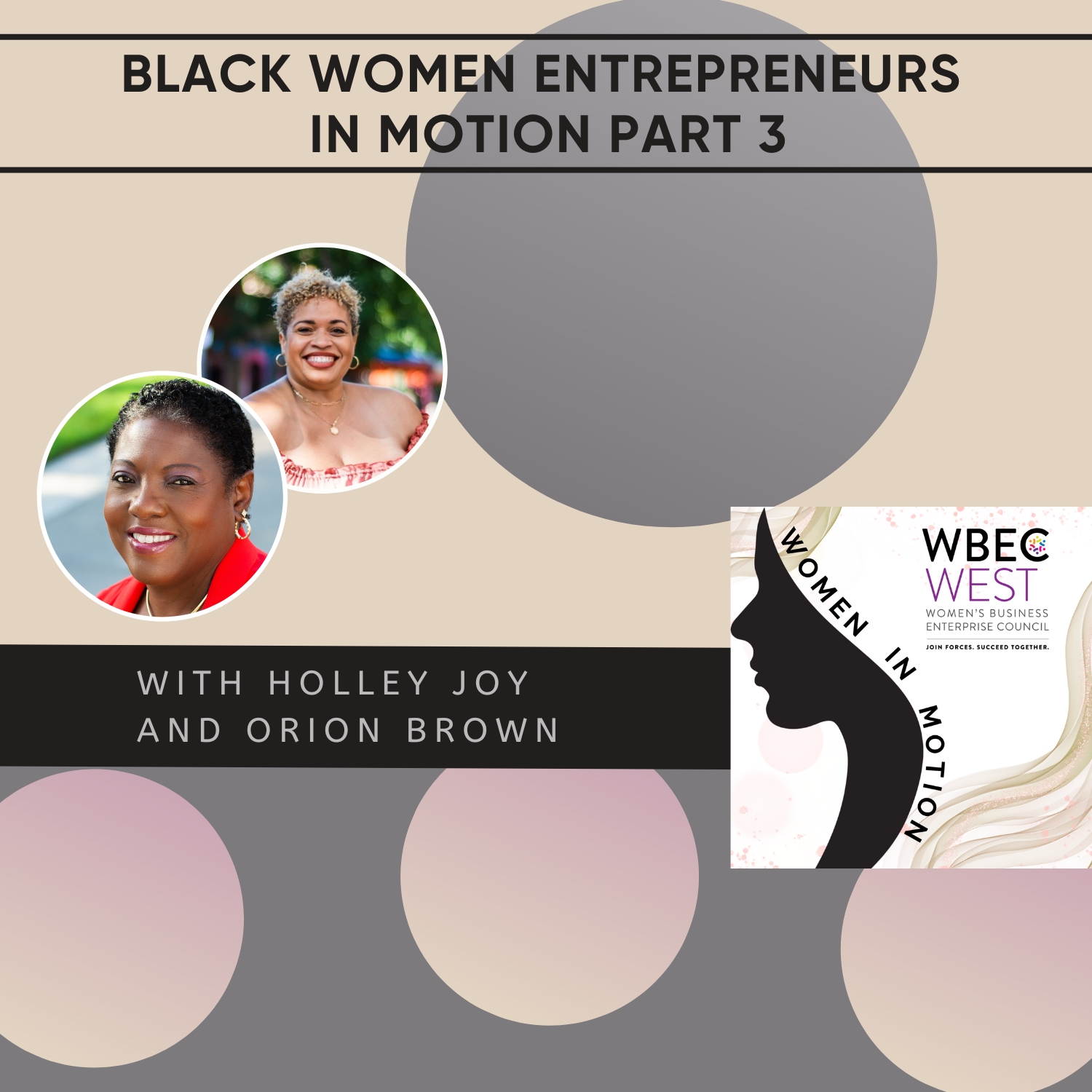
In part 3 of our Black Women Entrepreneurs in Motion series, Orion Brown and Holley Joy discuss their experiences in the business world and how DEI has impacted their businesses.

Holley Joy talks about Liberty Utilities’ experience in supplier diversity and their efforts to partner with African American women-owned businesses, and Orion shares her insights on how entrepreneurs can identify potential clients and partners and approach mentorship. The guests emphasize the importance of networking and seeking out opportunities to learn and grow as an entrepreneur.

Holley-Joy-headshotMs. Holley Joy is the Supplier Diversity Manager with Liberty Utilities. Holley has over 10 years of experience in Supplier Diversity, including 4 years as the Manager of Supplier Diversity at California American Water.

Over the past 10 years, she has cultivated and sustained relationships with diverse suppliers, CPUC personnel and Supplier Diversity Managers of the Joint Utilities in California. Holley possesses a Bachelor of Science Degree in Business Administration from the University of LaVerne. 

With Holley`s knowledge and passion for Diversity and Inclusion, she looks forward to building successful relationships internally and externally to successfully support and further enhance??Liberty Utilities Supplier Diversity Program. 
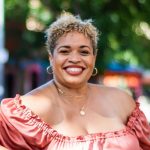
Orion-BrownOrion Brown, Founder & CEO of BlackTravelBox®, a premium clean beauty brand targeting women of color. She is a brand strategist with over fifteen years’ experience dynamically leading cross-functional teams across multiple industries. Her areas of deep expertise include consumer insights, brand strategy, product and packaging innovation, operations, and portfolio management.

Before becoming an entrepreneur, she led brand strategy for Oracle, led consumer brand marketing efforts for the Transformers and My Little Pony digital brands at Hasbro, and she spent the bulk of her brand career at Kraft Foods. There she led marketing, management, and operations initiatives across several beloved global brands.

She received her Bachelor of Arts from The University of Chicago and holds an MBA from Duke University.

Orion is a lover of travel and food, spending most of her free time outside of career pursuing the best of both.

About our Co-Host

Pamela-Williamson-WBEC-WestDr. Pamela Williamson, President & CEO of WBEC-West,  is an exemplary, dedicated individual, and has extensive experience as a senior leader for over twenty years.

She has served as the CEO of SABA 7 a consulting firm, overseen quality control at a Psychiatric urgent care facility of a National Behavioral Health Care Organization where she served as Vice President and Deputy Director,and has served as the CEO of WBEC-West, since 2008.

Her extensive experience in developing and implementing innovative alliances with key stakeholders has enabled the organizations to reach new levels of growth and stability. Her ability to lead and empower staff members creates a strong team environment which filters throughout the entire organization.

She takes an active role in facilitating connections between corporations and women business enterprises and sees a promising future for WBENC Certified women-owned businesses.

Dr. Williamson holds a Doctorate in Healthcare Administration, a Master’s degrees in Business Administration, and bachelor degrees in both Psychology and Sociology.

Connect with Dr. Williamson on LinkedIn.

Music Provided by M PATH MUSIC

This transcript is machine transcribed by Sonix

TRANSCRIPT

Intro: [00:00:07] Broadcasting live from the Business RadioX Studios. It’s time for Women in Motion. Brought to you by WBEC West. Join forces, Succeed Together. Now here’s your host.

Lee Kantor: [00:00:27] Lee Kantor here with Dr. Pamela Williamson. So excited to be talking to these women today in this episode of Women in Motion. Pamela, who do we have today?

Dr. Pamela Williamson: [00:00:38] I am excited because we have two guests. One is Orion Brown and she is the founder and CEO of Black Travel Box, a premier clean beauty brand targeting women of color. She is a brand strategist with over 15 years experience dynamically leading cross-functional teams across multiple industries. Her areas of expertise include consumer insights, brand strategy products and packaging, innovation operations and portfolio management. So Orion, thank you for joining us today. And our second guest is Holley Joy. Holley is the supplier diversity manager with Liberty Utilities. Holley has over ten years of experience in supplier diversity, including four years as the manager of supplier diversity at California American Water. Holley, thank you for joining us. And I think I’m going to kick off with the question for you. Can you tell our listeners a little bit more about Liberty Utility and also how do they engage with women of color, specifically black women entrepreneurs?

Holley Joy: [00:01:40] Hi, good afternoon and thank you, everyone, for joining. Thank you, Dr. Pamela, for inviting me to this conversation and to my fellow podcaster. Ryan, congratulations to you on the success of your business. I’ve been with Liberty Utilities for the past year, notwithstanding my previous decade experience in supplier diversity. And so I’ve always been interested in how do we bring forth and recognize and actually work with partner with diverse owned businesses. Liberty Utilities is actually an international company. Our parent company is Algonquin Power and they are based in Canada. But we provide several types of utility services across the nation in various states, everything from water to solar to electric and power in the different states and in Bermuda and Chile.

Holley Joy: [00:02:33] We also provide water utility services there. Liberty’s experience in supplier diversity is probably more prevalent in the state of California and is now expanding to the West region, which in terms of liberty’s territories or services, includes California, Arizona and Texas. So I’ll speak first about California because that’s where we’ve had the most experience. We work with diverse companies. We are under compliance of a general order with the Public Utilities Commission, and we have been successful in meeting all of the targets and goals these past few years for those diverse categories. For African-American women owned businesses, though, full transparency, we struggle in that particular category. And I’m not I’m not thinking that it’s because there’s a lack of African-American owned women that could partner with us for the products and services that we procure. But I think that we just need to do more in focusing specifically on that particular group of individuals. We offer a variety of products and services as we are executing on just daily operational needs and also projects. So I’m pleased to be a part of Quebec West as a corporate member, and I’m looking forward to partnering and creating a forum, a vehicle, a platform or a path with African-American women business owners through Quebec West that we can absolutely find an alignment for opportunities for some of the projects that we’re we’re looking for both in California and in Arizona.

Lee Kantor: [00:04:18] Now I’d like to throw out a topic to the group. How has this increased focus on DEI impacted both of your businesses?

Orion Brown: [00:04:32] Yeah, I’ll hop in here. I think, you know, the we’ve seen a lot of shifting over the last several years. So when we look at, say, things like investment numbers into black women owned businesses, black owned businesses or just women owned businesses more more broadly, you know, we saw some pretty abysmal numbers in the 2018, 2019 time frame at the pivot point that we saw with, you know, social issues and discussions around George Floyd ET. A lot of companies have been doubling down on bringing in more vendors. And then on the investment side, we’ve seen a lot more discussion around how to best support and empower these know, black women owned businesses in particular. I think the challenge is, though, is keeping that momentum. And so as we see a slowdown in the broader ecosystem and there’s a little bit less of a headiness within sort of the investment space, particularly in venture capital. And I think that also trickles down to Angel as well. Angel really follows. We’re seeing that that interest is waning. So the funds are, you know, tending to dwindle the opportunities while there are many, I think that, you know, people kind of forget, especially, you know, for myself as a as a black woman entrepreneur, I will get people going. Oh, well, have you heard of this, this fund or this grant program? And it’s literally thousands, if not tens of thousands of people applying for the same one grant or, you know, five grants maybe.

Orion Brown: [00:06:17] And many times those are between the 5 to $15,000 range. So when we’re talking about check size, when we’re talking about opportunities to tap into the investment network and when we’re really talking about the resources that are needed, there’s still quite a bit of work to be done there. We’ve seen that uptick. It’s kind of cooled off and now it’s, you know, we’re just looking forward to seeing what that starts to transition to going forward. And hopefully we get to a place of equilibrium where there are additional opportunities. Funds aren’t looking at black women owned businesses as impact investments, but as investments, period. And that’s what I’m hoping for in the future.

Holley Joy: [00:07:07] I would agree with that Orion. I think that also there is a messaging that has to be broader from not just my company standpoint, but in the utility space that I operate in that we have to be more focused on specifically those areas where we’re feeling like there has not been the we have not reached our goals and objectives and African-American women. And just as an aside, African-American men are the same. But in this particular conversation, we speak about African-American women. I think that there is absolutely some additional things, some additional very specific focused groups and forums that we need to bring to the table to give visibility to the companies that are seeking to do business with African-American women as well as be ready and more available with projects that are not some some time on the 1 or 2 year horizon, but exactly in the moment.

Holley Joy: [00:08:08] And that’s going to require myself, a supplier, diversity manager, my supply chain team, really coming together to identify what do those projects look like, what are the types of suppliers that we need? And then seeking the partnership that we have with the community based organizations like WBEC West to specifically target the members within their groups for opportunities that are occurring in the moment, that absolutely are providing the good products and services that we need to execute successfully and deliver the water utilities that we need to have in that moment. So we’re working on that. We certainly want to do that and and build that greater in California. In Arizona, I think we have a great opportunity because I’m just embarking on standing up that program. So I am starting to reach out. And just yesterday had a conversation about a supplier forum that I’d like to do probably first quarter of excuse me, first month of the fourth quarter. And I’ll be reaching out to WBEC West and some of the other organizations for targeted audiences for opportunities with Liberty.

Lee Kantor: [00:09:17] Now, go ahead. I’m sorry.

Orion Brown: [00:09:20] I was just going to say I absolutely love that. And just to piggyback off of it, what what better way to invest in a business than to give it to the opportunity to invest its own revenue. And so when we’re actually creating those types of opportunities, making sure the infrastructure is in place for them to be successful, understanding the differences between working with the massive, you know, institutional businesses that you may partner with historically and what that looks like, how that looks very differently for a small or mid cap business and making sure that that there’s infrastructure and process and resourcing accordingly to set that relationship up for success is really key.

Holley Joy: [00:10:03] Absolutely. Orion You it’s like you’re in my head. We are so aligned in that space because you cannot, even as a supplier diversity manager, go out and speak to the opportunities if in fact your infrastructure and your administrative processes and tools are not supporting it. Everything from internal outreach and educating our staff about the possibilities and who is in the diverse marketplace, but also our procurement practices and making sure that we align with what the goals and objectives are that we’re trying to reach and that it speaks to that it’s not a set aside that we’re looking for. It’s not that we’re asking for special dispensation, but we’re asking for making sure that all of the components line up so that there’s a better opportunity for not just inclusion, but success. And that we would be able to tell the story about how we have introduced, built and developed some of the companies that are seeking to do business with us. Once we get the word out, once we put the infrastructure in place and once we present the opportunities, I have no doubt that there are African-American women owned businesses that are ready and able to compete and can come to the table and deliver what it is that we need in our projects. So we’re we’re aligned on all of that. It’s just a matter of putting all of those pieces in place.

Lee Kantor: [00:11:27] Now, what do these entrepreneurs have to do to be ready to do business? And Orion, for your from your perspective, what advice would you give an entrepreneur? So when they do have a conversation with somebody like Holly that they are prepared for it and ready, you know, they’re ready to do business. Not that they just want to do business, but they’re actually ready to do business.

Orion Brown: [00:11:57] Well, I think, you know, every company is going to be different. And the key is to be able to have the right people at the table who can articulate what it’s going to take. So oftentimes in companies, you’ll find if procurement drives the bus, there may be other business leaders that are actually standing in the gap and trying to create programs and trying to bring that diversity into the pipeline. But ultimately, you need to have procurement on the discussion and vice versa. So depending on how the business is actually structured, the first thing you need to do is figure out who the right person is that knows what the process should be and is, you know, ideally, if not the decision maker adjacent to the decision maker, that can give you that really clear point of clarity as to what their requirements are as a business owner. Ultimately, you just have to be ready to spend more than you thought you were going to take twice as long. We don’t want you to actually do that. But when you’re starting to estimate what it’s going to take to make it, especially if you’ve never done, you know, say, large corporate contracts or larger partnerships before, give yourself fudge space. So when they’re when you’re asked, what’s your timeline, yes, you want to meet the RFP timeline, but make sure that you’re giving yourself enough space to make mistakes, figure it out and still deliver with the level of excellence that the client is expecting.

Orion Brown: [00:13:19] So that’s what I would say for any business, doesn’t matter what category you’re in, but ultimately what those specifics are in terms of scale, in terms of your capability statement, all of those things you can partner and, you know, talk to folks at Quebec and and other places to get, you know, a general sense of it. But it really is going to come down to the person who knows and who is within the company that you’re trying to do business with.

Holley Joy: [00:13:46] Absolutely, Orion. If I could just qualify my this next statement by saying I have a healthy respect for any entrepreneur that endeavors to chart their own path that is brave enough to to decide on their own destiny and then also has a product or service that they are passionate about, that they are creative enough about and they are steadfast in delivering on that product or service. I say that because that is certainly one of the things that a business would have to do to be ready. Right. Know your product or service. Know what your who your competitors are. Know what your bandwidth is in terms of time and money. As you begin to seek clientele from whether it’s a small, medium or large corporation. I’d also ask that the entrepreneurs, especially if you’re coming into a space like Liberty or into a company that is just new to you, that you would allow some grace for your learning of their processes and also some patience in what those processes are.

Holley Joy: [00:14:56] Everything is not always a turnkey that you can just walk in and talk to you today and you know, here’s a contract we’re handing to you tomorrow. There are timing issues, whether that’s internal to the departments, whether that is something from a liberty perspective, we have to align with regulatory compliance issues or things of that nature, but also taking some time to learn the client that they’re pursuing. Right. I sometimes hear so many times of businesses and not just African-American women owned businesses, but businesses that say, you know, I can do whatever it is that you need. You know, thinking that that is the actual selling point. That’s really not what I am looking for. And as I speak to some of my colleagues, we’re not looking for you to do everything. We want to see how you align on that one best product or service that you know, without a doubt you’re going to be able to deliver 100% of the time. There’s no guessing about it. There’s no, Oh, let me see how I can do it. I don’t know this for sure. We want to know what is your main product or service? And let’s see if we have alignment for some of the opportunities that we’re offering.

Lee Kantor: [00:16:12] Now, what are some resources that you believe are the go to resources that can help diverse entrepreneurs kind of get their foot in the door?

Holley Joy: [00:16:28] Yeah, I’m assuming that might be for me. I don’t know. But also I’d love to hear what Orion’s experience because that’s the real talk there. But the resources that a new business has approaching Liberty Utilities is first and foremost. Absolutely. Find out is this a product or service that they’re offering that the utility actually aligns with? Right. I always say if if I’m looking for apples, please don’t try and sell me oranges, but just make sure do some research on the company, whether that is local in your area. You can find it on LinkedIn. You might be. In our case, you can find our annual report on the California Public Utility Commission website and it tells you what projects we have we have executed on in the prior year. It tells you where we landed in our spending with diverse suppliers. It speaks about what’s coming up and it also provides a standard industrial code numbers for people to see where are they spending the bulk of the money. I can tell you right now that 80% of all of the dollars spent in a utility are usually in construction and engineering.

Holley Joy: [00:17:36] That’s not to say that the other 20% is not important to us. Those are that 20% is what keeps us moving as a business. We’re looking for maybe it support. We might be looking for consultants. We might be looking for. Well, not might be. We certainly are also looking for promotional products because we’re out and about in the community. So learning about the company and using the couple of resources that I’ve given you are certainly key. Also, the resources that are available through their membership and associations like WebEx or their local chambers who might have a tie in to a larger utility. As I said, in Arizona, I’m just starting to to foster and broker those relationships. In California, However, we are members and sponsors and partners with several community based organizations that do have knowledge about what the utilities are looking for, can make introductions to supplier diversity managers and also internal team members to the point that Orion made before. Who is the actual decision maker or next to the decision maker that can actually talk shop about the products and services that they’re looking for.

Lee Kantor: [00:18:57] Orion, are there any kind of go to resources for you or that you’ve kind of leaned on in your years as an entrepreneur?

Orion Brown: [00:19:04] Yes. And you know, it’s interesting because, you know, my background is in CPG and brand management, so I’m familiar with sort of the spaces and places that physical goods can show up. So one of the places that, you know, was just mentioned is this idea of, you know, essentially corporate gifting. A lot of entrepreneurs don’t know that those programs exist. Alternatively, when we look at things like the military folks will think, well, oh, I don’t sell defense capabilities or tech or army fatigues, but they don’t realize that that the US Army globally is, you know, one of the largest procurement opportunities for things that come in, grocery things that show up in personal care, beauty. We’ve got people deployed all over the planet and there are sourcing, you know, American made American owned brands. And so the first thing that I’m going to say and this is going to sound super rudimentary, but if you don’t know where to start, start with Dr. Google because he knows, you know, this is the place where you can ask the question where you know who purchases the most, you know, whatever product it is. If you make the best churn butter on the planet, go look for who’s purchasing fresh churned butter, because you’d be surprised. It might be the local hospitals that are looking for natural, you know, fresh churned butter. I’m making something up. But this is where, you know, the getting into starting with the industry first and then coming down into specific players makes sense. So you may not know that utilities is a way that you know, a way in a potential client for you. So now that you’ve kind of figured that out, you can begin to look at, okay, so where are the utility companies? Where could I actually service someone? Is it my immediate area? Are they, you know, in broader places? Another thing, you know, everybody’s all on the i fad right now, but Chatgpt is actually a really great tool to help you essentially index what is out there.

Orion Brown: [00:21:02] So you can literally say, I am a, you know, a maker of I am a service provider of please give me 20 different potential clients that I could sell my products to. And you’d be surprised how the wide variety, because it’s essentially indexing the Internet, it gives you a really wide breadth that gives you a great starting place. Secondarily to that, now that’s just the upfront research. Then you want to actually start talking to people within the space. If there’s people who provide the same service you do and maybe you’re a few years ahead of you, if there are people who do the same thing in terms of product or, you know, close to it, if you can find mentorship in that way, you can also find what channels they’re actually selling through and creating partnerships at these corporate levels. And I think beyond that is also just getting into communities so we bank and other communities where you can tap into and shoot a note and say like, Hey, I’m looking for resources. Do you have matchmaking days where I can figure out what my business might fit the need, you know, what kind of companies might be a good partner for us. I’ve seen a number of events that do essentially sort of matchmaking services or just info sessions. These are the opportunities to educate yourself as to what your market could potentially be outside of the obvious areas that you may or may not be thinking of.

Lee Kantor: [00:22:24] Now, you mentioned mentoring. Let’s throw this out there to the group. What is kind of the best strategies for a person that wants to get fined, identify a mentor, and also to be a good mentee? You know, I’m sure all of you can speak to both sides of this, but for the person out there who has never had a mentor, what’s the best way to attract one? And for the person who is a mentor, what are you looking for in a mentee? Holly, want to take the first stab at this?

Holley Joy: [00:23:06] I’m sorry. I was just trying to formulate the question. You said what are. What are you looking for? Could you repeat the question?

Lee Kantor: [00:23:14] Yeah, I’m just trying to help the audience in terms of if they’ve never been a mentor. We spoke earlier about how being mentored or being a mentor is important for a lot of people’s careers. Let’s talk about kind of the nuts and bolts of from the standpoint of finding a mentor. Like, how do you find one That sounds good, but how do I get one? And also from the standpoint of anybody who’s been a mentor, what are you looking for in a mentee in order to really have a productive relationship for both of you?

Holley Joy: [00:23:49] Okay. So in terms of how do you find a mentor, I don’t have any professional resources for that. And perhaps, Ryan, you might have some resources, but for me personally and even professionally, on a personal level, the mentorship that I have provided have not necessarily been specifically defined as mentorship, but mentorship. But it’s been kind of organic. I’ve had different suppliers that come and speak to me on a regular basis or want to speak with me on a regular basis, and we schedule a cadence of meetings and it’s a mixture of getting to know the individual behind the business and then also understanding their business and offering insight that is from a layperson’s perspective or even sometimes in my professional self as a supplier diversity manager. So, you know, again, I don’t have a hold a title as a professional mentor, but the mentorship that I have been involved in have been strictly organic. It’s been very easygoing conversations. And I think in terms of what the mentee would need to present is a willingness to learn and to step outside of their box within reason. Not that it’s, you know, should break their bank.

Holley Joy: [00:25:08] I’m not encouraging spend all of the money that you have trying to go in this new direction. But certainly consider what this layperson, that being myself might be looking for as they talk about their business, as they tell me what the product or service is and that they would be willing to listen. And I think that that has built some very good, just personal and professional relationships that have kind of morphed into a mentorship where they now say, Hey, you know what, I’d like to run something by you. What do you think? I value your opinion in that right there. It’s enough to provide me with some encouragement, to speak freely, to really assess and and really want to help. How do they grow and develop their business. So I’d have to defer to Orion or maybe someone else on the call to say, you know, if there are mentors, professional mentors out there somewhere, I’m not aware of them. And so I apologize. I’m not able to point you to an actual resource.

Dr. Pamela Williamson: [00:26:13] Lee, this is Pamela. I want to take that question and and give people a little bit of feedback on on ways to get a mentor. I think the number one way to get a mentor is just ask. Find someone that you look up to or find someone that’s where you want to be and just ask them if they’ll they’ll mentor you. Um, as far as where to look for mentors, look in your existing network. Uh, there are women owned business entrepreneurs who want to give back. So between looking at in your existing network or joining a new network, those are great ways to find people. There are, you know, we West has a national black pitch competition. And part of that competition is you get assigned a mentor. And so that’s another good way is to look for offerings where they are assigning mentors to you. But I think the number one way is to find someone that you admire in a position you aspire to be in and ask them. Orion I know you went through the National black business pitch.

Orion Brown: [00:27:28] I did. I did. Yes. Um, you know, I have a I what I would say is a little bit of a hot take on mentorship, um, and that I think people are a little bit fatigued on the traditional sense of mentorship, particularly the corporate sense of it, right? So, you know, in corporations over the last couple of decades, I’ve definitely seen numerous angles and ways in of trying to sort of forcibly matchmake people. Sometimes it works, sometimes it doesn’t. It’s hit or miss. And I think particularly within the entrepreneurship realm, it’s also a very similar thing. I think getting the exposure and broadening your network, um, to more people through programs, through sort of more official channels just gives you a better opportunity to find someone that you might click with. But I think the second thing here, that’s a little bit of a hot take coming out of COVID. People are tired. And so when you say, Hey, I would love for you to be my mentor, that’s a whole nother job in their minds. So I think, you know, in terms of what I would recommend in terms of approach is one, don’t necessarily think of it as a, okay, so this is a person I have to talk to every month. Sometimes it’s a matter of saying like and I think this was said earlier, like, Hey, I really respect your opinion. I have this particular business challenge. I’d love to bounce some ideas off of you. That in and of itself as a moment is mentorship.

Orion Brown: [00:28:56] It doesn’t have to be that. Now we have a meeting every three weeks and I sit down and I take you through the latest and you tell me what I should be doing with my business. And so if you provide that, if you if you give it that flexibility, if you think of it as a personal board of directors as opposed to this one on one mentorship where there’s, you know, sort of these rigid structures, then you can start to look at the people that you’ve connected with. And it’s totally fine to say, you know, maybe you’ve gone through the national pitch competition and you say, Hey, you are a great mentor for my 92nd pitch. I would love to be able to stay connected with you. Are you cool with that? And just, you know, put that out there, allow the person to opt in or opt out and then how that what that actually ends up looking like is coming back over time, whatever it is that you wanted to connect with them on, maybe you find that they’re very creative. Maybe you find that they’re they have an amazing network. That’s when you come back around and say, Hey, I know you have an amazing network. You’re such a great connector. You were really generous previously. I’m looking for this. Is there anyone in your network that would make sense and do you have any recommendations on how to approach them with that? And that’s a beautiful, finite conversation that you can have.

Orion Brown: [00:30:13] And the next time you actually need that type of help and that type of support, you can you can have that conversation with them. You may have somebody who’s in a completely different industry and you go, Well, I go to Susan for this, but I go to Janet for that because they have different networks, so they have different skill sets. So I prefer to think of it as a personal board of directors and developing those relationships and not making it so formal and rigid that it feels like it’s a bit of a schlep for a better term, right? Like giving it something that has breathing room. In terms of the question of what do I expect from the people that I mentor, there’s usually three things. One, I want you to come prepared and know what it is that you’re asking for because it’s work to dig out of a person what it is that they need. Now, if their need is, I don’t know what I need, can you help me figure that out? That’s actually a really clear and very complete question. We can work together to do that. But it’s when a person comes and says, okay, so I’m talking to you. And you just kind of get that dead silence. I think a lot of that does come from that obligatory, structured, okay, this person is my mentor, so I have to show up and give them face time. But when you make it very clear and very specific, this is a challenge I’m running into or I have this actually really big win and I want to know how to like make it even bigger.

Orion Brown: [00:31:34] Those are some really clear questions that you can come in with upfront. The other thing is, is do your homework. Just like if it were a manager. Now, I’m not managing you, I’m not managing your business. But before you come to a manager, typically in a corporate setting or even in an entrepreneurial one, you kind of do your homework and say, okay, this is the challenge. This is the problem. I have some initial ideas. I did some research. I’m thinking these three things might be the way that I want to go, but I don’t know which two to choose from. That’s going to make the conversation more productive. And then for me, it’s just going to make it easier for me to give you my time freely because I know she popped 45 minutes on my calendar. I already know that she’s going to have clear topic. We’re going to you know, I’m going to be able to pour in and give her what she needs and she’s going to be able to come out and go do something with that. And that’s the third thing. Taking the advice you get. Now, mind you, not everybody’s advice is going to be right for your business. It’s not going to be granular and nuanced. Ultimately, you have to make those choices. But. I would say some of the harder mentorship situations that I’ve been in is when people have come back time and time again with the same issue, not taking the advice they’ve been given.

Orion Brown: [00:32:51] So this is where you need to be able to come in and say, I heard what you said, this is why I’m not doing that. Help me think through that, because if you’re still having the same problem and you’re asking everybody to help you, but you’re not willing to make those any of those steps, that’s just going to shut down, you know, that that flow of insight and support because people won’t feel like their voices are being heard or valued and that’s not the way to go. So those are the things that I really look for in a mentee. And, you know, classically people say, oh, well, you know, what are you giving back to the mentor? I personally give of myself as a gift. It is not meant to be. I don’t think it necessarily has to be, you know, sort of bilateral exchange. If I get something out of it, I should be getting out of it. The fact that I get to pass forward something somebody else poured into me. So that’s how I kind of think about that. And I would be a little bit cautious of folks who are like, Well, you got to make it worth my time for me to be your mentor. That that makes me that gives me a little bit of trepidation there. But that’s how I think about it. Hot take.

Lee Kantor: [00:33:54] Hot take. Now, do you have any advice for the new entrepreneur, especially somebody that might have been coming from a corporate environment and it’s the first time they’re in kind of this Eat what you kill world of entrepreneurship.

Orion Brown: [00:34:10] Now there is eat what you kill in corporate too. But I get what you’re saying there. I think the biggest thing is you’re going to come in with an amazing foundation of what a scaled business looks like. So all bets are off because that’s not what it looks like when you’re creating it from seed. When you’re creating it from the dirt and figuring out and getting that root system in place. So be willing to learn from people, break paradigms. Um, you know. Overstep some of the things that have been, well, this is how we did it here, and be willing to reinvent and be really innovative. Your product or service doesn’t have to be the innovative thing. Sometimes it’s how you get it made and how you get it done that the innovation really comes in. And so being willing to have that flexibility and if you don’t think that way, find someone who does and do that mentorship process of saying like, Hey, I’ve got this idea, I know how to do this for $500 million, how do I get this done on $5, $5, you know, and let them bounce things off of you. And then that’s when you bring in sort of your okay, so the watch outs, I know some of the pitfalls I’ve seen are in these areas. So let me go ahead and de-risk those and think about the contingencies and the opportunities around them. But the key here is to really be flexible because the way you did things in that structured corporate environment with the scale, with the resources, with the ingrained infrastructure culture is not what you’re going to have when you’re just starting out to create it for yourself.

Lee Kantor: [00:35:51] Now, Holly, do you have a take on this?

Holley Joy: [00:35:55] I don’t only because the as a new business I, I don’t have any experience in that. And so I agree with everything that Orion has said, but nothing to add.

Lee Kantor: [00:36:08] But you haven’t seen people come to you as entrepreneurs that might have a great resume from a corporate background, but they just aren’t ready yet. To be an entrepreneur to serve you or the firms you’re working with.

Holley Joy: [00:36:23] Well, yes, I’ve seen I’ve seen that where but it’s not necessarily that they’re not ready. It’s it’s in a lot of cases that we as an entity are not ready to accept their newness into their entrepreneurship, if that makes sense. So, for instance, there are certain areas within our business that there are required to they would like to have 3 to 5 years experience, notwithstanding that someone might have 20 years experience having worked for someone else, but as a business entity solely operating on their own. Sometimes it doesn’t meet the internal criteria then that’s not across all industries, but certainly that I’ve seen that happen where it has nothing to do with the business not being ready. It’s the internal infrastructure that is not able to accommodate for that particular industry or what we’re sourcing for in the moment. To that, I would say again, it’s flexible. Every situation is different, but also that the business owner would would would have to be understanding and know that that is the criteria for some of the utilities or at least some of the larger corporations.

Dr. Pamela Williamson: [00:37:39] And that’s a really great point. Just understanding that the access that you may have had in a corporate environment, you will not necessarily have by definition of being a new player. And even with that, I would urge people to take creativity into account, right? So if you find a partner that you think could be a really good positive partner and they are interested in you, but you just don’t meet sort of the letter of what they have in their, you know, their criteria. This is where you start getting creative.

Dr. Pamela Williamson: [00:38:10] Maybe you partner with a business that’s been an older business that does a broader thing and you use that as a way in. So you, you know, the the business offers, you know, 360 degree services and you offer a certain niche service under that. Can you do a subcontract partnership where you work with this larger business that’s been around a little bit longer and they subcontract out some of that work to you that gives you more of a resume for the business, right? So you’ll you’ll have more access to, I would say, heavy hitting partners without having the direct risk on either side of the fence. And you can start to show like that collective experience of having done these things. This is the same chicken or egg that, you know, oftentimes young people will talk about. They want me to have experience, but I need to get experience in order to have the experience to get the experience. And so finding ways that are creative to get those pieces in place is going to be key. And of course, you can’t get creative with a partner that just isn’t interested in you. So that’s, you know, that’s sort of the dating advice right there, just not that into you go find a partner that is interested in being creative and figuring out ways to to work within the systems that are in place or to stretch those systems in such a way that you can get your foot in the door, perform with excellence, and then begin to prove yourself so that you can stay in the game.

Lee Kantor: [00:39:37] Yeah, I think that’s a great point. And I think that’s where associations like Quebec West and other business associations really give a young person an opportunity to take, to volunteer, take leadership roles and demonstrate and learn right in front of other people that they might be interested in doing business with down the road where it isn’t. They might not have the skills today, but if they step up, volunteer, take a leadership role, they’re demonstrating the will and desire to be that person. Now is there for anybody. Is there any piece of advice that you would give that person may be coming out of school today to kind of build their career, whether it’s being an entrepreneur or just build a successful career? Is there anything that you would recommend they do today as it is kind of getting close to graduation time for a lot of folks?

Holley Joy: [00:40:42] You know, Lee, if I might. And this is this is a very real situation. For me right now, being that I’m about to my son is about to graduate from high school and he is interested in businesses and business administration with a concentration on entrepreneurship. And I think that his thought is it’s just going to go 0 to 60, that he’s going to come out of school and he’s going to be this entrepreneur and he’s going to be successful. And so I’ve had conversations with him about how to prepare for that, that between now and and his successful entrepreneurship, there’s going to be a whole bunch of life happening. And there were things that I’ve been telling him that he needs to concentrate on. He needs to get out and work within whatever industry so that he can begin to understand the natural relationships that occur between a business and a client or a customer. He needs to be able to know how to network and present himself as an entrepreneur. But before being an entrepreneur, just how to network socially, I think that there is some in some ways a disadvantage to technology in this space, because I think that a lot of our younger people are forgetting about the very personable aspect of business and that everything can be done online.

Holley Joy: [00:42:06] And as Orion mentioned earlier, everybody is over the top about AI, and I’m not saying that it’s not those are not good tools or that technology is a bad thing. I’m simply saying that businesses and entrepreneurs need to continue to understand how to present themselves personally and socially to market themselves their business in order to get to where they’d like to be. So I would say to any new entrepreneur, you know, study that technology is a great thing, making sure that you have all of the tools that businesses or your competitors are offering, you know, having your websites up, having your marketing structure, having your financial plans and your business, you know, outlook and your business plans ready and solid. And to keep revisiting that all with a mind towards you still have to get out there and personally network so that people can get to know you as they get to know your business. All of the traits that you have, the great characteristics that you have for integrity, personability stick to itiveness, tenacity. Those are the same traits that anyone that’s seeking to do business with you would like for you to display.

Lee Kantor: [00:43:25] All right. Before we wrap up, Orion, could you share kind of your ideal customer and the best way for them to get Ahold of you?

Orion Brown: [00:43:34] Sure. So black travel Box is, as you said, a personal care products company focused specifically on travelers of color. We’re inclusive, so we formulate for a wide variety of hair textures and skin tones. I am a big proponent of saying that the beauty aisle is broken and we all should be trying different products and seeing what works best for us. So I invite you to check out the brand. We’re at Black Travel Box.com. We’re also at literally Ampersand or not Ampersand, the at symbol at Black Travel Box on all social platforms. And you can also find us until the end of May on the iPhone women platform. We are running currently running a crowdfunding campaign to get us ready to move into the hospitality space and work with hotels.

Lee Kantor: [00:44:28] And Holly, what could we be doing for you? What do you need more of?

Holley Joy: [00:44:33] Um, I think that we need more of just African-American women owned businesses. If you are providing products or services in the areas of construction, engineering, any discipline, even promotional products, janitorial services, anything that makes a business run, I’d certainly ask you to look at Liberty Utilities just to get to know the company, and that would be at Liberty utilities.com. And if you would like to get in contact with me specifically, you can reach me at Holly. Holly Joy at Liberty utilities and that’s utilities.com.

Lee Kantor: [00:45:21] Well Pamela. What a show. You learn anything today? I learned a lot today. And I just want to thank both our guests for participating. And I want to give out a quick shout out to Orion’s product. I can honestly say I do not travel anywhere that requires me to pack a suitcase without putting my black box in it. I love the products. I specifically love the shampoo bar. So thank you so much for creating this product for African American women. It’s fantastic. And Holly, thank you for sharing your knowledge and your expertise. It was a great show. I think our listeners walked away with lots of great information. And so we appreciate you spending your time with us today. All right. Well, that’s Thank you. Well, that’s a wrap for Women in Motion this week. This is Lee Kantor for Dr. Pamela Williamson. We’ll see you all next time.

Tagged With: Black Travel Box, Black Women Entrepreneurs, Liberty Utilities

Black Women Entrepreneurs in Motion Part 2

June 21, 2023 by angishields

Women in Motion
Women in Motion
Black Women Entrepreneurs in Motion Part 2
Loading
00:00 /
RSS Feed
Share
Link
Embed

Download file

In this episode of the Women in Motion, Lee Kantor and Dr. Pamela Williamson talk with Todd Jackson and Anna Spearman about their experiences as black entrepreneurs and the barriers they face in networking and accessing opportunities with corporations.

They provide insights and advice on how to overcome these barriers, including attending conferences and events, following up with connections, and having a strategy for networking. They also discuss the importance of representation and diversity in the business world and the role of corporations in promoting diversity and inclusion.

This episode emphasizes the need for exposure and mentorship opportunities to increase diversity in the industry.

Todd-JacksonTodd Jackson (TJ), is Manager, Supplier Diversity with Republic Services.

TJ is the manager of Supplier Diversity at Republic Services. He’s responsible for creating and managing supplier diversity in the environmental service industry to meet Republic Services’ set initiatives by end of 2025 in the supply chain.

TJ’s career spans from manufacturing to program management with positions such as Process and Equipment Development Engineering, Strategic Sourcing and Supplier Diversity.

Prior to joining Republic Services, TJ is a former employee of Intel Corporation and Union Pacific Railroad and served in the United States Air Force. TJ has served in the capacity of several board of directors’ positions for non-profit organizations. Motto: “I can……”

Connect with Todd on LinkedIn.

Anna-SpearmanAnna Spearman  is CEO and founder of Techie Staffing. Since its launching, Techie Staffing has placed VPs of Engineering, Senior Directors of UX, Principal Data Scientists, Directors of Product Management, Directors of Engineering,  Directors of DevOps, Senior Full Stack Engineers, Senior Backend Engineers, Senior Front End Engineers, and Senior Product Designers. Techie Staffing was profitable within the first year.

Techie Staffing will celebrate its 3rd anniversary on July 6th, 2023.  

 Connect with Anna on LinkedIn.

About our Co-Host

Pamela-Williamson-WBEC-WestDr. Pamela Williamson, President & CEO of WBEC-West,  is an exemplary, dedicated individual, and has extensive experience as a senior leader for over twenty years.

She has served as the CEO of SABA 7 a consulting firm, overseen quality control at a Psychiatric urgent care facility of a National Behavioral Health Care Organization where she served as Vice President and Deputy Director,and has served as the CEO of WBEC-West, since 2008.

Her extensive experience in developing and implementing innovative alliances with key stakeholders has enabled the organizations to reach new levels of growth and stability. Her ability to lead and empower staff members creates a strong team environment which filters throughout the entire organization.

She takes an active role in facilitating connections between corporations and women business enterprises and sees a promising future for WBENC Certified women-owned businesses.

Dr. Williamson holds a Doctorate in Healthcare Administration, a Master’s degrees in Business Administration, and bachelor degrees in both Psychology and Sociology.

Connect with Dr. Williamson on LinkedIn.

Music Provided by M PATH MUSIC

This transcript is machine transcribed by Sonix

TRANSCRIPT

Intro: [00:00:07] Broadcasting live from the Business RadioX Studios. It’s time for Women in Motion. Brought to you by WBEC West. Join forces, Succeed Together. Now here’s your host.

Lee Kantor: [00:00:27] Lee Kantor here with Dr. Pamela Williamson. Another episode of Women in Motion. So excited about the group we have here today, Pamela.

Dr. Pamela Williamson: [00:00:37] Me too. I am excited for two reasons. One, this is our second show where we are celebrating Juneteenth. And the second reason that I’m excited is because we have two amazing guests. Our first one I’d like to introduce is Anna Spearman. She is the CEO and founder of Techie Staffing. Since launching this amazing business, she has placed VP’s of engineering senior directors of UX, principal data scientist, directors of Product management, directors of Engineering, Teche Staffing was profitable within the first year of operation and they will be celebrating their third anniversary on July 6th of this year. So Anna, welcome. Our second guest that we have today is Todd Jackson, also known as TJ. He’s the manager of supplier diversity at Republic Services. He’s responsible for creating and managing supplier diversity in the environmental service industry space. So, TJ, I’d like to throw the first question out to you, which is just tell us a little bit more about your role within Republic Service and talk to us a little bit about who Republic Service is.

Todd Jackson: [00:01:51] Sure. Thank you, Pamela. Yes, this is TJ. Supplier diversity here at Republic Services really started back in the emphasis of the George Floyd movement incident, and Republic Services wanted to to change the narrative of diversifying the supply chain. And so my my job was to create and design a program that will allow diverse suppliers, certified diverse suppliers to participate in the supply chain in the environmental industry. So our purpose is really to transform supplier diversity within the environmental services industry and then just really drive that economic empowerment with diverse communities and through that is the inclusive supply chain. So our procurement procedures, we’re changing those, we’re making sure we’re doing different things. And I would always like to to say that I’m probably more of a dad, see, and which that means D is the disruptor, A is the advocate and D is the doer. And then I’m a supporter. And then of course, the C is the connector. So I’m all those things here at Republic Services.

Lee Kantor: [00:03:12] Now the topic of today’s show is to celebrate black women entrepreneurs. Is there anything black women entrepreneurs can get some help with when it comes to some of the barriers that it is to get into some of these corporations to do work with them? I’d like to throw that out to to both TJ and Anna, maybe explain some of the barriers and also explain some of the ways to get into the corporations to partner.

Anna Spearman: [00:03:44] Hi. So this is Anna. So I would.

Anna Spearman: [00:03:46] Say, you know, as of course, I’m a black woman entrepreneur and for the past three years and I would say maybe one of the biggest barriers is just networking. You know, I really realized with DEI and specifically diverse suppliers and diversity in general, it’s really about breaking that network because a lot of people who only network within their own circle, usually it’s only going to be a lot of homogeneous groups and it’s not going to be truly diverse. So it’s really interesting when you when I first got in and when I was creating Tiki staffing, I had no network, no contacts. Like, you know, I had to create all of that from scratch. And it’s interesting how you see how a lot of people have the privilege to have different contacts in their families and friends that have the opportunity to make decisions and really give them an opportunity, because that’s all it takes, is an opportunity.

Lee Kantor: [00:04:44] Tj, can you share your your kind of because you’re on the other side you have some of these opportunities that the entrepreneur would want?

Todd Jackson: [00:04:52] Yes. And I would say an Echo Anna’s is really about the network and getting to know the supplier diversity professional if they have one in their that particular company or someone who has that connection, such as an area president, such as a general manager to connect with that that supplier. But really growing the network is what it’s about. And I would say that just because you have that connection doesn’t mean that that business is going to happen. I think the emphasis should be more on if you don’t have the network, grow the network, make sure that you have a relationship with that person. And then when opportunities come, they can have that opportunity to provide you as a supplier within that response for a proposal or just doing business.

Lee Kantor: [00:05:53] Now, are there any advice on how to grow a network when you don’t have a network like Anna was mentioning? There’s you know, some people have relatives or friends that are part of that crowd you want to get involved with. But if you don’t have anybody, how do you kind of penetrate that network so you can get that opportunity.

Todd Jackson: [00:06:14] That this is? Tj That’s a good question, Lee. I think one of the ways is that the organizations such as Whitbeck West is providing those opportunities to connect with network, with corporations through conferences, through some of the venues that the organization is providing, I would say show up, be available and continue to to network and harvest those relationships.

Anna Spearman: [00:06:46] And this is Anna. And just like what TJ is saying last month, actually, or actually it was the month of March, I attended the Webbank National Conference in Nashville, Tennessee. And being in person instead of because I initially was just doing cold outreach on LinkedIn, but being in person and having people see me and be able to introduce myself and really tell my story in person really made a difference. It was amazing to not only network with the WBS, but networking with corporate members who were there was the expo where I was able to connect with many supplier diversity professionals from Fortune 500 companies and health care, automotive, just a diverse set of industries. So that really allowed me to just open my network and I was even able to run into people that I had attended previous in-person events with at the Webbank West. And it was amazing that they were able to see that I was there and I was actively investing in my business and coming out and just really showing that I really want to be an active member. And it really made a difference, you know, to have increased introductions and more people really wanting to create additional connections for me.

Todd Jackson: [00:08:00] Yeah, totally agree, Lee on that. This is TJ and it’s just really about that in person. I mean, as you know, we’ve been going through the virtual world for since the pandemic, but we’re out of that pandemic. So those those that eye to eye contact relating to the stories that folks are telling is very important. And as Anna spoke about, is, you know, there’s going to be a lower probability of you connecting through those cold emails such as LinkedIn or just getting on a corporation’s website and putting in something. You really need to have that interaction. And the organization such as we bank, whereas and the National We Bank can provide that.

Lee Kantor: [00:08:57] Pamela.

Dr. Pamela Williamson: [00:08:59] I think the only thing I would add is that showing up is definitely a significantly important. I think the other thing that I hear a lot from corporations is that people will show up, they will connect and get that eye to eye experience. But then sometimes people forget to follow up. And I think that’s the other big piece of having a successful networking experience is to make sure that you follow up with who you connect with. I think my other comment would just be around making sure that you have a strategy for your networking. I think a lot of people just go out and connect but don’t really have a strategy with what they’re going to do with that connection once they make it. So I think the follow up and showing up, following up and having a strategy are the three pieces that I think are significant.

Lee Kantor: [00:09:54] Now, do you think that if you do an effective job in networking in this manner and really take advantage of the associations like Quebec West, where you can be seen, you can be heard? Is that going to help us resolve this lack of representation? A lot of women of color feel.

Dr. Pamela Williamson: [00:10:15] This is Pamela. I’m going to say no. I think that that’s a piece that is a woman of color. That’s a piece I can own. Like I can definitely attend networking events. I definitely am going to show up. I’m going to hold conversations. I’m going to follow up. But I think corporations hold a big piece of moving that forward, especially if people want to do businesses with corporate America. I think that. Todd I’m curious what your thoughts are around what corporations can do or what your corporation is doing to not only just ensure that women of color have a seat at the table, but also ensuring that they’re able to order and they’re able to actually eat from that table of opportunity.

Todd Jackson: [00:11:06] Yeah, that was I was thinking about that as you were you were speaking. I noticed that here at Republic Services, there were really some, a couple of, um, internal goals that were set and, and it was really based on doing business with not only black owned businesses, but women of color as well. And so I think some of the corporations, through that pandemic and all the the killings that people were really trying to commit to doing business with women of color and black owned businesses. But I think sometimes the corporations may forget what how to proceed in that after all the the limelight have settled. So I think it’s really it’s really on the corporations to main that particular focus on making sure that when they provide those opportunities, get them to the table and you can look at your supply chain and know how many suppliers you have, you know, the ethnicity around those suppliers, I think your focus has to be intentional, and that’s for any corporation. If they’re doing true business around supplier diversity, it is not a box for me. It is the way of life for me here at Republic Services. And and you have to have mechanisms in place for corporations to make sure that those those initiatives are are valid and make sure those initiatives are done and and materialize. So putting metrics around that is one of that. One of the things also trying to have compensation around the businesses that you’re you’re bringing in or doing business with. Here at Republic Services, we’re a little different model. We’re somewhat of a hybrid. So we have operations in approximately 40 something states. And so we’re headquartered here in Phenix. But it is it behooves all of us in Republic services to to understand that it’s not only sustainability as a pillar, it’s not only charitable giving as a pillar, but it is also diversifying in the supply chain. Because if we’re doing business in a diverse community, we need to have a diverse supply chain and we need to make sure that all of our city are represented in our supply chain.

Lee Kantor: [00:13:54] Now, Anna, your business is just three years old. Have you seen any progress?

Anna Spearman: [00:14:01] This is Anna. And of course, I’ve seen progress. You know, when I started during the pandemic and had to make that pivot, it definitely was. It was a little daunting at first, I’ll admit. I always say that it was super stressful, but at the same time it’s super rewarding. So actually in 2021, that’s when it really blew up because at the time I had contacted a CEO who raised 50 million a Series B round of funding and they were going through a hiring sprint. And it was an amazing first client to really have because basically it was just a really mission based pharma tech company. And so it felt amazing to be able to pitch that startup to engineers and really emphasize how they can potentially help people’s lives in terms of getting the proper drug pricing transparency that they need. And so in one month, we actually filled five roles. It was senior front end, senior back end and senior full stack engineer roles. And since then, you know, we’ve been working with companies like Indeed as well as multiple high growth startups to fill their engineering leadership as well as their product and design roles. So it’s definitely just taking a lot of contacting and creating everything from scratch from my networking as well as establishing the business paperwork and coding the website. But but for sure, I’ve seen like crazy progress and it’s amazing to see how I started and where I am right now. It’s just truly a transformation for myself and tech staffing.

Lee Kantor: [00:15:36] Pamela.

Dr. Pamela Williamson: [00:15:38] So I have a follow up question from TJ’s statement that he made. I’m curious about you talked about the diversification of the supply chain. I’m curious about whether you see a correlation between the diversification of the supply chain and the diversification of those individuals within organizations that make decisions.

Todd Jackson: [00:16:08] Uh, yeah, good question. Yeah. So if you see, if you here at Republic Services, I think you probably hit the, uh, the head on the nail. There is basically if you have those particular diversifications within that particular area, I think you get more, more diversity. I mean that you can really go on a correlation here with Republic services as far as supplier to area. So we’re we’re definitely in all the 43 states, right? So if you have some diversification within a particular area, I think it drives more diverse. Unlike unless you have a super champion that is a non diverse area. So I think you can draw that correlation for sure. Pamela But it’s not always true. But I think the the thing that I harp on here at Republic Services is that we continue to be those change agents, whether you’re in a undiverse area or not, right? So here at Republic Services, probably in the Wyoming and the Montana and all that areas, we probably won’t have a lot of diverse As far as women of color. However, we do have a lot of diverse for veterans as well. So that could be that’s kind of how you kind of correlate it to areas of the United States as well. Um, I think you probably can draw other correlations to the geographical area within the United States as well. But yes, there are many correlations throughout our corporations and probably other corporations as well on where they see that. So I really think, yes, you really need to have some diversification within your workforce to drive supply chain diversity education as well.

Lee Kantor: [00:18:10] So I’d like to shift gears a little bit here. Can we talk about how you’ve individually overcome some adversity? And from your standpoint as a startup, you know, that has its own challenges? And then TJ, in your role, there must have been a lot of, you know, hurdles you had to get over in order to kind of see your vision through.

Anna Spearman: [00:18:36] Well, this is Anna, I would say. Well, just to start off with my background. So three years ago, actually at the time I was attending the University of Virginia where I was a computer science major in an entrepreneurship minor, and I was coming back to LA where I was born and raised for spring break, and that’s when lockdown happened in spring of 2020. So I had to finish my second semester of senior year remote and upon graduation there was initially I either wanted to be a junior software engineer and then be a technical product manager and then become an entrepreneur. That was always going to be my goal was to be an entrepreneur and no matter what because I was raised around entrepreneurship. But so but just basically there was a rapid dwindling of entry level tech and product roles with companies during the time. They just didn’t really know how to ramp up entry level tech talent or really what was going on in general. But on these same job boards, I saw a wealth of senior tech jobs, specifically with companies that were thriving due to the pandemic, such as Discord and Peloton. So I with a little bit of experience recruiting at a past summer internship, as well as wanting to utilize my entrepreneurship minor, I just thought, why not start now? And I created tech staffing. So tech staffing is actually a technology staffing agency specializing in direct hire engineering, product and design roles nationwide.

Anna Spearman: [00:20:01] So the biggest adversity is, of course, you know, starting off like I am young or it’s almost like a triple minority because I have, you know, I’m definitely I’m a black woman, but there’s also the age. So just overcoming I always have to be twice as good. You know, I have to make sure that I am extremely sharp because if I make a mistake, then people will be like, Oh, well, she’s young. Like, okay. They’re like and just disregard when really there’s a lot of people that have many years of experience that make plenty of mistakes, you know? But because they have that years of experience to protect them, that definitely helps. So it’s just always trying to stay as sharp as possible and really honing in on my craft so that people truly understand that, you know, we will be able to provide like top tier caliber talent. And we worked with Fortune 500 companies where we beaten out agencies that have been around for for 30 plus years. So it’s just always staying as sharp as possible and, you know, doing what I can personally do to break down barriers. You know that. In my control because some things I do understand aren’t in my control. But, you know, the some of the subjects or things that I do have to learn that are in my control, then I am going to execute on it.

Todd Jackson: [00:21:20] Yeah, this. This is TJ. I think if you if I go back a few years prior to Republic Services, I did work with Intel. Intel was one of the members of the DDR who were looking at to do more business with not only black owned businesses, but women of business as well within the the DDR. Um, when the the incident happened about 2020, 20, 21, that’s when I kind of opened up my LinkedIn to, to see if I can do more of an impact to those corporations that do not even have a supplier diversity program. So from, from that standpoint, just coming in and creating a new environment around diverse suppliers was a barrier of itself, right? Because it’s more of when I say a supplier, diversity professional, you really are a change agent for the corporation as well. And you have to put in some of those particular practices of, of, of um, you know, where you have MSAs with different content and how do you go about creating certain policies around supplier diversity. So you always have that kick back of, you know, why have we got to do this or barriers such as that or why we got to change? Um, why, why this and why that? My, my answer to that is, is that the world is changing as well. And when you have a diverse supplier, I would say probably over 90% of that diverse supplier has that innovation, that technology that some of the larger corporations or suppliers don’t have because they don’t have to be agile, they don’t have to be flexible, they don’t have to be adaptive.

Todd Jackson: [00:23:27] They’ve already got their foot into the door. And so we have to make sure that those barriers for those diverse suppliers are removed or at least have an opportunity to to do that. So what I do is I really try to make sure that it is the barriers that are pop up that we resolve them, whether it be through supplier segmentation, whether it be through Tier one. Not everybody can be a Tier one supplier within the the Republic services. Some may have to work with a non diverse supplier that has the niche of the market in the environmental industry and put that into a tier two span. But either either way, Tier one or Tier two would definitely want to make sure that the supply chain from end to end is diverse. And so those barriers such as networking or getting them in front of some of the category managers or senior manager leaderships, that that is that is important. And of course, dispelling, dispelling those myths around, um, diversity as far as diverse supplier, it needs to be nipped in the bud.

Lee Kantor: [00:24:44] So TJ, what are some of those myths?

Todd Jackson: [00:24:48] I think some of the myths are that they’re too small, right? Everybody started out at some point small. They just grew the business. The second of all is they don’t have the innovation and technology. We know that that’s not true because they’re more agile and flexible than the bigger boats. I mean, you can take, for instance, the ship of Intel. Intel needs very small tugboats to put it in the port, same as the environmental industry, where environmental industry was more waste connection, waste connected. So how do you go about dispelling that? You know, this is just a male dominant, which it is a dominant field. How do you go about saying that women can play a part of that as well? So you have woman owned disposal companies, you have women owned gas providers, petroleum that can do that. So the question is, is not about not about if they not can do it, but how about giving them opportunity to do it and execute. And that’s what it’s that’s what it’s about.

Lee Kantor: [00:26:03] Well, stories kind of are a great way to illustrate some of these points. T.j., can you share a story about a minority supplier that really with with an opportunity really got to a new level? You don’t have to name the name, but maybe explain the challenge that they were asked to to deliver on and how they delivered.

Todd Jackson: [00:26:27] Well, I think one of the things is, is that one of the suppliers we are using in one type of capability. So when we looked at that particular supplier, we noticed that the supplier had many channels of opportunities for this particular for a Republic services. And the question is how do we expand the growth? How do we expand their capability within the organization from one product to to the next that that we can use? Well, we just ensure that, you know, it met the criteria around that and then provided an opportunity for that to to to happen into one of the one of the areas that geographical areas because each each landfill is different each state has different regulations around how we align align the sales for making the landfill. So that provides different geosynthetics around liners and things of that nature. So giving them an opportunity to expand within the organization from one product or one service to multiple services. So using that particular supplier to grow their business through multiple services and capability, that is just one of the ways. And then the other way is bringing on that supplier that in a small way providing, you know, everybody needs an opportunity, but providing the service that they do, um, got more, more notoriety around the, the stakeholders. And once the stakeholders did that, the word spread and then after the word spread, the, the, the supplier got more opportunities within a sector and started growing the business by that. So there’s, there’s two stories that I shared that shows you how you can grow within the Republic services.

Lee Kantor: [00:28:40] Now, Anna, can you share a story for your firm where you were given an opportunity and maybe you don’t have to name the company, but the problem they were having in how you were able to help them and that helped you get to a new level.

Anna Spearman: [00:28:53] Of course. This is Anna. So at the time I was working with a Fortune 500 company and they were hiring for a VP of engineering. And this company, their future was really going to be embedded in AI and really trying to just transform their industry and really make a difference. So they this VP of engineering, was going to manage an org of 300 engineers and hire an additional I think it was about 250 engineers. So this was a big role. And both the internal and other agencies, it was other executive recruitment agencies that were really large and had been around for years. They just really weren’t sending any talent that was even passing through the initial stages of the interview. So they decided to give tech staffing a chance. And that’s all it takes is a chance. So I took that chance and I wasn’t going to lose it. So we recruited for the role and by the end of that project we finished with two VP of engineering candidates that the company liked so much that they were willing to present both of them an offer. So if one candidate rejected the offer, it would be presented to the other candidate. And it was just an amazing candidate. Matchmaking experience. Like it really warmed my heart because the candidate that ended up accepting the offer he was really looking for the role just wasn’t about the salary.

Anna Spearman: [00:30:27] It was overall about the company he was working at and the culture, and especially due to the pandemic. And it really changed his outlook and his mindset. So that company coming in during that time really made a change to his direction and his career and also just making a change at that company itself since they were just really thinking about an innovative future, like especially in AI. So that definitely was the most heartwarming, especially, you know, since we were able to make a difference in just like TJ was saying, you know, the first myth that they say is they’re small. But even though we may be smaller right now, we’re extremely flexible and we’re also just on it versus a lot of other agencies who are bigger, they’re a little bloated and they’re not having maybe as many people who just truly care and are really on it in terms of finding the right aligned talent. So even though we were one of the smaller agencies of that company, we ended up being their top performer because we just we, we just like I said, we had to be sharp and we had no room for error. But that’s all we needed was a chance. And we took it and we executed on it. And and we’ve received nothing but praise for that company from that company.

Lee Kantor: [00:31:45] Now I’d like to share or put this out to the group. What for the for the organizations and the leaders that are listening now that maybe haven’t leaned into working with diverse suppliers as much as maybe other people in their space? What are some of the benefits of having a more diverse entrepreneur pool to be choosing from in your mind that you’ve seen in TJ? Why don’t you start?

Todd Jackson: [00:32:14] I think one of the first things is you have if you have a diverse supplier pool, you have different perspectives. You’re not only representing a particular group, you’re representing the world because the world has changed, right? The world is, um, people of color, people with different backgrounds, seeing how things work. So I would, I would say the perspectives is probably one of the, one of the things that people should lean into is right is having that I think Anna hit it on the head again is, you know, you may be small, but you’re agile, you’re flexible. You can give that personal relationship where maybe a larger company cannot give that. Um, then you’re able to pivot as well. So I think those are very, those are things that you really should be leaning into and providing that, particularly if you serve in the communities and the communities is diverse. I mean, you have an obligation to be diverse as well. That’s kind of where I stand, is, you know, um, why not put the tax dollars into the communities that are diverse? They’re coming from that community, they’re working from that community. So it’s all impactful to to not only the community, but those those corporations that are doing business within those communities. And I would suggest that those communities that are diverse, I would I would lean on corporations that are in my my community to say. Hey, what are you doing in the world of workforce diversity? What are you doing in the world of supply chain diversity? Who is doing business in our community? That looks like me. Those are some of the questions that I would would push back on from a community standpoint.

Anna Spearman: [00:34:12] This is Anna. I would definitely just agree with TJ there in terms of working with supplier or the diverse suppliers, it’s really just that change in perspective. So coming from my perspective, my background is not not as traditional. You know, I was a computer science major and as a black woman, I would walk into lecture halls of 100, maybe 200 students, and I would see maybe one other person that looked like me and just know other black women. So you really understand, like walking. I’ve always been used to walking into spaces where I’m the only one. And so that definitely provides perspective. So for some of these companies, and although we don’t specialize in diversity, you know, and but it’s just been super natural in providing a diverse candidate pipeline because in the back of my mind, I’m always thinking about, you know, will I be the only one when I walk into this room? So it just adds that needed perspective and also just that resilience, you know, So you’re just strengthened by those battle scars of all of that adversity. So like I said, from all of the times that I’ve, you know, had to break down those barriers, it’s made me stronger.

Anna Spearman: [00:35:26] And it’s it’s made me, I don’t want to say hardened in a way, but it just made me, like I said, battle ready and sharp where I have to really know that craft. So having all of those different perspectives, you know, and perspectives outside of my view, you know, LGBTQ age, all different backgrounds, socioeconomic backgrounds, like that’s super important because I came from a private school and I was a financial aid kid. But you know that private school, their tuition is like 40,000. So interacting with people that were from lower socioeconomic all the way to the top 1%. So having all of those different perspectives, especially perspectives outside of my view, really just provides a value add because every company is always talking about how they understand their users. But if they’re if their users or if their teams aren’t reflecting who their users look like or what their users backgrounds are, then how are they ever going to be able to accommodate and help the users lives in any way?

Todd Jackson: [00:36:31] Yeah, and this is TJ and I like to just add on. Even though we’re here talking about women of color, diverse supplier just comes in all types of ways. Here at Republic Services, we do the five major groups, right? So people with disabilities, LGBTQ plus that Anna talked about, of course minority owned our veterans owned and then of of course, women business as well. So all that diversity within a company can can contribute to a larger diverse supply chain. And I think one other thing is sometimes times, even though you want to lean in through those particular procedures and programs, sometimes you just have to be intentional. And what I mean by intentional is, is that you got to focus on, hey, let’s bring in some business. I have that. I have that opportunity, I have that decision making. Let’s let’s do this. That’s being intentional.

Lee Kantor: [00:37:36] Now, is there any advice or any thoughts on what it takes for the community to inspire and encourage maybe the next generation of diverse entrepreneurs?

Anna Spearman: [00:37:50] This is Anna. I would definitely say my number one word for that is exposure. Exposure makes such a huge difference. So, for example, I studied Chinese for eight years, so four years in high school and four years in college. And I was actually able to study abroad in China. And really getting that exposure just really changed my life and just changed my perspective, you know, because I’m always trying to look at different perspectives that are outside my my views. So it’s just, you know, really when you expose people and it doesn’t have to be just like STEM or just any new topic that can really change their life. Like my life was also changed in high school where my counselor or one of the science teachers. Since they knew I enjoyed math, they recommended that I join the OR. I join a robotics summer camp for Girl Scouts. And that changed my life because I never really heard about coding or computer science at all. And I learned Robot C and I learned how to code a robot autonomously. And that was that blew my mind. And all that took was one counselor to just expose me.

Anna Spearman: [00:39:01] And so I always say to just exposure. And I actually had a beautiful full circle moment where so I played tennis when I was eight and I attended. I was a part of this program in South Central that helped my basically exposed minority kids to tennis, which is like the sport of kings and queens and is a really elegant sport. And I was able to come back and just teach them about STEM and just teach them about what I was doing. And although they had no idea what I was talking about, about UX research managers and data scientists and machine learning, but at least they heard it and at least they were exposed to it. And you never know whichever kid that may be allowed them to Google it and can lead them to a new path. So exposure is so important in order to get people the opportunities that not only that they need, but that they’re passionate about and that only grow, you know, different organizations or have them create their own companies.

Todd Jackson: [00:39:59] Yeah, this is TJ and I’m going to echo on the word exposure as well. Um, and I may not know, Mandarin like, uh, like Anna, but I do know a little of Japanese. So being in the Air Force was exposed to a lot of different countries, a lot of different people. Um, which in hand exposed my, my two children who are engineers, aerospace industrial engineers. So just knowing, um, the exposure around that and making sure that folks are giving back, that is probably the most important thing because I can remember doing taking a whole, um, junior middle school through a science program. Did STEM, did robotics, uh, my son did robotics as well. But exposure is so important. Um, those kids never knew about rockets on how to build a rocket or what is propulsion and things of that nature. Those kids didn’t know what materials can actually clean a a copper penny. So it’s really about trying to understand the exposure and give those folks exposure that may not be able to go outside of their community to see any other thing that’s happening. And that’s why it’s so important that corporations do do those particular things in the charitable giving, um, space as well as, as volunteering. Uh, those your skill set into those, those communities did mentoring as well. So you know going to that. Nesby Junior Nesby meetings and things of that nature provides that opportunity that that exposure for those and then hopefully those exposure provides that entrepreneurial spirit where we have more awareness in the world as well.

Lee Kantor: [00:42:03] Well, thank you, TJ. Well, TJ, what do you need more of? How can we help you?

Todd Jackson: [00:42:11] Oh, I need to make sure how you can help me is make sure that when we have those diverse suppliers, they really know about the industry that they’re they’re committing to. Right. So you’re talking about the waste industry waste and the environment is going to be here to. We’re not here. Uh, so how do we go about moving that that waste? How do we go go about doing doing the organics? How do we go about doing plastic circularity where we’re recycling those particular types of plastic so they don’t end up in the landfills, so they don’t end up creating the, the, the impacts of our our environment. So we really want to make sure that we, uh, we really learn about those industries. I’m one of those industries that people really don’t think about, right? They just put their cart on the edge of the the street and some truck come and pick it up. But it is a process behind picking up that truck, putting it in a transfer station, transporting that to a landfill, packing it, composing not only composing, but understanding that, you know, decomposing, give off methane. How do you collect that methane, making sure that the environmental waste is not our tables are not contaminated. So using these different synthetics to cover it and underlying our landfills. So that is where we want to start putting people in, because really environmental waste industry was really dominated by male and dominant by Caucasian. So we really want to put some diversity within this space and all aspects of environmental waste.

Lee Kantor: [00:44:06] So so TJ, if somebody wants to learn more about Republic or connect with you, what is the best way to do that?

Todd Jackson: [00:44:13] Oh, you’re just going to our website Republic services.com supplier diversity and there will be a contact that you can send as well.

Lee Kantor: [00:44:23] And what do you need more of? How can we help you?

Anna Spearman: [00:44:28] Oh, this is Anna. I would say, well, same thing. Exposure. So, you know, just like touching different audiences, whether that’s hiring managers or whether that is engineering, product and design candidates. I do say we specialize from senior level to C-suite talent, but if you are entry level, you know, feel free to contact me because I definitely understand what it feels like to be entry level and trying to get that first job. You know, I had to create my own first job, but I can definitely try to just help in any way I can and provide any resources. So just any exposure at all to to any audience would be amazing.

Lee Kantor: [00:45:04] And then the website, the best way to contact you?

Anna Spearman: [00:45:07] Yes. So my website is w-w-w dot tech staffing. So tiki Tiki staffing staffing.com. And you can contact me at my email and my email. It’s Anna Anna at tech staffing.com.

Lee Kantor: [00:45:28] Good stuff. Well, Pamela, what a show, right?

Dr. Pamela Williamson: [00:45:33] It’s been great. You know, I want to thank both of our guests for providing both valuable and just some great, vibrant conversations on this topic and sharing the their the journeys and experiences that they’ve had to their success. So thank you both.

Anna Spearman: [00:45:53] Thank you. Glad to be here.

Todd Jackson: [00:45:54] Thank you. Glad to be here as well.

Lee Kantor: [00:45:57] All right. This is Lee Kantor for Dr. Pamela Williamson. We will see you all next time on Women in Motion.


Tagged With: Black Women Entrepreneurs

Black Women Entrepreneurs in Motion Part 1

June 14, 2023 by angishields

Black-Women-Entrepreneurs-in-Motion-Part-1-feature
Women in Motion
Black Women Entrepreneurs in Motion Part 1
Loading
00:00 /
RSS Feed
Share
Link
Embed

Download file

This episode of Women in Motion features a discussion on the challenges faced by black women entrepreneurs. Host Lee Kantor is joined by Dr. Pamela Williamson and guests Pat Crenshaw, Pam Coleman, and Angela Garmon.

They talk about the importance of building networks and relationships, leveraging resources, and getting paid for their work. They also share their personal experiences as entrepreneurs and emphasize the importance of having a clear plan, vision, and measurable goals, and educating and inspiring the next generation of entrepreneurs.

Patricia-CrenshawPatricia Crenshaw is President/CEO at Pacific Southwest Minority Supplier Development Council.

She has more than 20 years of experience in search/recruiting, public relations, brand management and media relations, building strategic partnerships for organizations in the higher education, municipalities, technology, healthcare and non-profit sectors.

Pat specializes in data-driven, science/technology-heavy programs in healthcare/ medical research recruiting, business operations and project management. She analyzes complex situations providing client-focused and cost-effective solutions.

She has demonstrated success by being brought into diverse scenarios and providing the required results. When challenged, she delivers creative yet efficient solutions while thriving in the face of tight deadlines.

Connect with Patricia on LinkedIn.

Pam-ColemanPam Coleman, Certified Women Owned Business at Ms. C’s. Homestyle Cooking Pam is committed to keeping the art of cooking with love alive. She started Ms. C’s many years ago as an alternative to fast and processed foods by offering home-cooked meals.

Pam has been cooking for the public since 2006.  She says that God gives us all a gift to deliver to the world and hers is that of service through food.

Pam studied Business at Phoenix College and continued her education in the Hustle Phoenix Program, as well as ASU Prepped. Most recently, she was a student learning Sustainable Food Systems at Rio Salado College.

Connect with Pam on LinkedIn and follow Ms. C’s on Facebook.

Angela-GarmonAngela Garmon, Certified Women Owned Business at ARG Coaching & Consulting Group LLC

Angela Garmon is a leading voice for effective change management. She is the Founder and Business Strategist of ARG Coaching & Consulting Group a strategic change management consulting firm that supports diverse leaders nationwide as they conquer change and cultivate results.

Angela is an Advocate, Educator, and Strategist through seasons of change. She has a true passion to see others succeed. Her time spent in management and leading teams as they rolled out Six Sigma projects made her realize how much people feared change. Coupled with her board work and the presidency of NAWBO Phoenix (creating an award-winning chapter) drives her passion to see other women and minority executives succeed.

Angela understands that poorly managed change negatively impacts the bottom line. Her mission is to close the disparity gaps that exist for women and minorities, stabilize firms, and generate wealth in diverse communities that are often underrepresented or underutilized in the business ecosystem.

Connect with Angela on LinkedIn and Facebook.

About our Co-Host

Pamela-Williamson-WBEC-WestDr. Pamela Williamson, President & CEO of WBEC-West,  is an exemplary, dedicated individual, and has extensive experience as a senior leader for over twenty years.

She has served as the CEO of SABA 7 a consulting firm, overseen quality control at a Psychiatric urgent care facility of a National Behavioral Health Care Organization where she served as Vice President and Deputy Director,and has served as the CEO of WBEC-West, since 2008.

Her extensive experience in developing and implementing innovative alliances with key stakeholders has enabled the organizations to reach new levels of growth and stability. Her ability to lead and empower staff members creates a strong team environment which filters throughout the entire organization.

She takes an active role in facilitating connections between corporations and women business enterprises and sees a promising future for WBENC Certified women-owned businesses.

Dr. Williamson holds a Doctorate in Healthcare Administration, a Master’s degrees in Business Administration, and bachelor degrees in both Psychology and Sociology.

Connect with Dr. Williamson on LinkedIn.

Music Provided by M PATH MUSIC

This transcript is machine transcribed by Sonix

TRANSCRIPT

Intro: [00:00:07] Broadcasting live from the Business RadioX Studios. It’s time for Women in Motion. Brought to you by WBEC West. Join forces, Succeed Together. Now here’s your host.

Lee Kantor: [00:00:27] Lee Kantor here with Dr. Pamela Williamson, Women in Motion, brought to you by WBEC West. So excited about this show. This show we’re going to be focusing in on black women entrepreneurs in motion. Dr. Pamela, you have brought together quite the crowd today. Can you share who we’ve got?

Dr. Pamela Williamson: [00:00:47] Definitely. And you are absolutely right. I did bring a great crowd today. So today on Women in Motion, we are celebrating Juneteenth, also known as Emancipation Day, by having a little coffee and lots of conversation with Pat Crenshaw, the president and CEO of the Pacific Southwest Minority Supplier Development Council, covering both Arizona and San Diego market. Pam Coleman, chef and CEO of Ms. C’s Homestyle Cooking, and Angela Garmon, managing member and founder and also business strategist of ARG Coaching and Consulting Group.

Lee Kantor: [00:01:21] Well, since this is a roundtable and the topic is black women entrepreneurs, I thought we’d start kind of at the beginning as we have a room full of black women entrepreneurs. But let’s talk about challenges and we’ll start with you, Pat. Any challenges that you can share that black women entrepreneurs face?

Pat Crenshaw: [00:01:41] Thank you. Yes, it is the main challenge that black women face is the idea of finding opportunities that will automatically fit their business right away. It is. Sometimes it’s difficult to start, and then once you get started and get that first client, get that second client, it sort of start rolling out of that. But the but the start is the that one, that first client that will have an impact, not just that client that you’re volunteering for or that type of client, but it’s one that you can say, Hey, I have that have now gotten that check and I know that I can do this. That is the biggest that is one of the biggest challenges is getting past getting past that first thing.

Lee Kantor: [00:02:25] So, Pam, do you find that that getting paid for the first time is what moves an entrepreneur from maybe a entrepreneur to an actual entrepreneur when when the check clears?

Pam Coleman: [00:02:37] Well, yes, obviously that kind of validates what you’re doing out there. And it does it gives you the incentives and the motives to to keep pushing on. And, you know, so for me, it’s just like, well, you believe in what I’m doing. So to pay me for the value that I bring is definitely the thing that keeps me moving.

Lee Kantor: [00:02:59] Now, Angela, did you find the same thing that getting paid is what kind of launched you to a new level that gave you the confidence and the kind of credibility that says, Yes, I can really do this, I’m getting paid for it?

Angela Garmon: [00:03:14] You know, I think getting paid, yes, that’s always the end goal. But when I think about my initial start in business, one of the I have two major challenges that really stick out. And the first one was really, how do I position my company to be attractive to that corporate client? And then the second one is how do I connect with decision makers? And I remember early on when I started my business, this woman had invited me to have coffee with her and her husband. Her husband is also an entrepreneur. He founded and scaled to a multi-million dollar consulting firm, and she wanted to connect with me, to provide me with that mentorship. And I remember him sitting down with me at the table and he said, Angela, my first client, was NASA. And often times what I see is that women do not come to the table and ask to speak to that president or the CEO of the company and make those connections right away. And my response to him was, you know, I really don’t have contacts with a company such as NASA. And so when you think about when I think about women, business ownership, specifically minorities, oftentimes we lack the connections to those larger corporations and those key decision makers. And we’re often met with those gatekeepers or the admins. And so how do you begin to penetrate your market? How do you begin to really connect with your ideal client? And I find that most often when I talk to when I look back on my own personal journey, but then also when I begin to connect with other women and minorities in business.

Lee Kantor: [00:05:02] So Angela, how did you build your network and those relationships so they could positively impact your business?

Angela Garmon: [00:05:09] You know, I begin to look and see where were my ideal clients at. And so instead of just networking haphazardly, which is what I did when I first got started, I literally started to be strategic about it. Where is my ideal client and how can I connect with them? And so really connecting with organizations like We Back West or Nawbo or PSA, those organizations really helped me to scale and to position myself differently within the marketplace.

Lee Kantor: [00:05:45] Now, Pat, how do you recommend the people that you deal with kind of leverage their network and leverage, you know, the work you’re doing, the Pacific Southwest Minority Supplier Development Council?

Pat Crenshaw: [00:05:59] Building relationships, building those relationships so that I call them your extended self Salesforce. You can’t be everywhere, but you can get a referral from anywhere from. And so more and more the people get an opportunity to meet with you and to get to know you and your business. Then they can become your extended Salesforce. And that is something I think that that people don’t think about. The other thing is, is keep in mind that most businesses do business with people they know that they’re familiar familiar with. And so by building that relationship past, oh, I want to do business with you, and just sort of looking at the general pictures of like looking at asking a life question, I mean, it can be as simple as what’s your favorite restaurant? It does not have to be a proven question, like, you know, how many kids you have or something of that nature on the personal side, But sort of finding that that equal place that you can do it so that way you build that relationship and then they begin to trust you as an individual and then they trust your business because now they get to know you.

Lee Kantor: [00:07:02] Do you find that sometimes, Pat, Do you find that sometimes people try to accelerate the relationship building and they don’t kind of treat each other kind of human to human, but they’re just trying to like they’re hungry for a sale, so they’re just trying to accelerate everything. When they got to kind of let things breathe a little bit.

Pat Crenshaw: [00:07:21] All the time. It is it is walking up to someone and saying that you want to make a deal and introducing your business instead of introducing yourself. And you need to introduce yourself first because if you introduce your business and they don’t know who you are, the odds are begin to drop very quickly because first impression matters. And so it is important that you sort of think about the individual, although the corporation, the person may be is excuse me, although the the person is representing that corporation isn’t their individual first. And so you have to think you you really want to think about that that personal connection.

Lee Kantor: [00:08:04] Now, Pam, have you found that having a network that is strategic has helped you in your business to be able to really get to know kind of key players and build relationships over time so that you can kind of get business with them down the road? Maybe not the first day you met them.

Pam Coleman: [00:08:25] Yeah, no, absolutely. And just to say having become a part of Quebec West has been a game changer in my arena. Most of my clients in Vienna have been part of a private sector. So because of this certification, I’m exposed more to to corporate opportunities, which is allowing the business to scale. So absolutely.

Lee Kantor: [00:08:49] So now speaking of resources that can help the black woman entrepreneur, you mentioned Quebec West and and I’m sure we’re going to mention Pacific Southwest Minority Supplier Development Council. And your experience, Pam, what’s kind of the best way to leverage resources like that? How do you kind of wring out the most value from those folks?

Pam Coleman: [00:09:10] Well, I guess, as we’ve talked about before, is building those relationships. I did. You know, I have realized early in the journey that relationships are very important. So with that, I’m able to, you know, to let people know who I am. I guess that kind of steps in front of me because I absolutely enjoy, you know, working with people on all levels. So but that definitely has has allowed me to let people know who I am and what we do and the value that we can bring to to the event.

Lee Kantor: [00:09:45] Now, Angela, how do you kind of get the most out of your involvement in organizations like that?

Angela Garmon: [00:09:52] You know, every organization that I’m part of, I’m actively participating in any way that I can. So whether that is volunteering to be on a forum or a committee or even volunteering just to be an ambassador for the group, however I can get involved, I found that that helps to build credibility for myself. It helps to build community and then it also helps to build connection. And I believe that if you can connect all three of those areas, people then begin to see not only you as an individual, but it also allows them to see how you navigate in the business space. How do you treat other people that are around you? And so leveraging or being actively involved in my communities are first and foremost at the forefront of everything that I do to make sure that I get the most out of the experience and also to make sure that I’m able to give as well as get from them. And then also taking advantage of the resources that are there. You know, I talk to countless women who are starting up businesses and they might join an organization like a Webrequest or a DSW, and they’re looking at it initially as I’m going to get business.

Angela Garmon: [00:11:21] And if I don’t get business right away, then I’m not going to renew and so I often ask them the question is, how do you how do you measure value? And if their value is just measured off of whether or not they get business, then I kind of challenge them with curiosity to really think about it from a different perspective and what, you know, what kind of resources can you leverage there? What kind of network can you begin to build? And then the connections that you’re making, how are they actually moving you closer to or towards your goals? So measuring value a little bit differently when I’m being part of those organizations as well and actually thinking about how is this organization or partnership with this organization supporting my business growth, so not just getting me business, but how is it also supporting my business growth? And I look at the opportunities that are there that exist in the communities that I’m part of, and I try to maximize those opportunities to my advantage whenever possible.

Lee Kantor: [00:12:27] Yeah, I agree 100%, and that’s some of the advice I give young people when I’m mentoring them. When it comes to these types of organizations or any type of business organization is lean into it, go deep on fewer of them, and don’t treat them like an ATM machine where you just sign up and you expect money to come out of it just because you cut a check to them, you have to really kind of embrace them and immerse yourself in their to demonstrate leadership, to demonstrate your skills and build relationships authentically in order to get the most out of them down the road. It’s always to me down the road you’re kind of planting seeds that are going to bear fruit down the road. This is not a transactional relationship. These are human beings that are trying their best to help you. So help them help you so you can get the most out of them. Pat Is that how you counsel your members and young people?

Pat Crenshaw: [00:13:22] So I call this a call this a marathon versus a sprint. And when you, you know, listening to Angela and thinking about how she how you sort of engage. I sort of tell them, you know. You became certified. You are now a certified MBA, a Webby. There is not a company that does a good that runs a good business. That’s going to automatically open a contract for you. There’s a process. There’s there’s a a contract cycle. So looking at it from that, getting them to understand it from that standpoint. Okay. So where’s the opportunities in the network for you versus saying, I want to do business with this person and sort of with this company and sort of targeting that company, knowing that and and sometimes, you know, Dr. Pamela and I know that the contract that you’re looking for, sometimes it just closed out because we’ve already referred people into, you know, 6 or 8 months ago. And they don’t they don’t corporations normally don’t do do contracts. For six months. They normally do them for a long period of time. So looking at it as a marathon of getting to know people, getting to know the contract cycle, keeping in touch, going through the process and learning.

Pat Crenshaw: [00:14:47] And not only that, I have an MBA that sort of talks about, you know, doing your research on a corporation before you approach them. You know, the most corporations have annual reports and other ways to communicate with minority owned businesses and women owned businesses. So do your research before you get before you go to them and you can ask for a meeting. But if they say no, be prepared to say, okay, so what is your next cycle? What is, you know, when when is this going to come up with something that you’re looking for? Something like like my businesses and some businesses are a little different that they they come up, you know, not as much as contract driven, but sometimes that, you know, some of the ones that are loan contract driven, that are contract driven, it is difficult to get them to understand we’re just not going to we just can’t find a contract for you and they don’t have one available.

Lee Kantor: [00:15:45] Right. You have to be patient and things aren’t going to happen on your timeline. It’s going to happen on the timeline of the businesses involved. I mean, I think a lot of people, they have to kind of manage their expectations. It’s not transactional and that’s not how business works. It’s just, you know, we’re human beings dealing with human beings. Um, yeah. Now I’d like to shift gears a little bit and look at this. Look at business through maybe the lens of somebody who hasn’t partnered with or worked with a diverse entrepreneur community. What could you tell them about some of the benefits of working with and partnering with more diverse entrepreneurs? Why don’t we start with Angela on this as your consultant? So start consulting.

Speaker7: [00:16:38] It’s funny. Lee So when when I think.

Angela Garmon: [00:16:40] About working with diverse and minority businesses, I think the main one of the main things that we bring to the table is a different perspective. Oftentimes, regardless of who you’re working with, ideally, we come from different demographics, different backgrounds, different upbringings. And so as a diverse supplier, we typically will bring a different opinion or voice to the table. And then when I also think about just people in my network and smaller being a smaller business myself, we tend to be more agile, more flexible as well. And so I think that those are some strengths whenever we’re looking to partner with maybe a prime or a Tier one partner, you know, And so being able to be flexible, being able to be more malleable and able to learn through the process, I think that we tend to be a bit more open to the process and and learning. And so I think not only do we bring that diversity of thought, we also come to the table with the willingness to be to want to learn from whomever we’re partnering with now.

Lee Kantor: [00:17:56] Pam, can you share a story maybe in your business where you worked with somebody that hadn’t been working with a diverse entrepreneur like yourself?

Pam Coleman: [00:18:07] You know what? It happens Probably more than more than enough. I think I’m coming from the direction of the food industry, obviously, and service. So there are a lot of times I have encountered opportunities in which they’ve been used to a certain type of catering or a certain type of meals in there. But I’d like to think I bring and change the flavor of what a corporate meat might look like or a corporate event. So. So, absolutely. But it is welcomed. It is welcomed. People receive that. They receive the company. And I think that’s one of the things that kind of, you know, makes us different. That’s what I’m looking for. Just kind of give give that environment a little more flavor.

Lee Kantor: [00:18:54] Well well, I think that even in in the name of your company, homestyle homestyle means different things to different folks. So when you’re talking homestyle and you’re bringing your style of homestyle to an event, you know, you’re opening up the eyes to, to people that maybe haven’t had that experience before.

Pam Coleman: [00:19:14] No, absolutely. Homestyle comes from continuing the tradition of cooking with love. And there’s a difference. And that’s what I bring to the table. And and absolutely it is definitely a welcomed along those lines. Yes.

Lee Kantor: [00:19:31] So now do you can you share a little bit of maybe some conversations you have? Like if somebody has they you know, they don’t know what they don’t know? Like how do you educate them in a way that allows them to open their mind to you as a service provider?

Pam Coleman: [00:19:48] Well, absolutely. I mean, just, you know, with the different meals and things like that, experiencing that. And yes, I do get a lot of this tastes like Aunt Susie’s My foods have memories. That’s one of the things that I bring to the table. So that conversation continues and there are opportunities when I’m serving different meals. It opens the door for me to educate people about. A lot of times where Southern Foods began, there’s certain foods that have come to America, but by only one way, and that was the slave trade. But they’re pretty much ingrained in in Southern cooking today. So yeah, it gives me an opportunity to educate folks about the power of food.

Lee Kantor: [00:20:31] Has there been a time maybe you can share when a client of yours, you know, kind of was moved or touched by your food and you did bring back a memory to them that maybe was unexpected?

Pam Coleman: [00:20:45] No, absolutely. You know, I had a restaurant a few years ago. I had an older couple come in and on my menu were, you know, I used to do the chicken livers and things like that. The man literally he almost went into tears because he said it’s been 50 years since he has had that meal before from where he lived. So that’s the connection I think that I have with people and the food that I provide. It is it’s just bringing back those memories. And most memories of food are happy ones. I see a lot of memories of people just totally, you know, upset with a food experience. It usually has a happy connection.

Lee Kantor: [00:21:26] And an emotional one because, you know, you’re you’re, you know, you’re exciting more of the senses of an individual. You know, a smell or a taste can bring back a memory from their childhood that, you know, that they hadn’t thought about in years.

Pam Coleman: [00:21:44] No, absolutely. Again, you know, and this is from the beginning, a home style was on purpose, wanted again to bring those foods that are prepared with love. You know, hopefully one day they’ll make it an Olympic sport because it is real. I truly, truly believe it is real. And people receive that. They receive that love. You can taste it in the food. And that’s what we will continue to do, bring that service along with bringing those those happy memories regarding food as well.

Lee Kantor: [00:22:16] Now, how has your business impacted the community? Because I would imagine that there’s ripple effects on every meal that you serve.

Pam Coleman: [00:22:24] No, absolutely. And that’s really, really important to me to impact and make a difference in the lives in the communities in which we serve in that, you know, if I’ve got this little saying, nobody goes hungry on my watch and I mean that I’m from a service, you know, perspective that’s kind of why I’m here on this earth. But being able to hire within the community in which we serve, being able to be a part of nonprofit organizations, I’m connected with one now. We work with children. We go into elementary schools and middle schools and teach them about nutrition, introduce them to new fruits and vegetables They might not ever, you know, have been experienced. So so that that’s important to me to stay connected to the community that I serve. Yes.

Lee Kantor: [00:23:13] Now, Angela, can you share a story maybe where you’ve seen kind of an impact like that and an impression you’ve made that had maybe surprised you a little bit?

Speaker7: [00:23:25] Um, yeah. You know, so.

Angela Garmon: [00:23:27] When I first started my business, I totally first generation entrepreneur had no idea how to really grow a business, how to even develop in a business, you know, develop out a business. I think the easy part is the conceptualizing it and the very start, but actually scaling and growing is a little bit different. And so as I as I begin to grow as an entrepreneur and connecting with other women, I was actually able to help them get out of their way, their own way, break down their barriers even as I’m scaling and growing mine. So I often tell people, you know, we’re great at what we do, right? I’m great as a change management consultant. I’m great at looking at other people’s processes, procedures, helping them put the right processes, procedures in place and moving their teams, moving their organizations forward. And so as I begin to develop out my business and then started to connect with corporations, connecting with government entities, I learned the art of business. I actually learned how to scale out. And so when I, I was president of Nawbo Phenix for 2019, 2020, I had the privilege of leading that group. And I remember at the start of my presidency for Nawbo Phenix, I had sat down with Dr. Williamson, and I will never forget this because at the start of it, she asked me, she said to me, she said, Angela, it’s all well and good that you’re serving as president of Nawbo Phenix, but what are you going to do with it? And so having women in your life like Dr.

Angela Garmon: [00:25:14] Pamela Williamson or other other mentors or people that can be a sounding board for you can actually push you into a different different sphere of influence and so my entire presidency, I’m sitting there thinking, but what am I going to do with it? But what am I going to do with it? And then over that ten year, it actually COVID actually happened. And so we had to transition everything not only for my business personally transitioned everything into this virtual world, but then also have to transition the association. And then at the same time, we started seeing the statistics behind not only women owners, women, business ownership. So at that time, I think that the American Express report was saying that if parity had been reached for minority women owned business like $981 billion would have been generated in 2019. And if it had been reached for black women alone, $522 billion would have been generated. And then fast forward to COVID and you see that 40% of businesses are shuttering at an alarming rate.

Angela Garmon: [00:26:22] You know, at that alarming rate. I found my what and I heard her say, but what are you going to do with it? And so I launched a nonprofit. And when I launched that nonprofit, the nonprofit was then awarded a half $1 million to support 20 black owned businesses across the state. And at the time, that was the largest known grant given in Arizona to support black and minority owned businesses. And so that is, to me, a success story that, you know, I was able to see the opportunities that existed in the marketplace, but also see the challenges and then meet those needs. And I think that as business owners, we should always be looking for the opportunities that exist. How can we reposition our businesses? I know through COVID we heard that word pivot quite often, but really, how can we begin to reposition? Because sometimes it’s not just a pivot, it is a true reposition in the marketplace. And and seeing how we might be able to offer different services in a unique way to those that might need it. And that goes where it doesn’t matter what sector you’re in, you just have to look for those opportunities and possibly reposition yourself differently to make sure that you’re continuing to thrive. And as a as a company.

Lee Kantor: [00:27:52] Now, one of the challenges for the underserved entrepreneur is the things that you describe access to support, access to capital. Can you share, Angela, maybe we’ll start with you on this, some some suggestions of where to look for support or capital or the resources in order to be successful.

Speaker7: [00:28:19] Yeah. So, you know, I think that looking, looking to see what.

Angela Garmon: [00:28:24] Resources are free within your community is always going to be my initial suggestion, especially if you’re in a space where you’re just now starting out and trying to figure out where you are. So you always have those organizations and many people, especially minority businesses, they don’t know about like the SBA or the SBDC or score those organizations that are driven by the government that’s there to excuse me to actually support you and to support your growth, to make sure that you you as a business owner have the tools and resources that you need to thrive and scale. And that’s one one way that I found about being part of being connected to the SBA and Sbdc community. That’s how I found out about ADA certification, which is helping you to become sole source for government opportunities. And so don’t neglect those free resources, but then also find communities like We West and DSW to where you can really tap into and get involved. One of the best programs that I had ever been part of was the platinum supplier program that we back West has. And like I think I had been in business almost 3 or 4 years before I got certified as a WB, and it was like a light bulb click after I went through that platinum supplier program. And so sometimes it’s not, you know. So again, if you’re part of a community like look for how are they really helping their businesses thrive? And Pat had came up and Pat, you can correct me if I’m wrong, but I think it was like coffee, coffee and cultivate. But you know, even being part of that experience with DSW and just sitting listening to other business owners, those that are right at that, you know, where you want to be, these multi-million dollar businesses and listening to some of the struggles that they went through. But understanding that I’m not alone also helps. And so finding those, finding finding people that will mentor you and not being afraid to build out those relationships are also resources that I would say look and see who’s there looking to, who’s where you want to be, and start building out those relationships and asking questions, remaining curious, and just finding out how, how and who is there to help you navigate that, this entrepreneur space. Pat, do you have any other suggestions when it comes to resources regarding accessing capital or looking for support or mentorship?

Pat Crenshaw: [00:31:22] So first I’m going to correct the name of the program that she mentioned. She she put two different programs together there. She she mentioned coffee and conversations was what she meant and then cultivate and pitch. So that was two different programs that she she added she she put them together. So so the best the the best way to do it is sort of look at your look at your network and leverage your network. There are a lot of programing out there as well that are looking at looking at capital from Cdfi’s. Capital is not you know, one bank is not where you want to go because some banks does not service your service, minority owned businesses or or that’s not their target. Each bank has a target. So, you know, people say get to know your banker. Yes. You need to get to know a banker. So that way that if it’s your banker or another banker, that person can that knows and knows the industry so can sort of help you navigate, where should I be going to look for capital? Because if one if you go to one bank or one large bank and that bank, their target is not, you know, their goal is not to help it. Say, let’s say if you went to a bank that only sort of funded farmers and you’re looking for to do consulting, they don’t understand your business well enough to be able to help you with funding and they would not be funding you.

Pat Crenshaw: [00:32:53] So if you if you keep a banker in your life or keep a banker in your business and they know you and know about your business, they can also point you in the right direction, whether it’s a cdfi, a large banker. And then not only that is is looking for additional resources. She mentioned the SBA for for additional resources, but it is just becoming that there is no one size fit all when it comes to banking. Just because you bank with some of the larger banks or even with a community bank does not mean that that is where you should be going to look for a loan. Now, there are microlenders out there that do small, very small loans. And then there’s there there that will get you through. But they’re not only that, there’s invoice lenders. So if you got a big say, if you got a big contract and you needed to build out that contract and do that business and do that, say you got to do a lot of you got to sell, you got to buy a lot of widgets to make a product. Well, there’s invoicing opportunities out there. And I’m not saying go for the invoicing that does the 10%, 10 to 15%, but there are some smaller ones out there. There’s also, you know, you also have to when you pick up contracts and you’re looking at contracts and capital, you’re also need to look at the terms of that contracts and capital, because you’re also going to have to look at how you’re going to have to pay that back.

Pat Crenshaw: [00:34:20] And all of that comes into term when you’re looking for capital. So you’ve got to be careful. Don’t just, you know, everybody wants the big contract, but then you also got to service that contract. You got to come up with capital to support that contract. And Liam, I’ll share a story because it happens to a lot of minority owned businesses and women owned businesses that they will go and they’ll get this huge contract. I got someone in San Diego and if you talk to her, the first thing she said was say is. I almost lost everything. So she received a big contract with one of the large companies in San Diego. I mean, it was huge. And she was excited and everything. And then she found out that the contract was. The payment terms was really far out and I’m not going to say how many, how far out on purpose. And once you found out how far out they were and then she’s still got to pay her team. The she her parents had to mortgage their house. Everybody mortgaged their house for her to service that to come up with capital because she hadn’t been in long in business long enough to get that capital that she needed, that large, that amount of capital.

Pat Crenshaw: [00:35:37] And so when you start a business and you start looking for that business and you just want to go for the big companies and you know, we recommend that you start with another VB or another MBA so you can start growing that. So you have the capital that, that you can you can go out and apply for capital. Because, you know, just like you have to have it for anything else you purchase, you have to have that available. And so, you know, she will tell you and we have this conversation a lot is, you know, stop looking for the big ones. Look for the ones that will not take you out. And I believe in, you know, one group I was talking to was talking about insurance. No, don’t do insurance until you get until you sell 100 units. Well, if some if something happened with one of those 100 units and you become you get sued or something like that, you could lose what you’ve already had or what you did. So when you started the business. So I always recommend that you look at ways to make sure that you maintain what you started with, but also maintain, you know, get the capital that you need to scale and grow.

Lee Kantor: [00:36:46] Yeah, because sometimes what you wish for, you get and they might have unintended consequences along the way, right? Like she thought. She thought she won the lottery. And in essence, you know, it could have really hurt her, her not only just her, but it could have hurt her family, could have heard lots of people by getting such a big contract.

Pat Crenshaw: [00:37:08] And she talks about it all the time because it’s just, you know, it was devastating to her family because she was saying, what are we going to do? And then finally they got to a point where then, you know, some of the profits started to come in the door. And, you know, I mean, she she she mortgaged her family’s probably all the houses in her family probably for two years.

Lee Kantor: [00:37:30] Right. And because a lot of times people don’t understand that sometimes large organizations, you know, take up to a half a year to pay you. And that’s just sometimes they take advantage, I think of the smaller vendors like that. But that’s just the reality of working with larger enterprise companies sometimes.

Pat Crenshaw: [00:37:52] Well, also that and the other thing is, is that is also why some of the corporations don’t want to don’t select smaller businesses because they don’t want to put them out of business, not because they don’t want to do business with them, but they just don’t want to put them out of business as well.

Lee Kantor: [00:38:09] Right. So now let’s shift gears a little bit. And Pam, let’s talk about your backstory. What kind of inspired you to be an entrepreneur?

Pam Coleman: [00:38:20] Um. Well, you know what? The. The main thing I’m just is family, really. Um, I am an entrepreneur, an entrepreneur, and I wanted to plant the seed of entrepreneurship in my family. I understand how, um, for me, important that is. I always say take any job and turn it into your company. I just believe in that. And you can serve the community that way. And it has started to blossom. My nieces and nephews. I got a few of those who’ve already ventured out into the world of entrepreneurship and and they always say, Auntie, we watched you. We saw you grinding and doing your thing. So so that was one of the reasons why. And then, of course, as I shared before, was to, you know, find our place in the community and find out where we can make a difference and where we can help.

Lee Kantor: [00:39:12] And that’s a great example of representation and showing up as the entrepreneur and then being a role model to others that see that it’s possible, you know, that this is a dream that can come true and you can control your own destiny by, you know, becoming your own boss.

Pam Coleman: [00:39:32] No, absolutely. And I’ve made it so it’s it’s etched on me. But it’s dream big. Always. Remember, I was 18 years old. I wrote it on a piece of paper. And I’ve moved in that direction always. And the message is, is to never quit. I mean, there have been times when I just wanted to throw my hands in the air. But but the, the my need to want to complete this mission in this journey was more overwhelming. So you just pass through. But, you know, there’s a quote out there I use all the time. I never lose. I either win or I learn. And that just has helped me move through my business and allow me to keep moving forward because each, you know, each of those opportunities sometimes are a learning lesson and and can change the direction of the company and moving it in in in a forward motion.

Lee Kantor: [00:40:28] And role modeling. Kind of that entrepreneurial mindset is leaving a mark as well. You’re showing people around you whether they choose to be their own boss or not. But this is how, you know, even if you’re working for somebody else, treat them like your customer right value, You know, create value for them as a customer, then that will help you grow your business, even if it’s your career in a in an organization.

Pam Coleman: [00:40:53] Well, and that is so true. You know, my my grandson is trying to venture off into a career path. And I told him, find a job that’s in that path, in that thing that you want to do. Learn from that, you know what I’m saying? And then be able to move forward. But now you have a knowledge of how that business operates as you begin to try and create your own. So know that that’s very important to me. Like I said, I wish everybody could be an entrepreneur and, you know, not only for the freedom, but that creativity to be able to bring their gifts to the world.

Lee Kantor: [00:41:29] And it gives you a chance to be kind of your authentic self in the work that you do every day.

Pam Coleman: [00:41:36] Absolutely. There’s only one version of me. So, listen. Absolutely. And that is that is part of being an entrepreneur. Absolutely. Is bringing forward your best you.

Lee Kantor: [00:41:49] Well, Angela, what’s your backstory? How’d you get involved in your coaching and consulting business?

Angela Garmon: [00:41:55] Well, my story is a little more unique or different, I guess, than than Miss Pam’s. But so being a first generation entrepreneur, we were always taught you work a 9 to 5, and that’s going to create stability in your life.

Angela Garmon: [00:42:11] And so entrepreneurship was never in my purview and when I worked in the hospitality industry, I’ve been with Starwood for over 13 plus years, and they announced the sale and acquisition of the hotel and they announced that I would lose my job. And so, you know, my entire career I had spent time helping leaders within the organization lead and manage change. But I didn’t think that I would become the leader that would have to actually manage this entire acquisition. And so I became everybody jumped ship. The entire executive committee jumped ship during that time. And I in order to get my severance package, I had to stay and see the acquisition acquisition through. And when I transitioned out of the hotel industry, I started in nonprofit and then I went on to help another black woman owned business. She went into her brick and mortar just as I was transitioning out of nonprofit, and she asked me to join her team to help her as she scaled her business. And so she was actually the first black woman that I had ever seen in business. I didn’t even think that, you know, again, that was possible. But working together, I understood that my skills were transferable. And looking back over my career, I saw how I was able to help every hotel or the nonprofit that I worked for, either through a season of change and create the results that they wanted to through that season and or help them create a space for stability. And so when I started working with her and we were able to get her revenues up by 40% the first year, another 45 plus percent. The second year, she was like, You should be doing this for yourself and helping other businesses. And so that’s how entrepreneurship started for me is just someone else believing in me and telling me that I should go out on my own.

Angela Garmon: [00:44:26] And then also, quite honestly, teaching me about generational wealth and the ability to create your own destiny, your own journey and navigate that. And so had it not been for me seeing another black woman go before me, I don’t know if I ever would have stepped out on faith or and stepped into this position that I’m in. And I’m glad that I’m able to be, because now my daughter, who’s coming behind me, it’s breaking down those barriers for her and she’s stepping into entrepreneurship as well. And so I just now I want to create this space and this legacy to where anybody that’s in our family now, just like Miss Pam, everybody in our family now can realize that they can create the life that they want for themselves.

Lee Kantor: [00:45:20] It’s funny how once that mindset shifts, now you see the world in a different way.

Angela Garmon: [00:45:27] Yes. And you know, and that’s importantly and even with what I do in change management. it starts there. It starts in the mind first.

Angela Garmon: [00:45:36] You know, shaping or changing your mindset to believe that you’re able and capable of doing something or seeing a vision strong enough towalk towards, and then those tools in place to make it happen.

Lee Kantor: [00:45:50] And then once you see it, then now everywhere you turn, I’m sure you’re seeing opportunities and connecting dots in ways that you never did in the past.

Angela Garmon: [00:45:58] Yes. Yes. And I think it was Pat that had said it earlier. But, you know, just looking looking specifically like I was having a conversation yesterday with a larger government entity. And I now I’m asking the right questions. When does that contract expire?

Angela Garmon: [00:46:19] Who are your primes? What are the qualifications for that proposal when it comes to bid? And that way I’m preparing myself for future opportunities when they open up.

Lee Kantor: [00:46:34] Now, Pat, what about you? What’s your back story? How did you get involved in the work you’re doing now?

Pat Crenshaw: [00:46:42] Wow. Um. I came from a family of. I came from a family of both. My family always had eight to fives. But not only did they have 8 to 5, they had they had they had 5 to 9, 10 to 2, 2 to 2 fives, you name it. After they walked after they walked out of the out of one location, they walked into something else. Um, my mom was the family store. We used to have a joke in the house that if you saw if you saw a kid coming around the corner and you wanted a cookie, you better go grab that cookie now, because she will sell the cookie out of your hand if you were looking at it. Um, and I mean, so we’ve always had some type of that experience in our lives. I’ve always had some entrepreneur in our lives. So how I got to where I am here is based on that. But I used to help nonprofits. Um, I used to help build the infrastructure for nonprofits. I helped nonprofits build infrastructure because all the nonprofits are are started for, you know, out of a passion or a need that they see that needs to be filled in the community. And then they start to build and then they start to put them up funding in themselves. And sometimes they continue to put those fundings in because their passion is so strong that they’re not looking at the infrastructure, they’re looking at growing that non profit.

Pat Crenshaw: [00:48:11] And they all have the most of them have the desire that the non profit continues. So I started by, um, helping people on my weekends build the infrastructure and the business structure for a non profit so that they can continue to, to grow and maybe go into chapters. And so that’s where I started. Little did I know that when I and I was also I’ve been into, I’ve been in nonprofits for we’re not going to say how many years, but I’ve been been here very long time. And, um, and so once I was offered this opportunity, I realized that businesses are started from a passion and they’re all started from some passion that they believe in, but then they don’t, you know, they believe in the passion and then they don’t think about the infrastructure. And in order to get capital and in order to scale, in order to be that business that you are seeing in your head, you’ve got to have that infrastructure in place, too. So I spend my time every day. It’s helping build to build that infrastructure and making connections to how they can get more contracts. And that’s how I got here.

Lee Kantor: [00:49:23] And that must be very rewarding to be able to kind of combine all your skills and passions in one place now and focus in on this deserving crowd.

Pat Crenshaw: [00:49:33] Well and. Yes, it is. But I was one of those people that kept going from industry to industry at one point in my life, and I kept saying, If you don’t soon settle down, you’re never going to be an executive anywhere. Because, like, it seems like every time I got hired for a job, it was a different industry. And then I took a position in another nonprofit which surprised the data out of me because I was not in. I was trying to get out of nonprofits, and when I took it out, every industry that I touched. I used in that position. And I was in that position for 16 years because it was just I was watching my life replay in everything that I did. And it was like, okay, now I know why. Every industry, everything that I touched in my younger days, it was preparing me for what I was coming in front of me. And it amazes me how much that did tie in. And yes, so and so that position prepared me for this one. So it is always, you know, you think you’re going sideways sometimes even and business owners feel like they’re going sideways. They’re not gaining anything. It just feels like they’re just, you know, instead of going up, it’s going sideways. Like, okay, I got a step side this way, this way or this, go the other way. And when you do that, there’s a foundation that’s being built up under you. There’s a trust that’s being built up under you. There’s a confidence that you think, okay, I know this area now so I can be better on it. So and that’s how I got here.

Lee Kantor: [00:51:10] Well, do you have a piece of advice you can share for that aspiring entrepreneur? Something that will get them maybe to take the leap?

Pat Crenshaw: [00:51:21] Take the leap. Just jump. It’s simple. Just jump. It is. You know, if you have that desire, if your heart is. If your heart’s in it, know that it is not going to look like you think it looks now It is. You know, you have this vision of what it is today, but know your vision will change. Know that your vision will grow. And as your vision grows, your ability grows. And when you start thinking about it and you’re looking back, you sort of just go. This is fun, but it’s a lot of work. You know, people have a tendency to think, Oh, wow, I get a chance to work for myself. But I think Pam said, wow, I was spending my I was spending a lot of time getting this done. I was spending you know, and when you start thinking about the time that you put into into your business, you put a lot of hours into what you believe in. And so just jump.

Lee Kantor: [00:52:30] Pam, do you have any advice for that aspiring entrepreneur? Maybe some wisdom.

Pam Coleman: [00:52:34] I’m going to agree with Ms.. Pat All the way. Yes. If you believe in in something, if you have that passion, I tell people all the time there’s a gift that God has put in you to deliver to the world. So if that is evident in you, then you go for it. You go after it. And I think the biggest thing I don’t even use that word. But but failure. It’s not a failure. You bump up against something, you learn from it, you get better from it. And those are some of the foundation bricks that would allow your business to grow, to grow. So absolutely, I jumped off and didn’t worry about if it was a net up underneath all. I knew that I was going to keep going. So absolutely. Yes. Just go for it.

Lee Kantor: [00:53:17] What about you, Angela? Any advice other than take action?

Angela Garmon: [00:53:22] Definitely echo everything that they say. I would also add.

Angela Garmon: [00:53:26] To it, don’t just do it to make money. That’s make an impact. Do it to make an impact. And so always have your why in front of you. I know that Simon Sinek, what’s your why? But if you always have your why right in front.

Angela Garmon: [00:53:42] Of you, then that’s going to keep you moving forward, especially during the tough times. I know as an entrepreneur or even working with entrepreneurs that are just getting started, they think that they’re going to make money right away and there’s going to be these really hard or tough seasons that you have to navigate. And so if you’re just in it for the money, then then that will that will first of all, be a heavy burden on you, especially when that financial stability isn’t in place. So go into your organization, building out your organization with thinking about how can you make an impact on your community, on your world, your children’s world, etcetera. And and if you go into it with making an impact and and with your why, then those will be your driving forces as you decide how you want to continue to move forward.

Lee Kantor: [00:54:43] Great advice and having that true north that and having metrics that aren’t necessarily financial as part of the metrics that matter to you will help you kind of during those tough times and you’ll appreciate the impact you are making and not just focusing on, you know, one metric that may not be working out for you during this period of time.

Angela Garmon: [00:55:04] Yeah. And also, Lee, I would say don’t compare your journey to someone else’s.

Angela Garmon: [00:55:09] And I think that as women we tend to do that quite often. We tend to look at someone else’s where they currently are versus where we where we are at. And so that comparison, I love that quote. Comparison is the thief of joy. But that comparison will really pull you down and so be okay with where you are in this moment. But to your point, have a clear plan, a clear vision, and some measurable goals and an action to get to get you to where you want to be so that you can focus on what you want and not what someone else is doing.

Lee Kantor: [00:55:45] Well, Angela, if somebody wants to connect with you and learn more about your business, what is the best coordinates.

Angela Garmon: [00:55:52] So I can be reached at ARG Cc Group.com And if you want to keep it easy, you can just also go to Angela Garmon.com and you can find my website through that as well.

Lee Kantor: [00:56:05] And Pam, what’s the best way to connect with you?

Pam Coleman: [00:56:08] Well, you can go to my website at taste Mrcs. Dot com. Not only will you be able to to reach me, but you can take a look and see what I’m doing out there in the community.

Lee Kantor: [00:56:19] And Pat, if somebody wants to learn more about what’s the coordinates.

Pat Crenshaw: [00:56:26] Visit msdc.org and you’ll find everything about what we do.

Lee Kantor: [00:56:34] Well, thank you all for being part of this roundtable. It is so important to educate and inspire the next group of entrepreneurs that we got out there because it’s important and they are the lifeblood of, you know, this country. And they’re going to help us change the world for the good, I hope. Dr. Pamela, thank you so much for putting this together. This has been a great conversation.

Dr. Pamela Williamson: [00:57:00] Definitely my pleasure. I enjoyed listening to everyone’s tips and also learning more about each of their businesses. So thank you all for joining us.

Lee Kantor: [00:57:09] All right. This is Lee Kantor for Dr. Pamela Williamson. We will see you all next time on Women in Motion.


Tagged With: ARG Coaching & Consulting Group, Black Women Entrepreneurs, Ms. C’s, Pacific Southwest Minority Supplier Development Council

Business RadioX ® Network


Our Most Recent Episode

CONNECT WITH US

  • Email
  • Facebook
  • LinkedIn
  • Twitter
  • YouTube

Our Mission

We help local business leaders get the word out about the important work they’re doing to serve their market, their community, and their profession.

We support and celebrate business by sharing positive business stories that traditional media ignores. Some media leans left. Some media leans right. We lean business.

Sponsor a Show

Build Relationships and Grow Your Business. Click here for more details.

Partner With Us

Discover More Here

Terms and Conditions
Privacy Policy

Connect with us

Want to keep up with the latest in pro-business news across the network? Follow us on social media for the latest stories!
  • Email
  • Facebook
  • Google+
  • LinkedIn
  • Twitter
  • YouTube

Business RadioX® Headquarters
1000 Abernathy Rd. NE
Building 400, Suite L-10
Sandy Springs, GA 30328

© 2025 Business RadioX ® · Rainmaker Platform

BRXStudioCoversLA

Wait! Don’t Miss an Episode of LA Business Radio

BRXStudioCoversDENVER

Wait! Don’t Miss an Episode of Denver Business Radio

BRXStudioCoversPENSACOLA

Wait! Don’t Miss an Episode of Pensacola Business Radio

BRXStudioCoversBIRMINGHAM

Wait! Don’t Miss an Episode of Birmingham Business Radio

BRXStudioCoversTALLAHASSEE

Wait! Don’t Miss an Episode of Tallahassee Business Radio

BRXStudioCoversRALEIGH

Wait! Don’t Miss an Episode of Raleigh Business Radio

BRXStudioCoversRICHMONDNoWhite

Wait! Don’t Miss an Episode of Richmond Business Radio

BRXStudioCoversNASHVILLENoWhite

Wait! Don’t Miss an Episode of Nashville Business Radio

BRXStudioCoversDETROIT

Wait! Don’t Miss an Episode of Detroit Business Radio

BRXStudioCoversSTLOUIS

Wait! Don’t Miss an Episode of St. Louis Business Radio

BRXStudioCoversCOLUMBUS-small

Wait! Don’t Miss an Episode of Columbus Business Radio

Coachthecoach-08-08

Wait! Don’t Miss an Episode of Coach the Coach

BRXStudioCoversBAYAREA

Wait! Don’t Miss an Episode of Bay Area Business Radio

BRXStudioCoversCHICAGO

Wait! Don’t Miss an Episode of Chicago Business Radio

Wait! Don’t Miss an Episode of Atlanta Business Radio